




 ASM Home




Abstract
Indonesia’s demographic transition has generated one of the country’s most consequential development opportunities: a historically large working-age population relative to dependents. Yet the approaching end of the most favorable phase of this transition has intensified debate over whether Indonesia has adequately converted its demographic advantage into sustained prosperity. This qualitative literature review evaluates the extent to which Indonesia has realized its demographic dividend, identifies the mechanisms that have constrained its conversion, and assesses whether meaningful opportunity remains on the road to Golden Indonesia 2045. Drawing on recent peer-reviewed literature published since 2020 and triangulating it with current official demographic and labour-market evidence, the study finds neither complete success nor outright failure. Indonesia has captured important gains through labour-force expansion, fertility decline, wider educational access, poverty reduction, infrastructure development and economic participation. However, these gains remain substantially below their potential because of weak learning outcomes, persistent childhood malnutrition, youth labour-market difficulties, skill mismatch, extensive informality, relatively constrained female labour-force participation, uneven regional human capital, and insufficient movement toward high-productivity activities. The first demographic dividend is therefore best characterized as substantially under-realised rather than lost. Its residual window is narrowing, while population ageing is accelerating. Policy must consequently shift from celebrating labour quantity toward maximizing productivity per worker and simultaneously constructing a second demographic dividend through human capital, formalization, innovation, savings, pension coverage, lifelong learning and healthy ageing.
Keywords: Golden Indonesia 2045; Demographic Dividend; Demographic Transition; Human Capital; Labour Productivity; Youth Employment; Labour Informality; Female Labour-Force Participation; Population Ageing; Second Demographic Dividend
JEL Classification: J11; J21; J24; O15; O47
Introduction
Indonesia's aspiration to become a sovereign, advanced and sustainable nation by its centenary in 2045 is inseparable from its demographic trajectory. The National Long-Term Development Plan for 2025–2045 places economic transformation, human-capital competitiveness, poverty reduction, greater international influence and environmental sustainability at the centre of the Golden Indonesia vision. Bappenas explicitly frames the RPJPN 2025–2045 as the country's twenty-year development compass, comprising eight development missions, seventeen development directions and forty-five principal indicators. The plan also emphasises that the sheer number of Indonesian people cannot itself be treated as an advantage unless their physical health, skills, technological capabilities and productivity improve substantially [1].
This distinction is essential because a demographic bonus is not synonymous with a demographic dividend. A demographic bonus describes a favourable population structure in which the proportion of people of working age becomes relatively large compared with dependent children and older persons. A demographic dividend, by contrast, is the economic return obtained when this favourable structure is converted into greater labour participation, productivity, savings, investment, human-capital accumulation and income per capita. The transition from demographic opportunity to economic dividend therefore depends on institutions and policies rather than population arithmetic alone [2-5].
This distinction has become increasingly urgent in Indonesia. Statistics Indonesia has described approximately 2012–2035 as the broader period associated with Indonesia's demographic dividend while identifying 2020–2030 as its main window of opportunity. This does not mean that all demographic benefits abruptly disappear after 2030 or 2035. It does, however, mean that the extraordinarily favourable age structure cannot be assumed to remain indefinitely available [6].
Indeed, recent population evidence suggests that Indonesia is already moving beyond its lowest-dependency stage. SUPAS 2025 reported a dependency ratio of 45.05, up from 44.33 in the Long Form Population Census 2020. Total fertility had fallen to approximately 2.13, while people aged 60 years and over represented about 11.97% of the population. Population growth has also moderated. These developments are characteristic of a society progressing from the first demographic dividend toward a more pronounced ageing phase [7].
The public debate is nevertheless complicated by narratives suggesting that Indonesia has largely missed its demographic dividend. Such a message captures an important truth—that a relatively favourable working-age structure does not vanish overnight—but can also create a misleading impression of a fixed demographic expiry date. The demographic transition operates through several clocks: the peak working-age-share window, the broader period of low dependency, the rise in old-age dependency and the possibility of generating a second demographic dividend through savings, accumulated assets and higher human capital. Research from Indonesia and other Asian economies confirms that demographic effects are neither instantaneous nor mechanically determined by a particular year [8-11].
The economic stakes are considerable. In February 2026, Indonesia's labour force reached approximately 154.91 million, of whom 147.67 million were employed, while the open unemployment rate was 4.68%. Yet agriculture, forestry, and fisheries still accounted for around 28.78% of employment, and the average monthly wage of employees was approximately IDR 3.29 million. A large workforce therefore coexists with a continuing challenge of productivity and employment quality [12].
Furthermore, informality remains extraordinarily important. OECD assessments have placed Indonesian informal employment at around 60% under relevant measures, with implications for earnings security, training, taxation, labour protection, health insurance and pension accumulation. Sen's analysis of Indonesian labour-market inequality similarly describes weak mobility ladders between lower-productivity informal employment and better jobs. Consequently, the central demographic question is no longer merely whether Indonesians are working, but whether they are working productively, formally and for wages capable of supporting middle-class living standards and old-age security [13-17].
Human capital introduces another dimension. Indonesia has achieved substantial expansion in education, but greater schooling has not always translated into equivalent learning. Beatty et al. [18] documented a troubling historical divergence between schooling expansion and learning profiles, while more recent research has demonstrated significant geographical inequalities in human capital and continuing education–occupation mismatches [16,17]. Indonesia therefore risks possessing a historically abundant labour force without generating commensurately abundant productive capabilities.
Against this background, this article addresses three questions. First, to what extent has Indonesia successfully converted its favourable demographic structure into employment, human-capital, productivity and welfare gains? Second, what structural and institutional constraints have prevented fuller realization of the first demographic dividend? Third, does meaningful demographic opportunity remain, and what policy transformations are needed to convert that remaining opportunity into progress toward Golden Indonesia 2045?
The central argument is that describing Indonesia as either a demographic success or failure is analytically inadequate. Indonesia has already captured meaningful benefits from fertility transition, workforce expansion, education, urbanization and development. Nevertheless, a substantial portion of the potential dividend has been lost or postponed through deficient learning, malnutrition, skill mismatch, labour informality, gender barriers, low-productivity employment and inadequate structural transformation. The appropriate diagnosis is therefore partial realisation accompanied by substantial under-conversion. More importantly, the remaining opportunity is still economically significant but increasingly time-sensitive.
Literature Review
From demographic transition to economic dividend
Contemporary demographic-dividend theory emphasizes that fertility decline initially reduces child dependency, increasing the relative size of the working-age population. When these additional potential workers are healthy, educated and productively employed, output per capita can increase because a greater proportion of the population generates income. Households may simultaneously save more because they support fewer children, while governments can redirect resources toward human-capital and productive investment. Yet empirical literature increasingly stresses that demographic structure is an enabling condition rather than a sufficient cause of growth [5,19-21].
This insight is particularly relevant for middle-income countries. A rapid increase in the potential labour supply can generate a dividend only if labour demand expands sufficiently and if workers possess capabilities required by productive firms. Otherwise, demographic abundance can manifest as youth unemployment, underemployment, informality or low-wage self-employment. Comparative evidence therefore shows that education, employment institutions, technological capabilities and macroeconomic structure determine whether favourable demography becomes prosperity rather than merely labour abundance [21,22].
The literature also distinguishes the first from the second demographic dividend. The first is primarily generated by changes in age structure and economic-support ratios. The second arises when longer life expectancy, lower fertility and preparation for retirement encourage individuals and institutions to accumulate savings, financial assets and human capital. If ageing populations remain healthy, skilled and economically engaged while pension systems mobilise long-term savings, demographic maturation can continue supporting income growth even after the working-age share ceases rising [8-10].
Female labour-force participation creates an additional “gender dividend.” Fertility reduction potentially releases women's time from intensive unpaid reproductive work, but gains depend on childcare systems, labour-market opportunities, transport, social norms and job quality. Cross-country analysis confirms that higher female participation can add significantly to growth, although its magnitude depends on productivity and the kinds of jobs women enter [23]. For Indonesia, this mechanism is important because women's educational progress has not been matched by equivalently transformative labour-force outcomes.
Figure 1 summarises the analytical proposition used throughout this review: demography creates an opportunity, but economic institutions determine whether that opportunity survives the conversion process. The figure therefore clarifies why a large working-age population should be interpreted as a conditional development window rather than as a self-executing growth mechanism.
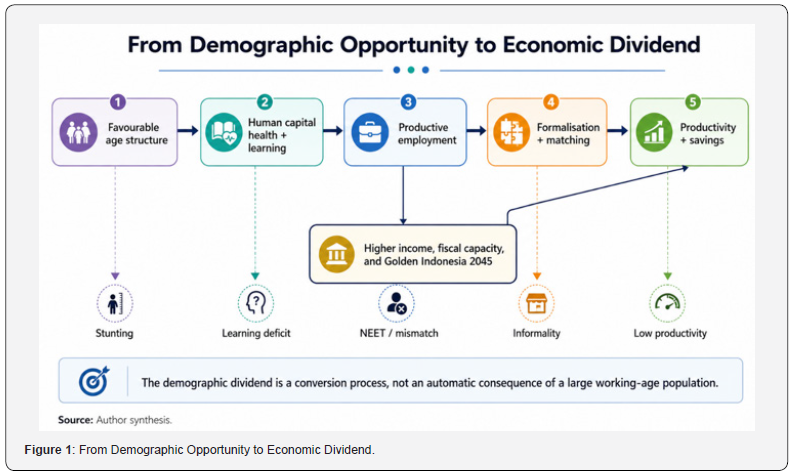
The conversion funnel illustrates five sequential requirements: favourable age structure, human-capital formation, productive employment, formalisation and matching, and ultimately productivity plus savings. Leakages can occur at every stage. Childhood malnutrition lowers later capability; weak learning reduces usable skills; NEET status and mismatch interrupt labour-market entry; informality limits productivity and protection; and weak productivity reduces the income and savings available for the second dividend. Thus, measuring demographic success only through the dependency ratio overlooks the mechanisms that actually create prosperity.
Indonesia's demographic transition and the problem of timing
Indonesia's fertility decline, mortality transition and urbanization have profoundly transformed household structure and population age composition. Ananta [2] interprets this “mega-demography” as both a foundation for Indonesia Emas and a warning against complacency. Rostiana and Rodesbi [3] similarly associate demographic transition with economic growth while stressing that complementary development conditions matter. Nurarifin and Ridena [4] add information and communications technology and human-capital development to the mechanisms through which the Indonesian dividend may translate into welfare.
Fertility change itself is becoming more complex. Utomo et al. [24] discuss whether Indonesia is entering a second demographic transition characterized by changes in family behavior and fertility patterns, while Utomo et al. [25] show that education and preferences concerning family size interact in important ways in Greater Jakarta. Widyastari et al. [26] likewise demonstrate transformations in marriage and family dynamics in Java. These changes imply that demographic transition should be understood as a social transformation rather than merely a falling fertility statistic.
Indonesia also exhibits major regional differences. Some provinces retain younger age structures and stronger population growth, whereas others are moving much more rapidly into ageing. Human-capital conditions also vary geographically. Sari and Tiwari's [16] subnational human-capital evidence shows why a single national demographic indicator can conceal highly unequal productive capabilities. Similarly, Yusa and Gitaharie [27] find that demographic conditions can contribute to regional economic convergence, but the strength of that mechanism depends on supporting development conditions.
Financial inclusion may also influence whether demographic opportunity becomes household asset accumulation. Yusa, Suprayitno and Wafi [28] connect financial inclusion with Indonesia's first demographic dividend, reinforcing the proposition that demographic conditions operate through financial as well as labour-market channels. Consequently, the closing of the first dividend is not simply a matter of fewer young workers; it is also a question of whether today's workers can accumulate sufficient assets to finance tomorrow's ageing society.
Figure 2 is intended to prevent an overly literal interpretation of the phrase “15 years left”: Indonesia is moving through several overlapping demographic phases rather than approaching a single cliff edge. The figure is designed to show that the policy problem is not only about how long the first dividend lasts, but also about how quickly the country can convert the remaining window into productivity, savings and resilience before ageing intensifies.
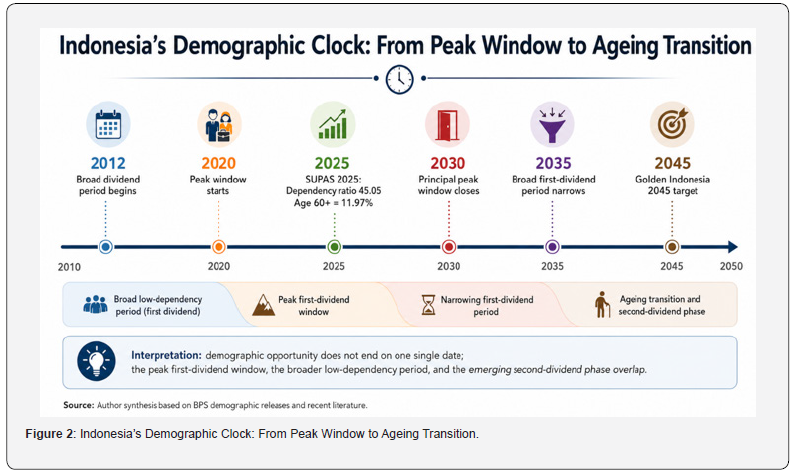
The principal window identified by BPS around 2020–2030 is narrower than the broader 2012–2035 demographic-dividend period. Meanwhile, favorable dependency conditions may remain economically useful beyond those dates even as elderly dependency begins increasing. The appropriate policy implication is not that Indonesia can wait until 2035 or 2040, but the opposite: investments requiring a decade or more to mature—schooling, nutrition, industrial capability, formalization and pension development—must be accelerated before demographic conditions become less favorable [6,7].
Human capital: schooling is not the same as learning
Human-capital theory provides the first major bridge between demographic structure and productivity. Indonesia has expanded access to education substantially, yet the relevant variable for demographic-dividend conversion is not years of attendance alone but accumulated cognitive, technical and socio-emotional capability. Beatty et al. [18] demonstrate that Indonesia's historical schooling expansion coexisted with weak or declining learning profiles. Indrawati and Kuncoro [29] consequently argue that the country's response to technological change requires not only wider education but improvements in quality, industry linkages, higher education and vocational capability.
Vocational education illustrates this challenge. Ariansyah et al. [30] compare vocational and general graduates under differing economic conditions and demonstrate that simply expanding vocational streams does not guarantee superior labour outcomes. Paramitasari et al. [17] show that education–job mismatch is shaped partly by local agglomeration and labour-market structure, while Putranto, Natalia and Pitriyani [31] similarly emphasise the gap between education and labour-market requirements.
Choi, Li and Ogawa [32] find somewhat more encouraging evidence: upper-secondary vocational education is associated with better job security and formal-economy access, although some wage and benefit advantages are gender-specific. Yet another study comparing urban and rural outcomes finds that vocational graduates do not universally obtain higher wages or better working conditions, with benefits such as training and pensions considerably stronger in urban areas. Together, these studies suggest that vocational education becomes productive when linked to labour demand, employer training and regional economic ecosystems rather than merely expanding enrolment [32,33].
This is critical for demographic policy because a poorly matched young cohort cannot indefinitely postpone entry into productive employment. Skill depreciation, discouragement, prolonged NEET status and repeated informal employment can create labour-market scarring. The value of a demographic window is therefore cohort-specific: time lost at age twenty cannot be fully restored by better policy when the same cohort reaches forty [34,35].
Health and nutrition as lifetime productivity investments
Human-capital accumulation begins long before labour-market entry. Childhood nutrition, sanitation, maternal health and access to healthcare shape cognition and physical development and consequently influence learning and adult productivity. This creates a direct bridge between stunting prevention and the demographic dividend.
Indonesian studies demonstrate the multidimensional determinants of childhood stunting. Mulyaningsih et al. [36] identify determinants operating beyond the individual household level, while Laksono et al. [35] highlight the importance of maternal education. Evidence from South and West Sulawesi further confirms that child nutritional outcomes reflect interconnected socioeconomic, maternal and environmental factors [34].
The long-run implications are especially relevant. Cameron et al. [37] show links between childhood stunting, water and sanitation and cognitive outcomes, while Lestari et al. [38], using longitudinal Indonesian evidence, associate childhood stunting with poorer educational and cognitive outcomes in adulthood. Such evidence means that malnutrition occurring during the demographic-dividend years creates productivity losses that survive long after prevalence indicators improve.
Social protection can partially interrupt these intergenerational mechanisms. Cahyadi et al. [39], using experimental evidence from Indonesia's conditional cash-transfer programme, demonstrate cumulative benefits arising from sustained interventions. Social assistance therefore should not be treated exclusively as redistribution: well-designed programmer supporting health, nutrition and schooling can constitute productive investment in the future labour force.
Gender, care and productive participation
Indonesia also possesses an incompletely realised gender dividend. Women's educational attainment has improved markedly, yet labour-market participation continues to be constrained by childbirth, childcare, care responsibilities, labour-market segmentation and job availability. These constraints represent an economic loss because human capital that has already been financed through families and public education is not fully utilised.
Halim, Johnson and Perova [40] provide particularly relevant causal evidence. Expanded preschool availability increased women's employment, demonstrating that childcare infrastructure can influence labour supply. However, additional employment was not automatically equivalent to high-quality formal work, illustrating why care provision must be integrated with job creation rather than viewed in isolation.
Andrina [41] similarly argues for stronger childcare-support policies in Indonesia. Miranti, Sulistyaningrum and Mulyaningsih [43] demonstrate how the pandemic exposed the vulnerability of Indonesian women, especially those concentrated in informal and care-intensive roles. Kim and Williams [42] find that labour-market institutions such as minimum wages can also affect women's bargaining power inside households, suggesting that female employment has welfare effects beyond measured output.
Digitalization does not automatically solve these problems. Kusumawardhani et al. [44] find heterogeneous effects of internet availability on Indonesian women's labour outcomes, with connectivity by itself insufficient to guarantee skilled or formal employment. Similarly, technological and trade changes may generate gender-differentiated labour demand; Oishi and Wie [45] show that different channels of Indonesian trade liberalization affected women's manufacturing employment in different directions.
Consequently, raising female participation must not be reduced to persuading women to work. It requires affordable childcare, safe transport, formal job creation, flexible but protected work, effective anti-discrimination systems and stronger care services. In demographic terms, childcare should be understood as productive economic infrastructure.
Method
This study employs a qualitative literature review (QLR) designed to synthesize recent conceptual, empirical and policy-oriented knowledge concerning Indonesia's demographic dividend. It does not employ a systematic-literature-review protocol. Accordingly, it does not claim exhaustive database coverage, does not apply PRISMA procedures, does not calculate pooled effect sizes, and does not conduct a formal meta-analytic or study-level risk-of-bias assessment.
The QLR approach is appropriate because the central research problem is multidimensional and interpretive. Determining whether Indonesia has “failed” to use its demographic dividend cannot be established through one variable or one econometric coefficient. The issue spans fertility, dependency ratios, education, learning, nutrition, employment, informality, gender, wages, technology, savings, regional inequality, pensions and ageing. A meaningful assessment therefore requires synthesis across disciplines and analytical levels.
The literature base prioritized peer-reviewed articles published from 2020 through August 2026, with emphasis on research directly examining Indonesia and on comparative studies offering theoretical or Asian contextual relevance. Literature was selected purposively according to relevance to seven analytical clusters: demographic-transition theory; human capital and education; health and nutrition; employment and informality; gender and care; structural transformation and productivity; and ageing, savings and social protection.
More than fifty peer-reviewed journal articles are incorporated in the synthesis. The academic evidence was triangulated with recent official information from Statistics Indonesia, Bappenas and the OECD. This triangulation was necessary because peer-reviewed publications inevitably lag rapidly changing labour-market and demographic statistics. The Indonesian demographic-dividend literature was used as contextual material identifying a contemporary public-policy narrative, but its claims were not accepted without verification against official or scholarly evidence.
The analysis was conducted through interpretive thematic comparison. Evidence was classified into three outcome categories. Realized dividend refers to benefits already plausibly associated with favorable demography, including labour-force expansion, fertility reduction and human-capital improvements. Under-realized dividend refers to economic potential constrained by low productivity, weak skills, informality, labour mismatch or exclusion. Still-convertible dividend refers to opportunities that can continue producing benefits through current younger cohorts and through mechanisms of the second demographic dividend.
The approach has several limitations. First, it cannot generate a credible numerical counterfactual for the GDP Indonesia “would have achieved” had the demographic dividend been perfectly exploited. Therefore, the term failure must be interpreted comparatively and institutionally rather than as an exact lost-output estimate. Second, different demographic-window definitions generate different end dates. Third, Indonesia's national averages conceal large provincial differences. Finally, literature after 2020 still contains evidence based on earlier survey waves, which is inevitable when assessing long-run processes such as education, fertility and lifetime labour outcomes.
Results
Indonesia has captured a real first demographic dividend
The evidence does not support the proposition that Indonesia completely failed to exploit demographic transition. Fertility has fallen substantially, dependency burdens have declined compared with earlier decades, school participation has expanded, the workforce has grown dramatically, infrastructure and connectivity have improved, poverty has fallen over the long run and Indonesia has developed a large consumer market. These developments created genuine economic benefits that would be difficult to reconcile with the claim of total demographic failure [2,3,4].
Employment figures reinforce this conclusion. With approximately 147.67 million people employed in February 2026, Indonesia has successfully absorbed an enormous absolute number of workers. The unemployment rate of 4.68% also means that the principal problem cannot be characterized simply as mass open unemployment [12].
Social-protection capacity has also increased. Cahyadi et al. [39] show that sustained conditional transfers can yield cumulative human-development effects. During the pandemic, Indonesia's expanded social-protection measures prevented a substantially larger increase in poverty, according to Suryahadi, Al Izzati and Yumna [47]. Olivia, Gibson and Nasrudin [46] and Temenggung et al. [48] likewise document the extraordinary shock of COVID-19 and policy responses that helped preserve economic and social capacity during a period that could otherwise have caused even greater demographic scarring.
The appropriate starting point is therefore recognition that demographic transition has contributed to Indonesia's development. The question is whether the resulting benefits were proportionate to the scale and duration of the opportunity.
The decisive weakness is employment quality rather than employment quantity
The most consistent finding across the labour literature is that Indonesian employment quantity substantially exceeds employment quality. Informality remains pervasive, and informal workers generally possess weaker access to contracts, social protection, training and pensions. Santoso et al. [14] document formal–informal wage differences across Indonesian cohorts, while Sen [15] identifies persistent inequality in labour-market mobility. OECD evidence similarly highlights informality as a central structural problem. Recent macroeconomic assessment also indicates that post-pandemic job creation has been concentrated disproportionately in lower-paying and informal activities, reinforcing concerns about the quality rather than merely the quantity of employment [49,50].
This matters because informal employment leaks the demographic dividend through several channels. Lower firm productivity reduces wages; lower wages restrict savings; limited training weakens future productivity; absence of pension contributions increases future dependence; and small-scale enterprises often face difficulty adopting technology or accessing capital. An individual may therefore be statistically “employed” while contributing far less to a demographic dividend than a similarly aged worker in a productive, formal, technologically capable firm.
Minimum-wage policy also illustrates the trade-offs between job quantity, labour participation and wage quality. Siregar [51] finds spatially differentiated labour-market effects in Java, suggesting that national labour policies interact with regional conditions. Pritadrajati [50], meanwhile, examines whether social assistance affects employment, formality and mobility, highlighting the importance of designing protection systems that preserve work incentives while reducing vulnerability.
Pandemic evidence deepened the concern. Ridhwan et al. [52] show that lockdowns affected household income, consumption and expectations. Suryahadi, Al Izzati and Yumna [47] found that recovery was uneven, with stronger outcomes among formal and better-educated workers while vulnerable informal workers faced weaker real-wage recovery. Demographic-dividend policy must therefore be resilient to shocks because a favourable age structure has value only if working-age households maintain productive attachment during crises.
Youth represent the most time-sensitive conversion problem
The demographic dividend is fundamentally cohort-based. A young adult who remains outside employment, education or training during several critical years loses experience, earnings and skill accumulation. Youth unemployment and NEET are therefore not ordinary labour-market statistics; they represent destruction of a time-limited demographic asset.
Purwa, Meidika and Krismaningtyas [55] document pandemic-related NEET challenges among young people in East Java. Al Ayyubi, Pratomo and Prasetyia [54] evaluate Indonesia's Pre-Employment Card programmed and provide evidence on its potential to improve youth labour-market performance. Such interventions matter, but training programmes become economically transformative only when they connect participants with expanding productive employment rather than merely producing credentials. National evidence on young workers further shows disproportionate exposure to job loss and wage deterioration following re-employment, indicating that early-career scarring can persist beyond the immediate shock [53].
Vocational studies reinforce this conclusion. Choi, Li and Ogawa [32] find some benefits of vocational schooling for job security and formal employment, while Choi et al. [33] find important urban–rural differences and question the assumption that vocational expansion alone guarantees superior outcomes. Ariansyah et al. [30] similarly show that labour-market performance varies by school type and economic circumstances. The policy lesson is that vocational education is not a substitute for productive labour demand.
Indonesia consequently needs to evaluate youth programmes through placement, sustained employment, wage progression and formalisation rather than participation counts. A demographic dividend is realised when young people acquire a trajectory of increasing productivity, not when they simply complete training.
Indonesia faces a human-capital conversion deficit
Education provides perhaps the clearest example of partial success. Indonesia has substantially widened access, but learning quality remains a binding constraint. Beatty et al. [18] show why more years of schooling should not automatically be equated with more skills. Indrawati and Kuncoro [29] link the human-capital challenge explicitly to Indonesia's competitiveness and capacity to exploit technological change.
Labour-market mismatch magnifies the problem. Paramitasari et al. [17] demonstrate that education–occupation mismatch varies with agglomeration conditions, while Putranto, Natalia and Pitriyani [31] identify continuing disconnection between education and labour-market requirements. These findings imply that the return to educational expansion depends on complementary job ecosystems.
Regional human-capital inequality is similarly important. Sari and Tiwari [16] show substantial geographical variation in Indonesia's subnational human capital. This means that Indonesia does not possess one homogeneous demographic dividend. Metropolitan regions with better schools, healthcare, connectivity and productive firms are better placed to convert young populations into growth, whereas poorer regions can experience favourable age structures without comparable income gains.
This regional issue affects national convergence. Yusa and Gitaharie [27] find that demographic dividends can contribute to regional convergence, but such convergence is not automatic. Poetiray, Purnomo and Utomo [56], examining labour-related demographic opportunities and challenges in Salatiga, likewise illustrate the importance of local institutional conditions. Therefore, demographic policy should be decentralised enough to reflect different provincial and city-level demographic clocks.
Malnutrition has already destroyed part of the potential dividend
Stunting represents one of the most consequential examples of irreversible or difficult-to-reverse demographic leakage. A child affected by chronic malnutrition does not simply become shorter; developmental disadvantages may influence cognition, educational achievement and later productivity.
Recent Indonesian evidence consistently identifies socioeconomic, maternal and environmental determinants of stunting [34-36]. More importantly for demographic economics, longitudinal research associates childhood stunting with poorer adult educational and cognitive outcomes [38].
This has two implications. First, part of Indonesia's historical demographic dividend has already been permanently weakened by childhood deprivations experienced by cohorts that are now adults. Second, eliminating stunting today remains relevant even as the first demographic window closes, because children born in the 2020s will comprise a central part of Indonesia's 2045 workforce.
Human-capital investment must therefore use a life-course framework. Maternal health, nutrition, sanitation, early childhood development, foundational literacy, secondary schooling, vocational skills and adult reskilling should be treated as connected stages in a single productivity system.
Female economic potential remains materially underused
Another major source of under-realisation is the incomplete conversion of women's educational progress into sustained, high-quality employment. The literature indicates that childcare availability, household responsibilities, job structures, technology and economic shocks all shape women's participation [40,41,43]. Recent SUSENAS-based evidence further shows that simultaneous childcare and eldercare responsibilities are associated with especially large reductions in women's labour-force participation, strengthening the case for integrated care infrastructure [57].
The childcare evidence is especially significant because it reframes care provision as infrastructure. If mothers with skills and education leave employment because childcare is unavailable or incompatible with working hours, Indonesia loses productive labour and tax revenue while households lose earnings and retirement contributions. Halim, Johnson and Perova's [40] evidence that preschool availability affects women's employment makes this mechanism concrete.
However, employment quality again matters. Internet access can facilitate economic participation but does not ensure that women enter high-skill formal occupations [44]. Trade and technological upgrading can similarly be skill-biased and generate gender-differentiated effects [45]. Consequently, “raising female LFPR” should not be an isolated numerical target. The objective should be to create higher-productivity female employment with adequate care, protection and career progression.
Structural transformation has been too weak to maximise labour productivity
A large working-age population generates its greatest dividend when labour moves from relatively low-productivity activities toward more productive manufacturing and modern services. Indonesia's challenge is that substantial labour remains in agriculture and small-scale informal activities while manufacturing upgrading has not proceeded rapidly enough.
Hendarmin and Wahyudi [58] identify the importance of Indonesia's structural-transformation patterns. Indrawati and Kuncoro [29] warn about premature deindustrialisation and the need to revitalise manufacturing, modern services and resource-based value chains. Ke [59] places Indonesia within a broader ASEAN “middle technology trap,” in which countries struggle to move from technology adoption toward deeper innovative capability.
The latest employment structure reinforces this concern: agriculture, forestry and fisheries still accounted for roughly 28.78% of Indonesian employment in February 2026. This does not imply that agriculture itself is undesirable; modern agriculture can be highly productive. The problem is the concentration of workers in segments with low capital intensity, weak technology adoption and limited value added [12].
Thawley, Crystallin and Verico [60] argue that achieving a higher Indonesian growth path requires faster productivity improvements and investment. Yudhistira, Brodjonegoro and Qibthiyyah [61] similarly emphasise the still-unrealised potential of urbanisation. Urban economies can raise productivity through agglomeration, matching and shared infrastructure, but congestion, housing constraints and fragmented transport can prevent these advantages from materialising.
Wahyuni [63] adds a regional labour-productivity perspective, while Soseco, Olivia and Oxley [62] show significant interprovincial wealth inequality. Together these findings imply that demographic conversion requires spatial economic transformation as well as national reform.
Digitalisation can raise productivity, but access alone is insufficient
Indonesia's digital expansion offers an important route for converting the remaining demographic dividend. Trinugroho et al. [65] study digital-technology adoption among micro and small businesses, while Affandi et al. [66] link digital adoption, financial literacy and business performance among ultra-micro, micro and small enterprises. Falentina et al. [64] also provide evidence that digitalisation can improve micro and small enterprise performance in Yogyakarta.
Yet digital connectivity does not automatically generate productivity. Firms require complementary managerial skills, finance, reliable electricity, logistics and market access. Handayani, Nasrudin and Rezki [67] demonstrate how reliable electricity affects micro and small enterprises and poverty reduction. Nasir, Salim and Wen [68] similarly link ICT and labour productivity in Southeast Asian emerging economies.
Digital policy should therefore move from a first-generation emphasis on access toward a second-generation strategy centred on productive adoption: cloud systems, AI-assisted operations, digital finance, enterprise resource management, quality assurance, e-commerce logistics and skills allowing workers to complement rather than simply compete with automation. This more comprehensive approach is necessary if digital transformation is to raise labour productivity rather than merely broaden low-value participation.
Ageing is transforming the demographic problem
Perhaps the strongest reason not to postpone reform is the emerging ageing transition. Indonesia is ageing while still substantially below the income levels at which many advanced economies built mature pension and long-term-care systems. Kudrna, Le and Piggott [11] project a pronounced rise in old-age dependency over the longer run as fertility declines and longevity improves.
SUPAS 2025 already recorded people aged 60 and above at approximately 11.97% of the population. The issue is therefore no longer hypothetical [7].
Seftiani [71] argues for adaptive social protection in preparing for an ageing Indonesian society, while Asmorowati, Schubert and Supeno [70] identify tensions between governance capacity and elder-care needs. Limited pension coverage is particularly problematic because workers who spend much of their careers informally may enter old age without adequate contributory retirement income. Recent pension-model evidence for Indonesia likewise shows that reform design must explicitly account for the interaction between population ageing and a large informal workforce, because combinations of formal-sector and social-pension reforms generate distinct welfare, equity and fiscal trade-offs [69].
This dynamic fundamentally changes the interpretation of the demographic dividend. Informality today becomes old-age vulnerability tomorrow. Low wages today mean lower savings tomorrow. Weak adult reskilling today can lead to premature labour-force exit tomorrow. Consequently, labour-market, financial and ageing policies must be analysed as one intertemporal system.
Discussion and Analysis
Has Indonesia failed?
The evidence does not justify a categorical answer of “yes.” A country that has expanded employment to almost 148 million people, lowered fertility, increased schooling, reduced poverty over the long term, developed extensive infrastructure and maintained significant economic growth cannot reasonably be described as having captured nothing from demographic change.
Yet the evidence also rejects a strong success narrative. The magnitude of informality, weak learning, stunting, youth transition problems, vocational mismatch, limited female participation, low-productivity employment and inadequate pension accumulation demonstrates that the economic value extracted from Indonesia's favourable age structure has been substantially smaller than its potential.
The most defensible verdict is therefore that Indonesia has not lost its demographic dividend entirely, but it has materially under-realised it. This formulation recognises both the gains already captured and the substantial value still being lost through weak conversion mechanisms.
This conclusion is more meaningful than the binary notion of failure for two reasons. First, no credible counterfactual permits calculation of a precise “100% demographic dividend” against which Indonesia can be judged. Second, dividend conversion occurs along multiple margins. Indonesia can simultaneously succeed in labour-force absorption, underperform in job quality, improve educational access, underperform in learning, reduce fertility, and remain poorly prepared for old-age dependency.
The concept of demographic-dividend leakage is therefore useful. Demographic potential can leak away at successive stages: malnutrition before school; weak learning during school; mismatch after graduation; NEET during labour-market entry; informality during working life; low productivity during employment; and insufficient savings before retirement. Figure 1 captures this sequential logic.
The initial proposition: useful warning, cautious timetable
The prevailing ‘missed-dividend’ narrative performs an important public function by stressing urgency, but it should not become a literal policy timetable. Official BPS framing identifies the peak window principally around 2020–2030 and the broader dividend period around 2012–2035. Meanwhile, the dependency ratio can remain comparatively manageable for longer under alternative thresholds [6,7].
These are not necessarily contradictory statements. They measure different aspects of demographic change. What is misleading is the idea that policymakers can divide the remaining number of years into a countdown and wait until the final years to react.
A child entering primary school in 2026 will not become a fully trained worker for more than a decade. A reform of vocational institutions takes years to alter cohorts of graduates. Building domestic technological capability requires sustained investment. Contributory pensions need decades of accumulation. Urban reform, manufacturing upgrading and female employment transformations likewise cannot be switched on near the end of a demographic window.
Accordingly, the meaningful phrase is “very few policy cycles remain before the age structure becomes materially less forgiving.” In practice, this means that delayed reform in the late 2020s would carry much larger economic costs in the 2030s and 2040s.
The policy target must change from labour abundance to productivity per worker
Indonesia's demographic discourse historically emphasised the quantity of working-age people. The next phase requires a fundamental change in the unit of analysis: output per worker, real income per worker, formal employment per worker, skills per worker, assets accumulated per worker, and healthy productive years per worker.
This transition is consistent with research on higher-growth pathways for Indonesia. Thawley, Crystallin and Verico [60] emphasise productivity and investment, while Indrawati and Kuncoro [29] stress the interaction among human capital, industrial capability and technological transformation. Digitalisation studies likewise show that productive adoption—not simple access—is what matters for enterprise performance [64-66].
The objective is therefore not merely to “create jobs.” Indonesia must create jobs capable of generating rising productivity, skill accumulation, formal protection and savings. This distinction is essential because a low-productivity job may absorb labour today while contributing little to the second demographic dividend.
Policy Pillar I: a national human-capital conversion emergency
The first priority is preventing further irreversible human-capital loss. Stunting prevention should remain central, but policy should move beyond anthropometric indicators to a continuous life-course framework connecting maternal nutrition, early childhood development, foundational learning, secondary schooling and workforce skills.
Learning quality warrants particular urgency. Indonesia cannot reach high-income status by expanding educational credentials while cognitive capability stagnates. The findings of Beatty et al. [18] mean that the education system should be evaluated by learning rather than attendance alone. Teacher quality, foundational literacy and numeracy, diagnostic assessment, school leadership and targeted remediation should therefore receive greater weight.
Vocational and higher education must also become more demand-responsive. Industry partnerships should affect curriculum design, equipment, work-based training and instructor competencies. Labour-market information should allow programmes with weak placement outcomes to be redesigned or discontinued. The relevant performance measure should become the proportion of graduates moving within twelve months into productive employment aligned with their training.
The adult workforce also requires systematic reskilling. Workers aged 30–50 in 2026 will still form a major part of Indonesia's labour force in the 2040s. Excluding them from skills policy would waste a substantial part of the remaining demographic opportunity.
Policy Pillar II: make youth employment a demographic emergency
Youth employment policy should be treated as time-critical because employment trajectories exhibit persistence. Indonesia should integrate education-to-work services across schools, universities, vocational institutions, local governments and employers.
A stronger system would combine labour-market counselling, apprenticeships, verified micro-credentials, employment services and first-job incentives. Programmes such as the Pre-Employment Card provide institutional experience that can be developed further, but success should be measured by sustained placement, wage growth and formalisation rather than training completion alone [54].
Public reporting should therefore include a Youth Demographic Conversion Dashboard incorporating NEET prevalence, duration of unemployment, first-job waiting time, the share entering formal employment, real starting wages, twelve- and twenty-four-month employment retention, and training-to-job matching. Such a dashboard would shift the policy system from counting beneficiaries toward measuring conversion into productive careers.
Policy Pillar III: unlock the gender dividend through care infrastructure
Indonesia can increase effective labour supply without waiting for another generation simply by using existing female human capital more effectively. But this requires addressing the care economy directly.
Affordable childcare and preschool should be expanded around residential and employment centres. Quality and opening hours matter because short-duration preschool may increase participation without enabling mothers to enter stable full-time jobs. Halim, Johnson and Perova [40] demonstrate that childcare availability has employment effects, while Andrina [41] highlights the need for policy support.
Maternity protection, parental leave and flexible work should be designed to prevent women's movement from formal employment into insecure work following childbirth. Transport and workplace safety are equally important. The strategic objective is not merely more women working, but more women accumulating professional experience, wages, pension entitlements and leadership opportunities over the life course.
Such measures could generate a dividend at multiple levels: higher household earnings, increased tax revenue, reduced vulnerability, improved bargaining power and stronger child development. In other words, care policy should be treated not only as social policy but also as a core component of macroeconomic productivity strategy.
Policy Pillar IV: accelerate formalisation rather than accepting informality as permanent
Indonesia's large informal sector cannot realistically disappear rapidly, but accepting its persistence as inevitable would substantially weaken both demographic dividends. Formalisation should therefore be incremental, incentive-compatible and productivity-enhancing.
Micro and small firms require simpler registration, predictable taxation, digital bookkeeping, financing, market access and affordable social-security participation. Digitalisation can reduce administrative costs, while reliable electricity and digital payments can increase enterprise capacity [64,67]. Recent evidence also finds markedly lower labour-social-security participation among informal workers, particularly among workers facing intersecting disadvantages in income, education and rural location, underscoring the need for simplified enrolment and targeted contribution support [72].
Worker protection should also become more portable. A worker moving among salaried employment, platform work and self-employment should not repeatedly lose social-insurance accumulation. Portable protection would transform formalisation from a binary firm category into a progressively expanding set of worker rights.
Formalisation is particularly important for ageing. Every year spent outside a contributory pension system reduces the assets available in retirement. Thus, expanding pension participation among today's 25–45-year-olds is not merely social policy; it is one mechanism for creating the second demographic dividend.
Policy Pillar V: structural transformation and technological upgrading
Human-capital reform cannot deliver a dividend if productive firms do not demand skilled workers. Labour-supply reform must therefore be matched with industrial transformation.
Indonesia needs deeper domestic value creation in manufacturing, resource downstreaming, modern agriculture, digital services and green industries. The danger is not the existence of agriculture or natural resources but an economy concentrated at low-productivity stages of production. Industrial and innovation policies should encourage technology adoption, supplier upgrading, export capability and links between universities and firms.
The emerging AI economy raises the urgency further. Routine tasks may become increasingly automatable precisely when Indonesia is seeking better jobs for a large workforce. The answer cannot be to resist technology. It must instead be to equip workers and firms to use AI as a productivity complement.
A successful demographic strategy would therefore link skills policy directly to technology diffusion. Subsidising equipment without workforce capability is ineffective; training workers without firms able to use their skills is equally ineffective.
Policy Pillar VI: transform urbanisation into productivity
Urbanisation can amplify the demographic dividend because dense labour markets improve employer–worker matching, facilitate knowledge diffusion and support specialised services. Yet Indonesia's urban potential remains incompletely realised [61].
Investment in metropolitan transport, affordable housing, water, sanitation, electricity and digital infrastructure should therefore be recognised as labour-productivity policy. Long commutes, housing exclusion and congestion reduce the effective value of agglomeration.
Secondary cities are equally important. A demographic strategy concentrated only in Jakarta or a small set of Java metropolitan areas would deepen regional inequality and encourage costly migration. Productive secondary cities can become employment nodes connecting surrounding rural regions with manufacturing, logistics, health, education and modern services.
Wahyuni [63], Sari and Tiwari [16], Yusa and Gitaharie [27], and Soseco, Olivia and Oxley [62] collectively reinforce the need to treat demographic transformation as a place-based development challenge. A credible demographic strategy must therefore connect national goals with regional productivity systems, infrastructure provision and human-capital equalisation.
Policy Pillar VII: deliberately construct the second demographic dividend
The most important strategic extension of the demographic debate is that Indonesia's opportunity does not end when the first dividend closes. A second dividend can be created if workers accumulate productive assets and human capital while longer lives are translated into longer healthy lives.
This requires wider pension participation, long-term savings, financial inclusion, affordable investment products and higher lifetime earnings. Yusa, Suprayitno and Wafi [28] provide evidence connecting financial inclusion with demographic-dividend processes in Indonesia. The financial system should therefore become an explicit part of demographic strategy.
Healthy ageing is equally important. Policy should increase healthy life expectancy, prevent non-communicable disease, support mid-career reskilling and reduce barriers preventing capable older adults from working voluntarily. Retirement institutions should permit flexible transitions rather than assuming a binary productive/unproductive divide at a particular age.
The silver economy can itself generate new industries in healthcare, long-term care, housing, assistive technology, finance and recreation. Population ageing therefore creates fiscal pressures but also new demand and employment possibilities.
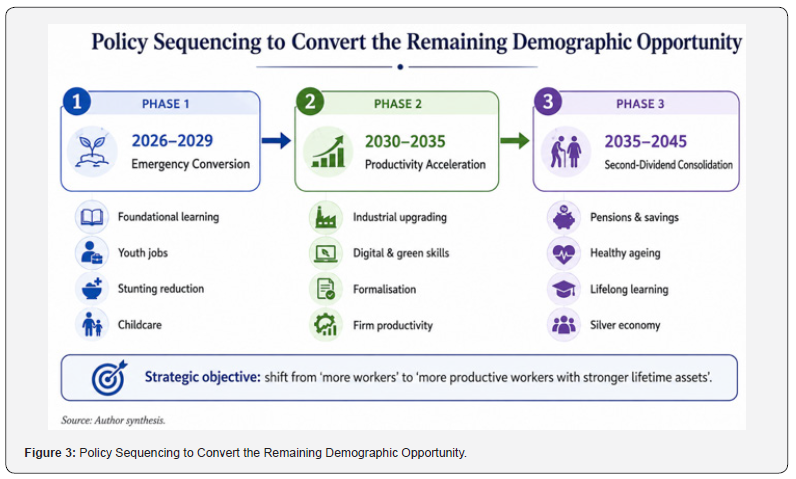
Figure 3 converts this diagnosis into policy sequencing: the remainder of the 2020s should be treated as an emergency conversion period, the early 2030s as a productivity acceleration phase, and the later period to 2045 as a second-dividend consolidation phase. The three phases should overlap rather than operate sequentially in a rigid sense, because learning improvement, youth employment, nutrition and childcare require immediate action while ageing preparedness and savings mobilisation must begin well before the first dividend fully narrows.
A demographic-dividend balance sheet
The overall evidence can be summarised as a balance sheet. Realised gains include fertility decline, a historically favourable age structure, a massive labour force, high employment absorption in absolute terms, wider schooling, infrastructure expansion and a larger domestic market.
Under-realised gains include learning quality, productive youth transition, high-quality vocational matching, female employment, formalisation, wage progression, digital productivity and pension coverage. Emerging liabilities include population ageing, incomplete pension coverage, rising healthcare and care needs, cumulative informal employment, and the possibility that weak productivity growth could lock Indonesia into a lower-growth equilibrium. This balance-sheet framing explains why neither celebratory nor catastrophic interpretations are adequate: the demographic opportunity has generated value, but a significant portion has been weakened, delayed or converted into future risk.
Conclusion and Policy Recommendations
This qualitative literature review asked whether Indonesia has failed to use its demographic dividend and whether meaningful opportunity remains before Golden Indonesia 2045. The evidence supports a qualified but consequential conclusion: Indonesia has not completely failed, but it has substantially under-converted its demographic opportunity into productivity and prosperity.
The distinction matters. Indonesia has achieved fertility decline, workforce expansion, wider education, major employment absorption, infrastructure development and considerable social progress. These constitute a genuine realised demographic dividend. However, the scale of the opportunity was extraordinary, and the conversion mechanisms have remained incomplete. Weak learning, stunting, youth labour-market difficulties, education–job mismatch, extensive informality, constrained female employment, technological limitations, unequal regional capability and insufficient retirement saving have reduced the economic return generated by the favourable population structure.
There is still time, but the remaining opportunity should not be described casually as another fifteen years of demographic comfort. Official demographic evidence indicates that the principal window associated with exceptionally favourable conditions is already well advanced, while the elderly share and dependency ratio are beginning to move upward. The economic value of the remaining first dividend is therefore both positive and rapidly time-sensitive [6,7].
The immediate priority for 2026–2029 should be an emergency demographic conversion agenda centred on foundational learning, stunting prevention, school-to-work transitions, youth employment, childcare, female participation and formalisation. During 2030–2035, emphasis should increasingly shift toward industrial upgrading, firm productivity, advanced digital and green skills, innovation and deeper domestic value chains. Throughout both periods, Indonesia should begin building its second demographic dividend through financial inclusion, pension coverage, long-term asset accumulation, lifelong learning and healthy ageing.
A National Demographic Dividend Dashboard would improve accountability. Rather than focusing predominantly on the dependency ratio, it should monitor learning outcomes, NEET rates, youth employment transitions, female labour-force participation, formal employment, real wages, labour productivity, pension participation, healthy life expectancy and regional disparities. Province-specific indicators are particularly important because Indonesia's demographic clocks differ substantially across its territory.
Ultimately, Golden Indonesia 2045 will not be determined by how many people happen to fall between conventional working-age boundaries. It will depend on what those people can learn, produce, earn, save and innovate, and on how long they can remain healthy and economically secure.
The policy debate should therefore move beyond the question, “How many years of demographic bonus remain?” The economically decisive question is how rapidly Indonesia can convert every remaining favourable demographic cohort into healthier, better-skilled, more productive, more formally employed and financially more secure citizens. If that conversion is accelerated now, Indonesia can still recover an important portion of the under-realised first dividend while constructing a second dividend through higher savings, better social protection and healthier ageing.
References
- Kementerian PPN/Bappenas (2024), Rencana Pembangunan Jangka Panjang Nasional (RPJPN) 2025–2045 and Visi Indonesia Emas 2045. Jakarta, Indonesia: Kementerian PPN/Bappenas.
- Ananta A (2020) Prospek mega-demografi menuju Indonesia Emas 2045. Jurnal Kependudukan Indonesia 15(2): 119-132.
- Rostiana E and Rodesbi A (2020) Demographic transition and economic growth in Indonesia. Jurnal Economia 16(1): 1-17.
- Nurarifin and Ridena S (2020) The role of ICT and human capital development in pursuing a demographic dividend and improving economic welfare in Indonesia. The Journal of Indonesia Sustainable Development Planning 1(2): 113-124.
- Kotschy R, Suarez Urtaza P, and Sunde U (2020) The demographic dividend is more than an education dividend. Proceedings of the National Academy of Sciences 117(42): 25982-25984.
- Badan Pusat Statistik (BPS) (2022) Analisis Profil Penduduk Indonesia. Jakarta, Indonesia: BPS.
- Badan Pusat Statistik (BPS) (2026) Hasil Survei Penduduk Antar Sensus (SUPAS) 2025. Jakarta, Indonesia: BPS.
- Cai F (2020) The second demographic dividend as a driver of China's growth. China & World Economy 28(5): 26-44.
- Ogawa N, Mansor N, Lee SH, Abrigo MRM, and Aris T (2021) Population aging and the three demographic dividends in Asia. Asian Development Review 38(1): 32-67.
- Ziesemer T and von Gässler A (2021) Ageing, human capital and demographic dividends with endogenous growth, labour supply and foreign capital,” Portuguese Economic Journal 20(2): 129-160.
- Kudrna G, Le T, and Piggott J (2022) Macro-demographics and ageing in emerging Asia: The case of Indonesia. Journal of Population Ageing 15: 7-38.
- Badan Pusat Statistik (BPS) (2026) Keadaan Ketenagakerjaan Indonesia Februari 2026. Jakarta, Indonesia: BPS.
- OECD, OECD Economic Surveys: Indonesia (2024) Paris, France: OECD Publishing.
- Santoso RP, Sahadewo GA, Sugiyanto C, and Setiastuti SU (2022) Informal and formal wage differences based on cohorts in Indonesia. Economies 10(12): 317.
- Sen K (2024) Broken ladders? Labour market inequality in Indonesia and India. Bulletin of Indonesian Economic Studies 60(2): 161-191.
- Sari VA and Tiwari S (2024) The geography of human capital: Insights from the subnational Human Capital Index in Indonesia. Social Indicators Research 172: 673-702.
- Paramitasari N, Khoirunurrofik BR Mahi, and Hartono D (2024) Charting vocational education: Impact of agglomeration economies on job–education mismatch in Indonesia. Asia-Pacific Journal of Regional Science 8(2): 461-491.
- Beatty A, Berkhout E, Bima L, Pradhan M, and Suryadarma D (2021) Schooling progress, learning reversal: Indonesia's learning profiles between 2000 and 2014. International Journal of Educational Development 85: 102436.
- Jafrin N and Masud MM (2021) Demographic dividend and economic growth in emerging economies: Fresh evidence from the SAARC countries. International Journal of Social Economics 48(8): 1159-1174.
- Singh P and Kumar S (2021) Demographic dividend in the age of neoliberal capitalism: An analysis of employment and employability in India. The Indian Journal of Labour Economics 64(3): 595-619.
- Berde É, and Kurbanova M (2023) Does the demographic dividend with human capital development yield an economic dividend? Evidence from Central Asia. Post-Communist Economies 35(2): 154-178.
- Marois G, Zhelenkova E, and Ali B (2022) Labour force projections in India until 2060 and implications for the demographic dividend. Social Indicators Research 164: 477-497.
- Baerlocher D, Parente SL, and Rios-Neto E (2021) Female labor force participation and economic growth: Accounting for the gender bonus. Economics Letters 200:109740.
- Utomo A, Ananta A, Setyonaluri D, and Aryaputra C (2022) A second demographic transition in Indonesia? China Population and Development Studies 6: 288-315.
- Utomo A, McDonald P, Utomo I, and Hull T (2021) Do individuals with higher education prefer smaller families? Education, fertility preference and the value of children in Greater Jakarta. Child Indicators Research 14(1): 139-161.
- Widyastari DA, Isarabhakdi P, Vapattanawong P, and Völker M (2020) Marital dissolution in postmodern Java, Indonesia: Does early marriage increase the likelihood to divorce? Journal of Divorce & Remarriage 61(8): 556-573.
- Yusa IGPD and Gitaharie BY (2024) How the demographic dividend affects economic convergence: Insights from Indonesia. Economics Development Analysis Journal 13(3).
- Yusa IGPD, Suprayitno AW, and Wafi FA (2025) Does financial inclusion enhance Indonesia's first demographic dividend?. Economics Development Analysis Journal 14(1).
- Indrawati SM and Kuncoro A (2021) Improving competitiveness through vocational and higher education: Indonesia's vision for human capital development in 2019–2024. Bulletin of Indonesian Economic Studies 57(1): 29-59.
- Ariansyah K, Wismayanti YF, Savitri R, Listanto V, Aswin A, et al. (2024) Comparing labor market performance of vocational and general school graduates in Indonesia: Insights from stable and crisis conditions. Empirical Research in Vocational Education and Training 16(5).
- Putranto FGF, Natalia C, and Pitriyani NKD (2024) Closing the gap between education and labor market requirement: Do vocational education matter? The Journal of Indonesia Sustainable Development Planning 5(3): 181-191.
- Choi S, Li H, and Ogawa K (2023) Upper secondary vocational education and decent work in Indonesia: A gender comparison. International Journal of Educational Development. 101: 102833.
- Choi S, Li H, Ogawa K, and Tanaka Y (2024) Secondary vocational education and decent work in Indonesia: Differences between urban and rural areas. International Journal of Training Research 22(2): 125-146.
- Anastasia H, Hadju V, Hartono R, Samarang, Manjilala, et al. (2023) Determinants of stunting in children under five years old in South Sulawesi and West Sulawesi Province: 2013 and 2018 Indonesian Basic Health Survey. PLOS ONE 18: e0281962.
- Laksono AD, Wulandari RD, Amaliah N, and Wisnuwardani RW (2022) Stunting among children under two years in Indonesia: Does maternal education matter? PLOS ONE 17(7): e0271509.
- Mulyaningsih T, Mohanty I, Widyaningsih V, Gebremedhin TA, Miranti R, et al. (2021) Beyond personal factors: Multilevel determinants of childhood stunting in Indonesia. PLOS ONE 16(11): e0260265.
- Cameron L, Chase C, Haque S, Joseph G, Pinto R, et al. (2021) Childhood stunting and cognitive effects of water and sanitation in Indonesia. Economics & Human Biology 40: 100944.
- Lestari E, Siregar A, Hidayat AK, and Yusuf AA (2024) Stunting and its association with education and cognitive outcomes in adulthood: A longitudinal study in Indonesia. PLOS ONE 19(5): e0295380.
- Cahyadi N, Hanna R, Olken BA, Prima RA, Satriawan E, et al. (2020) Cumulative impacts of conditional cash transfer programs: Experimental evidence from Indonesia. American Economic Journal: Economic Policy 12(4): 88-110.
- Halim HC Johnson, and Perova E (2022) Preschool availability and women's employment: Evidence from Indonesia. Economic Development and Cultural Change 71(1): 39-61.
- Andrina M (2022) Maternal employment and childcare arrangements in Indonesia: The needs for childcare support policies. Masyarakat Indonesia 48(2): 221-236.
- Kim JH and Williams BD (2021) Minimum wage and women's decision-making power within households: Evidence from Indonesia. Economic Development and Cultural Change 70(1): 359-414.
- Miranti R, Sulistyaningrum E, and Mulyaningsih T (2022) Women's roles in the Indonesian economy during the COVID-19 pandemic: Understanding the challenges and opportunities. Bulletin of Indonesian Economic Studies 58(2): 109-139.
- Kusumawardhani N, Pramana R, Saputri NS, and Suryadarma D (2023) Heterogeneous impact of internet availability on female labor market outcomes in an emerging economy: Evidence from Indonesia. World Development 164: 106182.
- Oishi Y and Wie D (2023) Importing inequality: Trade liberalisation, technology and women's employment. Bulletin of Indonesian Economic Studies 59(3): 391-419.
- Olivia S, Gibson J, and Nasrudin R (2020) Indonesia in the time of COVID-19. Bulletin of Indonesian Economic Studies 56(2): 143-174.
- Suryahadi A, Al Izzati R, and Yumna A (2021) The impact of COVID-19 and social protection programs on poverty in Indonesia. Bulletin of Indonesian Economic Studies 57(3): 267-296.
- Temenggung D, Saputro A, Rinaldi R, and Pane D (2021) Managing recovery and seizing reform opportunities. Bulletin of Indonesian Economic Studies 57(1): 1-28.
- Pangestu M and Armstrong S (2025) Is this time different? Indonesia's response to uncertainty. Bulletin of Indonesian Economic Studies 61(3): 297-332.
- Pritadrajati D (2023) Does social assistance disincentivise employment, job formality, and mobility? Labour Economics 84: 102398.
- Siregar TH (2022) Investigating the effects of minimum wages on employment, unemployment and labour participation in Java: A dynamic spatial panel approach. Bulletin of Indonesian Economic Studies 58(2): 195-227.
- Ridhwan MM, Rezki JF, Suryahadi A, Ramayandi A, and Ismail A (2024) The impact of COVID-19 lockdowns on household income, consumption and expectations: Evidence from high-frequency data in Indonesia. Bulletin of Indonesian Economic Studies 60(1): 67-94.
- Pratomo DS, Fitanto B, Athoillah M et al. (2025) The fragile workforce: Indonesian youth workers vulnerability during the COVID-19 pandemic,” International Journal of Adolescence and Youth 30(1): 2526467.
- Al Ayyubi MS, Pratomo DS, and Prasetyia F (2023) Does pre-employment card program improve Indonesian youth labor market performance in pandemic era? Cogent Economics & Finance 11(2): 2267752.
- Purwa T, Meidika YA, and Krismaningtyas Y (2023) Dampak pandemi COVID-19 terhadap penduduk usia muda yang tidak bekerja, bersekolah, maupun mengikuti pelatihan (NEET) di Jawa Timur. Jurnal Ekonomi Indonesia 12(1): 29-53.
- Poetiray MYG, Purnomo D, and Utomo AW (2023) Peluang dan tantangan pemanfaatan bonus demografi pada aspek ketenagakerjaan di Kota Salatiga. Jurnal Kependudukan Indonesia 18(1): 1-14.
- Asrofi DAN, Pratomo DS, Pangestuty FW, Tasmilah and Al Ayyubi MS (2026) Double care burden, women's participation, and household welfare in Indonesia. Development Studies Research 13(1): 2688100.
- Hendarmin and Wahyudi ST (2023) Structural transformation patterns and factors that influenced: The case in Indonesia. Jurnal Economia 19(1): 112-126.
- Ke Y (2024) ASEAN Four's middle income trap dilemma: Evidence of the middle technology trap. Asian Review of Political Economy 3(14).
- Thawley C, Crystallin M, and Verico K (2024) Towards a higher growth path for Indonesia. Bulletin of Indonesian Economic Studies 60(3): 247-282.
- Yudhistira MH, Brodjonegoro BPS, and Qibthiyyah RM (2024) Unlocking urban potential. Bulletin of Indonesian Economic Studies 60(2): 129-159.
- Soseco T, Olivia S, and Oxley L (2024) Interprovincial wealth inequality by factor components in Indonesia. Bulletin of Indonesian Economic Studies 60(2): 193-215.
- Wahyuni RNT (2024) Regional convergence and spatial shift-share analysis of labor productivity in Indonesia. Signifikan: Jurnal Ilmu Ekonomi 13(2): 291-302.
- Falentina AT, Resosudarmo BP, Darmawan D, and Sulistyaningrum E (2021) Digitalisation and the performance of micro and small enterprises in Yogyakarta, Indonesia. Bulletin of Indonesian Economic Studies 57(3): 343-369.
- Trinugroho I, Pamungkas P, Wiwoho J, Damayanti SM, and Pramono T (2022) Adoption of digital technologies for micro and small business in Indonesia. Finance Research Letters 45: 102156.
- Affandi Y, Ridhwan MM, Trinugroho I, and Hermawan Adiwibowo D (2024) Digital adoption, business performance, and financial literacy in ultra-micro, micro, and small enterprises in Indonesia. Research in International Business and Finance 70: 102376.
- Handayani PW, Nasrudin R, and Rezki JF (2024) Reliable electricity access, micro and small enterprises, and poverty reduction in Indonesia. Bulletin of Indonesian Economic Studies 60(1): 35-66.
- Nasir MS, Salim A, and Wen J (2024) Does information and communication technology improve labor productivity? Recent evidence from the Southeast Asian emerging economies. Growth and Change 55(1): e12708.
- Kudrna G, Piggott J, and Poonpolkul P (2025) Sustainable and equitable pension reform for emerging economies: An application to Indonesia. Economic Modelling 148: 107080.
- Asmorowati S, Schubert V, and Supeno E (2024) Stretching the social protection system beyond capacity: Tensions between governance capacity and conceptualisations of elder care in nursing homes in Indonesia. International Journal of Sociology and Social Policy 44(11/12): 1200-1218.
- Seftiani S (2022) Learning from pandemic COVID-19 toward ageing societies in Indonesia: Building resilience with adaptive social protection. Masyarakat Indonesia 48(2): 237-247.
- Ngadi D Asiati, Aini YN, Purba YA, and Rajagukguk Z (2025) Increasing labor social security membership for informal workers in Indonesia. Cogent Social Sciences 11(1): 2534139.