




 ASM Home




Abstract
Despite sustained national poverty reduction, poverty in Indonesia remains disproportionately rural and closely intertwined with agrarian livelihoods. This article presents a qualitative and integrative literature review of the characteristics, reproduction mechanisms, and potential pathways for breaking poverty chains in agrarian rural Indonesia. Rather than treating poverty as an income deficit alone, the review conceptualises agrarian poverty as multidimensional precarity produced through interactions among restricted access to land and productive assets, seasonal and insecure employment, weak bargaining power, limited human capital, indebtedness, uneven access to markets and technology, gender and generational inequalities, and exposure to climatic, health and economic shocks. The evidence also demonstrates substantial heterogeneity among landless laborers, marginal farmers, commercially oriented smallholders and diversified rural households. Isolated interventions - including credit, technology, commercialization, cash transfers and mechanization - rarely produce durable poverty exits when complementary constraints remain unresolved. An integrated framework is therefore proposed around five mutually reinforcing components: a social protection floor, a capability-building ladder, an income-generating engine, a resilience shield and an institutional backbone coordinating village, district, market and state actors. Indonesia's continuing rural-urban poverty gap indicates that future policy should move beyond poverty-headcount reduction towards durable livelihood resilience, productive asset accumulation, equitable participation in agrifood value chains and intergenerational socioeconomic mobility.
. Keywords: Rural Poverty; Agrarian Poverty; Smallholders; Agricultural Labour; Livelihood Diversification; Poverty Traps; Rural Transformation; Social Protection; Indonesia; Agrarian Policy
JEL Classification: I32; Q12; Q15; O13; R23
Introduction
Indonesia’s development trajectory has produced a substantial long-term decline in poverty, yet this national achievement coexists with a persistent spatial and occupational concentration of deprivation. The most recent official statistics available at the time of writing show that Indonesia’s national poverty rate fell to 8.07% in March 2026, representing 22.93 million people. However, poverty remained substantially higher in rural areas, at 10.67%, than in urban areas, at 6.34%; 12.10 million of Indonesia’s poor population lived in rural areas. The rural–urban differential therefore remains a critical feature of contemporary Indonesian poverty, notwithstanding continuing national improvement [1].
This disparity is particularly significant because agriculture remains embedded in the livelihood portfolios of a very large number of rural households. The 2023 Agricultural Census identified 27.80 million agricultural land users, of whom 17.25 million were classified as petani gurem—farmers using less than 0.5 hectares of agricultural land. The prevalence of such very small operational holdings illustrates a fundamental problem: participation in agriculture does not necessarily imply access to a productive asset base sufficiently large to generate secure household livelihoods. Small farm size is only one dimension, but it strongly interacts with labour arrangements, input access, market power, technology, finance, ecological conditions and the household’s ability to diversify [2].
The Indonesian expression sekadar menyambung nyawa, literally conveying the condition of doing little more than keeping oneself alive, provides a useful heuristic for understanding extreme livelihood insecurity. It captures a situation in which immediate necessities absorb most available resources, leaving little scope for saving, investment or risk taking. In this article, the expression is used as an interpretive device rather than as a claim that all Indonesian agricultural workers share the same experience; its analytical value lies in directing attention to low remuneration, seasonal employment, restricted access to land and incomplete social protection as mutually reinforcing sources of vulnerability.
This qualification is essential because contemporary agrarian Indonesia is highly differentiated. A landless daily agricultural labourer, a tenant farmer, a household farming 0.2 hectares, an independent oil-palm smallholder, a livestock farmer with access to forest resources, and a commercially oriented vegetable grower connected to modern retail markets may all be labelled “farmers” or “rural agricultural households,” while occupying radically different positions in markets and agrarian relations. Research on Java demonstrates continuing class differentiation and asymmetric relations between labourers, landlords and commercially oriented farmers, while research on contract farming shows that different institutional arrangements allocate labour, production control and risk in markedly different ways [3,4]. Rural livelihood studies additionally show that contemporary smallholders frequently combine agriculture with forestry, livestock, wage employment, microenterprise and other non-farm income sources rather than depending exclusively upon cultivation [5,6].
Agrarian poverty should consequently not be reduced either to “low agricultural productivity” or to an undifferentiated problem of low income. Longitudinal Indonesian evidence indicates that agricultural households’ welfare trajectories are influenced by land and labour mobility and that movement toward more productive non-agricultural activities can improve welfare, although gains depend strongly on time period, household capabilities and employment opportunities [7]. Similarly, rural transformation generates potential opportunities in services, processing, logistics and other components of the agrifood system, yet the ability of poorer households to capture those opportunities is conditioned by education, skills, physical connectivity, finance and social networks [8-11].
Poverty in agrarian settings is therefore more adequately conceptualized as a dynamic process of vulnerability and reproduction. Restricted assets constrain productivity and bargaining power; low and unstable returns limit savings; weak savings constrain investment in productive assets and human capital; shocks trigger borrowing, consumption reduction or distress asset sales; these coping mechanisms then weaken future production and mobility. Poverty can consequently reproduce itself across agricultural seasons and household generations. The process resembles a system of interacting feedback loops rather than a single deficiency [12,13].
The problem has become even more consequential under climate uncertainty and changing food systems. Rural households face interacting weather, market, health and employment shocks. Pandemic evidence from Indonesia demonstrated that poorer households possessed fewer financial and physical assets with which to absorb disruptions and were therefore more likely to reduce consumption, while relatively better-off households could rely on savings, credit and more diversified assets [14,15]. Climate risks similarly create the possibility that households temporarily escaping poverty can fall back into deprivation unless adaptation and social protection mechanisms protect accumulated gains [16,17].
The policy question is thus not simply how to raise agricultural production or deliver assistance to poor households. It is how to alter the mechanisms that repeatedly return vulnerable agrarian households to poverty. The pathways examined in this review include livelihood diversification, improved access to productive resources and more advantageous production arrangements, skills upgrading, stronger household financial resilience, educational investment and better integration with markets and social protection. Recent literature makes it possible to assess these pathways within a more systemic policy framework involving productive assets, labour markets, agrifood value chains, institutional coordination, gender equality, youth mobility and resilience.
Accordingly, this article addresses three questions. First, what structural, livelihood, socioeconomic and environmental characteristics define poverty and vulnerability in agrarian rural Indonesia? Second, through what mechanisms is agrarian poverty reproduced across seasons, household life cycles and generations? Third, what combinations of household-, community-, market- and state-level interventions are most capable of interrupting those mechanisms, and what trade-offs and implementation challenges must be addressed?
Literature Review and Conceptual Foundations
Agrarian Rurality as a Heterogeneous Socioeconomic Space
Traditional representations of rural society often equate rurality with agriculture and agriculture with farming households. Such representations are increasingly inadequate. Rural transformation involves interdependence among agricultural production, food processing, transport, logistics, retail, services, migration and urban demand. Rural households themselves frequently construct portfolios rather than rely on one occupation. Comparative food-system literature consequently emphasizes that structural transformation does not simply move labour linearly from “agriculture” to “industry”; it transforms the entire network connecting farms with downstream and upstream activities [8,10,17,18].
Indonesian evidence is consistent with this interpretation. Race et al. [5] describe modern Indonesian smallholders as livelihood diversifiers whose activities extend across farming and forest landscapes. Nugroho et al. [6] similarly demonstrate that forest extraction can form an important component of livelihood strategies among smallholder cattle farmers. Agroforestry research emphasizes the combination of subsistence products, cash crops, ecosystem functions and household food provisioning [19-21]. These findings caution against evaluating rural welfare using crop income alone.
Heterogeneity exists not only in livelihood activities but in agrarian class positions. Habibi [3] shows how class relations and control over productive resources remain central to agrarian change in rural Java. White and Wijaya [4] demonstrate that contract farming and sharecropping embody different labour regimes and risk-sharing arrangements. Thus, poverty is partly relational: one household’s weak bargaining position may be connected to another actor’s control over land, capital, markets or contracts.
From Monetary Poverty to Multidimensional Agrarian Precarity
Official poverty lines remain indispensable for monitoring national progress, but poverty-headcount measures cannot fully capture the insecurity experienced by households whose consumption lies slightly above a poverty threshold yet is highly vulnerable to harvest failure, illness, employment loss or price shocks. The relevant conceptual distinction is between observed poverty at one point in time and the probability of recurrent deprivation over time.
A livelihood perspective directs attention to interacting stocks of natural, physical, financial, human and social capital. A household may possess labour but little land; land but inadequate water; productive assets but no working capital; skills but weak market access; or a profitable crop but no effective risk protection. Rural wellbeing therefore depends on the configuration of capabilities and institutions rather than one isolated variable [18]. Comparative poverty-trap studies further indicate that improvements in one component may generate little durable change when complementary constraints—such as soil quality, water or finance—remain unresolved [13].
The term agrarian precarity is useful because it highlights uncertainty. It refers here to persistent insecurity produced by unstable employment, volatile production and prices, weak ownership of productive assets, exposure to environmental hazards, and limited capacity to absorb shocks without sacrificing future welfare. The concept is especially applicable to agricultural workers paid only when labour is demanded, marginal farmers facing weather-dependent output, and young rural workers cycling between insecure agricultural and non-agricultural jobs. Research in South Sulawesi demonstrates that youth can experience persistent livelihood precarity even while agrarian transformation expands their aspirations beyond conventional farming [22].
The Agrarian Poverty Reproduction Chain
The synthesis developed in this article conceptualizes poverty reproduction through six mutually reinforcing mechanisms. Together, these mechanisms explain why short-term gains in income or production may fail to become durable exits from poverty when complementary constraints remain unresolved.
First is the asset-deficit mechanism. Land scarcity or landlessness reduces the scale on which households can produce and constrains collateral, investment and food provisioning. The very large number of Indonesian petani gurem illustrates why farm-size constraints remain structurally important. Land, however, should not be treated exclusively as hectares owned; secure access to forests, grazing resources, irrigation, machinery and other productive resources also matters [23].
Second is a labour-seasonality mechanism. Agricultural employment fluctuates with planting, maintenance and harvesting cycles. Younger Indonesians’ movement away from agriculture has been associated in part with low and unpredictable agricultural returns and the attraction of more stable non-agricultural opportunities [24]. Seasonality creates periods in which household expenditures continue despite reduced employment income.
Third is the market-power mechanism. Smallholders may increase production without capturing a proportionate share of final value when they face high input costs, weak price information, limited storage, fragmented marketing, asymmetric contracts or dependence on individual traders. Producer organizations can strengthen coordination and access to modern channels, but institutional design determines whether poorer farmers are included [25,26].
Fourth is the debt and coping mechanism. When shocks occur without adequate savings or insurance, households may borrow, sell productive assets, reduce food intake or withdraw expenditure from schooling and health. Such strategies protect immediate survival while potentially reducing future earning capacity.
Fifth is the human-capital mechanism. Low income restricts investment in nutrition, education and occupational skills; weaker human capital then limits access to higher-return employment. Longitudinal Indonesian evidence suggests that mobility from agriculture can improve welfare, but productive mobility requires access to sufficiently remunerative alternatives [7]. Rural youth research reinforces the conclusion that creating opportunities matters more than merely encouraging young people either to remain in or leave farming [22,24].
Sixth is shock amplification. Climatic, health and macroeconomic disruptions interact with pre-existing inequality. Poor households begin with fewer buffers and can therefore suffer a larger proportional loss from the same shock. This produces path dependence: today’s emergency coping reduces tomorrow’s productive capacity [15,27].
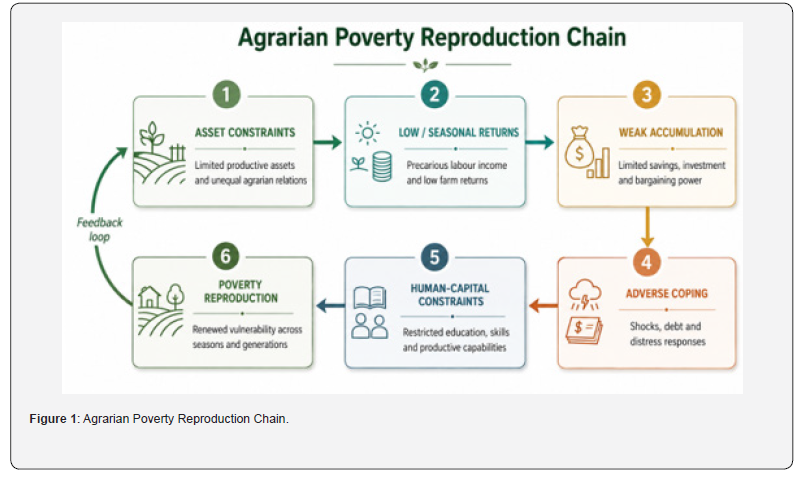
Figure 1 conceptualizes agrarian poverty as a feedback system rather than a linear shortage of money. Its central implication is that interventions applied only at one point in the chain may generate temporary improvement while leaving the mechanisms of poverty reproduction intact.
Figure 1 begins with unequal access to productive resources and proceeds through low or unstable returns, weak savings and bargaining power, shock-related debt and distress coping, and constrained human-capital accumulation. The final stage—intergenerational reproduction—feeds back into the initial condition because children entering adulthood with limited assets, education or networks are disproportionately likely to occupy similarly precarious livelihood positions. The chain does not imply that every poor household follows an identical sequence. Rather, it represents a heuristic for identifying combinations of reinforcing constraints.
Methods
Review Design
This study employs a qualitative, interpretive and integrative literature review. It is explicitly not a Systematic Literature Review (SLR), does not employ PRISMA reporting, does not claim exhaustive bibliographic coverage, and does not undertake statistical meta-analysis. Its purpose is conceptual and explanatory: to integrate diverse bodies of literature in order to identify recurring mechanisms, tensions, contextual differences and policy implications.
This methodological choice follows the argument that integrative reviews are particularly valuable when a research problem spans theoretical traditions and empirical literatures that would otherwise remain fragmented [28]. Qualitative review guidance similarly stresses clarity of purpose, explicit judgments about source quality, contextual interpretation, meaningful synthesis and reviewer reflexivity rather than mechanical aggregation alone [29]. Kraus et al. [30] emphasize that literature reviews can operate as independent scholarly studies when they establish a transparent research purpose and synthesising logic, while Kalpokaite and Radivojevic [31] emphasize iterative qualitative interpretation as a basis for producing a coherent explanatory narrative.
Identification and Use of Literature
The primary analytical literature consists of peer-reviewed studies published from 2020 to August 2026. Literature was identified through iterative keyword searches in multidisciplinary scholarly search engines and publisher databases, supplemented by backward and forward reference tracing from highly relevant studies. Search combinations covered rural poverty, agrarian poverty, smallholders, agricultural labour, landlessness, petani gurem, agrarian change, livelihood diversification, social protection, Village Fund, value chains, agricultural extension, mechanisation, gender, rural youth, climate resilience, agroforestry, oil-palm smallholders and Indonesia. Priority was given to articles with verifiable journal metadata and DOI information and to studies whose research questions, populations or mechanisms were directly relevant to agrarian poverty and rural transformation. The final reference base cited in the manuscript comprises 66 peer-reviewed journal articles and two official BPS statistical sources.
Priority was given to empirical studies directly examining Indonesia. Comparative Global South literature was incorporated selectively where it clarified mechanisms relevant to Indonesia—for example, food-system transformation, commercialisation, adaptive social protection and the distributional consequences of mechanisation. Such comparative evidence is used conceptually, not as a substitute for Indonesian empirical evidence.
An initial deductive coding frame covered survival-oriented livelihoods, seasonal work, land scarcity, social protection, diversification, financial vulnerability and education. The coding frame was subsequently expanded inductively as additional themes emerged from the scholarly literature, including agrarian class, gender, youth precarity, climate resilience, value-chain governance, digitalisation and institutional coordination. This iterative movement between sensitising concepts and the literature is consistent with an interpretive review design in which the objective is explanatory synthesis rather than exhaustive counting of studies.
Analytical Strategy
The review applied thematic comparison across four questions: (1) What form of deprivation or vulnerability is documented? (2) Through what mechanism does it affect household welfare? (3) Which household or agrarian groups experience the mechanism most strongly? and (4) what interventions potentially alter the mechanism, including their trade-offs? These questions structured the comparison across themes and helped connect descriptive findings to explanatory mechanisms and policy implications.
The analysis did not equate frequency of publication with strength of evidence. Rather, it compared causal interpretations, longitudinal findings, household studies, institutional analyses and qualitative evidence. Where findings differed—for example, regarding commercialization or technology adoption—the review sought to identify the contextual variables producing those differences.
The limitations of this approach should be recognized. A qualitative review cannot estimate how frequently a particular finding occurs in the entire literature, and the Indonesian evidence base remains geographically uneven, with Java, Sumatra and selected commodity systems receiving disproportionate scholarly attention. The findings should therefore be read as an analytical synthesis of mechanisms and documented patterns rather than a statistically representative inventory of all Indonesian villages.
Results: Thematic Findings
Asset Poverty, Land Scarcity and Agrarian Relations
The first defining characteristic of agrarian poverty is restricted control over productive assets. Indonesia’s large population of farmers operating less than 0.5 hectares demonstrates that small operational scale is not a marginal phenomenon. For these households, a modest decline in productivity, output price or family labour availability can have large welfare consequences because production begins from a narrow asset base.
Yet farm size alone does not explain poverty. Land quality, irrigation, tenure security, location, commodity choice, access to machinery and connectivity to markets all influence returns. Moreover, some households possess no farm land and depend primarily upon agricultural wage labour. Such workers occupy a structurally different position because improvements in crop profitability benefit them only insofar as they generate additional employment or higher wages.
Habibi [3] demonstrates the importance of agrarian class relations in Java, where control over land and capital influences bargaining between employers and rural labour. White and Wijaya [4] further show that sharecropping and contract production involve different distributions of labour obligations, autonomy and risk. These studies imply that policies framed around a generic “small farmer” can overlook poor agricultural labourers whose principal asset is labour rather than land.
Access arrangements can nonetheless broaden productive opportunities. Kresna et al. [23], examining smallholder dairy farmers’ access to state-owned agroforestry lands in West Java, show that social capital and institutional relationships can influence access to resources. Evidence from private-forest farmers in West Java likewise links small landholdings and unequal land distribution with income inequality and a higher incidence of poverty, reinforcing the importance of productive asset scale and livelihood diversification [32]. Social-forestry outcomes are also highly context dependent: reviews and recent Indonesian case studies show that tenure history, administrative accessibility, local participation and collective institutions shape whether poorer or landless households can obtain meaningful livelihood benefits [33,34]. Agroforestry studies further demonstrate that trees, food crops and other products can provide multiple economic and subsistence functions, although limited farm size, knowledge and technological capacity can constrain transitions from subsistence towards improved welfare [19-21].
These findings suggest that an effective anti-poverty agenda must analyses access, rather than ownership alone. Relevant resources include cultivable land, irrigation, common or forest resources, machinery services, productive infrastructure and secure contractual arrangements. Redistribution may be appropriate in some settings, but better tenancy, social forestry, collective machinery access and secure resource-use rights can also influence livelihood capacity.
Seasonal Work and the Rural Working Poor
The second characteristic is the coexistence of work and poverty. Agricultural labour can be physically demanding while remaining economically precarious because paid working days are seasonal and unevenly distributed across production cycles. Such seasonality is particularly consequential for households with limited savings or alternative employment, because recurring lean periods can convert low earnings into repeated liquidity shortages. Contemporary labour evidence supports the broader point that agricultural employment often provides less predictable and less attractive income than alternative sectors, contributing to declining youth interest in agriculture [24].
This condition produces a category of rural working poor whose problem is neither inactivity nor unwillingness to work. Instead, the return to available labour is insufficiently stable or productive to support accumulation. During peak seasons, income may cover household consumption; during lean periods, households rely on secondary activities, borrowing, remittances or reduced expenditures.
The policy implication is significant. Agricultural poverty cannot be addressed solely by creating more days of low-productivity employment. The relevant objective is to increase the annual return to household labour. This may involve farm productivity improvements, but it can also involve vocational skills, rural services, food processing, construction, machinery operation and other off-farm employment. Comparative evidence shows that agrifood systems generate considerable employment beyond farms, including wholesaling, transport, logistics and processing [10,35].
Low Productivity, Low Profitability and Unequal Value Capture
Agricultural productivity remains important, but the literature indicates that productivity and household welfare are not synonymous. Farmers require access to appropriate seeds, water, soil fertility management, technical information, equipment and management capability. Extension services can therefore produce meaningful effects. Research among smallholders in Banten associates access to agricultural extension with stronger technology adoption and farm income [36]. Indonesian rice-farming evidence further indicates that individual inputs may be insufficient when implemented without complementary interventions; the effectiveness of technology depends upon combinations of practices and institutional support [37].
Commodity-specific evidence strongly reinforces this point. Research on Indonesian oil-palm smallholders demonstrates substantial variation in productivity, fertilizer use, certification readiness and economic performance. Yield gaps have been connected to agronomic management, balanced nutrient use and farm practices [38-40]. Yet socio-economic constraints—including affordability, access to finance and input distribution—also condition whether technically desirable practices can be adopted [41]. This means that advising farmers to use improved inputs without resolving liquidity and distribution constraints may have little effect.
At the same time, productivity growth can interact with land expansion. Dalheimer et al. [42] examine the relationship between technical efficiency and farmland expansion among Indonesian oil-palm smallholders, illustrating why productivity policy must consider land-use consequences. Cocoa research likewise shows that optimal input strategies depend upon both climatic and market conditions, demonstrating the inadequacy of universal technical prescriptions [43].
The larger analytical point is that the relevant household objective is profitability and resilient net income, not output volume alone. Farmers capture income after subtracting input costs, finance, labour, transport and marketing costs. Thus, value-chain position matters.
Commercialization: Opportunity, Heterogeneity and Risk
Commercialization can raise incomes, encourage technology adoption and connect farmers to expanding markets. Comparative evidence associates agricultural commercialization with improvements in income and sometimes food and nutrition outcomes, particularly where market access is strong [44]. In Indonesia, commercially oriented commodity sectors provide similarly important evidence.
Oil palm has generated measurable welfare gains for many smallholder households. Chrisendo et al. [45] link oil palm cultivation with agricultural structural transformation, while Chrisendo et al. [46] find improvements in living standards and human-capital formation among participating smallholder households. Mehraban et al. [47] additionally examine the relationship between oil-palm cultivation, household welfare and exposure to economic risk.
Nevertheless, positive average effects should not be interpreted as universal. Santika et al. [48] show that sustainability certification has heterogeneous effects on village wellbeing and poverty, with outcomes dependent upon local livelihood structures. Certification itself creates financial and organizational barriers for independent smallholders [49-51], and de Vos et al. [52] document pre-certification conditions that can restrict independent farmers’ readiness to meet formal sustainability requirements. Commercial upgrading may consequently favour households already possessing sufficient assets, records, organization and market connectivity.
Commercialization also has gender implications. Mehraban et al. [53] demonstrate that changes associated with oil-palm cultivation affect intra-household gender roles, illustrating why household income gains cannot simply be assumed to translate into equal control over resources.
The conclusion is not that commercialization should be resisted. Rather, commercialisation should be evaluated by who participates, who bears risk, who controls decisions and how value is distributed.
Cooperatives, Producer Organizations and Value-Chain Bargaining
Collective action can alter individual smallholders’ weak market position. Widadie et al. [25] show how producer organizations can support vegetable farmers in linking with modern retail channels. Such organizations may aggregate output, reduce transaction costs, improve quality coordination, purchase inputs collectively and strengthen negotiation with buyers.
Yet collective organizations should not be romanticized. Their poverty-reducing impact depends upon internal governance, membership accessibility and the distribution of benefits. Requirements relating to production volume, quality standards, fees or land ownership may exclude households with the weakest asset base. Contract farming also produces divergent outcomes according to contract design. Ikeda and Natawidjaja [26] show that relationships between specialized suppliers and modern retailers depend on sustainability of the contractual arrangement, while Setiadi [54] identifies potential prosperity gains from contract broiler farming. White and Wijaya’s [4] agrarian analysis nevertheless cautions that contractual production remains a labour and power relationship as well as a market arrangement.
Accordingly, collective organizations should be assessed against at least four criteria: inclusion, bargaining power, risk sharing and distribution of value added. These criteria shift attention from formal membership or market access alone towards the distributional consequences of collective arrangements for poorer and less asset-rich producers.
Food Insecurity among Food-Producing Households
A central paradox of agrarian poverty is that households producing agricultural commodities can remain food insecure. Food availability at farm level does not automatically guarantee year-round economic access to a sufficiently diverse diet. Smallholders may specialize in commercial crops and purchase food from markets; agricultural labourers may produce no food for their own household; and subsistence production may provide calories but insufficient dietary diversity. Recent evidence from rural West Sleman shows that women agricultural labourers experienced a higher proportion of moderate-to-severe food insecurity than women landowners or tenants, while low agricultural income and weak household assets were important correlates of food insecurity [55].
Agroforestry can contribute to household food security by supplying diverse products and stabilising ecological functions [19]. Traditional Indonesian smallholder agroforestry nevertheless continues to confront constraints involving small landholdings, limited technological adoption and market development [20]. Sudomo et al. [21] similarly emphasise the potential of agroforestry to contribute to livelihood and food security under climate change, while recognising institutional and technical challenges.
International smallholder evidence shows that commercialisation and nutrition can be complementary when higher income and stronger market access increase dietary purchases, but the relationship is context dependent [44]. Thus, agricultural policy should not infer nutritional welfare directly from production indicators.
Diversification: From Distress Coping to Opportunity
Livelihood diversification is one of the most consistent themes in rural development research. In Indonesia it takes numerous forms: multiple crops, livestock, forestry, petty trade, processing, temporary wage employment, transport services, construction, migration and remittances. Race et al. [5] describe diversification as a defining feature of modern Indonesian smallholder livelihoods, while Nugroho et al. [6] show how forest extraction can complement livestock-based livelihoods.
However, diversification has two analytically distinct forms. Distress diversification occurs when households accept low-return secondary activities because farming income is insufficient. It helps them survive but may not increase long-run productivity. Opportunity-led diversification, by contrast, moves household labour or capital into higher-return activities and can become a pathway toward accumulation.
This distinction is important when considering recommendations for agricultural labourers to seek additional income sources. Backyard livestock, food processing or temporary non-farm employment may stabilise consumption, but their transformative capacity depends on market scale, skills, capital and demand. Diversification should therefore be evaluated according to the return it generates and the correlation of its risks with the household’s existing livelihood. Adding a second activity vulnerable to the same drought or commodity shock provides much less resilience than combining agriculture with an income stream that responds to different economic conditions.
Urbanisation and expanding agrifood systems can create such diversification opportunities. De Bruin et al. [9] identify connectivity, infrastructure, services and social networks as crucial conditions enabling rural households to benefit from changing urban food demand. The growth of midstream food-system enterprises - including processing, logistics, wholesaling and transport - can also create employment outside direct cultivation [10]. For Indonesia specifically, provincial evidence shows that both the expansion of high-value agriculture and the growth of rural non-farm employment are associated with higher rural household income and lower poverty, although the pace of transformation varies considerably across regions [11].
Rural Youth, Human Capital and Intergenerational Poverty
Breaking agrarian poverty requires a generational perspective. Education is not merely a social service but a productive capability that influences the occupations available to the next generation. For this reason, school completion, vocational education, digital skills and access to tertiary education should be treated as long-term mechanisms for weakening the intergenerational transmission of agrarian poverty rather than as peripheral welfare measures.
This recommendation is broadly consistent with recent literature, although the process is more complex than simply keeping children in school. Ngadi et al. [24] document declining agricultural participation among Indonesian youth, related to agricultural wages, unstable work, and changing occupational preferences. Griffin et al. [22], examining South Sulawesi, describe livelihood precarity and aspirations emerging in the context of incomplete agrarian transformation. Young people may aspire to leave farming without obtaining secure alternative employment.
This creates a policy dilemma. “Farmer regeneration” programs sometimes frame youth departure as a problem to be reversed, while employment policy may implicitly regard movement out of agriculture as development. Neither view is sufficient. The objective should be to expand high-quality choices. Some young people can become commercially viable, technologically capable agricultural entrepreneurs; others may achieve greater welfare in rural processing, logistics, services, manufacturing or urban employment.
Comparative research on youth employment across agrifood systems demonstrates that younger workers participate not only in farming but in substantial off-farm agrifood activity [35]. Agricultural transformation policy should consequently combine agricultural skills with transferable vocational, business and digital capabilities.
Gendered Constraints and Unequal Household Benefits
Women contribute substantially to agricultural and household production but do not necessarily exercise equivalent control over assets, technologies or income. Qanti et al. [56] show that social norms and perceptions influence women’s participation in agricultural decision-making in West Java, meaning that interventions delivered nominally to a “farm household” can have gender-differentiated consequences. Recent national evidence on agricultural transformation further shows that shifts towards high-value commodities and non-farm employment can create new opportunities for women while also reproducing unequal workloads, access barriers and marginalisation unless gender-responsive institutions are in place [57].
Mechanisation provides an illustrative case. Technology can reduce physical drudgery and increase productivity, but labour substitution may affect men and women differently depending on existing task divisions. Indonesian evidence on small-scale rice farming indicates changes in female and hired labour utilisation associated with mechanisation [58]. The broader literature similarly warns that mechanisation brings simultaneous productivity opportunities and distributional risks [59].
Digitalisation creates comparable tensions. Access to digital information, finance or marketing can lower transaction costs, yet unequal ownership of devices, literacy or data access can reproduce rather than eliminate inequality. Digital agricultural transformation therefore needs complementary investment in skills, affordable connectivity and institutionally trusted services.
Climate and Ecological Vulnerability
Agrarian poverty is uniquely exposed to environmental conditions because natural capital remains a direct input into livelihoods. Climate variability, drought, flooding, changing rainfall patterns, pests and soil degradation can simultaneously reduce output, employment and local food availability.
Agroforestry offers one potential strategy because diversified biological systems can combine production and ecological functions [19,21]. Yet environmental adaptation cannot be reduced to a technical package. Households require the financial capacity to adopt new practices and survive transition periods.
Adaptive social protection therefore becomes important. Tenzing [17] argues for integration of social protection and climate adaptation rather than treating them as separate policy fields. Indonesian research provides direct support: Fitrinitia and Matsuyuki [16] examine the Program Keluarga Harapan in relation to climate disasters among smallholder households, while Isnan et al. [60] show the importance of combining formal assistance with community-based support and institutions. Research on agroforestry farmers in West Java also demonstrates that resilience depends on interacting financial, human, social, physical and natural capitals, underscoring the need to treat livelihood resilience as a multidimensional capacity rather than a purely agronomic outcome [61].
Shock resilience is particularly important because progress out of poverty can be reversed. Pandemic research demonstrated that Indonesia’s social-protection response played a significant role in cushioning poverty effects [27], while evidence from rural West Sumatra shows that poorer households’ smaller asset buffers intensified livelihood losses during lockdowns [15]. These findings support treating social protection not simply as redistribution but as protection of productive capacity.
Social Protection, Finance and the Risk of Indebtedness
Households require liquidity for both emergencies and investment. In principle, credit can finance productive inputs, technology, livestock or business expansion. In practice, the consequences depend upon borrowing costs, repayment schedules and investment profitability.
Microfinance research in Indonesia indicates that financial institutions can contribute to poverty reduction, while digital finance potentially broadens access to financial services [62,63]. Yet credit should not be equated with wealth. If households borrow to finance food during a lean season, repay expensive debt from a future harvest and repeatedly refinance consumption gaps, financial access can reproduce dependency rather than accumulation.
Forms of borrowing that tie households to disadvantageous trading relationships deserve particular concern. A stronger policy interpretation, however, is not simply that poor households should “manage money better”; financial vulnerability is frequently structural. When income is highly seasonal and social insurance is weak, even disciplined households may need emergency liquidity, which is why the design, cost and timing of credit are as important as its availability.
The appropriate architecture consequently includes savings, affordable credit, insurance and predictable social protection. Savings provide first-line buffers; credit enables productive investments; insurance protects against insurable agricultural shocks; transfers prevent catastrophic consumption reductions when risks exceed household capacity.
Village Institutions and Local Development
Indonesia’s decentralised governance makes village institutions central to rural poverty reduction. Rammohan and Tohari [64] find that the Village Fund programme improved rural household consumption and generated labour-market effects, with particularly relevant implications for agricultural households and female labour-force participation. Village investment can improve roads, irrigation, public facilities and local employment, thereby addressing multiple constraints simultaneously.
Yet fiscal decentralization does not automatically guarantee pro-poor distribution. Sidik and Habibi [65] emphasize village class dynamics and the possibility that local elites disproportionately influence resources and decision-making. This insight is important because local participation mechanisms can coexist with unequal power.
Village-level anti-poverty policy therefore needs both resources and accountability. Effective decentralization requires transparent targeting, accessible participation, credible grievance mechanisms, public information, and monitoring of who captures benefits. Local knowledge is valuable, but local institutions reproduce social hierarchy unless governance mechanisms explicitly counter exclusion.
Technology, Mechanisation and Digital Agriculture
Technology is frequently presented as a solution to low agricultural productivity, and there is substantial evidence that better technology can increase efficiency. Indonesian extension research shows that information and institutional support facilitate adoption [36], while assessments of agricultural mechanisation emphasise opportunities to improve productivity and precision [66].
Nevertheless, technology is not distributionally neutral. Mechanisation may reduce demand for some manual tasks even while generating higher-skilled employment for machinery operators, maintenance services and contractors. Paman et al. [58] demonstrate that mechanisation affects hired and female labour utilisation in Indonesian rice production. This is directly relevant to poor landless workers: a technology that improves farm-owner profit can simultaneously reduce employment opportunities for particular worker categories.
Daum [59] therefore argues that sustainable mechanisation must be assessed across economic, environmental and social dimensions rather than through productivity alone. Daum et al. [67] similarly show that mechanisation, digitalisation and youth engagement are contested components of agricultural transformation whose effects depend on institutional choices.
The pro-poor technological question is therefore not “Should agriculture mechanise?” but “How can technological change raise productivity while expanding or replacing displaced labour with better livelihood opportunities?” This formulation shifts evaluation from adoption rates alone to the distribution of productivity gains, employment effects and new skill requirements across different rural groups.
Discussion and Analysis
Agrarian Poverty as Interlocking Disadvantage
The literature reviewed above supports a central conclusion: agrarian poverty in Indonesia is best understood as a system of interlocking disadvantages. Households do not experience land scarcity, seasonal labour, limited education, debt, weak market power and climate shocks independently. These constraints interact.
A farmer operating a very small plot may attempt intensification, but lack liquidity for inputs. Credit may provide liquidity, but poor market access can suppress output prices. Commercialization may improve prices, but contract requirements can exclude farmers without scale or certification. Mechanization may raise productivity, but agricultural labourers may lose working days. A cash transfer may prevent hunger following a shock, but it may not alter landlessness or occupational opportunities. Skills training may improve employability, but only if productive jobs exist within accessible labour markets.
This systemic interpretation explains why poor households can remain trapped even when individual programs appear technically effective. It also clarifies why an intervention may have positive average effects while leaving the poorest participants behind.
The term poverty chain should therefore be understood dynamically. At one end lies a weak asset position; in the middle are unstable income, shocks and coping responses; at the other end lies reduced capacity for investment in the next generation. The chain is broken not when one transfer raises current consumption, but when feedback loops cease to reproduce vulnerability.
From “Mere Survival” to Resilience and Accumulation
The expression sekadar menyambung nyawa is particularly useful when interpreted as a livelihood state rather than as a universal description of agricultural workers. It captures a condition in which virtually all available resources are allocated to immediate survival, leaving households with little capacity to tolerate experimentation, delayed returns or productive risk taking.
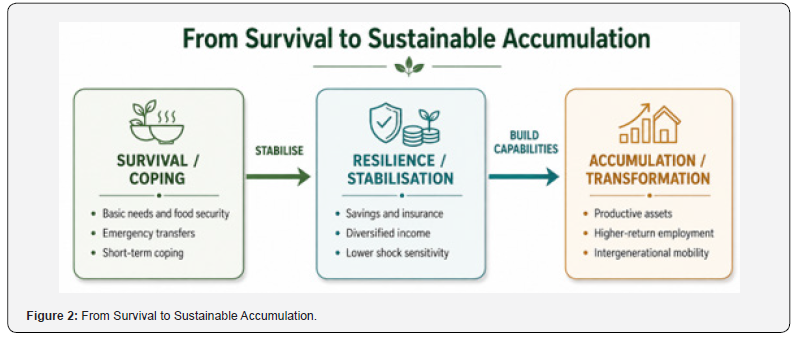
This distinction helps differentiate three policy objectives: survival or coping, resilience or stabilization, and accumulation or transformation. Treating them separately clarifies both what a policy instrument is expected to achieve and the time horizon over which success should be evaluated.
Survival or coping means preventing immediate deprivation. Food assistance, emergency cash, healthcare protection and temporary employment can be crucial. Success is measured by whether households avoid hunger, untreated illness or catastrophic asset sales.
Resilience or stabilization means enabling households to withstand ordinary shocks without falling back into deprivation. Savings, insurance, diversified income and predictable social protection become central.
Accumulation or transformation means expanding productive assets, human capital and access to higher-return opportunities sufficiently to generate sustained upward mobility. It represents a more demanding policy outcome because households must be able not only to raise current consumption but also to retain gains across shocks and generations.
Figure 2 emphasizes that poverty relief and durable poverty exit are not the same policy achievement. Immediate assistance can be indispensable without being structurally transformative, whereas transformation becomes possible when households move from coping towards resilience and ultimately towards sustained accumulation.
The transitions represented in Figure 2 also imply sequencing. Asking households in severe food insecurity to take entrepreneurial risks is unrealistic when failure threatens basic consumption. Stabilization should often precede investment. Once minimum security exists, households can make longer-horizon decisions involving skills, productive assets and enterprise development. This is consistent with development-resilience perspectives in which poverty trajectories depend upon the capacity to absorb shocks while sustaining or improving future livelihood potential [12].
What Works for Whom?
A central implication of heterogeneity is that anti-poverty policies should be differentiated by livelihood position. The binding constraints facing a landless labourer are not identical to those facing a commercially viable smallholder, and policy design should reflect those differences rather than relying on a generic category of “farmers”.
Landless and near-landless agricultural workers
For landless labourers, productivity-oriented farmer subsidies may offer only indirect benefits. Their priorities are more likely to include predictable employment, labour protection, social insurance, vocational skills and access to rural non-farm jobs. Where feasible, improved access to productive land or fairer cultivation arrangements may increase bargaining power. Mechanisation programs affecting their employment should include retraining and labour-transition strategies.
Marginal smallholders
Farmers with very small holdings may benefit from extension, irrigation, improved inputs and producer organisations, but farm-scale limitations can constrain the maximum livelihood attainable from cultivation. Diversified livestock, agroforestry, high-value products and non-farm employment may therefore be as important as yield enhancement. The large number of petani gurem suggests that this is not a niche policy category.
Commercially viable smallholders
Households with adequate productive assets can benefit substantially from technological upgrading, certification, collective marketing, value addition, financial services and links with modern markets. The oil-palm literature demonstrates meaningful welfare and human-capital gains from commercially successful smallholder production while simultaneously documenting certification, finance and management barriers [45,46,48,50].
Rural youth
Youth policy should focus on occupational choice rather than agricultural retention as an end in itself. Young people need pathways into modern agriculture and productive non-agricultural employment. Digital competence, machine operation, food processing, logistics, entrepreneurship and vocational certification can widen opportunities. Evidence that youth increasingly leave Indonesian agriculture partly because of low and uncertain returns suggests that exhortation alone will not regenerate farming [24].
Rural women
Policies should evaluate control over resources rather than only household participation. Women’s access to land, training, producer organisations, technology and finance should be monitored directly. Technologies that displace female labour require alternative employment pathways, while interventions increasing household income should consider who controls the additional income [53,56].
Why Single-Sector Solutions Commonly Underperform
Several recurring policy errors emerge from the synthesis, and each reflects a failure to recognize complementary constraints. The common problem is not that the individual instrument is inherently ineffective, but that it is asked to achieve outcomes that depend on other missing conditions.
Credit without a viable investment opportunity can become household debt. Microfinance and digital finance are useful when financial resources support activities yielding returns above borrowing costs; they are less transformative when loans repeatedly finance subsistence consumption.
Technology without markets can increase physical output while providing limited income gains. Farmers require prices and market access sufficient to make adoption profitable.
Commercialisation without bargaining power can deepen dependence. Contracts may reduce transaction costs but can also allocate risk asymmetrically.
Mechanization without labour transition can improve farm-level productivity while reducing demand for low-skilled rural workers. This is particularly relevant for landless workers.
Cash transfers without capability-building can prevent destitution without altering the structures reproducing poverty. This does not mean transfers have failed; it means they have accomplished a protective rather than transformative function.
Education without employment opportunities may increase aspirations without delivering economic mobility, contributing to rural youth precarity. The return to education therefore depends partly on the availability and accessibility of productive rural or urban labour markets.
Agricultural intensification without ecological resilience can generate short-run income while increasing exposure to soil degradation, water stress or climatic shocks. Productivity strategies should therefore be screened for their effects on the natural-resource base on which future rural livelihoods depend.
These observations explain why poverty reduction should be organized around policy packages rather than isolated instruments. Policy coherence is especially important for poorer households because they have the least capacity to compensate privately for missing infrastructure, insurance, skills or market access.
An Integrated Architecture for Breaking the Agrarian Poverty Chain
The literature synthesis supports a five-part architecture: the Floor, Ladder, Engine, Shield and Institutional Backbone. The framework is designed to distinguish functions that are analytically separate but operationally interdependent in producing durable poverty exits.
The Floor: minimum livelihood security
The Floor prevents catastrophic deprivation through food security, healthcare, basic education and predictable social protection. Social assistance is especially important during climatic, health and economic shocks. Indonesian research on pandemic protection and smallholder resilience demonstrates that these programs can prevent short-term losses from becoming deeper poverty [16,27,60].
The Ladder: assets and capabilities
The Ladder enables households to move beyond protection. It includes land or secure resource access, education, vocational skills, extension, financial capability, savings and productive assets. These investments increase the range of economically viable choices available to rural households and strengthen their capacity to enter higher-return activities.
The Engine: sustainable income growth
The Engine creates higher and more stable returns through profitable agriculture, producer organisations, value addition, processing, rural enterprises and high-quality non-farm employment. It deliberately avoids treating agriculture as the only route out of agrarian poverty.
The Shield: protection against reversals
The Shield protects accumulated gains through climate adaptation, income diversification, savings, insurance, disaster response and resilient natural-resource management. Without it, households can climb temporarily and fall back following one major shock.
The Institutional Backbone
The other four components depend upon institutions coordinating across sectors. Village government, district agencies, agricultural extension systems, social-protection agencies, educational institutions, financial providers, cooperatives and private value-chain actors need compatible incentives and information.
Figure 3 depicts poverty reduction as an institutional architecture rather than a collection of separate programmes. None of its five components substitutes for another: protection without opportunity can stabilize consumption without generating upward mobility, while productive opportunity without protection leaves accumulated gains vulnerable to reversal.
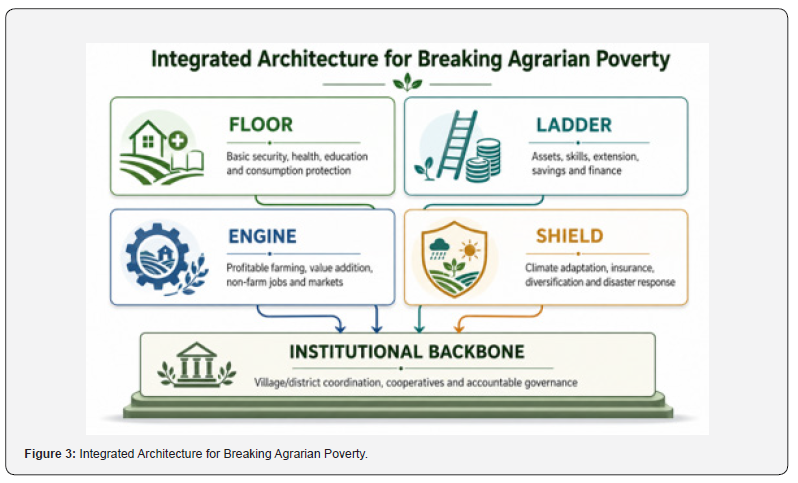
Figure 3 also highlights why administrative fragmentation is costly. A poor farmer may simultaneously interact with separate agricultural, social-assistance, education, village-development and financial programs, each applying different eligibility criteria and databases. Convergence at household and village levels would allow protection and productive inclusion to reinforce one another.
Policy Sequencing
Integration does not mean implementing every intervention simultaneously. Sequencing matters.
First, stabilize highly vulnerable households. When consumption is below subsistence needs or households face severe debt and illness, productive investment is unlikely to be sustained.
Second, build capabilities and resolve binding constraints. Depending on context, this may mean irrigation, land access, training, basic finance, roads or producer organization.
Third, connect production to profitable demand. Extension and technology should be linked with market development and value capture.
Fourth, promote diversification and occupational mobility. As household security improves, members can enter higher-return agricultural or non-agricultural opportunities.
Fifth, protect gains from reversal through savings, insurance, adaptive social protection and climate-resilient practices. These measures reduce the probability that a health, climatic or market shock will erase earlier investments in assets and human capital.
This sequencing is consistent with evidence that single technologies may underperform when complementary inputs and institutional support are absent [37]. It also provides a practical rationale for coordinating social protection and productive-development programmes around the evolving constraints of the same household.
Village-Level Convergence and Governance
The Village Fund offers an institutional platform through which infrastructure and locally tailored programs can support poverty reduction. Evidence of improved consumption and labour-market participation provides reason for optimism [64]. Yet local elite capture remains a significant concern [65].
A comprehensive rural poverty strategy should therefore encourage village-level convergence while strengthening accountability. Potential mechanisms include public beneficiary registries, participatory mapping of livelihood groups, transparent procurement, citizen monitoring, inclusion of women’s and labourers’ organisations, and publication of programme outcomes. Village-level studies of extreme poverty also underline the importance of combining livelihood strategies with locally grounded empowerment rather than relying exclusively on transfers or infrastructure expenditure [68].
Local indicators should also move beyond expenditure absorption and count changes in household capabilities and resilience. Relevant outcomes include greater income stability, productive-asset ownership, lower reliance on distress borrowing, improved nutrition and school progression, stronger women’s decision-making, more secure youth employment and faster recovery after shocks. Tracking these indicators would make local evaluation more sensitive to the distinction between temporary consumption support and durable reductions in vulnerability.
Reassessing Indonesia’s Progress in 2026
Indonesia’s poverty trajectory is clearly positive. A national poverty rate of 8.07% in March 2026 represents continued improvement, but it should be interpreted alongside the persistence of higher poverty in rural areas [1]. The appropriate interpretation is not that poverty-reduction policies have failed, but that the next stage of policy needs a more demanding criterion of success.
The continuing rural poverty rate of 10.67%, compared with 6.34% in urban areas, demonstrates that rural disadvantage persists [1]. Simultaneously, the large number of petani gurem indicates continuing structural constraints on agricultural scale [2]. These statistics are consistent with the qualitative literature documenting livelihood diversification, agrarian differentiation, youth mobility, gender inequality and vulnerability to shocks.
Consequently, relying exclusively on the poverty headcount can obscure households positioned just above the poverty line but still exposed to rapid downward mobility. Poverty monitoring should increasingly incorporate measures of vulnerability and resilience.
Useful complementary indicators include income volatility, household savings, debt-service burdens, productive assets, secure land access, dietary diversity, insurance coverage, school transition, quality of youth employment, women’s control over resources and recovery time following shocks. Used together, these measures would better reveal whether households have achieved a resilient exit from poverty or remain exposed to rapid downward mobility.
Conclusion and Policy Recommendations
This qualitative literature review demonstrates that poverty in agrarian rural Indonesia is not adequately explained by low income or low agricultural productivity alone. It is more accurately understood as multidimensional agrarian precarity produced by interacting deficits in productive assets, stable employment, bargaining power, human capital, finance, social protection and resilience.
The evidence also rejects a homogeneous conception of rural poverty. Landless workers, marginal smallholders, tenant farmers, commercially integrated commodity producers, women, youth and diversified rural households encounter different constraints. Policy should therefore begin with livelihood segmentation rather than a universal package labelled “farmer assistance.”
The first policy priority is to establish a reliable social floor. Poor households should not need to sacrifice nutrition, health, children’s education or productive assets following ordinary shocks. Social protection should become increasingly adaptive and interoperable with disaster and climate-risk systems.
Second, policy must strengthen the asset and capability ladder. For some households, this requires improved or more secure access to land and water; for others, extension, vocational education, machinery services, financial capability or collective organisation is more important. Educational policy should be understood as an intergenerational poverty strategy rather than merely a welfare service.
Third, Indonesia needs a stronger income engine extending beyond primary agricultural production. Productivity remains important, but value addition, processing, logistics, rural services, farmer organisations, small enterprises and quality non-farm employment are equally relevant. The transformation of agrifood systems means that rural prosperity can be generated both on and beyond farms.
Fourth, every upward-mobility strategy requires a resilience shield. Climate change, illness, market volatility and economic disruptions can destroy years of gradual household accumulation. Savings, insurance, diversified livelihoods, climate-resilient production and responsive public transfers should protect households from returning to poverty.
Fifth, these elements require an accountable institutional backbone. Village and district governments, agricultural agencies, social-protection providers, schools, financial institutions, cooperatives and private value-chain actors need stronger coordination. The objective should be convergence around household constraints rather than the multiplication of disconnected projects.
Technology policy deserves particular caution. Mechanisation and digital agriculture can increase productivity and reduce drudgery, but their benefits depend on access, scale and skills and can redistribute employment. Pro-poor technological change therefore requires machinery-service models accessible to smallholders, training for displaced workers, digital inclusion, and deliberate creation of new skilled rural occupations.
Commercialisation should likewise be pursued with attention to distribution. Evidence from Indonesian commodity systems confirms that commercially successful agriculture can improve living standards and human capital, while certification costs, weak bargaining power and unequal household roles can limit benefits. Policies should evaluate who captures value, who assumes risk, and whether the poorest producers can meet entry requirements.
Financial inclusion should focus on productive financial security, not the volume of credit distributed. Households need savings and insurance as well as affordable credit. Credit used repeatedly for basic consumption because seasonal income is inadequate is evidence of unresolved livelihood vulnerability, not necessarily successful inclusion.
Finally, Indonesia should distinguish poverty relief from durable poverty-chain disruption. A household leaving official poverty in one survey period but remaining one illness, failed harvest or employment shock away from deprivation has experienced important progress, but not yet a resilient exit.
The central policy question should therefore shift from asking how assistance can be delivered to poor rural households towards asking what combination and sequence of protection, productive assets, capabilities, market opportunities and accountable institutions can prevent poverty-producing mechanisms from reproducing themselves. This reframing places durable livelihood mobility, rather than programme delivery alone, at the centre of policy evaluation.
References
- BPS-Statistics Indonesia (2026) In March 2026, the percentage of the poor population decreased to 8.07 percent.
- BPS-Statistics Indonesia (2023) Agricultural Census 2023 (Sensus Pertanian 2023).
- Habibi M (2021) Masters of the countryside and their enemies: Class dynamics of agrarian change in rural Java. Journal of Agrarian Change 21(4): 720-746.
- White B and Wijaya H (2022) What kind of labour regime is contract farming? Contracting and sharecropping in Java compared. Journal of Agrarian Change 22(1): 19-35.
- Race D, Suka AP, Oktalina SN, Bisjoe AR, Muin N, et al. (2022) Modern smallholders: Creating diversified livelihoods and landscapes in Indonesia. Small-scale Forestry 21: 203-227.
- Nugroho E, Ihle R, Oosting SJ and Heijman W (2023) The role of forest extraction in the livelihood strategies of Indonesian smallholder cattle farmers. Outlook on Agriculture 52(2): 153-162.
- Moeis FR, Dartanto T, Moeis JP and Ikhsan M (2020) A longitudinal study of agriculture households in Indonesia: The effect of land and labor mobility on welfare and poverty dynamics. World Development Perspectives 20: 100261.
- Arslan A, Cavatassi R and Hossain M (2022) Food systems and structural and rural transformation: A quantitative synthesis for low- and middle-income countries. Food Security 14: 293-320.
- de Bruin S, Dengerink J and van Vliet J (2021) Urbanisation as driver of food system transformation and opportunities for rural livelihoods. Food Security 13: 781-798.
- Reardon T, Liverpool-Tasie LSO and Minten B (2021) Quiet revolution by SMEs in the midstream of value chains in developing regions: Wholesale markets, wholesalers, logistics, and processing. Food Security 13: 1577-1594.
- Sudaryanto T, Erwidodo, Dermoredjo SK, Purba HJ, Rachmawati RR, et al.(2023) Regional rural transformation and its association with household income and poverty incidence in Indonesia in the last two decades. Journal of Integrative Agriculture 22(12): 3596-3609.
- Dou Y, Deadman PJ, Berbés-Blázquez M, Vogt ND and Almeida O (2020) Pathways out of poverty through the lens of development resilience: An agent-based simulation. Ecology and Society 25(4): 3.
- Radosavljevic S, Haider LJ, Lade SJ and Schlüter M (2020) Effective alleviation of rural poverty depends on the interplay between productivity, nutrients, water and soil quality. Ecological Economics 169: 106494.
- Edwards R, Halimatussadiah A, Moeis FR and Maulia RF (2022) Agriculture, development and sustainability in the Covid-19 era. Bulletin of Indonesian Economic Studies 58(1): 1-30.
- Mahdi M, Nugroho A, Triana L, Azhari R, Agussabti, et al. (2025) The impacts of COVID-19 lockdowns on livelihood assets and income inequality in rural West Sumatra. Discover Public Health 22: 558.
- Fitrinitia IS and Matsuyuki M (2023) Social protection for climate-disasters: A case study of the Program Keluarga Harapan cash transfer program for smallholder farm household in Indonesia’, Progress in Disaster Science 17: 100278.
- Tenzing JD (2020) Integrating social protection and climate change adaptation: A review. WIREs Climate Change 11(2): e626.
- Woodhill J, Kishore A, Njuki J, Jones K and Hasnain S (2022) Food systems and rural wellbeing: Challenges and opportunities. Food Security 14: 1099-1121.
- Duffy C, Toth GG, Hagan RPO, McKeown PC, Rahman SA, et al. (2021) Agroforestry contributions to smallholder farmer food security in Indonesia. Agroforestry Systems 95: 1109-1124.
- Achmad B, Sanudin, Siarudin M, Widiyanto A, Diniyati D, et al. (2022) Traditional subsistence farming of smallholder agroforestry systems in Indonesia: A review. Sustainability 14(14): 8631.
- Sudomo A, et al. (2023) Can agroforestry contribute to food and livelihood security for Indonesia’s smallholders in the climate change era? Agriculture 13(10): 1896.
- Griffin C, Sirimorok N, Dressler WH et al. (2024) The persistence of precarity: Youth livelihood struggles and aspirations in the context of truncated agrarian change, South Sulawesi, Indonesia. Agriculture and Human Values 41: 293-311.
- Kresna R, Widiyanto A, Achmad B, Sanudin, Siarudin M, et al. (2024) Out of the woods: Social capital and smallholder dairy farmers’ access to state-owned agroforestry lands in West Java, Indonesia. Agroforestry Systems 98: 637-652.
- Ngadi N, Zaelany AA, Latifa A, Harfina D, Asiati D, et al. (2023) Challenge of agriculture development in Indonesia: Rural youth mobility and aging workers in agriculture sector. Sustainability 15(2): 922.
- Widadie F, Bijman J and Trienekens J (2021) Value chain upgrading through producer organisations: Linking smallholder vegetable farmers with modern retail markets in Indonesia. International Journal on Food System Dynamics 12(1): 68-82.
- Ikeda S and Natawidjaja RS (2022) The sustainability of contract farming with specialized suppliers to modern retailers: Insights from vegetable marketing in Indonesia. Agriculture 12(3): 380.
- Suryahadi A, Izzati RA and Yumna A (2021) The impact of COVID-19 and social protection programs on poverty in Indonesia. Bulletin of Indonesian Economic Studies 57(3): 267-296.
- Elsbach KD and van Knippenberg D (2020) Creating high-impact literature reviews: An argument for “integrative reviews”’. Journal of Management Studies 57(6): 1277-1289.
- Wilson SM and Anagnostopoulos D (2021) Methodological guidance paper: The craft of conducting a qualitative review. Review of Educational Research 91(5): 651-670.
- Kraus S, Breier M, Lim WM, et al. (2022) Literature reviews as independent studies: Guidelines for academic practice. Review of Managerial Science 16: 2577-2595.
- Kalpokaite N and Radivojevic I (2021) Adapting practices from qualitative research to tell a compelling story: A practical framework for conducting a literature review. The Qualitative Report 26(5): 1546-1566.
- Fauziyah E, Awang SA, Suryanto P and Achmad B (2025) Inequality and poverty of privately owned forests farmers in rural areas of Indonesia. Forest Science and Technology 21(1): 1-14.
- Rakatama A and Pandit R (2020) Reviewing social forestry schemes in Indonesia: Opportunities and challenges. Forest Policy and Economics 111: 102052.
- Sirimorok N, Sahide MAK, Herrawan H, Faturachmat F and Maryudi A (2024) Linking commoning with social forestry: An Indonesian case. Trees, Forests and People 18: 100737.
- Dolislager M, Reardon T, Arslan A, Fox L, Liverpool-Tasie LSO, et al. (2021) Youth and adult agrifood system employment in developing regions: Rural (peri-urban to hinterland) vs. urban. Journal of Development Studies 57(4): 571-593.
- Amrullah ER, Takeshita H and Tokuda H (2025) Impact of access to agricultural extension on the adoption of technology and farm income of smallholder farmers in Banten, Indonesia. Journal of Agribusiness in Developing and Emerging Economies15(3): 531-547.
- Dewi S, Bahru BA and Zeller M (2026) Revealing the effect of agricultural interventions on technical efficiency: Empirical evidence from Indonesian smallholder rice farmers. Agricultural and Food Economics 14: 16.
- Lim KH et al. (2023) Improving yield in oil palm smallholder fields requires higher and balanced nutrient use. Agricultural Systems 210: 103729.
- Monzon JP, Lim YL, Tenorio FA, Farrasati R, Pradiko I, et al. (2023) Agronomy explains the existing large yield gap in independent smallholder oil palm fields. Agricultural Systems 210: 103689.
- Mettauer R, Baron V, Turinah, Demitria P, Smit H, et al. (2021) Investigating links between management practices and economic performances of smallholders’ oil palm plots: A case study in Jambi, Indonesia. Agricultural Systems 194: 103274.
- de Vos RE, Lim YL, Sunawan, Donough CR, Monzon JP, et al. (2026) Fertilizer use in Indonesian oil palm smallholder systems: Agronomic and socio-economic constraints and opportunities. Environment, Development and Sustainability.
- Dalheimer B, Kubitza C and Brümmer B (2022) Technical efficiency and farmland expansion: Evidence from oil palm smallholders in Indonesia. American Journal of Agricultural Economics 104(4): 1364-1387.
- Hoffmann MP, Cock J, Samson M, Janetski N, Janetski K, et al. (2020) Fertilizer management in smallholder cocoa farms of Indonesia under variable climate and market prices’, Agricultural Systems 178: 102759.
- Ogutu SO, Gödecke T and Qaim M (2020) Agricultural commercialisation and nutrition in smallholder farm households. Journal of Agricultural Economics 71(2): 534-555.
- Chrisendo D, Siregar H and Qaim M (2021) Oil palm and structural transformation of agriculture in Indonesia. Agricultural Economics 52(5): 849-862.
- Chrisendo D, Siregar H and Qaim M (2022) Oil palm cultivation improves living standards and human capital formation in smallholder farm households’. World Development 159: 106034.
- Mehraban N, Kubitza C, Alamsyah Z, Qaim M (2021) Oil palm cultivation, household welfare, and exposure to economic risk in the Indonesian small farm sector. Journal of Agricultural Economics.
- Santika T, Wilson KA, Law EA, St John FAV, Carlson KM, et al. (2021) Impact of palm oil sustainability certification on village well-being and poverty in Indonesia. Nature Sustainability 4: 109-119.
- Apriani E, Kim YS, Fisher LA and Baral H (2020) Non-state certification of smallholders for sustainable palm oil in Sumatra, Indonesia. Land Use Policy 99: 105112.
- Watts JD, Pasaribu K, Irawan S, Tacconi L, Martanila HP (2021) Challenges faced by smallholders in achieving sustainable palm oil certification in Indonesia’. World Development 146: 105565.
- Tey YS, Brindal M, Hadi AHIA and Darham S (2022) Financial costs and benefits of RSPO certification among independent smallholders: A probabilistic view of the oil palm sector in Indonesia. Sustainable Production and Consumption 30: 377-386.
- de Vos RE, Suwarno A, Slingerland M, van der Meer PJ and Lucey JM (2023) Pre-certification conditions of independent oil palm smallholders in Indonesia: Assessing prospects for RSPO certification. Land Use Policy 130: 106660.
- Mehraban N, Debela BL, Kalsum U and Qaim M (2022) What about her? Oil palm cultivation and intra-household gender roles. Food Policy 110: 102276.
- Setiadi S, Setiadi A, Mukson, Roessali W (2022) Contract broiler farming as an effective pathway to improve rural prosperity in Indonesia. International Social Science Journal 72: 461-473.
- Samputra PL and Antriyandarti E (2024) Food insecurity among female farmers in rural West Sleman, Indonesia. Agriculture & Food Security 13: 2.
- Qanti SR, Peralta A and Zeng D (2022) Social norms and perceptions drive women’s participation in agricultural decisions in West Java, Indonesia. Agriculture and Human Values 39: 645-662.
- Rachmawati RR, Siscawati M, Seda FSSE and Sudaryanto T (2025) Reaping equality: Strategies for gender roles in Indonesia's agricultural transformation. Asia and the Pacific Policy Studies 12(2): e70021.
- Paman U, Khairizal and Wahyudy HA (2020) Impact of mechanization development on women and hired labor utilizations of small-scale rice farming operations in Kampar Region, Indonesia. Engineering in Agriculture Environment and Food 13(3): 89-97.
- Daum T (2023) Mechanization and sustainable agri-food system transformation in the Global South: A review. Agronomy for Sustainable Development 43: 16.
- Isnan W, Muin N, Iriani I, Humaedi MA, Diniyati D, et al. (2025) Bridging gaps in rural resilience: Smallholder farmers’ perceptions of formal and community-based social assistance in Indonesia. Agricultural and Food Economics 13: 70.
- Sanudin, Widiyanto A, Fauziyah E and Sundawati L (2023) Agroforestry farmers' resilience in social forestry and private forest programs during the COVID-19 pandemic in Indonesia. Forest Science and Technology 19(3): 197-209.
- Ismail A, Santoso DB and Satria D (2024) Microfinance and poverty in Indonesia: The macro impact of people’s credit bank’. Journal of Business Economics and Management 25(4): 647-664.
- Tarique M and Malik Z (2025) Asymmetric impact of digital finance on poverty and income inequality using NARDL approach: Evidence from Indonesia. Journal of the Knowledge Economy 16: 16211-16236.
- Rammohan A and Tohari A (2023) Rural poverty and labour force participation: Evidence from Indonesia’s Village Fund program. PLOS ONE 18(6): e0283041.
- Sidik RM and Habibi M (2023) A prize for the village ruling class: “Village Funds” and class dynamics in rural Indonesia. Journal of Contemporary Asia.
- Herdiansyah H, Antriyandarti E, Rosyada A, Arista NID, Soesilo TEB, et al. (2023) Evaluation of conventional and mechanization methods towards precision agriculture in Indonesia. Sustainability 15(12): 9592.
- Daum T, Adegbola YP, Adegbola C, Daudu C, Issa F, et al. (2022) Mechanization, digitalization, and rural youth—Stakeholder perceptions on three mega-topics for agricultural transformation in four African countries. Global Food Security 32: 100616.
- Situmorang BS, Putri RF, Giyarsih SR, Gunawan GT & Yustindra GJ, et al. (2025) The dynamics of extreme poverty: Livelihood and empowerment strategies in a West Java Village, Indonesia. GeoJournal 90: 283.