




 ASM Home




Abstract
Indonesia has achieved national progress in poverty reduction and child nutrition, yet its 30 lagging districts remain trapped in mutually reinforcing deprivations. Using district-level diagnostic panel data as the primary empirical input, this article combines descriptive analysis with a qualitative literature review of more than fifty peer-reviewed journal articles published since 2020 and relevant official statistics. The 30-district averages are 30.43% for poverty in 2025, 28.80% for inadequate food consumption in 2025, and 35.64% for stunting in 2024, compared with national benchmarks of 8.25%, 7.21%, and 19.8%, respectively. Poverty reduction in the lagging districts also decelerated after 2015. The thematic synthesis shows that stunting is not adequately addressed as a stand-alone health outcome, food inadequacy is not simply a production problem, and poverty cannot be sustainably reduced through transfers or infrastructure in isolation. Progress has been constrained by geographic remoteness, weak last-mile services, high food prices, low dietary diversity, fragmented budgeting, administrative capacity gaps, unreliable data interoperability, and limited adaptation to Indigenous and local contexts. The article proposes an Integrated District Acceleration Compact that aligns first-1,000-days nutrition, affordable local diets, cash-plus social protection, productive livelihoods, water and sanitation, primary healthcare, logistics, digital connectivity, adaptive governance, and climate-sensitive implementation. A differentiated district typology, pooled performance financing, geocoded household delivery, and public quarterly review are recommended to convert sectoral programs into a coherent territorial strategy.
Keywords: Stunting; Food Consumption Inadequacy; Poverty; Lagging Districts; Indonesia; Multisectoral Convergence; Food Systems; Social Protection; Place-Based Development; Policy Integration
JEL classification: I14; I18; I32; Q18; R58
Introduction
Background: national progress, territorial persistence
Indonesia’s recent national indicators convey a story of progress that is real but territorially incomplete. The national poverty rate fell to 8.25% in September 2025, while the 2024 Indonesian Nutritional Status Survey reported a stunting prevalence of 19.8%, the first national estimate below 20%. Those achievements indicate that sustained social policy, economic recovery, public health programs, and nutrition-specific interventions can improve population outcomes. Nevertheless, national averages conceal a deep geographical concentration of deprivation in districts where remoteness, sparse settlement, weak market integration, difficult terrain, inadequate public services, and limited administrative capacity interact. In those places, the policy problem is not merely that poverty, food inadequacy, and stunting are each high; it is that they reproduce one another within the same households and [1-3].
The primary diagnostic material for this article consists of three panel data sets covering the same 30 lagging districts. The panel data report poverty and inadequate food consumption for 2025 and district stunting values derived from SSGI 2024. Although the stunting data is presented as a 2025 profile, its stated statistical source is SSGI 2024; this article therefore uses 2024 as the correct reference year for that indicator. This distinction is important because mixed-year comparisons can identify concurrent territorial burdens but cannot establish contemporaneous causal relationships. The panel data nevertheless provide a useful common district frame for examining how three dimensions of deprivation overlap and where integrated acceleration is most urgent [4-6].
Across the 30 districts, mean poverty is 30.43%, almost 3.7 times the national rate. Mean inadequate food consumption reaches 28.80%, approximately four times the national benchmark of 7.21%. Mean stunting is 35.64%, 1.8 times the 2024 national estimate. Only Nias Utara records food inadequacy below the national line, while all 30 districts remain above the national stunting rate. Poverty is also exceptionally persistent: the trend series indicates that the average annual reduction slowed from about 1.64 percentage points in 2007–2015 to only 0.69 percentage points in 2015–2025. The remaining burden is therefore increasingly concentrated in places where the marginal difficulty of improvement is high and conventional program expansion generates diminishing returns.
The consequence is a triple-deprivation trap. Poverty restricts the capacity to buy diverse foods, travel to health facilities, maintain safe housing, obtain clean water, and absorb livelihood shocks. Inadequate food consumption reduces energy and micronutrient intake, but it also signals unstable access, high prices, low market density, and dependence on narrow food baskets. Stunting emerges from cumulative maternal, fetal, infant, dietary, infectious, and care disadvantages, and it subsequently weakens educational attainment, productivity, and lifetime earnings. These pathways are not deterministic, but their repeated co-occurrence produces intergenerational capability loss that cannot be reversed by a single-sector intervention [7-9].
Urgency and policy relevance
The urgency is both ethical and economic. A child’s linear growth reflects exposure during a biologically sensitive period, especially from conception to the second birthday, when nutrition, infection, caregiving, and maternal health shape survival, cognitive development, and later human capital. Delayed action therefore carries costs that may not be fully reversed even when household income improves later. At the same time, treating every short child as a simple food-deficit case is analytically inadequate: birth size, maternal age and nutrition, breastfeeding and complementary feeding, infection, water and sanitation, social conditions, and health-service quality all contribute, with relative importance varying across locations [10-12].
Policy urgency also derives from the distribution of the burden. Most of the 30 districts are located in Papua and the newly reorganized Papuan provinces, while others are in North Sumatra, East Nusa Tenggara, and West Papua. Standard unit-cost assumptions are poorly suited to mountainous, island, riverine, forest, and conflict-sensitive environments. A school meal, antenatal visit, growth-monitoring session, water system, or road connection may cost substantially more per beneficiary than in densely populated western Indonesia. Applying uniform input targets without adjusting for spatial cost and service difficulty can therefore create nominal equality while reproducing effective inequality [13-15].
The central policy question is not whether Indonesia needs more programs. It already operates major nutrition, health insurance, social assistance, village development, food, infrastructure, and livelihood programs. The more consequential question is how these instruments can be coordinated around the same households, villages, and district bottlenecks, financed according to territorial difficulty, and held accountable for jointly produced outcomes. Evidence on stunting convergence, Village Funds, cash transfers, food security, road infrastructure, and local institutions suggests that program effects are strongly conditioned by implementation quality and complementary supply-side capacity [16-18].
Aim, objectives, and research questions
This article aims to develop a comprehensive and holistic strategy for accelerating the elimination of stunting, inadequate food consumption, and poverty in Indonesia’s lagging districts. It has four objectives: to interpret the panel data indicators as a connected territorial diagnosis; to synthesize post-2020 evidence on determinants and intervention performance; to identify why otherwise valuable programs often produce uneven results in remote districts; and to formulate an integrated, place-based policy architecture with differentiated priorities, financing, delivery, and monitoring.
The analysis addresses four questions. How do poverty, food inadequacy, and stunting reinforce one another in lagging districts? What interventions have been implemented in Indonesia and comparable settings, and what results and implementation constraints are visible in the recent literature? Which combinations of interventions are appropriate for different district burden profiles? Finally, what governance and accountability mechanisms can convert fragmented sectoral programs into a coherent acceleration strategy?
Literature Review
Stunting as cumulative life-course deprivation
Stunting is conventionally measured as height-for-age below minus two standard deviations from the WHO child growth standard, but its policy meaning is broader than a single anthropometric threshold. It reflects cumulative constraints on linear growth and frequently coexists with developmental, health, and socioeconomic disadvantages. Global evidence emphasizes that national stunting decline is rarely attributable to one intervention; it results from combinations of maternal education, household income, fertility change, health-service coverage, improved sanitation, food access, and direct nutrition actions [1,2]. Stunting is therefore a sentinel indicator of whether multiple systems are reaching vulnerable mothers and children, although it should not be used as the sole measure of child well-being.
Indonesia-specific research confirms the multi-level character of the problem. Analyses of national datasets find that household wealth, maternal education, rural residence, maternal and child characteristics, subdistrict conditions, and provincial context are associated with stunting. The persistence of rural–urban and socioeconomic disparities indicates that individual behavior-change messages cannot compensate for unequal service environments and household resources [19-21]. Maternal education matters not only because it may improve feeding knowledge, but because it is associated with autonomy, health literacy, service navigation, and economic opportunity.
The first 1,000 days remain the most important program window. Indonesian evidence links prenatal nutritional status, birth length, birth weight, maternal age, breastfeeding, complementary feeding, dietary diversity, and infections to later linear growth. In Central Java, birth length and socioeconomic status showed direct positive relationships with length-for-age, while maternal age, feeding history, and consumption of nutrient-poor drinks also mattered. In Sambas, prenatal and postnatal conditions jointly shaped stunting risk in infancy [10,11]. These findings support a continuum-of-care model beginning before pregnancy and extending through pregnancy, birth, breastfeeding, complementary feeding, immunization, infection management, and responsive caregiving.
Environmental pathways are equally important. Unsafe water, poor sanitation, inadequate hygiene, and repeated enteric infection can limit nutrient absorption and elevate growth-faltering risk even when food is available. Rural evidence from West Java associates unsafe drinking water and poor maternal hygiene with higher stunting risk, while other Indonesian studies link sanitation and household socioeconomic conditions to child growth [22,23]. Nutrition-sensitive services are therefore not optional complements; in high-burden districts they are part of the causal treatment.
Stunting policy must also recognize Indonesia’s double burden of malnutrition. Poor households may simultaneously contain a stunted child and an overweight mother because low-cost diets can be energy-dense but protein- and micronutrient-poor. Evidence from urban-poor settings shows the coexistence of maternal overweight and child stunting and links it to education, occupation, and household dietary patterns [24]. Consequently, nutritional improvement cannot be equated with greater calorie availability alone; policies must improve dietary quality and protect against both undernutrition and nutrition-related noncommunicable disease.
Food consumption inadequacy, food security, and diet quality
The prevalence of inadequate food consumption, often operationalized through the prevalence of undernourishment, estimates the share of the population whose habitual dietary energy consumption is insufficient. It is related to but narrower than food security. Food security includes availability, economic and physical access, utilization, and stability, while nutrition security additionally requires diet quality, care, health, sanitation, and the biological capacity to use nutrients. This distinction is crucial in lagging districts: increasing aggregate food production may leave household access, price, diversity, seasonality, and intrahousehold allocation unchanged.
Affordability is a central mechanism. Healthy diets cost more than energy-sufficient diets in most settings, and the gap is particularly consequential where transport, storage, and market density raise retail prices. Global evidence shows that many households can afford sufficient calories while remaining unable to afford nutritionally adequate diets [25]. In remote Indonesian districts, the relevant food-policy metric is therefore not only tonnes produced, but the delivered cost, seasonal availability, cultural acceptability, and nutrient density of foods available to pregnant women, adolescents, and young children.
Indonesia’s food-system transition has created both opportunities and risks. Participation in modern food markets can increase smallholder income and food security when farmers obtain stable demand, information, transport, and bargaining capacity. Yet rising income does not automatically improve diet diversity. Panel evidence from rural Indonesia found that household dietary diversity declined alongside agricultural production diversity even as incomes increased, illustrating how commercialization, changing preferences, and market structure can disconnect income growth from diet quality [26,27]. Livelihood development must therefore be connected to nutrition objectives rather than relying on a passive trickle-down pathway.
Local food systems and social institutions are particularly relevant in eastern Indonesia. Research in West Papua demonstrates that dietary transition, forest use, Indigenous foods, and food security are deeply interconnected. Replacing local staples and protein sources with costly, processed, or logistically fragile foods can reduce resilience and erode cultural assets. Qualitative research in rural communities similarly shows that food security depends on social capital, customary norms, shared labor, local ecosystems, and adaptive practices [28-30]. A holistic strategy should strengthen, not displace, locally valued food systems while addressing nutritional gaps and food-safety constraints.
Diet quality also depends on the diversity and quality of protein. Indonesian dietary data indicate socioeconomic differences in access to diverse animal and plant protein sources and in essential amino-acid adequacy. District-level linear programming for stunting-priority areas has identified problem nutrients that cannot be solved by generic food baskets without attention to local food patterns and cost [31,32]. Nutrition-sensitive food policy should prioritize affordable eggs, fish, legumes, dairy where feasible, fortified foods where justified, and diverse local sources rather than a one-size-fits-all commodity package.
Food insecurity is also shaped by shocks. Fishing households in eastern Indonesia use coping and adaptation strategies when catches, prices, weather, and access fluctuate, but repeated shocks can deplete assets and reduce food quality. During COVID-19, social assistance helped protect food security, while global evidence showed that income loss and supply disruption magnified malnutrition risks [33-35]. Climate, disaster, conflict, and market-shock responsiveness must therefore be embedded in routine food and social-protection systems rather than activated only after crisis conditions become visible.
Poverty dynamics and spatial poverty traps
Poverty in lagging districts should not be treated as a static headcount. Households move into and out of poverty due to prices, illness, disasters, employment, agricultural cycles, family events, and public transfers. Indonesian studies distinguish chronic poverty from transient poverty and show that their determinants and policy remedies differ. Chronic poverty requires structural changes in assets, capabilities, infrastructure, and opportunity, whereas transient poverty calls for shock-responsive protection that prevents temporary losses from becoming permanent deprivation [36,37].
Spatial concentration creates additional persistence. District-level evidence suggests some poverty convergence across Indonesia, but spatial clustering and West–East disparities remain. Geographic isolation raises the price of food and construction materials, reduces competition, limits labor-market depth, and weakens access to schools, health services, banking, and administrative support [3,14]. Road connectivity can reduce rural inequality, yet roads alone are insufficient if they are seasonally impassable, disconnected from transport services, or not accompanied by markets, cold chains, digital connectivity, and maintenance institutions [13].
Fiscal decentralization and village finance have expanded local resources, but results vary with administrative capacity and expenditure quality. Village Fund studies associate the program with lower rural poverty, higher consumption among poor households, and greater female labor-force participation, while other evidence shows that village-owned enterprises do not automatically create employment when governance, business models, and market connections are weak [17,38]. Fiscal efficiency appears more strongly related to poverty reduction where capital expenditure is productive and institutions can convert budgets into reliable services [39].
Social protection is indispensable but not self-sufficient. Cash transfers can stabilize consumption, protect schooling and healthcare, and reduce negative coping, but average nutritional effects are modest when food, health, water, and care services are unavailable or unaffordable. Reviews find that cash-plus packages can outperform cash alone in some contexts, particularly when combined with food, primary healthcare, nutrition behavior change, or livelihood support, although effects vary by design and delivery quality [40,41]. Indonesian evidence also warns that outdated registries, exclusion and inclusion errors, and the politics of targeting can undermine legitimacy and reach [42].
Economic inclusion is therefore essential. Micro, small, and medium enterprises can reduce poverty through employment and income, but their impact depends on scale, productivity, finance, infrastructure, and market access. Indonesian evidence suggests that small and medium enterprises have stronger poverty effects than survivalist microenterprises, which often reproduce low productivity and vulnerability [43]. In lagging districts, livelihood policy should move beyond distributing equipment toward building complete value chains, producer organizations, procurement demand, extension, storage, transport, and risk management.
The triple-deprivation nexus and a place-based foundation
The three outcomes form a recursive system rather than a simple linear chain. Poverty reduces access to food, care, water, sanitation, transport, and information. Food inadequacy increases susceptibility to illness and constrains maternal and child nutrition. Stunting and recurrent illness can reduce developmental potential and later productivity, feeding back into poverty. At the territorial level, weak governance, remoteness, climate exposure, and thin markets intensify each pathway. The same household may receive a cash transfer, live near an intermittently functioning health post, face unaffordable protein prices, and use unsafe water; each intervention is individually relevant, yet the combined outcome remains poor because critical complements are missing.
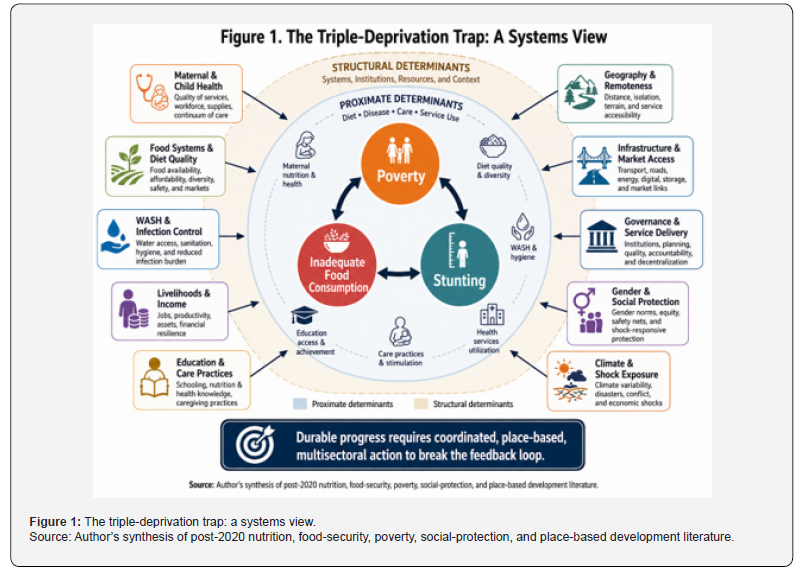
Figure 1 presents the conceptual model used in this review. It locates poverty, inadequate food consumption, and stunting inside a wider set of maternal, health, WASH, food-system, geographic, institutional, educational, gender, climate, and conflict drivers. The model is deliberately circular because a successful intervention can enter through several points, but durable change requires enough complementary pathways to break the feedback loop.
Figure 1 highlights a critical distinction between proximate and structural causes. Nutritional counseling, supplements, and treatment address proximate risks, while income, markets, water systems, transport, education, and accountable institutions shape whether households can act on that counseling. Conversely, infrastructure and income growth may fail to improve child growth when maternal care, feeding quality, infection control, and service use remain weak. Holistic policy is not an argument for doing everything everywhere at once; it is an argument for identifying each district’s binding constraints and sequencing a sufficiently complete package around them.
A place-based approach begins from the proposition that development constraints and institutional capacity vary geographically. Rather than applying identical program intensity, it differentiates objectives, delivery models, costs, and timelines according to local burden, terrain, settlement patterns, markets, culture, and state capacity. Multisectoral convergence provides the complementary principle. Convergence does not mean that every agency attends the same meeting; it means that households and villages receive synchronized interventions, budgets are mapped to shared bottlenecks, and success is measured through joint outcomes. Indonesian district studies show that leadership, local regulation, data use, cross-sector coordination, frontline capacity, and community participation differentiate stronger and weaker stunting-reduction performance [18,44,45].
Method
Review design and evidence identification
This study uses a qualitative literature review, also described as an integrative or narrative review, rather than a systematic literature review. The purpose is interpretive synthesis: to connect heterogeneous evidence on nutrition, food systems, poverty, social protection, infrastructure, local governance, and territorial development around a clearly defined policy problem. It does not claim exhaustive coverage, does not apply a PRISMA selection flow, and does not pool effect sizes. This design is appropriate because the research question spans multiple disciplines, intervention types, outcome measures, and study designs that cannot be meaningfully reduced to a single meta-analytic estimate.
Evidence was identified iteratively through scholarly search engines, PubMed, DOAJ, journal and publisher platforms, citation chaining, and targeted searches for Indonesia, lagging or remote districts, stunting, undernutrition, food insecurity, dietary diversity, poverty dynamics, Village Funds, social protection, roads, health insurance, and multisectoral convergence. Priority was given to peer-reviewed journal articles published from 2020 through July 2026, with emphasis on nationally representative Indonesian studies, district implementation research, high-quality reviews, and comparative evidence relevant to low- and middle-income countries. More than fifty peer-reviewed articles are included in the final synthesis. Official BPS, Ministry of Health, and Ministry of Villages sources are used for current indicators and policy context but are not counted toward the journal-article minimum.
Studies were selected purposively for conceptual relevance, methodological credibility, recency, and capacity to explain either causal pathways, intervention performance, or implementation conditions. Quantitative observational studies were used to identify associations and disparities; quasi-experimental and panel studies informed judgments about program effects; qualitative studies illuminated governance, acceptability, and delivery barriers; and reviews provided broader evidence on integrated nutrition and cash-plus interventions. No individual study was treated as decisive, and claims were calibrated to design strength.
Primary diagnostic inputs and descriptive analysis
The panel data constitute the primary empirical diagnostic. Their district values were transcribed for all 30 districts and checked for internal consistency. Descriptive calculations include means, ranges, ratios to national benchmarks, simple Pearson correlations, standardized scores, and an unweighted composite used only for visualization and typology. The composite is not proposed as an official index and does not imply that poverty, inadequate food consumption, and stunting have identical welfare weights.
The analysis respects the different reference years. Poverty and inadequate food consumption refer to 2025, while stunting refers to SSGI 2024. National comparisons use the September 2025 poverty estimate, the 2025 food-consumption benchmark shown in the data material and BPS table, and the 2024 SSGI stunting estimate. Because the district data are cross-sectional and partly asynchronous, correlations are interpreted as descriptive co-location rather than causal effects.
Thematic synthesis and limitations
The literature was coded into six broad themes: determinants and pathways; nutrition-specific interventions; food-system and diet interventions; poverty, social protection, and livelihoods; infrastructure and last-mile service access; and governance, finance, data, and accountability. A second-stage synthesis compared evidence across themes to identify recurrent complementarities, implementation failures, and conditions for success. The resulting policy design was then stress-tested against the district diagnostic: each proposed pillar had to address a documented pathway, an observed burden, or a recurrent delivery constraint.
The review has four limitations. First, it is purposive rather than exhaustive and may underrepresent relevant Indonesian-language or unpublished implementation evidence. Second, district averages hide village, gender, age, Indigenous, disability, and livelihood heterogeneity. Third, the indicators use different reference years and methodologies, so their joint interpretation is diagnostic rather than causal. Fourth, much peer-reviewed Indonesian evidence comes from more accessible provinces; transferring findings to remote Papuan districts requires local validation, cultural adaptation, conflict sensitivity, and implementation learning. These limitations reinforce the case for district-specific diagnosis and adaptive policy.
Results
A concentrated and uneven triple burden
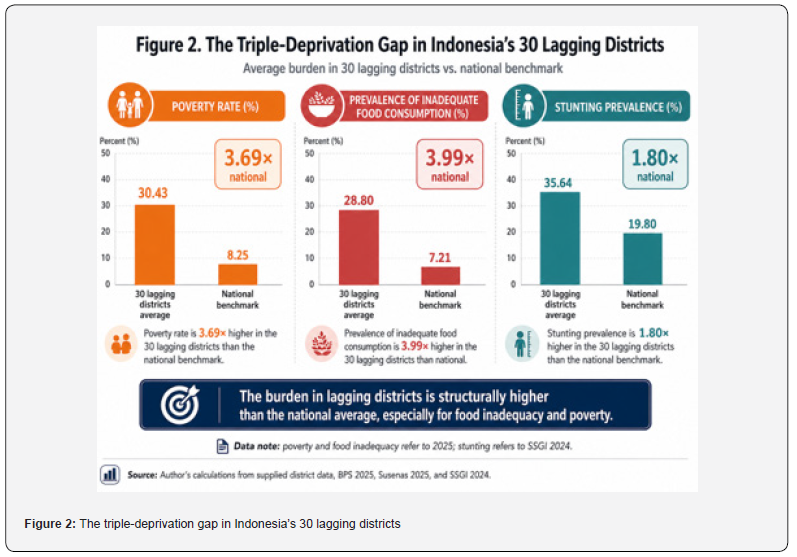
Figure 2 compares the mean burden across the 30 districts with the national benchmarks. The gap is largest for inadequate food consumption, closely followed by poverty, while stunting remains nearly twice the national level. The juxtaposition shows that the policy challenge is not a small residual problem at the margin of national success; it is a structurally different development regime requiring higher intensity, longer timelines, and different delivery assumptions.
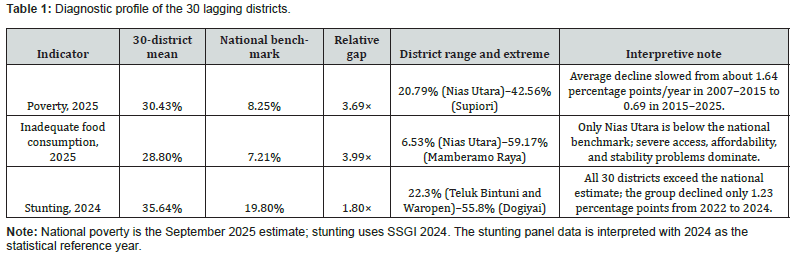
Figure 2 clarifies why a national-average allocation formula is inadequate. A district group with poverty at 30.43% and food inadequacy at 28.80% requires far more than proportional expansion of standard services. It faces large numbers of households with overlapping constraints and high unit costs of reaching them. The burden ratios—3.69 times national poverty, 3.99 times national food inadequacy, and 1.80 times national stunting—support an explicit equalization principle in intergovernmental finance and program design (Table 1).
The district pattern is highly heterogeneous. Mamberamo Raya has the highest inadequate food consumption at 59.17% but below-mean stunting within this district group, while Dogiyai records the highest stunting at 55.8% but poverty slightly below the group mean. Supiori combines the highest poverty with high food inadequacy and stunting. These contrasts show why ranking districts on a single indicator can misdirect resources: a food-logistics emergency, a maternal-child nutrition emergency, and a livelihood or fiscal-capacity problem require overlapping but different operational packages.
Figure 3 plots poverty against food inadequacy and scales each district marker by stunting prevalence. The upper-right quadrant identifies districts where income and food-access constraints coincide, while large bubbles identify additional child-growth urgency. The absence of a perfect line is analytically useful: it reveals different combinations of proximate and structural constraints rather than weakening the case for integration.
Six districts—Pegunungan Arfak, Supiori, Intan Jaya, Puncak, Mamberamo Tengah, and Yahukimo—are above the 30-district mean on all three indicators. Dogiyai and Tolikara have especially high food inadequacy and stunting even though poverty is below the group mean, while Mamberamo Raya, Deiyai, and Paniai show extreme food inadequacy and poverty with stunting below the group mean. These are not arguments for reducing attention to the lower indicator; they are signals about the likely binding constraints and the order in which interventions should be intensified.
Simple district-level correlations further illustrate the need for caution. Poverty and food inadequacy are moderately correlated at approximately 0.51, while poverty–stunting and food inadequacy–stunting correlations are lower, at about 0.23 and 0.18. These patterns do not refute documented household pathways. District averages aggregate different histories, age cohorts, ecological contexts, service systems, and lagged effects. Stunting in 2024 reflects exposure over preceding years, whereas 2025 poverty and food indicators capture more recent conditions.
What has been done on stunting—and what the results imply
Indonesia has strengthened stunting policy through national targets, district convergence actions, village-level prioritization, Posyandu revitalization, maternal and child health services, supplementation, behavior-change communication, sanitation programs, and the use of Village Funds. The national decline to 19.8% by 2024 indicates meaningful aggregate progress, but the 30 lagging districts declined from an average of 36.87% in 2022 to 35.64% in 2024—1.23 percentage points compared with a national decline of 1.8 percentage points. The slower reduction suggests that the existing policy mix is directionally correct but insufficiently adapted to high-cost and low-capacity environments.
Evidence on district convergence is consistent with that interpretation. Qualitative studies in West Sumatra and Pidie identify political commitment, local regulation, planning, interagency coordination, data use, frontline workers, and community engagement as important facilitators. They also document fragmented responsibilities, variable technical capacity, incomplete village coverage, weak monitoring, and uneven understanding of convergence [18,44]. Convergence can become a compliance exercise unless it changes who receives what service, when, and with what follow-up.
Village financing can contribute when paired with administrative capacity and appropriate uses. Panel evidence indicates that Village Funds were associated with lower stunting, particularly outside Java, but effects depend on the ability of village governments to allocate, implement, and monitor relevant activities [16]. The lesson for lagging districts is not simply to earmark more village money for nutrition. It is to provide technical packages, procurement support, remote-area cost norms, supervision, and transparent outcome tracking so that spending produces functioning services rather than isolated activities.
The recent literature also supports better targeting within the maternal-child continuum. National and local analyses repeatedly identify low birth size, maternal and child undernutrition, poor feeding, low education, infection, and sanitation as risks, but their relative prevalence differs. Policy should use village-level case finding and risk stratification: adolescent girls with anemia, women with chronic energy deficiency, high-risk pregnancies, low-birth-weight infants, growth faltering, incomplete immunization, poor complementary feeding, and unsafe water each require specific follow-up. Standard counseling without the foods, transport, tests, staff, or referral capacity needed to act on it will have limited effect [12,46].
Service contact must also be distinguished from service quality. Recording attendance at Posyandu or antenatal care does not ensure accurate anthropometry, respectful counseling, supply availability, clinical action, referral completion, or home follow-up. Remote districts need workforce retention packages, mobile and outreach teams, tele-support where connectivity permits, reliable transport and cold chains, and quality-assurance systems that focus on completed care pathways. Human-resource policy is therefore part of stunting policy.
Food-security and food-system interventions
Indonesia’s food response includes social assistance, subsidized or noncash food support, stabilization measures, agricultural production programs, local food initiatives, fisheries, school and maternal-child feeding, and food-security monitoring. These instruments can protect consumption, but their effects depend on whether nutritious foods are physically available. In a remote district with thin markets, increasing purchasing power can raise prices or shift demand toward processed foods if supply and logistics do not respond. Cash and food support must therefore be coordinated with local procurement, transport, storage, market competition, and nutrition standards.
Evidence on social capital and local systems suggests that community institutions can improve resilience. National household analysis associates bonding and bridging social capital with food security, while qualitative studies show how reciprocal exchange, customary institutions, and shared resource management help rural households manage shocks [29,47]. Social capital, however, should not be romanticized as a substitute for public services. Communities cannot compensate indefinitely for missing roads, unaffordable fuel, absent health staff, or failing water systems; policy should use local institutions as partners with resources and authority.
Local food diversification is promising when it is nutrition-led and market-aware. West Papuan research supports protecting forest and Indigenous food resources, while evidence on protein adequacy indicates the need to improve access to diverse protein sources [28,31]. District food plans should map seasonal nutrient supply, prices, production potential, cultural preferences, and environmental limits. Priorities may include small livestock, eggs, fish, legumes, sago, tubers, fruits, vegetables, and fortified staples, but the appropriate mix must be locally determined and supported by veterinary services, inputs, storage, food safety, and stable demand.
Public procurement can create that demand. Health facilities, early-childhood centers, schools, and social-assistance programs can purchase from qualified local producer groups when supply, quality, and accountability conditions are met. This can connect nutrition spending with livelihoods, reduce transport exposure, and increase the availability of fresh foods. Yet procurement rules must avoid elite capture and unreliable delivery. Producer aggregation, transparent contracts, price information, staged quality requirements, and independent grievance mechanisms are needed to make local procurement both inclusive and dependable.
The highest food-inadequacy districts require an emergency-plus-transformation model. Immediate measures should prevent hunger and negative coping through reliable transfers, nutrition-sensitive food baskets, supplementary feeding for identified risks, and shock-responsive logistics. Simultaneously, medium-term investment should reduce delivered food costs through transport, storage, renewable energy for cold chains, market facilities, communications, and local production. Emergency assistance without transformation creates permanent dependence; transformation without immediate protection leaves children exposed during the years required for markets and production to develop.
Poverty reduction, social protection, and productive inclusion
Indonesia’s poverty programs have expanded substantially, but the literature identifies persistent problems of targeting, program fragmentation, benefit adequacy, graduation, and coordination. A national review of poverty-eradication programs calls for stronger integration and reform, while poverty-dynamics studies show that households face different risks and trajectories [36,48]. In lagging districts, registries may be less accurate because of mobility, weak civil registration, difficult enumeration, and rapid household change. Static targeting is therefore especially problematic.
A dynamic, geocoded social registry should be linked to active outreach and community validation. The goal is not to replace statistical targeting with discretionary selection, but to combine interoperable administrative data with transparent local correction, appeals, and frequent updating. Particular attention is required for pregnant women, children under two, people with disabilities, isolated Indigenous communities, displaced households, and families exposed to conflict or disaster. Targeting accuracy is a service-delivery function, not merely a database attribute.
Cash-plus design is especially relevant. Cash protects choice and consumption, but households cannot purchase what is absent, travel when transport is unavailable, or obtain care from an unstaffed facility. A lagging-district package should combine predictable cash or food entitlements with transport support, nutrition and care services, WASH access, livelihood coaching, childcare, and productive assets where feasible. Global evidence suggests that complementary services can improve outcomes, while Indonesian food-security research indicates that government assistance can be decisive during shocks [34,40].
Productive inclusion should focus on viable economic pathways rather than uniform entrepreneurship. Options differ across fisheries, agroforestry, livestock, tourism, construction, public works, transport, crafts, digital services, and public procurement. The state’s role is to reduce fixed costs of participation through infrastructure, finance, extension, training, market information, certification, and buyer connections. Village-owned enterprises and cooperatives can help, but only when governance and business models are credible; creating an entity is not equivalent to creating a market or [26,38].
Health protection also prevents impoverishment. JKN membership can reduce out-of-pocket expenditure among vulnerable populations, yet effective financial protection requires accessible providers and transport. Remote households may be insured on paper while facing prohibitive nonmedical costs and referral delays [49]. District poverty strategies should therefore include patient transport, referral accommodation, mobile services, and provider availability as components of social protection.
Cross-cutting implementation barriers and success factors
Five recurrent barriers emerge from the evidence. The first is fragmentation: ministries and local agencies plan against separate output indicators, use different beneficiary lists, and operate on unsynchronized calendars. The second is last-mile weakness: staff, commodities, maintenance, transport, and supervision become unreliable precisely where needs are highest. The third is thin or distorted markets, which make nutritious food, construction, and service delivery expensive. The fourth is administrative overload, as low-capacity governments face complex planning, procurement, reporting, and data demands. The fifth is contextual mismatch, including insufficient adaptation to language, culture, Indigenous institutions, terrain, climate, and security conditions.
The evidence also identifies consistent success factors. Strong local leadership matters when it creates shared priorities and protects implementation continuity, but leadership must be institutionalized through regulations, budgets, technical teams, and public reporting. Frontline workers need manageable caseloads, competencies, supplies, supervision, and incentives. Communities need meaningful roles in diagnosis, delivery, and monitoring, not ceremonial participation. Data must support action at household and village levels rather than simply flow upward for reporting [18,45].
Complementarity is another success factor. Nutrition education becomes more effective when families can access nutritious food; cash becomes more effective when markets function; roads become more effective when transport services and value chains develop; Village Funds become more effective when administrative capacity improves; and insurance becomes more effective when providers exist. This pattern recurs across global and Indonesian evidence and is the strongest justification for an integrated district compact [7,16,40].
Finally, adaptation must be continuous. Climate variability, commodity prices, migration, conflict, epidemics, and administrative restructuring can quickly invalidate plans. Indonesia’s emerging adaptive social-protection literature emphasizes the relevance of combining formal systems with local networks and climate-risk information [15]. Lagging districts need contingency finance, pre-agreed delivery options, redundancy in food and medical supply chains, and rapid household-registry updates.
Results
Discussion and Analysi
Why sector-by-sector responses underperform
The main analytical conclusion is that sectoral programs underperform when the outcome depends on complements outside their control. A health office can provide nutrition counseling but cannot lower food prices, repair a road, or generate income. An agriculture office can increase production but cannot ensure that young children consume nutrient-dense foods or that mothers have time and knowledge for appropriate feeding. A social agency can transfer cash but cannot guarantee market supply, safe water, or clinic quality. Each institution can meet its output target while the household remains trapped.
This is a coordination failure intensified by territorial disadvantage. The value of one intervention rises when another is present, but budgets, accountability, and timelines remain separated. The solution is not to dissolve sectoral expertise into a single bureaucracy. It is to create a binding coordination instrument that specifies a small number of shared outcomes, maps each district’s bottlenecks, aligns financing, identifies named delivery responsibilities, and reviews household-level coverage gaps. Integration should occur at the level of strategy, geography, and beneficiary experience while technical standards remain sector-specific.
The slowdown in poverty reduction after 2015 and the slower stunting decline in the 30 districts illustrate a last-mile transformation problem. Early national gains can be achieved by expanding programs to accessible populations; later gains require reaching smaller, dispersed, and more complex groups. Marginal costs rise, standard delivery becomes less reliable, and institutional quality matters more. Continuing to allocate resources primarily by population size can therefore widen effective access gaps even when nominal per-capita spending appears equal [3,39].
A differentiated district typology
A useful strategy must differentiate districts without creating rigid labels. Table 2 presents an illustrative typology based on the panel data indicators, within-group means, and literature on likely binding constraints. It is not a substitute for village-level assessment and should be revised annually. Its purpose is to organize policy emphasis while maintaining a common minimum package.

Type A districts need the broadest package because no single entry point is likely to be sufficient. Type B districts require immediate diet and child-nutrition measures combined with supply and logistics. Type C districts need poverty and food-access transformation while preserving maternal-child services so stunting does not rise. Type D districts require deeper investigation of prenatal conditions, feeding, infection, WASH, and service quality. Type E districts should not be deprioritized; their nationally high burdens and potentially greater implementation feasibility make them important places to consolidate gains and generate transferable learning.
The typology also guards against interpreting a relatively lower district value as acceptable. Teluk Bintuni and Waropen have the lowest stunting in the group at 22.3%, yet that remains above the national estimate. Nias Utara’s food inadequacy is below the national benchmark, but its poverty and stunting remain high. Every district therefore needs the common platform, while marginal allocation and sequencing should respond to its profile.
The Integrated District Acceleration Compact
This article proposes an Integrated District Acceleration Compact (IDAC) as the central governance instrument. The Compact would be a multi-year agreement among the national government, province, district, villages, service providers, community institutions, and development partners. It would not replace existing programs. It would align them around a district diagnosis, a geocoded household and service map, a small set of shared outcomes, a pooled or coordinated performance budget, and quarterly public problem-solving reviews.
Figure 4 summarizes the proposed architecture. Seven substantive pillars feed into a common delivery platform, which must improve household capabilities, service and market conditions, and institutional capability. Outcomes are sequenced because immediate coverage and reliability improvements should precede changes in diet, infection, and income security, which in turn precede sustained reductions in stunting, food inadequacy, and poverty.
The first pillar is the maternal-child nutrition and health continuum. It includes adolescent nutrition and anemia control, preconception care, maternal nutrition, quality antenatal care, skilled birth and newborn services, early breastfeeding, appropriate complementary feeding, immunization, infection treatment, growth monitoring, developmental support, and referral. A named case-management function should follow high-risk mothers and children across services. The key performance measure is not the number of sessions delivered but the proportion of eligible households receiving the complete, timely package.
The second pillar is an affordable and diverse local food system. Each district should maintain a seasonal food-and-nutrient map, monitor the delivered prices of a small nutritious food basket, support environmentally appropriate local production, and use transparent public procurement to create demand. Food assistance should meet nutrition standards and adapt to local preferences. In food-emergency districts, a logistics cell should track stocks, transport disruption, market concentration, and price spikes in real time.
The third pillar combines social protection with productive inclusion. Pregnant women, children under two, and chronically poor households should receive predictable benefits sufficient to protect essential consumption. The plus may include transport vouchers, childcare, nutrition services, WASH connections, livelihood coaching, savings, insurance facilitation, and productive assets linked to viable markets. Graduation should be based on resilience and capability, not arbitrary time limits. Public works can create income while building feeder paths, water systems, terraces, market facilities, and climate-resilient community assets.
The fourth and fifth pillars address WASH, primary healthcare, and spatial connectivity. Minimum service packages should include safe water quality, sanitation use and maintenance, handwashing, waste management, staffed primary care, essential commodities, outreach, patient transport, and referral reliability. Connectivity investment should be selected through a service-access lens: which road, bridge, dock, airstrip, communications link, or renewable-energy system most reduces the time and cost of reaching food, health, education, and livelihood opportunities? Infrastructure should be funded with maintenance and service operation from the start.
The sixth pillar is convergent governance, finance, and data. The district head should chair a compact board with a professional delivery unit responsible for bottleneck analysis, budget mapping, implementation support, and public dashboards. Village plans should be nested within the district compact, while national ministries provide standards, technical assistance, and equalization finance. A single household identifier and geocoded service registry should allow authorized frontline teams to see which households are missing which components, with strong privacy, consent, role-based access, and grievance safeguards.
The seventh pillar is climate, conflict, and cultural adaptation. Plans should identify seasonal isolation, drought, floods, landslides, crop or fishery risks, insecurity, and displacement. Alternative supply routes, pre-positioned stocks, contingency cash, mobile services, and remote supervision should be agreed before shocks. Indigenous leaders, women’s groups, youth, disability organizations, and local health and food practitioners should participate in design. Cultural adaptation is not an optional communication layer; it shapes trust, diet, caregiving, land use, and implementation feasibility (Table 3).
Financing, accountability, and data architecture
The Compact requires financing reform because current allocations often fail to reflect the cost of remoteness. A national equalization window should combine population, burden, service deficit, geographic cost, and implementation-capacity criteria. High-cost districts need predictable multi-year envelopes rather than a succession of short projects. Greater resources must be accompanied by procurement support, independent audit, community monitoring, and transparent unit-cost benchmarks to reduce leakage and avoid normalizing inefficiency.
A portion of finance should be linked to verified improvements in coverage and service reliability, not only final outcomes. Stunting and poverty change slowly and are influenced by factors beyond annual district control. Performance measures should therefore include complete antenatal care, anemia treatment, low-birth-weight follow-up, minimum dietary diversity, water-system functionality, referral completion, social-protection payment reliability, road passability, stock-out days, and grievance resolution. Final outcomes remain essential, but intermediate indicators create actionable accountability.
Data integration should solve operational questions. Which pregnant women missed antenatal care? Which children show growth faltering? Which villages have the highest nutritious-food prices? Which water systems are not functioning? Which households receive cash but lack market access or safe water? A district data platform should combine civil registration, social protection, health, nutrition, WASH, education, market, and infrastructure data at appropriate levels. Interoperability should minimize repeated enumeration while protecting privacy and preventing stigmatizing public disclosure.
Quarterly review should be public and problem-centered. Rather than presenting aggregate expenditure, each review should select a small number of bottlenecks, assign corrective actions, and track completion. Community scorecards, beneficiary feedback, and independent verification should complement administrative reporting. This approach addresses the constitutive problem identified in social-transfer research: people should not become passive objects of a targeting system; they should be able to contest errors and shape service improvement [42].
Sequencing, monitoring, and policy recommendations
Implementation should be sequenced over three horizons. In the first 24 months, the priority is to prevent irreversible harm and restore reliability: identify high-risk mothers and children, stabilize nutritious-food access, ensure predictable benefits, repair critical water and health-service failures, establish transport and referral support, update registries, and create the delivery unit. Quick wins should be chosen for their effect on trust and service continuity rather than visibility alone [43-50].
Over years two to five, the Compact should deepen food-system, livelihood, workforce, and infrastructure transformation. Producer groups, local procurement, storage, energy, roads, digital systems, and enterprise support require time to mature. Health and nutrition quality improvement should institutionalize supervision and referral pathways. WASH systems should shift from construction counts to functionality, water quality, and sustained use. Social protection should become shock-responsive and link eligible households to viable economic opportunities [51-58].
Over five to ten years, the objective is structural convergence: sustained reductions in poverty, food inadequacy, stunting, child-development gaps, and spatial service deficits. Success should include resilience to shocks and lower dependence on emergency logistics. This horizon recognizes that changing human capital, markets, infrastructure, and institutions in remote districts cannot be compressed into one budget cycle. Long timelines, however, should not excuse slow delivery of immediate entitlements (Table 4).
A learning agenda should accompany implementation. Districts should test alternative outreach models, transport subsidies, food baskets, local procurement arrangements, workforce incentives, digital tools, and community-accountability mechanisms using phased or quasi-experimental designs where ethical and feasible. Evidence should be shared through a structured cross-district learning network. The objective is not to impose one best practice but to identify which delivery models work for which geographic and institutional conditions.
Ten policy actions follow. The national government should establish a dedicated lagging-district acceleration window with explicit remoteness adjustment; districts should complete village-level triple-deprivation and service-readiness maps; high-risk mothers and children should receive a complete case-managed package; social assistance should become cash-plus in the highest-burden villages; food policy should track a nutritious-basket price and use transparent local procurement; infrastructure should be selected by its effect on service and market access time; district delivery units should manage interoperability and bottleneck resolution; performance finance should reward complete coverage and reliability; adaptive social protection should be embedded in routine plans; and independent evaluation should continuously refine the model.
Conclusion
Indonesia’s 30 lagging districts face a development challenge that is qualitatively different from the national average. Their mean poverty and inadequate-food-consumption rates are nearly four times the national benchmarks, and their mean stunting rate remains almost twice the national estimate. Poverty reduction has slowed, food inadequacy is nearly universal relative to the national threshold, and stunting decline lags the national pace. These patterns are not explained by a single deficit and cannot be eliminated through a single ministry or program.
The qualitative literature review shows that stunting is cumulative and multi-level, food security depends on affordability, diversity, stability, and local systems, and poverty is dynamic and spatially embedded. Existing Indonesian interventions have produced important gains: national stunting has declined, social protection has buffered consumption, Village Funds have supported poverty and stunting reduction in some settings, and infrastructure and health insurance improve access and financial protection. Yet results remain uneven because complementary services, markets, institutions, and delivery capacity are often missing.
The required shift is from program coexistence to territorial integration. The proposed Integrated District Acceleration Compact provides a practical structure: seven pillars, one district diagnosis, one interoperable delivery map, coordinated multi-year finance, case management for high-risk households, and public adaptive review. It combines urgent protection with long-term transformation and differentiates policy intensity according to district profiles.
The strategy is holistic but not indiscriminate. It does not require every intervention to receive equal emphasis everywhere. It requires each district to identify its binding constraints and assemble a sufficiently complete package to overcome them. In Dogiyai, the immediate emphasis may be maternal-child nutrition and food access; in Mamberamo Raya, logistics and affordability may dominate; in Supiori and the six triple-high districts, full-intensity action is necessary. Every package must remain locally validated and culturally legitimate.
Ending the triple-deprivation trap will require higher and more predictable resources, but money alone is not the decisive reform. The decisive reform is the capacity to convert resources into reliable, complementary experiences for households: nutritious food that is available and affordable, income that is secure and productive, water and health services that function, transport that connects, and institutions that learn and respond. Achieving that standard would not only reduce three indicators; it would expand the capabilities and life chances of communities that national averages have too often left behind. ior-change messages cannot compensate for unequal service environments and household resources [19-21]. Maternal education matters not only because it may improve feeding knowledge, but because it is associated with autonomy, health literacy, service navigation, and economic opportunity.The first 1,000 days remain the most important program window. Indonesian evidence links prenatal nutritional status, birth length, birth weight, maternal age, breastfeeding, complementary feeding, dietary diversity, and infections to later linear growth. In Central Java, birth length and socioeconomic status showed direct positive relationships with length-for-age, while maternal age, feeding history, and consumption of nutrient-poor drinks also mattered. In Sambas, prenatal and postnatal conditions jointly shaped stunting risk in infancy [10,11]. These findings support a continuum-of-care model beginning before pregnancy and extending through pregnancy, birth, breastfeeding, complementary feeding, immunization, infection management, and responsive caregiving.
Environmental pathways are equally important. Unsafe water, poor sanitation, inadequate hygiene, and repeated enteric infection can limit nutrient absorption and elevate growth-faltering risk even when food is available. Rural evidence from West Java associates unsafe drinking water and poor maternal hygiene with higher stunting risk, while other Indonesian studies link sanitation and household socioeconomic conditions to child growth [22,23]. Nutrition-sensitive services are therefore not optional complements; in high-burden districts they are part of the causal treatment.
Stunting policy must also recognize Indonesia’s double burden of malnutrition. Poor households may simultaneously contain a stunted child and an overweight mother because low-cost diets can be energy-dense but protein- and micronutrient-poor. Evidence from urban-poor settings shows the coexistence of maternal overweight and child stunting and links it to education, occupation, and household dietary patterns [24]. Consequently, nutritional improvement cannot be equated with greater calorie availability alone; policies must improve dietary quality and protect against both undernutrition and nutrition-related noncommunicable disease.
Food consumption inadequacy, food security, and diet quality
The prevalence of inadequate food consumption, often operationalized through the prevalence of undernourishment, estimates the share of the population whose habitual dietary energy consumption is insufficient. It is related to but narrower than food security. Food security includes availability, economic and physical access, utilization, and stability, while nutrition security additionally requires diet quality, care, health, sanitation, and the biological capacity to use nutrients. This distinction is crucial in lagging districts: increasing aggregate food production may leave household access, price, diversity, seasonality, and intrahousehold allocation unchanged.
Affordability is a central mechanism. Healthy diets cost more than energy-sufficient diets in most settings, and the gap is particularly consequential where transport, storage, and market density raise retail prices. Global evidence shows that many households can afford sufficient calories while remaining unable to afford nutritionally adequate diets [25]. In remote Indonesian districts, the relevant food-policy metric is therefore not only tonnes produced, but the delivered cost, seasonal availability, cultural acceptability, and nutrient density of foods available to pregnant women, adolescents, and young children.
Indonesia’s food-system transition has created both opportunities and risks. Participation in modern food markets can increase smallholder income and food security when farmers obtain stable demand, information, transport, and bargaining capacity. Yet rising income does not automatically improve diet diversity. Panel evidence from rural Indonesia found that household dietary diversity declined alongside agricultural production diversity even as incomes increased, illustrating how commercialization, changing preferences, and market structure can disconnect income growth from diet quality [26,27]. Livelihood development must therefore be connected to nutrition objectives rather than relying on a passive trickle-down pathway.
Local food systems and social institutions are particularly relevant in eastern Indonesia. Research in West Papua demonstrates that dietary transition, forest use, Indigenous foods, and food security are deeply interconnected. Replacing local staples and protein sources with costly, processed, or logistically fragile foods can reduce resilience and erode cultural assets. Qualitative research in rural communities similarly shows that food security depends on social capital, customary norms, shared labor, local ecosystems, and adaptive practices [28-30]. A holistic strategy should strengthen, not displace, locally valued food systems while addressing nutritional gaps and food-safety constraints.
Diet quality also depends on the diversity and quality of protein. Indonesian dietary data indicate socioeconomic differences in access to diverse animal and plant protein sources and in essential amino-acid adequacy. District-level linear programming for stunting-priority areas has identified problem nutrients that cannot be solved by generic food baskets without attention to local food patterns and cost [31,32]. Nutrition-sensitive food policy should prioritize affordable eggs, fish, legumes, dairy where feasible, fortified foods where justified, and diverse local sources rather than a one-size-fits-all commodity package.
Food insecurity is also shaped by shocks. Fishing households in eastern Indonesia use coping and adaptation strategies when catches, prices, weather, and access fluctuate, but repeated shocks can deplete assets and reduce food quality. During COVID-19, social assistance helped protect food security, while global evidence showed that income loss and supply disruption magnified malnutrition risks [33-35]. Climate, disaster, conflict, and market-shock responsiveness must therefore be embedded in routine food and social-protection systems rather than activated only after crisis conditions become visible.
Poverty dynamics and spatial poverty traps
Poverty in lagging districts should not be treated as a static headcount. Households move into and out of poverty due to prices, illness, disasters, employment, agricultural cycles, family events, and public transfers. Indonesian studies distinguish chronic poverty from transient poverty and show that their determinants and policy remedies differ. Chronic poverty requires structural changes in assets, capabilities, infrastructure, and opportunity, whereas transient poverty calls for shock-responsive protection that prevents temporary losses from becoming permanent deprivation [36,37].
Spatial concentration creates additional persistence. District-level evidence suggests some poverty convergence across Indonesia, but spatial clustering and West–East disparities remain. Geographic isolation raises the price of food and construction materials, reduces competition, limits labor-market depth, and weakens access to schools, health services, banking, and administrative support [3,14]. Road connectivity can reduce rural inequality, yet roads alone are insufficient if they are seasonally impassable, disconnected from transport services, or not accompanied by markets, cold chains, digital connectivity, and maintenance institutions [13].
Fiscal decentralization and village finance have expanded local resources, but results vary with administrative capacity and expenditure quality. Village Fund studies associate the program with lower rural poverty, higher consumption among poor households, and greater female labor-force participation, while other evidence shows that village-owned enterprises do not automatically create employment when governance, business models, and market connections are weak [17,38]. Fiscal efficiency appears more strongly related to poverty reduction where capital expenditure is productive and institutions can convert budgets into reliable services [39].
Social protection is indispensable but not self-sufficient. Cash transfers can stabilize consumption, protect schooling and healthcare, and reduce negative coping, but average nutritional effects are modest when food, health, water, and care services are unavailable or unaffordable. Reviews find that cash-plus packages can outperform cash alone in some contexts, particularly when combined with food, primary healthcare, nutrition behavior change, or livelihood support, although effects vary by design and delivery quality [40,41]. Indonesian evidence also warns that outdated registries, exclusion and inclusion errors, and the politics of targeting can undermine legitimacy and reach [42].
Economic inclusion is therefore essential. Micro, small, and medium enterprises can reduce poverty through employment and income, but their impact depends on scale, productivity, finance, infrastructure, and market access. Indonesian evidence suggests that small and medium enterprises have stronger poverty effects than survivalist microenterprises, which often reproduce low productivity and vulnerability [43]. In lagging districts, livelihood policy should move beyond distributing equipment toward building complete value chains, producer organizations, procurement demand, extension, storage, transport, and risk management.
The triple-deprivation nexus and a place-based foundation
The three outcomes form a recursive system rather than a simple linear chain. Poverty reduces access to food, care, water, sanitation, transport, and information. Food inadequacy increases susceptibility to illness and constrains maternal and child nutrition. Stunting and recurrent illness can reduce developmental potential and later productivity, feeding back into poverty. At the territorial level, weak governance, remoteness, climate exposure, and thin markets intensify each pathway. The same household may receive a cash transfer, live near an intermittently functioning health post, face unaffordable protein prices, and use unsafe water; each intervention is individually relevant, yet the combined outcome remains poor because critical complements are missing.
Figure 1 presents the conceptual model used in this review. It locates poverty, inadequate food consumption, and stunting inside a wider set of maternal, health, WASH, food-system, geographic, institutional, educational, gender, climate, and conflict drivers. The model is deliberately circular because a successful intervention can enter through several points, but durable change requires enough complementary pathways to break the feedback loop.
Figure 1 highlights a critical distinction between proximate and structural causes. Nutritional counseling, supplements, and treatment address proximate risks, while income, markets, water systems, transport, education, and accountable institutions shape whether households can act on that counseling. Conversely, infrastructure and income growth may fail to improve child growth when maternal care, feeding quality, infection control, and service use remain weak. Holistic policy is not an argument for doing everything everywhere at once; it is an argument for identifying each district’s binding constraints and sequencing a sufficiently complete package around them.
A place-based approach begins from the proposition that development constraints and institutional capacity vary geographically. Rather than applying identical program intensity, it differentiates objectives, delivery models, costs, and timelines according to local burden, terrain, settlement patterns, markets, culture, and state capacity. Multisectoral convergence provides the complementary principle. Convergence does not mean that every agency attends the same meeting; it means that households and villages receive synchronized interventions, budgets are mapped to shared bottlenecks, and success is measured through joint outcomes. Indonesian district studies show that leadership, local regulation, data use, cross-sector coordination, frontline capacity, and community participation differentiate stronger and weaker stunting-reduction performance [18,44,45].
Method
Review design and evidence identification
This study uses a qualitative literature review, also described as an integrative or narrative review, rather than a systematic literature review. The purpose is interpretive synthesis: to connect heterogeneous evidence on nutrition, food systems, poverty, social protection, infrastructure, local governance, and territorial development around a clearly defined policy problem. It does not claim exhaustive coverage, does not apply a PRISMA selection flow, and does not pool effect sizes. This design is appropriate because the research question spans multiple disciplines, intervention types, outcome measures, and study designs that cannot be meaningfully reduced to a single meta-analytic estimate.
Evidence was identified iteratively through scholarly search engines, PubMed, DOAJ, journal and publisher platforms, citation chaining, and targeted searches for Indonesia, lagging or remote districts, stunting, undernutrition, food insecurity, dietary diversity, poverty dynamics, Village Funds, social protection, roads, health insurance, and multisectoral convergence. Priority was given to peer-reviewed journal articles published from 2020 through July 2026, with emphasis on nationally representative Indonesian studies, district implementation research, high-quality reviews, and comparative evidence relevant to low- and middle-income countries. More than fifty peer-reviewed articles are included in the final synthesis. Official BPS, Ministry of Health, and Ministry of Villages sources are used for current indicators and policy context but are not counted toward the journal-article minimum.
Studies were selected purposively for conceptual relevance, methodological credibility, recency, and capacity to explain either causal pathways, intervention performance, or implementation conditions. Quantitative observational studies were used to identify associations and disparities; quasi-experimental and panel studies informed judgments about program effects; qualitative studies illuminated governance, acceptability, and delivery barriers; and reviews provided broader evidence on integrated nutrition and cash-plus interventions. No individual study was treated as decisive, and claims were calibrated to design strength.
Primary diagnostic inputs and descriptive analysis
The panel data constitute the primary empirical diagnostic. Their district values were transcribed for all 30 districts and checked for internal consistency. Descriptive calculations include means, ranges, ratios to national benchmarks, simple Pearson correlations, standardized scores, and an unweighted composite used only for visualization and typology. The composite is not proposed as an official index and does not imply that poverty, inadequate food consumption, and stunting have identical welfare weights.
The analysis respects the different reference years. Poverty and inadequate food consumption refer to 2025, while stunting refers to SSGI 2024. National comparisons use the September 2025 poverty estimate, the 2025 food-consumption benchmark shown in the data material and BPS table, and the 2024 SSGI stunting estimate. Because the district data are cross-sectional and partly asynchronous, correlations are interpreted as descriptive co-location rather than causal effects.
Thematic synthesis and limitations
The literature was coded into six broad themes: determinants and pathways; nutrition-specific interventions; food-system and diet interventions; poverty, social protection, and livelihoods; infrastructure and last-mile service access; and governance, finance, data, and accountability. A second-stage synthesis compared evidence across themes to identify recurrent complementarities, implementation failures, and conditions for success. The resulting policy design was then stress-tested against the district diagnostic: each proposed pillar had to address a documented pathway, an observed burden, or a recurrent delivery constraint.
The review has four limitations. First, it is purposive rather than exhaustive and may underrepresent relevant Indonesian-language or unpublished implementation evidence. Second, district averages hide village, gender, age, Indigenous, disability, and livelihood heterogeneity. Third, the indicators use different reference years and methodologies, so their joint interpretation is diagnostic rather than causal. Fourth, much peer-reviewed Indonesian evidence comes from more accessible provinces; transferring findings to remote Papuan districts requires local validation, cultural adaptation, conflict sensitivity, and implementation learning. These limitations reinforce the case for district-specific diagnosis and adaptive policy.
Results
A concentrated and uneven triple burden
Figure 2 compares the mean burden across the 30 districts with the national benchmarks. The gap is largest for inadequate food consumption, closely followed by poverty, while stunting remains nearly twice the national level. The juxtaposition shows that the policy challenge is not a small residual problem at the margin of national success; it is a structurally different development regime requiring higher intensity, longer timelines, and different delivery assumptions.
Figure 2 clarifies why a national-average allocation formula is inadequate. A district group with poverty at 30.43% and food inadequacy at 28.80% requires far more than proportional expansion of standard services. It faces large numbers of households with overlapping constraints and high unit costs of reaching them. The burden ratios—3.69 times national poverty, 3.99 times national food inadequacy, and 1.80 times national stunting—support an explicit equalization principle in intergovernmental finance and program design (Table 1).
The district pattern is highly heterogeneous. Mamberamo Raya has the highest inadequate food consumption at 59.17% but below-mean stunting within this district group, while Dogiyai records the highest stunting at 55.8% but poverty slightly below the group mean. Supiori combines the highest poverty with high food inadequacy and stunting. These contrasts show why ranking districts on a single indicator can misdirect resources: a food-logistics emergency, a maternal-child nutrition emergency, and a livelihood or fiscal-capacity problem require overlapping but different operational packages.
Figure 3 plots poverty against food inadequacy and scales each district marker by stunting prevalence. The upper-right quadrant identifies districts where income and food-access constraints coincide, while large bubbles identify additional child-growth urgency. The absence of a perfect line is analytically useful: it reveals different combinations of proximate and structural constraints rather than weakening the case for integration.
Six districts—Pegunungan Arfak, Supiori, Intan Jaya, Puncak, Mamberamo Tengah, and Yahukimo—are above the 30-district mean on all three indicators. Dogiyai and Tolikara have especially high food inadequacy and stunting even though poverty is below the group mean, while Mamberamo Raya, Deiyai, and Paniai show extreme food inadequacy and poverty with stunting below the group mean. These are not arguments for reducing attention to the lower indicator; they are signals about the likely binding constraints and the order in which interventions should be intensified.
Simple district-level correlations further illustrate the need for caution. Poverty and food inadequacy are moderately correlated at approximately 0.51, while poverty–stunting and food inadequacy–stunting correlations are lower, at about 0.23 and 0.18. These patterns do not refute documented household pathways. District averages aggregate different histories, age cohorts, ecological contexts, service systems, and lagged effects. Stunting in 2024 reflects exposure over preceding years, whereas 2025 poverty and food indicators capture more recent conditions.
What has been done on stunting—and what the results imply
Indonesia has strengthened stunting policy through national targets, district convergence actions, village-level prioritization, Posyandu revitalization, maternal and child health services, supplementation, behavior-change communication, sanitation programs, and the use of Village Funds. The national decline to 19.8% by 2024 indicates meaningful aggregate progress, but the 30 lagging districts declined from an average of 36.87% in 2022 to 35.64% in 2024—1.23 percentage points compared with a national decline of 1.8 percentage points. The slower reduction suggests that the existing policy mix is directionally correct but insufficiently adapted to high-cost and low-capacity environments.
Evidence on district convergence is consistent with that interpretation. Qualitative studies in West Sumatra and Pidie identify political commitment, local regulation, planning, interagency coordination, data use, frontline workers, and community engagement as important facilitators. They also document fragmented responsibilities, variable technical capacity, incomplete village coverage, weak monitoring, and uneven understanding of convergence [18,44]. Convergence can become a compliance exercise unless it changes who receives what service, when, and with what follow-up.
Village financing can contribute when paired with administrative capacity and appropriate uses. Panel evidence indicates that Village Funds were associated with lower stunting, particularly outside Java, but effects depend on the ability of village governments to allocate, implement, and monitor relevant activities [16]. The lesson for lagging districts is not simply to earmark more village money for nutrition. It is to provide technical packages, procurement support, remote-area cost norms, supervision, and transparent outcome tracking so that spending produces functioning services rather than isolated activities.
The recent literature also supports better targeting within the maternal-child continuum. National and local analyses repeatedly identify low birth size, maternal and child undernutrition, poor feeding, low education, infection, and sanitation as risks, but their relative prevalence differs. Policy should use village-level case finding and risk stratification: adolescent girls with anemia, women with chronic energy deficiency, high-risk pregnancies, low-birth-weight infants, growth faltering, incomplete immunization, poor complementary feeding, and unsafe water each require specific follow-up. Standard counseling without the foods, transport, tests, staff, or referral capacity needed to act on it will have limited effect [12,46].
Service contact must also be distinguished from service quality. Recording attendance at Posyandu or antenatal care does not ensure accurate anthropometry, respectful counseling, supply availability, clinical action, referral completion, or home follow-up. Remote districts need workforce retention packages, mobile and outreach teams, tele-support where connectivity permits, reliable transport and cold chains, and quality-assurance systems that focus on completed care pathways. Human-resource policy is therefore part of stunting policy.
Food-security and food-system interventions
Indonesia’s food response includes social assistance, subsidized or noncash food support, stabilization measures, agricultural production programs, local food initiatives, fisheries, school and maternal-child feeding, and food-security monitoring. These instruments can protect consumption, but their effects depend on whether nutritious foods are physically available. In a remote district with thin markets, increasing purchasing power can raise prices or shift demand toward processed foods if supply and logistics do not respond. Cash and food support must therefore be coordinated with local procurement, transport, storage, market competition, and nutrition standards.
Evidence on social capital and local systems suggests that community institutions can improve resilience. National household analysis associates bonding and bridging social capital with food security, while qualitative studies show how reciprocal exchange, customary institutions, and shared resource management help rural households manage shocks [29,47]. Social capital, however, should not be romanticized as a substitute for public services. Communities cannot compensate indefinitely for missing roads, unaffordable fuel, absent health staff, or failing water systems; policy should use local institutions as partners with resources and authority.
Local food diversification is promising when it is nutrition-led and market-aware. West Papuan research supports protecting forest and Indigenous food resources, while evidence on protein adequacy indicates the need to improve access to diverse protein sources [28,31]. District food plans should map seasonal nutrient supply, prices, production potential, cultural preferences, and environmental limits. Priorities may include small livestock, eggs, fish, legumes, sago, tubers, fruits, vegetables, and fortified staples, but the appropriate mix must be locally determined and supported by veterinary services, inputs, storage, food safety, and stable demand.
Public procurement can create that demand. Health facilities, early-childhood centers, schools, and social-assistance programs can purchase from qualified local producer groups when supply, quality, and accountability conditions are met. This can connect nutrition spending with livelihoods, reduce transport exposure, and increase the availability of fresh foods. Yet procurement rules must avoid elite capture and unreliable delivery. Producer aggregation, transparent contracts, price information, staged quality requirements, and independent grievance mechanisms are needed to make local procurement both inclusive and dependable.
The highest food-inadequacy districts require an emergency-plus-transformation model. Immediate measures should prevent hunger and negative coping through reliable transfers, nutrition-sensitive food baskets, supplementary feeding for identified risks, and shock-responsive logistics. Simultaneously, medium-term investment should reduce delivered food costs through transport, storage, renewable energy for cold chains, market facilities, communications, and local production. Emergency assistance without transformation creates permanent dependence; transformation without immediate protection leaves children exposed during the years required for markets and production to develop.
Poverty reduction, social protection, and productive inclusion
Indonesia’s poverty programs have expanded substantially, but the literature identifies persistent problems of targeting, program fragmentation, benefit adequacy, graduation, and coordination. A national review of poverty-eradication programs calls for stronger integration and reform, while poverty-dynamics studies show that households face different risks and trajectories [36,48]. In lagging districts, registries may be less accurate because of mobility, weak civil registration, difficult enumeration, and rapid household change. Static targeting is therefore especially problematic.
A dynamic, geocoded social registry should be linked to active outreach and community validation. The goal is not to replace statistical targeting with discretionary selection, but to combine interoperable administrative data with transparent local correction, appeals, and frequent updating. Particular attention is required for pregnant women, children under two, people with disabilities, isolated Indigenous communities, displaced households, and families exposed to conflict or disaster. Targeting accuracy is a service-delivery function, not merely a database attribute.
Cash-plus design is especially relevant. Cash protects choice and consumption, but households cannot purchase what is absent, travel when transport is unavailable, or obtain care from an unstaffed facility. A lagging-district package should combine predictable cash or food entitlements with transport support, nutrition and care services, WASH access, livelihood coaching, childcare, and productive assets where feasible. Global evidence suggests that complementary services can improve outcomes, while Indonesian food-security research indicates that government assistance can be decisive during shocks [34,40].
Productive inclusion should focus on viable economic pathways rather than uniform entrepreneurship. Options differ across fisheries, agroforestry, livestock, tourism, construction, public works, transport, crafts, digital services, and public procurement. The state’s role is to reduce fixed costs of participation through infrastructure, finance, extension, training, market information, certification, and buyer connections. Village-owned enterprises and cooperatives can help, but only when governance and business models are credible; creating an entity is not equivalent to creating a market or [26,38].
Health protection also prevents impoverishment. JKN membership can reduce out-of-pocket expenditure among vulnerable populations, yet effective financial protection requires accessible providers and transport. Remote households may be insured on paper while facing prohibitive nonmedical costs and referral delays [49]. District poverty strategies should therefore include patient transport, referral accommodation, mobile services, and provider availability as components of social protection.
Cross-cutting implementation barriers and success factors
Five recurrent barriers emerge from the evidence. The first is fragmentation: ministries and local agencies plan against separate output indicators, use different beneficiary lists, and operate on unsynchronized calendars. The second is last-mile weakness: staff, commodities, maintenance, transport, and supervision become unreliable precisely where needs are highest. The third is thin or distorted markets, which make nutritious food, construction, and service delivery expensive. The fourth is administrative overload, as low-capacity governments face complex planning, procurement, reporting, and data demands. The fifth is contextual mismatch, including insufficient adaptation to language, culture, Indigenous institutions, terrain, climate, and security conditions.
The evidence also identifies consistent success factors. Strong local leadership matters when it creates shared priorities and protects implementation continuity, but leadership must be institutionalized through regulations, budgets, technical teams, and public reporting. Frontline workers need manageable caseloads, competencies, supplies, supervision, and incentives. Communities need meaningful roles in diagnosis, delivery, and monitoring, not ceremonial participation. Data must support action at household and village levels rather than simply flow upward for reporting [18,45].
Complementarity is another success factor. Nutrition education becomes more effective when families can access nutritious food; cash becomes more effective when markets function; roads become more effective when transport services and value chains develop; Village Funds become more effective when administrative capacity improves; and insurance becomes more effective when providers exist. This pattern recurs across global and Indonesian evidence and is the strongest justification for an integrated district compact [7,16,40].
Finally, adaptation must be continuous. Climate variability, commodity prices, migration, conflict, epidemics, and administrative restructuring can quickly invalidate plans. Indonesia’s emerging adaptive social-protection literature emphasizes the relevance of combining formal systems with local networks and climate-risk information [15]. Lagging districts need contingency finance, pre-agreed delivery options, redundancy in food and medical supply chains, and rapid household-registry updates.
Discussion and Analysi
Why sector-by-sector responses underperform
The main analytical conclusion is that sectoral programs underperform when the outcome depends on complements outside their control. A health office can provide nutrition counseling but cannot lower food prices, repair a road, or generate income. An agriculture office can increase production but cannot ensure that young children consume nutrient-dense foods or that mothers have time and knowledge for appropriate feeding. A social agency can transfer cash but cannot guarantee market supply, safe water, or clinic quality. Each institution can meet its output target while the household remains trapped.
This is a coordination failure intensified by territorial disadvantage. The value of one intervention rises when another is present, but budgets, accountability, and timelines remain separated. The solution is not to dissolve sectoral expertise into a single bureaucracy. It is to create a binding coordination instrument that specifies a small number of shared outcomes, maps each district’s bottlenecks, aligns financing, identifies named delivery responsibilities, and reviews household-level coverage gaps. Integration should occur at the level of strategy, geography, and beneficiary experience while technical standards remain sector-specific.
The slowdown in poverty reduction after 2015 and the slower stunting decline in the 30 districts illustrate a last-mile transformation problem. Early national gains can be achieved by expanding programs to accessible populations; later gains require reaching smaller, dispersed, and more complex groups. Marginal costs rise, standard delivery becomes less reliable, and institutional quality matters more. Continuing to allocate resources primarily by population size can therefore widen effective access gaps even when nominal per-capita spending appears equal [3,39].
A differentiated district typology
A useful strategy must differentiate districts without creating rigid labels. Table 2 presents an illustrative typology based on the panel data indicators, within-group means, and literature on likely binding constraints. It is not a substitute for village-level assessment and should be revised annually. Its purpose is to organize policy emphasis while maintaining a common minimum package.
Type A districts need the broadest package because no single entry point is likely to be sufficient. Type B districts require immediate diet and child-nutrition measures combined with supply and logistics. Type C districts need poverty and food-access transformation while preserving maternal-child services so stunting does not rise. Type D districts require deeper investigation of prenatal conditions, feeding, infection, WASH, and service quality. Type E districts should not be deprioritized; their nationally high burdens and potentially greater implementation feasibility make them important places to consolidate gains and generate transferable learning.
The typology also guards against interpreting a relatively lower district value as acceptable. Teluk Bintuni and Waropen have the lowest stunting in the group at 22.3%, yet that remains above the national estimate. Nias Utara’s food inadequacy is below the national benchmark, but its poverty and stunting remain high. Every district therefore needs the common platform, while marginal allocation and sequencing should respond to its profile.
The Integrated District Acceleration Compact
This article proposes an Integrated District Acceleration Compact (IDAC) as the central governance instrument. The Compact would be a multi-year agreement among the national government, province, district, villages, service providers, community institutions, and development partners. It would not replace existing programs. It would align them around a district diagnosis, a geocoded household and service map, a small set of shared outcomes, a pooled or coordinated performance budget, and quarterly public problem-solving reviews.
Figure 4 summarizes the proposed architecture. Seven substantive pillars feed into a common delivery platform, which must improve household capabilities, service and market conditions, and institutional capability. Outcomes are sequenced because immediate coverage and reliability improvements should precede changes in diet, infection, and income security, which in turn precede sustained reductions in stunting, food inadequacy, and poverty.
The first pillar is the maternal-child nutrition and health continuum. It includes adolescent nutrition and anemia control, preconception care, maternal nutrition, quality antenatal care, skilled birth and newborn services, early breastfeeding, appropriate complementary feeding, immunization, infection treatment, growth monitoring, developmental support, and referral. A named case-management function should follow high-risk mothers and children across services. The key performance measure is not the number of sessions delivered but the proportion of eligible households receiving the complete, timely package.
The second pillar is an affordable and diverse local food system. Each district should maintain a seasonal food-and-nutrient map, monitor the delivered prices of a small nutritious food basket, support environmentally appropriate local production, and use transparent public procurement to create demand. Food assistance should meet nutrition standards and adapt to local preferences. In food-emergency districts, a logistics cell should track stocks, transport disruption, market concentration, and price spikes in real time.
hhhhhhhhhhhhhhhhThe third pillar combines social protection with productive inclusion. Pregnant women, children under two, and chronically poor households should receive predictable benefits sufficient to protect essential consumption. The plus may include transport vouchers, childcare, nutrition services, WASH connections, livelihood coaching, savings, insurance facilitation, and productive assets linked to viable markets. Graduation should be based on resilience and capability, not arbitrary time limits. Public works can create income while building feeder paths, water systems, terraces, market facilities, and climate-resilient community assets.
The fourth and fifth pillars address WASH, primary healthcare, and spatial connectivity. Minimum service packages should include safe water quality, sanitation use and maintenance, handwashing, waste management, staffed primary care, essential commodities, outreach, patient transport, and referral reliability. Connectivity investment should be selected through a service-access lens: which road, bridge, dock, airstrip, communications link, or renewable-energy system most reduces the time and cost of reaching food, health, education, and livelihood opportunities? Infrastructure should be funded with maintenance and service operation from the start.
The sixth pillar is convergent governance, finance, and data. The district head should chair a compact board with a professional delivery unit responsible for bottleneck analysis, budget mapping, implementation support, and public dashboards. Village plans should be nested within the district compact, while national ministries provide standards, technical assistance, and equalization finance. A single household identifier and geocoded service registry should allow authorized frontline teams to see which households are missing which components, with strong privacy, consent, role-based access, and grievance safeguards.
The seventh pillar is climate, conflict, and cultural adaptation. Plans should identify seasonal isolation, drought, floods, landslides, crop or fishery risks, insecurity, and displacement. Alternative supply routes, pre-positioned stocks, contingency cash, mobile services, and remote supervision should be agreed before shocks. Indigenous leaders, women’s groups, youth, disability organizations, and local health and food practitioners should participate in design. Cultural adaptation is not an optional communication layer; it shapes trust, diet, caregiving, land use, and implementation feasibility (Table 3).
Financing, accountability, and data architecture
The Compact requires financing reform because current allocations often fail to reflect the cost of remoteness. A national equalization window should combine population, burden, service deficit, geographic cost, and implementation-capacity criteria. High-cost districts need predictable multi-year envelopes rather than a succession of short projects. Greater resources must be accompanied by procurement support, independent audit, community monitoring, and transparent unit-cost benchmarks to reduce leakage and avoid normalizing inefficiency.
A portion of finance should be linked to verified improvements in coverage and service reliability, not only final outcomes. Stunting and poverty change slowly and are influenced by factors beyond annual district control. Performance measures should therefore include complete antenatal care, anemia treatment, low-birth-weight follow-up, minimum dietary diversity, water-system functionality, referral completion, social-protection payment reliability, road passability, stock-out days, and grievance resolution. Final outcomes remain essential, but intermediate indicators create actionable accountability.
Data integration should solve operational questions. Which pregnant women missed antenatal care? Which children show growth faltering? Which villages have the highest nutritious-food prices? Which water systems are not functioning? Which households receive cash but lack market access or safe water? A district data platform should combine civil registration, social protection, health, nutrition, WASH, education, market, and infrastructure data at appropriate levels. Interoperability should minimize repeated enumeration while protecting privacy and preventing stigmatizing public disclosure.
Quarterly review should be public and problem-centered. Rather than presenting aggregate expenditure, each review should select a small number of bottlenecks, assign corrective actions, and track completion. Community scorecards, beneficiary feedback, and independent verification should complement administrative reporting. This approach addresses the constitutive problem identified in social-transfer research: people should not become passive objects of a targeting system; they should be able to contest errors and shape service improvement [42].
Sequencing, monitoring, and policy recommendations
Implementation should be sequenced over three horizons. In the first 24 months, the priority is to prevent irreversible harm and restore reliability: identify high-risk mothers and children, stabilize nutritious-food access, ensure predictable benefits, repair critical water and health-service failures, establish transport and referral support, update registries, and create the delivery unit. Quick wins should be chosen for their effect on trust and service continuity rather than visibility alone [43-50].
Over years two to five, the Compact should deepen food-system, livelihood, workforce, and infrastructure transformation. Producer groups, local procurement, storage, energy, roads, digital systems, and enterprise support require time to mature. Health and nutrition quality improvement should institutionalize supervision and referral pathways. WASH systems should shift from construction counts to functionality, water quality, and sustained use. Social protection should become shock-responsive and link eligible households to viable economic opportunities [51-58].
Over five to ten years, the objective is structural convergence: sustained reductions in poverty, food inadequacy, stunting, child-development gaps, and spatial service deficits. Success should include resilience to shocks and lower dependence on emergency logistics. This horizon recognizes that changing human capital, markets, infrastructure, and institutions in remote districts cannot be compressed into one budget cycle. Long timelines, however, should not excuse slow delivery of immediate entitlements (Table 4).
A learning agenda should accompany implementation. Districts should test alternative outreach models, transport subsidies, food baskets, local procurement arrangements, workforce incentives, digital tools, and community-accountability mechanisms using phased or quasi-experimental designs where ethical and feasible. Evidence should be shared through a structured cross-district learning network. The objective is not to impose one best practice but to identify which delivery models work for which geographic and institutional conditions.
Ten policy actions follow. The national government should establish a dedicated lagging-district acceleration window with explicit remoteness adjustment; districts should complete village-level triple-deprivation and service-readiness maps; high-risk mothers and children should receive a complete case-managed package; social assistance should become cash-plus in the highest-burden villages; food policy should track a nutritious-basket price and use transparent local procurement; infrastructure should be selected by its effect on service and market access time; district delivery units should manage interoperability and bottleneck resolution; performance finance should reward complete coverage and reliability; adaptive social protection should be embedded in routine plans; and independent evaluation should continuously refine the model.
Conclusion
Indonesia’s 30 lagging districts face a development challenge that is qualitatively different from the national average. Their mean poverty and inadequate-food-consumption rates are nearly four times the national benchmarks, and their mean stunting rate remains almost twice the national estimate. Poverty reduction has slowed, food inadequacy is nearly universal relative to the national threshold, and stunting decline lags the national pace. These patterns are not explained by a single deficit and cannot be eliminated through a single ministry or program.
The qualitative literature review shows that stunting is cumulative and multi-level, food security depends on affordability, diversity, stability, and local systems, and poverty is dynamic and spatially embedded. Existing Indonesian interventions have produced important gains: national stunting has declined, social protection has buffered consumption, Village Funds have supported poverty and stunting reduction in some settings, and infrastructure and health insurance improve access and financial protection. Yet results remain uneven because complementary services, markets, institutions, and delivery capacity are often missing.
The required shift is from program coexistence to territorial integration. The proposed Integrated District Acceleration Compact provides a practical structure: seven pillars, one district diagnosis, one interoperable delivery map, coordinated multi-year finance, case management for high-risk households, and public adaptive review. It combines urgent protection with long-term transformation and differentiates policy intensity according to district profiles.
The strategy is holistic but not indiscriminate. It does not require every intervention to receive equal emphasis everywhere. It requires each district to identify its binding constraints and assemble a sufficiently complete package to overcome them. In Dogiyai, the immediate emphasis may be maternal-child nutrition and food access; in Mamberamo Raya, logistics and affordability may dominate; in Supiori and the six triple-high districts, full-intensity action is necessary. Every package must remain locally validated and culturally legitimate.
Ending the triple-deprivation trap will require higher and more predictable resources, but money alone is not the decisive reform. The decisive reform is the capacity to convert resources into reliable, complementary experiences for households: nutritious food that is available and affordable, income that is secure and productive, water and health services that function, transport that connects, and institutions that learn and respond. Achieving that standard would not only reduce three indicators; it would expand the capabilities and life chances of communities that national averages have too often left behind.
References
- Vaivada Tyler, Nadia Akseer, Selai Akseer, Ahalya Somaskandan, Marianne Stefopulos, et al. (2020) Stunting in Childhood: An Overview of Global Burden, Trends, Determinants, and Drivers of Decline. American Journal of Clinical Nutrition 112(Supplement 2): 777S-791S.
- Victora, Cesar G, Parul Christian, Luis Paulo Vidaletti, Giovanna Gatica-Domínguez, et al. (2021) Revisiting Maternal and Child Undernutrition in Low-Income and Middle-Income Countries: Variable Progress towards an Unfinished Agenda. The Lancet 397(10282): 1388-1399.
- Miranti Ragdad Cani (2021) Is Regional Poverty Converging across Indonesian Districts? A Distribution Dynamics and Spatial Econometric Approach. Asia-Pacific Journal of Regional Science 5: 851-883.
- Statistics Indonesia (BPS) (2026a) Poverty Profile in Indonesia, September 2025. Official Statistics News.
- Statistics Indonesia (BPS) (2026b) Prevalence of Inadequate Food Consumption by Regency/City, 2025. Statistical Table.
- Ministry of Health, Republic of Indonesia (2025) SSGI 2024: National Stunting Prevalence Drops to 19.8%. Health Development Policy Agency.
- Heidkamp, Rebecca A, Ellen Piwoz, Stuart Gillespie, Emily C Keats, et al. (2021) Mobilising Evidence, Data, and Resources to Achieve Global Maternal and Child Undernutrition Targets and the Sustainable Development Goals: An Agenda for Action. The Lancet 397 (10282): 1400-1418.
- Keats Emily C, Jai K Das, Rehana A Salam, Zohra S Lassi, Aamer Imdad, et al. (2021) Effective Interventions to Address Maternal and Child Malnutrition: An Update of the Evidence. The Lancet Child & Adolescent Health 5(5): 367-384.
- Osendarp Saskia, Jonathan Kweku Akuoku, Robert E Black, Derek D Headey, Marie T Ruel, et al. (2021) The COVID-19 Crisis Will Exacerbate Maternal and Child Undernutrition and Child Mortality in Low- and Middle-Income Countries. Nature Food 2: 476-484.
- Sartika ANM, Khoirunnisa E Meiyetriani, E Ermayani, IL Pramesthi, and AJ Nur Ananda (2021) Prenatal and Postnatal Determinants of Stunting at Age 0–11 Months: A Cross-Sectional Study in Indonesia. PLOS ONE 16(7): e0254662.
- Kartasurya, Martha Irene, Ahmad Syauqy, Suyatno, Julian Dewantiningrum, et al. (2023) Determinants of Length-for-Age Z Scores among Children Aged 6–23 Months in Central Java, Indonesia: A Path Analysis. Frontiers in Nutrition 10: 1031835.
- Gusnedi, Ricvan Dana Nindrea, Idral Purnakarya, Hermita Bus Umar, Andrafikar, et al. (2023) Risk Factors Associated with Childhood Stunting in Indonesia: A Systematic Review and Meta-Analysis. Asia Pacific Journal of Clinical Nutrition 32(2): 184-195.
- Wahyuni, Ribut Nurul Tri, Mohamad Ikhsan, Arie Damayanti, and Khoirunurrofik (2022) Inter-District Road Infrastructure and Spatial Inequality in Rural Indonesia. Economies 10(9): 229.
- Aritenang Adiwan F, and Aryani N Chandramidi (2023) The Spatial Effects of Fiscal Decentralization on Regional Convergence: The Case of Regions in Indonesia. GeoJournal 88(2): 2011-2030.
- Surtiari Gusti Ayu Ketut, Mia Wannewitz, Puguh Prasetyoputra, Tiodora Hadumaon Siagian, and Matthias Garschagen (2024) Indonesia’s Social Protection System: The Relevance of Informal Social Protection to Strengthen Adaptation to Climate Change. Journal of Integrative Environmental Sciences 21(1): 2375995.
- Indra Jul, and Khoirunurrofik (2022) Understanding the Role of Village Fund and Administrative Capacity in Stunting Reduction: Empirical Evidence from Indonesia. PLOS ONE 17(1): e0262743.
- Rammohan Anu, and Achmad Tohari (2023) Rural Poverty and Labour Force Participation: Evidence from Indonesia’s Village Fund Program. PLOS ONE 18(6): e0283041.
- Sufri Sofyan, Iskandar Nurhasanah, Saiful Bakri, Misbahul Jannah, Rajuddin, Sarah Ika Nainggolan, et al. (2024) Implementation Outcomes of Convergence Action Policy to Accelerate Stunting Reduction in Pidie District, Aceh Province, Indonesia: A Qualitative Study. BMJ Open 14 (11): e087432.
- Mulyaningsih Tri, Itismita Mohanty, Vitri Widyaningsih, Tesfaye Alemayehu Gebremedhin, Riyana Miranti, et al. (2021) Beyond Personal Factors: Multilevel Determinants of Childhood Stunting in Indonesia. PLOS ONE 16(11): e0260265.
- Widyaningsih Vitri, Tri Mulyaningsih, Fitria Nur Rahmawati, and Dhian Adhitya (2022) Determinants of Socioeconomic and Rural–Urban Disparities in Stunting: Evidence from Indonesia. Rural and Remote Health 22: 7082.
- Laksono Agung Dwi, Ratna Dwi Wulandari, Nurillah Amaliah, and Ratih Wirapuspita Wisnuwardani (2022) Stunting among Children under Two Years in Indonesia: Does Maternal Education Matter? PLOS ONE 17(7): e0271509.
- Novianti Siti, Emy Huriyati, and Retna Siwi Padmawati (2023) Safe Drinking Water, Sanitation and Mother’s Hygiene Practice as Stunting Risk Factors: A Case-Control Study in a Rural Area of West Java, Indonesia. Ethiopian Journal of Health Sciences 33(6): 935-944.
- Permatasari Tria Astika Endah, Yudi Chadirin, Ernirita, Feby Elvira, and Bella Arinda Putri (2023) The Association of Sociodemographic, Nutrition, and Sanitation on Stunting in Children under Five in Rural West Java, Indonesia. Journal of Public Health Research 12(3): 22799036231197169.
- Rachmah Qonita, Trias Mahmudiono, and Su Peng Loh (2021) Predictor of Obese Mothers and Stunted Children in the Same Roof: A Population-Based Study in the Urban Poor Setting Indonesia. Frontiers in Nutrition 8: 710588.
- Bai Yan, Alemu RD, Steven A Block, Derek Headey, and William A Masters (2021) Cost and Affordability of Nutritious Diets at Retail Prices: Evidence from 177 Countries. Food Policy 99: 101983.
- Toiba Hery, Tri Wahyu Nugroho, Dwi Retnoningsih, and Moh Shadiqur Rahman (2020) Food System Transformation and Its Impact on Smallholder Farmers’ Income and Food Security in Indonesia. Cogent Economics & Finance 8(1): 1854412.
- Mehraban Nadjia, and Amy Ickowitz (2021) Dietary Diversity of Rural Indonesian Households Declines over Time with Agricultural Production Diversity Even as Incomes Rise. Global Food Security 28: 100502.
- Nurhasan Mulia, Agus Muhamad Maulana, Desy Leo Ariesta, Avita Aliza Usfar, Lucentezza Napitupulu, et al. (2022) Toward a Sustainable Food System in West Papua, Indonesia: Exploring the Links between Dietary Transition, Food Security, and Forests. Frontiers in Sustainable Food Systems 5: 789186.
- Yusriadi and Andi Cahaya (2022) Food Security Systems in Rural Communities: A Qualitative Study. Frontiers in Sustainable Food Systems 6: 987853.
- Yusriadi (2025) Sustaining Food Security through Social Capital in Agroforestry: A Qualitative Study from North Luwu, Indonesia. Frontiers in Sustainable Food Systems 9: 1580017.
- Khusun Helda, Pablo Monsivais, Roselynne Anggraini, Judhiastuty Februhartanty, Elise Mognard, et al. (2022) Diversity of Protein Food Sources, Protein Adequacy and Amino Acid Profiles in Indonesia Diets: Socio-Cultural Research in Protein Transition (SCRiPT). Journal of Nutritional Science 11: e84.
- Fahmida Umi, Indriya Laras Pramesthi, Sari Kusuma, Arienta RP Sudibya, Rahmawati, et al. (2024) Problem Nutrients in Diet of Under-Five Children and District Food Security Status: Linear Programming Analyses of 37 Stunting Priority Districts in Indonesia. PLOS ONE 19(12): e0314552.
- Gibson Emily, Natasha Stacey, Terry CH Sunderland, and Dedi S Adhuri (2021) Coping or Adapting? Experiences of Food and Nutrition Insecurity in Specialised Fishing Households in Komodo District, Eastern Indonesia. BMC Public Health 21: 355.
- Fatmah (2024) Factors Associated with Food Security in Depok City, Indonesia during the COVID-19 Pandemic: A Cross-Sectional Study. Frontiers in Sustainable Food Systems 8: 1327887.
- Béné Christophe, Deborah Bakker, Mario J Chavarro, Brice Even, Jenny Melo, et al. (2021) Global Assessment of the Impacts of COVID-19 on Food Security. Global Food Security 31: 100575.
- Purwono Rudi, Wahyu Wisnu Wardana, Tri Haryanto, and M Khoerul Mubin (2021) Poverty Dynamics in Indonesia: Empirical Evidence from Three Main Approaches. World Development Perspectives 23: 100346.
- Sugiharti Lilik, Miguel Angel Esquivias, Mohd Shahidan Shaari, Ari Dwi Jayanti, and Abdul Rahim Ridzuan (2023) Indonesia’s Poverty Puzzle: Chronic vs. Transient Poverty Dynamics. Cogent Economics & Finance 11(2): 2267927.
- Arifin Bondi, Eko Wicaksono, Rita Helbra Tenrini, Irwanda Wisnu Wardhana, Hadi Setiawan, et al. (2020) Village Fund, Village-Owned Enterprises, and Employment: Evidence from Indonesia. Journal of Rural Studies 79: 382-394.
- Tirtosuharto Darius (2022) The Impact of Fiscal Efficiency on Poverty Reduction in Indonesia: Institutional Factor and Geographical Differences. Journal of Geographical Systems 24(1): 67-93.
- Little Madison T, Keetie Roelen, Brittany CL Lange, Janina I Steinert, Alexa R Yakubovich, et al. (2021) Effectiveness of Cash-Plus Programmes on Early Childhood Outcomes Compared to Cash Transfers Alone: A Systematic Review and Meta-Analysis in Low- and Middle-Income Countries. PLOS Medicine 18(9): e1003698.
- Manley James, Harold Alderman, and Ugo Gentilini (2022) More Evidence on Cash Transfers and Child Nutritional Outcomes: A Systematic Review and Meta-Analysis. BMJ Global Health 7: e008233.
- McCarthy John, Gerben Nooteboom, Shaummil Hadi, Pande Made Kutanegara, and Nulwita Muliati (2023) The Politics of Knowledge and Social Cash Transfers: The Constitutive Effects of an Anti-Poverty Regime in Indonesia. Journal of Contemporary Asia 54(4): 549-572.
- Nursini (2020) Micro, Small, and Medium Enterprises and Poverty Reduction: Empirical Evidence from Indonesia. Development Studies Research 7(1): 153-166.
- Syafrawati, Ricvan Dana Nindrea, Idral Purnakarya, Hermita Bus Umar, Andrafikar, Gusnedi, Asrawati, et al. (2023) Factors Driving and Inhibiting Stunting Reduction Acceleration Programs at District Level: A Qualitative Study in West Sumatra. PLOS ONE 18(3): e0283739.
- Samsudin Mohamad, Pramesthi Widya Hapsari, Martha Irene Kartasurya, Ahmad Syauqy, Muflihah Isnawati, et al. (2023) Comparison of High and Low Stunting Reduction Groups Using IFE–EFE Matrix Analysis in Central Java Province, Indonesia. Frontiers in Public Health 11: 1191473.
- Laksono Agung Dwi, Nailul Izza, Trisnani, Astridya Paramita, Hidayad Heny Sholikhah, et al. (2024) Determination of Appropriate Policy Targets to Reduce the Prevalence of Stunting in Children under Five Years of Age in Urban-Poor Communities in Indonesia. BMJ Open 14(9): e089531.
- Rusmawati Estiana, Djoni Hartono, and Adiwan Fahlan Aritenang (2023) Food Security in Indonesia: The Role of Social Capital. Development Studies Research 10(1): 2169732.
- Nugroho Anda, Hidayat Amir, Irsyan Maududy, and Irma Marlina (2021) Poverty Eradication Programs in Indonesia: Progress, Challenges and Reforms. Journal of Policy Modeling 43(6): 1204-1224.
- Maulana Nirwan, Prastuti Soewondo, Nadhila Adani, Paulina Limasalle, and Anooj Pattnaik (2022) How Jaminan Kesehatan Nasional Coverage Influences Out-of-Pocket Payments by Vulnerable Populations in Indonesia. PLOS Global Public Health 2(7): e0000203.
- Anam Choirul, Michal Plaček, Vladislav Valentinov, and Cristina del Campo (2023) Village Funds and Poverty Reduction in Indonesia: New Policy Insight. Discover Global Society 1: 14.
- Elisaria Ester, Jackline Mrema, Tariki Bogale, Giulia Segafredo, and Charles Festo (2021) Effectiveness of Integrated Nutrition Interventions on Childhood Stunting: A Quasi-Experimental Evaluation Design. BMC Nutrition 7: 17.
- Headey Derek, Rebecca Heidkamp, Saskia Osendarp, Marie Ruel, Nick Scott, et al. (2020) Impacts of COVID-19 on Childhood Malnutrition and Nutrition-Related Mortality. The Lancet 396(10250): 519-521.
- Laborde David, Will Martin, Johan Swinnen, and Rob Vos (2020) COVID-19 Risks to Global Food Security. Science 369(6503): 500-502.
- Nugroho Tri Wahyu, Nuhfil Hanani, Hery Toiba, and Sujarwo (2022) Does Social Capital Improve Food Security? Evidence from the Indonesian Family Life Survey. Asian Journal of Agriculture and Rural Development 12(2): 138-147.
- Picauly Intje, Anak Agung Ayu Mirah Adi, Eflita Meiyetriani, Majematang Mading, Pius Weraman, Siti Fadhilatun Nashriyah, Ahmad Thohir Hidayat, et al. (2023) Path Analysis Model for Preventing Stunting in Dryland Area Island East Nusa Tenggara Province, Indonesia. PLOS ONE 18 (11): e0293797.
- Suparman and Muzakir (2023) Regional Inequality, Human Capital, Unemployment, and Economic Growth in Indonesia: Panel Regression Approach. Cogent Economics & Finance 11(2): 2251803.
- Ministry of Villages and Development of Disadvantaged Regions, Republic of Indonesia (2026) Poverty, Food Consumption Inadequacy, and Stunting in 30 Lagging Districts. Presentation of panel data, drawing on BPS 2025 and SSGI 2024.
- Ministry of Villages and Development of Disadvantaged Regions, Republic of Indonesia. (2026) Minister Yandri and the Presidential Staff Office Accelerate Solutions in 30 Lagging Regencies.