




 ASM Home



Abstract
STEM education plays a strategic role in developing the skills needed to face the global challenges of the 21st century, from sustainability to digital transformation. However, its implementation remains uneven and is often reduced to fragmented initiatives lacking methodological coherence. This study integrates a literature review with an empirical analysis of a questionnaire administered to 131 teachers, exploring their knowledge, perceptions, prior experiences, and future intentions to implement interdisciplinary STEM pathways. The results highlight a strong awareness of the importance of STEM but often a fragmented understanding of its methodological principles and disciplinary integration. Key barriers emerge at the levels of teacher training, material resources, and school organization. Nonetheless, teachers demonstrate a cultural inclination toward innovation and recognize the educational and inclusive value of STEM pathways. The study concludes by emphasizing the need for systemic interventions: structured initial and ongoing teacher training, methodological support, and adequate infrastructure, so that STEM education can translate into authentic, inclusive, and transformative teaching practices.
Keywords: Stem Education; Disciplinary Integration; Teacher Training; Inclusion; Innovative Teaching
Introduction
The purpose of this work is to analyze, in light of the literature, teachers’ approaches and attitudes toward STEM pathways. To this end, a dedicated questionnaire was developed and administered to 131 teachers. Some preliminary results are presented in the following sections.
Since the replacement of the acronym SMET with STEM in the early 2000s, the concept has progressively gained relevance beyond the educational sphere, becoming a central reference in economic and social policies [1]. This has generated strong public visibility but also significant conceptual ambiguity: while some educational systems use STEM as a label for activities limited to one or two disciplines, others interpret it as a transformative paradigm requiring authentic integration of knowledge across disciplines in pathways aimed at solving complex problems [2]. At the political and macro-systemic level, STEM is often associated with international competitiveness, productivity, and the need to develop a skilled workforce capable of addressing rapid technological changes. Pedagogically, STEM literacy is conceived as a set of knowledge, skills, and dispositions necessary to critically interpret scientific information, make informed decisions, and contribute responsibly to democratic life [3].
However, despite broad international consensus on the centrality of STEM education [4], its implementation in schools remains highly fragmented. Most teachers are trained in a single discipline and rarely have the epistemological, pedagogical, and organizational tools needed to build truly interdisciplinary pathways [5,6]. A profound rethinking of both initial and in-service teacher training is therefore essential so that teachers can design and implement learning environments that reflect the complexity of contemporary problems and enhance the integrated dimension of knowledge.
Foundations of STEM Education
STEM as a “Metadiscipline”
Expanding on Vasquez’s perspective, we propose considering STEM as a “metadiscipline,” meaning that understanding the real world cannot emerge from the isolated study of individual subjects but requires the integration of concepts, languages, and tools from different disciplines within coherent pathways aimed at solving authentic and complex problems [7]. In this perspective, metadisciplinarity is not merely a connection between contents [7] but involves adopting methodologies that reflect the deeply interrelated nature of STEM fields.
From this perspective, STEM as a “metadiscipline” can be seen as consisting of two components: the scientific component, oriented toward discovery and analysis, and the engineering component, oriented toward design and optimization. The first is expressed through an inquiry-based approach, where students explore phenomena, ask meaningful questions, collect and interpret data, construct and revise hypotheses, and draw conclusions following an evidence-based investigation process [3].
The engineering component is expressed through the engineering design process (EDP), in which students are guided in defining concrete problems, designing and testing prototypes, and optimizing practical solutions according to specific constraints and criteria [8].
The interplay of these two approaches allows the abstract concept of “metadiscipline” to be translated into concrete experiences: while inquiry fosters understanding of phenomena and development of critical skills, EDP enables the application of such knowledge in real contexts to create functional solutions. Supporting this process, representations, graphs, models, and simulations serve as cognitive tools that facilitate understanding, collaboration, and negotiation of meaning, allowing students to move fluidly between different forms of representation [9]. In this framework, student centrality becomes concrete: students not only participate but exercise cognitive autonomy, make reasoned decisions, and contribute to collaborative processes requiring responsibility and metacognitive reflection, thus integrating knowledge, methods, and practices from different disciplines [10].
Teacher Training as a Critical Node
Difficulties in implementing STEM emerge already in initial teacher education. In contexts like Singapore, the introduction of specialized STEM schools highlighted teachers’ challenges in designing innovative curricula and integrating advanced content with appropriate methodologies [11]. In the United States, the gap between evidence-based research and school practice has been identified as a major reason for the failure of many reforms [12]. The literature converges on a central point: without solid epistemological and methodological preparation, teachers tend to reduce STEM to a set of superficial activities, losing its integrated and transformative dimension.
Disciplinary Integration, Foundational Knowledge, and Innovative Teaching Approaches
Disciplinary integration cannot disregard a solid mastery of content, particularly mathematics, which constitutes the essential conceptual framework for modeling and design. Students’ difficulties in mathematics, often exacerbated by math anxiety, negatively affect their approach to STEM and require targeted support strategies [13]. Therefore, a balance between disciplinary knowledge and innovative pedagogical approaches is necessary.
Research has widely documented that learning environments based on projects and real problems promote the development of critical, creative, and collaborative skills. Morrison et al. [14] show that in project-based schools, student success depends on project quality, the quality of educational relationships, and attention to 21st-century skills. Shernoff et al. [6] highlight the role of engineering design as a glue for disciplinary integration, while Milner-Bolotin [12] proposes a four-phase training model, Model, Reflect, Research, Practice, allowing teachers to systematically integrate research into practice.
Building authentic STEM pathways therefore requires conscious design that combines rigorous disciplinary content with activities promoting autonomy, reflection, collaboration, and artifact production. This implies viewing learning as an emergent, non-linear process, where students face open-ended problems, make decisions, and construct meaning through action.
Methodology
Materials, Data Collection, and Sample
This study integrates a theoretical review with a descriptive and discursive analysis of empirical data collected via a questionnaire. The dataset includes 131 responses collected through an online questionnaire aimed at teachers, with the goal of exploring their perceptions of STEM education, their preparation, prior experience, and future intentions to implement interdisciplinary pathways.
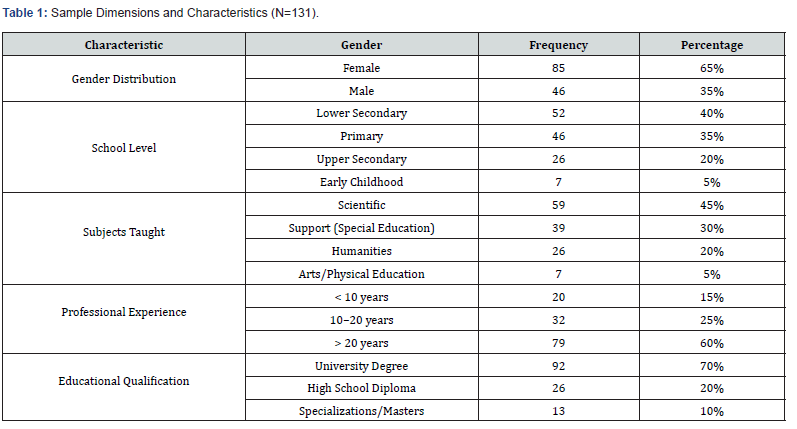
The sample’s heterogeneity allows for a detailed profile in terms of age, professional experience, school level, and main discipline. The mean age is around 52 years, with a strong concentration in the 45–60 age range (over 70%). Female teachers are predominant, representing 65% of the sample. Professional experience is substantial, with 60% of teachers having over 20 years of service (Table 1).
Questionnaire Analysis: Perceptions and Emerging Barriers
STEM Knowledge and Experience
The questionnaire used in this study is divided into two sections. The first collects teachers’ demographic and professional data (age, gender, school level, subject, educational qualification, years of experience, IT certifications, and participation in STEM courses) through closed-ended questions to outline their profile. The second section investigates perceptions and attitudes toward STEM implementation using Likert-scale items, covering the perceived ease and usefulness of STEM pathways, the role of technology, impact on student skills, support for students with disabilities, and required resources. This section also examines willingness to innovate, interest in training, and future intentions, providing a comprehensive overview of teachers’ beliefs regarding STEM education.
A key part of the questionnaire concerns teachers’ knowledge of the STEM acronym and their ability to define it. Eighty-five percent of participants report knowing what a STEM pathway is. However, analyzing open-ended questions reveals that understanding is often fragmented. Teachers tend to describe STEM as a set of laboratory activities, scientific experiments, or the use of technology and educational robotics, without a clear awareness of the disciplinary integration that forms the theoretical core of the approach. This discrepancy between declared knowledge and actual understanding aligns with international literature, which frequently highlights a reductive perception of STEM limited to its most visible or instrumental aspects, at the expense of its deeper methodological dimension.
Prior experiences show that only 60% have participated in STEM pathways, and only 40% have attended specific training courses. Among the latter, 65% used technology, while 35% followed traditional courses. This distinction suggests that STEM is present in schools as a local or individual initiative rather than as a widespread and systemic practice (Table 2).

Opinions on Implementation and Perceived Barriers
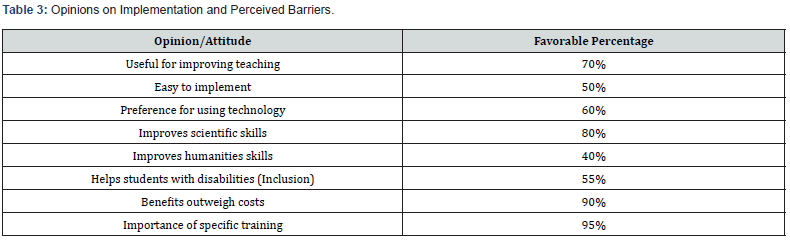
Analysis of subjective perceptions regarding the ease or difficulty of implementation reveals an ambivalent picture. Many teachers recognize the usefulness of STEM pathways for improving teaching, increasing student motivation, and fostering transversal skills. About 70% believe STEM implementation is useful, but only 50% consider it easy.
This gap between perceived usefulness and perceived feasibility is central. There is a widespread sense of complexity, likely due to the need to integrate multiple disciplines, difficulty in obtaining adequate materials, lack of laboratory spaces, and limited time for interdisciplinary planning. Such obstacles, including resource shortages and pressures from standardized assessments, are already well documented in the literature (Ejiwale, 2013) [15] (Table 3).
Preparation and Future Intentions
The data suggest that many teachers do not feel fully competent to design and implement STEM pathways. This perception is particularly evident among teachers with non-scientific backgrounds and those who report having never received specific training. It can be hypothesized that lack of confidence in one’s preparation is one of the main factors negatively affecting intentions to implement STEM pathways in the near future, reflecting the broader issue of insufficient initial and ongoing training. Despite perceived difficulties, a substantial portion of teachers express willingness to propose STEM pathways in their classes, indicating a cultural openness to innovation that requires support through training policies, pedagogical guidance, and infrastructure investments.
Barriers to Implementation and Empirical Findings
The literature has extensively documented the presence of complex, multi-level barriers that hinder STEM education implementation (Ejiwale, 2013). One of the most significant relates to teacher preparation, often lacking in both content knowledge and pedagogical skills. The difficulty of orchestrating interdisciplinary activities while maintaining conceptual rigor and methodological flexibility generates insecurity and frequently leads to oversimplification. Empirical analysis confirms this issue: only 40% of teachers received specific training, and a significant portion does not feel fully competent to plan STEM pathways. This finding aligns with the conclusion that without solid preparation, teachers tend to reduce STEM to superficial activities.
Organizational and Resource Barriers
Continuous professional development is also fragmented, lacking structured mentoring, co-planning, and reflective practice pathways, which are essential to support innovative approaches. Organizationally, scarcity of resources, lack of adequate laboratories, and absence of functional makerspaces strongly limit the ability to conduct authentic, hands-on experiences. While 80% of teachers find organizing STEM pathways enjoyable and stimulating, 70% acknowledge that substantial organizational resources are required, reaffirming that infrastructural and time limitations impede the perception of easy implementation. Although the sample shows a preference for using technology in STEM implementation over traditional methods (83% vs. 13%), literature highlights how standardized assessments pressure teachers to use traditional teaching methods, leaving less room for authentic problem-solving activities [2,15].
Inclusion and Accessibility in STEM Education
Truly inclusive STEM education requires designing learning environments and activities that consider student variability from the outset, including cognitive differences, abilities, cultural background, gender, and special educational needs. At the microsystem level, this translates into adopting Universal Design for Learning (UDL) strategies, a pedagogical approach aimed at making learning accessible and meaningful for all students, providing flexible and multiple pathways to acquire knowledge, develop skills, and demonstrate learning.
UDL is realized, for example, through multiple modes of content representation (texts, images, simulations, graphs), multiple modes of skill expression (reports, projects, prototypes, presentations), and multiple modes of motivational engagement (collaborative activities, real-world problems, immediate feedback). The use of assistive technologies and differentiated tasks completes this approach, making not only content but also cognitive processes and assessment methods accessible [16].
However, inclusion should not be understood solely as access; it also involves the epistemic dimension, i.e., each student’s ability to acquire, understand, and apply STEM knowledge meaningfully. Ensuring epistemic inclusion means designing experiences in which all students can actively participate in knowledge construction, developing cognitive and metacognitive skills, autonomy, responsibility, and problem-solving abilities. Inclusion thus becomes a structural element of STEM teaching quality, ensuring that all students can learn and contribute fully to interdisciplinary pathways.
Studies on gender, ethnicity, and socioeconomic inequalities show that barriers to entry into STEM careers persist despite educational policy efforts [17,18]. The significant presence of support teachers (30%) in the analyzed sample indicates particular sensitivity to inclusion issues: 55% of teachers believe STEM can assist students with disabilities, reflecting a positive (though not unanimous) perception of the inclusive potential of the approach, particularly through hands-on activities and assistive technology [19].
Conclusion
The conclusions of this study indicate the need to consider STEM education not merely as a set of innovative activities but as a true paradigm shift involving planning, methodologies, and teachers’ professional culture. The combined analysis of literature and teacher responses highlights widespread interest in STEM and recognition of its educational value but also shows that this interest is not yet supported by the conditions necessary for coherent and systematic application.
The gap between the theoretical vision of STEM as a “metadiscipline” and its daily translation in school practices suggests that the core issue is not teachers’ willingness to innovate but the presence of solid epistemological and methodological preparation enabling them to design truly integrated pathways. The tendency to reduce STEM to laboratory experiments or isolated technological activities reveals that, without adequate training support, the approach risks losing its transformative potential and remaining confined to episodic initiatives.
Another element concerns organizational and infrastructural dimensions. STEM education requires spaces, tools, time, and a school culture conducive to collaboration and co-planning—factors that many schools struggle to guarantee consistently. Lack of adequate resources affects teachers’ ability to experiment with complex teaching approaches and contributes to the perception of implementation difficulty.
Pedagogically, the study highlights how STEM can significantly promote inclusion and participation, provided it is designed with attention to student variability and diverse modes of learning and demonstrating competence. Adopting principles such as Universal Design for Learning and integrating inquiry-based and engineering-based practices can support equitable access to learning processes and promote active student engagement.
Overall, the study underscores the urgency of systemic intervention. For STEM to become a structural element of teaching rather than an experimental parenthesis, teacher education—both initial and ongoing—must be organic, continuous, and based on effective models of research and practice. Educational policies must also provide concrete support for teachers, offering spaces, tools, planning time, and opportunities for professional collaboration.
References
- Marrero ME, Gunning AM, & Germain-Williams T (2014) What is STEM Education? Global Education Review 1(4): 1-6.
- Kennedy T, & Odell MR (2014) Engaging Students In STEM Education. Science education international 25(3): 246-258.
- Bybee RW (2013) The case for STEM education: Challenges and opportunities.
- National Science and Technology Council (2018) Charting a Course for Success: America’s Strategy for STEM Education.
- Honey M, Pearson G, & Schweingruber H (2014) STEM Integration in K-12 Education. National Academies Press.
- Shernoff DJ, Sinha S, Bressler DM, Ginsburg L (2017) Assessing teacher education and professional development needs for the implementation of integrated approaches to STEM education. IJ STEM Ed 4: 13.
- Vasquez J, Sneider C, & Comer M (2013) STEM Lesson Essentials, Grades 3–8: Integrating Science, Technology, Engineering, and Mathematics, Portsmouth, NH: Heinemann, Germany.
- Jolly A (2016) STEM by Design: Strategies and Activities for Grades 4-8 (1st). Routledge.
- Glancy AW, & Moore TJ (2013) Theoretical Foundations for Effective STEM Learning Environments. School of Engineering Education Working Papers.
- Stohlmann M, Moore TJ, & Roehrig GH (2012) Considerations for Teaching Integrated STEM Education. Journal of Pre-College Engineering Education Research (J-PEER) 2(1): 4.
- Teo TW, & Ke KJ (2014) Challenges in STEM Teaching: Implication for Preservice and Inservice Teacher Education Program. Theory Into Practice 53(1): 18-24.
- Milner-Bolotin M (2018) Evidence-based research in STEM teacher education: From theory to practice. Frontiers in Education 3(92).
- Beilock SL, Gunderson EA, Ramirez G, & Levine SC (2010) Female teachers’ math anxiety affects girls’ math achievement. PNAS Proceedings of the National Academy of Sciences of the United States of America 107(5): 1860-1863.
- Morrison JA, Frost JH, Gotch CM, McDuffie AR, Austin BW, et al. (2020) Teachers’ Role in Students’ Learning at a Project-Based STEM High School: Implications for Teacher Education. International Journal of Science and Mathematics Education 19: 1103-1123.
- English LD (2016) STEM education K-12: perspectives on integration. IJ STEM Ed 3(3).
- Basham JD, Israel M, & Maynard K (2010) An Ecological Model of STEM Education: Operationalizing STEM for All. Journal of Special Education Technology 25(3): 9-19.
- Stoet G & Geary DC (2018) The Gender-Equality Paradox in Science, Technology, Engineering, and Mathematics Education. Psychological Science 29(4): 581-593.
- Riegle-Crumb C, King B, & Irizarry Y (2018) Does STEM stand out? Examining racial/ethnic gaps in persistence across postsecondary fields. Educational Researcher 48(3): 133-144.
- Liu F (2020) Addressing STEM in the context of teacher education. Journal of Research in Innovative Teaching & Learning 13(1): 129-134.

























