




 ASM Home



Summary
Modernizing urban governance in China’s new era serves as the core vehicle for advancing the modernization of the national governance system and governance capabilities. This paper traces the policy evolution from the “Five Coordination’s” in 2015 to the “Five Transformations” by 2025. It integrates practical explorations such as the new-era “Fengqiao Experience” and the People-Centered City Concept, alongside exemplary cases of modern urban governance from megacities and county-level cities. this paper dissects the “preserving fundamentals-innovation” evolutionary logic inherent in urban governance. It constructs a four-dimensional core framework encompassing “value-subject-method-space” and proposes four practical innovation pathways: institutional, technological, cultural, and collaborative. Research indicates that modernizing urban governance in the new era fundamentally entails achieving a shift from “scale expansion” to “quality enhancement” and a transition from “fragmented governance” to “systemic governance.” This is accomplished by firmly upholding core values such as the people-centered approach and systems thinking, while leveraging the collaborative efforts of diverse actors, technological empowerment, and cultural immersion.
Keywords:Modernization of Urban Governance; Upholding Principles While Innovating; Core Dimensions; Practical Innovation Pathways
Introduction
Research Background
Contemporary China is undergoing the most extensive and rapid urbanization process in human history. By 2024, the urbanization rate of China’s permanent residents had reached 67%, with the urban population increasing to 940 million. In this context, cities have become the vital hubs for all economic and social activities, as well as the critical domains for national governance [1]. Amid rapid urbanization, China’s urban development is shifting from an outward-expanding model focused solely on incremental growth and relentless pursuit of scale expansion. It is gradually transitioning toward a new phase of inward-focused development that prioritizes existing stock, strives for quality enhancement, and achieves structural optimization.
However, rapid urbanization has also given rise to numerous challenges. “Urban ills” such as severe traffic congestion, deteriorating environmental conditions, and significant disparities in public services have become increasingly pronounced. At the same time, new challenges—including accelerated population mobility and the emergence of diverse governance entities—have posed extremely rigorous tests for traditional urban governance models [2,3]. To effectively address these challenges, the Central Urban Work Conference introduced the concept of “one respect and five coordination’s” starting in 2015. By 2025, this framework had evolved to further specify the requirements of “one optimization, six constructions,” and “five transformations.” This progression clearly reflects the strategic adjustments and conceptual innovations in urban governance during the new era [4]. Correspondingly, the new-era “Fengqiao Experience” has infused fresh momentum into the governance community. The concept of “people-centered cities” is gradually taking root and being put into practice through various explorations, all of which have accumulated a wealth of practical insights for advancing the modernization of urban governance [5,6]. Against this backdrop, comprehensively and meticulously tracing the developmental trajectory of urban governance, extracting its key core dimensions, and exploring innovative practical pathways has become a critically important research topic in advancing the modernization of urban governance.
Literature Review
Existing research has explored various aspects of urban governance in the new era. Regarding the evolutionary logic, Yang et al. [4] highlighted the continuity and contemporary innovation between the “Five Coordination’s” and the “Five Transformations,” emphasizing the shift in governance values, approaches, and priorities. In terms of governance actors, Chen et al. [5], drawing on the “Fengqiao Experience,” proposed a path to build a “single-core, multi-stakeholder” governance community under Party leadership. Regarding governance methods, Zhang et al. [3] constructed a refined governance framework encompassing “concept-planning-system-means.” Li [7] emphasizes the synergistic empowerment of “technology + institutions.” Regarding value orientation, Xie et al. [6] elucidated the core essence of the principle that “cities are built by the people and for the people,” highlighting the people-centered nature of governance.
While existing research has yielded substantial findings, it still exhibits notable shortcomings: First, most studies focus on single dimensions—such as technological empowerment or grassroots governance—without systematically integrating the logic and core elements of governance evolution; Second, insufficient attention has been given to translating cultural dimensions into practical applications, failing to fully explore the value of local characteristics and cultural identity within governance. Third, discussions on the dynamic coordination mechanism between “preserving fundamentals” and “innovation” remain superficial, making it difficult to explain the unity of governance continuity and adaptability. In light of this, this paper builds upon existing research to construct a systematic analytical framework and proposes an innovative pathway that combines theoretical depth with practical feasibility.
Research Approach and Methodology
This paper employs literature review and logical analysis, using “preserving fundamentals while innovating” as its central thread. It first clarifies the evolutionary logic of urban governance in the new era, defining the core values to uphold and the contemporary direction for innovation. Subsequently, it integrates existing research elements to construct a four-dimensional core framework encompassing “values-subjects-methods-spaces.” Finally, drawing on practical case studies, it proposes four practical innovation pathways: institutional, technological, cultural, and collaborative. The research emphasizes the integration of theory and practice, aiming to provide valuable insights for advancing urban governance modernization in the new era.
The Evolutionary Logic of Urban Governance in the New Era: A Dual Variation of Steadfastness and Innovation
The evolution of urban governance in the new era does not negate traditional models, but rather represents adaptive innovation grounded in core values, thereby forming a dual logic of “preserving fundamentals as the foundation and innovation as the priority” (See Table 1). This logic maintains continuity in the direction of urban development while also endowing urban governance practices with contemporary relevance.

Upholding Integrity: The Core Legacy of Urban Governance Fundamental Stance: A People-Centered Value Orientation
The principle that “people are at the heart of the city” runs through the entire process of governance evolution [4]. The 2015 Central Urban Work Conference proposed the “Five coordination’s,” with the first being “coordinating the three major layouts of production, living, and ecology,” and the second being “coordinating the three major entities of government, society, and citizens.” This laid the methodological foundation for the people-centered approach. By the 2025 conference, the principle of “people-centered development” was elevated to the foremost position among the “Five Transformations,” emphasizing the shift from “prioritizing material over people” to “putting people first.” This signifies a value-based upgrade from focusing on “whether something exists” to prioritizing “how well it functions” [4]. The new-era “Fengqiao Experience” emphasizes resolving conflicts locally and ensuring uninterrupted public services, while the People’s City concept explicitly states that “cities belong to the people and development is for the people.” Both approaches uphold the fundamental principle of putting people at the center [5,6]. This legacy of values ensures that urban development remains fundamentally dedicated to meeting the people’s evergrowing aspirations for a better life.
Goal Pursuit: Strategic Resolve for High-Quality Development
Whether it is breaking down structural barriers through the “Five coordination’s” to establish a foundation for balanced development, or focusing on quality enhancement through the “Five Transformations” to pursue the intrinsic value of development, the core objective remains unchanged: to propel cities from their previous state of rapid growth toward a trajectory of high-quality development [4]. This strategic resolve manifests specifically in the following ways: consistently adhering to a systematic approach to thinking, avoiding the tendency to prioritize GDP growth above all else; and maintaining a balanced focus on both development and security, thereby driving the city’s sustainable development process [8]. For instance, in recent years, China has been continuously advancing urban renewal initiatives. Since 2019, nearly 280,000 aging residential communities across the country have commenced renovation projects, benefiting 120 million residents. During this period, over 130,000 elevators were installed and 3.8 million parking spaces added, enabling more and more residents to transition from merely having a place to live to enjoying a better quality of life in their homes.
Thinking Approach: A Systems Theory-Guided Governance Methodology
General Secretary Xi Jinping emphasized that “urban development is a systematic project,” and systems thinking has become the core methodology for urban governance [4]. The “Five coordination’s” establish a systematic framework encompassing spatial, scale, and industrial dimensions, effectively addressing the challenges posed by fragmented governance. Meanwhile, the “Five Transformations” further propel systemic thinking toward dynamic coordination, thereby achieving an upgrade from static control to dynamic governance [4]. This mindset ensures that urban governance consistently prioritizes holistic, collaborative, and sustainable approaches, treating cities as organic living entities and accurately grasping their developmental patterns and intrinsic connections.
Core Framework: The Concept of a Governance Community Based on Joint Construction, Co-governance, and Shared Benefits
The “Five coordination’s” initiative has for the first time established a multi-stakeholder governance framework involving government, society, and citizens at the top-level design stage. The new-era “Fengqiao Experience” is driving collaborative efforts among diverse actors to deepen and expand practical implementation. Meanwhile, the “Five Transformations” integrate multi-stakeholder governance into every aspect of the governance process [4,5]. This new governance framework breaks away from the traditional model where the government handled everything alone, instead fostering a collaborative ecosystem where multiple stakeholders participate and work together [9]. For example, in implementing the “Fengqiao Experience” for the new era, Beijing’s Tongzhou District has leveraged the establishment of multi-stakeholder participation platforms to actively encourage citizens, businesses, and social organizations to engage in urban governance. This has facilitated a shift from “government-led” governance to a model of “joint construction and co-governance.”
Innovation: Upgrading Governance to Meet the Demands of the Times Governance Values: From “Framework Construction” to “Human-Centered Deepening”
The “Five coordination’s” focus on establishing a framework for multi-stakeholder participation, while the “Five Transformations” place human needs at the heart of governance. They emphasize shifting from a supply-oriented approach to a demand-oriented one, prioritizing the higher-level needs of the people—such as fairness, justice, and security—that they aspire to [4]. The concept of a people-centered city has been further clarified and defined, with the principle of “asking the people about their needs, seeking their advice, and evaluating outcomes based on their feedback” making governance values more concrete and tangible [6]. For instance, Shenyang City launched the “City Steward” initiative in urban governance while establishing the “Convenience Channel for Urban Management Services” to address citizen concerns. This effort has resolved over 361,400 urgent and pressing issues faced by residents, thereby making city management more aligned with citizens’ expectations.
Governance Path: From “Incremental Expansion” to “Upgrading Existing Assets”
The urbanization rate rose from 56.10% in 2015 to 67% in 2025. During this process, the primary challenge in governance shifted from accommodating growth to enhancing quality [4]. The “Five coordination’s” effectively address the demands of incremental expansion, leveraging macro-level planning to guide the continuous growth of urban space. Meanwhile, the “Five Transformations” emphasize “intensive and efficient development,” driving initiatives such as urban renewal and the upgrading of aging residential communities. This approach ensures the full and effective utilization of spatial resources [4,10]. This shift in approach reflects both the objective demands of the current stage of urban development and demonstrates the precise adaptation of governance responses to match these requirements.
Governance Strategy: From “Universal Drivers” to “Characteristic Activation”
The “Five coordination’s” establish a universal driving framework of “reform-technology-culture,” while the “Five Transformations” emphasize “distinctive development,” actively encouraging the exploration of local historical and cultural heritage, resource endowments, and other so-called “genetic codes.” [4] Practices such as Jiangsu’s pilot program for building beautiful and livable cities and Shanghai Yangpu Riverside’s transformation of the “industrial rust belt” all demonstrate how distinctive endowments are being converted into development momentum [6,10]. For instance, Shenyang has fully tapped the potential value of urban micro-spaces by creating pocket parks and implementing micro-upgrades in back alleys. The city has meticulously developed as many as 3,198 pocket parks, effectively fulfilling numerous recreational and leisure needs of its residents.
Governance Focus: From “Prioritizing Construction” to “Balancing Construction and Management”
While the “Five coordination’s” emphasize planning, construction, and management synergy, a tendency to “prioritize construction over operations” persists in practice. In contrast, the “Five Transformations” explicitly call for “greater emphasis on governance investment,” driving the gradual shift of resources from hardware construction toward management services. This transformation compels municipal governments to evolve from construction-focused entities into service-oriented operators [2,4]. For instance, in advancing the modernization of urban governance, Lianghe County in Dehong Prefecture has focused not merely on the construction of physical infrastructure, but has placed greater emphasis on refining the “one committee, one office, one platform” working mechanism, thereby establishing a new model for urban governance in frontier counties.
Governance Methodology: From “Static Framework” to “Dynamic Synergy”
The “Five coordination’s” establish a systemic governance framework, while the “Five Transformations” emphasize the dynamic nature of “coordinated governance,” driving crossdepartmental and cross-level collaboration to achieve precise coordination and rapid response [4]. Technology-driven empowerment provides robust support for dynamic collaboration, such as the “City Brain” enabling intelligent allocation of governance resources [7]. The “Three-End Optimal Governance” model implemented by Kulun Banner employs a closed-loop management approach through “front-end screening, mid-end resolution, and back-end governance.” During the 2025 period, it proactively identified and collected over 1,800 potential conflicts and hidden dangers, achieving an on-site resolution rate of 92%.
Building Core Dimensions for Modern Urban Governance in the New Era
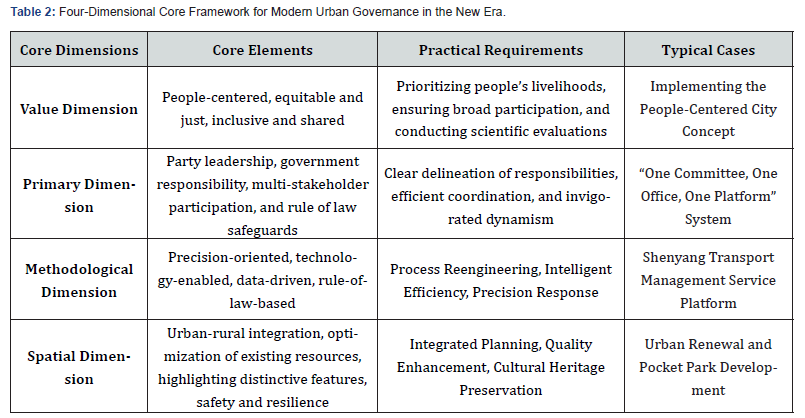
Based on the aforementioned evolutionary logic and drawing upon existing research findings, this paper constructs a fourdimensional core framework comprising “value-subject-methodspace”( See Table 2). This framework provides theoretical underpinnings and practical guidance for modernizing urban governance. It comprehensively addresses the value orientation of urban governance while encompassing the structural components, methodological tools, and spatial carriers of governance, forming an organically unified whole.
Value Dimension: Deep Implementation of the People- Centered City Concept
The People’s City concept represents the core value of urban governance in the new era. Its essential tenets encompass the principles of belonging to the people, serving the people, and relying on the people [6]. In the course of practical implementation, the specific requirements for this dimension are as follows: First, prioritize the well-being of the people as the starting point for governance, focusing on urgent and pressing issues such as education, healthcare, and elderly care that directly impact the public [2]. Second, we must effectively safeguard citizens’ right to participate by leveraging various channels such as community deliberative councils and online platforms to facilitate the expression of public opinion [9]. Third, public satisfaction must serve as the benchmark for measuring governance effectiveness, achieving a shift from a “government-serving” model to a “publicordering” model. This value dimension provides fundamental guiding principles for governance work, ensuring the governance process remains firmly rooted in the people’s interests [8].
The implementation of the people-centered urban development philosophy has ensured that the benefits of urban progress are more widely and equitably shared among all citizens. By the end of 2024, a total of 38.35 million units of various types of affordable housing and shantytown relocation housing had been constructed nationwide, helping over 100 million people realize their dream of secure housing. The Residential Project Standards, effective May 1, 2025, fortify residential safety through multiple dimensions including structural integrity, seismic design, and fire safety. For instance, new residential buildings must maintain a minimum floor-to-ceiling height of 3.0 meters and install elevators starting from the fourth floor, comprehensively enhancing health and comfort standards. These measures fully demonstrate the people-centered and humanistic value orientation in urban governance.
Core Dimension: Multi-stakeholder Collaborative Governance Under the Leadership of Party Building
Party-building leadership represents a distinctive advantage in China’s urban governance. Through a governance system characterized by “Party committee leadership, government responsibility, social collaboration, public participation, legal safeguards, and technological support,” it fosters a multistakeholder collaborative framework [9]. Specifically, its performance manifests in the following aspects: First, Partybuilding leadership enables the coordinated allocation of resources, establishing a four-tiered linkage mechanism spanning the city, district, subdistrict, and community levels [6]. Second, the government must clearly define its own boundaries of authority and responsibility, transitioning from a “paddler” to a “helmsman” responsible for establishing relevant standards, ensuring fairness, and implementing oversight [4]. Third, social forces are deeply involved in the process, leveraging methods such as purchasing services and the PPP model to introduce market entities and social organizations [5]. Fourth, citizens should play an active role by participating in governance through volunteer services, community self-governance, and other activities [6]. This configuration in the subject dimension maintains the holistic nature of governance while simultaneously unleashing the vitality inherent in diverse actors [5].
Shenyang’s “One Committee, One Office, One Platform” work system serves as a model example in terms of practical implementation at the institutional level. Within this framework, the “One Committee” functions as the coordinating body, with its dual co-chairs held by the Municipal Party Secretary and the Mayor respectively, thereby establishing an organizational structure characterized by “dual-core drive and citywide collaborative coordination.” The membership of this framework has been expanded beyond its original scope to include all 13 districts, counties (cities), and 42 municipal departments. This expansion has effectively broken down interdepartmental barriers, creating an environment conducive to resource integration and utilization. This high-level, integrated governance framework ensures both efficient decision-making and strong implementation capabilities while fully enabling diverse stakeholders to participate effectively in relevant affairs.
Methodological Dimension: Deep Integration of Precision and Technology Empowerment
Refined governance and technological empowerment are key approaches to enhancing governance effectiveness. Refined governance requires “meticulous attention to detail, like embroidery,” focusing on numerous governance particulars and the public’s actual experience [3]; Technology-driven solutions leverage big data, artificial intelligence, and other tools to tackle various challenges encountered in governance processes [7]. Integrating refined governance with technological empowerment manifests in the following ways: First, establishing an intelligent governance chain of “perception-analysis-response.” For instance, “Smart Urban Management” achieves precise issue resolution through smart cameras and grid patrol officers. Second, driving the reengineering of governance processes. Initiatives like “One- Stop Online Services” and “Immediate Response to Complaints” enhance service efficiency [6,7]. Third, achieve precise allocation of governance resources by identifying gaps in people’s livelihoods through big data analysis and optimizing the distribution of public services [3].
Shenyang City continues to advance application innovation in its “One Platform” transportation management and service system, streamlining closed-loop processes and breaking down data silos. The platform integrates 1,546 units across four tiers— city, district, subdistrict, and grid—into a unified system. It establishes a framework encompassing 462 data resource catalogs and 32 thematic databases, consolidating 184 million urban foundational data entries. It has assigned identification codes to 2.612 million urban infrastructure assets and entered them into the database, enabling a closed-loop management system for urban operation issues: “detection-notification-resolutionevaluation.” -feedback-evaluation“ closed-loop management for urban operation management issues. Through a workflow of ”coordinated deployment, responsibility-based assignment, priority supervision, and time-bound feedback,” it handles over 4,000 issues daily. This innovative approach significantly enhances the efficiency and precision of urban governance.
Spatial Dimension: Coordinated Advancement of Urban-Rural Integration and Stock Optimization
Spatial governance serves as a vital vehicle for urban management, with its core objective being to achieve “intensive and efficient production spaces, livable and moderate residential spaces, and ecologically pristine landscapes [6].” This dimension encompasses: First, existing spaces require quality enhancement through a series of measures such as urban renewal and ecological restoration to elevate the value of established spaces (Zhang and Xu, 2025); Second, urban and rural areas must advance toward integrated development, promoting the mutual flow of resources between them and gradually achieving equal access to public services, thereby resolving the issues inherent in the urban-rural dual structure [1]; Third, we must focus on shaping distinctive urban spaces, effectively preserving the historical and cultural heritage of cities as well as their regional characteristics, and avoid creating a situation where all cities look alike [10]; Fourth, establish secure spaces, further refine the emergency management system, and enhance the city’s risk prevention and control capabilities [8].
This spatial dimension focuses on optimizing urban internal spaces while also promoting urban-rural coordination, achieving systematic and inclusive spatial governance. Nationwide, 48,000 pocket parks and 127,800 kilometers of urban greenways have been constructed, with over 360 prefecture-level and above cities implementing open access to parks and green spaces. The safety engineering of urban infrastructure lifelines is accelerating, with many cities achieving intelligent sensing, dynamic monitoring, and early warning response for the operational status of utilities like gas and water supply. Collectively, these measures are building a livable, resilient, and smart urban spatial system.
Practical Innovation Pathways for Modernizing Urban Governance in the New Era
Based on the four core dimensions and drawing upon relevant practical explorations in the literature, this paper proposes four pathways for practical innovation (See Table 3). This approach ensures that governance modernization can be effectively implemented and yield tangible results. While these four pathways are distinct, they mutually reinforce one another, ultimately forming a comprehensive practical system for urban governance modernization in the new era.

Institutional Innovation: Establishing a Legal Framework and Full-Cycle Management System
Institutional innovation serves as a fundamental safeguard in the process of modernizing governance. On one hand, it is essential to refine the legal framework by clarifying through local legislation the respective responsibilities and authority boundaries of subdistrict offices, functional departments, and social organizations. This will institutionalize innovative practices such as the “subdistrict/township blows the whistle, departments respond” mechanism [2,8]. On the other hand, it is essential to establish a full-cycle management mechanism that integrates “planning, construction, management, and operation” into a unified framework to prevent unfinished projects and resource wastage. Additionally, the assessment and evaluation system should be optimized by constructing a multi-dimensional evaluation framework encompassing “public satisfaction, governance effectiveness, and distinctive development,” thereby reducing the emphasis on GDP-oriented metrics. Furthermore, mechanisms for coordinating interests must be strengthened, employing consultative democracy and value compensation to resolve conflicts of interest arising during urban renewal and project development.
Shenyang has undertaken productive explorations in institutional innovation. The city has prioritized strengthening institutional safeguards, successively enacting as many as 33 local regulations, rules, and policy guidelines, while also formulating 52 standards and technical guidelines for industry management. These measures provide both institutional frameworks and robust technical support for refined governance. Concurrently, Shenyang has established a working mechanism characterized by tightly interconnected and synergistic components that collectively unleash empowering effects. Specifically, this mechanism operates through a sequential process of “annual deployment, quarterly advancement, and field research,” with each phase seamlessly linking to the next. This approach guides efforts to tackle the toughest challenges in urban management. This mechanism strengthens the two-way transmission of responsibilities between industry sectors and local jurisdictions. Through monthly directives, it clarifies management priorities and issues specific work requirements to relevant departments. For areas with lagging management performance, its principal leaders are summoned for discussions to effectively enforce local management accountability. Such institutional design ensures the standardization and sustainability of urban governance efforts.
Technological Innovation: Building a Digital Twin and Smart Governance Ecosystem
Technological innovation serves as a crucial pillar for enhancing governance effectiveness. On one hand, efforts should focus on building a digital twin platform for cities, integrating data resources from government affairs, transportation, and ecological sectors. This integration enables the simulation, prediction, and optimization of governance scenarios [1,7]; On the other hand, we must vigorously promote models like “City Brain + Grid Governance,” integrating intelligent dispatch with grassrootslevel awareness to enhance efficiency in addressing various issues. Furthermore, we must expand the application scenarios of smart services, actively promoting digital employment, digital healthcare, digital elderly care, and other applications to achieve round-the-clock and online public services. Concurrently, we must prioritize mitigating potential risks in technological governance by establishing a robust data security framework to prevent the emergence of “digital Leviathans” and technological discrimination.
Lianghe County in Dehong Prefecture has leveraged and upgraded resources from its smart city video command center for technological innovation. By integrating video data from public security surveillance networks, traffic management, and comprehensive law enforcement with operational data, the county has established a unified digital foundation for urban management. It actively employs IoT sensing and AI-powered video recognition technologies to address issues like street vending, illegal parking, and exposed garbage through remote intelligent audio alerts and online monitoring. Kulun Banner’s Comprehensive Governance Center leverages a grassroots micro-governance system—the “Party cell + grid officer + household liaison” iron triangle— to scientifically divide the area into 857 governance grids. It deploys 560 Party cells and 2,063 household liaisons, focusing on four key sources: “village origins, petition origins, police sources, and online sources.” Weekly comprehensive inspections ensure “hidden conflicts” become visible and “potential risks” are detected, reported, and addressed early. These technological innovations have significantly enhanced the intelligence and precision of urban governance.
Cultural Innovation: Cultivating Local Characteristics and Building a Shared Governance Culture
Cultural innovation serves as a vital pathway to enhance governance cohesion and represents one of the core innovations in this paper. First, we must thoroughly explore the cultural resources inherent to our localities, integrating historical contexts and traditional customs into urban renewal and public space development. Second, vigorously promote core socialist values through initiatives like moral education forums and civilized community campaigns to cultivate an atmosphere of integrity and mutual support. Third, establish a governance community culture by leveraging community development and public activities to strengthen residents’ sense of identity and belonging, thereby addressing the governance challenges posed by “stranger communities [11].” Fourth, promote the integration of culture and industry, transforming local culture into creative industries, tourism, and other business models to achieve a win-win situation where cultural value and economic value are both realized.
The new-era “Fengqiao Experience,” enriched by the influence of outstanding traditional culture and the cultivation of core socialist values, offers valuable insights for cultural innovation. When undertaking grassroots governance initiatives, Kulun Banner places significant emphasis on the guiding role of culture. By adopting the “Three-Pronged Optimal Governance” model, it shifts the focus of governance downward and deploys service resources to the grassroots level. Ultimately, through tangible governance outcomes, it has earned widespread public acclaim. Similarly, during the renovation of back alleys and lanes, Shenyang City prioritized cultural preservation. By employing “micro-upgrades,” residents could tangibly experience “changes happening around them.” This approach achieved multiple objectives: optimizing urban structure, enhancing quality, sustaining cultural continuity, and continuously increasing public satisfaction. These practical governance practices clearly demonstrate that cultural innovation can provide deep-seated momentum for urban governance while offering robust spiritual support.
Collaborative Innovation: Establishing Cross-Domain Integration and Resource Allocation Mechanisms
Collaborative innovation is crucial for addressing fragmented governance. On one hand, we must improve cross-departmental coordination mechanisms by establishing high-level coordinating bodies and cross-departmental project teams to tackle crosssectoral governance challenges. On the other hand, we need to channel resources to the grassroots level, directing more funding, talent, and technology toward neighborhoods and communities to strengthen local governance capabilities [2,9]. Furthermore, we must deepen coordinated governance between urban and rural areas by establishing mechanisms for the two-way flow of resources, enabling high-quality urban resources to extend into rural regions. Additionally, we should expand cross-regional collaboration by building governance coordination mechanisms within urban clusters to achieve resource sharing and joint risk prevention.
In implementing the “Fengqiao Experience” for the new era, Tongzhou District of Beijing adheres to the principle of synchronized action. It leverages the oversight of the “No. 1 Proposal” as an opportunity, prioritizes the handling of key proposals as a lever, and effectively implements reform measures in accordance with the functions and responsibilities of the People’s Congress. This approach vigorously advances all tasks, continuously deepens and expands the grassroots practice of whole-process people’s democracy, and ensures that the district committee’s decisions and deployments are more practical, responsive to public sentiment, and heartwarming. In Shenyang, collaborative innovation has intensified oversight of challenging issues through a dispatch mechanism strictly adhering to the principle: “General problems handled through statutory platforms; difficult problems resolved through coordination and agreement; complex problems decided through research.” Industry departments have been organized to refine operational manuals, clarifying responsibility for 251 categories of urban management issues. For complex urban management issues such as those arising at district boundaries or involving overlapping functions, local and industry departments conduct on-site inspections to determine responsibilities, achieving comprehensive coverage of urban management with no blind spots.
Conclusion
Research indicates that modernization of urban governance in the new era possesses the following essential characteristics: grounded in core values such as upholding the people-centered approach and adopting a systems thinking mindset, it achieves a fundamental shift from a “scale expansion” model to a “quality enhancement” model. This transformation is accomplished through the synergistic efforts of multiple stakeholders, technological empowerment, and cultural immersion. Concurrently, it marks a fundamental transition from a state of “fragmented governance” to “systemic governance.” This transformation not only signifies a profound shift in urban development philosophy but also reflects the inherent demands of modernizing governance systems. Modernizing urban governance in the new era embodies the dialectical unity of upholding principles and embracing innovation. Its evolutionary logic lies in advancing governance values, pathways, strategies, priorities, and methodologies in response to contemporary needs, while steadfastly adhering to core values such as the people-centered approach, systemic thinking, and multi-stakeholder governance. The core framework of “value-subject-method-space” dimensions constructed in this paper integrates previously fragmented elements from existing research, forming a systematic analytical framework. The four practical pathways proposed—institutional, technological, cultural, and collaborative—emphasize the unique value of cultural innovation, offering actionable solutions to tackle “urban ills” and advance governance modernization.
As China’s urbanization continues to advance, modernizing urban governance will encounter numerous new challenges and opportunities. The “Five Transformations” outlined at the 2025 Central Urban Work Conference chart the course for future urban development: shifting from “prioritizing physical infrastructure over people” to “people-centered development,” from “scale expansion” to “quality enhancement,” from “singletrack development” to “comprehensive coordination,” from “government-led” to “co-construction and co-governance,” and from “traditional management” to “smart governance.” These shifts will drive profound transformations in urban development approaches and governance models, making cities more livable, resilient, intelligent, and civilized—better aligning with people’s aspirations for a better life.
Modernizing urban governance in the new era is an ongoing endeavor with a starting point but no endpoint. We should adopt a more open attitude to learn from and draw on advanced domestic and international experiences. At the same time, we must employ more innovative thinking to tackle the various challenges encountered in urban governance. Furthermore, we need to take more pragmatic actions to continuously advance the modernization of governance systems and capabilities, thereby ensuring that cities truly become a strong foundation for people pursuing a better life.
References
- Ge T, Wang G (2025) Theoretical Foundation of Chinese Modern Urban Governance: Establishing Urban Sociology and Urban Science Systems for The New Era. City Planning Review 49(8): 4-10.
- Wang C (2019) Reform of Urban Grassroots Governance Mechanisms in the New Era: Innovation and Challenges—An Analysis Based on Local Government Practices. Truth Seeking (5): 27-41.
- Zhang M, Liu Y (2019) Research on the Framework and Pathways for Refined Urban Governance in the New Era. E-Government 9: 76-84.
- Yang H, Xu J (2025) From the “Five Coordinations” to the “Five Transformations”: Upholding Principles and Embracing Innovation in Urban Governance for the New Era. Contemporary Economic Management. 2025-11-13.
- Chen J, Yu D (2024) The significance of the "Fengqiao Experience" empowering the urban governance community in the New Era. Journal of Southeast University (Philosophy and Social Science). 26(5): 99-107.
- Xie J, Li Q (2020) Advancing Urban Construction and Governance Modernization in the New Era Guided by the Important Concept of People-Centered Cities —Implementing the Spirit of General Secretary Xi Jinping's Speech During His Inspection of Yangpu Riverside in Shanghai. Party & Government Forum 7: 4-6.
- Li X (2020) The Logic Reconstruction of Fine Management in the New Era City: A Perspective of "Technical Empowerment". Urban Development Studies 27(5): 72-79.
- Zhang J (2022) The Communist Party of China's Century-Long Journey, Experience, and Practical Pathways in Urban Governance. The Journal of South China Sea Studies 8(4): 34-44.
- Sun B (2022) The Ideological Cornerstone and Institutional Capacity of Grassroots Governance in Urban China in the New Era. Teaching and Research (4): 35-43.
- Zhou L, Shi J, Ding Z (2020) Exploration on Practical Approach of Urban Governance in the New Era: Case Study of Jiangsu Pilot Beautiful and Livable City Construction. Urban Development Studies 27(2): 1-7.
- He S (2021) Research on Urban Community Governance in the New Era: Context, Environment, and Foundations. Journal of Shandong Academy of Governance (5): 79-87.

























