




 ASM Home



Abstract
This study aims to develop an economic model that illustrates how long-standing Confucian values and the doctrine of socialism with Chinese characteristics influence China’s economic development, particularly amid the growing U.S.-China rivalry. By endogenizing an individual’s willingness to cooperate—modeled through its direct impact on subjective value formation and incorporating an internal, incremental welfare adjustment consistent with the principles of prospect theory--the model is able to capture the cyclical fluctuation of cooperative behavior. It concludes that trade alone isnot an effective means to bridge the cultural divide between nations. Greater understanding and appreciation of diverse culture backgrounds—promoted through education and culture exchange—are essential. Finally, the study recommends several prudent industrial policies, including balancing economic growth with inequality reduction and managing domestic economic imbalances rather than externalizing them through persistent trade surpluses, to ensure long-term global welfare.
Keywords:Cyclical Cooperation; Confucianism; Socialism vs. Capitalism; Prospect theory; The US-China relationship; Chinese economic development JEL: A10,C71,F10
Introduction
Throughout the history, an individual’s free choice and the government’s authoritative governance have gone hand in hand. Nowadays, the bottom-up mechanism like democracy or capitalism seems to transcend the top-down totalitarianism or communism though the latter has now gradually reverted to socialism or “capitalism from above.” However, these two mechanisms might alternate or evolve if our economic system can be examined over a longer span of time. As Douglass North argued in his book [1] that the key to human evolutionary change is the intentionality of the players, the alternation of these mechanisms, therefore, is for the most part a deliberate process shaped by the perceptions of the individuals about the consequences of their actions.
For most of human history, individuals who questioned the norms, beliefs and preferences they inherited from their ancestors would have struggled to devise alternatives that were more efficient. Cultural wisdom and tradition were venerated because they had aided survival, and since few individuals had a deep understanding of how they contributed to their well-being, it would have been evolutionarily risky to question their validity. As such, most human societies in history have resisted rapid cultural changes, such as those that accompany major technological, philosophical and scientific advancement. Instead, cultures tend to emphasize the prudence of their ancient ancestors, revering the distant past with a mix of nostalgia and idealism [2].
The project of the Chinese Communist Party to “build a harmonious socialist society” within the framework of “Socialism with Chinese characteristics” is to pinpoint the concept “harmony” as an overlapping field in China between traditional Confucian values, rediscovered in and adapted to the twenty-first century representing contemporary New Confucianism, and official socialist values, redesigned since the process of “reform and opening up” representing “Socialism with Chinese characteristics.”
The pendulum swing of political system swerving between extreme socialism and capitalism has shaken the solidarity of domestic society and the stability of world order. The relationship between the US and China is even peculiarly volatile. It rests on seismic fault—of cultural misunderstanding, historical grievance, and ideological incompatibility. If these two giants could not find a way to coexist without betraying their core interest value (the socialism with Chinese characteristics vs. market capitalism underpinned by liberal democracy) through managed strategic competition, would they be destined for a war that could rewrite the future of both countries and the world? [3].
This paper is intended to examine the economic impact of an interaction (e.g., trade) between two individuals or countries with diverse cultural background. In the beginning, I introduce below the essences of Chinese economic culture that are evolved along the line of the New Confucianism and the socialism with Chinese characteristics.
Quintessence of Chinese Culture
Chinese culture can be punctuated in the Confucian concept of “jen (仁)” [4]. Confucius interpreted it in one sentence, “to conquer yourself (k’e-chi(克己)) and return to property (fu-li(復禮)) is jen.” The concept of k’e-chi is closely linked to self-cultivation (hsiu-shen(修身)). fu-li means to bring oneself with li(禮). “li(禮)” denotes the ideal social norm established by the existing state and acceptable by the general public. The concept of k’e-chi and fu-li may seem elusive, but jen is probably still the most difficult to grasp. Although it has been freely translated as benevolence, charity, humanity, love, human-heartedness, and goodness, none is really satisfactory. The best way to approach the concept of jen is to regard it as the virtue of the highest order in the value system of Confucianism. In other words, jen gives “meaning” to all the other ethical norms that perform integrative functions in a Confucian society.
The fundamental fact of Confucianism is that it is a secular social theory, the purpose of which is to achieve a harmonious society. There are different articulations of Confucian theory of society and the individual. Most of the literature depicts Confucianism as a social theory and a social force that tends to mold the Chinese into group-oriented or family-oriented and socially dependent beings. This view has a good deal of sociological truth and has been more or less borne out to date by empirical studies. The Confucian paradigm of man has the theoretical thrust as well as a built-in structural imperative to develop a person into a relation-oriented individual who is not only socially responsive and dependent but is also capable of asserting a self-directed role in constructing a social world.
Similarities between Confucian tradition and Chinese Communism were already highlighted when Marxism was introduced into China and its process of sinification took place at the beginning of the 20th century [5]. It is worth remembering that both New Confucianism and Chinese Socialism are now involved in ongoing processes of redesign and adaptation of their respective traditional values. Undoubtedly, this makes it easier that these two forces, when located in the same reality, tend to coincide. On this, David Shambaugh [6] says that atrophy and adaptation are simultaneous processes that the Chinese Communist Party (CCP) has been experiencing for a number of years, and that if this adaptation is sufficient to allow it to survive, the CCP will be able to transform itself from a classic Leninist party into a new kind of hybrid party. This author is also of the opinion that, as Confucian political culture is very conducive to embracing Leninism, it feeds the soil in which this new hybrid is growing.
The Impact of Culture on Economic Behavior
Either the confrontation of economic systems between countries or the transition of an economic regime choice within a specific state faces the double problems of how one visualizes the interests of one’s trading partner as well as how the society allocates its product or welfare according to one’s “need” or “contribution” in the whole society. To address these dual problems this study assumes a common parameter (denoted as η hereafter) that simultaneously characterizes the degree of one’s altruism on one hand and the weight of product allocation mechanism that compromises one’s “need” versus “contribution” on the other hand.
In line with North’s idea this paper is intended to ascribes the phenomenon of an institution’s transformation to the interaction of two competing forces that dictate an individual’s daily behavior: one is pro-individual’s self-interest and advocating market’s free choice, the other emphasizes the concept of gregariousness and cooperativeness and is prone to conform with the state or social aggregate norm instead of personal interest. Following the framework developed in my working paper [1], this study provides a model capable of explaining the dynamic behavior of an individual’s cooperative attitude and the evolution of an economic system by incorporating a welfare incremental adjustment mechanism as illustrated by the prospect theory [7].
According to the prospect theory, the objective function that a representative individual aims to achieve is defined to be the gain or loss relative to some reference point. If an individual accomplishes more gain than loss in the past, her reference point will be adjusted upward by learning, thereby making any further gain less likely and dampening the incentive to stick to her original strategy. Analogously, when the individual suffers from more loss than gain, her reference point will then be revised downward such that her initial strategy will be more likely to bring in gain than loss in the future and becomes more desirable. Once an individual’s decision is driven more or less by the rule of prospect theory with her reference point determined by the outcome in the preceding period, we will likely observe a cyclical behavior of certain strategy such as the cooperative attitude in this study.
Drawing upon the Ricardian type of trading model, this study endogenizes an individual’s cooperation strategy choice by examining its impact on her intertemporal utility improvement from trade. It concludes that unless the initial cooperativeness among the trading partners is well aligned, the dynamics of a cooperation cycle would be very irregular. Either the divergence in time preference or the disparity in the area of product specialization will widen the fluctuation of cooperation cycle or even lead to a complete breakdown of mutual cooperation relationship.



The basic model is set up in the next section. After deriving the optimal choice of cooperative strategy for each individual in section III, a computer simulation of the model will be conducted. Empirical studies of the impact of ideological beliefs on economic development will be explored in section IV. Some policy implications of this model will be then discussed, especially toward the recent development of the Sino-US economic relationship. Some concluding remarks are made in the final section.
Economic Modeling of Regime Transformation When China Opens to the World
In the beginning I would admit that it is nearly impossible to simply use a mathematical model describing the complex impact
of culture on an individual’s economic behavior. The model developed below is a very preliminary attempt to explain how Chinese
economic system evolves and transforms once it opens to the Western (say the U.S.) liberal capitalist market. For the sake of simplicity,
it is assumed that there be two countries, represented by two individuals (A and B), and two goods (X and Y). These two individuals can
be extended to be two countries, like China and the US. Based on a Ricardian economy, each individual or country is characterized by
her productivity in X and Y. For instance, individual A (B) can produce  amount of X good and
  of Y good per unit of labor
input. Initially individual A has a relatively comparative advantage and completely specialized in producing X good while individual B
has an advantage and specialized in producing Y good, i.e.,
of Y good per unit of labor
input. Initially individual A has a relatively comparative advantage and completely specialized in producing X good while individual B
has an advantage and specialized in producing Y good, i.e.,

Each individual is basically distinct from the other by the formation of her value function (Say V (t) at time t ) which is strongly
influenced by the culture she is cultivated and immersed with. According to the discussion above, the utility (or value) of an individual
pursues in her life time is characterized by how she visualizes the satisfaction from her own consumption on one hand, and her socalled
paternalistic attitude toward the wellbeing of her family or her offspring of next generations on the other hand. This altruistic
behavior of each individual is characterized by a parameter  To derive the individual A’s overall satisfaction from the current consumption for both individuals at period t (i.e., UA(t)), the individual A will put some weight
  on her trading partner’s consumption satisfaction versus her own
  . Here I implicitly assume that the welfare of others cannot exceed one’s own. By
assuming a logarithm type of Cobb-Douglas utility function with parameter β to characterize the individual’s preference on X good (and 1− β on the Y good), and variable StA to denote the product X’s allocation share to individual A (so the share of 1-StA allocated to individual B) while variable StB denoting the product Y’s allocation share to individual B (so the share of 1-StB to individual A), we can describe the individual A’s direct utility level at period t as follows:
. Here I implicitly assume that the welfare of others cannot exceed one’s own. By
assuming a logarithm type of Cobb-Douglas utility function with parameter β to characterize the individual’s preference on X good (and 1− β on the Y good), and variable StA to denote the product X’s allocation share to individual A (so the share of 1-StA allocated to individual B) while variable StB denoting the product Y’s allocation share to individual B (so the share of 1-StB to individual A), we can describe the individual A’s direct utility level at period t as follows:
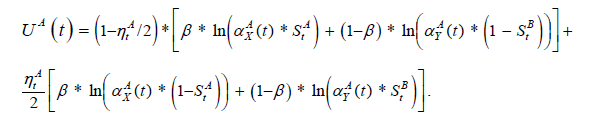
Based on the implication of prospect theory, each individual is pursuing some sort of incremental welfare improvement over the
preceding period with a relative weight defined by parament γ instead of current absolute utility level. The greater the γ , the individual
is more inclined to pursue her utility improvement as well as the enhancement of resources reserved for the next period or generation
than the absolute level of her present wealth (utility). Take into account both the altruistic factor ηtA and the incremental improvement (or cross-generation consideration) factor γ , the individual or country A will now maximize the following inter-temporal value function  denotes the individual’s time preference and plays a cultural role similar to γ in affecting an individual’s intertemporal economic choice.
There are basically two forces interacting within each individual’s mind: one is the internal self-satisfying force, the other is the accommodating force with outer world. The former accounts for the activities that are primarily driven by self-interest, including the seeking of social status, control right, and the satisfaction from material consumption. The latter reflects the interaction of ourselves with others and derives the utility from harmonious relationship with outer environment. The internal self-satisfying force motivates the activities that distinguish ourselves from others and contributes to the innovation and the idiosyncrasy of the real world. The outer accommodating force can explain our gregarious predisposition and cooperative behavior. The interaction of these two forces will contribute to the dynamic adjustment of ηtA,ηtB as well as δ and γ between zero and one. For the simplicity I would focus on the discussion on the dynamic transformation of ηtA and ηtB that reflect the degree of individuals’ or countries’ cooperative attitude toward establishing a more harmonious relationship, and treat δ and γ as exogenously given.
Optimal Decision on Cooperative Strategy and Altruistic Attitude
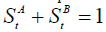
Before deciding the optimal choice of altruistic attitude and corresponding cooperative strategy ηtA and ηtB for individuals A and B, we need to solve the allocation schemes of products X and Y for A and B, i.e.,StA and StB If the product allocation (consumed vs. exchanged) scheme (StA) is entirely determined by the capitalist market mechanism, i.e., if the liberal capitalism prevails, then StA will be determined by the proportion of person A’s production contribution in total outputs’ value which will also equal her consumption (or expenditure) share of total production. Assume there exists one period of lag. Then we will come to the following equation  where the relative price of good X to good Y is pt at time t. Similarly,
 And we have the relationship that
  .
.
According to the ultimate goal of utopian socialism, the total social welfare should idealistically be distributed based on the “need” of each member of the society rather than simply on the “production contribution” of the individual. In other words, the consumption share
of good X would be determined entirely based on good X’s intrinsic value β rather than its production value p*αX. Nowadays the
product allocation mechanism for the prevailing socialism has been compromised somewhere between the market-driven production value scheme (i.e., based on  and the need-based preference share (β). Here for easy illustration I use the same weight (η) to simultaneously characterize the degree of compromise for socialistic goal and the degree of his altruism or
cooperativeness.
and the need-based preference share (β). Here for easy illustration I use the same weight (η) to simultaneously characterize the degree of compromise for socialistic goal and the degree of his altruism or
cooperativeness.
We thereby express the product allocation share of good X for person A at time t  as follows:
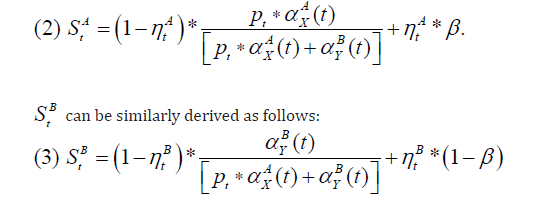
Since the relative price 𝑝𝑡 is defined so that the selling value of good X that is exported (or not consumed) to person B by person A, i.e., 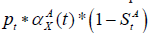 should be equal to the purchase value of good Y imported by person B, i.e.,
  In other words, which can be further expressed below after the substitution of equation (2) for the term 𝑆𝑡𝐴 and equation (3) for the term StB :

According to the Euler equation, we can derive the first order condition for person A’s cooperative strategy choice as follows:
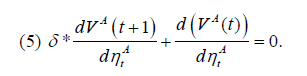
To simplify the discussion in the following we assume that the unit labor production for the two individuals, i.e.,  of X good and
  of Y good, are constant all the time. By examining the equation (1), we know that the impact of ηtA on VA(t +1) and VA(t) is mainly through its direct effect on the term StA and the subsequent indirect effect on UA(t). From equation (2) above, we can readily
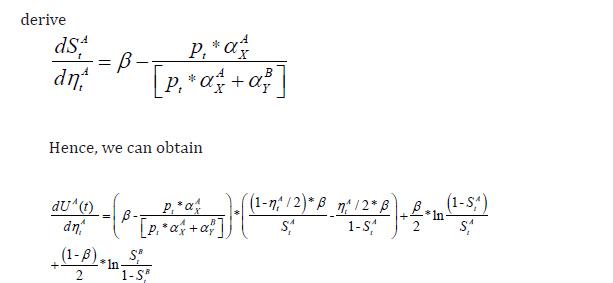
Therefore, the first order condition for the optimal choice of person A’s cooperative strategy ηtA becomes
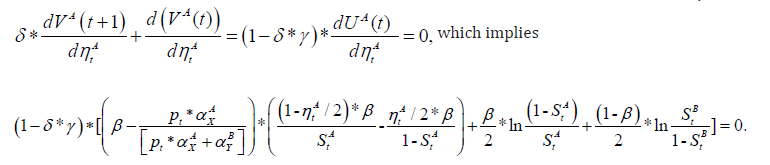
As a result, we can derive the optimal 𝜂𝑡𝐴 as follows:

By the same token,ηtB can be derived below:
 Assume there be one period delay
in the price adjustment. Then t p is described in the equation (4) and StA and StB in equations (2) and (3), are functions of last period’s cooperativeness for both person A and B
Assume there be one period delay
in the price adjustment. Then t p is described in the equation (4) and StA and StB in equations (2) and (3), are functions of last period’s cooperativeness for both person A and B 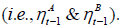 .
Once the optimal choice of cooperation strategy at time t, i.e., ηtA,ηtB is
decided according to equations (6) and (7), we can then determine the price level pt+1, the domestic consumption level (St+1A and St+1A) as well as trade proportion (1-St+1A and 1-St+1A)in the next period t+1, and so on.
.
Once the optimal choice of cooperation strategy at time t, i.e., ηtA,ηtB is
decided according to equations (6) and (7), we can then determine the price level pt+1, the domestic consumption level (St+1A and St+1A) as well as trade proportion (1-St+1A and 1-St+1A)in the next period t+1, and so on.
By examining the equations (6) and (7) we can obtain the following proposition:
Proposition I: Assume that person A obtains a comparative advantage in the production of good X. The less preferrable for the
home-produced good X (i.e., 𝑎 𝑠𝑚𝑎𝑙𝑙𝑒𝑟 β ) or more desirable for the foreign good (i.e., 𝑎 𝑏𝑖𝑔𝑔𝑒𝑟 1-β ), or the system becomes more
open toward trade (i.e., 𝑔𝑟𝑒𝑎𝑡𝑒𝑟 1-StA), or there exists a smaller gap between the production value share ( and its preference share (i.e., β ) , the person A would become more altruistic and behave more cooperatively with its trading partner (i.e., ηtA increases).
Simulation of Culture’s Impact on Economic Behavior
There are several aspects of culture that would play significant roles in affecting an individual’s economic behavior. In the model above the following four variables would be factored into the consideration of the individual’s economic choice for their best consumption shares, StA and StB. The first variable is the altruistic attitude toward the welfare of its trading partner which is represented by parameters, ηtA & ηtB The second variable is an ideological belief about whether the social value of product allocation should be based on one’s production contribution or one’s intrinsic need, which is also represented by ηtA & ηtB. The third variable is an individual’s time preference which is represented by the parameter 𝛿. The fourth variable is reflecting the economic goal of an individual pursuing its absolute hedonistic pleasure at present or seeking an incremental improvement of wellbeing each time which is represented by the parameter γ . We believe that the indoctrination of long-lasting Chinese culture as pivoted by Confucianism would drive the individual toward more growth oriented economic discipline and pitch a relatively higher value of γ or δ . These two variables are treated as exogenously given in the model. Instead, the first two variables are strongly influenced by the reaction of an individual’s trading partner and would be dealt with in a dynamic evolving way. At each point of time the individual would constantly revise its socialistic attitude and the degree of altruism after observing the reaction of its trading partner.
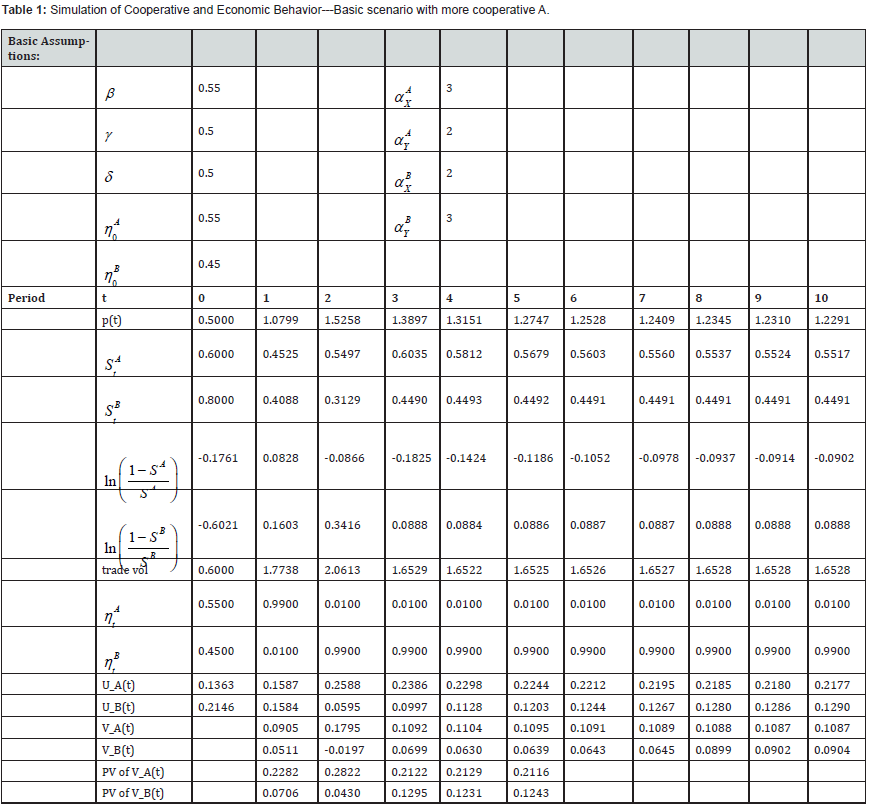
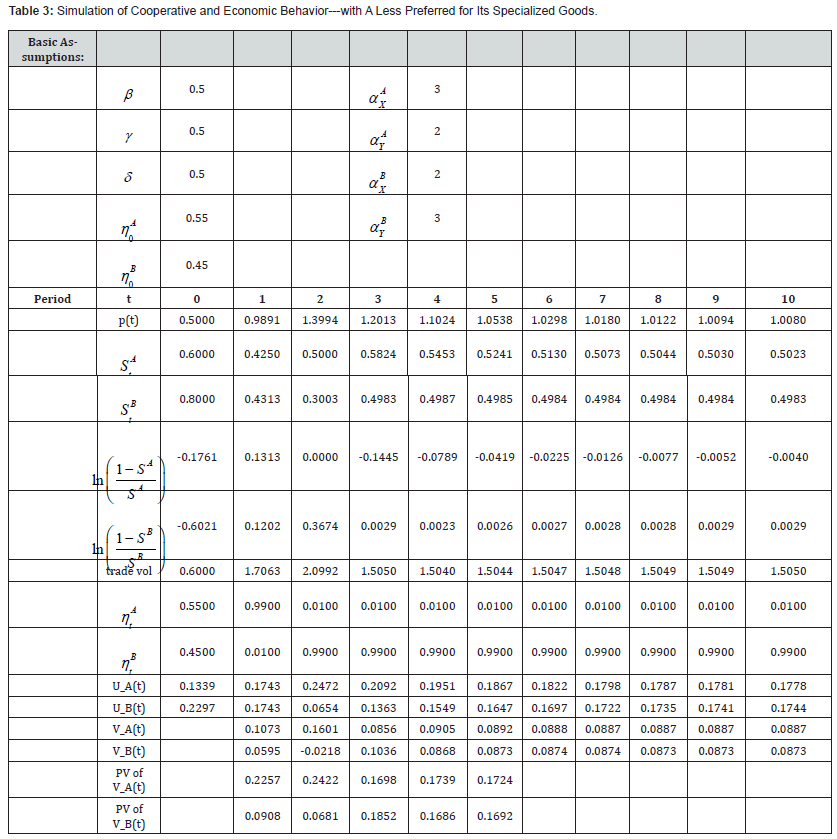
To facilitate the calculation of each period’s cooperativeness I need to input the value of β ,γ ,δ as well as the initial data of ηtA & ηtB and StA & StB in the beginning period. The following three scenarios are considered:
i. Basic scenario: 
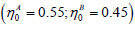
In this benchmark scenario, I assume an expenditure share of β = 0.55 , a time preference factor of δ = 0.5, and a moderate
prospect effect γ = 0.5 . Initially, individual A is slightly more open to trade than individual B  . Furthermore, individual A has a comparative advantage in producing good X, while individual B is more efficient in producing good
Y. This is represented by the ratios
. Furthermore, individual A has a comparative advantage in producing good X, while individual B is more efficient in producing good
Y. This is represented by the ratios  . also assume that, at the outset, individual A exhibits a slightly more cooperative and altruistic attitude than individual
  .
.
As shown in the table above, the degrees of altruism or cooperativeness for individuals A and B (i.e., 𝜂𝑡𝐴 & 𝜂𝑡𝐵) closely align with the levels of openness to their trading partners 
Additionally, the value functions for each period 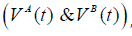 , as well as their present values
 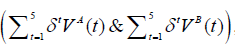 are positively correlated with the individuals’ levels of altruism or cooperativeness
  .
.
Initially individual A is more willing to cooperate and more open to trade than individual B. However, after the first period—during which individual B experiences a greater expansion of trade than individual A--A begins to reverse their cooperative and trading attitude, despite B’s continued improvement in cooperative behavior. Observing that B benefits more from trade, A becomes increasingly hesitant to cooperate. This highlights a tendency for individuals to swing between complete trust and distrust.
As a result, individual A experiences cyclical fluctuation in net welfare (i.e., the present value of all its future value functions) despite an initial period of gain. In contrast, individual B enjoys steady and cyclical benefits from trade following a brief transitional adjustment. Ultimately, the individual who maintains a higher willingness to cooperate and openness to trade realizes a greater net present value of welfare than their trading partner.
ii. Scenario with individual A more far-sighted or greater propensity toward utility improvement:

Comparing Table 2 with Table 1, we observe that individual A experiences a substantial improvement in the net present value of life-time welfare during the initial period. Since each period’s utility function is unaffected by the time preference parameter (δ ) and the prospect theory adjustment factor (γ ), we focus solely on the resulting changes in value functions (VA(t) & VB(t)) across time.
For individual A, a reduction in future utility satisfaction—compared to the baseline scenario in Table 1—leads to a temporary decline in the present value of welfare. However, this initial decline is soon reversed, and utility begins to improve overtime, gradually increasing the overall present value of welfare for individual A.
In contrast, for individual B, a reduction in the time preference factor and the degree of utility improvement significantly enhances satisfaction from future utility gain (𝑖.𝑒., V B (t) increases). Although the net present value of welfare initially declines due to the lower discount factor (smaller δ ), it subsequently increases over time, reflecting a delayed but substantial improvement in overall welfare.
iii. Scenario with a reduction of preference for the goods in which individual A is specialized:

Comparison of Table 3 with Table 1 reveals that a reduction in the preference for the good in which individuals A specializes (i.e., a decrease in β from 0.55 to 0.5) leads to a decline in individuals A’s consumption utility, while simultaneously increasing individual B’s utility in each subsequent period. Consequently, individual A experiences a deterioration in incremental utility gains across all periods except the initial one. In contrast. Individual B enjoys an improvement in incremental utility gains in all periods except the second.
As a result, the net present value of welfare diminishes for individual A due to the declining preference for its specialized good, whereas it improves for individual B.
The weakening preference for individual A’s specialized product worsens its terms of trade, compelling a larger share of domestic production to be allocated toward trade (i.e., an increase in 1−SAt) in order to maintain trade balance.
Based on the simulation results, the following proposition is proposed:
Proposition II: The dynamics of cooperative attitudes and corresponding economic behavior between two trading entities
(individuals or countries) tend to evolve as follows:
i. Initial Asymmetry and Behavioral Fluctuation: A small initial gap in cooperative attitudes can trigger wide fluctuations in
the cooperative behavior, ranging from complete trust to complete distrust, and vice versa. Corresponding changes in economic welfare will
follow. An individual A (or country) that begins with a greater willingness to cooperate and openness to trade may enjoy a short-term
welfare gain. However, upon perceiving that its trading partner disproportionately benefits from this openness, it may sharply reverse
its cooperative stance. Consequently, the net present value of welfare will exhibit cyclical fluctuations for both entities, with the initially
more cooperative partner (individual A) realizing relatively larger gains.
ii. Impact of Time Preference and Growth Orientation: A Far-sighted or less hedonistic attitude tends to generate short-time
welfare improvements that taper off over time. A growth-oriented mentality may amplify early utility gains but diminish long-term
benefits. A stronger preference for future outcomes (i.e., a lower discount rate) leads to cyclical fluctuations in the net present value
of welfare. Consequently, a more myopic orientation—prioritizing immediate utility—initially suppresses utility improvements and
welfare but eventually stabilizes, exhibiting milder cyclicality.
iii. Specialization in a more or less Favored Good: Specialization in a relatively less favored good diminishes an individual’s
consumption utility in each period and reduces the net present value of future incremental utility gains, while simultaneously enhancing
these outcomes for the trading partner. When an individual possesses a comparative advantage in producing a good that is less preferred
in the consumption basket, the perceived benefit from trade declines, and the terms of trade worsen relative to its counterpart. As a
result, both the consumption utility and the net present value of welfare for the individual specializing in the less favorable good—here,
individual A—deteriorate over time.
Empirical Study of the Impact of Ideological Belief on Economic Development
In this model presented above, four variables are utilized to characterize a country’s ideological beliefs. The first variable is the altruistic attitude toward the welfare of its trading partner, represented by parameters, ηtA & ηtB. The second variable pertains to ideological belief regarding whether the social value of product allocation should be based on one’s production contribution or one’s intrinsic need; this is also represented by ηtA & ηtB. The third variable is an individual’s time preference, represented by the parameter 𝛿. The fourth variable reflects the economic goal of an individual pursuing absolute hedonistic pleasure in the present or seeking an incremental improvement in well-being over time, represented by the parameter 𝛾.
This paper aims to pinpoint the role of culture in deciding an individual’s economic behavior via a dynamic transformation of its utility preference between self-interest and altruism (i.e., η) when exposed to external impetus, such as trade. In the context of a country, this transformation of utility function can be metaphorically understood as a dynamic choice between economic growth and social equality or between market-oriented capitalism and fairly-distributed socialism. Each country strives for higher economic growth while maintaining control over or avoiding widening income inequality. The issue of a government’s prudent economic policy is analogous to an optimal asset allocation problem for an investor facing the trade-off between expected return and risk.
The theory of the Capital Asset Pricing Model (CAPM) demonstrates that, in a market equilibrium, an investor’s ultimate portfolio
choice should be determined by the Sharpe ratio, defined as the expected excess return divided by the standard deviation of a market
portfolio, i.e.,  where
where  are the expected return and standard deviation of a market portfolio, respectively, and rf is risk-free rate. This Sharpe ratio also reflects the degree of an individual’s relative risk aversion, calculated as the minus second derivative divided by the first derivative of the individual’s utility function, i.e., -U"/U'[8].
Based on the construction and elaboration of model developed in this paper, the parameter η above that measures an individual’s utility weight between self-interest and social altruism (or the concern for other’s interest) can be interpreted as the country’s cultural Sharpe ratio. This ratio reflects the premium for its accepted social risk, or the required utility improvement needed to compensate for an increase in social inequality. Consequently, I will use a country’s GDP growth rate (r) as a proxy for utility improvement and Gini Index as a proxy for income inequality. Thus, the cultural Sharpe ratio is defined as cultural Sharpe ratio = r/Gini Index.
A relatively far-sighted individual who places a greater weight on future welfare (i.e., a higher δ ) or seeks incremental improvement in well-being each time rather than pursuing immediate absolute hedonistic pleasure (i.e., a higherγ ) will tend to save more. Therefore, the parameters δ or γ are measured by an individual’s saving rate.
Table 4 below describes the data inputs required to measure these four parameters for the US and China from 2001 to 2022. The data on Gross Domestic Product (GDP) in terms of trillion US dollars (and its associated GDP growth rate (r)) and saving rates (%) for the US and China are sourced from the World Bank. The Gini Index data are derived from World Bank estimates. While the Gini Index data for the U.S. is fairly complete, the data for China’s Gini Index for some years between 2001 and 2021 are unavailable. Additionally, the latest available data for China’s Gini Index is for 2021. I interpolate and extrapolate values to fill in the gaps between data points.
Table 5 shows the impact of these cultural factors on GDP performance for the U.S. and China. By conducting a correlation analysis between GDP, the saving rate, and the cultural Sharpe index, we can conclude that a country’s saving behavior is the primary driver of its economic performance. China’s relatively higher saving propensity compared to the US (47.6 % versus 15.3%, as shown in Table 4) has led to its relatively higher GDP growth rate over the last 20 years (13.5% versus 4.3%, as shown in Table 4).
The altruistic or socialistic attitude, as represented by cultural Sharpe ratio, has a negative influence on China’s GDP while positively contributing to the U.S. GDP performance. China’s policy, based on the doctrine of socialistic capitalism which places relatively greater emphasis on social equality and harmony than on economic growth, has negatively impacted its absolute GDP performance. In contrast, the U.S. GDP performance benefits from its focus on the discipline of entrepreneurship, with relatively less emphasis on social equality. Over the last two decades, China has demonstrated a relatively higher cultural Sharpe ratio than the U.S. (0.33 versus 0.11, as shown in Table 4). This observation is further supported by the impact of Gini index on GDP. China’s society, with its more equalized Gini index compared to that of the U.S., has also incurred a cost in terms of GDP performance.
The measurement of the cultural Sharpe ratio reflects a country’s reservation or premium needed to compensate for its social inequality. A higher cultural Sharpe ratio indicates a greater socialistic or altruistic orientation and suggests a higher willingness to cooperate. However, in the arena of international trade, this measurement cannot fully capture a country’s cooperative attitude toward its trading partner. Instead, I propose using the foreign country’s GDP growth rate as a proxy for a nation’s main concern in contributing to its domestic GDP performance. In the last two columns of Table 5, we can see that a more cooperative attitude toward trade with the U.S. by incorporating U.S. GDP growth as a primary concern has significantly contributed to China’s economic performance since it joined the WTO in 2001. In contrast, the situation is quite different in the case of the U.S. whose GDP has deteriorated from the incorporation of China’s growth input.
Policy Implications on the Confrontation between China and the U.S.
History abounds in the confrontation and competition between state and market system. We cannot take the market system—which produces such plenty and so many solutions—for granted. Markets are essential to progress, to finding solutions to our most pressing problems, but they don’t exist in a vacuum. Markets are social constructs, whose effectiveness is determined partly by the rules of the state and partly by the value of society. If left unattended they will corrode those values. We must concentrate on rebuilding social capital to make markets work. To do so, individuals and their institution must rediscover their sense of solidarity and responsibility for the system. More broadly, by rebasing valuation on society’s values (culture), we can create platforms of prosperity.
Trade is an effective conduit to transmit one’s intention of cooperation. A political system to become (state) socialism or (market) capitalism can be either a cause or an outcome for this eventual choice of cooperation strategy. Whether a country or a political party should pursue its left, right or moderate economic policy will be deemed as an external as well as internal ramification from an intense and sophisticated interaction for the two trading partners. One of the implications of this study is that unless the two parties or systems are well coordinated in their initial cooperative attitudes, or highly resonated in their time preference and the degree of openness toward trade, we will witness a great fluctuation of cooperation behavior or even bring to a complete breakdown of mutual trust in the end.
The computer simulation of the trade model with distinct cultural background provides some less sanguine warning of mistrustful confrontation as vividly exhibited between the US and China today. One way of showing the initiative of cooperativeness or “jen” could not anticipate the exact same feedback from the counterparty. Once the gain from trade is unevenly distributed might trigger an entirely opposite response from each other and result in a long-term repercussion of welfare outcome. In other words, simply relying on the exchange through bilateral trade could not fundamentally iron out the cultural gap deeply rooted between the trading entities. Other alternatives like culture reconciliation, assimilation or recognition from each other are indispensable to fend off the current predicament of creeping distrust between the two countries or economic systems.
It is unlikely that China will actively seek conflict. Nor will it seek convergence, knowing full well that the gulf that divides these two nations in terms of values, beliefs, and systems will never fully close. This has been a historical tradition: even at the height of its preeminence in the world up until the Industrial Revolution, China did not seek to spread values or make efforts to proselytize the relevance of its culture and institutions. In the words of Henry Kissinger in his book On China, “China did not export its ideas but let others come to seek them.” A sensible approach today would call for both countries to look after their own security while respecting each other’s needs and desires, and for an ongoing dialogue about shared global challenges that will gradually bring the two nations closer together.
As shown in the empirical results (Tables 4 & 5) in Section IV, a country’s saving rate, which reflects its time preference, has a positive correlation with its GDP. China’s relatively high GDP growth over the last two decades, compared to the U.S. (13.5% versus 4.3%), can be attributed to its higher saving rate compared to that of the U.S. (47.6% versus 15.3%). However, this significant distinction in saving behavior between the two trading partners may encourage a country to externalize the gap between consumption and production, leading to trade imbalances. Particularly when the divergence in GDP growth rates is substantial, as seen between the U.S. and China, this dramatic trade imbalance problem can provide U.S. President Donald Trump a timely rationale for proposing a drastic tariff reform. Ideally, the best outcome would be a new trade agreement among economies committed to managing their domestic economic imbalances rather than externalizing them in the form of trade surpluses.
As a proxy for measuring a country’s altruistic or socialistic attitude, this study employs the cultural Sharpe ratio, defined by the ratio of GDP growth rate to the Gini index. This ratio quantifies the required premium for the accepted social risk, or the utility improvement needed to compensate for an increase in social inequality. Empirical studies have demonstrated that a country that embraces a more socialistic or Confucianism-like political culture--such as China--tends to promote a more harmonious society, evidenced by a lower Gini Index. However, this often comes at the cost of reduced economic growth. Therefore, moderation of economic policy goal between growth and equality should be carefully considered and adopted during different stages of economic development.
Since joining the WTO in 2001, particularly benefitting from access to the vast U.S. consumer market, China’s GDP has surged from $1.34 trillion to $7.96 trillion in 2022, allowing it to narrow the gap with its major trading partner, the United States. This divergence in economic growth rate has gradually widened the gap in cultural Sharpe ratios, inadvertently fostering mutual mistrust regarding each other’s willingness to cooperate in trade. The growing asymmetry in cooperative attitudes may significantly weaken the desire for trade and fuel rising ant-globalization sentiment. Moreover, a country’s time preference--shaped by inherited culture and social structures-- can influence its approach to international trade and potentially contribute to the formation of a Thucydides Trap.
Two other implications can be derived from this study. The Chinese culture that stresses the long-term gain rather than the shortterm instant pleasure would plant in a seed for the cyclical fluctuation of public welfare according to the implication of prospect theory. This cyclical phenomenon is particularly distinctive in the Chinese history which abounds with the ups and downs of dynasties. Another policy implication for the China’s government can be obtained from proposition II above that the government should devote more resources to develop those industries whose consumption value cater to its comparative advantage of production rather than simply for the fanfare of so-called national pride.
Conclusion
Some scholar [9-11] argues that institutions themselves—domestic or international—are ultimately no more than a shoal of red herring when it comes to economic progress: we should instead focus on developing the ethical forces that underpin markets. In her monumental trilogy examining the economic and social success of the ‘bourgeoisie’, Deirdre McCloskey argues that the importance of institutions is hugely overrated. In her view, the key driver of economic advance is ‘trade-tested betterment’, an ethical approach to economic exchange first elucidated by Adam Smith, Jane Austen and Benjamin Franklin. In her world, the ethics of good business revolves around the idea that human beings are not merely profit-maximization or utility-maximizing drones, but instead people capable of integrity, trust, respect, prudence, thrift, affection and the other ‘bourgeois virtues [12].’
The deepening chasm of distrust between the US and China did not develop overnight. It has been fueled by a vast array of accumulated political and strategic perceptions. The diplomatic formulations used by each side about the other are no longer believable. This study peels off those diplomatic languages and looks into the intrinsic relationship developed through economic interaction. The quintessence of bilateral trade dispute is the ideological gap about the system choice between the state and market. Neither of the two systems can claim its absolute superiority over the other. The ramifications of sporadic Sino-US economic confrontation are the phenomenon of cyclical cooperation and noncooperation as observed in the past decades as well as the root cause for the fall and rise of dynasties in the Chinese history [13,14].
This study is a small step to theorize the economic interaction between the entities with diverse cultural background. Some implications from this model may shed some light on the persistent angst on the deglobalization tide plaguing the world and the deepening distrust between the US and China. Trade itself is not an effective tool to shrink this widen cultural schism. More understanding and appreciation of diverse culture background in the world through education and culture exchange is indispensable. The cyclical fluctuation of cooperative behavior is particularly evident in the society embedded with a long historical heritage that emphasizes the respect for ancestors, family elders and country leader like China. Finally, this study recommends several prudent industrial policies, including balancing economic growth with inequality reduction and managing domestic economic imbalances rather than externalizing them through persistent trade surpluses, to ensure long-term global welfare.
References
- Hu L (2005) Cyclical Cooperation and Non-cooperation in an Economic Organization—Implications for the Japanese Economy. ICSEAD (The International Centre for the Study of East Asian Development, Kitakyushu) Working paper Series.
- Galor Oded (2022) The Journey of Humanity—The Origins of Wealth and Inequality. Dutton, an imprint of Penguin Random House.
- Rudd K (2022) The Avoidable War—The Dangers of a Catastrophic Conflict between the US and Xi Jinping’s China. Public Affairs, New York.
- Tu Wei-ming (1968) The Creative Tension between Jen and Li. Philosophy East and West 18(1-2): 29-39.
- Jesús Solé-Farràs (2008) Harmony in Contemporary New Confucianism. China Media Research 4(4).
- Shambaugh D (2008) China’s Communist Party: Atrophy and Adaptation. Woodrow Wilson Center Press, Washington, D.C.
- Kahneman D and Tversky A (1979) Prospect Theory: An Analysis of Decision under Risk. Econometrica 47(2): 263-292.
- Beneplanc Gilles and Jean-Charles Rochet (2011) Risk Management in Turbulent Times. Oxford University Press, New York.
- McCloskey D (2006) The Bourgeois Virtues. University of Chicago, United States.
- McCloskey D (2010) The Bourgeois Dignity. University of Chicago, United States.
- McCloskey D (2016) The Bourgeois Equality. University of Chicago, United States.
- Hu L (1995) Cyclical Cooperation and Noncooperation. Academia Economic Papers 23(1): 57-93.
- Jin Keyu (2023) The New China Playbook—Beyond Socialism and Capitalism. Viking, an imprint of Penguin Random House.
- Kissinger H (2011) On China. The Penguin Press.

























