




 ASM Home



Abstract
Given the instability of foreign direct investment (FDI) and its contribution to GDP, this study aimed to estimate the desired level of FDI and its contribution to the Saudi economy during the period 1990-2023, using a partial adjustment model and probability distribution. This study showed that a 10% increase in both real GDP and the degree of economic openness leads to an increase in FDI of 9.1% and 3.9%, respectively. A 10% increase in carbon dioxide (CO2) emissions leads to a 10.7% decline in FDI. Foreign direct investment is expected to decline from SAR 103.05 billion in 2025 to SAR 76.14 billion in 2030, especially in light of current and anticipated military tensions and wars in the Middle East. The upper limit of the probability of foreign direct investment contributing to GDP is 3.55% at a 95% confidence level. Therefore, it is necessary to increase it to 5.7% in accordance with Saudi Vision 2030. This will be achieved through creating an investment climate, continuously announcing investment activities and opportunities available to foreigners, and improving environmental quality.
Keywords:Foreign Direct Investment; Saudi Economy; Probability Distribution; Saudi Vision 2030
Introduction
Foreign investment may be direct, known as long-run real investment in productive assets, or indirect, known as short-run, non-real investment, such as investment in securities. Foreign direct investment refers to a company’s investment in projects located outside the borders of its home country in various forms, including establishing a new project, acquiring assets of an existing facility, or through mergers and acquisitions. The advantages of foreign direct investment are numerous, including: (1) reducing imports and increasing export-oriented production, (2) contributing to driving economic development, (3) improving local investment through the inflow of capital and local savings, (4) developing a competitive among local companies, (5) reducing unemployment rates through the establishment of new projects, (6) increasing rates of economic growth and development through the provision of capital [1].
Some studies have focused on foreign direct investment (FDI). Hussein [2] studied FDI and its impact on growth and economic integration in the Gulf Cooperation Council (GCC) countries. This study showed that FDI contributes to increasing economic growth rates, producing many goods, encouraging inter-regional trade, and increasing economic integration among the GCC countries. Al-Sayari and Al-Bakr [3] studied FDI in the GCC countries. Their study showed that FDI flows to the GCC countries are positively affected by investment flows in the previous year, the abundance of natural resources, the presence of regulations, and economic growth. This study recommended the need to attract investments with added value to the economy, which contribute to creating new job opportunities and localizing technology. A study of [4] indicated that foreign investment is the main source of economic growth in least developed countries, as it contributes to increasing exports and economic development rates. This study recommended the following: (1) The necessity of creating an appropriate investment environment to localize foreign investments, establish development projects, and provide job opportunities; (2) Expanding markets through joint Arab action, with the aim of increasing international competitiveness; (3) The necessity of transitioning to a green economy, given its importance in attracting foreign investments. Then, Rahma’s study [1] demonstrated that the determinants of foreign direct investment (FDI) are represented by gross domestic product (GDP), government spending, economic openness, export value, and inflation. The study revealed a long-term relationship between the independent variables and FDI. In the short run, a significant relationship was found between GDP and FDI. Tayer’s study [5] also examined the determinants of attracting foreign direct investment in the Kingdom of Saudi Arabia. This study revealed that the tax burden is the most influential variable in the long run, followed by political and security stability, loans provided to the private sector, and economic openness. Ghanem et al. [6] studied the impact of environmental protection on foreign direct investment (FDI) flows to the Kingdom of Saudi Arabia. This study revealed that the Middle East Green Initiative led to a decrease in carbon dioxide emissions, due to improved energy efficiency in key sectors, in addition to the shift towards solar power generation. Despite the importance of FDI in developing the national economy, it has been characterized by instability. It was also found that a 10% increase in domestic consumption of refined petroleum products leads to a 7.97% increase in carbon dioxide emissions. A 10% increase in both estimated carbon dioxide emissions and the inflation rate leads to a 4.71% and 2.3% decrease in FDI, respectively. A 10% increase in economic openness leads to a 34.42% increase in FDI. A study by Hakimi [7] addressed the legal foundations supporting foreign investment in the Kingdom of Saudi Arabia. This study revealed that to achieve the goals of Vision 2030, the Public Investment Fund was developed and the rules and regulations governing investment were amended to align with the vision’s objectives. This study recommended the need to update the foreign investment system and its executive regulations, particularly with regard to the conditions and procedures for granting licenses, adding certain projects to the list permitted for foreign investors, and providing a clear investment map of the most important projects offered for foreign direct investment and the sectors they cover. A study by Al-Adadi [8] demonstrated that foreign direct investment stimulates local investment, increases capital formation, and aids in technology transfer to the host country. This study also confirmed that foreign direct investment has a positive impact on the Saudi economy, despite its decline in some years due to the coronavirus crisis.
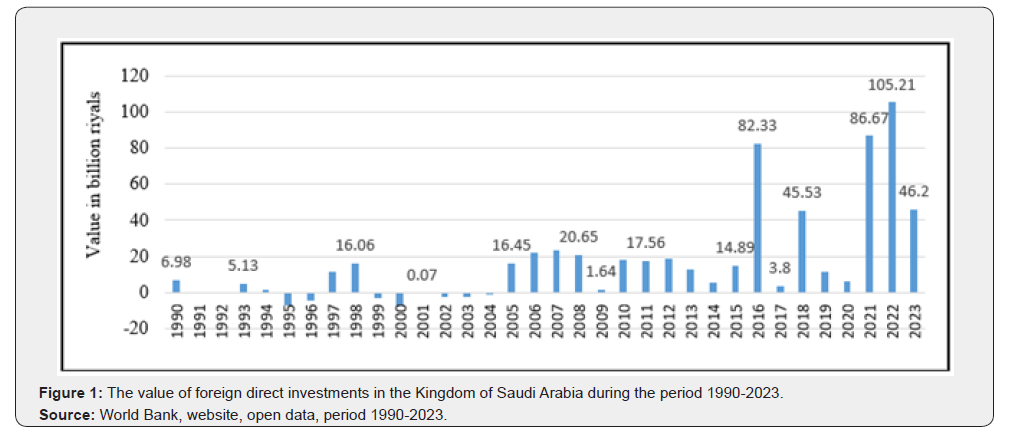
By monitoring the flow of foreign direct investment (FDI) into the Kingdom of Saudi Arabia, it was found that its value was characterized by instability, ranging from a low of -7.05 billion riyals in 2000 to a high of 105.21 billion riyals in 2022. It is well known that the instability of foreign direct investment hinders the localization of imported technology and its contribution to the gross domestic product, and thus the instability of the economic growth rate, which declined from 9.8% in 1991 to -0.6% in 1999, then increased to 8.8% in 2003, and then decreased to -0.8% in 2023 [9].
Research Objectives:
This research aimed to estimate the desired level of foreign
direct investment (FDI) and its contribution to the Saudi economy
during the period 1990-2023. This was achieved by examining the
following objectives:
i. The current status of FDI flows to the Kingdom of Saudi
Arabia.
ii. Estimating the desired or targeted level of FDI until
2030.
iii. Estimating the percentage or potential contribution
of FDI to the Kingdom of Saudi Arabia’s gross domestic product (GDP).
Materials and Methods
To achieve its objectives, this study relied on data from: (1) the annual statistics issued by the Saudi Central Bank (SAMA), and (2) the World Bank website. To achieve its objectives, this study also relied on estimating the Partial Adjustment Model, a long-run dynamic model that can be formulated as follows:

Where: represents the target level of foreign direct investment value, Xt represents the factors determining the flow of foreign direct investment, the most important of which are: real GDP (X1),the inflation rate prevailing in the Saudi economy (X2) ,the degree of economic openness expressed as the ratio of foreign trade (exports + imports) to GDP (X3), the productivity factor of invested capital , environmental quality expressed as carbon dioxide emissions (X5),et represents the random error.
The model was estimated as a preliminary step in the short run as follows:

Where: represents the adjustment coefficient and its value ranges between zero and one. The value of determines the speed of adjustment, while the average adjustment lag is equal to (1−λ ) / λ. The model is estimated using the ordinary least squares (OLS) method [10].
The contribution of foreign direct investment to GDP was also estimated through the following economic equations [11]:
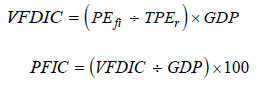
Where:
VFDIC represents the value of foreign direct investment contribution.
PE fi represents the productivity elasticity of foreign investment.
TPEr represents the sum of the production elasticities of resource
possibilities.
GDP represents gross domestic product.
PFIC represents the percentage of foreign direct investment
contribution.
The Bernoulli distribution, sometimes known as the binomial
distribution, and standard errors at a 95% confidence level were
used to estimate the proportion or probability of foreign direct
investment’s contribution to GDP. When estimating the proportion
or probability of contribution, the estimate is accompanied
by standard errors, which are taken into account when estimating
confidence intervals, as follows:
Standard error of probability at 95% confidence level = 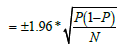
95% confidence interval for probability = 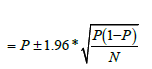
Where: represents the probability of contributing to the GDP, represents the probability of not contributing, represents the length of the time series 1990-2023 Gujaratic, Arabization and review by Odeh and Al-Dash, 2015)).
Results and Discussion
The Current Status of Foreign Direct Investment (FDI) Flows into the Kingdom of Saudi Arabia:
A study of the current status of FDI flows into the Kingdom of Saudi Arabia during the period 1990-2023. (Figure 1) and (Table 1) 1 showed that foreign direct investment (FDI) ranged from a minimum of -7.05 billion riyals in 2000 to a maximum of 105.21 billion riyals in 2022, with an annual average estimated at approximately 16.88 billion riyals. FDI increased at an annual growth rate of 9.95% during the study period. The ratio of foreign direct investment to GDP ranged from a minimum of -1.31% in 1995 to a maximum of 3.3% in 2016, with an annual average estimated at approximately 0.72% during the study period. In general, the ratio of foreign direct investment to GDP increased at an annual growth rate of 5.1% during the study period. Both foreign direct investment and its ratio to GDP were characterized by instability, with the coefficient of variation reaching 159.17% and 151.4% for each, respectively.
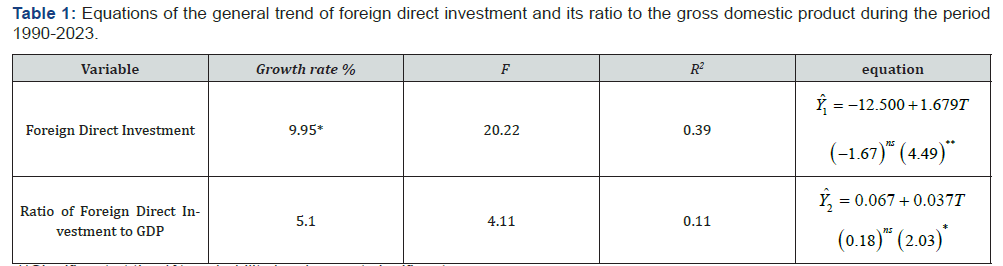
**Significant at the 1% probability level, ns not significant. Source: Calculated from the data in (Table 1).
Estimating the Desired or Targeted Level of Foreign Direct Investment Characterizing the Determining Variables of Foreign Direct Investment:
By studying the current situation, the flow of foreign direct investment into the Kingdom of Saudi Arabia was characterized. Regarding the determining factors of foreign direct investment, the data in Tables (2 and 3) indicate an increase in real GDP from SAR 1,211.2 billion in 1990 to SAR 3,468.5 billion in 2023. This means that real GDP increased at an annual growth rate of 3.4% during the study period. The deflator, as an indicator of the inflation rate,
*The growth rate was calculated using the following law 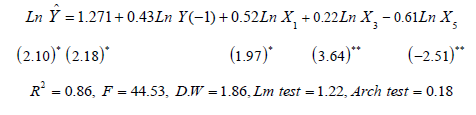 increased from 36.37% in 1990 to 118.9% in 2022, then decreased
to 115.4% in 2023, with an annual average of 69.14%
during the study period. In general, the deflator increased at an
annual growth rate of 4.0%. The capital productivity coefficient
decreased from 520.7% in 1990 to 337.1% in 2015, and then increased
to 339.0% in 2023. In general, the capital productivity
coefficient decreased at an annual rate of 1.1% during the study
period.
increased from 36.37% in 1990 to 118.9% in 2022, then decreased
to 115.4% in 2023, with an annual average of 69.14%
during the study period. In general, the deflator increased at an
annual growth rate of 4.0%. The capital productivity coefficient
decreased from 520.7% in 1990 to 337.1% in 2015, and then increased
to 339.0% in 2023. In general, the capital productivity
coefficient decreased at an annual rate of 1.1% during the study
period.
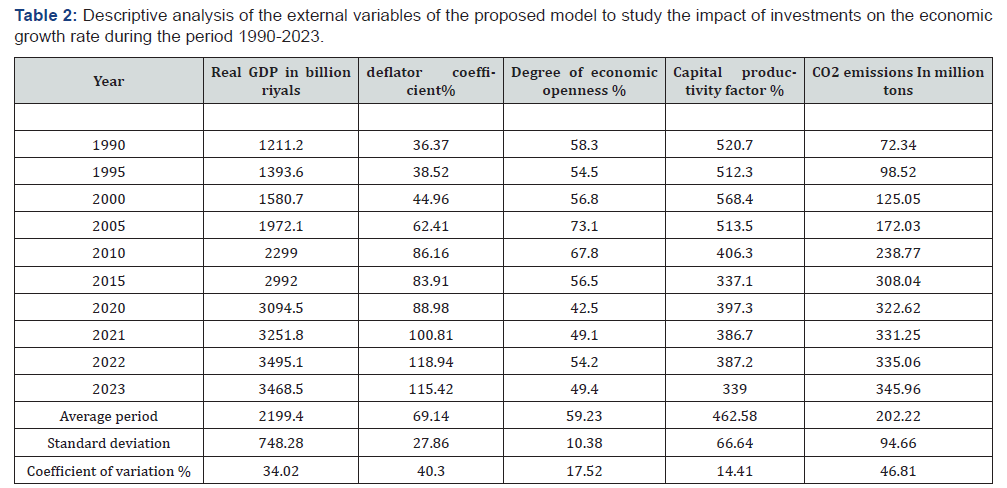
Source: Compiled from: (1) Saudi Central Bank, Open Data Platform, period 1990-2023, (2) World Bank, Open Data, period 1990- 2023.
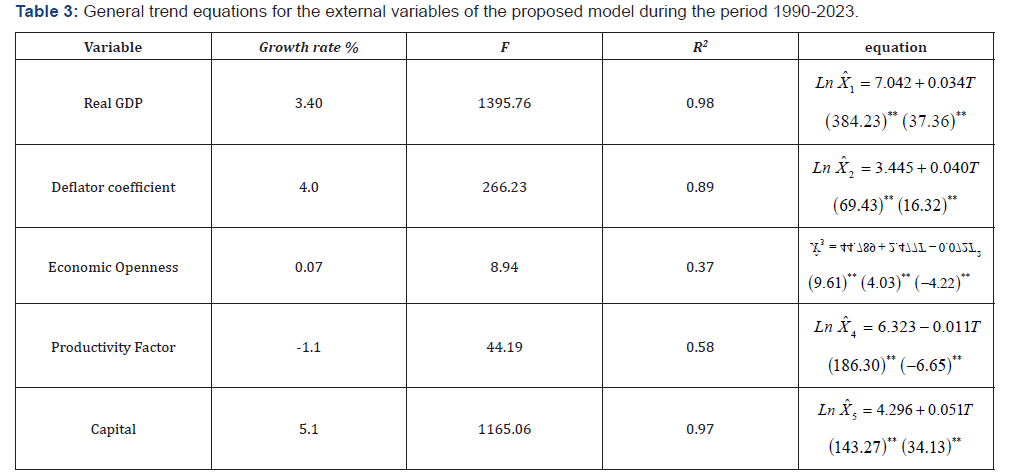
**Significant at the 1% probability level, ns not significant. Source: Calculated from the data in (Table 2).
The degree of economic openness, expressed as the ratio of the value of foreign trade (exports + imports) to GDP, increased from 58.3% in 1990 to 82.5% in 2008, and then decreased to 49.4% in 2023. Overall, the degree of economic openness increased at a small rate of 0.07% per year during the study period. Carbon dioxide (CO2) emissions also increased from 72.34 million tons in 1990 to 346.0 million tons in 2023, i.e., an annual growth rate of 5.1% during the study period.
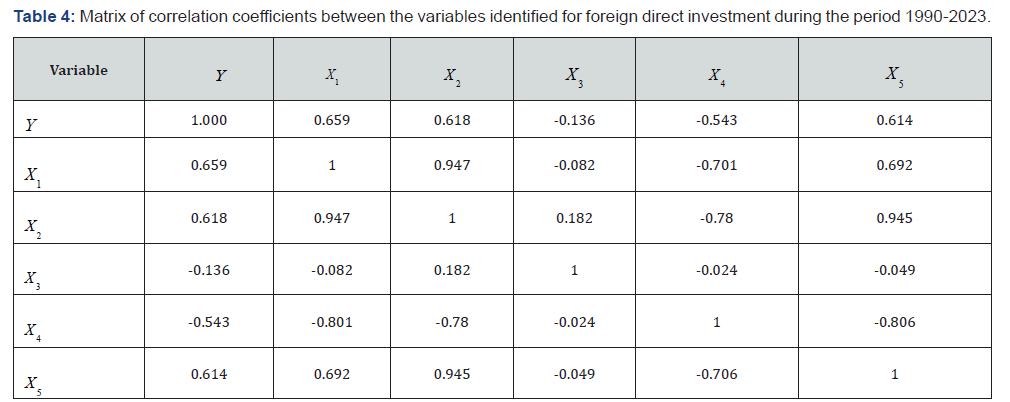
The correlation coefficient matrix between the variables identified for foreign direct investment was estimated. The data in (Table 4) reveal a strong correlation (0.947) between real GDP and the prevailing inflation rate in the Saudi economy. There is also a strong correlation (0.945) between the prevailing inflation rate and environmental quality, expressed as carbon dioxide emissions (CO2). There is also a strong correlation (0.806) between environmental quality and the productivity of invested capital. Therefore, both the inflation rate and the productivity of invested capital were excluded to eliminate the problem of multicollinearity, which leads to large standard errors and inaccurate regression coefficients, thus making the effect of the independent variable insignificant [10].
Source: Collected and calculated from the data in (Table 2).
Estimating the Target Level of Foreign Direct Investment (FDI) by 2030
Foreign direct investment (FDI) is determined by a number of factors, the most important of which are: market size (real GDP), the prevailing inflation rate, the degree of economic openness, the productivity of invested capital (the ratio of value added to total domestic investment), and environmental quality, expressed in terms of carbon dioxide emissions (CO2). By conducting a stepwise multiple regression analysis, the target level of FDI was estimated using a partial adjustment model in the short run and can be expressed as the following equation:
Note:
Significance at 0.05*
Significance at 0.01**
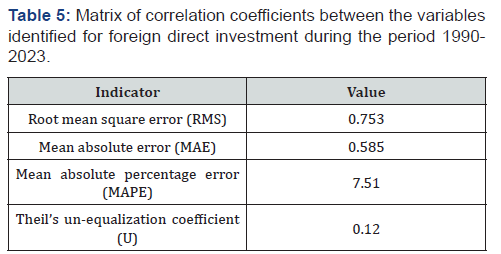
The estimated model is clearly free of the problem of autocorrelation of the residuals in the short run according to the value of D.W, and the insignificance of the value of (F) for the Breusch-God- Frey serial correlation LM Test, which is 1.22. There is also no autocorrelation in the variance of the series, due to the insignificance of the value of (F) for the Arch Test, which is 0.18. The estimated model also has good efficiency in representing the data used in the estimation, according to the indicators measuring the efficiency of the model, the most important of which is the coefficient of unequal distribution of Theil (U-Theil), whose value is close to zero (Table 5).
Source: Compiled and calculated from the short-run estimated econometric model used in this study.
It is also clear that the value of is equal to 0.43, so the value of is equal to 0.57. Therefore, the model is converted from the short run to the long run by dividing by the value of . Then the model in the long run becomes as follows:

The long-run model shows that a 10% increase in both real GDP and the degree of economic openness leads to a 9.1% and 3.9% increase in FDI, respectively. Environmental quality, mea sured by carbon dioxide (CO2) emissions increased by 10%, is shown to decrease FDI by 10.7%, according to the estimated longrun model.
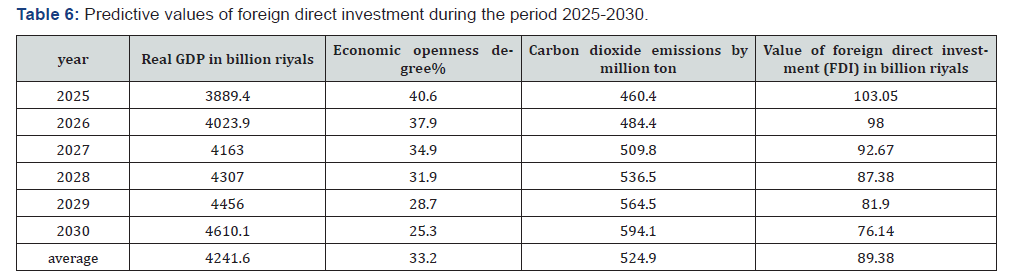
The value of foreign direct investment in the Kingdom of Saudi Arabia until 2023 was predicted by forecasting the external variables of the estimated model, using the general trend equations shown in (Table 3). The data shown in (Table 6) show the following: (1) Real GDP is expected to increase from 3,889.4 billion riyals in 2025 to 4,610.1 billion riyals in 2030, with an annual average estimated at approximately 4,241.6 billion riyals; (2) The degree of economic openness will decrease from 40.6% in 2025 to 25.3% in 2030, with an annual average estimated at approximately 33.2%; (3) Carbon dioxide emissions (CO2) will increase from 460.4 million tons in 2025 to 594.1 million tons in 2030, with an annual average estimated at approximately 524.9 million tons. In light of the predictive values of the external variables in the long-run model, foreign direct investment is expected to decline from SAR 103.05 billion in 2025 to SAR 76.14 billion in 2030, with an annual average estimated at approximately SAR 89.38 billion during the period 2025-2030.
Source: Calculated from the equations in (Table 3) and the standard economic model estimated in the long run.
Estimating the Contribution of Foreign Direct Investment to the Saudi Economy Estimating the Contribution of Foreign Direct Investment to the Gross Domestic Product (GDP)
To estimate the contribution of foreign direct investment to the GDP, it was necessary to estimate the GDP function using resource potential, most notably agricultural land (cropped area), total employment, total domestic and foreign direct investment, and water resources used for both agricultural and industrial purposes. By conducting multiple regression analysis in both linear and double logarithmic forms, the double logarithmic model proved superior and could be expressed by the following equation:

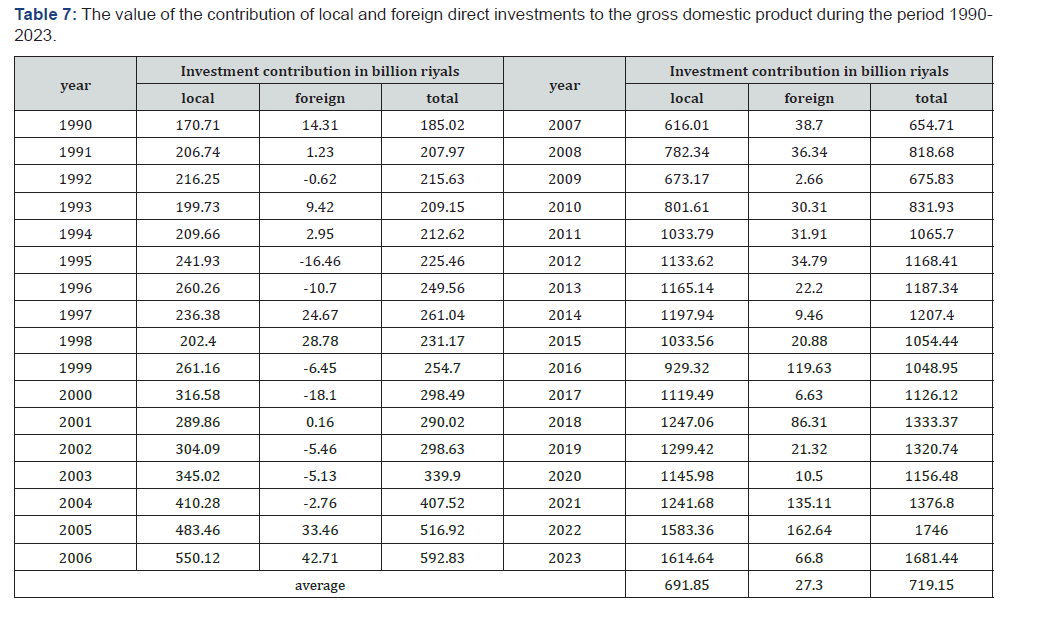
The estimated model shows that a 10% increase in agricultural land area, total employment, total domestic and foreign direct investment, and the amount of water resources used in the agricultural and industrial sectors would increase GDP by 1.22%, 5.11%, 4.81%, and 0.32%, respectively. Given the production elasticity of domestic and foreign direct investment (DDI) of 0.481, the sum of the production elasticities of resource potential (RPP) of 1.146, and GDP, the contribution of total domestic and foreign direct investment to GDP was estimated, ranging from a minimum of SAR 185.02 billion in 1990 to a maximum of SAR 1,746.0 billion in 2022, with an annual average estimated at approximately SAR 719.15 billion during the period 1990-2023 (Table 7).
Source: Calculated from the equations in (Table 3) and the standard economic model estimated in the long run.
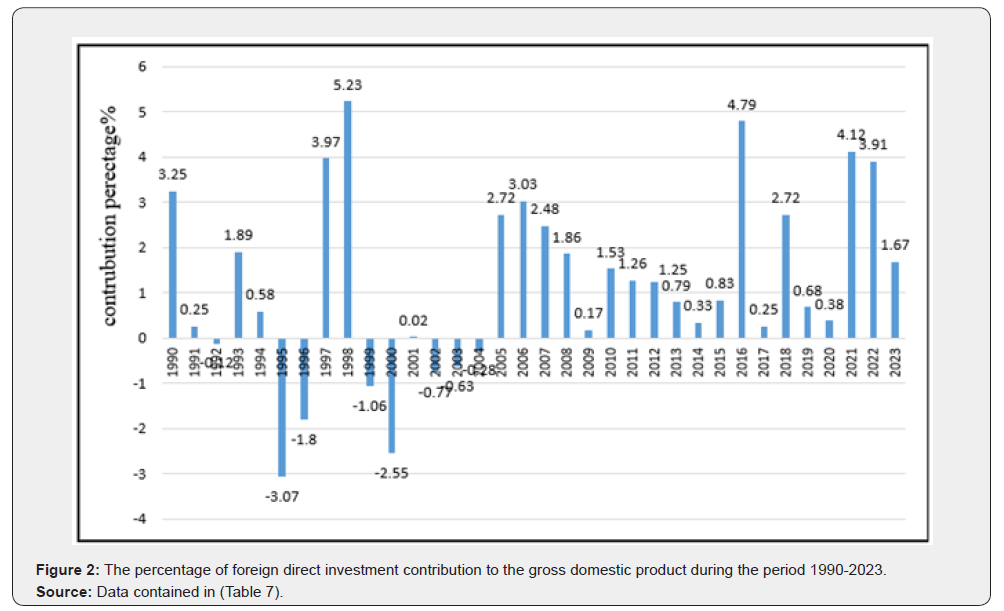
Given that foreign direct investment (FDI) accounted for 4% of total investments in the Saudi economy during the period 1990- 2023, the value of FDI’s contribution to GDP was estimated, ranging from a minimum of -18.10 billion riyals in 2000 to a maximum of 162.64 billion riyals in 2022, with an annual average estimated at approximately 27.30 billion riyals during the study period (Table 7). The contribution of FDI to GDP also ranged from a minimum of -3.07% in 1995 to a maximum of 5.23% in 1998, with an annual average estimated at approximately 1.17% during the period 1990-2023 (Figure 2).
Probability Distribution of Foreign Direct Investment’s Contribution to GDP
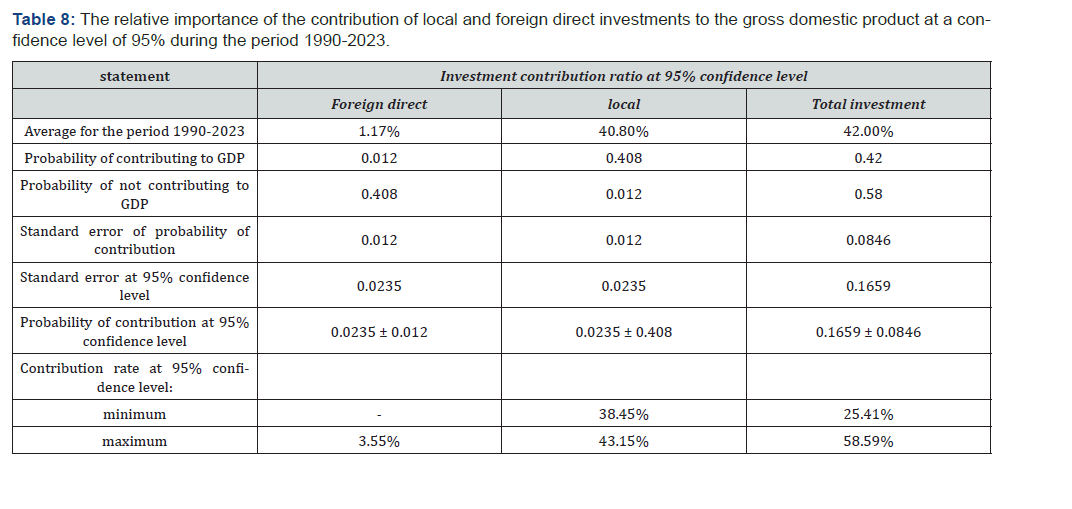
By examining the contribution of domestic and foreign direct investments to GDP, the data in (Table 8) showed that the upper limit of the probability of foreign direct investment’s contribution to GDP is 3.55% at a 95% confidence level. The probability of domestic investment’s contribution to GDP ranged from a minimum of 38.45% to a maximum of 43.15% at a 95% confidence level. From the above, it is clear that the total contribution of domestic and foreign direct investments to GDP ranged from a minimum of 25.41% to a maximum of 58.59% at a 95% confidence level.
Source: Collected and calculated from the data contained in (Table 7) and (Figure 2).
Conclusion
Despite the importance of foreign direct investment in the transfer and localization of modern technology, its contribution to GDP remains slight, accounting for no more than 3.55% at a 95% confidence level. Meanwhile, the contribution of domestic investment to GDP ranged from a low of 38.45% to a high of 43.15% at a 95% confidence level during the period 1990-2023. According to Saudi Vision 2030, the contribution of foreign direct investment to GDP will reach 5.7%, in addition to increasing the private sector’s contribution to GDP from 40% to 65% by 2030 [12]. In light of the factors determining foreign direct investment, a gradual decline in such investments is expected until 2030, especially in light of the current and anticipated military tensions and wars in the Middle East. By tracking the contribution of foreign direct investment to GDP during the study period, it was found to have reached 5.23% in 1998. Therefore, the contribution of foreign direct investment to GDP could be increased to 5.7% in accordance with Saudi Vision 2030. This could be achieved by creating an investment climate, continuously announcing investment activities and opportunities available to foreigners, and improving environmental quality [13- 16].
References
- Rahma Al-Siddiq Talha Muhammad (2020) Determinants of Foreign Direct Investment in the Kingdom of Saudi Arabia (1985-2017), Arab Democratic Center, Berlin, Germany. International Journal of Economic Studies 13: 47-67.
- Hussein Moawia Ahmed (2014) Foreign Direct Investment and Its Impact on Growth and Economic Integration in the Gulf Cooperation Council, King Abdulaziz University Journal: Economics and Administration 28(2): 103-150.
- Al-Sayari Salah and Al-Bakr Ahmed (2016) Foreign Direct Investment in the Gulf Cooperation Council Countries, Economic Research Department, Saudi Arabian Monetary Agency, December.
- Nafady Muhammad Siddiq (2017) The Green Economy as a Sustainable Development Mechanism for Attracting Foreign Investment (A Field Study Applied to the Egyptian Environment). Scientific Journal of the Faculties of Commerce Sector, Al-Azhar University, 17(1): 640-671.
- Tayr Abdelhaq (2021) Determinants of Attracting Foreign Direct Investment in Saudi Arabia - An Econometric Study for the Period (1995-2020). Journal of Management and Development for Research and Studies, Ali Lounici University - Blida 2, Laboratory of Group Management and its Role in Achieving Development 10(2): 37-56.
- Ghanem Adel Muhammad Khalifa, Othman Saad Al-Nashwan, Khalid Nahar Alrwis (2023) The Impact of Environmental Protection on Foreign Direct Investment Flows to the Kingdom of Saudi Arabia. International Journal of Economic Studies, Arab Democratic Center for Strategic, Economic and Political Studies – Berlin, 6(25): 62-73.
- Hakimi Adel Hadi Abbas (2023) Legal Foundations Supporting Foreign Investment in the Kingdom of Saudi Arabia According to Vision 2030. Al-Mustaqbal Journal of Humanities 3(1): 233-309.
- Al-Adhadi Ahmed (2023) Foreign Direct Investment in Light of the Kingdom of Saudi Arabia's Vision 2030.
- The Saudi Central Bank, Open Data Platform, 1990-2023.
- Gujarati Damodar N, Arabization and review by Odeh Hind Abdel Ghaffar and Al-Dash Afaf Ali Hassan (2015) Basic Econometrics, the Second Part, Marekh House of Publishing, Cairo, pp: 983-986.
- Alamri Yosef, Adel M Ghanem and Mohamad Alnafissa (2024) Estimating the Contribution of Saudi Agricultural Development Fund to GDP and Economic Growth. Environment, Development, and Sustainability 26(11): 28877-28891.
- General Authority for Statistics (2023) The Kingdom Adopts a New Methodology for Calculating Foreign Direct Investment Data, General Authority for Statistics website.
- The World Bank, Open Data, 1990-2023.
- Al-Duwaib Amna Khalifa Salem (2025) Measuring the Impact of Exports on Economic Growth in the Libyan Economy Using the Autoregressive Distributed Lag Model during the Period 1985-2021. African Journal of Advanced Studies in the Humanities and Social Sciences 4(1): 324-337.
- Masoudi Zakaria and Azzi Khalifa (2019) Determinants of Economic Growth in Algeria Using the FMOLS and ECM Models - An Econometric Study for the Period 1980-2017. Journal of Development and Foresight for Research and Studies 4(7): 117-136.
- Kingdom of Saudi Arabia (2025) Saudi Vision 2030 Annual Report for 2024, p. 79.

























