




 ASM Home



Abstract
The health and social dimensions of climate change highlight the immediate demand for inclusive and fair socio-ecological approaches. The environment and especially the climate change represent major social determinants of health. Climate crisis is not merely an environmental problem; it poses a significant risk to human health and the stability of society and democracy. These are complex interelations that necessitate a change in perspective, placing socio-ecological and health aspects at the center of climate initiatives. The current inter-disciplinary work explores the various ways climate crisis impacts society and health, highlighting both challenges and opportunities, by focussing specifically on the UN SDGs. In this framework, the effects are presented and the necessity for context-specific strategies is underlined. Policies for action and socio-ecological adaptation must be guided by climate justice principles, ensuring that no community is overlooked, ultimately relying on global solidarity and collective efforts. Social policy for leveraging the strength of innovation, cross-disciplinary teamwork, and addressing the needs of at-risk communities can transform the climate crisis into a chance to create healthier, more resilient societies. The road forward requires courageous governance and unwavering commitment to socio-ecological transformation to create a sustainable future where humanity and the planet can flourish together.
Keywords:Social Policy; Climate Crisis; Health; Resilience; Socio-Ecological Transformation
Abbreviations: UN SDGs: United Nations Sustainable Development Goals; WHO: World Health Organization; REIDs: Re-Emerging Infectious Diseases; CFCs: chlorofluorocarbons; PM: Particulate Matter; GHGs: Green House Gases
Introduction
Researchers and policymakers are increasingly concerned with how to establish a robust public health system, as environmental contamination, disease outbreaks, and various emergencies pose present significant threats to human health, well-being and sustainability today. Public health systems around the world are experiencing a major shock, particularly in the aftermath of the COVID-19 pandemic [1].
Climate crisis is one of the most daunting challenges of the 21st century, with far-reaching ramifications for human health, societal stability, and global equity. This complex issue is not confined to environmental science but calls for a collaborative approach from health professionals, policymakers, economists, and social scientists.
Climate change is a result of global industrialization, where there is the need for great amount of energy, which is provided by fossil fuels [2]. The predominant greenhouse gas is carbon dioxide (CO2), whose increased concentration in the atmosphere establish it as driving force to climate change. The elevated concentration of CO2 in the atmosphere leads to augmented absorption of the infrared radiation, which results to warmer atmosphere [3]. As greenhouse gas emissions continue to drive global temperature increases, the resulting shifts in weather patterns, sea levels, and biodiversity loss have direct and indirect impacts that threaten the very foundations of public health and social cohesion [4,5].
The urgency of the climate change issue cannot be understated. Concomitantly, the increase in temperature has been documented to increase in frequency and intensify heatwaves, flooding, and hurricanes. These, in turn, cascade into effects on human health and infrastructure [6,7]. More vulnerable populations-especially the aged, young children, those in poverty, and people of colour-increase pre-existing inequities within social settings and health status [8,9]. Furthermore, the psychological impact of climate change, now referred to as “eco-anxiety,” is becoming a growing concern, especially among the younger generation who will be facing an uncertain future [10].
The convergence of climate change and public health presents challenges and opportunities. Actually, the health impacts of climate change represent one the significant crises that continually exert substantial pressure on healthcare systems globally [11]. To mitigate the effects of this crisis, worldwide collaboration should be established. While the threats are large and complex, there is a growing recognition that addressing climate change can simultaneously advance health equity, improve living conditions, and foster sustainable development. Besides, Sustainable Development Goals strategies adopted by United Nations members to attain global sustainability, encompass enhancing climate actions and ensuring health and healthcare [12]. For instance, a shift in energy sources to clean ones reduces not only greenhouse gas emissions but also air pollution, which is a major cause of respiratory and cardiovascular diseases [13]. In addition, designing better urban green spaces cools the cities and encourages physical activities and mental health for the citizens [14].
This inter-disciplinary work attempts to discuss in detail the health and socio-ecological aspects of the current climate crisis for taking action. Synthesizing existing research, it gives a highlight on critical effects of climate change on human health, examines social determinants mediating those impacts, and gives strategic recommendations for future socio-ecological adaptation and climate change mitigation. It calls for a climate justice framework, placing the needs of the most vulnerable at the center and guaranteeing equitable access to resources and opportunities. This report will hopefully inspire and inform action at every level, from the local community to international levels, through an interdisciplinary lens. It is in this sense that the road ahead will require innovation, collaboration, inclusion, and resilience as humanity faces one of the biggest challenges of our time. Understanding and taking action on the interconnections between climate change, socio-ecological systems and health and can help realize an equitable and sustainable future for all.
The Impacts of Climate Change on Health
Overview of Health Risks
Climate crisis enhances current health vulnerabilities through extreme weather events, increased air pollution and alterations in disease vector distributions [15,16]. It is projected that from 2030 to 2050, climate change will lead to 250,000 extra deaths per year due to factors such as heat exposure, malnutrition, and vector-borne diseases [7,17]. With extended periods of intensified heatwaves, heat-related illnesses such as heatstroke have increasingly affected populations in afflicted regions. These are skewed towards urban areas, given the way concrete and asphalt absorb heat, causing the so-called “heat island” effect, further magnifying temperature extremes [6].
Rising sea levels and flooding also increase exposure to waterborne diseases, such as cholera and leptospirosis, particularly in low-lying coastal regions [5]. Changes in precipitation patterns further exacerbate malnutrition by reducing agricultural yields and destabilizing food supply chains. For instance, prolonged droughts in Sub-Saharan Africa have been linked to higher rates of food insecurity and associated health conditions like anemia and stunted growth in children [18].
Air pollution is an important part of climate change. Pollutants are Greenhouse Gases (GHGs), chlorofluorocarbons (CFCs) and other Particulate Matter (PM) [15,19]. PM is categorized into particles whose diameter is higher than 10 μm and those of less than 10 μm (PM2.5-10). Particularly PM2.5 has caused major health concerns due to its composition, as it contains acids and heavy metals in such a diameter that they can penetrate human body and reach lungs [19]. PM can be formed and reach atmosphere primarily through combustion in industries and human use, or secondary PM formation by the emitted GHGs.
The predominant GHG is the carbon dioxide, but there are several other important GHGs involving sulfur dioxide, nitrogen dioxide, carbon monoxide, volatile organic compounds (VOCs), nitrous oxide and methane. In fact, the later absorbs more infrared radiation than carbon dioxide, but due to oxidation reactions it has shorter presence in the atmosphere [3,19,20]. In addition, reactions between VOCs and nitrogen oxides, enhanced by sunlight leads to the formation of another GHG, ozone) [19].
Air pollution from GHGs and PM is associated with cardiovascular and respiratory diseases, abnormality of reproduction and nervous system and lung cancer [21]. In addition, polluted air can affect skin, either minor, like skin aging, or cause more severe damage, like skin cancer [22]. Table 1 depicts some GHGs and their effects on human health, inspired from [23].

Climate change results in altered disease vectors, leading to Emerging Infectious Diseases (EIDs) or Re-Emerging Infectious Diseases (REIDs) [24]. EIDs represent the diseases that did not exist or only affected a small number of people in restricted areas, but in the last 20 years have spread causing severe health issues both locally and on an international level [25]. On the other hand, REIDs are the diseases that occurred in the past causing huge health problems but respited and now concerning reappears [25]. Either EIDs or REIDs contribute significantly to global death rate, as 700 hundred people lose their life due to parasite, bacterial or virus exposure [26].
For vector-borne diseases transmission, the appropriate environmental conditions are required. Thus, the changes in climate enhance the life cycle of pathogens, making them more durable, creating an environment suitable for their growth and spread across the host human bodies [24]. For instance, malaria is now appearing at higher altitudes in regions like the Ethiopian highlands, where cooler temperatures previously limited its spread [27]. These changes in climate, not only affect humans, but animals, too, creating a complex hosting group, which as a result can affect the land usage [24]. However, despite the linkage between climate change, vector-borne diseases and humananimal interactions, the transmission of such diseases is also affected by social and economic factors, like globalization, trade, migration and poverty [24, 28].
The psychological effects of climate change, including ecoanxiety and trauma from disasters related to climate, go deep. Isolation and lack of access to care place rural and marginalized communities particularly at risk for heightened mental health risks. Disasters, including hurricanes, wildfires, and floods, displace populations and lead to increased mental health challenges in the long term, including post-traumatic stress disorder [10].
The uncertainty about the future climate condition contributes to generalized anxiety, especially in the younger generation. A lot of young people describe feelings of hopelessness and despair when confronted with the existential threat of climate change. Community-based mental health interventions, such as counseling and support groups, are thus imperative to address these growing concerns. Schools and workplaces can also play a role in fostering resilience through awareness campaigns and mental health resources [29].
Health Inequalities and Vulnerable Populations
Climate change causes health inequalities, derived from age, health condition, residence location, demographic and governance factors, and financial condition [30,31]. Climate change impacts vulnerable groups, including the elderly, children, poor communities, and Indigenous populations, through a number of disproportionate adverse effects. Heatwaves, for example, are highly dangerous for older adults because their diminished thermoregulatory capacity puts them at higher risks of heatrelated illnesses [8,32]. Increased temperatures, therefore, may intensify chronic illnesses like cardiovascular diseases, common in aging populations [6].
Elderly are a vulnerable group, due to immune system degradation, making them susceptible to diseases intensified by climate change [30,33]. In addition, communication disabilities, like listening, seeing and speaking combined with mental health issues, including slow mobility, Alzheimer’s disease, senility or dementia further heighten their vulnerability [30]. Socioeconomic factors, like residence location, financial status and limited technological understanding contribute to social isolation and lack of information, resulting in health inequality issues [33].
Mobility difficulties render them vulnerable to floods, hurricanes and wildfires, making an evacuation plan difficult to accomplish, posing risks of injuries or even death [33]. Exposure to wildfire smoke and heatwaves exacerbates respiratory and cardiovascular diseases [6,33]. Furthermore, floods and wildfire smoke contaminate food and water and due to their degraded immune system, older people are more vulnerable to infections. Mental issues are, also, prevalent in many cases, including stress and depression [33].
The relationship between summer temperatures and mortality among the elderly also should be underlined. Southern countries seem to be the most affected, as they display high mortality numbers. Moreover, women’s deaths appear to be higher than men’s, highlighting the danger that women face during heatwaves. Specifically, it was found that in eight out of thirteen studies women exhibited higher mortality rates during heatwaves [34].
Another very important vulnerable group is children. The fact that magnifies this group lies in the fact that children have not yet developed important defensive systems, like the underdeveloped immune system, alongside their cognitive immaturity, leaves them susceptible to psychological, mental and physical harm [35- 37]. Children’s rapid breath and their high ratio of body surface to volume enhance their vulnerability to environmental impacts on their health [37]. According to the World Health Organization (WHO), approximately 88% of the worldwide burden of diseases associated with climate change has affected children younger than the age of five [35,36]. 85% of total children in the world population live in developing countries, while the rest live in developed nations. Children from developing and developed countries experience the impacts of climate change differently. In developing countries, the impacts are more immediate and severe due to lack of infrastructures, support systems and services to provide help, preparation and adaptation. On the other hand, in developed countries, children live the effects of climate change more vicariously, being informed by the media and school. Despite this, young people in developed countries express their worry about climate change [38]. Physical impacts of climate change on children include injuries, respiratory allergies and asthma, cardiovascular diseases, neurological disorders, diarrhea, dehydration, imbalance of electrolytes, fever, renal disease, heat stress, exposure to vector- and water-borne diseases, like West Nile and Malaria or exposure to contaminated water, increased malnutrition due to food insecurity and death [35-39]. In addition, mental health issues can develop, including posttraumatic stress disorder, anxiety, depression, panic, sleep disorder, attachment disorder, learning difficulties, increased aggression and violent behavior and, in severe cases, suicidal tendency [35-39]. Furthermore, extreme weather events linked to climate change have increased cases of domestic violence and child abuse within affected families [36]. Moreover, prenatal exposure to climate change related stressors can have long term consequences, leading to difficulties in developing language skills or developing autism, schizophrenia, mobility problems, asthma, behavioral issues, neurological issues and reduced IQ in affected children [35].
In addition to children and elderly, whose vulnerability is defined by age, there are also low income communities, such as indigenous communities, which are highly affected by climate change. Indigenous population rises to 476 million people, globally, representing approximately 6% of world population, according to the United Nations [40]. Among the challenges they face are the denial of their identity and priorities, poverty, absence of political representation and limited access to social services. Indigenous people often reside in areas prone to flooding or other climate hazards, such as informal settlements with inadequate infrastructure. These populations face significant barriers to accessing healthcare services, clean water and nutritious food, further amplifying their vulnerability [41]. These communities are very close to nature. In fact, their livelihoods are closely tied to natural ecosystems, such as farming, fishing and hunting [42]. Apart from their livelihoods, natural ecosystems, like land and sea are factors of wellbeing for them and changes in these ecosystems affects their mental health, resulting in non-clinical mental health issues [43]. Despite their vulnerability, indigenous people have developed their knowledge over climate change over the years. In fact, their ordinary occupation with the environment makes them experienced people to detect any climate changes. Throughout the years, as Indigenous people have observed many alterations in local systems, they have developed technologies and their acknowledgement to identify changes in weather, climate and local environment and how these changes affect local communities, socially, ecologically and culturally [44].
Social Dimensions of Climate Change
Climate Change as a Social Determinant of Health
Social Determinants of Health (SDOHs) are factors, such as people education, employment/unemployment/job insecurity, income, housing, lifestyle conditions, food/nutrition, and certainly the natural environment, which have a significant impact on health disparities, which are the unjust and preventable variations in health outcomes.
Particularly climate change is increasingly considered as a SDOH, as it not only has physical and mental effects on humans but also affects the economics of public health systems, increasing the costs of health care, widening the gap between wealthier and low-income people, making the accessibility to health care units more difficult and, also, burdening the other SDOHs [7,45].
All factors that are social and environmentally linked exacerbate the magnification of the effects of climate change on marginalized persons. For example, housing and infrastructure deficiencies in informal settlements increase the impacts of extreme weather events, leaving affected people with few options to recover or adapt. Such vulnerabilities are accentuated by systemic inequalities-like lack of access to education and healthcare-that weaken the adaptive capacity of a system or entity [42]. The unfavorable socio-economic conditions of marginalized, disadvantaged, and vulnerable groups in urban areas have been associated with negative health outcomes, such as chronic and infectious diseases, detrimental health behaviors, obstacles to obtaining health care services, and increased overall mortality. The areas of intervention suggested encompass access to health care, behavior, income, housing, and social unity [46].
The social dimensions of climate change are often gendered, with women and girls bearing the greatest impacts of its effects. In many developing regions, women bear responsibilities related to gathering water, fuel, and food—tasks that are made more arduous by environmental degradation. Limited access to education and economic resources further constrains women’s ability to adapt to changing conditions [47]. Climate-induced migration can also lead to increased risks of gender-based violence and exploitation, with women and girls in temporary shelters or in transit facing increased vulnerability [48].
Health Risks of Climate-Induced Displacement/ Migration
Due to climate change, many people are forced to leave their place and as a result, climate change has become a reason for displacement. Climate-induced disruptions, such as droughts, floods, and resource scarcity, force people to migrate. Climate alterations, including rise in sea water level, air degradation due to the increase of GHGs and CFCs emissions, land degradation such as degradation in agricultural and hunting lands, degradation of fishing lands, drought and deforestation has forced people to leave their places, either permanently or temporarily [49,50]. The European Parliament Research Service (EPRS) published a report referencing that 1.2 billion people could be displaced by 2050 attributed to natural disasters and ecological alterations, representing the worst case scenario [51]. However, displacement is not a problem arising only from environmental degradation, but also, from economic, political and social factors [50]. Thus, the underdeveloped countries and communities, that contribute the least to global warming, are the ones that affected the most by its implications. According to Climate Refugees in 2017 30.6 million people forcibly relocated across 135 countries [52].
Environmental migration, now commonly referred to as “climate refugees,” is a global issue whereby communities are being relocated from their homelands by rising seas and desertification. The discussion about climate-dislacement/migation started in 1985 by Essam El-Hinnawi, who actually gave a definition about environmental refugees: “those people who have been forced to leave their traditional habitat, temporarily or permanently, because of a marked environ mental disruption (natural and/ or triggered by people) that jeopardize their existence and/ or seriously affects the quality of their life” [53]. Despite the introduction of such a definition, there is still confusion regarding the term climate refugee and its legal acceptance by the Refugee Conviction in 1951, which was established by the United Nations, due to vast human mass migration attributed to war [50,51]. As a result, when people leave their country are not confronted as refugees, but as people who on their own volition left their place, and thus are not protected legally [52].
Forced displacement has an impact on mental health and well-being of humans. Mental health implications derive from physical trauma and the feeling of loss [54]. In the first case, people can harm themselves due to exposure to extreme weather conditions, such as strong winds, floods and heatwaves. This traumatic experience can lead to mental implications, like stress, posttraumatic stress disorder, depression and anxiety. On the other hand, the feeling of loss includes the loss of home, land, tools, vehicles and personal stuff that probably have an emotional value. Loss of such stuff, alongside the new beginning in another location, the uncertainty of the future and the economic instability leads to mental implications, which starts with the moment of loss that is a life changing effect and continues with other stressors. As a result, the sense of loss can lead to stress, distress, anxiety, sadness, depression, feeling of hopelessness and helplessness, rage, fear, uncontrolled use of alcohol and drugs and even lead to suicide commitment [55].
A thorough and cohesive strategy is essential for comprehending population shifts prompted by climate change, as well as other influences on migration. The connections among migration, climate change and socio-economic development, governance, and urban sustainability, emphasizing migration experiences at these levels in both origin and transit countries need to be clarified. It is essential to examine the various factors prompting migration along with the strategies and regulations for efficient migration management. Targeted studies need to be carried out on the elements influencing immigrants’ geographic movement, across various activities and phases of their lives. In this context, migration models have been developed, introducing fresh ideas to classify various types of flows driven by climate change. The significance of different factors influencing migration and other elements in diverse economic and social results at both personal and regional levels, such as changes in individual earnings and alterations in regional employment/unemployment or wage levels. Moreover, the challenge of enumerating migrants and identifying the reasons for migration is evident because of the absence, restrictions, or inconsistencies in information and documentation.
Climate-induced migrants face declined social capital, economic insecurity, and increased health vulnerability, which raise a need for inclusive adaptation policies [14]. The quantity of internal and international migrants is significantly greater than in earlier decades. Additionally, the influence of this topic on mass media and the agendas of political and non-governmental organizations is significantly more substantial. Among the various reasons that compel an individual to migrate, there are those driven by environmental deterioration and climate change. These migration patterns are anticipated to be among the key issues of the 21st century. Consequently, a primary challenge encountered is the creation of migration policies and cooperative global measures. Nonetheless, the effects of climate change are influenced not only by natural exposure but also by the vulnerability and resilience of regions and their inhabitants, as well as their adaptation capabilities. This is crucial since environmental degradation caused by climate change leads to significant negative economic consequences in areas where a majority rely on sectors like agriculture, fishing, and forestry, among others.
Moreover, large-scale migrations create tensions between groups over limited resources in the recipient areas and can cause social conflicts. Large numbers of people moving to urban centers due to being displaced result in high demands for shelter, sanitation, and other public facilities. These changes in social structures sometimes create tension in the host communities and may breed conflict and discrimination if not addressed accordingly [48]. Beyond urban centers, rural areas that represent climate migration also undergo demographic changes. The loss of working-age individuals can render older residents more vulnerable, while decreased agricultural productivity weakens the local economies even more.
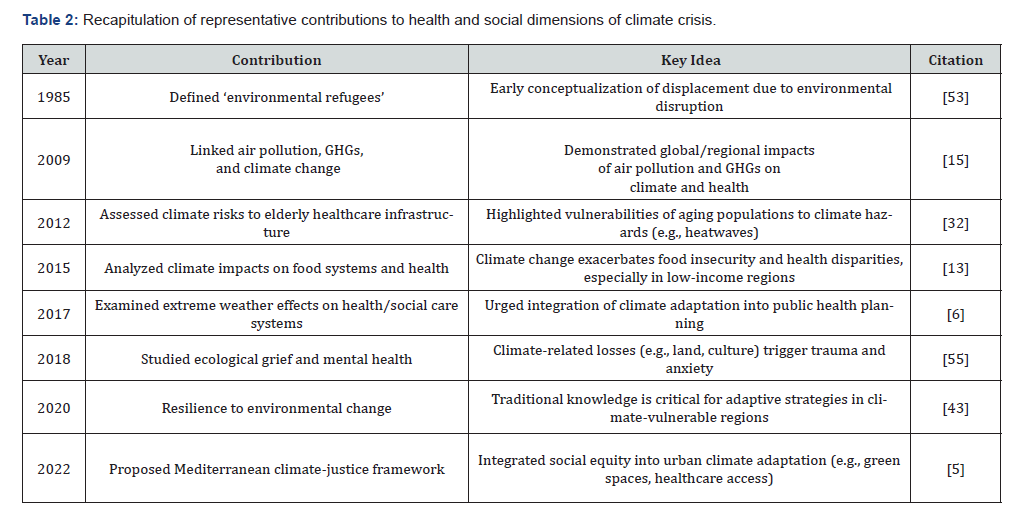
Representative literature contributions to the health and social dimensions of climate crisis are recapitulated in Table 2.
Future Climate Adaptation and Social Policy for Health Resilience
Health and social care systems should be strengthened in the face of climate-related hazards. This involves enhancing resilience in healthcare infrastructure, such as hospitals and clinics, to resist extreme weather conditions. Emergency preparedness should also be enhanced through the development of climate-specific health protocols, including early warning systems and disaster response training for healthcare workers [56].
It is thus secure to presume that a transformation and reorganization of the healthcare sector in a systematic way will occur in the coming years. For the thorough assessment of health systems, the General Systems Theory (GST) has been employed in the last years. Its fundamental concepts were first outlined by von Bertalanffy [57], with the initial goal of managing various data modules in computer science. The integration of systemic morphology within the framework of public health, simultaneously acknowledged the various disciplinary methodologies and emphasized the active engagement between them. This conceptual method regarding the connections among diverse systems found in nature, ranging from physical and biological to social sciences, highlights the importance of humans to perceive a system in a comprehensive way. Theoretical frameworks utilized in systematic theory can suggest a comprehensive perspective for healthcarerelated challenges [58,59]. In the past few years, researchers have sought to apply this theory to public health challenges [60,61]. According to systematic theory, the public health system is categorized into four sub-systems: resource inputs, decisionmaking planning, operations, and service outputs. Actually, the structure, engagement, and inter-reliance in a systems-focused method within healthcare, is gaining greater focus and redirects the curiosity towards a comprehensive and evolving perspective across various sub-disciplines. GST presents a reliable method and has the potential to be a motivating factor for the health sector [62,63]. The interplay and interdependence of the elements and sub-systems within a system are emphasized, especially under emergencies such as the climate crisis [64,65]. Particularly, care needs for the aging populations who are highly vulnerable to health risks due to climate-related variables should be a priority. Expansion of access to mobile health units and telemedicine services helps reach the most underserved areas in cases of emergency or climate-induced displacements and migration [7].
Tackling climate change requires an integrated strategy that involves various sectors like health, agriculture, energy, and urban planning. Multi-sectoral approaches should link health equity priorities to sustainable development efforts, such as renewable energy, better access to public transportation, and decreased urban pollution [18]. Partnerships may be able to drive innovation in large-scale adaptation projects, such as the development of climate-resilient infrastructure and technologies, by pooling resources and expertise [13]. Policy development for smart cities may also establish a foundation for the integration of interventions related to smart healthcare services, which implies application of data science within healthcare to facilitate data-driven decisionmaking in the health sector [66-68].
Educational initiatives are critical for empowering communities to adopt adaptive behaviors and build resilience to climate-related challenges. Public health campaigns should raise awareness about the direct and indirect impacts of climate change on health, emphasizing the importance of preventive measures. Schools, universities, and community centers can serve as hubs for education and skill-building, offering programs that foster environmental stewardship and prosocial purpose [48]. Behavioral interventions may involve encouraging energy conservation, waste reduction, and sustainable dietary habits as part of a broad response to the climate crisis [5]. Moreover, adaptation strategies will have to be informed by a gender-sensitive approach, one that empites women through education, skill-building, and leadership opportunities [48,69].
Furthermore, the aforementioned climate-induced migration dynamics create a critical need for policy-making that balances the needs of displaced populations with those of host communities in order to achieve social cohesion and resilience [4]. Social networks and relationships that enable communities to function cohesively, is often depleted in the process of climate change. Displacement, resource scarcity, and environmental degradation weaken community bonds, making collective adaptation efforts more difficult. Loss of cultural and historical ties to the land also undermines identity and mental well-being, particularly for indigenous communities [42]. Social policy for the empowerment and resilience of immigrants against climate change, along with the transformation processes faced by countries of origin and transit migration, must be taken into consideration.
Rebuilding social capital is considered crucial for building resilience [70]. The community-based adaptation strategies, participatory planning, and local leadership will help rebuild trust and cooperation among community members. Inclusive policy mechanisms that give a voice to the most marginalized, including women, indigenous communities and youth, are critical in the elaboration of equitable solutions.
Holistic Socio-Ecological Transformation
Concluding, the far-reaching consequences of climate crisis on health and society require a holistic, inter-disciplinary socioecological approach to attain the UN Sustainable Development Goals of Climate Action, Good Health and Well-being. It calls for health and social considerations to be embedded in every aspect of climate action beyond a single policy. Policymakers should focus on frameworks that connect health outcomes with broader social objectives, such as economic stability, education, equity, and justice.
Co-benefits can be realized through collaboration across various sectors. The integration of renewable energy solutions with health-related policies and programs at the community level can thus have greater impact. When solar-powered clinics in remote settings reduce emissions, they also can ensure continuity in healthcare services uninterrupted by power failures. Urban land use planning can incorporate blue and green spaces to enhance cooling, biodiversity, and mental well-being. Increasing public transportation, for example, can reduce GHG emissions, improve air quality, and contribute to a healthier lifestyle all at the same time.
It is also critical to have a shift in funding priorities. Governments and international organizations need to put adequate resources into investigating and implementing crosssectoral socio-ecological interventions. Investments in capacitybuilding programs, especially in the healthcare professional and community leaders, will help with tools on how to navigate through complex climate-induced challenges. Further, fostering international solidarity via technology transfer and financial assistance is vital in order to allow vulnerable regions to employ practical adaptation measures for embedding social and ecological justice.
Public engagement lies at the heart of resilience building. Grassroots and community-led processes can help identify traditional, local climate risks and possible adaptation measures. Stimulating social policy, by engaging citizens in the collection and analysis of data, can be empowering for communities and enhance the evidence base for decision-making. Therein, building a culture of shared responsibility and collective action can help societies adapt better and foment long-term resilience and sustainability.
References
- Dimoulas C, Fouskas VK (2023) The Covid-19 Crisis: Global Competitive (Geo)Politics, Labour Regimes and the Case of Greece. In: Cafruny AW, Simona Talani L (eds.), The Political Economy of Global Responses to COVID-19. International Political Economy Series. Palgrave Macmillan, Cham.
- Yang M, Chen L, Wang J, Msigwa G, Osman AI, et al. (2023) Circular economy strategies for combating climate change and other environmental issues. Env Chem Let: 21: 55-80.
- Soeder DJ (2021) Fossil fuels and climate change, In: Soeder DJ. Author, Fracking and the Environment, Springer Nature Switzerland AG, Chapter 9.
- Kelly AM, Wassou NL (2025) Climate change and its effect on health outcomes: An empirical investigation of Sub-Saharan Africa countries. SN Soc Scien: 5(4): 47.
- Marí-Dell’Olmo M, Oliveras L, Barón-Miras LE, Borrell C, Montalvo T, eta al. (2022) Climate change and health in urban areas with a Mediterranean climate: A conceptual framework with a social and climate justice approach. Inter J En Res Pub Heal 19: 12764.
- Curtis S, Fair A, Wistow J, Val DV, & Oven K (2017) Impact of extreme weather events and climate change for health and social care systems. Env Heal 16: 128.
- Tzavella F, Vgenopoulou I, & Fradelos EC (2021) Climate change as a social determinant of the quality of public health. Arch Hel Med 38: 401-409.
- Aubrecht C, Steinnocher K, Köstl M, Züger J, & Loibl W (2013) Long-term spatio-temporal social vulnerability variation considering health-related climate change parameters particularly affecting elderly. Nat Haz 68: 1371-1384.
- Paavola J (2017) Health impacts of climate change and health and social inequalities in the UK. Env Heal 16: 113.
- Boyd CP, Parr H (2020) Climate change and rural mental health: A social geographic perspective. Rur Rem Heal 20: 6337.
- Irei S, & Chan TW (2024) Sources, processing, transport, health and climate impacts of air pollutants. Applied Sciences 14: 1361.
- United Nations (n.d.). Sustainable Development Goals.
- McMichael AJ, Butler CD, & Dixon J (2015) Climate change, food systems and population health risks in their eco-social context. Pub Heal 129(10): 1361-1368.
- Donatuto J, Grossman EE, Konovsky J, Grossman S, & Campbell LW (2014) Indigenous community health and climate change: Integrating biophysical and social science indicators. Coas Manag 42: 355-373.
- Ramanathan V, & Feng Y (2009) Air pollution, greenhouse gases and climate change: Global and regional perspectives. Atm Env 43(1): 37-50.
- Vaezi A, Shahbazi R, Sheikh M, Sotiropoulou REP, & Tagaris E (2024) Environmental pollution and human health risks associated with atmospheric dust in Zabol City, Iran. Air Qual Atm Heal 17: 2491-2513.
- World Health Organization. (n.d.). Climate change.
- Levy BS, Patz JA (2017) The impact of climate change on public health, human rights, and social justice. In: Elias SA (Ed.), Encyclopedia of the Anthropocene 2: 435-439.
- Turner MC, Gapstur SM, Andersen ZJ, Baccarelli A, Pope CA III, et al. (2020) Outdoor air pollution and cancer: An overview of the current evidence and public health recommendation. CA: Canc r Clin 70: 460-479.
- Yoro KO, Daramola MO, (2020) CO₂ emission sources, greenhouse gases, and the global warming effect, In: Rahimpour MR, Farsi M, Makarem MA (Eds.), Advances in Carbon Capture, Brian Romer, Chapter 1, pp. 3-28.
- Manisalidis I, Stavropoulou E, Stavropoulos A, & Bezirtzoglou E (2020) Environmental and health impacts of air pollution: A review. Front Pub Heal 8: 14.
- Drakaki E, Dessinioti C, & Antoniou CV (2014) Air pollution and the skin. Fron Env Scien 2: 11.
- Naiyer S, Abbas SS, (2022) Effect of greenhouse gases on human health. In: Sonwani S, Saxena P, (Eds.), Greenhouse Gases: Sources, Sinks and Mitigation, Springer, Singapore, Chapter 5.
- Semenza JC, & Suk JE (2017) Vector borne diseases and climate change: A European perspective. FEMS Microb Let 365(2): 244.
- Wang WH, Thitithanyanont A, Urbina AN, & Wang SF (2021) Emerging and re emerging diseases. Path 10: 827.
- World Health Organization (n.d.). Vector borne diseases.
- Quintão AF, Brito I, Oliveira F, Madureira AP, & Confalonieri U (2017) Social, environmental, and health vulnerability to climate change: The case of the municipalities of Minas Gerais, Brazil. J Env Pub Heal: 2821343.
- Mostafavi E, Ghasemian Mahani A, Rawaf S, Nguyen T, Al Awaidy S, et al. (2022). Emerging and re-emerging infectious diseases in the WHO Eastern Mediterranean Region, 2001–2018. Int J Heal Pol Manag 11: 1286-1300.
- Dueñas i Cid D, Ochoa i Cañigueral L (2016) Climate change and health related challenges as a trigger for educational opportunities to foster social knowledge and action. In: Filho WL Ed., Climate Change Management, Springer, pp. 297-312.
- Kalaiyarasi V, & Rajkumar P (2020) Impact of climate change on elderly health. Int J Manag 11: 1273-1278.
- Rhoades JL, Gruber JS, & Horton B (2018) Developing an in depth understanding of elderly adults’ vulnerability to climate change. Geront 58: 567-577.
- Oven KJ, Curtis SE, Reaney S, Riva M, Stewart MG, et al. (2012) Climate change and health and social care: Defining future hazard, vulnerability and risk for infrastructure systems supporting older people's health care in England. App Geog 33: 16-24.
- Hosseini MM, Zargoush M, & Ghazalbash S (2024) Climate crisis risks to elderly health: Strategies for effective promotion and response. Heal Prom Int 39(2): daae031.
- van Steen Y, Ntarladima AM, Grobbee R, Karssenberg D, & Vaartjes I (2019) Sex differences in mortality after heat waves: Are elderly women at higher risk? Int Arc Occup Env Heal 92(1): 37-48.
- Burke SEL, Sanson AV, & Van Hoorn J (2018) The psychological effects of climate change on children. Cur Psych Rep 20(5): 35.
- Anderko L, Chalupka S, Du M, & Hauptman M (2020) Climate changes reproductive and children’s health: A review of risks, exposures, and impacts. Ped Res 87: 414-419.
- Stanberry LR, Thomson MC, & James W (2018) Prioritizing the needs of children in a changing climate. PLoS Med 15: e1002627.
- Sanson AV, Van Hoorn J, & Burke SEL (2019) Responding to the impacts of the climate crisis on children and youth. Chi Dev Pers 13(4): 201-207.
- D’Amato G, Vitale C, De Martino A, Viegi G, Lanza M, et al. (2015) Effects on asthma and respiratory allergy of climate change and air pollution. Mult Resp Med 10: 39.
- World Health Organization (2024) International Day of the World's Indigenous Peoples 2024 [Speech]. WHO South-East Asia.
- Zikas P, Fouskas T, Papadopoulou D, Economou C (2025) Behind the stalls of farmers’ markets: unveiling the effects of low-status work on the health and quality of life of migrant workers in fresh produce, meat, and fish markets. 2025; Comparative Cultural Studies: European and Latin American Perspectives 20: 1-29.
- Brondízio ES, de Lima ACB, Schramski S, & Adams C (2016) Social and health dimensions of climate change in the Amazon. An Hum Bio 43(4): 405-414.
- Ford JD, King N, Galappaththi EK, Pearce T, McDowell G, et al. (2020) The resilience of Indigenous peoples to environmental change. One Earth 2(6): 532-543.
- Reyes-García V, del-Amo D, Álvarez-Fernández S, Benyei P, García D, et al. (2023) Local indicators of climate change impacts described by indigenous peoples and local communities: Study protocol. PLoS ONE 18: e0279847.
- Ragavan MI, Marcil LE, & Garg A (2020) Climate change as a social determinant of health. Ped 145(5): e20193169.
- M Papanastasiou S, Papatheodorou C (2019) ‘Liberalising’ social protection amid austerity in Greece. Routledge Handbook of European Welfare Systems, eBook ISBN9780429290510, pp. 220-236.
- Divakaran B, Lembeck S, Kerr R, Calmus H, & Potter T (2016) Nurses see "the big picture": Addressing climate change as a social determinant of global health. Creat Nurs 22: 243-248.
- Bentley M (2011) Adapting to climate change in a way that promotes social equity and health: An examination of South Australia's tackling climate change strategy. Int J Envi Cul Econ Soc Sust 7: 151-169.
- Lunstrum E, Bose P, & Zalik A (2016) Environmental displacement: The common ground of climate change, extraction and conservation. Area 48(2): 130-133.
- Berchin II, Valduga IB, Garcia J, & Andrade Guerra JBSO (2017) Climate change and forced migrations: An effort towards recognizing climate refugees. Geoforum 84: 147-150.
- Apap J, & Harju SJ (2023) The concept of ‘climate refugee’: Towards a possible definition. European Parliament Research Service, PE 698.753.
- Why climate refugees? (n.d.).
- El Hinnawi E (1985) Environmental Refugees. Nairobi, Kenya: United Nations Environment Programme.
- Shultz JM, Rechkemmer A, Rai A, & McManus KT (2018) Public health and mental health implications of environmentally induced forced migration. Dis Med Pub Heal Prepar 132(2): 116-122.
- Cunsolo A, Ellis NR (2018) Ecological grief as a mental health response to climate change related loss. Nat Clim Chan 8: 275-281.
- World Health Organization (2021) WHO Guidance on Preparing for National Response to Health Emergencies and Disasters. Geneva, Switzerland: World Health Organization.
- von Bertalanffy L (1969) General System Theory: Foundations, Development, Applications. New York, NY: George Braziller Incorporated.
- Durrani H (2016) Healthcare and healthcare systems: Inspiring progress and future prospects. Mhealth 2: 3.
- Lipsitz LA (2012) Understanding health care as a complex system: The foundation for unintended consequences. JAMA 308: 243-244.
- Savoia E, Agboola F, & Biddinger PD (2014) A conceptual framework to measure systems’ performance during emergency preparedness exercises. Int J Env Res Pub Heal 11: 9712-9722.
- Vincenten J, MacKay JM, Schröder Bäck P, Schloemer T, & Brand H (2019) Factors influencing implementation of evidence based interventions in public health systems—a model. Cen Eur J Pub Heal 27: 198-203.
- Kochan CG, Nowicki DR, Sauser B, & Randall WS (2018) Impact of cloud based information sharing on hospital supply chain performance: A system dynamics framework. Int J Prod Eco 195: 168-185.
- de Vasconcelos PF, de Freitas CHA, Jorge MSB, de Carvalho REF, de Sousa Freire VEC, et al. (2019) Safety attributes in primary care: Understanding the needs of patients, health professionals, and managers. Pub Heal 171: 31-40.
- Katrakazas P, Grigoriadou A, & Koutsouris D (2020) Applying a general systems theory framework in mental health treatment pathways: The case of the Hellenic Center of Mental Health and Research. Int J Men Heal Sys 14: 67.
- Zhou J, Wang C, Zhang X, & Wang S (2022) Public health system and socio-economic development coupling based on systematic theory: Evidence from China. Sustain 14(19): 12757.
- Schuh RG, Eichelberger RT, Stebbins S, Pomer B, Duran L, et al. (2012) Developing a measure of local agency adaptation to emergencies: A metric. Eval Prog Plan 35(4): 473-480.
- Lee S & Kim C (2018) Estimation of association between healthcare system efficiency and policy factors for public health. App Sc 8: 2674.
- Dzhunushalieva G, & Teuber R (2025) Why does data selection matter in tracking progress toward Sustainable Development Goals? SN Soc Sc 5: 60.
- Antoniou M, Fradelos EC, Roumeliotaki T, Malli F, Symvoulakis E, et al. Assessing mental resilience with individual and lifestyle determinants among nursing students: An observational study from Greece. Aims Public Health 11(3): 946-961.
- Economou C, Kaitelidou D, Karanikolos M, Maresso A (2017) Greece: Health System Review. Health Syst Transit 19(5): 1-166.

























