




 ASM Home



Probable Estimation of The Contribution of Production, Imports and Water Required to Meet Domestic Consumption Needs for Potatoes in Saudi Arabia
Adel M. Ghanem1, Mohammad H. Alqunaibet2, Khalid N. Alrwis1 and Sharafeldin B. Alaagib1
1Office of Food Security Studies and Research, Vice Rectorate for Postgraduate Studies and Scientific Research, King Saud University, Saudi Arabia
1Agricultural Economics Department, College of Food and Agricultural Sciences, King Saud University, Saudi Arabia
Submission:February 02, 2025;Published: February 12, 2025
*Corresponding author:Adel M. Ghanem, Office of Food Security Studies and Research, Vice Rectorate for Postgraduate Studies and Scientific Research, King Saud University, Saudi Arabia
How to cite this article: Adel M. G, Khalid N. A, Nashwa Abdul hamid Al-t, Sahar Abdel Moneim k, Said Azali A. Estimating the Used and Virtual Water and Their Impact on The Total Water Footprint of Dates In The Kingdom of Saudi Arabia. Ann Soc Sci Manage Stud. 2025; 11(3): 555811.DOI: 10.19080/ASM.2025.11.555812
Abstract
This research aimed to estimate the relative importance of the contribution of production, imports, and the quantity and value of water needed to meet local consumption needs for potatoes during the period 2000-2023. This study yielded a set of results, the most important of which are: (1) Potato production is concentrated in the alluvial shelf areas, the most important of which are (Riyadh, Hail, Qassim, Tabuk, and Al-Jawf), where the total relative importance of production in these areas reached 98.8%, while the contribution of the rest of the production areas does not exceed 1.2%, (2) The disparity in potato productivity between regions is attributed to the difference in soil fertility, water quality, temperature, humidity, rainfall rates, and farmers’ experience, (3) The contribution of production to meeting local consumption needs for potatoes ranged between a minimum of 76.48% and a maximum of 101.52% at a confidence level of 95%, while the maximum contribution of Saudi imports to meeting local consumption needs reached 23.52% at a confidence level of 95%, (4) The total amount of water used in potato production amounted to 3.25 billion m3, with a value of 1.57 billion riyals, representing about 0.83% of the total amount of water used for agricultural purposes, which amounted to 390.39 billion m3 during the period 2000-2023. (5) This study recommends the necessity of increasing the productivity of the potato crop in the Kingdom of Saudi Arabia, so that it approaches the productivity of the same crop in neighboring regional countries, the most important of which are Jordan (39.96 tons/hectare), the State of Kuwait (44.13 tons/hectare), by increasing the degree of soil fertility, high-yield varieties, and modern technological methods.
Keywords:Potato; Contribution of Production and Imports; Consumption Needs; Quantity and Value of Water; Sedimentary Shelf
Introduction
Potatoes are one of the most important open-air vegetable crops in each of the regions of Hail, Qassim, Tabuk, Riyadh, and Al-Jouf, where the percentage of potato area to the total area of open-air vegetables in these regions reached 56.22%, 43.47%, 40.09%, 33.34%, and 14.42%, respectively (Figure 1). Potato cultivation and production are concentrated in the sedimentary shelf areas with old geological waters with limited renewal. Most of the sedimentary shelf areas are characterized by water scarcity and low levels of non-renewable groundwater. Achieving sustainable development also requires efficient management of the use of non-renewable or depletable natural resources such as groundwater in a way that meets the needs of the present generation without compromising the right of future generations to these resources. Therefore, Cabinet Resolution No. (335) dated 11/9/1428 AH was issued, approving the rules and procedures for rationalizing water consumption and regulating its use in agricultural fields. The resolution included gradually stopping the export of vegetables subject to open-air cultivation over the next five years. In implementation of the Cabinet decision, the Ministry of Environment, Water and Agriculture (formerly the Ministry of Agriculture) issued a circular to stop the export of potatoes, watermelons, onions, squash and cantaloupe as of 11/1/1433 AH.
The study [1] aimed to determine the water footprint of potato production in the southeast of Buenos Aires Province (Argentina). It was found that the water footprint of potatoes amounted to 323.99 m3/ton. The percentage of blue, green and gray water amounted to about 24.15%, 32.25% and 43.6%, respectively. From the above, it is clear that the percentage of gray water is high, which indicates the importance of nitrogen fertilizers and the seriousness of groundwater pollution. Finally, this study recommended the need to reduce the water footprint and achieve sustainability of potato production, through improving irrigation and fertilization efficiency, technical advice to farmers, and legal and tax regulation of groundwater use.

Fuqiang et al. [2] investigated the relationship between water consumption and potato yield. The results showed that the average water consumption at the tuber formation stage was the largest, ranging from 185.35 to 239.52 mm, followed by the tuber initiation stage (100.02 to 132.30 mm), the starch accumulation stage (82.48 to 112.36 mm), and the seedling stage (49.32 to 69.81 mm). By combining the four moisture production function models of Jensen, Minhas, Blank, and Stewart, the Jensen and Stewart models were determined to be suitable for the moisture production function of potatoes in a cold and dry environment. The water production function model was used to investigate the relationship between water consumption and yield in each potato growth period, and provide a theoretical basis for optimizing the irrigation system under the deficit irrigation conditions of potatoes in the irrigation area.
Some economic studies have focused on developing a strategy for potato production. The study [3] showed that the priority of productive areas in potato cultivation places Hail in first place, followed by Qassim, then Al-Jawf. Tabuk ranked fourth, followed by Riyadh, then Asir, then Najran and Al-Baha regions in seventh place, then the Eastern Region, Makkah Al-Mukarramah and Madinah Al-Munawwarah, respectively. The proposed economic plan using linear programming includes increasing potato production by 30.64% and reducing the amount of water used in water-stressed sedimentary shelf areas by 70.48%, thus reducing the use of non-renewable groundwater. The proposed economic plan also leads to reducing imports and increasing the selfsufficiency rate for potatoes from 89.45% to 116.85%. Finally, this study recommended that the Ministry of Environment, Water and Agriculture should reconsider the potato production policy by focusing potato cultivation in areas with high and medium productivity according to the priorities of the regions and the proposed economic direction of the land and water resources used in potato production.
Local potato production amounted to 621.75 thousand tons, while the available for consumption (production + imports - exports) amounted to 715.93 thousand tons, thus the self-sufficiency rate reached 86.84% in 2023 [4]. Due to the insufficiency of local production to meet consumer needs, the country was forced to import potatoes and their derivatives (fresh potatoes, seeds, frozen potatoes, potato chips and potato starch) from abroad, as the Kingdom imported 425.43 thousand tons at a value of $448.39 million, equivalent to 1.69 billion riyals, representing 4.31% of the total value of agricultural imports amounting to 39.25 billion riyals in 2023 [5]. In this field, the study raises several questions, the most important of which are: (1) Is potato cultivation concentrated in areas with high productivity? (2) What is the effect of potato cultivation concentrated in alluvial shelf areas on water consumption for agricultural purposes?
Research objectives
This research aimed to estimate the relative importance of the
contribution of production, imports and water required to meet
local consumption needs for potatoes during the period 2000-
2023, by studying the following objectives:
i. The current status of production and productivity of
potato crop in the Kingdom of Saudi Arabia and comparing it with
the productivity of other countries,
ii. Estimating the minimum and maximum contribution of
local production and imports to meet local consumption needs for
potatoes,
iii. Estimating the quantity and value of water used to meet
local consumption needs for potatoes.
Study Methodology
This study relied, in achieving its objectives, on published data issued by government agencies and international organizations, the most important of which are: (1) the statistical book issued by the Ministry of Environment, Water and Agriculture, (2) the agricultural statistics for the year 2023, the international trade statistics issued by the General Authority for Statistics, (3) the Food and Agriculture Organization (FAOSTAT), (4) specialized studies in estimating the water needs of various crops, the most important of which is the study [6]. The study also relied on dividing potato production areas into three production categories based on the range (the difference between the largest and smallest value) and the number of categories, using the following law [7]: 2.5×∜n, where n represents the number of production areas, while the category length was calculated by dividing the range by the number of categories.
This study also relied on indicators of meeting local consumption needs for potatoes, the most important of which are: (1) Self-sufficiency ratio = (total local production ÷ total local consumption) × 100, (2) Production sufficiency period for local consumption = total local production ÷ daily local consumption, (3) Import coverage period for local consumption = total imports ÷ daily local consumption [8].
Finally, the Bernoulli distribution, sometimes known as the
binomial distribution, and standard errors at 95% confidence
level were used to estimate the proportion or probability of
contribution to meeting local consumption needs for potatoes
during the period 2000-2023. When estimating the proportion
or probability of contribution to meeting consumption needs, the
estimate is accompanied by standard errors that are considered
when estimating confidence intervals as follows:
Standard error of probability at 95% confidence 
95% confidence interval of probability 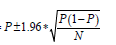
Where: represents the probability of contributing to meeting consumption needs, represents the probability of not contributing, represents the length of the time series (2000- 2023) Gujaratic, Arabization and review by [9].
Research results
The current status of potato production and productivity in the Kingdom of Saudi Arabia:

Source:Ministry of Environment, Water and Agriculture (2023). Statistical Book for the year 2023.
By studying the current status of potato production in various regions of the Kingdom of Saudi Arabia, it is clear from the data in (Table 1) that potato production is concentrated in the alluvial shelf areas, the most important of which are: Riyadh (50.09%), Hail (24.31%), Qassim (12.73%), Tabuk (8.41%), and Al-Jawf (3.26%). From the above, it is clear that the total relative importance of the production of the mentioned regions reached 98.8%, while the contribution of the rest of the productive regions does not exceed 1.2%. It is known that the alluvial shelf areas are characterized by low and varying rainfall rates, and they depend on non-renewable groundwater, and therefore the continuation of this situation leads to an impact on the strategic water reserve of the Kingdom [10].
Productivity is a measure of the efficiency of converting agricultural resources into final output, i.e. the ability to convert inputs into outputs according to specific specifications and at a specific cost within a specific period of time. Productivity is the amount produced by one unit of production elements, and is calculated by dividing potato production by the cultivated area [11]. The index was used to determine the amount of variation in potato productivity between regions. The productivity index could be expressed by the following equation: Productivity index = (productivity of comparison area ÷ productivity of base area) × 100.
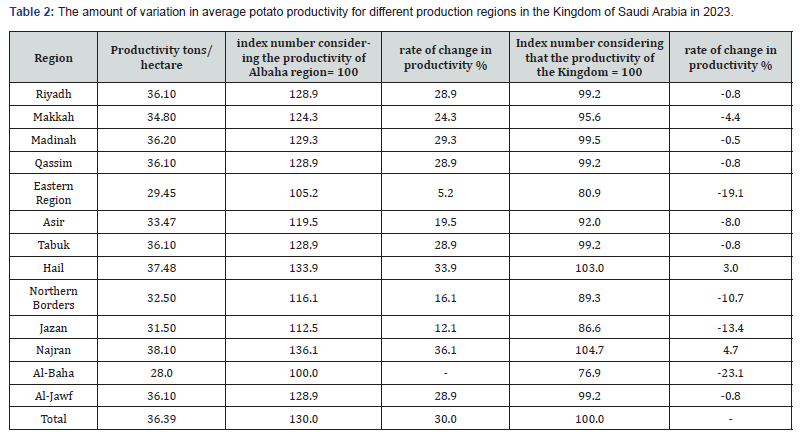
By calculating the potato productivity index, considering that the productivity of Al-Baha region is equal to 100, given that it is the lowest region in potato productivity, it is clear from the data in (Table 2) that the productivity of Najran and Hail regions outperforms its estimated counterpart for Al-Baha region by a rate of 36.1%, 33.9% for each, respectively, while the productivity of Al-Madinah region outperforms its estimated counterpart for Al-Baha by a rate of 29.3%. The productivity in each of (Riyadh, Qassim, Tabuk, Al-Jawf) outperforms its estimated counterpart for Al-Baha region by a rate of 28.9%, respectively. The productivity of Makkah Al-Mukarramah, Asir, Northern Borders, Jazan, and Eastern regions also outperforms its estimated counterpart for Al- Baha region by a rate of 24.3%, 19.5%, 16.1%, 12.1%, and 5.2%, respectively, in 2023.
Source:Calculated from data in (Table 1).
In the case of comparing the productivity of the regions with the average productivity at the Kingdom level of 36.39 tons/ hectare, it becomes clear that the productivity of the Najran and Hail regions exceeds the average productivity at the Kingdom level by a rate of 4.7% and 3% for each of them, respectively, while the productivity of the rest of the regions is less than the average productivity by a rate ranging between a minimum of 0.5% for the Madinah region and a maximum of 23.1% for the Al-Baha region in 2023. The disparity in potato productivity between the regions is attributed to the disparity in the degree of fertility of agricultural lands and the quality of water used for irrigation, in addition to the disparity in temperature, humidity, rainfall rates, and the experience of potato farmers.
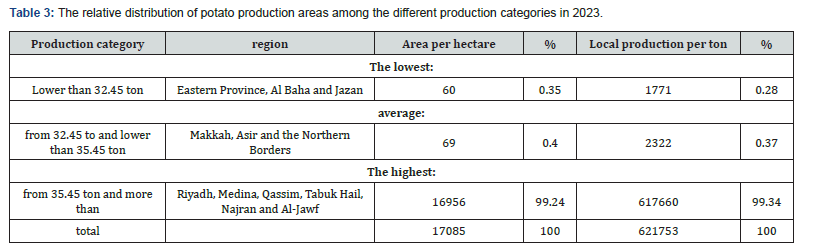
By distributing potato production areas across different production categories, it is clear from the data in (Table 3) that Riyadh, Medina, Qassim, Tabuk, Hail, Najran, and Al-Jawf regions fall into the high production category (35.45 tons or more), as the percentage of cultivated area and production of potatoes in the high production category areas reached 99.24% and 99.34% for each of them, respectively, in 2023. This situation is a correction to what the geographical distribution of potato area and production was during the period 2014-2018, as Riyadh, Eastern Province, Qassim, Al-Jawf, Makkah Al-Mukarramah, and Medina regions fell into the low production category (less than 26.11 tons/hectare). The percentage of cultivated area and production of potato crop in the low-productivity category areas reached 63.30% and 58.90% for each, respectively [3].
Source:Calculated from data in (Table 1).
By comparing the hectare productivity of potato crops in the Kingdom with the productivity of the same crop in some European, African, Asian countries and the United States of America, it is clear from the data shown in (Figure 2) that potato productivity in the Kingdom is less than its estimated counterpart for Turkey, South Africa, France, Jordan, Germany, the Netherlands, Kuwait, Denmark, the United States of America, and New Zealand, by rates of 23.52%, 24.88%, 25.9%, 32.01%, 32.47%, 40.77%, 45.79%, 46.09%, 62.17%, 68.02% respectively in 2022. Despite the increase in potato productivity in the Kingdom of Saudi Arabia to 36.39 tons/hectare in 2023, it is less than the productivity of the same crop in Turkey, South Africa, France, Jordan, Germany, the Netherlands, Kuwait, Denmark, the United States of America, and New Zealand.

Indicators of meeting local consumption needs for potatoes:
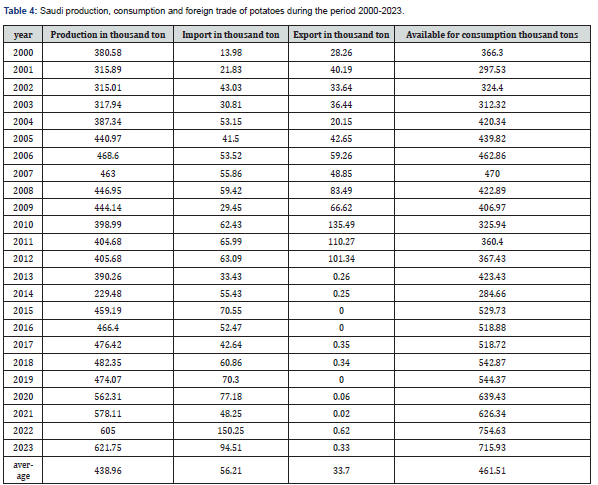
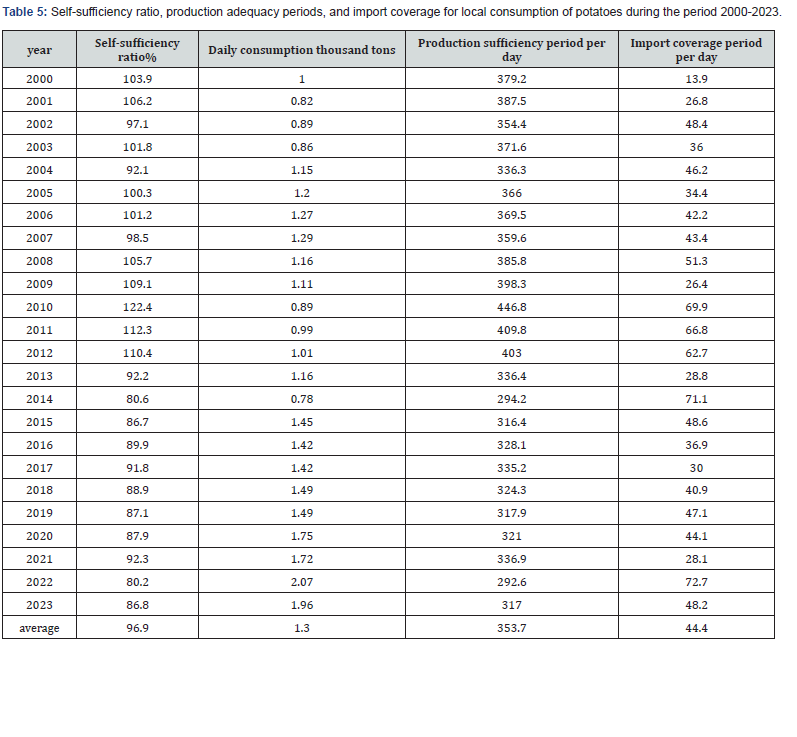
Indicators of meeting local consumption needs for potatoes in the Kingdom of Saudi Arabia were estimated during the period 2000-2023. The data in (Tables 4, 5) show an increase in local production from 380.58 thousand tons in 2000 to 621.75 thousand tons in 2023, i.e. an increase at an annual growth rate of 2.1% during the study period. Due to the increase in population, the availability for local consumption increased from 366.30 thousand tons in 2000 to 715.93 thousand tons in 2023, i.e. an increase at an annual growth rate of 3.0% during the study period. Given that the annual growth rate in local consumption exceeded its estimated counterpart for local production during the study period, the self-sufficiency rate for potatoes decreased from 103.9% in 2000 to 86.8% in 2023, i.e. a decrease at a rate of 0.9% annually (Table 6).
Source:(1) Ministry of Environment, Water and Agriculture, Statistical Book, period 2020-2023, (2) Food and Agriculture Organization (FAOSTAT), period 2000-2022.
Source: Calculated from data in (Table 4).
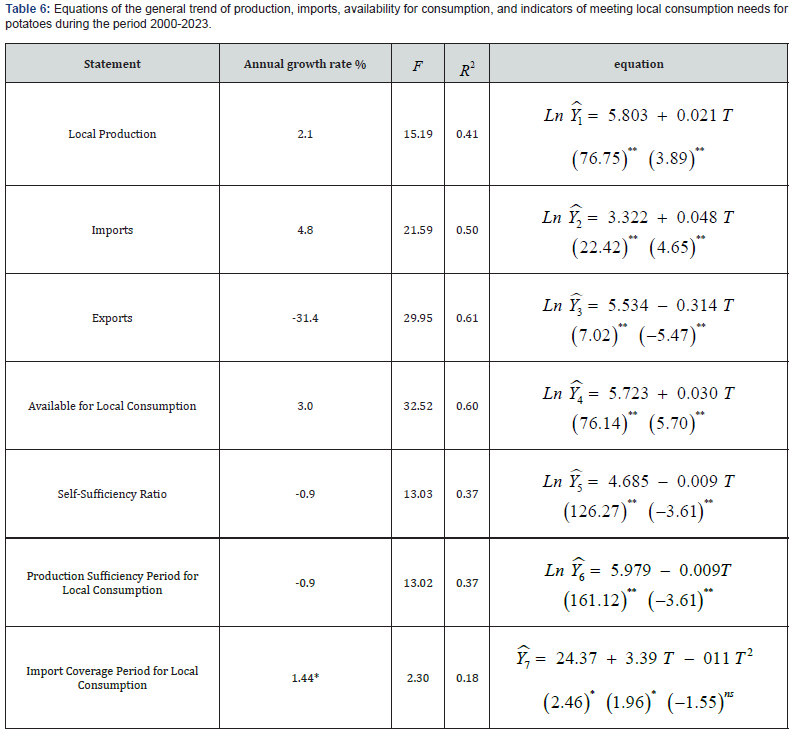
**Significant at 1% probability level, *Significant at 5% probability level, ns not significant.
Source: Compiled and calculated from data in Tables (4, 5).
*The annual growth rate was calculated from the following law:
The Kingdom of Saudi Arabia relied on local production to meet the consumption needs of potatoes, as the production sufficiency period for local consumption decreased from 379.2 days in 2000 to 317.0 days in 2023, with an annual average estimated at about 353.7 days during the study period. On the other hand, the import coverage period for local consumption The Time Interval of Imports Sufficiency increased from 13.9 days in 2000 to 48.2 days in 2023, with an annual average of 44.4 days during the study period. From the above, it is clear that the ratio of the average production sufficiency period to the import coverage period for local consumption of potatoes amounted to 796.62% during the period 2000-2023.
The extent of the contribution of production and imports to meeting local consumption needs for potatoes:
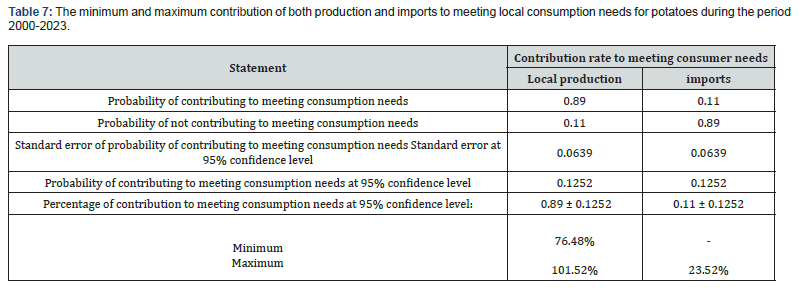
The minimum and maximum contributions of both production and imports to meeting local consumption needs for potatoes were estimated during the period 2000-2023. It is clear from the data in (Table 7) and (Figure 3) that the contribution of local production to meeting local consumption needs for potatoes ranged between a minimum of 76.48% and a maximum of 101.52% at a confidence level of 95%, while the maximum contribution of Saudi imports to meeting local consumption needs for potatoes was 23.52% at a confidence level of 95%.

Collected and calculated from the data in (Table 3).
Estimating the water used to meet local consumption needs for potatoes:
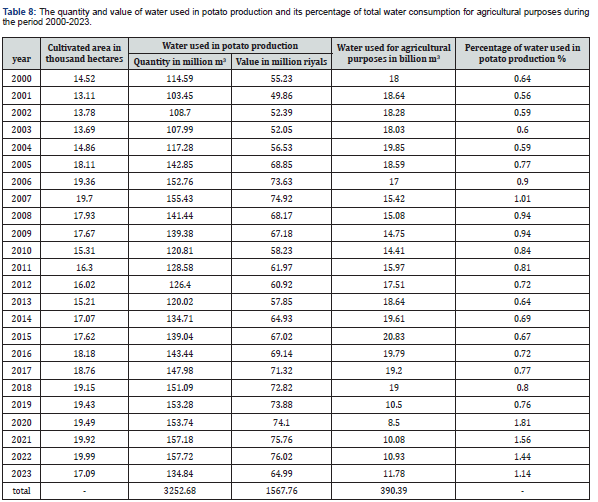
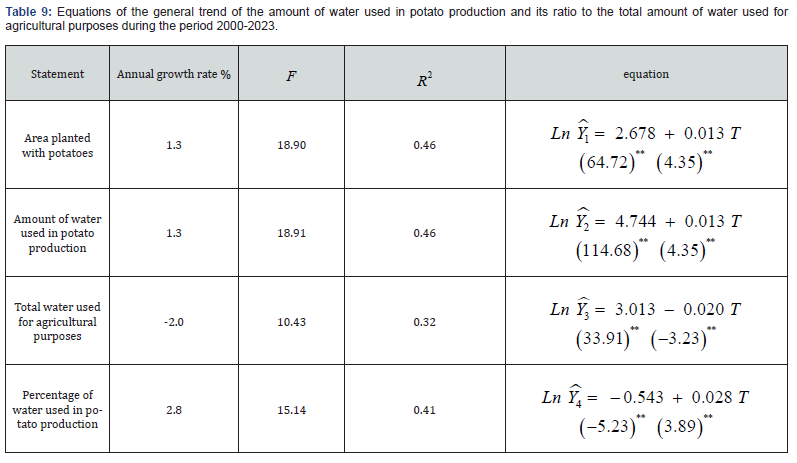
The amount of water used to meet local consumption needs for potatoes was estimated by multiplying the area planted with potatoes by the average water requirements per unit of land (hectare). The data in (Table 6) shows an increase in the area planted with potatoes from 14.52 thousand hectares in 2000 to 17.09 thousand hectares in 2023, i.e. the planted area increased at an annual growth rate of 1.3% during the period 2000-2023. In light of the average water requirements for potatoes, which amounted to 7.89 thousand m3/hectare [6], The amount of water used in potato production is estimated at about 114.59 million m3, representing 0.64% of the total amount of water used for agricultural purposes in 2000. Due to the expansion of the area planted with potatoes, the amount of water used increased to 134.84 million m3, representing 1.14% of the total amount of water used for agricultural purposes in 2023. In general, the amount of water used in potato production and its percentage of the total amount of water used for agricultural purposes increased at an annual growth rate of 1.3% and 2.8% for each, respectively.
In light of the amount of water used in potato production and the average cost of extracting groundwater of 0.482 riyals/m3 at a discount rate of 10% [13-15], the value of water used in potato production increased from 55.23 million riyals in 2000 to 64.99 million riyals in 2023. It is also clear from the data in (Table 8) and (Figure 4) that the total amount of water used in potato production amounted to 3.25 billion m3, with a value of 1.57 billion riyals, representing about 0.83% of the total amount of water used for agricultural purposes, amounting to 390.39 billion m3 during the period 2000-2023 (Table 9).
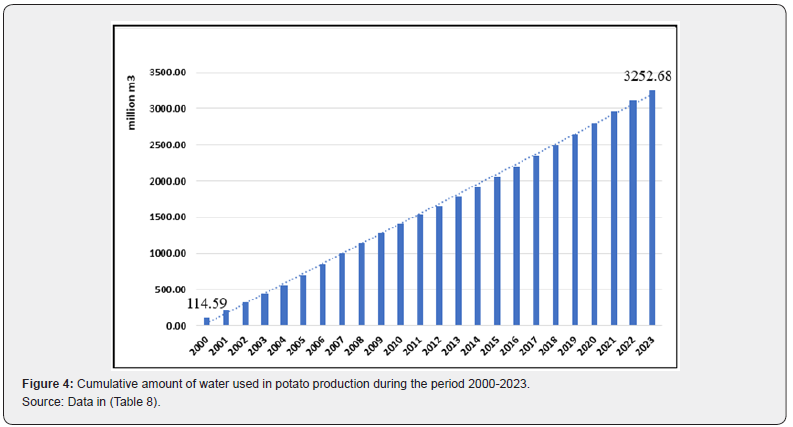
Compiled and calculated from: (1) Ministry of Environment, Water and Agriculture (2023). Statistical Book, (2) Al-Amoud, Ahmed Ibrahim et al. (2010). A guide for estimating crop water requirements in the Kingdom of Saudi Arabia, King Abdulaziz City for Science and Technology, General Administration of Research Grants.
**Significant at 1% probability level.
Source: Collected and calculated from the data in (Table 8).
Conclusion and Recommendations
The results of the study showed that potato cultivation is concentrated in the sedimentary shelf areas, as they are characterized by low and variable rainfall rates, and depend on non-renewable groundwater, and therefore the continuation of this situation leads to an impact on the strategic water reserve of the Kingdom. In addition, the expansion of potato cultivation, for the purpose of achieving self-sufficiency, leads to an increase in the consumption of water, which is characterized by relative scarcity. By studying the geographical distribution of potato area and production in the Kingdom of Saudi Arabia in 2023, compared to the average period 2014-2018, The Ministry of Environment, Water and Agriculture has succeeded in refocusing potato cultivation and production from low-productivity areas to highproductivity areas. Despite the increase in potato productivity in the Kingdom (30.27 tons/ha), it is less than the productivity of the same crop in Turkey, South Africa, France, Jordan, Germany, the Netherlands, Kuwait, Denmark, the United States of America, and New Zealand. This study recommends the need to increase potato productivity in the Kingdom of Saudi Arabia, so that it approaches the productivity of the same crop in neighboring regional countries, most notably Jordan (39.96 tons/ha) and Kuwait (44.13 tons/ha), by increasing soil fertility, high-productivity varieties, and modern technological methods.
Acknowledgement
The authors extend their sincere appreciation to the Deanship of Scientific Research at King Saud University for supporting the work.
References
- Rodriguez CI, Ruiz de Galarreta VA and Kruse EE (2015) Analysis of water footprint of potato production in the pampean region of Argentina. Elsevier, Journal of Cleaner Production 90: 91-96.
- Fuqiang Li, Hengjia Zhang, Xuan Li, Haoliang Deng, Xietian Chen, et al. (2022) Modelling and Evaluation of Potato Water Production Functions in a Cold and Arid Environment. Water 14(13): 1-13.
- Ghanem Adel Mohammed, Abdulaziz Alduwais, Youssef Alamri, and Mohammed Alnafissa (2019) Potato Production Strategy in the Kingdom of Saudi Arabia. Egyptian Journal of Agricultural Economics 29(4): 1447-1456.
- Ministry of Environment, Water and Agriculture (2023) Statistical Book for the year 2023.
- General Authority for Statistics (2023) Agricultural Statistics for the year 2023.
- Alamoud Ahmed bin Ibrahim et al (2010) A guide for estimating water requirements for crops in the Kingdom of Saudi Arabia, King Abdulaziz City for Science and Technology, General Administration of Research Grants.
- Thomas H and Pawel L (2006) Statistics: Methods and Applications Comprehensive Reference for Science, Industry, and Data Mining, Stat soft. Inc., United States of America.
- Ghanem Adel Mohamed Khalifa and Sahar Abdel Moneim Kamara (2010) A study of the economic factors determining the food security coefficient of sugar in Egypt. The third conference of the Department of Economics and Agricultural Business Administration (Agricultural Development Strategy and Challenges of Egyptian Food Security), Faculty of Agriculture, Alexandria University, (28-29) July, Alexandria Journal of Agricultural Research 56(2): 1-10.
- Gujarati Damodar N, Arabization and review by Odeh, Hind Abdel Ghaffar and Al-Dash, Afaf Ali Hassan (2015) Basic Econometrics. the Second Part, Marekh House of Publishing, Cairo, pp: 1145-1146.
- Ministry of Environment, Water and Agriculture (2020) Survey study and determination of the crop composition of the governorates of the Kingdom of Saudi Arabia according to the environmental systems of each governorate.
- Alnashwan OS, Khalid Alrwis, Adel Mohammed Ghanem, Sharafeldin Bakri Ahamed and Nageeb Alduwdahi (2019) Maize production strategy in Saudi Arabia. Journal of Experimental Biology and Agricultural Science 7(6): 545-553.
- Food and Agriculture Organization (FAOSTAT), period 2020-2022.
- Alnashwan Othman S, Mohammad H Alqunaibet and Adel M. Ghanem (2016) Estimating groundwater extraction cost and its efficiency use in dates production in Riyadh Region, Saudi Arabia. Universidade Federal Rural de Pernambuco Departamento de Administracao Custos e @gronegocio on line 12(1): 282-289.
- Bector CR and Chandra S (2005) Fuzzy Mathematical Programming and Fuzzy Matrix Games. Springer Berlin Heidelberg, New York.
- Blank LT and Tarquin AJ (1989) Engineering Economy. Third Edition, Mc Grow- Hill Book Company, New York.

























