




 ASM Home




Engaging with Engagement the Case of a Dynamic, Cultural Vessel: Zen
Chris D Beaumont1*, Darrell Berry2 and John Ricketts3
1Institute for Future Initiatives, LifeStyle by Design, The University of Tokyo, Japan
2Significance Systems, Brighton BN1 6SP, UK
3Significance Systems, Sydney NSW 2069, Australia
Submission: September 14, 2022; Published: September 23, 2022
*Corresponding author: Chris D Beaumont, Institute for Future Initiatives, LifeStylebyDesign, The University of Tokyo 7-3-1 Hongo, Bunkyo-ku, Tokyo 113-0033, Japan
How to cite this article:Chris D B, Darrell B, John R. Engaging with Engagement the Case of a Dynamic, Cultural Vessel: Zen. Ann Soc Sci Manage Stud. 2022; 7(5): 555722. DOI: 10.19080/ASM.2022.07.555722
Abstract
Today, global interconnectivity has never been more apparent with COVID-19 and supply chain constraints exacerbated by the conflict in Ukraine. This network mediated, dynamic environment creates more fluid, formal and informal, boundaries between organizations and individuals. Technology can empower organisations to leverage data analytics to deliver better decisions. Signal analyses can identify and track highly engaging narratives. Their internal structure can be analyzed so that organisations can, build on existing foundations, contextualize social media and engage with engagement. Many complex narratives are woven on a framework of authority and expertise. Such an approach facilitates communications that are effective and efficient.
This paper looks at a lost global, communications opportunity, Zen, at a time when society is increasingly concerned about well-being and mental health. The historical and cultural richness of seeking enlightenment that Zen exudes has, to date, largely been valued by cultures, but treated by marketers in a superficial manner that on only scratches the surface and unfortunately dilutes any impact. Zen is a rich cultural vessel. Understanding local context is essential for organisations to readily get their message across in a meaningful and credible manner.
Keywords: Narratives; Engagement; Culture; Big Data; AI; Zen; Lifestyle; Well-being; Communications
Narratives are Shaping our World
COVID-19 [1], in early 2020, rapidly changed how people around the world were able to live their daily lives. Such a quick and fundamental transformation has led people to reassess their basic lifestyle tenets. Many things were seen to be broken and the pandemic, especially regarding communications brought the future faster than might have been expected. Health and well-being moved up to the top of the agenda, but in many regards the pandemic magnified existing social inequalities and damage to the young [2]. WFH (Working From Home) has created tension and heightened people broadly reassessing how they can find a sustainable work-life harmony. Technology can help people connect but it can also impact how they communicate and behave. For example, smart phones can lead to additive behavior that materially impacts well-being [3].
Today, our world is online. Stories fuel our imagination today. Narratives and social media are now integral parts of today’s connected world. They provide echo chambers / media bubbles that show a lens to understanding (changing) values and behavior.
Narrative Economics, Shiller [4], shows how the stories we tell ourselves about the world drive our behavior — and thus the world itself if enough people buy into them. To affect behavior, one needs to understand what people feel is important and enhance engagement amongst the existing narratives that are shaping our world. While the pandemic has heightened an interest in wellbeing it has also magnified inequalities leading to increased mental health concerns [5], a viscous cycle in health inequalities, and switching companies. In respect to the latter, the so-called ‘Great Resignation’ was not started by the pandemic but is reflective of a deeper social malaise [6].
Zen Buddhism [7] is seen to offer a timely holistic approach to finding peace and feeling relaxed, but ask six people in a room and you may get ten different answers. This is even though Zen was introduced to the west by Suzuki Daisetsu [1870-1966] as Japan [8] was modernizing and opening itself up [9]. It is a communication challenge with Zen being an experiential process that drops literal thinking and words. The Zen ‘koan’ is a puzzle or poetry or paradox intended to open the mind [10]. This lack of insight is compounded when you factor in the basic ethics and culture of different societies, which saw national identity heightened by individual and distinct responses to the global pandemic [11,12]. Like many religions, Zen Buddhism has been distorted [13] to support holy wars. However, like the thinking of the undefeated samurai Miyamoto Musashi on manifesto on swordsmanship, strategy, and winning [14], the same thinking has been applied to business leadership strategy [15]. Trenson [16] recently investigates the textual evidence that points to what is referred to as “medieval Shinto” and the integration process of Buddhist elements in martial schools.
During period of unprecedent change it is critical to track what people think is important not what marketers and politicians feel they need? In these unusual times with heightened uncertainty, it becomes more of an imperative to be able to communicate and connect in a relevant and credible way. People find trusted voices in their networks. Unlike traditional mass-media of intrusion the almost ubiquitous use of social media has existing stories in the wild. It is therefore practical to engage with existing rich engagement [17], with specific narratives and their gatekeepers / influencers, building on existing and authentic foundations. The ability to identify emergent new voices in almost real-time offers a new way of thinking and communicating, that places an emphasis on what is important, to effect new behavior, rather than the volumetric mentality associated with social listening.
With globalization and the spread of the Internet, there has been an increasing interest in culture and cultural differences [18], across borders since the seminal work of Hofstede [19]. Going forward culture and ethics will be increasingly important as leaders look to create more sustainable enterprises that are transparent. The cross-cultural energy that can be created by social media, naturally magnifies the role of language as a vessel of cultural values [20]. This is often filtered by the Hofstede dimensions of individualism and uncertainty avoidance. While such considerations are material constraints and important considerations for MNCs to take their Strategic Leadership Narrative around the world, the authors recognize that existing ‘cultural’ narratives can offer ‘free equity’ if leveraged appropriately.
The Significance Systems’ platform: earth.ai exploits Big Data and AI techniques to analyse the structure of engagement on any topic, across the whole of the internet. It shows people’s true emotions and how they are feeling in a way traditional social, or marketing research does not. Critically, one can find the strongest story around any topic. This state-of-the-art, communication science measures long-term engagement for narratives. Naturally, distinctive narratives behave in discrete ways and vary in their value and utility [21]. Timeless narratives are relatively rare, representing only 5percent, of all narratives. They have utility, being characterized by deep, long-term engagement driven by a relatively small number of opinion formers such as authorities and / or experts. Such narratives persist and grow, becoming part of society and the culture.
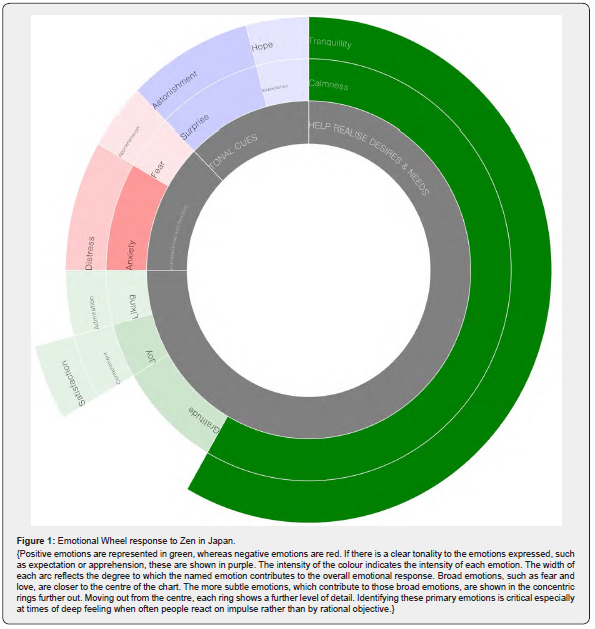
In all the countries analysed in this paper (Australia, France, Germany, Japan, the UK, and the US), the existing Zen narrative is timeless. It is a narrative with utility since it has long-term engagement which is part of society and culture and is expected to persist and grow (Figure 1). However, in general, the content efficiency of the Zen narrative is low, but with a large range of topics and themes that are valued. Therein lies the opportunity if one hopes to leverage this cultural vessel, since there is currently a gap between the needs of the market and the existing content.
Often the focus of attention is content, but if one wishes to effect change it is also important to remember that emotions precede action. Since most narratives are transient, they are also neutral, and do not provoke an emotional response. Affect orientation is a measure of the degree to which the narrative stimulates an emotional response: active or passive, positive or negative.
Leveraging findings from the psychological literature [22], we present the emotional response to the narrative in the form of an emotional wheel. It represents a hierarchy of the emotional linkages (Figure 1). In the case of Japan (Figure 1), the emotions that dominate the Zen narrative are positive, with a sense of tranquility driving calmness; and to a lesser extent satisfaction fueling contentment and joy. Some distress and apprehension create anxiety and fear, while their also remains surprise and hope. Such tonal cues can be leverage as well as recognizing that the positive emotions help people realize their desires and fulfil needs. The key topics driving the engagement with the Zen narrative, in Japan, reflect a sense of occasion, whether reflective of traditional food, ceremony, and / or places to be at one with nature or history.
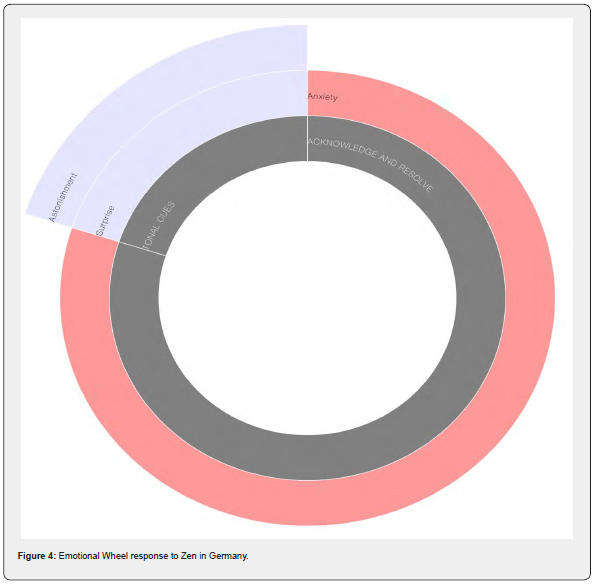
In the countries investigated, in Q3 2022, it is not surprising that in Japan that Zen is dormant, with an affect orientation that is positive but dormant. In contrast, in Australia, France, the UK, and the US, the affect orientation of Zen is active and positive conveying a sense of delight, at a time of heightened concern and volatility. In Germany, there is a rather more reserved emotional response, perhaps indicative of both their underlying culture [higher ‘longterm orientation’ like Japan, when compared to other countries [23], and understanding of Zen, since it is active, but neutral.
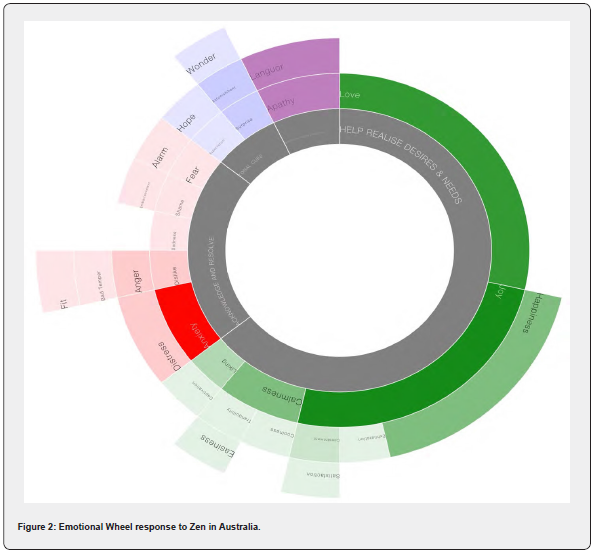
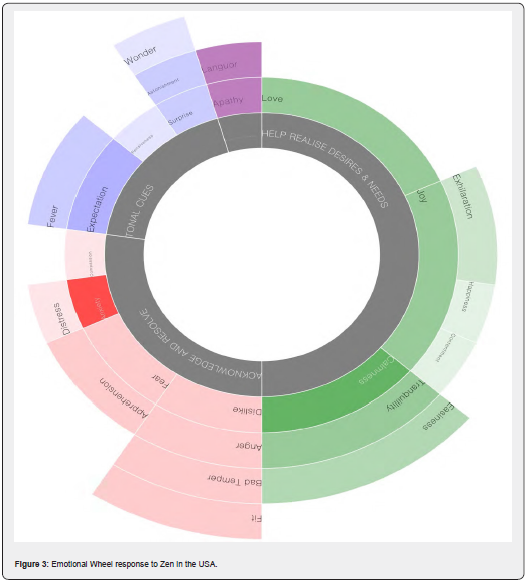
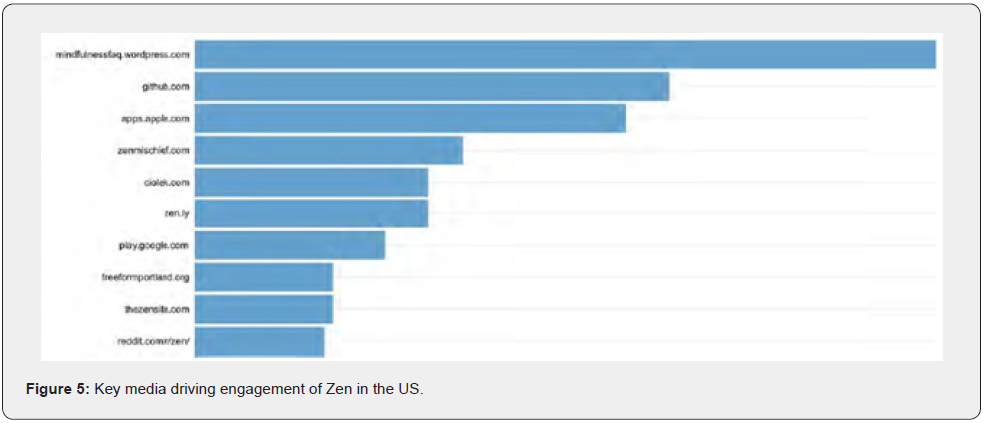
In contrast to Japan, in Australia (Figure 2) there are many more emotional dimensions to the Zen narrative, which are relatively weaker but where love and joy dominate the positivity, while there is a sense of calmness coming from a feeling of tranquility and ease. That said, there is more anxiety, which is driven by everyday stress on the one hand and popular Zen apps on the other. Digital games, puzzles and home design are the topics currently driving engagement which confirms the relative embryonic nature of the narrative in Australia. In the US, there are also a broad set of emotions stimulated which are positive and some negative, but significantly those associated with expectation and surprise (Figure 3), anticipating personal improvement. The strongest media driving engagement with the Zen narrative is mindfulness; the relationship between people and Zen. In France, there are also a similar mix of emotions but as not pronounced as in Australia. While the key media are App stores, reflective of the importance of (word) games in driving narrative engagement, there is also interest in the Asian myth.
In Germany, there is also a plethora of online elements driving engagement including some associated with sleep and meditation, but the current emotional response is quite distinct since anxiety dominates, albeit rather weakly reflective of the somewhat neutral stance (Figure 4). In the US, mindfulness (Figure 5) is the most significant media. This is not a volumetric index since often, the most popular media are not the ones with the strongest impact on topical or social engagement. Rather, it ranks media voices according to their power to lead debate and shape perception, and drive market performance in terms of preference and desirability. In the UK, the core positive emotions are joy love and calmness. Budismnow is the most significant media influencing the Zen narrative.
When looking at narratives, especially across borders, it is important to investigate with a fine granularity so that you are aware of the true vernacular in the market, and / or not unduly influenced by the existing associations or naming’s. Regarding the latter, in the UK at the time of the research there was some social discussion of the Hong Kong situation, and in particular, the arrest and subsequent appearance in court of Cardinal Zen, on the World Day of Prayer for the Church in China (May 22nd). There was also an internet provider called Zen, which was founded in 1995, and which the founder hopes reflect a better way of doing business. By taking the name, it tries to reinforce its corporate values of putting people and the environment first (“before money”).
Implications
Globalization began at time when mass media still dominated how stories were framed and evolved. It was representative of an era of hierarchy and dogma, often characterized by western centralized command and control [24]. The Internet, with social media has created unparalleled interconnectivity, where stories and opinions can be initiated anywhere. This networked society is flattened and empowered unlike any previous generation. There is a richer diversity of opinions, with an increasing need to understand the role culture plays in setting expectations. This is just one element that drives more fluid conversations, with dynamic boundaries, influenced by both formal and informal commentators.
Such a new world order and apparent complexity needs to be embraced. It can be harnessed by integrating data analyses into decision-making, that can also inspire greater creativity. It is critical to understand what is significant from a market’s perspective, not necessarily from a marketing viewpoint. Understanding what the market wants can enable you to magnify and annex on-going trends and narratives. The imperative to communicate and connect, at a visceral level, demands that the complex is simplified. This paper has illustrated how using Big Data, from all openly available public and personal sources, with AI it is practically expedient to focus the right message, to the right people, and in the right context.
Engaging with (existing stories) engagement can more readily move people and move markets. In the same vein, it is possible to identify and engage with existing cultural vessels, to annex ‘free equity’. We have illustrated this idea by exploring the Zen narrative in several different mature and competitive marketplaces. It is evident that, at any time, the local understanding of the same narrative can vary in a material way. Our analyses show largely a failure of Zen communications, to date, illustrates that Zen is a proven process that can improve one’s sense of well-being and life satisfaction. Our approach can help understand what is significant from a market’s perspective and can be undertaken on a regular basis as necessary to monitor the mood of the society, to empower focused, relevant, and credible response, by public and private sector leaders. Significantly, in so doing, it can reassure society that their leadership is on top of an evolving situation, by controlling the most appropriate narrative.
References
- Beaumont CD, Ricketts J (2020) A Significant Moment in History: A Virtual Living Lab. Life Style Narratives That Are Shaping Our World; the Cases of Japan and UK 2019–2020. Sustainability, 12, 9658. Special Issue: Big Data, Knowledge Management and IoT: New Perspectives for New Challenges in Disruptive Times.
- Haldane A (2022) Comment, RSA Journal.
- Yang SY, Wang YC, Lee YC, Lin YL, Hsieh PL, et al. (2022) Does Smartphone Addiction, Social Media Addiction, and/or Internet Game Addiction Affect Adolescents’ Interpersonal Interactions? Healthcare 10: 963.
- Shiller J (2019) Narrative Economics: How Stories Go Viral and Drive Major Economic Events, Princeton University Press, New Jersey, United States.
- World Health Organization (2022) COVID-19 pandemic triggers 25% increase in prevalence of anxiety and depression worldwide, News Release.
- Fuller J, Kerr W (2022) The Great Resignation did not start with the Pandemic. HBR, Human Resource Management.
- Suzuki DT {Jung CG Foreword} (1991) An Introduction to Zen Buddhism. Grove Press (1/e; 1934), New York, United States.
- Jansen MB (2000) The Making of Modern Japan. Belknap Harvard.
- Viglielmo VH (2015) CHAPTER XIII. Nishida Kitarō: The Early Years. Tradition and Modernization in Japanese Culture, Shively DH (ed.), Princeton: Princeton University Press, pp. 507-562.
- Heine S (2002) Opening a Mountain: Koans of the Zen Masters. Oxford, New York.
- Gelfand MJ, Joshua Conrad Jackson, Xinyue Pan, Dana Nau & Dylan Pieper, et al. (2021) The relationship between cultural tightness–looseness and COVID-19 cases and deaths: a global analysis. Lancet Planet Health.
- Melton J, Sinclair R ( 2021) Culture and COVID-19: A Global Analysis of the Successes of Collectivist Countries and the Failures of Individualistic Countries.
- Victoria BD (1997) Zen at War. John Weatherhill New York (2/e; 2006, Rowman & Littlefield)
- Miyamoto M (1645; 2018) The Book of Five Rings. translator, Harris V, Arcturus.
- Romero LE (2020) Become A Business Samurai With Musashi’s Five Powerful Lessons, Forbes.
- Trenson S (2022) Buddhism and Martial Arts in Premodern Japan: New Observations from a Religious Historical Perspective. Religions 13(5): 440.
- Beaumont CD, Berry D, Ricketts J (2021) ‘Engaging with Engagement’: a new communications strategy that provides coherence making companies more competitive and public institutions more agile and accessible. Advances in Journalism and Communications 9(4): 161-195.
- De Mooij M (1995) Consumer behaviour and culture. Consequences for global marketing and advertising, SAGE.
- Hofstede G (1983) Culture’s Consequences: International Differences in Work-Related Values. SAGE Publications, 4: 625-629.
- Alcántara-Pilar J, Del Barrio-García S, Porcu L & Crespo-Almendros E (2017) Language as a cultural vessel in online servicescapes: Its impact on consumers' perceived risk, attitudes and behavioural intentions. Journal of Consumer Behaviour 16(6): 1-15.
- Beaumont CD, Berry D, Ricketts K & Ricketts J (2021) The Vital Role of Ensuring On-Going Relevance During a Period of Unprecedented Change, Due To COVID-19; An Ability to Identify and Understand Timeless Narratives Takes on Greater Utility for Communications Efficiency. Ann Soc Sci Manage Stud 6(4): ASM.MS.ID.555691
- Plutchik R (2002) Emotions and Life: Perspectives from Psychology, Biology, and Evolution. Amer Psychological Assn.
- Hofstede (2022) National Culture.
- Riley C (2017) After the Mass-Age; Analog: Norwood, USA.