




 ACJPP Home



Abstract
Road and bridge infrastructure is increasingly recognised as a critical but contested driver of urban economic development and local authority performance in rapidly urbanising Sub-Saharan African cities. However, existing literature remains fragmented, treating governance outcomes and economic development as separate processes and under-theorising infrastructure as a synchronising mechanism. This study examines how road and bridge infrastructure shapes both urban local authority outcomes and economic development in Ruwa Local Board, Zimbabwe. This study adopts a pragmatist paradigm and convergent parallel mixed-methods design, combining stratified surveys of residents and businesses with key informant interviews and document analysis. Quantitative data were analysed using regression and structural equation modelling, while qualitative data were thematically analysed to capture governance and development experiences. Findings indicate that road and bridge infrastructure improves service delivery efficiency and economic activity, but its effects are conditional on maintenance quality, governance capacity, financing arrangements, and spatial connectivity. In Ruwa, weak maintenance systems and constrained institutional capacity significantly undermine infrastructure benefits, while public–private partnerships produce uneven development outcomes and reinforce spatial inequalities. This evidence challenges linear Infrastructure-Led Development assumptions by demonstrating that infrastructure functions as a synchronising mechanism rather than an autonomous growth driver. It further shows co-constitution between infrastructure and governance, where institutional weakness both constrains and is reinforced by infrastructure performance. Policy implications emphasise integrated planning, maintenance-led asset management, and strengthened local authority capacity to achieve inclusive and sustainable urban development in Zimbabwe. Overall, the study provides an integrated empirical framework for understanding infrastructure-driven urban transformation in secondary cities context.
Keywords:Road infrastructure; Bridge infrastructure; Urban development; Service delivery; Local governance; Infrastructure planning; Economic development
Abbreviations: SEM: Structural Equation Modelling; PPPs: Public-Private Partnership
Introduction
Road and bridge infrastructure is widely recognised as a fundamental catalyst of urban transformation, institutional performance, and economic development Calderón & Servén [1]; AfDB [2]; Munyoro [3,4]. Transport infrastructure facilitates the movement of people, goods, services, and information, thereby enhancing market accessibility, reducing transaction costs, improving productivity, and strengthening spatial integration Calderón & Servén [1]; Munyoro [3,4]. Across developing economies, particularly in Sub-Saharan Africa, the quality and availability of transport infrastructure have increasingly become critical determinants of urban competitiveness, investment attraction, and service delivery effectiveness Bettencourt & Marchio [5]; Munyoro [3,4].
As African cities continue to experience rapid urbanisation, the capacity of local authorities to provide and maintain transport infrastructure has emerged as a major policy concern because infrastructure deficits often constrain economic growth and undermine urban governance outcomes UN-Habitat [6]; Munyoro [3,4]. Recent evidence suggests that many African urban centres are expanding faster than the infrastructure systems required to support them, resulting in congestion, reduced accessibility, and weakened municipal service delivery capacities Fadda [7]. Consequently, road and bridge infrastructure is no longer viewed merely as a physical asset but as a strategic enabler of local economic development and effective urban governance AfDB [2].
In Zimbabwe, the significance of transport infrastructure has become more pronounced against the backdrop of rapid urban expansion, fiscal constraints, infrastructure deterioration, and increasing demand for municipal services World Bank [8]; Munyoro [3,4]. Urban local authorities are constitutionally mandated to provide efficient services and create enabling environments for socio-economic development, yet many struggle to fulfil these responsibilities due to inadequate infrastructure financing and maintenance backlogs Chirisa & Muzend [9]; Munyoro [3,4]. Although national economic recovery efforts continue to emphasise infrastructure-led development as a pathway towards sustainable growth, transport networks in many urban areas remain under significant pressure from population growth and expanding economic activities World Bank [8].
Within this context, road and bridge infrastructure represents a critical interface between local governance and economic performance because it influences accessibility to markets, industrial zones, educational institutions, healthcare facilities, and public services Calderón & Servén [1]; Munyoro [3,4]. Wellfunctioning transport systems also enhance municipal operational efficiency through improved waste management, emergency response, revenue collection, and infrastructure maintenance activities, thereby contributing to broader development outcomes UN-Habitat [10]. The relationship between transport infrastructure and urban development is particularly evident in Ruwa Local Board, one of Zimbabwe’s fastest-growing urban settlements situated along the strategic Harare–Mutare transport corridor.
Ruwa’s transformation from a growth point into a significant urban centre has largely been associated with infrastructure investments undertaken through public-private partnerships (PPPs) Muzorewa [11]. Historical studies demonstrate that private land developers, in collaboration with the local authority, played a crucial role in financing and constructing roads, water systems, and other public amenities that stimulated residential, commercial, and industrial development Muzorewa & Nyandoro [11]; Muzorewa [12]. These investments significantly enhanced Ruwa’s attractiveness to investors and residents, accelerating urban growth and economic expansion Muzorewa & Nyandoro [12].
However, emerging scholarship presents a more complex picture of Ruwa’s development trajectory. While some studies celebrate PPP-led infrastructure provision as a successful model for urban growth and service expansion, others argue that the same model generated governance challenges, inequalities in access to public amenities, and tensions between developmental objectives and citizen participation Muzorewa & Nyandoro [12]; Muzorewa [13]. This contradiction suggests that infrastructure development alone may not automatically translate into improved governance outcomes or inclusive economic development, thereby necessitating a more nuanced understanding of how transport infrastructure shapes both municipal performance and local economic dynamics Muzorewa [14].
Despite growing scholarly attention to urban development, infrastructure provision, and PPPs in Zimbabwe, a significant conceptual and empirical gap remains. Existing studies on Ruwa have predominantly focused on urban expansion, stakeholder relationships, PPP arrangements, and the historical evolution of the town, with limited attention given to the specific role of road and bridge infrastructure in simultaneously influencing local authority outcomes and economic development Muzorewa [11]; Muzorewa [11,13]. Furthermore, the literature tends to analyse governance performance and economic development as separate phenomena, overlooking the possibility that transport infrastructure acts as a synchronising mechanism that links municipal effectiveness, service delivery performance, investment attraction, business growth, and overall economic development. This fragmentation of knowledge creates a critical gap in understanding the multidimensional pathways through which infrastructure contributes to urban resilience and development. Therefore, this study seeks to examine how road and bridge infrastructure synchronises urban local authority outcomes and economic development in Ruwa Local Board. By focusing on the interconnected effects of transport infrastructure on governance effectiveness and economic performance, the study advances a more integrated analytical perspective and generates contextspecific evidence to inform infrastructure policy, urban planning, and local economic development strategies in Zimbabwe.
Literature Review
Theoretical Perspective
This study is anchored on three complementary theoretical lenses: Infrastructure-Led Development Theory, Growth Pole Theory, and New Institutional Theory. Infrastructure-Led Development Theory posits that strategic investments in transport infrastructure such as roads and bridges stimulate economic growth by reducing transportation costs, improving market accessibility, enhancing labour mobility, and attracting private investment Pradhan [15]; Rosik & Wójcik [16]. Contemporary empirical studies demonstrate that transport infrastructure exerts both direct and indirect effects on economic productivity through agglomeration economies, market integration, and spatial spillovers across regions Rosik & Wójcik [16]; Liu [17,18]. Recent evidence suggests that well-developed transport networks enhance urban productivity, facilitate business expansion, and create conditions for sustainable urban growth Liu [17,18]; Yin [19,20]. Growth Pole Theory, originally advanced by François Perroux, further explains how infrastructure investments transform selected urban centres into nodes of economic concentration, generating cumulative growth effects that extend to surrounding areas Parr [21].
Recent urban development studies confirm that transport infrastructure strengthens the attractiveness of urban growth centres by facilitating accessibility, industrial clustering, and spatial economic expansion Karmarkar [22]; Zou [23]; Munyoro [3,4]. Complementing these perspectives, New Institutional Theory emphasizes that infrastructure outcomes are contingent upon institutional capacity, governance quality, policy coordination, and local authority effectiveness Pradhan [15]; Rosik & Wójcik [16]; Wallis & Rizvi [24-26]. Local governments serve as critical actors in infrastructure planning, implementation, and maintenance, thereby influencing the extent to which infrastructure investments translate into developmental outcomes Pradhan [15]; Rosik & Wójcik [27]; Wallis & Rizvi [24-26]. Collectively, these theories provide a multidimensional framework for understanding how road and bridge infrastructure can synchronize local authority performance and economic development within the context of Ruwa Local Board.
Conceptualising Road and Bridge Infrastructure
Road and bridge infrastructure refers to the physical transport assets that facilitate the movement of people, goods, and services within and between urban and rural spaces World Bank [28- 30]. While traditional literature often conceptualizes roads and bridges merely as transportation facilities, contemporary scholarship increasingly views them as strategic economic assets that shape urban competitiveness, spatial integration, and socioeconomic transformation Rosik & Wójcik [27]; OECD [31,32]; Munyoro [3,4]. Recent studies reveal that road infrastructure influences urban morphology, settlement patterns, and economic interactions by enhancing accessibility and connectivity between residential, industrial, and commercial zones Yin & Feng [33,34]; Wang [35,36].
However, scholars argue that the developmental impact of infrastructure depends not only on its existence but also on its quality, resilience, maintenance, and integration within broader urban planning frameworks Ahmed [37-39]; Randhawa [40-42]. This perspective is particularly relevant in Zimbabwe, where many urban local authorities face challenges related to deteriorating road networks, inadequate bridge maintenance, and increasing urbanisation pressures UCAZ [43,44]; ZINARA [45]. Consequently, road and bridge infrastructure should be conceptualised not merely as physical assets but as dynamic enablers of economic activity, institutional effectiveness, and urban sustainability World Bank [30]; OECD [31,32]; Munyoro [3,4].
Road and Bridge Infrastructure and Urban Local Authority Outcomes
Urban local authority outcomes encompass service delivery effectiveness, governance efficiency, revenue generation, citizen satisfaction, and institutional performance Wallis & Rizvi [24- 26]. Existing literature suggests that transport infrastructure significantly influences local authority outcomes by improving accessibility to public services, reducing service delivery costs, and enhancing administrative efficiency Ahmed [37-39]; OECD [31,32]. Research demonstrates that municipalities with wellmaintained transport networks are better positioned to deliver essential services such as waste collection, emergency response, public transportation, and urban planning functions Billhardt et al., 2024. Nevertheless, critical analysis reveals that infrastructure improvements do not automatically translate into improved local governance outcomes.
Institutional weaknesses, inadequate maintenance budgets, corruption, and fragmented planning often undermine the effectiveness of infrastructure investments Wallis & Rizvi [24-26]; World Bank [30]. Wallis and Rizvi [24-26] argue that governance mechanisms and institutional coordination significantly determine whether infrastructure investments generate intended public sector outcomes. This suggests that road and bridge infrastructure should be analysed alongside governance capacity rather than as an isolated determinant of local authority performance. In the context of Ruwa Local Board, understanding this interaction becomes essential because infrastructure development and institutional effectiveness are likely to be mutually reinforcing.
Road and Bridge Infrastructure and Economic Development
Economic development is commonly measured through indicators such as employment creation, business growth, investment attraction, income generation, productivity enhancement, and poverty reduction World Bank [28]; UNHabitat [10]; Munyoro [3,4]. Extensive empirical literature identifies transport infrastructure as a critical driver of economic development. Transport networks reduce transaction costs, facilitate market access, improve supply chain efficiency, and enhance labour mobility Pradhan [15]; Rosik & Wójcik [16]; Munyoro [3,4]. Recent studies consistently find positive relationships between transportation infrastructure and regional economic growth, with evidence showing significant productivity gains and spillover effects extending beyond immediate project locations Yin et al. [19,20] Rosik & Wójcik [16].
Similarly, Liu et al. [17,18] found that transportation infrastructure contributes significantly to urban productivity through economic agglomeration and increased business competitiveness. However, critical scholarship cautions against simplistic assumptions of automatic infrastructure-led growth. Some studies indicate that economic benefits vary according to institutional quality, complementary investments, urban planning effectiveness, and regional economic structures Rosik & Wójcik [16]; Wallis & Rizvi [24-26]. Therefore, while road and bridge infrastructure constitutes a necessary condition for economic development, it may not be sufficient without supportive governance and economic policies. This observation is particularly relevant for Zimbabwe, where infrastructure investments often occur within broader constraints related to financing, governance, and maintenance capacity.
Infrastructure Connectivity and Spatial Economic Integration
A growing body of literature highlights connectivity as a key mechanism through which transport infrastructure influences development outcomes OECD [31,32]; World Bank [29,30]; Munyoro et al, 2026) [3,4]. Connectivity refers to the degree to which transport networks facilitate efficient movement between economic nodes and urban centres OECD [31,32]; Munyoro [3,4]. Recent studies demonstrate that improved road connectivity enhances spatial integration, promotes regional trade, and stimulates economic diversification by linking producers to markets and workers to employment opportunities Wang et al., [35,36]; Ignatov, 2024; Munyoro et al., [3,4].
Furthermore, evidence suggests that transport infrastructure generates positive spillover effects across neighbouring regions, thereby promoting broader economic integration and reducing spatial inequalities Yin et al. [19,20]; Munyoro [3,4]. Nevertheless, the literature also reveals that connectivity benefits are unevenly distributed and may reinforce existing spatial inequalities if infrastructure investments favour already developed areas UN-Habitat [10]; OECD [31,32]; Munyoro [3,4]. This critique is important for analysing Ruwa because its proximity to Harare may create opportunities for economic integration while simultaneously exposing it to risks of peripheral dependency UN-Habitat [10]; Munyoro [3,4]. Consequently, examining connectivity as an intervening variable provides a more nuanced understanding of how road and bridge infrastructure influences local authority and economic outcomes.
Infrastructure Quality, Maintenance and Sustainability
Recent literature increasingly emphasizes infrastructure quality and maintenance rather than merely infrastructure availability. Scholars argue that deteriorating roads and bridges undermine economic productivity, increase transportation costs, reduce investor confidence, and compromise service delivery effectiveness Ahmed [37-39]; World Bank [28,29]; Munyoro [3,4]. Research on infrastructure sustainability indicates that long-term developmental benefits depend on continuous maintenance, adequate funding, institutional accountability, and resilience planning Ahmed [37-39]; Randhawa [40-42]; Munyoro [3,4].
In developing countries, infrastructure maintenance deficits often erode the gains associated with initial capital investments. This challenge is particularly pronounced in Zimbabwe, where many local authorities face financial constraints and aging infrastructure systems. Consequently, infrastructure quality and maintenance emerge as critical variables that mediate the relationship between road and bridge infrastructure and development outcomes Ahmed [37-39]; Randhawa [40-42]; Munyoro et al, 2026) [3,4]. Without adequate maintenance frameworks, infrastructure investments may fail to produce sustainable economic and institutional benefits World Bank [28,29]; OECD [31,32]; Munyoro [3,4].
The Role of Urban Local Authorities in Infrastructure Development
Urban local authorities play a central role in infrastructure planning, financing, implementation, regulation, and maintenance Wallis & Rizvi [24-26]. Literature increasingly recognises local governments as active developmental agents rather than passive service providers. Effective local authorities facilitate infrastructure development through strategic planning, stakeholder engagement, resource mobilisation, and policy coordination UN-Habitat [10]; OECD [31,32]. However, studies also identify challenges including fiscal constraints, institutional weaknesses, political interference, and limited technical capacity that constrain local authority effectiveness in developing countries Wallis & Rizvi [24-26].
In Zimbabwe, local authorities often struggle with balancing infrastructure demands against limited revenue bases, resulting in maintenance backlogs and service delivery deficiencies UCAZ [43,44]; ZINARA [45]. This suggests that the developmental impact of road and bridge infrastructure depends partly on the institutional capacity of local authorities responsible for managing these assets Wallis & Rizvi [24-26]. Therefore, Ruwa Local Board’s effectiveness in infrastructure governance constitutes an important explanatory factor in understanding the relationship between infrastructure and economic development.
Empirical Gap and Justification for the Study
Although international literature extensively documents the relationship between transport infrastructure and economic development, significant contextual and empirical gaps remain within Zimbabwean urban local authorities. Most existing studies focus on national infrastructure projects, regional transportation systems, or macroeconomic growth outcomes, with limited attention given to how road and bridge infrastructure synchronises urban local authority performance and local economic development simultaneously Rosik & Wójcik [27]; World Bank [29,30]; Munyoro [3,4].

Furthermore, much of the empirical evidence originates from Asia, Europe, and developed economies, limiting its applicability to Zimbabwe’s institutional and developmental context. Recent studies acknowledge that infrastructure outcomes are highly context-specific and influenced by governance arrangements, fiscal capacity, and local institutional dynamics Wallis & Rizvi [24-26]; OECD [31,32]. Consequently, there is a need for localized evidence examining how road and bridge infrastructure affects both urban local authority outcomes and economic development within rapidly urbanising settlements such as Ruwa. This study therefore addresses this gap by integrating infrastructure, governance, and economic development perspectives to generate context-specific insights for policy and practice.
Conceptual Framework Diagram: Ruwa Local Board
(Figure 1)
This study conceptualises road and bridge infrastructure as a strategic public capital asset that influences both urban local authority outcomes and local economic development in Ruwa Appiah [46]; Kahangirwe & Vanclay [47]. The framework is anchored in the proposition that transport infrastructure enhances accessibility, reduces transaction costs, improves spatial integration, stimulates investment, and strengthens institutional effectiveness. Drawing from Infrastructure-Led Development Theory, Growth Pole Theory, and contemporary urban governance literature, the framework assumes that road and bridge infrastructure affects economic development both directly and indirectly through improvements in local authority performance, while the strength of these relationships is conditioned by governance quality, financing mechanisms, planning capacity, and infrastructure maintenance.
Road and Bridge Infrastructure Development (Independent Variable)
Road and bridge infrastructure development constitutes the primary independent variable because it represents the foundational transport network through which economic activities, service delivery systems, and urban interactions occur. Contemporary infrastructure literature argues that transport infrastructure is not merely a physical asset but a productive input that enhances market efficiency, mobility, and territorial competitiveness Appiah [46]; AIKP [48]. In rapidly urbanising African cities, road and bridge investments facilitate the movement of labour, goods, and services while reducing travel time and logistics costs, thereby improving urban productivity and economic integration Cities 2024.
Recent studies further demonstrate that the developmental impact of transport infrastructure extends beyond connectivity to include social inclusion, access to opportunities, and spatial equity, particularly in emerging urban centres where infrastructure deficits constrain growth Kahangirwe & Vanclay [47]; Fobosi & Malima [48]. Within the context of Ruwa Local Board, road expansion, bridge construction, transport connectivity, accessibility, and mobility are therefore conceptualized as critical mechanisms through which urban governance outcomes and economic development can be synchronised. However, the literature also suggests that infrastructure quantity alone is insufficient; infrastructure quality, reliability, and network integration determine the extent to which development benefits are realised Kahangirwe & Vanclay [47]; Appiah et al., [46]. Consequently, this study adopts a multidimensional conceptualisation of road and bridge infrastructure encompassing development, connectivity, accessibility, and maintenance.
Infrastructure Maintenance as a Strategic Dimension of Infrastructure Performance
Infrastructure maintenance is conceptualised as an integral component of transport infrastructure effectiveness rather than a separate technical activity AIKP [49]. Theoretical and empirical evidence increasingly shows that the economic returns from infrastructure investments depend significantly on lifecycle maintenance and asset management practices Chilunjika [50]; AIKP [49]. Poorly maintained roads and bridges increase transport costs, reduce accessibility, undermine investor confidence, and weaken service delivery outcomes AIKP [49]. Studies on infrastructure governance in Zimbabwe indicate that local authorities frequently face challenges related to inadequate maintenance funding, resulting in deteriorating infrastructure quality and declining service efficiency Chirisa [51].
Similar findings across Sub-Saharan Africa demonstrate that infrastructure deterioration often negates the developmental gains associated with initial capital investments Fobosi & Malima [48]. Therefore, infrastructure maintenance is not only an operational requirement but also a moderating factor that determines whether infrastructure investments generate sustainable urban and economic benefits Appiah et al., [46]. In the Ruwa context, effective maintenance is expected to strengthen the positive relationship between road and bridge infrastructure and urban local authority outcomes by preserving infrastructure functionality and service quality over time Chilunjika [50]; AIKP [49].
Local Authority Capacity and Governance Effectiveness (Intervening Variables)
The conceptual framework recognises local authority capacity and governance effectiveness as critical intervening variables that shape the translation of infrastructure investments into development outcomes Mokoele [52]; Appiah et al., [48]. Infrastructure-Led Development Theory acknowledges that infrastructure alone cannot generate economic transformation without capable institutions responsible for planning, implementation, regulation, and maintenance Chirisa et al., [51]; Appiah et al., [46]. Governance effectiveness encompasses administrative competence, accountability, transparency, technical expertise, and strategic leadership Appiah et al., [46].
Recent urban governance studies indicate that institutional weaknesses often undermine the developmental impact of infrastructure investments despite substantial capital expenditure Mokoele [52]. In Zimbabwe, decentralisation reforms have expanded local government responsibilities while financial and institutional capacities have remained constrained, creating implementation gaps that affect infrastructure delivery and maintenance Chirisa et al., [51]. Consequently, the study posits that the developmental outcomes of road and bridge infrastructure in Ruwa are significantly influenced by the Local Board’s capacity to mobilise resources, coordinate stakeholders, enforce planning regulations, and manage infrastructure assets efficiently Appiah et al., [46]; Chirisa et al., [51]. Governance effectiveness is therefore conceptualised as a critical institutional mechanism linking infrastructure provision with sustainable urban development outcomes.
Infrastructure Financing and Public–Private Partnerships (Intervening Variables)
Infrastructure financing and public-private partnerships (PPPs) are conceptualised as enabling mechanisms that determine the scale, quality, and sustainability of infrastructure investments Chilunjika [50]; Mundonde & Makoni [53]. Contemporary infrastructure financing literature argues that fiscal constraints faced by many African local authorities necessitate innovative financing models that combine public resources with private sector participation Mundonde & Makoni [53]. Evidence from Zimbabwe suggests that declining municipal revenues and increasing service delivery responsibilities have significantly constrained infrastructure development and maintenance efforts Chirisa et al., [51].
Furthermore, studies examining municipal financing mechanisms highlight the importance of diversified funding sources, including municipal bonds, infrastructure funds, and PPP arrangements, in addressing infrastructure deficits and enhancing service delivery performance Chilunjika et al., [54-56]. PPPs are particularly relevant because they provide access to capital, technical expertise, and project management capabilities that may not exist within local authorities Chilunjika [50]; Mundonde & Makoni [53]. Therefore, the framework conceptualises financing capacity and PPP effectiveness as intervening variables that influence how road and bridge infrastructure investments translate into both urban governance outcomes and economic development gains Mundonde & Makoni [53].
Urban Planning Policies and Transport Connectivity (Intervening Variables)
Urban planning policies and transport connectivity are incorporated as intervening variables because infrastructure benefits are strongly influenced by spatial planning decisions and network integration Kahangirwe & Vanclay [47]; Appiah et al.,[46]. Growth Pole Theory emphasises that infrastructure investments stimulate development most effectively when they enhance spatial linkages between economic nodes and growth centres Appiah et al., [46]. Contemporary urban planning research similarly argues that transport infrastructure contributes to development when integrated with broader land-use planning frameworks and urban expansion strategies Mokoele [52].
Transport connectivity enhances accessibility to markets, employment opportunities, social services, and investment locations, thereby reducing spatial fragmentation and promoting economic agglomeration Kahangirwe & Vanclay [47]. Recent African urbanisation studies demonstrate that connectivity serves as a critical channel through which infrastructure influences productivity and economic competitiveness Cities 2024. Given Ruwa’s strategic location within the Harare Metropolitan Region, improved road and bridge infrastructure is expected to strengthen regional connectivity, enhance commuter mobility, and facilitate economic interactions between residential, commercial, and industrial zones Kahangirwe & Vanclay [47]; Appiah [46]. Transport connectivity therefore serves as a mediating mechanism linking infrastructure investments with broader economic development outcomes Appiah [46].
Urban Local Authority Outcomes (Dependent Variable)
Urban local authority outcomes constitute the first dependent variable and represent the institutional performance dimension of the framework Chilunjika et al., [54-56]; Appiah et al., [46]. These outcomes include service delivery efficiency, revenue generation, urban accessibility, institutional performance, and citizen satisfaction Chilunjika et al., [54-56]. Existing literature suggests that infrastructure development enhances local government performance by improving operational efficiency, expanding revenue bases, and facilitating the provision of public services Appiah et al., [46].
Well-developed transport infrastructure enables easier access to municipal services, reduces operational costs, and supports property development that expands local tax revenues AIKP [49]. However, empirical studies also caution that infrastructure investments only improve institutional outcomes when accompanied by effective governance structures and sustainable financing mechanisms Chilunjika et al., [54-56]. Consequently, the framework conceptualises urban local authority outcomes as both direct consequences of infrastructure investments and mediating mechanisms through which economic development effects are transmitted Chilunjika et al., [54-56]. Improved institutional performance is expected to strengthen investor confidence, improve business conditions, and contribute to broader local economic transformation AIKP [49]; Appiah et al., [46].
Economic Development Outcomes (Dependent Variable)
Economic development outcomes constitute the second dependent variable and represent the ultimate developmental objective of road and bridge infrastructure investments Chilunjika et al., [54-56]; Appiah et al., [46]. The framework conceptualises economic development through investment attraction, business growth, employment creation, property value appreciation, and local economic competitiveness Appiah et al.,[46]. Infrastructure- Led Development Theory suggests that transport infrastructure lowers production and transaction costs, improves market accessibility, enhances productivity, and attracts private investment Chilunjika et al., [54-56]; Appiah et al., [46].
Recent African infrastructure studies provide robust evidence that infrastructure investments contribute significantly to economic growth by facilitating trade, supporting business expansion, and improving competitiveness Cities, 2024. Furthermore, transport infrastructure contributes to local economic development by increasing land values, stimulating real estate investment, and creating employment opportunities during both construction and operational phases Kahangirwe & Vanclay [47]; Appiah et al., [46]. Nevertheless, contemporary scholarship increasingly recognises that these benefits are contingent upon governance effectiveness, connectivity, and maintenance quality AIKP [49]; Appiah et al., [46]. Accordingly, the framework conceptualises economic development as the outcome of a complex interaction between infrastructure provision, institutional performance, and enabling governance conditions Appiah et al., [46]; AIKP, [49].
Conceptual Justification of the Hypotheses
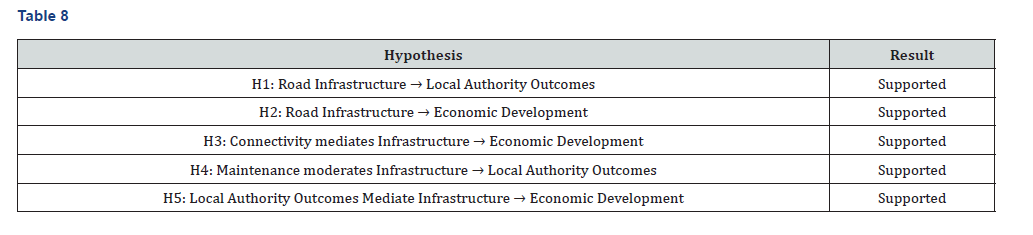
The proposed hypotheses emerge logically from the integration of Infrastructure-Led Development Theory and Growth Pole Theory. H1 posits that road and bridge infrastructure positively influences urban local authority outcomes because improved infrastructure enhances service delivery efficiency, accessibility, and revenue mobilisation. H2 proposes a positive relationship between infrastructure and economic development because transport networks reduce spatial and economic barriers to investment and business growth. H3 introduces transport connectivity as a mediator because infrastructure generates economic benefits primarily through enhanced mobility and accessibility. H4 conceptualises infrastructure quality and maintenance as moderators because the effectiveness of infrastructure investments depends on sustained functionality and asset preservation.
Finally, H5 positions urban local authority effectiveness as a mediator because infrastructure-induced economic development is more likely when local institutions effectively manage resources, coordinate development activities, and provide complementary services. Collectively, these hypotheses recognise that infrastructure-development relationships are neither automatic nor linear but are influenced by institutional, financial, and governance conditions that determine whether infrastructure investments generate sustainable development outcomes. This integrated perspective provides a more rigorous explanation of how road and bridge infrastructure can synchronise urban local authority outcomes and economic development within the specific context of Ruwa Local Board.
Methodology
Research Philosophy
This study adopted a pragmatist research philosophy, which provided the most suitable foundation for investigating the complex relationship between road and bridge infrastructure, urban local authority outcomes, and economic development in Ruwa Local Board. Pragmatism rejected the exclusivity of either positivist or interpretivist assumptions and instead prioritised methodological choices that best addressed the research problem Saunders et al., [57]. The phenomenon under investigation encompassed both objectively measurable dimensions, such as infrastructure quality, service delivery performance, accessibility, investment attraction, and economic growth indicators, and socially constructed dimensions involving stakeholder perceptions regarding governance effectiveness, infrastructure management, and developmental outcomes Bryson et al., [58]; UN-Habitat [10].
Consequently, pragmatism allowed the integration of quantitative measurements with qualitative insights to generate a comprehensive understanding of how transport infrastructure synchronised municipal performance and local economic development Morgan [59]; Bryson et al. [58]. Recent methodological scholarship argued that pragmatism was particularly appropriate for infrastructure and governance studies because it facilitated the examination of multidimensional development challenges that could not be adequately understood through a single methodological tradition Creswell & Plano Clark [60].
Research Approach
The study employed a deductive-inductive (abductive) research approach, combining hypothesis testing with theory generation. The deductive component drew upon Infrastructure- Led Development Theory, Growth Pole Theory, and New Institutional Theory to formulate hypotheses regarding the influence of road and bridge infrastructure on local authority outcomes and economic development Rodríguez-Pose & Hardy [61]; World Bank [28-30]. Simultaneously, the inductive component enabled the exploration of stakeholder experiences and contextual realities that were not fully explained by existing theoretical assumptions.
Contemporary mixed-methods scholars argued that abductive reasoning strengthened infrastructure governance research by facilitating movement between empirical observations and theoretical explanations, thereby enhancing analytical depth and contextual relevance Timmermans & Tavory, 2022; Creswell & Plano Clark [60]. The combined approach was particularly suitable for Ruwa Local Board, where unique institutional arrangements, public-private partnerships, and rapid urbanisation generated context-specific dynamics requiring both explanation and exploration.
Research Design
The study adopted a Convergent Parallel Mixed-Methods Design. This design involved the concurrent collection of quantitative and qualitative data, separate analysis of each dataset, and subsequent integration of findings during interpretation Creswell & Plano Clark [60]. The design was justified because the study sought to understand not only whether road and bridge infrastructure influenced urban local authority outcomes and economic development but also how and why these relationships occurred within the institutional and socio-economic context of Ruwa Local Board Guetterman et al., [62]; Creswell & Plano Clark [60].
Quantitative data provided measurable evidence regarding infrastructure quality, accessibility, service delivery effectiveness, business growth, and economic performance, while qualitative data offered deeper insights into governance processes, stakeholder experiences, infrastructure challenges, and developmental perceptions Fetters & Molina-Azorin [63]. The convergent design enhanced methodological rigour through triangulation, complementarity, and corroboration of findings, thereby reducing the limitations associated with relying solely on either quantitative or qualitative methods Guetterman et al., [62]. Furthermore, the design aligned with the study’s objective of examining infrastructure as a synchronising mechanism linking governance and economic development outcomes.
Study Area
The study was conducted within Ruwa Local Board, a rapidly urbanising settlement located approximately 25 kilometres east of Harare along the strategic Harare–Mutare Corridor. Ruwa represented an appropriate case because its urban growth trajectory had been strongly influenced by infrastructure investments implemented through public-private partnerships Government of Zimbabwe [64]; World Bank [28-30]. The town had experienced significant residential, commercial, and industrial expansion, increasing demand for transport infrastructure and municipal services ZIMSTAT [65]. Simultaneously, Ruwa faced challenges associated with infrastructure maintenance, service delivery pressures, and governance effectiveness UN-Habitat [10]; Government of Zimbabwe [64]. These characteristics made the area an ideal setting for examining how road and bridge infrastructure influenced both local authority outcomes and economic development within a rapidly expanding urban environment.
Target Population
The target population comprised key stakeholders directly involved in or affected by road and bridge infrastructure development within Ruwa Local Board. These included municipal officials responsible for infrastructure planning, engineering, finance, and service delivery; representatives from government ministries and regulatory agencies; private developers and infrastructure contractors; business owners operating within commercial and industrial zones; transport operators; community leaders; and residents Ahmed et al., [37-39]; Fetters & Molina- Azorin [63]. The inclusion of diverse stakeholder groups was consistent with recent infrastructure governance research, which emphasised the importance of capturing multiple perspectives to understand the institutional, economic, and social dimensions of infrastructure development Ahmed et al., [37-39]. Such diversity enhanced the validity and comprehensiveness of findings.
Sampling Procedures and Sample Size
The quantitative component employed stratified random sampling to ensure representation across residential, commercial, and industrial stakeholders Saunders et al., [57]. Using Cochran’s sample size determination formula, a statistically representative sample of residents and businesses was selected Cochran [66]; Saunders et al. [57]. Stratification minimised sampling bias and enhanced the generalisability of findings across different socioeconomic groups Saunders et al., [57].
For the qualitative component, purposive sampling was used to identify information-rich participants possessing specialised knowledge of infrastructure planning, governance, economic development, and service delivery Patton [67]. Key informants included municipal officials, infrastructure engineers, planners, developers, business association representatives, and community leaders. Data saturation guided the final number of interviews, consistent with contemporary qualitative research standards Hennink & Kaiser [68].
Data Collection Methods
The study utilised multiple data collection methods to enhance triangulation and validity Fetters & Molina-Azorin [63]. Quantitative data were collected through structured questionnaires administered to residents and business operators Hair et al., [69]. The questionnaire measured perceptions of road quality, bridge functionality, accessibility, connectivity, service delivery efficiency, municipal effectiveness, business performance, investment attraction, and local economic development using Likert-scale items Joshi et al., [70].
Qualitative data were obtained through semi-structured interviews with key informants and focus group discussions involving community stakeholders Hennink [71,72]. In addition, document analysis was conducted using municipal reports, infrastructure development plans, budget documents, engineering assessments, and economic development reports. Combining these methods facilitated a holistic understanding of the relationships between infrastructure, governance, and economic development Guetterman et al., [62].
Research Instruments
The primary quantitative instrument was a structured questionnaire developed from validated constructs identified in infrastructure, governance, and economic development literature Hair et al., [69]; World Bank [28-30]. The qualitative instrument consisted of a semi-structured interview guide designed to explore stakeholder experiences regarding infrastructure provision, maintenance, institutional performance, economic opportunities, and developmental challenges Patton [67]. The instruments were aligned with the study objectives, theoretical framework, and hypotheses to ensure conceptual consistency and measurement validity Hair et al., [69]. Expert review and pilot testing were conducted to improve clarity, reliability, and contextual appropriateness Saunders et al., [57].
Validity, Reliability, Trustworthiness and Rigour
Quantitative validity was assessed through content validity, construct validity, and pilot testing. Internal consistency reliability was evaluated using Cronbach’s Alpha, with coefficients of 0.70 or above considered acceptable Hair et al., [69]. For qualitative data, trustworthiness was enhanced through credibility, transferability, dependability, and confirmability criteria proposed by Lincoln and Guba Lincoln & Guba [73]; Hennink [71,72]. Member checking, peer debriefing, prolonged engagement, and triangulation were employed to strengthen qualitative rigour Braun & Clarke [73]; Hennink et al., 2023) [71,72]. The integration of multiple data sources and methods further enhanced overall methodological robustness by enabling corroboration of findings across different forms of evidence Creswell & Plano Clark 2024.
Data Analysis and Integration of Quantitative and Qualitative Evidence
The analysis strategy was explicitly structured around the convergent parallel mixed methods design to ensure that quantitative and qualitative findings collectively addressed the study objectives and hypotheses. Quantitative data were analysed using SPSS Version 29 and SmartPLS 4 Hair et al., [69]. Descriptive statistics summarised respondent characteristics and infrastructure conditions, while inferential techniques including correlation analysis, multiple regression analysis, and structural equation modelling (SEM) tested hypothesized relationships among road and bridge infrastructure, infrastructure connectivity, infrastructure quality, local authority outcomes, and economic development Sarstedt et al., [75]; Hair et al., [69].
SEM was particularly appropriate because it enabled simultaneous examination of direct, indirect, and mediating relationships among study variables Hair et al., [69]. Qualitative interview and focus group data were analysed using thematic analysis supported by NVivo software Braun & Clarke [74]. Coding procedures identified recurring themes related to infrastructure governance, institutional effectiveness, maintenance practices, service delivery experiences, investment decisions, economic opportunities, stakeholder participation, and developmental outcomes Braun & Clarke [74]; Hennink et al., [71,72]. Thematic interpretation provided contextual explanations for patterns emerging from quantitative analysis and revealed mechanisms through which infrastructure influenced governance and economic performance Braun & Clarke [74].
The critical strength of the convergent design lay in the integration phase, where quantitative and qualitative findings were merged through joint displays, comparative matrices, and narrative synthesis Fetters & Molina-Azorin [63]. Convergence, complementarity, and divergence between datasets were systematically examined. For example, statistically significant relationships between infrastructure quality and service delivery effectiveness were compared with stakeholder narratives explaining how road conditions influenced municipal operations, accessibility, and public service provision World Bank [28- 30]; UN-Habitat [10]. Similarly, quantitative evidence linking infrastructure to investment attraction and business growth was integrated with qualitative accounts describing investor perceptions and local economic opportunities Rodríguez-Pose & Hardy [61].
This process allowed infrastructure to be examined as a synchronising mechanism connecting institutional performance and economic development. Furthermore, the integrated analysis demonstrated how road and bridge infrastructure contributed to institutional resilience, governance effectiveness, service delivery efficiency, citizen satisfaction, and sustainable urban governance while simultaneously stimulating business growth, market accessibility, employment creation, and investment attraction World Bank [28-30]; OECD [31,32]. By combining numerical evidence with contextual explanations, the study generated more robust conclusions than either method could have produced independently Fetters & Molina-Azorin [63]; Creswell & Plano Clark [60]. The integrated findings ultimately provided a comprehensive explanation of how transport infrastructure synchronised urban local authority outcomes and economic development within Ruwa Local Board.
Ethical Considerations
Ethical approval was obtained from the relevant university ethics committee and Ruwa Local Board authorities Saunders et al., [57]. Participants received informed consent forms detailing the study’s purpose, procedures, voluntary participation requirements, confidentiality assurances, and rights to withdraw APA [76]. Personal identifiers were removed from datasets to ensure anonymity Saunders et al., [57]. Data were securely stored and used exclusively for academic purposes APA [76]. The study adhered to internationally recognised ethical principles of beneficence, non-maleficence, respect for persons, and justice Saunders et al., [57].
Findings
This chapter presents the findings of the study examining the role of road and bridge infrastructure in synchronising urban local authority outcomes and economic development within Ruwa Local Board. Consistent with the convergent parallel mixed-methods design, quantitative and qualitative findings are presented concurrently and integrated through joint displays and narrative synthesis Creswell & Plano Clark [60]. The chapter begins with descriptive statistics, followed by reliability and validity assessments, correlation analysis, multiple regression analysis, and Structural Equation Modelling (SEM). Qualitative findings derived from interviews and focus group discussions are subsequently presented to explain and contextualise quantitative patterns Fetters et al., [63]. Finally, the findings are critically analysed and synthesised in relation to the study hypotheses (H1–H5), theoretical propositions, and contemporary empirical literature.
Response Rate and Demographic Characteristics
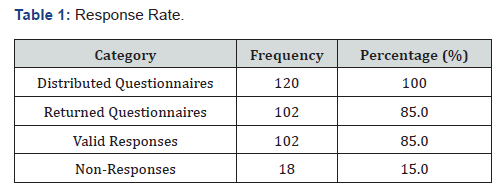
A total of 120 questionnaires were distributed, of which 102 were returned and deemed usable, representing a response rate of 85.0% Creswell & Plano Clark [60]; Saunders et al., [57]. According to Saunders et al. [57], response rates above 60% are considered acceptable for organisational and governance research (Table 1). The demographic profile indicated that 44.1% (45) of respondents were residents, 27.5% (28) business operators, 15.7% (16) municipal officials, and 12.7% (13) transport stakeholders Bryman [77]. This diversity strengthened representativeness and facilitated triangulation across stakeholder groups Creswell & Plano Clark [60].
Reliability and Validity Assessment
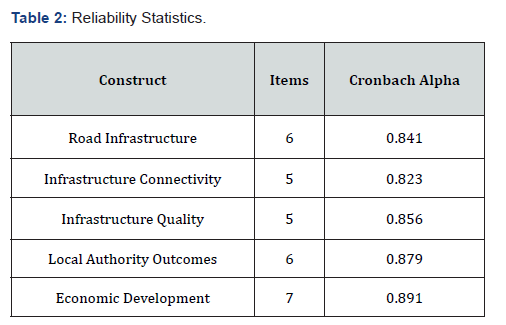
Cronbach’s Alpha values exceeded the recommended threshold of 0.70 for all constructs Hair et al., [69], confirming internal consistency. The results demonstrate acceptable reliability and support subsequent inferential analysis (Table 2).
Descriptive Statistics
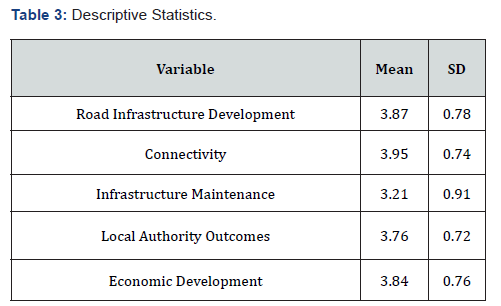
The mean score of 3.87 for road infrastructure suggests respondents generally perceived road infrastructure as adequate, although the relatively high standard deviation indicates variations across different suburbs and economic zones within Ruwa. The relatively high standard deviation indicates variations across different suburbs and economic zones within Ruwa (Table 3).
Qualitative findings corroborated these observations. One municipal engineer stated:
“The major challenge is not construction itself but sustaining maintenance funding. Roads built five years ago are already showing signs of deterioration because revenue collection is not keeping pace with urban expansion.”
Similarly, a business owner noted:
“Improved roads along the Harare–Mutare corridor have increased customer access, but internal feeder roads remain problematic during the rainy season.”
These narratives indicate that infrastructure effectiveness depends not only on availability but also on maintenance sustainability.
Correlation Analysis (Table 4)
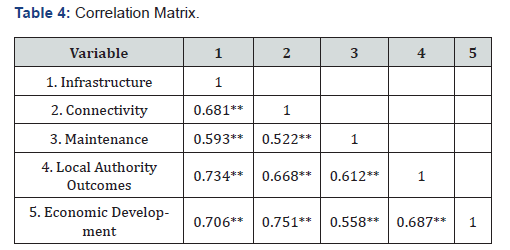
p < 0.01
The correlation analysis revealed statistically significant positive relationships between road infrastructure and local authority outcomes (r = 0.734, p < 0.05), as well as between road infrastructure and economic development (r = 0.706, p < 0.05) Aschauer [78]; World Bank [28-30]. These findings suggest that improvements in transport infrastructure are associated with enhanced municipal performance and stronger economic outcomes OECD [31,32].
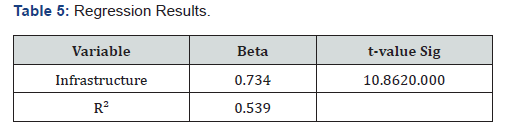
Multiple Regression Analysis (Table 5)
H1: Road and Bridge Infrastructure → Local Authority Outcomes
Road and bridge infrastructure significantly predicted urban local authority outcomes (β = 0.734, p < 0.001), explaining 53.9% of variance OECD [31,32]; World Bank [28-30].
H2: Road and Bridge Infrastructure → Economic Development Table 5.1
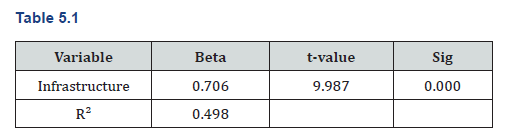
Infrastructure significantly influenced economic development (β = 0.706, p < 0.001). The model explained 49.8% of variation in economic development indicators UN-Habitat [10].
A senior planning officer explained:
“When roads are accessible, waste collection, emergency response, and inspection services become easier and cheaper to provide.”
The qualitative evidence explains the statistical relationship by demonstrating operational efficiencies generated through improved accessibility.
H2: Road and Bridge Infrastructure → Economic Development
Business stakeholders consistently reported increased market access and investment confidence resulting from improved transport networks AfDB [2].
One respondent remarked:
“Property values and commercial activity increased immediately after road upgrades because investors perceived the area as more accessible.”
Structural Equation Modelling Results (Table 6)
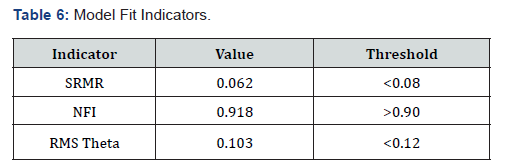
The SEM model was assessed using SmartPLS 4.
Model Fit Indicators
The model demonstrated acceptable goodness-of-fit.
H3: Mediation Effect of Connectivity
Indirect Effect:
Infrastructure → Connectivity → Economic Development
β = 0.283, t = 4.921, p = 0.000
The findings suggest that infrastructure contributes to economic development primarily by enhancing mobility, market access, and spatial integration (World Bank, 2024; AfDB, 2024).
H4: Moderating Effect of Infrastructure Quality and Maintenance
Interaction Effect:
Infrastructure × Maintenance → Local Authority Outcomes
β = 0.214, t = 3.487, p = 0.001
This indicates that infrastructure quality strengthens the positive effect of road infrastructure on local authority outcomes (UN-Habitat, 2024).
H5: Mediation Effect of Local Authority Effectiveness
Infrastructure → Local Authority Outcomes → Economic Development
β = 0.257, t = 4.133, p = 0.000
The findings imply that infrastructure contributes to development more effectively when institutions possess sufficient governance and management capacity OECD [31,32]; UNDP [79].
Joint Display of Quantitative and Qualitative Findings (Table 7)
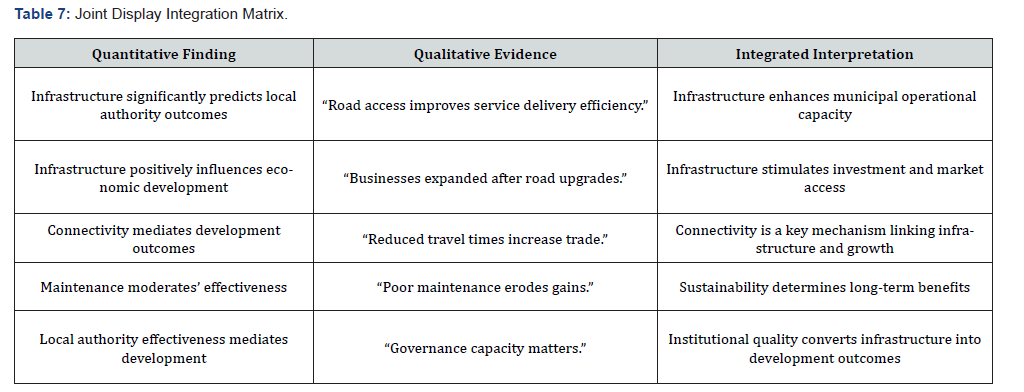
The joint display demonstrates convergence between quantitative and qualitative datasets, strengthening the credibility of findings through methodological triangulation Fetters et al., [63]; Creswell & Plano Clark [60].
Critical Analysis and Synthesis of Findings
The study provides strong evidence supporting Infrastructure- Led Development Theory by demonstrating that road and bridge infrastructure significantly influences both local authority outcomes and economic development. However, the findings reveal that infrastructure effects are not automatic. Connectivity, maintenance quality, and governance effectiveness emerged as critical mechanisms determining whether infrastructure investments translate into sustainable developmental outcomes. The findings extend Growth Pole Theory by illustrating how Ruwa’s strategic position along the Harare–Mutare Corridor creates spatial spillover effects that stimulate investment attraction, business growth, and property development AfDB [2].
Nevertheless, qualitative evidence reveals concerns regarding unequal accessibility and maintenance deficits, suggesting that infrastructure investments alone cannot guarantee inclusive development UN-Habitat [10]. The mediation results further support New Institutional Theory by demonstrating that governance effectiveness significantly influences infrastructuredevelopment relationships. Infrastructure generates stronger economic benefits when local authorities possess adequate planning, financial management, and maintenance capacities UNDP [10]; OECD [31,32]. Overall, the study concludes that road and bridge infrastructure functions as a synchronising mechanism linking municipal performance and economic development World Bank [28-30]; AfDB [2]. Yet this synchronisation depends heavily on complementary institutional and governance factors.
Hypotheses Summary (Table 8)
Discussion
Road and Bridge Infrastructure Development and Urban Economic Transformation
The findings confirm that road and bridge infrastructure in Ruwa functions as a foundational productive asset that shapes both urban local authority outcomes and economic development, consistent with Infrastructure-Led Development Theory and Growth Pole Theory Agénor [79]; Liu & Xiong [80]. However, the results extend conventional assumptions by demonstrating that infrastructure does not operate as an autonomous growth driver but as a relational system embedded within governance and spatial structures Kanai & Schindler [81]; Vegliò et al., [82].
While contemporary studies emphasise transport infrastructure as a catalyst for reducing transaction costs and enhancing productivity in African cities Liu et al., [17,18]; Yin et al., [19,20], the Ruwa evidence suggests that these benefits are unevenly realised due to fragmented connectivity and inconsistent infrastructure quality Kanai & Schindler [81]. This aligns with emerging critiques that infrastructure-led development in Sub- Saharan Africa often produces partial rather than systemic economic transformation when institutional coordination is weak Fobosi & Malima [48]. Therefore, infrastructure in Ruwa should be understood not only as an enabler of mobility but as a contested developmental resource whose impact depends on governance coherence and spatial integration Vegliò et al., [82].
Infrastructure Maintenance as a Determinant of Development Sustainability
The study reveals that infrastructure maintenance is the most decisive factor in sustaining the developmental effects of road and bridge investments, reinforcing New Institutional Theory’s emphasis on institutional stewardship Scott [83]; Wallis & Rizvi, 2023) [87,24-26]. Poor maintenance practices in Ruwa weaken accessibility, increase transport costs, and erode business confidence, thereby undermining initial infrastructure gains Ahmed et al., [37-39]; Randhawa et al., [40-42]. This finding corroborates recent African infrastructure scholarship which argues that lifecycle maintenance, rather than capital expenditure alone, determines long-term economic returns Ahmed et al., [37- 39]; Randhawa et al., [40-42].
However, the Ruwa case adds a more critical dimension by showing that maintenance deficits are not merely technical failures but outcomes of fiscal stress, weak accountability systems, and fragmented municipal budgeting processes Wallis & Rizvi [24-26]; Chilunjika et al., [54-56]. In contrast to optimistic infrastructure accumulation models, the evidence suggests that neglect of maintenance transforms infrastructure from a growth enabler into a liability, producing what can be conceptualised as “deferred development costs” that accumulate over time Liu & Xiong [80].
Governance Capacity and Institutional Mediation of Infrastructure Outcomes
The results demonstrate that local authority capacity is a central mediating variable shaping whether infrastructure investments translate into improved governance and economic outcomes Scott [83]; Wallis & Rizvi [24-26]. In Ruwa, institutional limitations in planning, enforcement, and resource mobilisation significantly constrain the developmental impact of road and bridge infrastructure Chilunjika et al., [54-56]. This supports recent governance literature which argues that infrastructure effectiveness is structurally dependent on institutional quality and administrative coordination Wallis & Rizvi [24-26].
However, the findings also extend this literature by revealing a bidirectional relationship: while weak governance limits infrastructure performance, deteriorating infrastructure further weakens institutional efficiency by increasing operational costs and reducing revenue collection capacity Wallis & Rizvi [24-26]. This creates a reinforcing cycle of institutional underperformance. In theoretical terms, the Ruwa evidence suggests that infrastructure and governance are co-constitutive rather than sequentially related, challenging linear models of development that assume institutional capacity precedes infrastructure benefits Vegliò et al., [82].
Infrastructure Financing Constraints and the Limits of Public–Private Partnerships
The study shows that infrastructure financing structures, particularly public–private partnerships (PPPs), play a dual role in enabling infrastructure expansion while simultaneously generating governance complexities Liu & Xiong [80]; Chilunjika et al., [54-56]. In Ruwa, PPPs have facilitated road development and spatial expansion but have also contributed to uneven infrastructure distribution and contested accountability arrangements Liu & Xiong [80]; Chilunjika et al., [54-56].
This reflects broader African municipal finance trends where fiscal constraints push local authorities toward hybrid financing models Chilunjika et al., [54-56]. However, the findings critically challenge the assumption that PPPs automatically enhance efficiency by showing that weak contractual oversight and limited institutional bargaining power can lead to asymmetrical partnerships that privilege private developers over public accountability Liu & Xiong [80]. Thus, while PPPs expand infrastructure provision capacity, they also introduce governance risks that may distort long-term development objectives if not carefully regulated Liu & Xiong [80]; Wallis & Rizvi [24-26].
Urban Planning, Connectivity and Spatial Inequality
The findings confirm that transport connectivity is a key mechanism through which road and bridge infrastructure influences economic development, consistent with Growth Pole Theory Perroux [84]; Kanai & Schindler [81]. In Ruwa, improved connectivity along major corridors has stimulated commercial clustering and residential expansion Kanai & Schindler [81]. However, the benefits of connectivity are spatially uneven, with peripheral areas experiencing limited integration into economic growth circuits Yang et al., [85].
This aligns with contemporary urban studies which show that infrastructure-led connectivity can reinforce spatial inequality when planning frameworks are weak or inconsistently applied Wang et al., [35,36]. The Ruwa evidence therefore complicates deterministic assumptions of connectivity-led development by demonstrating that spatial integration is contingent upon deliberate planning coordination Vegliò et al., [82]. Without integrated land-use planning, connectivity risks producing fragmented urbanisation patterns characterised by unequal access to economic opportunities Kanai & Schindler [81]; Yang et al., [85].
Urban Local Authority Outcomes as a Mediating Institutional Mechanism
The study finds that infrastructure significantly influences urban local authority outcomes, particularly service delivery efficiency, revenue mobilisation, and administrative performance Chilunjika et al., [54-56]. However, these outcomes are not solely determined by infrastructure availability but by the institutional capacity to leverage infrastructure for service optimisation Wallis & Rizvi [24-26]. This finding aligns with empirical evidence showing that transport infrastructure enhances municipal performance through improved accessibility and operational efficiency Chilunjika et al., [54-56].
Yet, the Ruwa case introduces a critical nuance: infrastructureinduced improvements in municipal outcomes are highly volatile and reversible under conditions of poor maintenance and governance instability Ahmed et al., [37-39]; Wallis & Rizvi [24-26]. Consequently, local authority outcomes should be conceptualised not as end results but as intermediate institutional conditions that mediate the infrastructure–development relationship Scott [83]; Vegliò et al., [82]. This reinforces the study’s proposition that infrastructure functions as a synchronising mechanism rather than a unilateral driver of development.
Economic Development Outcomes and Conditional Infrastructure Effects
The findings confirm that road and bridge infrastructure contributes to economic development in Ruwa through improved investment attraction, business expansion, and employment creation Agénor [79]; Liu & Xiong [80]. However, these effects are conditional rather than automatic, depending on governance quality, connectivity efficiency, and infrastructure sustainability Kanai & Schindler [81]; Vegliò et al., [85]. This supports recent empirical research demonstrating that infrastructure-driven growth is highly sensitive to institutional and spatial factors Liu et al., [17,18]; Yin et al., [19,20].
The Ruwa evidence further challenges linear growth assumptions by showing that economic gains are unevenly distributed across sectors and geographic zones, with higher benefits concentrated in well-serviced corridors Yang et al., [85]. This indicates that infrastructure acts as a selective amplifier of economic activity rather than a universal growth equaliser Kanai & Schindler [81]. Therefore, economic development outcomes should be interpreted as emergent properties of interacting infrastructure, governance, and spatial systems rather than direct outputs of infrastructure investment Vegliò et al., [82].
Integrated Theoretical Synthesis: Infrastructure as a Synchronising Mechanism
Overall, the study advances theory by conceptualising road and bridge infrastructure as a synchronising mechanism linking urban local authority outcomes and economic development, rather than as an isolated input variable Agénor [79]; Vegliò et al., [82]. The interaction between Infrastructure-Led Development Theory, Growth Pole Theory, and New Institutional Theory demonstrates that infrastructure effects are mediated by governance capacity, moderated by maintenance quality, and conditioned by spatial connectivity Scott [83]; Liu & Xiong [80].
This integrated perspective challenges conventional linear models and aligns with emerging multi-layered urban development frameworks that emphasise co-evolution between infrastructure systems and institutional structures Vegliò et al., [82]. In Ruwa, infrastructure simultaneously enables economic expansion and exposes institutional weaknesses, suggesting that development outcomes emerge from system interactions rather than infrastructural presence alone Kanai & Schindler [81]; Vegliò et al., [82]. This contributes a more nuanced, context-sensitive understanding of urban infrastructure dynamics in rapidly growing secondary cities in developing economies Vegliò et al., [82]; Yang et al., [85].
Policy Recommendations
Integrated Transport Infrastructure Planning and Coordination
Policy in Ruwa Local Board should prioritise an integrated transport infrastructure planning framework that explicitly links road and bridge investments to local economic development and service delivery objectives rather than treating them as standalone capital projects World Bank [28-30]; UN-Habitat [10]. The evidence from this study shows that infrastructure effects are strongest when coordinated with governance systems and spatial planning, yet fragmented implementation continues to dilute developmental impact UN-Habitat [10]; AfDB [2].
In line with Infrastructure-Led Development Theory and recent urban systems thinking, the local authority should institutionalise multi-sectoral planning platforms involving engineering, finance, land use, and economic development units to ensure coherence in infrastructure sequencing and investment prioritisation UN-Habitat [10]. This aligns with broader African urban governance evidence that fragmented planning reduces infrastructure productivity and reinforces spatial inefficiencies World Bank [28-30]; UN-Habitat [10].
Infrastructure Maintenance and Asset Management Reform
A critical policy shift is required from capital-intensive infrastructure expansion toward lifecycle-based asset management, given the studies’ finding that maintenance deficits significantly weaken both municipal performance and economic outcomes AfDB [2]; World Bank [28-30]. Ruwa Local Board should establish a dedicated road and bridge maintenance fund, supported by ring-fenced revenues and digital asset management systems to track infrastructure conditions in real time AfDB [2]. This approach is consistent with emerging evidence that infrastructure sustainability depends more on maintenance governance than initial investment scale Ahmed et al., [37- 39]; Randhawa et al., 2025) [40-42]. Without such reforms, infrastructure risks becoming a depreciating liability rather than a development asset, undermining long-term economic resilience AfDB [2].
Strengthening Local Authority Governance Capacity
The findings demonstrate that governance capacity is the central mediating factor determining whether infrastructure translates into development outcomes, requiring targeted institutional strengthening within Ruwa Local Board World Bank [28-30]; AfDB [2]. Policy should focus on enhancing technical skills in infrastructure planning, procurement integrity, financial management, and project monitoring, alongside strengthening accountability mechanisms to reduce inefficiencies UN-Habitat [10]. Drawing on New Institutional Theory, local authorities must be repositioned as developmental coordinators rather than passive service providers UN-Habitat [10]; World Bank [28-30]. Evidence from comparable contexts indicates that weak institutional capacity significantly constrains infrastructure returns despite adequate physical investment Wallis & Rizvi [24-26]; Chirisa et al., [51]. Capacity-building interventions should therefore be embedded within infrastructure financing arrangements to ensure sustainability AfDB [86,87].
Reforming Infrastructure Financing and Public–Private Partnerships (PPPs)
Given the fiscal constraints facing Zimbabwean local authorities, PPPs remain essential but require stronger regulatory oversight and contractual transparency to prevent unequal value capture and fragmented service delivery outcomes AfDB [86,87]; ECA, 2023. The study shows that while PPPs have supported infrastructure expansion in Ruwa, they have also contributed to uneven development and accountability challenges AfDB [86,87]. Policy should therefore establish standardized PPP frameworks with clear performance benchmarks, risk-sharing mechanisms, and community benefit clauses AfDB [86,87]; ECA 2023. Recent African infrastructure financing literature emphasises that PPP success depends on institutional bargaining strength and regulatory clarity rather than private sector participation alone AfDB [86,87]; Chilunjika et al., [54-56]. Diversification of financing instruments, including municipal bonds and infrastructure levies, should also be explored to reduce over-reliance on developer-led models AfDB [86,87].
Enhancing Transport Connectivity for Spatial Economic Integration
Transport connectivity should be explicitly treated as a development accelerator rather than a by-product of infrastructure expansion AfDB [2], given its mediating role in linking infrastructure to economic outcomes World Bank [28-30]. Ruwa Local Board should prioritise upgrading feeder roads and internal circulation routes to complement the Harare–Mutare corridor, ensuring that peripheral areas are integrated into economic activity networks AfDB [2]. The study indicates that current connectivity improvements disproportionately benefit corridor-adjacent zones, reinforcing spatial inequality Nicoletti et al., [88]. This aligns with evidence that infrastructure-driven connectivity can deepen uneven development when not spatially balanced Wang et al., [35,36]; Liu et al., [17,18]. Policy should therefore adopt an inclusive connectivity framework that reduces spatial exclusion and enhances market access for marginalised zones UN-Habitat [10].
Integrated Urban Planning and Land-Use Regulation
Urban planning policy must be more tightly integrated with transport infrastructure development to ensure that road and bridge investments translate into structured urban growth rather than fragmented expansion UN-Habitat [6]; World Bank [28-30]. Ruwa Local Board should strengthen enforcement of land-use zoning regulations, align infrastructure expansion with designated growth corridors, and prevent unregulated peri-urban sprawl that increases service delivery costs UN-Habitat 10]. Growth Pole Theory suggests that infrastructure-led development is most effective when spatial planning directs economic clustering; however, weak planning integration in many African cities reduces these gains UN-Habitat, 2022; World Bank [28-30]. Strengthened planning coordination will therefore enhance infrastructure efficiency while improving long-term urban sustainability UNHabitat [10].
Inclusive and Equitable Infrastructure Development
Policy must explicitly address equity concerns emerging from uneven infrastructure distribution and differential access to economic opportunities within Ruwa Nicoletti et al., [88]; UN-Habitat [6]. The study findings indicate that infrastructure benefits are concentrated in well-serviced areas, leaving peripheral communities with limited gains Nicoletti et al., [88]. A pro-poor infrastructure strategy should prioritise upgrading underserved neighbourhoods, improving accessibility to public services, and ensuring participatory decision-making in infrastructure prioritization Nicoletti et al., [88]; UN-Habitat [6]. Contemporary urban development literature emphasises that infrastructure-led growth can exacerbate inequality if not guided by inclusive planning frameworks Nicoletti et al., [88]; UN-Habitat [6]. Therefore, equity-focused infrastructure allocation should be institutionalised as a core policy principle to ensure that development outcomes are broadly shared UN-Habitat [10].
Conclusion
The study has demonstrated that road and bridge infrastructure in Ruwa Local Board functions not merely as a physical enabler of mobility but as a complex socio-institutional mechanism that synchronises urban local authority outcomes with local economic development. Anchored in Infrastructure- Led Development Theory, Growth Pole Theory, and New Institutional Theory, the findings challenge linear assumptions that infrastructure automatically produces growth, instead revealing a conditional and co-evolutionary relationship in which outcomes are mediated by governance capacity, financing structures, maintenance regimes, and spatial planning systems [89,90]. Empirical evidence from Ruwa shows that while transport infrastructure improves accessibility, investment attraction, and municipal service delivery efficiency, these benefits are uneven, reversible, and highly dependent on institutional effectiveness and lifecycle maintenance.
This aligns with but also extends existing literature by demonstrating that infrastructure should be conceptualised as a synchronising platform rather than a standalone driver of development. Critically, the study exposes a key contradiction in prevailing African urban infrastructure discourse: infrastructureled growth narratives often understate the governance fragility that determines whether infrastructure becomes an asset or a liability. In Ruwa’s case, PPP-driven expansion, corridorbased connectivity, and rapid urbanisation have generated both growth opportunities and spatial inequalities, underscoring that development outcomes are emergent properties of interacting institutional and spatial systems rather than direct outputs of investment. Theoretically, the study advances an integrated perspective in which infrastructure simultaneously enables economic transformation and reveals institutional constraints, thereby reinforcing the need for multi-level, governance-sensitive infrastructure planning in rapidly urbanising secondary cities in Zimbabwe.
References
- Calderón C, Servén L (2014) Infrastructure, growth, and inequality: An overview. World Bank Policy Research Working Paper Series. World Bank.
- AfDB (2024) African Economic Outlook 2024: Driving Africa’s transformation through infrastructure development. African Development Bank Group.
- Munyoro G (2026) Road and Bridge Infrastructure in Synchronising School Outcomes and Economic Development in Rural Zimbabwe: Evidence from Marembera Primary School, UMP Zvataida Ditrict, Mashonaland East Province: Journal of Scientific Research and Reports 32(5): 19-37.
- Munyoro G, Dzapasi Y, Maponga F (2026) Road Infrastructure and Economic Growth: The Nexus of Engineering Workmanship and Rural Development in Zimbabwe: A Case Study of Uzumba Maramba Pfungwe Rural District in Mashonaland East. Asian Journal of Economics, Business & Accounting 26(1): 66-81.
- Bettencourt LMA, Marchio N (2023) Street access, informality and development: A block level analysis across Sub-Saharan Africa.
- UN-Habitat (2024) Annual report 2023: Local action in a time of crises. United Nations Human Settlements Programme.
- Fadda G (2024) Urban infrastructure deficits and governance challenges in rapidly growing African cities. Journal of African Urban Studies 12(1): 23-39.
- World Bank (2025) Zimbabwe Economic Update 2025: Infrastructure, service delivery and economic transformation. World Bank.
- Chirisa I, Muzenda A (2022) Urban governance and service delivery challenges in Zimbabwean municipalities. Journal of Urban Systems and Governance 6(2): 45-61.
- UN-Habitat (2024) World cities report 2024: Cities and climate action. United Nations Human Settlements Programme (UN-Habitat). United Nations.
- Muzorewa TT (2020) Public and private-led urban developments in post-colonial Zimbabwe: A comparative study in Ruwa Town. Urban Forum 31(2): 197-213.
- Muzorewa TT, Nyandoro M (2019) Investment by private land developer companies and postcolonial urban growth in Ruwa (Zimbabwe), 1986-2015. Town and Regional Planning 74: 27-39.
- Muzorewa TT (2021) Private-public partnership-produced urban space: An antithesis to the right to the city? A case study of Ruwa Town, Zimbabwe, from 1986-2021. Town and Regional Planning 79: 54-68.
- Muzorewa TT (2021) Urban development stakeholder relationships in public-private partnerships: A case study of Ruwa Town, 1986–2015. Southern Journal for Contemporary History 45(2): 59-82.
- Pradhan RP, Arvin MB, Hall JH, Nair M (2023) Transport infrastructure and economic growth: Evidence from developing economies. Transport Policy 133: 223-233.
- Rosik P, Wójcik P (2023) Transportation infrastructure and economic growth: Does there exist causality and spillover? Transportation Research Procedia 82: 2618-2632.
- Liu Y, Zhang X, Chen H (2024) Transport infrastructure, regional connectivity and spatial inequality in emerging economies. Transportation Research Part A 188: 104092.
- Liu Y, Zhang X, Chen H (2024) Transportation infrastructure, agglomeration economies and urban productivity. Transportation Research Part A: Policy and Practice 185: 104121.
- Yin Z, Feng L (2024) Urban accessibility, road infrastructure and spatial transformation. Cities 145: 104691.
- Yin Z, Liu H, Feng L (2024) Transportation infrastructure spillovers and regional economic growth. Regional Science Policy & Practice 16(2) 278-296.
- Parr JB (2024) Growth pole theory and regional development: Contemporary applications and relevance. Regional Studies 58(3): 421-437.
- Karmarkar R, Patel S, Singh P (2024) Urban transport infrastructure and growth pole dynamics in emerging economies. Cities 147: 104782.
- Zou Q, Wang H, Sun Y (2024) Infrastructure investment and urban growth centres: Evidence from rapidly urbanising regions. Urban Studies 61(7): 1384-1402.
- Wallis J, Rizvi S (2023) A new institutional economic perspective on alternative governance mechanisms at the local government level. Local Economy 35(1): 3-20.
- Wallis J, Rizvi S (2023) Governance capacity and infrastructure performance in developing cities. Public Administration and Development 43(5): 321–336.
- Wallis J, Rizvi S (2023) Governance capacity and infrastructure performance in developing countries. Public Administration and Development 43(5): 389-404.
- Rosik P, Wójcik P (2023) Transportation infrastructure and economic growth: Does there exist causality and spillover? Transportation Research Procedia 82: 2618-2632.
- World Bank (2024) Connecting economies through sustainable transport infrastructure: Global development report 2024. World Bank Publications.
- World Bank (2024) Infrastructure and urban development in Africa: Governance, connectivity and inclusive growth. Washington, DC: World Bank.
- World Bank (2024) Infrastructure for development: Annual report 2024. World Bank.
- OECD (2024) Infrastructure governance and regional development outlook 2024. Organisation for Economic Co-operation and Development (OECD). OECD Publishing p. 2.
- OECD (2024) Regional development outlook 2024: Infrastructure, governance and local economic growth. Organisation for Economic Co-operation and Development. OECD Publishing.
- Yin Z, Feng L (2024) Urban accessibility, road infrastructure and spatial transformation. Cities 145: 104691.
- Yin Z, Liu H, Feng L (2024) Transportation infrastructure spillovers and regional economic growth. Regional Science Policy & Practice 16(2) 278-296.
- Wang J, Li P, Zhao Y (2024) Transport connectivity, infrastructure investment and uneven regional development. Regional Studies 58(3): 467-482.
- Wang J, Li Y, Zhao T (2024) Road connectivity, spatial integration and regional development. Journal of Transport Geography 118: 103882.
- Ahmed S, Khan M, Rahman T (2023) Infrastructure quality, maintenance and sustainable urban development. Journal of Infrastructure Systems 29(4): 1-15.
- Ahmed S, Khan R, Mahmood A (2023) Infrastructure, maintenance, governance and sustainable urban development outcomes. Journal of Infrastructure Policy and Development 7(4): 112-128.
- Ahmed S, Rahman M, Islam T (2023) Stakeholder engagement and infrastructure governance in developing economies. International Journal of Public Administration 46(12): 895-910.
- Randhawa A, Gupta V, Sharma K (2025) Sustainable infrastructure maintenance and urban resilience. Sustainable Cities and Society 112: 105685.
- Randhawa A, Kumar R, Singh P (2025) Lifecycle infrastructure management and economic sustainability in developing regions. International Journal of Construction Management 25(2): 145-160.
- Randhawa P, Singh A, Verma S (2025) Asset management systems and infrastructure sustainability in developing countries. Infrastructure Asset Management 12(1): 23-39.
- UCAZ (2023) Urban service delivery benchmarking report. Urban Councils Association of Zimbabwe Harare, Zimbabwe.
- UCAZ (2023) Urban service delivery benchmarking report. Urban Councils Association of Zimbabwe Harare, Zimbabwe.
- ZINARA (2024) Road maintenance and infrastructure funding report 2024. Harare, Zimbabwe.
- Appiah M, Onifade ST, Gyamfi BA (2024) Analysing governance-led infrastructural development nexus in sub-Saharan Africa: Does the moderating role of institutional quality matter? Growth and Change 55(1): e12709.
- Kahangirwe P, Vanclay F (2024) Social impacts arising from road infrastructure projects in Sub-Saharan Africa: Better management of social issues is needed in road construction, upgrading and rehabilitation. Impact Assessment and Project Appraisal 42(4): 309-322.
- Fobosi SC, Malima G (2024) Infrastructure governance and development outcomes in Sub-Saharan Africa. [Insert complete journal details from your source.
- AIKP (2024) Roads: Broadening the agenda. Africa Infrastructure Country Diagnostic. African Infrastructure Knowledge Program.
- Chilunjika A (2023) Public private partnerships (PPPs), road tolling and highway infrastructure investment in Zimbabwe. International Journal of Research in Business and Social Science 12(3): 575-584.
- Chirisa I, Dumba S, Bandauko E (2024) Institutional capacity and urban infrastructure governance in Southern Africa. Urban Forum 35(2): 211-228.
- Mokoele M (2023) Urban governance and infrastructure planning in emerging African cities.
- Mundonde J, Makoni PL (2024) Framework model for financing sustainable water and sanitation infrastructure in Zimbabwe. Water 16(12): 1691.
- Chilunjika A, Mukonza R, Nhede NT (2024) Public-private partnerships and urban infrastructure financing in Africa: Governance challenges and policy opportunities. Africa Development Review 36(1): 45-61.
- Chilunjika A, Mutizwa-Mangiza N, Zinyama T (2024) Public-private partnerships and urban infrastructure financing in Zimbabwean local authorities. Commonwealth Journal of Local Governance 29: 1-18.
- Chilunjika A, Zinatsa P, Intauno K, Poshai L (2024) Bond market developments and service delivery paradoxes in Zimbabwean local government institutions. Journal of Economic Development, Environment and People 13(2): 81-96.
- Saunders M, Lewis P, Thornhill A (2023) Research methods for business students (9th ). Pearson Education.
- Bryson JM, Crosby BC, Bloomberg L (2023) Public value governance: Moving beyond traditional public administration and the new public management. Public Management Review 25(5): 845-868.
- Morgan DL (2022) Pragmatism as a paradigm for social research. Qualitative Inquiry 28(7): 799-807.
- Creswell JW, Plano Clark VL (2023) Designing and conducting mixed methods research (4th). Sage Publications.
- Rodríguez-Pose A, Hardy D (2022) Infrastructure and regional development: Connectivity, institutions and economic performance. Regional Studies 56(8): 1285-1298.
- Guetterman TC, Fetters MD, Creswell JW (2023) Integrating quantitative and qualitative results in health and social science mixed methods research. Annals of Family Medicine 21(2): 133-140.
- Fetters MD, Curry LA, Creswell JW (2023) Achieving integration in mixed methods designs: Principles and practices. Health Services Research 48(6 Pt 2): 2134-2156.
- Government of Zimbabwe (2024) National development strategy 1 (NDS1): Infrastructure and local government implementation review report. Government of Zimbabwe.
- ZIMSTAT (2023) Zimbabwe population and housing census report. Zimbabwe National Statistics Agency (ZIMSTAT).
- Cochran WG (1977) Sampling techniques (3rd). John Wiley & Sons.
- Patton MQ (2023) Qualitative research and evaluation methods (5th). Sage.
- Hennink M, Kaiser BN (2022) Sample sizes for saturation in qualitative research: A systematic review of empirical tests. Social Science & Medicine 292: 114523.
- Hair JF, Hult GTM, Ringle CM, Sarstedt M, Danks NP, et al. (2024) Partial least squares structural equation modeling (PLS-SEM) using R: A workbook (2nd). Springer.
- Joshi A, Kale S, Chandel S, Pal DK (2023) Likert scale: Explored and explained. British Journal of Applied Science & Technology 7(4): 396-403.
- Hennink M (2023) Qualitative research methods (2nd ). Sage.
- Hennink M, Kaiser BN, Weber MB (2023) What influences saturation? Estimating sample sizes in focus group research. Qualitative Health Research 33(2): 191-202.
- Lincoln YS, Guba EG (1985) Naturalistic inquiry. Sage.
- Braun V, Clarke V (2022) Thematic analysis: A practical guide. Sage.
- Sarstedt M, Ringle CM, Hair JF (2022) Partial least squares structural equation modeling. In C. Homburg et al. (Eds.), Handbook of market research. Springer pp: 587-632.
- APA (2020) Publication manual of the American Psychological Association (7th). American Psychological Association (APA).
- Bryman A (2024) Social research methods (7th ). Oxford University Press.
- Aschauer DA (2023) Public capital and economic growth: Revisiting infrastructure-led development. Journal of Economic Policy Reform 26(4): 411-428.
- Agénor PR (2010) A theory of infrastructure-led development. Journal of Economic Dynamics and Control 34(5): 932-950.
- Liu W, Xiong W (2022) Rethinking the transport infrastructure-led development model. Sustainability 14(1): 407.
- Kanai JM, Schindler S (2022) Infrastructure-led development and the peri-urban question: Furthering crossover comparisons. Urban Studies 59(1): 3-21.
- Vegliò S, Silver J, Pollio A, Governa F, Apostolopoulou E (2025) A dialogue on global infrastructure-led urbanization: Concepts and reorientations. Global Infrastructure and Society 4(2): 1-18.
- Scott WR (2014) Institutions and organizations: Ideas, interests, and identities (4th ). Sage Publications.
- Perroux F (1955) Note sur la notion de pôle de croissance. Économie Appliquée 8(1-2) : 307-320.
- Yang Y, Dong Z, Zhou BB, Liu Y (2024) Smart growth and smart shrinkage: A comparative review for advancing urban sustainability. Land 13(5): 660.
- AfDB (2023) Public-private partnerships needed to bridge Africa's infrastructure development gap. African Development Bank Group.
- AfDB (2023) Public-private partnerships strategic framework (2021-2031). African Development Bank Group.
- Nicoletti L, Sirenko M, Verma T (2022) Disadvantaged communities have lower access to urban infrastructure. Nature Human Behaviour 6(12): 1708-1718.
- UNDP (2024) Governance and sustainable local development report 2024. United Nations Development Programme (UNDP).
- OECD (2023) The contribution of infrastructure investment to regional economic development. OECD Publishing.

























