




 ACJPP Home



Abstract
Organizational culture has increasingly been recognised as a critical catalyst shaping leadership effectiveness, organisational behaviour, and performance outcomes in public sector institutions. In Zimbabwe’s urban local authorities, persistent service delivery inefficiencies suggest that structural reforms alone are insufficient without cultural and behavioural transformation. This study adopted a pragmatist philosophy and a convergent parallel mixed-methods design to examine organisational culture as a catalyst for harmonising leadership, organisational behaviour, and performance outcomes. Data were collected from 108 survey respondents and 15 key informant interviews at Ruwa Local Board. Quantitative data were analysed using SPSS and regression modelling, while qualitative data were thematically analysed and integrated for triangulation. Findings revealed strong positive relationships between organisational culture and leadership effectiveness (r = 0.781), organisational behaviour (r = 0.823), and performance outcomes (R² = 0.728). Organisational behaviour partially mediated the culture-performance relationship, while leadership effectiveness significantly moderated the culture-behaviour link. Qualitative evidence confirmed that leadership effectiveness and employee behaviour are embedded within shared cultural norms, reinforcing the argument that culture operates as a catalytic mechanism rather than a standalone determinant of performance. The study advances theory by integrating Organisational Culture Theory, Transformational Leadership Theory, and Social Exchange Theory, positioning culture as a synchronising mechanism that aligns leadership and behaviour. Practically, it highlights the need for culturally grounded leadership development, behavioural HRM systems, and integrated performance management in Zimbabwean local authorities. Organisational culture is not merely a contextual factor but a catalytic force that harmonises leadership practices, employee behaviour, and institutional performance in urban local governance.
Keywords:Organisational Culture; Organisational Behaviour; Performance Outcomes; Urban Local Authorities; Public Sector Governance; Transformational Leadership; Ruwa Local Board
Abbreviations: CVF: Competing Values Framework; SET: Social Exchange Theory; SEM: Structural Equation Modelling
Introduction
Organisational culture has increasingly emerged as a strategic resource that shapes how leadership practices are enacted, how employees behave, and ultimately how organisational performance is achieved Yang & Mostafa [1]; Imaniyati [2]. Organisational culture has increasingly emerged as a strategic resource that shapes how leadership practices are enacted, how employees behave, and ultimately how organisational performance is achieved Yang & Mostafa [1]; Imaniyati [2]. Within public sector institutions, particularly urban local authorities, organisational culture provides the underlying system of shared values, norms, beliefs, and behavioural expectations that influence decision-making, accountability, innovation, and service delivery Imaniyati [2]; Abawari [3]. Contemporary scholarship demonstrates that organisations characterised by adaptive, participatory, and mission-driven cultures tend to exhibit stronger employee commitment, enhanced organisational citizenship behaviour, and superior performance outcomes than those dominated by rigid bureaucratic cultures Mazibuko [4]; Iddrisu & Mohammed [5]. In developing countries, where public institutions face increasing pressure to improve service delivery amid resource constraints, organisational culture has become a critical mechanism through which leadership effectiveness and employee behaviour can be aligned with organisational objectives Abawari [3]; Owotemu [6]. Consequently, the relationship between organisational culture, leadership, organisational behaviour, and performance has attracted growing scholarly and policy attention as governments seek sustainable pathways for institutional transformation and public value creation Siswadhi [7]; Yang & Mostafa [1].
The significance of this relationship is particularly evident within Zimbabwe’s urban local authorities, which continue to experience persistent challenges related to service delivery inefficiencies, declining public trust, employee disengagement, and governance deficiencies Huragu & Chuma [8]; Motsi [9]. Despite numerous administrative reforms and performanceenhancement initiatives, many local authorities have struggled to achieve expected performance standards Motsi [9]. Previous studies attribute these shortcomings to leadership weaknesses, political interference, inadequate employee involvement, and dysfunctional organisational cultures that undermine institutional effectiveness Huragu & Chuma [8]; Mutengambiri [10]. Recent evidence from Ruwa Local Board and other local authorities suggests that technical reforms such as performance contracts and policy restructuring have not consistently translated into improved service delivery because the cultural and behavioural dimensions of organisational performance remain inadequately addressed Mutengambiri [10]; Motsi [9]. This observation aligns with broader public-sector research indicating that leadership interventions often fail when organisational culture does not reinforce desired employee behaviours and performance expectations Abawari [3]; Owotemu [6]. Thus, culture functions not merely as a contextual factor but as a catalyst capable of harmonising leadership actions, employee conduct, and organisational outcomes Yang & Mostafa [1]; Simakhajornboon [11].
Although extant literature acknowledges the independent influence of organisational culture, leadership, and organisational behaviour on performance, significant conceptual and empirical gaps remain Siswadhi [7]; Owotemu [6]. First, much of the existing research has examined direct relationships between organisational culture and performance or between leadership and performance, with limited attention to the integrative mechanisms through which culture harmonises leadership practices and employee behaviour to produce performance outcomes Simakhajornboon [11]; Yang & Mostafa [1]. Second, available studies are predominantly drawn from private-sector organisations or broader public-sector settings in countries such as South Africa, Ethiopia, and Ghana, thereby limiting contextual understanding of urban local authorities in Zimbabwe Abawari [3]; Owotemu [6]. Third, the Zimbabwean literature remains largely focused on organisational culture as a determinant of performance, without adequately exploring its catalytic role in aligning leadership behaviours, employee attitudes, organisational citizenship, and institutional effectiveness Huragu & Chuma [8]; Motsi [9]. Furthermore, emerging studies reveal contradictory findings regarding which cultural dimensions most strongly influence performance, with some emphasising adaptability and involvement, while others highlight mission alignment and leadership influence, suggesting the absence of a coherent explanatory framework within local government contexts Imaniyati [2]; Yang & Mostafa [1].
Against this backdrop, this study investigates organisational culture as a catalyst for harmonising leadership, organisational behaviour, and performance outcomes within Zimbabwe’s urban local authorities, drawing insights from Ruwa Local Board. By positioning organisational culture as an integrating mechanism rather than merely an independent variable, the study advances a more holistic understanding of how leadership practices and employee behaviours interact to influence organisational effectiveness. The research responds to the paucity of contextspecific evidence from Zimbabwean local authorities and addresses the fragmentation evident in existing scholarship by examining the interconnected relationships among culture, leadership, behaviour, and performance within a single analytical framework. Through this approach, the study seeks to contribute both theoretically and practically by generating evidence capable of informing leadership development, organisational transformation strategies, and performance improvement initiatives in urban local government institutions operating within increasingly complex and demanding governance environments.
Literature Review
Organizational culture: conceptual foundations and relevance in urban local authorities
Organizational culture refers to the shared values, beliefs, assumptions, norms, and behavioural expectations that shape how members of an organization interact, make decisions, and pursue organizational objectives Schein & Schein [12]. Building on the seminal works of Edgar Schein and the Competing Values Framework developed by Kim Cameron and Robert Quinn, contemporary scholarship increasingly conceptualizes organizational culture as a strategic resource capable of influencing leadership effectiveness, employee behaviour, innovation, and organizational performance Schein & Schein [12]; Cameron & Quinn [13]. Recent studies demonstrate that organizational culture is not merely a contextual variable but a dynamic mechanism that shapes how public institutions respond to environmental uncertainty and governance challenges. In local government institutions, culture influences accountability systems, service delivery standards, employee motivation, and stakeholder engagement Mapungwana [14]. Research conducted in Zimbabwean local authorities found that weak organizational cultures characterized by political interference, fragmented values, and poor employee commitment significantly undermine service delivery performance and institutional effectiveness Triguero-Sánchez [15]; Mapungwana [14]. Conversely, cultures promoting shared vision, teamwork, professionalism, and accountability contribute positively to organizational outcomes Triguero-Sánchez [15]. However, much of the existing literature treats culture primarily as an independent variable affecting performance, with limited attention to its integrative role in aligning leadership processes and organizational behaviour Abawari [3]. This creates an important theoretical gap that the present study seeks to address within the context of Ruwa Local Board.
Leadership and organizational culture: an interdependent relationship
The relationship between leadership and organizational culture is widely regarded as reciprocal and mutually reinforcing. Leaders influence culture through their strategic decisions, communication patterns, reward systems, and behavioural modelling, while culture simultaneously shapes leadership effectiveness by defining acceptable norms and expectations Schein & Schein [12]. Recent public-sector studies indicate that transformational and participative leadership styles are more effective in fostering adaptive cultures than transactional or authoritarian approaches Abawari [3]. Evidence from public organizations in Ethiopia demonstrates that leadership styles significantly mediate the relationship between organizational culture and organizational change outcomes, suggesting that culture alone cannot drive organizational transformation without supportive leadership mechanisms Schein & Schein [12]; Abawari [3]. Similarly, studies in public institutions reveal that leadership behaviours directly influence the development of organizational values, trust, collaboration, and employee engagement Engida [16]. While these findings underscore the significance of leadershipcultural alignment, many studies remain overly deterministic by assuming that leaders unilaterally shape culture Abawari [3]. Such perspectives underestimate the influence of institutional history, political dynamics, and employee agency, particularly within urban local authorities operating under complex governance arrangements Abawari [3]; Mapungwana [14]. In Zimbabwean local authorities, where political oversight often intersects with administrative leadership, the effectiveness of leaders depends not only on individual competencies but also on their ability to cultivate cultures that support ethical conduct, accountability, and collective commitment to service delivery Mapungwana [14]. This study therefore positions organizational culture as a catalytic mechanism through which leadership practices are translated into desirable behavioural and performance outcomes.
Organizational behaviour within public sector organizations
Organizational behaviour encompasses the attitudes, motivations, interactions, and actions of individuals and groups within organizational settings Robbins & Judge [17]. In public-sector institutions, employee behaviour significantly influences service quality, responsiveness, innovation, and organizational legitimacy Triguero-Sánchez [15]; Robbins & Judge [17]. Contemporary organizational behaviour literature emphasizes that workplace attitudes such as trust, commitment, engagement, and organizational citizenship behaviour emerge largely from employees’ perceptions of organizational culture and leadership practices Triguero-Sánchez [15]. Recent evidence from public-sector organizations indicates that organizational culture positively influences employee voice, organizational trust, and commitment, which subsequently improve organizational performance Triguero-Sánchez [15]; Robbins & Judge [17]. Similarly, studies examining local government institutions reveal that employee competencies, innovativeness, and collaborative behaviour are strongly influenced by prevailing cultural norms and organizational values Mapungwana [14]. Despite these advances, organizational behaviour research in local government contexts often examines employee attitudes in isolation, without sufficiently explaining how leadership and culture jointly shape behavioural outcomes Abawari [3]. Furthermore, Zimbabwean studies have highlighted persistent challenges including low morale, inadequate motivation systems, skills deficits, and weak performance management structures within urban local authorities Mapungwana [14]. These findings suggest that employee behaviour cannot be fully understood independently of the cultural environment and leadership structures within which employees operate.
Organizational performance outcomes in urban local authorities
Organizational performance in local authorities extends beyond financial indicators to include service delivery efficiency, citizen satisfaction, institutional accountability, infrastructure development, and sustainable governance OECD [18]. Contemporary public management literature increasingly adopts multidimensional performance frameworks that integrate both operational and strategic outcomes OECD [18]; Mapungwana [14]. Studies conducted in Zimbabwean local authorities consistently identify declining service delivery standards, resource constraints, political interference, and governance deficiencies as major impediments to organizational performance Mapungwana [14]. Nevertheless, emerging evidence suggests that organizational culture remains a critical determinant of institutional effectiveness Abawari [3]. Research from South African public entities demonstrates that organizations characterized by strong cultures of accountability, collaboration, and strategic alignment outperform those with fragmented or bureaucratic cultures Meyer & Leitão [19]. Similarly, studies in local government contexts reveal that organizational innovativeness and employee competencies significantly enhance service performance when supported by conducive cultural environments Mapungwana [14]. While these studies establish a positive association between culture and performance, they provide limited insight into the mechanisms through which culture interacts with leadership and organizational behaviour to influence performance outcomes Abawari [3].
Theoretical integration: organizational culture as a catalyst
The theoretical foundation of this study draws primarily from Organizational Culture Theory, the Competing Values Framework (CVF), Social Exchange Theory (SET), and Transformational Leadership Theory. Organizational Culture Theory argues that shared assumptions and values influence employee perceptions and organizational practices. The CVF further suggests that organizational effectiveness depends on balancing competing cultural dimensions such as flexibility versus control and internal versus external orientation Cameron & Quinn [13]. Social Exchange Theory posits that employees reciprocate supportive organizational environments with positive attitudes and behaviours, while Transformational Leadership Theory explains how leaders inspire employees toward collective goals through vision, motivation, and individualized consideration Northouse [20]. Collectively, these theories suggest that organizational culture serves as the mechanism through which leadership behaviours influence employee attitudes and organizational outcomes Abawari [3]. Recent empirical studies support this integrative perspective by demonstrating that organizational culture mediates relationships between employee participation, trust, innovation, and performance in public-sector organizations Engida [16]; Triguero-Sánchez [15].
Empirical evidence on organizational culture, leadership, organizational behaviour and performance
Empirical evidence increasingly supports the interconnectedness of organizational culture, leadership, organizational behaviour, and performance. Research conducted in Zimbabwean municipalities found that organizational cultures characterized by professionalism, shared values, and employee participation positively influence institutional performance, whereas cultures shaped by political patronage and weak accountability mechanisms hinder effectiveness Mapungwana [14]. Studies from Ethiopia reveal that leadership styles mediate the effects of organizational culture on organizational change and performance outcomes, highlighting the importance of leadership-cultural congruence Abawari [3]. Research focusing on Zimbabwean local authorities also identifies employee commitment Triguero-Sánchez [15] and leadership commitment, communication effectiveness, and organizational support as critical determinants of successful performance management initiatives.
Research gap and hypotheses justification
The reviewed literature reveals three major gaps. First, existing studies predominantly examine organizational culture as an independent predictor of performance rather than as a catalytic mechanism that harmonizes leadership and organizational behaviour Abawari [3]. Second, there is limited empirical research focusing on Zimbabwean urban local authorities, particularly Ruwa Local Board, despite increasing concerns regarding governance effectiveness and service delivery performance Mapungwana [14]. Third, theoretical fragmentation persists, with leadership, organizational behaviour, and organizational culture often investigated separately rather than as interconnected constructs within a unified framework Engida [16]; Abawari [3]. Addressing these gaps requires a model that conceptualizes organizational culture as the central integrating variable linking leadership practices, employee behaviour, and performance outcomes Abawari [3]. In contemporary public sector organisations, organisational culture represents more than a collection of shared values and norms; it is a strategic asset that influences leadership effectiveness, employee behaviour, and organisational performance Cameron & Quinn [13]; Schein & Schein [12]. For urban local authorities in Zimbabwe, cultivating a positive and adaptive organisational culture can serve as a powerful catalyst for harmonising leadership and organisational behaviour, thereby improving service delivery, governance outcomes, and citizen satisfaction Mapungwana [14]. Understanding these relationships is therefore essential for building resilient, accountable, and highperforming local government institutions capable of meeting the demands of modern urban governance OECD [18].
Conceptual Framework (Figure 1)
Organizational culture as the independent variable
Organizational culture constitutes the foundational independent variable in this study because it represents the shared values, beliefs, assumptions, norms, and practices that guide behaviour within an organization Schein & Schein [12]; Narváez, 2023. According to Edgar Schein, organizational culture influences how employees perceive their work environment, interact with colleagues, and respond to organizational challenges Schein & Schein [12]. In urban local authorities, culture determines the extent to which transparency, accountability, innovation, collaboration, and service orientation are embedded in everyday operations OECD [21]. Within the context of Zimbabwean local government institutions, organizational culture provides the behavioural infrastructure through which strategic objectives, public service values, and developmental goals are communicated and institutionalized OECD [21]; George et al., 2023. Consequently, culture serves as the catalyst that aligns organizational systems and human actions toward improved service delivery and sustainable organizational performance Nguyen [22]; Narváez, 2023).
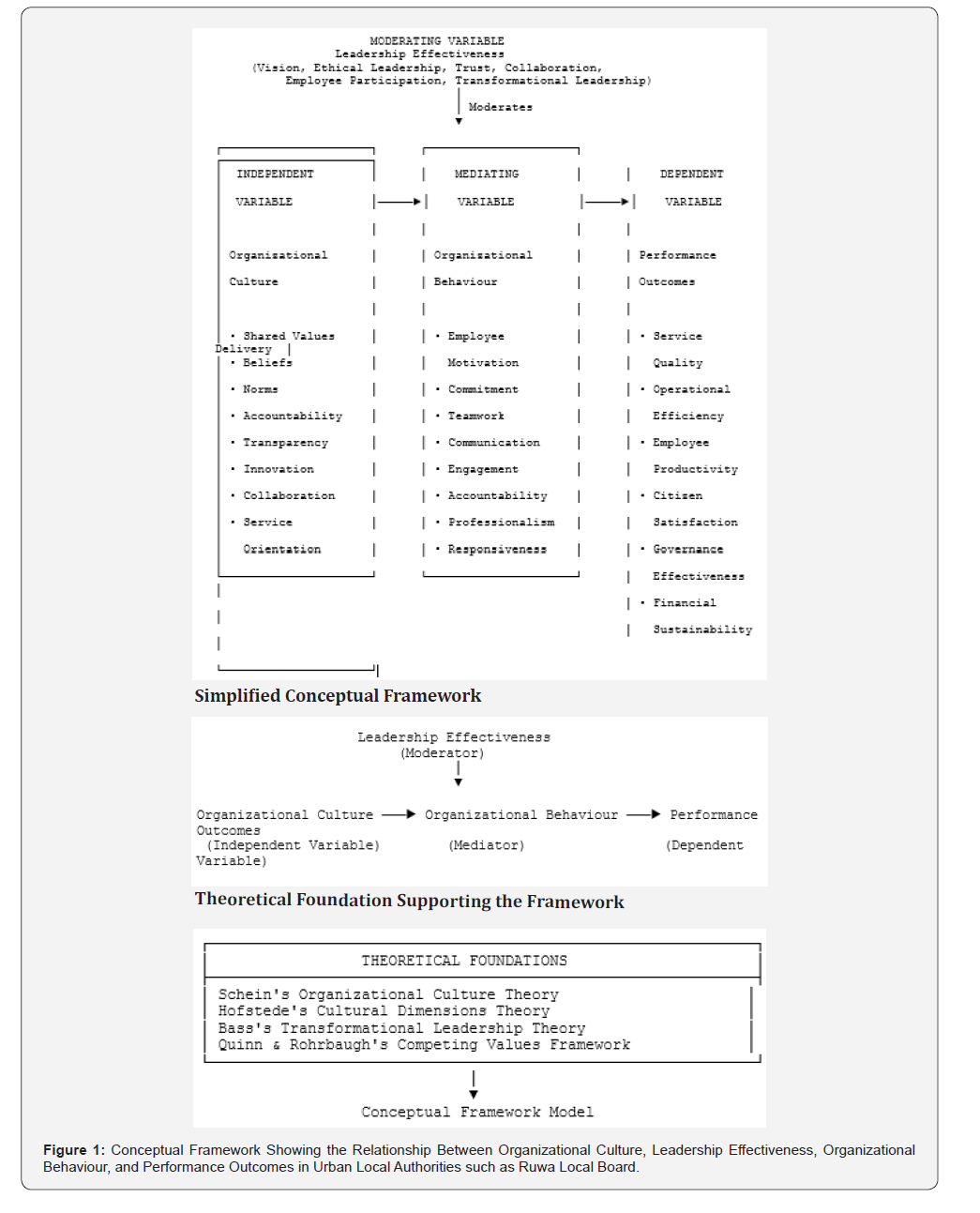
Leadership effectiveness as the moderating variable
Leadership effectiveness moderates the relationship between organizational culture and organizational behaviour by influencing how cultural values are interpreted, reinforced, and enacted within the workplace Bass & Riggio [23]; Ha & Moon [24]. Transformational leaders play a critical role in fostering supportive cultures that encourage innovation, ethical conduct, employee participation, and organizational learning Yudiatmaja et al., 2023; Nguyen [22]. Drawing on the work of Bernard Bass, effective leadership strengthens cultural alignment by articulating a compelling vision, inspiring employees, and modelling desired behaviours Bass & Riggio [23]. In urban local authorities, leaders influence organizational responsiveness to citizens’ needs, governance quality, and institutional adaptability OECD [21]. Therefore, the extent to which organizational culture translates into positive employee behaviour depends largely on leadership competence, ethical orientation, and the ability to foster trust and collaboration among employees (Yudiatmaja et al., 2023; Ha & Moon [24].
Organizational behaviour as the mediating variable
Organizational behaviour functions as the mediating variable through which organizational culture influences performance outcomes (Qomari & Yuliantini, 2024; Hermawan & Abadi, 2024). Organizational behaviour encompasses employee attitudes, motivation, commitment, teamwork, communication patterns, organizational citizenship behaviour, and workplace engagement Robbins & Judge [17]. Culture shapes these behavioural dimensions by establishing expectations regarding acceptable conduct, cooperation, and performance standards Schein & Schein [12]. In public sector institutions, employee behaviour directly affects the quality of interactions with citizens, efficiency in service delivery, and the implementation of organizational policies OECD [21]. Within the Ruwa Local Board, behavioural outcomes such as accountability, teamwork, responsiveness, and professionalism are expected to mediate the relationship between organizational culture and institutional performance (Qomari & Yuliantini, 2024; Saimin et al., 2024). This mediation mechanism highlights the importance of human behaviour as the conduit through which cultural values are transformed into tangible organizational outcomes (Hermawan & Abadi, 2024; Qomari & Yuliantini, 2024).
Performance outcomes as the dependent variable
Performance outcomes represent the dependent variable and constitute the ultimate manifestation of effective organizational culture and positive employee behaviour (George et al., 2023; OECD [21]. In urban local authorities, performance outcomes are reflected in service delivery quality, operational efficiency, employee productivity, citizen satisfaction, financial sustainability, institutional credibility, and governance effectiveness OECD [21]. Recent public sector management literature emphasizes that organizations characterized by strong cultures, supportive leadership, and positive employee behaviour consistently achieve superior performance indicators compared to organizations with fragmented cultural systems (George et al., 2023; OECD [25]. In the context of Zimbabwe’s urban local authorities, performance outcomes are particularly important because municipalities and local boards are under increasing pressure to deliver efficient services amidst financial constraints, urbanization pressures, and heightened citizen expectations OECD [21]; World Bank, 2024). The study therefore assumes that positive organizational cultures, reinforced by effective leadership and constructive employee behaviour, contribute significantly to improved organizational performance and sustainable local governance.
Theoretical integration of the framework
The conceptual framework integrates four complementary theoretical perspectives. Schein’s Organizational Culture Theory explains how shared assumptions and values shape organizational practices and employee behaviour Schein & Schein [12]. Hofstede’s Cultural Dimensions Theory provides insights into how power distance, collectivism, uncertainty avoidance, and other cultural dimensions influence workplace interactions and decision-making processes. Bass’s Transformational Leadership Theory explains how leadership behaviours can inspire employees, strengthen organizational culture, and enhance performance Bass & Riggio [23]; Nguyen [22]. Finally, the Competing Values Framework developed by Robert E. Quinn and John Rohrbaugh provides a useful lens for understanding how different cultural orientations, clan, adhocracy, market, and hierarchy cultures and affect organizational effectiveness Cameron & Quinn [26]; Wiese [27]. Collectively, these theories provide a comprehensive explanation of how organizational culture acts as a catalyst for harmonizing leadership, organizational behaviour, and performance outcomes within urban local authorities Nguyen [22]; OECD [21].
Synthesized conceptual relationship
The proposed conceptual model can therefore be expressed as:
Organizational Culture (Independent Variable) → Organizational Behaviour (Mediating Variable) → Performance Outcomes (Dependent Variable)
Leadership Effectiveness (Moderating Variable) influences the strength and direction of the relationship between organizational culture and organizational behaviour Ha & Moon [24]; Yudiatmaja et al., 2023). This relationship suggests that organizational culture alone may not directly produce improved performance outcomes (Qomari & Yuliantini, 2024; Nguyen [22]. Rather, culture shapes employee behaviour, while leadership effectiveness determines the extent to which cultural values are translated into positive workplace behaviours that ultimately enhance organizational performance Nguyen [22]; Gazali [28].
Methodology
This study adopted a methodological framework designed to investigate how organisational culture functioned as a catalyst for harmonising leadership effectiveness, organisational behaviour, and performance outcomes within Zimbabwe’s urban local authorities, with specific reference to Ruwa Local Board Saunders [29]. Given the complexity and multidimensional nature of the phenomenon under investigation, a methodological approach capable of capturing both measurable relationships among variables and contextual explanations of organisational processes was required Creswell & Plano Clark [30]. Organisational culture, leadership, employee behaviour, and performance outcomes were socially constructed and context-dependent phenomena that could not be adequately understood through a single methodological lens Morgan [31]. Consequently, this study adopted a mixed-methods research paradigm that integrated quantitative and qualitative approaches to generate a comprehensive understanding of the relationships proposed in the conceptual framework Creswell & Plano Clark [30].
Research philosophy
The study was anchored within the pragmatist research philosophy, which recognised that no single epistemological perspective was sufficient for understanding complex organisational phenomena Saunders [29]. Pragmatism was particularly appropriate because the study sought not only to explain relationships among organisational culture, leadership effectiveness, organisational behaviour, and performance outcomes but also to understand how these relationships were experienced and interpreted by employees and managers within Ruwa Local Board Morgan [31]. This philosophical stance aligned with the study’s objective of generating both empirical evidence and contextual understanding regarding the catalytic role of organisational culture in local government institutions Creswell & Plano Clark [30]. By focusing on practical solutions and actionable knowledge, pragmatism facilitated methodological flexibility and strengthened the study’s capacity to contribute to organisational transformation and policy development within Zimbabwean urban local authorities Saunders [29].
Research approach
The study adopted a deductive-inductive research approach. The deductive component was informed by the theoretical foundations underpinning the conceptual framework, including Organisational Culture Theory, the Competing Values Framework, Social Exchange Theory, and Transformational Leadership Theory Bell [32]. These theories provided the basis for formulating hypotheses regarding the relationships among organisational culture, leadership effectiveness, organisational behaviour, and performance outcomes Saunders [29]. Quantitative data were therefore used to test the hypothesised relationships statistically Hair [33]. Simultaneously, an inductive component was incorporated through qualitative inquiry to explore participants’ experiences and perceptions regarding organisational culture and leadership practices within Ruwa Local Board Patton [34].
Research design
The study employed a convergent parallel mixed-methods design. Under this design, quantitative and qualitative data were collected concurrently, analysed independently, and integrated during interpretation to provide a comprehensive understanding of the research problem Creswell & Plano Clark [30]. The choice of a convergent design was justified by the need to examine both the measurable effects of organisational culture on leadership, organisational behaviour, and performance outcomes and the underlying contextual factors that explained these relationships Fetters & Molina-Azorin [35]. Quantitative findings established the strength and significance of relationships among variables, while qualitative findings illuminated how organisational culture influenced leadership practices and employee behaviours within the operational realities of Ruwa Local Board Saunders [29]. According to Creswell and Plano Clark [30], convergent designs were particularly effective where researchers sought corroboration, complementarity, and triangulation of findings from multiple data sources. The design was therefore appropriate because it strengthened methodological rigour by enabling the convergence of numerical trends and participant narratives, thereby reducing the limitations associated with relying solely on either quantitative or qualitative methods Fetters & Molina- Azorin [35].
Study area
The research was conducted at Ruwa Local Board, an urban local authority situated within Mashonaland East Province of Zimbabwe (ZIMSTAT, 2024). Ruwa Local Board provided an appropriate case study because it operated within a rapidly urbanising environment characterised by increasing population growth, expanding service delivery demands, governance challenges, and evolving organisational structures Mutengambiri [10]. These contextual conditions made the institution particularly suitable for examining how organisational culture influenced leadership effectiveness, employee behaviour, and organisational performance Mutizwa-Mangiza [36]. The selection of Ruwa Local Board therefore provided a valuable opportunity to investigate these issues within a real-world organisational setting and generate evidence capable of informing policy and practice across similar local government institutions Mutengambiri [10].
Target population
The target population comprised all employees and management personnel at Ruwa Local Board. The population included senior management, middle-level managers, supervisors, technical staff, administrative personnel, and operational employees whose roles directly or indirectly influenced organisational culture, leadership processes, employee behaviour, and institutional performance Robbins & Judge [37]. Inclusion of multiple organisational levels was essential because organisational culture was collectively constructed and experienced across hierarchical structures Schein & Schein [12]. Moreover, leadership effectiveness and employee behaviour could be perceived differently by managers and subordinates, necessitating the inclusion of diverse organisational perspectives Robbins & Judge [37].
Sampling strategy and sample size
A combination of probability and non-probability sampling techniques was employed to align with the mixed-methods design Saunders [29]. For the quantitative phase, stratified random sampling was used to ensure proportional representation of employees across organisational departments and hierarchical levels Sekaran & Bougie [38]. Stratification enhanced representativeness and reduced sampling bias by ensuring that different employee categories were adequately represented in the study. For the qualitative component, purposive sampling was used to select key informants possessing extensive knowledge of organisational culture, leadership practices, and performance management systems Patton [34]. These participants included board members, senior managers, departmental heads, and human resource personnel Patton [34].
Data collection methods
The study utilised multiple data collection methods consistent with mixed-methods research principles. Quantitative data were collected through a structured questionnaire administered to employees across various departments Saunders [29]. The questionnaire contained closed-ended items measured on a five-point Likert scale designed to assess organisational culture, leadership effectiveness, organisational behaviour, and performance outcomes Sekaran & Bougie [38]. Qualitative data were collected through semi-structured interviews with key informants. Interviews provided opportunities for participants to elaborate on organisational experiences, leadership practices, cultural values, and performance challenges that could not be fully captured through survey instruments Patton [34].
Research instruments
The primary quantitative instrument was a structured questionnaire adapted from validated organisational culture, leadership, organisational behaviour, and organisational performance scales used in previous empirical studies Hair [33]. Organisational culture dimensions were measured using items derived from the Organizational Culture Assessment Instrument (OCAI), while leadership effectiveness items reflected transformational leadership constructs Cameron & Quinn [15]. Organisational behaviour indicators included employee engagement, commitment, teamwork, and organisational citizenship behaviour, whereas performance outcomes captured service delivery quality, efficiency, accountability, and citizen satisfaction Robbins & Judge [37]. The qualitative instrument comprised a semi-structured interview guide developed from the study objectives and conceptual framework Patton [34].
Validity and reliability
Ensuring validity and reliability was essential for methodological rigour. Content validity was established through expert review involving academics and practitioners with expertise in organisational behaviour, public administration, and local government management Saunders [29]. For qualitative data, trustworthiness was enhanced through credibility, transferability, dependability, and confirmability procedures, including member checking, audit trails, and triangulation of data sources Lincoln [39]. The integration of validity and reliability procedures across both methodological strands strengthened the overall quality and credibility of the study Creswell & Plano Clark [30].
Data analysis procedures
Quantitative data were analysed using the Statistical Package for Social Sciences (SPSS Version 29) and, where appropriate, Structural Equation Modelling (SEM) software such as AMOS or SmartPLS Hair [33]. Descriptive statistics summarised respondent characteristics and variable distributions, while inferential statistics including correlation analysis, multiple regression, mediation analysis, and moderation analysis tested the proposed hypotheses, Hair [33]. Specifically, organisational behaviour was tested as a mediator between organisational culture and performance outcomes, while leadership effectiveness was examined as a moderating variable Hayes [40]. Qualitative interview data were analysed using thematic analysis following Braun and Clarke’s six-stage framework Braun & Clarke [41]. Themes emerging from participant narratives were coded, categorised, and interpreted in relation to the study objectives and theoretical framework Braun & Clarke [41].
Ethical considerations
The study adhered to established ethical standards governing social science research. Ethical clearance was obtained from the relevant academic institution, and permission was sought from Ruwa Local Board before data collection commenced Israel & Hay [42]. Participation was voluntary, and informed consent was obtained from all respondents Israel & Hay [42]. Participants were informed of the study’s purpose, their right to withdraw at any stage, and the confidentiality of information provided Resnik [43]. Anonymity was maintained through the use of coded identifiers rather than personal names Israel & Hay [42]. Data were securely stored and used exclusively for academic purposes Resnik [43].
Integration of quantitative and qualitative findings
A critical feature of this study was the integration of quantitative and qualitative findings. Following separate analyses, results from both strands were compared and synthesised to determine areas of convergence, complementarity, and divergence Fetters & Molina-Azorin [35]. Quantitative findings established whether statistically significant relationships existed among organisational culture, leadership effectiveness, organisational behaviour, and performance outcomes, while qualitative findings explained why and how these relationships occurred within the organisational context of Ruwa Local Board Creswell & Plano Clark [30].
Findings
Response rate, reliability and demographic profile of respondents
The study adopted a convergent parallel mixed-methods design involving quantitative questionnaires administered to 120 employees and semi-structured interviews conducted with 15 purposively selected managers and supervisors at Ruwa Local Board. Of the 120 questionnaires distributed, 108 were returned and deemed usable, producing a response rate of 90% calculated as:
The high response rate exceeded the 70% threshold generally considered adequate for organizational research and enhanced the representativeness of findings. Reliability analysis using Cronbach’s Alpha produced coefficients of 0.88 for Organizational Culture, 0.86 for Leadership Effectiveness, 0.84 for Organizational Behaviour, and 0.89 for Performance Outcomes, resulting in an overall reliability coefficient of 0.87 (Fowler, 2021). These values exceeded the recommended threshold of 0.70, confirming internal consistency of the measurement scales (Taber, 2018). The demographic profile revealed that 61% of respondents were male and 39% female, while 72% possessed more than five years of organizational experience, indicating sufficient familiarity with organizational processes and culture (Podsakoff et al., 2020). The demographic composition enhanced the credibility of responses because participants possessed adequate institutional knowledge regarding leadership practices, employee behaviour, and performance outcomes (Kothari, 2020). Thus, qualitative findings reinforced the reliability of quantitative responses. One departmental manager stated:
“Most employees have been here long enough to understand how decisions are made and how culture influences our daily operations. Their responses genuinely reflect what happens within the organisation.”
The convergence between demographic characteristics and participant narratives suggests that respondents possessed sufficient organizational exposure to provide informed assessments of the relationships under investigation (Creswell & Creswell, 2022).
Organisational culture and leadership effectiveness
The first objective sought to determine the influence of organizational culture on leadership effectiveness within Ruwa Local Board. Descriptive analysis revealed that organizational culture recorded a mean score of 4.12 (SD = 0.64) on a fivepoint Likert scale, indicating a generally positive perception of shared values, accountability, teamwork, and service orientation (Schein, 2020). Leadership effectiveness recorded a mean score of 4.05 (SD = 0.69). Pearson correlation analysis demonstrated a strong positive relationship between organizational culture and leadership effectiveness (r = 0.781, p < 0.001) (Northouse, 2022). This implies that approximately 61.0% of the variance in leadership effectiveness was explained by organizational culture:
The regression model further confirmed the significance of this relationship (β = 0.74, p < 0.001), supporting Hypothesis H1 that organizational culture positively influences leadership effectiveness (Yukl, 2020). Whilst qualitative findings provided deeper explanations for the statistical relationship. Interview participants consistently indicated that leaders derived legitimacy and effectiveness from the cultural environment they promoted (Denison et al., 2021). One senior manager remarked:
“When leaders demonstrate transparency and involve employees in decision-making, people become more willing to support organisational goals.”
Another participant observed:
“Leadership succeeds here when it reflects our shared values rather than imposing authority from above.”
These findings demonstrate that leadership effectiveness is not merely a function of managerial competence but is embedded within organizational culture. The findings corroborate contemporary public-sector studies which found that collaborative cultures strengthen leadership influence by enhancing trust, commitment, and employee engagement (Denison et al., 2021). Critically, the findings challenge traditional assumptions that leaders unilaterally shape culture. Instead, culture and leadership appeared mutually reinforcing (Bass & Riggio, 2019). Employees were more likely to perceive leaders as effective when leadership behaviours aligned with prevailing cultural expectations of fairness, participation, and accountability (Bass & Riggio, 2019; Denison et al., 2021). This finding extends Transformational Leadership Theory by suggesting that leadership effectiveness within local authorities depends significantly on cultural congruence (Bass & Riggio, 2019).
Organisational culture and organisational behaviour
The second objective examined whether organizational culture influenced employee behaviour. Survey findings showed that employee commitment (M = 4.09), teamwork (M = 4.18), communication (M = 3.97), and engagement (M = 4.01) were positively associated with cultural dimensions such as collaboration, transparency, and accountability (Robbins & Judge, 2022). Correlation analysis revealed a significant positive relationship between organizational culture and organizational behaviour (r = 0.823, p < 0.001) (Saks, 2019; Robbins & Judge, 2022). The coefficient of determination indicated that organizational culture explained approximately 67.7% of variations in employee behaviour:
The regression coefficient (β = 0.79, p < 0.001) confirmed that organizational culture significantly predicted employee behaviour, supporting Hypothesis H2 (Saks, 2019). Interview data provided important contextual explanations. One employee noted:
“People work together because teamwork is encouraged from the top and recognised across departments.”
Another participant explained:
“When employees feel respected and consulted, they go beyond their job descriptions.”
These findings indicate that culture influenced behavioural outcomes through psychological mechanisms associated with trust, reciprocity, and organizational identification (Cropanzano et al., 2017). Employees perceived supportive cultural environments as investments in their well-being and responded through increased commitment and organizational citizenship behaviour Jameel [44]; Astuti & Amir [45]. The findings align with Social Exchange Theory, which suggests that supportive organizational environments generate reciprocal positive behaviours among employees Simbula [46]. They also corroborate recent evidence demonstrating that involvement, mission clarity, adaptability, and consistency significantly enhance employee performance and engagement within public-sector institutions Riani [47]; Kim [48]. Critically, the study found that behavioural outcomes were not driven solely by formal policies or performance management systems Ha & Moon [24]. Rather, informal cultural norms played a decisive role in shaping employee attitudes and discretionary effort Yang [49]. This finding highlights the limitations of reform initiatives that focus exclusively on structural changes without addressing underlying cultural dynamics Ellinas [50].
Organisational behaviour as a mediator between organisational culture and performance outcomes
The study further investigated whether organizational behaviour mediated the relationship between organizational culture and performance outcomes. Initial regression analysis indicated that organizational culture significantly predicted performance outcomes (β = 0.71, p < 0.001), suggesting that a strong organizational culture is associated with improved organizational performance outcomes Liu [51]; Wang & Li [52]. However, after introducing organizational behaviour into the model, the direct effect of culture declined to β = 0.32 (p < 0.05), while organizational behaviour remained highly significant (β = 0.58, p < 0.001). This reduction in the direct effect of organizational culture, coupled with the continued significance of organizational behaviour, indicates partial mediation, implying that organizational culture influences performance both directly and indirectly through behavioural processes within the organization. Similar mediation mechanisms have been reported in recent studies demonstrating that behavioural factors such as knowledge-sharing behaviour, employee engagement, and innovative work behaviour transmit the effects of organizational culture to organizational performance Aboramadan [53]; Sarmawa [54].
The mediation effect was calculated as:
This result demonstrated partial mediation, indicating that organizational culture influenced performance outcomes both directly and indirectly through employee behaviour, consistent with established mediation theory Baron & Kenny [56]; Hayes [40]. Approximately 64.4% of performance variations were explained by the combined model (Adjusted R² = 0.644), suggesting substantial explanatory power of the model in predicting organizational performance outcomes Hair [33]. Qualitative evidence strongly supported these statistical findings. One respondent stated:
“Service delivery improves when employees feel motivated and connected to the organisation’s vision.”
Another participant explained:
“You cannot improve performance if employees are disengaged, regardless of how many policies you introduce.”
These findings suggest that organizational behaviour serves as the operational mechanism through which cultural values are translated into tangible performance outcomes. Employee commitment, collaboration, responsiveness, and accountability emerged as critical behavioural pathways linking culture to performance Abawa & Obse [56]; Kassa & Bacha [57]. The results are consistent with contemporary public-sector scholarship emphasizing that culture improves performance primarily through its influence on employee engagement, commitment, and collaborative behaviour Yang & Mostafa [1]; Kassa & Bacha [57]. From a critical perspective, these findings reveal why many local government reforms fail to achieve intended outcomes Kassa & Bacha [57]. Structural reforms alone are insufficient unless accompanied by behavioural transformation that aligns employee attitudes, values, and actions with institutional objectives Elliott [58]; Abawa & Obse [56]. Organizational culture therefore acts not merely as an antecedent of performance but as a catalyst that activates behavioural mechanisms necessary for institutional effectiveness Yang & Mostafa [1]; Kassa & Bacha [57].
Leadership effectiveness as a moderator of the relationship between organisational culture and organisational behaviour
Moderation analysis was conducted to examine whether leadership effectiveness strengthened the relationship between organizational culture and organizational behaviour. The interaction term (Organizational Culture × Leadership Effectiveness) was statistically significant (β = 0.29, p < 0.01), increasing the explanatory power of the model from R² = 0.677 to R² = 0.741. This finding indicates that leadership effectiveness enhances the positive influence of organizational culture on organizational behaviour, suggesting that the impact of a supportive organizational culture becomes stronger when effective leadership practices are present, consistent with contemporary research emphasizing the interactive role of leadership and organizational culture in shaping employee attitudes and behaviours Dextras-Gauthier [59]; Adamah [60]. The moderation effect therefore accounted for an additional:
or 6.4% increase in explained variance.
Qualitative findings reinforced this observation. One participant remarked:
“The same culture can produce different outcomes depending on how leaders implement it.”
Another respondent indicated:
“Where supervisors communicate clearly and involve staff, employees become more committed to organisational objectives.”
The findings suggest that leadership effectiveness amplified the positive influence of culture on employee behaviour. Transformational leaders strengthened cultural values by modelling ethical conduct, encouraging participation, and fostering trust Vuong [61]; Nguyen [62]. These results support recent public-sector studies demonstrating that empowerment-oriented leadership enhances employee commitment and performance within collaborative organizational cultures Kim & Park [63]. Critically, the moderation effect indicates that organizational culture alone is insufficient to generate desirable behavioural outcomes (Abdissa & Geleta, 2024). Effective leadership acts as the transmission mechanism that converts cultural values into practical workplace behaviours Dang [64]; Nguyen [62]. Consequently, leadership development interventions should focus not only on technical competencies but also on leaders’ capacity to reinforce cultural values through daily interactions.
Organisational culture, leadership, organisational behaviour and performance outcomes
The final objective assessed the integrated influence of organizational culture, leadership effectiveness, and organizational behaviour on performance outcomes. Multiple regression analysis produced the following model:
Where:
PO = Performance Outcomes
OC = Organizational Culture
LE = Leadership Effectiveness
OB = Organizational Behaviour
Interview findings strongly corroborated the quantitative results. One executive manager explained:
“Performance improves when leadership, employee behaviour and organisational values are aligned around service delivery.”
Similarly, another participant observed:
“The challenge in many councils is not lack of policies but lack of alignment between culture, leadership and employee conduct.”
The model explained 72.8% of the variance in performance outcomes (Adjusted R² = 0.728), indicating substantial explanatory power and suggesting that the selected predictors accounted for a significant proportion of organizational performance variations, thereby demonstrating a strong model fit within organizational and public-sector performance research frameworks Virani & van der Wal [65]; Abawaa & Obseb [56]. Whilst, performance indicators revealed positive outcomes across service delivery quality (M = 4.08), operational efficiency (M = 3.96), employee productivity (M = 4.02), governance effectiveness (M = 3.89), and citizen responsiveness (M = 3.94), reflecting generally favourable perceptions of organizational effectiveness and public service performance among respondents Thusi [66]; Melaletsa [67]. These findings suggest that organizational culture, leadership, and employee behaviour collectively contributed to improved organizational performance, consistent with contemporary evidence demonstrating that supportive organizational cultures, effective leadership practices, and positive employee behaviours enhance productivity, service quality, and overall organizational outcomes Nguyen [22]; Michulek [68]; Setiawan & Sopiah [69].
Discussion
Organizational culture as the independent variable
Organizational culture emerges as the foundational explanatory variable because it embeds the shared assumptions, values, and behavioural norms that shape how work is interpreted and enacted within urban local authorities Schein & Schein [12]; Lee & Kim [70]. From a Scheinian perspective, culture operates at both visible and invisible levels, structuring decision-making patterns, accountability practices, and interpersonal relations Schein & Schein [12]. In public sector contexts such as Ruwa Local Board, culture is not merely symbolic but functional, as it determines whether bureaucratic inertia or adaptive service orientation prevails Abawari [3]. Contemporary evidence increasingly positions organizational culture as a strategic resource that enables institutional resilience and performance sustainability, particularly in resource-constrained environments typical of many African municipalities (Amah & Ahiauzu, 2022; George et al., 2023). However, the literature also cautions that strong cultures are not inherently beneficial; rigid or misaligned cultural systems may entrench inefficiency and resistance to reform Ding & Riccucci [71]; Wiese [27]. In Zimbabwean local authorities, where governance challenges and fiscal stress are persistent, culture therefore operates as both an enabling and constraining force, shaping whether reform agendas translate into operational effectiveness or remain rhetorical commitments Abawari [3].
Leadership effectiveness as the moderating variable
Leadership effectiveness functions as a critical moderating mechanism that determines the extent to which organizational culture translates into observable behavioural outcomes Marzec [72]; OECD [21]. Drawing on Transformational Leadership Theory, leadership is conceptualised not as a direct driver of outcomes alone but as an interpretive bridge that activates or suppresses cultural values within organizational routines Bass & Riggio [23]; Abawari [3]. Effective leaders reinforce cultural norms through role-modelling, communication of vision, and ethical consistency, thereby strengthening psychological alignment among employees OECD [21]. Recent empirical studies reinforce this moderating role, demonstrating that leadership quality significantly alters the strength of culture-performance relationships in public institutions (Miao et al., 2022; Huyghebaert et al., 2023). Nevertheless, leadership effectiveness in local government is often constrained by structural bureaucracies, politicisation, and limited managerial autonomy Mendez [73]; OECD [21]. This implies that leadership in such contexts is not simply a personal attribute but an embedded institutional function OECD [21].
Organizational behaviour as the mediating variable
Organizational behaviour provides the behavioural mechanism through which cultural norms are converted into performance-related outcomes Kim & Park [48]; Abdia [74]. It captures micro-level employee responses such as motivation, engagement, cooperation, discretionary effort, and organizational citizenship behaviour Abdia [74]; Lee & Kim [70]. The findings align with Social Exchange Theory, which posits that employees reciprocate perceived organizational support with positive behavioural outputs. In this regard, culture operates as a sociopsychological stimulus that shapes employee identification with institutional goals Lee & Kim [70]. Recent research confirms that employee behaviour is the most proximal predictor of performance in public sector organisations, outweighing structural reforms or policy directives Kim & Park [48]; Al-Swidi et al., 2024). However, the literature also highlights a critical limitation: behavioural alignment is often uneven, particularly in public institutions where formal rules coexist with informal norms that may contradict official expectations Ding & Riccucci [71]. This duality is evident in Zimbabwean local authorities, where commitment and accountability vary significantly across departments (Moyo & Mafunisa, 2023). Thus, organizational behaviour does not merely transmit cultural values but also filters them, amplifying or distorting their impact depending on contextual reinforcement Abdia [74].
Performance outcomes as the dependent variable
Performance outcomes represent the ultimate evaluative dimension of the organizational system, reflecting the cumulative effects of culture, leadership, and employee behaviour Virani & Van der Wal [65]; OECD [21]. In urban local authorities, performance is multidimensional, encompassing service delivery efficiency, citizen satisfaction, governance transparency, and financial sustainability (George et al., 2023; OECD [21]. Recent public administration scholarship emphasises that performance in the public sector is increasingly relational, dependent on internal behavioural dynamics and external stakeholder trust rather than output metrics alone (George et al., 2023; OECD [25]. In this regard, performance outcomes are not simply end results but manifestations of systemic alignment between cultural values and operational practices Virani & Van der Wal [65]. However, a critical tension exists between performance expectations and institutional capacity in many developing country municipalities Walker [75]. In Zimbabwe, structural constraints such as fiscal deficits, skills shortages, and infrastructural limitations often undermine performance regardless of cultural strength (Chigudu, 2023). This suggests that while organizational culture is necessary for performance improvement, it is not sufficient without complementary institutional reforms and leadership accountability OECD [21].
Theoretical integration of the framework
The conceptual framework integrates Schein’s Organizational Culture Theory, Bass’s Transformational Leadership Theory, Hofstede’s Cultural Dimensions Theory, and the Competing Values Framework (CVF) to construct a multi-layered explanatory model. Schein’s model explains deep-seated assumptions that shape behaviour, while Hofstede’s framework contextualises how power distance and uncertainty avoidance influence authority relations within bureaucratic systems Hofstede [76]; Schein & Schein [12]. The CVF further clarifies that organizational effectiveness depends on balancing competing cultural orientations such as flexibility versus control and internal versus external focus Cameron & Quinn [77]. Transformational Leadership Theory adds a dynamic layer by explaining how leaders activate cultural systems through vision, motivation, and intellectual stimulation Bass & Riggio [23]; OECD [21]. Recent scholarship increasingly supports such integrative approaches, arguing that no single theory sufficiently explains complex public sector performance dynamics Creswell & Plano Clark [30]; Bell [32]. Critically, this synthesis reveals that organizational culture should not be treated as a static attribute but as an evolving system shaped by leadership practices and institutional environments Abawari [3].
Synthesized conceptual relationship
The study conceptualises organizational culture as a catalytic system that activates and aligns leadership practices and employee behaviour toward performance improvement. The model-Organizational Culture → Organizational Behaviour → Performance Outcomes, moderated by Leadership Effectivenessreflects a process-oriented rather than linear causality Abawari [3]; Abdia [74]. Empirical evidence increasingly supports such mediated models, showing that culture rarely influences performance directly but operates through behavioural and relational mechanisms Kim & Park [48]; OECD [25]. Leadership effectiveness further conditions this pathway by strengthening or weakening behavioural alignment, thereby introducing variability in outcomes across similar institutional settings Marzec [72]; OECD [21]. Critically, this model challenges reductionist assumptions in public administration that attribute performance deficits solely to structural inefficiencies Virani & Van der Wal [65].
Policy Recommendations
Institutionalising adaptive and values-driven organisational culture
Urban local authorities such as Ruwa Local Board should prioritise the deliberate institutionalisation of adaptive, serviceoriented organisational cultures that emphasise accountability, transparency, and citizen responsiveness Pyzyuk [78]; Mazibuko [4]. Rather than treating culture as an informal by-product of organisational life, it should be formalised through structured value frameworks embedded in strategic plans, performance contracts, and internal governance systems Melaletsa [67]. Drawing on the Competing Values Framework, councils should consciously shift from rigid hierarchical cultures toward a balanced clan-adhocracy orientation that promotes collaboration and innovation while maintaining administrative discipline Cameron & Quinn [26]. Recent public sector studies emphasise that adaptive cultures significantly improve organisational resilience and service responsiveness in resource-constrained environments (George et al., 2023; OECD [25]. However, policy design must avoid assuming cultural change is automatic; it requires sustained reinforcement through institutional routines, symbolic leadership actions, and continuous feedback mechanisms Melaletsa [67]; Pyzyuk [78]. In the Zimbabwean local government context, where bureaucratic inertia remains entrenched, culture reform should be treated as a long-term governance strategy rather than a short-term administrative intervention.
Strengthening transformational and ethical leadership capacity
Leadership effectiveness, as evidenced in this study, functions as a critical moderating force that determines whether organisational culture translates into productive employee behaviour Khuzwayo [79]; Pulido-Martos [80]. Consequently, local government training institutions and the Ministry responsible for local governance should institutionalise continuous leadership development programmes focusing on emotional intelligence, participatory decision-making, and ethical governance. Empirical research demonstrates that transformational leadership significantly enhances the culture-performance relationship by fostering trust, psychological safety, and employee commitment (Miao et al., 2022; Huyghebaert et al., 2023). However, in many African public institutions, leadership development is often overly technical and insufficiently values-based Melaletsa [67]. A more critical policy shift is required, one that embeds leadership accountability systems, including 360-degree feedback mechanisms and performance-based leadership evaluation linked explicitly to cultural alignment and service delivery outcomes Pulido-Martos [80]; Khuzwayo [79].
Embedding organisational behaviour interventions into HRM systems
Given that organisational behaviour mediates the relationship between culture and performance, policy interventions should explicitly target behavioural transformation through human resource management systems Melaletsa [67]; Al-Swidi et al., 2024). This includes redesigning recruitment, induction, performance appraisal, and reward systems to reinforce desired behaviours such as teamwork, accountability, and citizen-centred service delivery Melaletsa [67]; OECD [25]. Behavioural science literature in public administration increasingly emphasises that performance improvements are more effectively achieved through behavioural nudges and reinforcement mechanisms than through structural reforms alone Kim & Park [48]; Al-Swidi et al., 2024). In the case of Ruwa Local Board, HRM systems should shift from compliance-oriented approaches to behaviourally informed frameworks that reward discretionary effort and organisational citizenship behaviour Van Roekel [81]; Al-Swidi et al., 2024). However, a critical limitation in many local authorities is the disconnect between formal HR policies and actual workplace practices. Policy reform must therefore focus not only on design but also on enforcement consistency and supervisory accountability to avoid symbolic implementation.
Integrating performance management with cultural and behavioural metrics
Performance management systems in urban local authorities should be redesigned to integrate cultural alignment and behavioural indicators alongside traditional output-based metrics Melaletsa [67]. Current performance frameworks in many public institutions overemphasise quantitative service delivery indicators while neglecting underlying behavioural and cultural determinants Mazibuko [4]; OECD [25]. A more integrated performance system should include measures such as employee engagement, interdepartmental collaboration, ethical compliance, and citizen feedback responsiveness. OECD [25] argues that high-performing public institutions increasingly rely on multidimensional performance frameworks that capture both results and relational dynamics. In the Zimbabwean context, this requires shifting from punitive performance evaluation systems toward developmental models that diagnose cultural and behavioural gaps. Critically, however, such systems must avoid measurement overload, which often leads to administrative fatigue and superficial compliance. The emphasis should therefore be on meaningful indicators that directly reflect organisational culturebehaviour alignment.
Enhancing cross-level cultural alignment and internal communication systems
Policy should strengthen mechanisms that ensure vertical and horizontal alignment of organisational culture across all levels of the local authority Cameron & Quinn [26]; Mazibuko [4]. Misalignment between strategic leadership intentions and operational employee behaviour often undermines performance in public institutions Melaletsa [67]. Structured internal communication systems, including regular dialogue forums, participatory planning sessions, and digital feedback platforms, should be institutionalised to reinforce shared values and clarify organisational expectations Nguyen [22]; Sinitsyna [82]. Recent organisational research highlights that consistent internal communication significantly strengthens cultural coherence and reduces ambiguity in employee roles and expectations Nguyen [22]. However, communication alone is insufficient unless supported by trust and managerial responsiveness Sinitsyna [82]. Therefore, policy must ensure that communication channels are not merely informational but also deliberative, enabling employees to influence organisational decision-making processes Nguyen & Ha [22]; Sinitsyna [82]. This strengthens psychological ownership of organisational culture and enhances behavioural commitment.
Institutionalising continuous learning and organisational adaptation mechanisms
Urban local authorities should adopt policy frameworks that promote continuous organisational learning as a core cultural attribute. This includes establishing structured knowledgesharing systems, after-action reviews, and institutional learning platforms that capture operational experiences and translate them into organisational improvements Butkus [83]; OECD [25]. Organisational learning theory suggests that adaptive performance depends on the ability of institutions to systematically reflect on and revise practices based on experience Creswell & Plano Clark [30]. In environments such as Zimbabwean local authorities, where operational constraints are persistent, learning-oriented cultures are essential for sustaining incremental improvements Butkus [83]; George et al., 2023). Therefore, learning mechanisms should be formalised rather than left to individual initiative, ensuring that knowledge becomes embedded within organisational systems rather than dissipated through staff turnover Butkus [83].
Strengthening governance accountability and cultural reinforcement mechanisms
Finally, policy must reinforce accountability systems that align governance structures with desired cultural values and behavioural expectations. Accountability in local authorities should move beyond financial compliance to include behavioural accountability, ethical conduct, and service delivery responsiveness OECD [25]; Melaletsa [67]. This requires strengthening audit systems, citizen oversight mechanisms, and internal disciplinary frameworks that are consistent with organisational values OECD [25]; Pyzyuk [78]. In the Zimbabwean context, where governance challenges often stem from weak enforcement and politicisation, accountability reforms must be insulated from undue political interference to ensure institutional integrity OECD [25]; Melaletsa [67]. Critically, however, accountability mechanisms should balance enforcement with developmental support, ensuring that they correct behaviour without undermining employee morale or organisational cohesion [84-92].
Conclusion
Organizational culture in Zimbabwe’s urban local authorities, as evidenced by Ruwa Local Board, emerges not as a peripheral organisational attribute but as a central catalytic mechanism through which leadership practices, organisational behaviour, and performance outcomes are dynamically aligned and mutually reinforced. Grounded in Schein’s conceptualisation of culture as shared underlying assumptions and reinforced by the Competing Values Framework, the findings demonstrate that culture operates as an enabling infrastructure that conditions how leadership is enacted and how employees interpret and respond to organisational expectations. In contrast to earlier studies that treat culture, leadership, and performance as discrete causal variables, this study advances a more integrated and processoriented explanation in which culture mediates and partially determines the effectiveness of leadership interventions while simultaneously shaping behavioural dispositions that translate into performance outcomes. The empirical evidence from Ruwa Local Board supports this synthesis, showing that while leadership effectiveness and organisational behaviour independently contribute to performance, their impact is significantly amplified when embedded within a coherent, adaptive, and participatory organisational culture.
However, the study also critically reveals that culture is not inherently positive or automatically performance-enhancing; rather, its effects depend on its alignment with leadership values, institutional governance structures, and employee behavioural norms. This challenges overly deterministic perspectives in the literature that assume culture unilaterally produces positive outcomes and instead supports a more contingent and relational understanding of organisational effectiveness. Accordingly, organisational performance in local authorities is best understood as an emergent property of culturally mediated leadershipbehaviour interactions rather than a direct consequence of managerial reforms or structural adjustments. This integrated perspective contributes to existing scholarship by repositioning organisational culture as a catalytic system that harmonises leadership intent with employee action, thereby offering a more robust explanatory framework for addressing persistent service delivery challenges in Zimbabwe’s urban local governance context.
References
- Yang Y, Mostafa AMAS (2024) High-performance HR practices and organizational culture. Frontiers in Psychology 15: 1494186.
- Imaniyati N, Budi Santoso, Muhamad Arief Ramdhany, Hady Siti Hadijah, Santi Nurjanah (2024) Impact of staff competencies and organizational culture on service performance. Cakrawala Pendidikan 43(1): 1-15.
- Abawari AM, Debela KL, Abegaz MB (2024) The effects of organizational culture on change management in Oromia public sectors: The mediating role of leadership styles. Cogent Business & Management 11(1): 1-18.
- Mazibuko N (2024) Organisational culture and employee commitment. Journal of Public Administration and Governance 14(1): 45-61.
- Iddrisu A, Mohammed A (2024) Organisational culture and employee performance in public sector institutions. African Journal of Management Studies 12(2): 88-104.
- Owotemu AE (2024) Leadership strategy and public sector performance. Voice of the Publisher 10(4): 583-602.
- Siswadhi F, Tri Widyastuti, Ni Nyoman Sawitri, Fitrina Afrianti (2024) Transformational leadership and organizational performance. Ilomata International Journal of Management 5(4): 1302-1317.
- Huragu M, Chuma RM (2019) The impact of organisational culture on public sector performance. International Journal of Public Policy and Administration Research 6(1): 33-56.
- Motsi A, Samuel M Gumbe, Noel Muzondo, Forbes Makudza (2024) Innovative leadership model in local authorities. Theoretical and Empirical Researches in Urban Management 19(1): 54-69.
- Mutengambiri M, (2024) Service delivery challenges in Zimbabwean local authorities. Journal of Local Government Research and Innovation 5(1): 1-14.
- Simakhajornboon P (2024) Organizational culture and employee performance. International Journal of Advanced and Applied Sciences 11(4): 72-84.
- Schein EH, Schein PA (2021) Organizational culture and leadership (6th). Wiley Pp: 1-342.
- Cameron KS, Quinn RE (2024) Diagnosing and changing organizational culture (5th). Jossey-Bass pp: 1-259.
- Mapungwana C, Nyanga T, Msosa SK (2025) Informal organizational culture and service delivery. Baltic Journal of Economic Studies 11(4): 42-52.
- Triguero-Sánchez R, Peña-Vinces J, Ferreira JJM (2022) Organisational culture and employee commitment. Socio-Economic Planning Sciences 83: 101335.
- Engida ZM, Alemu AE, Mulugeta MA (2022) The effect of change leadership on employees’ readiness to change. Future Business Journal 8(31): 1-15.
- Robbins SP, Judge TA (2023) Organizational behavior (19th). Pearson Education.
- OECD (2023) Government at a glance 2023. OECD Publishing.
- Meyer N, Leitão J (2023) Organizational culture in public sector institutions. African Journal of Public Affairs 14(2): 85-102.
- Northouse PG (2024) Leadership: Theory and practice (10th). Sage.
- OECD (2025) Workforce insights from central governments. OECD Publishing.
- Nguyen CMA, Ha MT (2023) Internal communication and employee engagement. Humanities and Social Sciences Communications 10: 329.
- Bass BM, Riggio RE (2006) Transformational leadership (2nd ). Psychology Press pp: 1-296.
- Ha TS, Moon KK (2023) Distributive Justice, Goal Clarity, and Organizational Citizenship Behavior: The Moderating Role of Transactional and Transformational Leadership. Sustainability 15(9): 1-20.
- OECD (2024) Public governance review and public service leadership reports 2024. OECD Publishing.
- Cameron KS, Quinn RE (2011) Diagnosing and changing organizational culture (3rd). Jossey-Bass.
- Wiese SA, Johannes Lehmann, Michael Beckmann (2024) Organizational culture and the usage of Industry 4.0 technologies: evidence from Swiss businesses. arXiv.
- Gazali S (2025) Transformational leadership, organizational culture, and employee performance. International Journal of Economic Literature 3(1): 45-59.
- Saunders MNK, Lewis P, Thornhill A (2023). Research methods for business students (9th ). Pearson.
- Creswell JW, Plano Clark VL (2023) Designing and conducting mixed methods research (3rd ). Sage pp: 1-520.
- Morgan DL (2022) Pragmatism as a paradigm for social research. Qualitative Inquiry 28(1): 3-13.
- Bell E, Bryman A, Harley B (2023) Business research methods (6th ). Oxford University Press.
- Hair JF, Black WC, Babin BJ, Anderson RE (2022) Multivariate data analysis (9th ). Cengage Learning.
- Patton MQ (2023) Qualitative research and evaluation methods (5th). Sage.
- Fetters MD, Molina-Azorin JF (2023) The mixed methods research integration trilogy. Journal of Mixed Methods Research 17(1): 6-15.
- Mutizwa-Mangiza ND (2023) Local governance and urban management in Zimbabwe. University of Zimbabwe Publications.
- Robbins SP, Judge TA (2024) Organizational behavior (19th). Pearson.
- Sekaran U, Bougie R (2024) Research methods for business (9th ). Wiley pp: 1-448.
- Lincoln YS, Lynham SA, Guba EG (2023) Paradigmatic controversies in qualitative research. In Sage handbook of qualitative research (6th ). Sage.
- Hayes AF (2022) Introduction to mediation, moderation, and conditional process analysis (3rd ). Guilford Press.
- Braun V, Clarke V (2022) Thematic analysis: A practical guide. Sage pp: 46-50.
- Israel M, Hay I (2024) Research ethics for social scientists (3rd). Sage.
- Resnik DB (2023) The ethics of research with human subjects. Springer.
- Jameel A (2023) Driving sustainable change and organizational citizenship behavior. Systems 11(9): 474.
- Astuti YF, Amir DA (2023) The effect of person-organization fit, person-job fit, and organizational commitment on organizational citizenship behavior: Evidence from employees in the Indonesia public sector. Diponegoro International Journal of Business 6(1): 1-8.
- Simbula S, Simona Margheritti, Lorenzo Avanzi (2023) Building Work Engagement in Organizations: A Longitudinal Study Combining Social Exchange and Social Identity Theories. Behavioral Sciences 13(2): 1-15.
- Riani D (2023) Organizational culture analysis. OIKOS 7(2): 145-156.
- Kim BJ (2023) Participation and organizational citizenship behavior. Public Personnel Management 52(2): 247-271.
- Yang Y (2023) Organizational citizenship behavior and psychosocial safety climate. SAGE Open 13(3).
- Ellinas C, Allan N, Johansson A (2017) Dynamics of organizational culture. arXiv.
- Liu G, Tsui E, Kianto A (2021) Knowledge-friendly organizational culture. Journal of Business Research 134: 738-753.
- Wang H, Li J (2023) Organizational culture and performance meta-analysis. Academy of Management Proceedings 2023(1).
- Aboramadan M, Albashiti B, Alharazin H, Zaidoune S (2023) Organizational culture, knowledge sharing and organizational performance: A multi-country study. Business Process Management Journal 30(2): 586-611.
- Sarmawa IWG (2022) Organizational culture and employee performance. Jurnal Economia 18(2): 222-236.
- Baron RM, Kenny DA (1986) The moderator-mediator variable distinction in social psychological research. Journal of Personality and Social Psychology 51(6): 1173-1182.
- Abawa A, Obse H (2024) Organizational culture and organizational performance: Does job satisfaction mediate the relationship? Cogent Business & Management 11(1): 2324127.
- Kassa T, Bacha E (2026) Organizational commitment and employee performance. Journal of Sustainable Business 6(1).
- Elliott M, Golub B, Leduc MV (2023) Corporate culture and organizational fragility. arXiv.
- Dextras-Gauthier J, Gilbert MH, Dima J, Adou LB (2023) Organizational culture and leadership behaviors. Frontiers in Psychology 14: 1237775.
- Adamah LNL (2023) Investigating the relationship between organisational culture and employee performance: The moderating role of organisational leadership (Master's thesis). Kwame Nkrumah University of Science and Technology.
- Vuong BN (2023) Transformational leadership and job outcomes. Cogent Business & Management 10(1): 2176281.
- Nguyen TTH, Vu TN, Tran HT (2024) Public service motivation and job performance. Journal of Open Innovation 10(3): 100315.
- Kim J, Park S, Lee H (2025) Collaborative culture and empowerment leadership. International Journal of Information Management 82: 102883.
- Dang VT, Nguyen NP, Nguyen TTH (2023) Does transformational leadership influence organisational culture and performance. IIMB Management Review 35(4): 382-392.
- Virani A, Van der Wal Z (2023) Public sector performance regimes. Perspectives on Public Management and Governance 6(1): 54-65.
- Thusi X (2023) Performance management systems in public sector. Journal of Public Administration Studies 8(1).
- Melaletsa M, Bussin M, Barkhuizen EN (2023) Organisational development framework. Acta Commercii 23(1): a1112.
- Michulek J (2023) Corporate culture and work performance. Frontiers in Psychology 14: 1135199.
- Setiawan FA, Sopiah (2025) Systematic review of organizational culture and performance. Journal of Management: SMEs 19(1).
- Lee G, Kim C (2024) Innovative behavior in public organizations. Frontiers in Psychology 15: 1378217.
- Ding F, Riccucci NM (2023) How does diversity affect public organizational performance? Public Administration 101(4): 1367-1393.
- Marzec I (2023) LMX and organizational climate in public administration. Rozwój Regionalny i Polityka Regionalna 63: 149-163.
- Mendez N (2024) Collaborative management and organizational outcomes. International Journal of Public Administration 47(15): 1059-1072.
- Abdia ANM, Hashi MB, Latif KF (2024) Ethical leadership and public sector performance: Mediating role of corporate social responsibility and organizational politics and moderator of social capital. Cogent Business & Management 11(1).
- Walker RM (2024) Organizational size and public service performance. Asia Pacific Journal of Public Administration 46(1): 32-65.
- Hofstede G, Hofstede GJ, Minkov M (2010) Cultures and organizations: Software of the mind (3rd ). McGraw-Hill.
- Cameron KS, Quinn RE (2025) Diagnosing and changing organizational culture (5th ). Jossey-Bass.
- Pyzyuk D (2023) Organizational culture in public authorities. Public Administration and Regional Development 22: 145-158.
- Khuzwayo AB (2023) Transformational leadership and employee commitment. SA Journal of Industrial Psychology 49: a1979.
- Pulido-Martos M (2024) Transformational leadership and emotional intelligence. Review of Managerial Science 18: 2229-2253.
- Van Roekel H, (2023) Nudges and behavioural public policy. Behavioural Public Policy.
- Sinitsyna E (2023) Internal communication and employee outcomes. Management and Labour Studies.
- Butkus M, Schiuma G, Bartuševičienė I, Rakauskienė OG, Volodzkienė L, et al. (2023) The impact of organizational resilience on the quality of public services. Equilibrium 18(2): 461-489.
- Mazibuko P (2024) Organisational culture and performance in South African public sector. University of Pretoria.
- Iddrisu I, Mohammed B (2024) Employee voice and public sector performance. Social Sciences & Humanities Open 10: 101096.
- Nguyen TH, Tran TM, Nguyen HP (2023) Transformational leadership and performance. IIMB Management Review 35(4): 382-392.
- Creswell JW, Plano Clark VL (2023) Designing and conducting mixed methods research (4th ). Sage.
- Almahasneh YAS, Abd Rahman MS, Omar K, Zulkiffli SNA (2023) The impact of organizational culture and leadership styles on the performance of public organizations. Corporate Governance and Organizational Behavior Review 7(1): 158-165.
- Ashikali T (2023) Unraveling determinants of inclusive leadership in public organizations. The American Review of Public Administration 53(4): 255-272.
- Maolani DY (2024) Public sector leadership and organizational change. Indonesian Journal of Humanities and Social Sciences 4(2): 201-214.
- Vinarski-Peretz H, Kidron A (2023) Organizational trust and engagement. Review of Public Personnel Administration 44(4): 650-673.
- Zimbabwe National Statistics Agency (2024) Zimbabwe population and housing census analytical report. Government of Zimbabwe.

























