




 ACJPP Home



Abstract
Urban local authorities in Zimbabwe operate in volatile, uncertain, complex, and ambiguous environments characterized by economic instability, climate change, infrastructural decay, and governance inefficiencies. Despite growing discourse on resilience, most municipalities remain largely reactive, with limited integration of strategic foresight into governance systems. This study adopted a pragmatist philosophy and a convergent parallel mixed-methods case study design, focusing on Marondera Municipality. Data were collected through semi-structured interviews, questionnaires (n=120), and documentary analysis. Quantitative data were analyzed using descriptive and inferential statistics, while qualitative data were thematically analyzed and integrated during interpretation.
Findings reveal that institutional resilience is significantly constrained by fragmented digital systems, weak fiscal planning, limited adaptive leadership, inadequate climate preparedness, and low citizen participation. Strategic foresight practices remain poorly institutionalized, resulting in reactive rather than anticipatory governance. Key vulnerabilities include energy insecurity, climate-induced water stress, and governance legitimacy deficits. However, evidence suggests that integrating foresight with digital transformation, participatory governance, and decentralized energy systems significantly enhances institutional adaptability. The study demonstrates that resilience is not merely recovery capacity but an anticipatory governance capability requiring systemic integration of foresight, adaptive leadership, and organizational learning. Existing resilience frameworks are insufficiently contextualized for Zimbabwe’s institutional realities, were structural constraints limit implementation. The study concludes that embedding strategic foresight within municipal governance is essential for transitioning from reactive to proactive resilience. It recommends institutionalizing foresight units, strengthening digital governance, and integrating scenario-based planning into municipal systems to enhance sustainable institutional resilience in Zimbabwean urban local authorities.
Keywords:Marondera Municipality; Urban Local Authorities; Institutional Resilience; Strategic Foresight; Governance Inefficiencies; Adaptive Leadership; Digital Transformation; Climate Change Adaptation; Participatory Governance
Introduction
Urban local authorities across the Global South are increasingly confronted by interconnected crises that threaten institutional sustainability, service delivery, and urban governance systems UN-Habitat [1], World Bank [2]. In Zimbabwe, urban municipalities continue to experience recurring shocks arising from economic instability, climate change, rapid urbanization, infrastructure decay, governance deficiencies, and public health emergencies ZIMSTAT, 2022, Moyo & Ncube [3]. These multidimensional pressures have exposed the fragility of local governance institutions, particularly their limited capacity to anticipate, absorb, adapt to, and recover from disruptions OECD [4].
Recent urban resilience discourses have therefore shifted from reactive crisis management towards proactive and anticipatory governance models anchored on strategic foresight and long-term resilience planning UNDP [5]. Strategic foresight refers to the systematic exploration of future uncertainties, emerging risks, and alternative development pathways to support informed decision-making and institutional preparedness European Commission [6]. While resilience literature has traditionally emphasized disaster response and recovery mechanisms, growing scholarship now argues that sustainable institutional resilience depends on embedding foresight capabilities into governance structures, policy formulation, and municipal strategic planning processes Conway [7], Raunio & Nordling [8]. This transition is particularly critical for Zimbabwean urban local authorities where governance systems often remain predominantly reactive and short-term oriented Chatiza [9].
The situation in Zimbabwe’s urban municipalities reflects broader structural governance challenges characterized by declining service delivery standards, inadequate infrastructure investment, financial constraints, weak institutional coordination, and increasing socio-economic vulnerabilities Chigudu [10], World Bank [2]. Urban councils are under pressure to manage rising populations, deteriorating water and sanitation systems, unemployment, and environmental risks while simultaneously responding to fiscal instability and political uncertainties UNHabitat [1]. Studies on Zimbabwean urban councils reveal that organizational resilience remains constrained by weak strategic management practices, limited human capital development, and insufficient innovation capabilities Chinongwa [11].
Although policy interventions such as the Urban Resilience Roadmap and devolution funding initiatives have attempted to strengthen adaptive urban governance, implementation gaps remain significant due to inadequate institutional foresight and limited future-oriented planning frameworks Government of Zimbabwe [12]. Marondera Municipality presents a compelling case in this regard because, despite articulating a vision of becoming a “smart city of excellence by 2030,” the municipality continues to face growing pressures related to water management, infrastructure expansion, population growth, and sustainable service delivery Marondera Municipality [13]. Existing initiatives such as the Integrated Urban Water Management Master Plan demonstrate efforts toward long-term planning; however, these initiatives remain largely sectoral and technocratic rather than institutionally embedded within broader foresight-driven governance systems OECD [14].
Despite increasing scholarly attention to urban resilience and strategic management, important conceptual and empirical gaps persist within the literature. First, most studies on resilience in Zimbabwean urban councils predominantly focus on service delivery efficiency, infrastructure rehabilitation, disaster response, or governance accountability, with minimal attention to strategic foresight as a foundational mechanism for sustainable institutional resilience Chigudu [10], Chatiza [9]. Existing research largely conceptualizes resilience as the ability to recover from shocks rather than the capacity to anticipate and strategically prepare for future disruptions Conway [7].
Second, international resilience frameworks are frequently generalized from developed-country contexts and inadequately account for the political, economic, and institutional complexities characterizing municipalities in fragile developing economies such as Zimbabwe UN-Habitat [1]. This creates a contextual contradiction where resilience policies advocate adaptive governance and innovation, yet local authorities continue to operate within rigid bureaucratic systems constrained by financial precarity and policy uncertainty Moyo & Ncube [3]. Third, while urban resilience initiatives in Zimbabwe emphasize infrastructure modernization and smart-city ambitions, there is limited empirical evidence examining how strategic foresight practices can be operationalized within municipal governance structures to strengthen long-term institutional adaptability European Commission [6]. The literature therefore lacks localized, context-sensitive analyses that integrate foresight thinking, governance resilience, and sustainable urban management within Zimbabwean municipalities Raunio & Nordling [8]. These unresolved tensions reveal a critical research gap requiring deeper investigation into how urban local authorities can move beyond crisis response toward institutionalized anticipatory governance systems OECD [15].
Against this background, the present study examines how strategic foresight can be embedded within urban local authorities to enhance sustainable institutional resilience, using Marondera Municipality as a case study. The study is premised on the argument that resilient municipalities are not merely those capable of surviving crises, but those capable of anticipating emerging risks, learning from uncertainty, and transforming governance systems proactively. By critically interrogating the intersection between foresight, governance capacity, and resilience-building, the study seeks to contribute both theoretically and practically to contemporary urban governance debates in Zimbabwe and beyond. The research responds directly to the absence of empirical studies that connect strategic foresight with institutional resilience in Zimbabwean municipalities and aims to generate contextually grounded insights for policy and governance reform. Furthermore, the study contributes to emerging African urban governance scholarship by advancing a more integrated understanding of resilience that transcends traditional reactive paradigms and embraces adaptive, futureoriented institutional transformation. In doing so, the research positions strategic foresight not as a peripheral planning tool, but as a central governance capability necessary for sustainable urban resilience in volatile and uncertain environments.
Literature Review and Theoretical Anchors
The increasing frequency of economic shocks, climaterelated disasters, governance crises, infrastructural deterioration, pandemics, demographic pressures, and technological disruptions has intensified the need for resilient urban governance systems across developing economies Eakin [16], Zivhave [17]. Zimbabwe’s urban local authorities, including Marondera Municipality, operate within highly volatile, uncertain, complex, and ambiguous (VUCA) environments characterized by fiscal instability, institutional fragmentation, policy inconsistency, and declining service delivery capacity Brooke & Fenner [18], Matamanda [19]. Contemporary scholarship increasingly argues that conventional reactive governance approaches are insufficient for sustaining urban institutions under such conditions because they focus primarily on short-term crisis response rather than anticipatory adaptation and long-term institutional preparedness Fastiggi [20], Seeliger & Turok [21]. Strategic foresight has therefore emerged as a critical governance capability that enables institutions to anticipate future disruptions, identify emerging risks and opportunities, and develop adaptive capacities that support sustainable institutional resilience Munyoro [22].
However, despite growing international attention to foresightdriven governance, Zimbabwean urban local authorities continue to exhibit weak institutional preparedness, inadequate scenario planning, fragmented strategic management systems, and limited integration of future-oriented governance practices into municipal decision-making processes Nyikadzino & Vyas-Doorgapersad [23]. Existing studies in Zimbabwe largely focus on governance deficits, participatory budgeting, collaborative governance, and service delivery challenges, while limited scholarly attention has been directed toward how strategic foresight can be embedded institutionally to enhance sustainable resilience in urban municipalities Marumahoko [24]. Consequently, there remains a significant theoretical and empirical gap regarding the mechanisms through which foresight capabilities influence adaptive governance, organizational learning, leadership responsiveness, innovation capacity, and institutional sustainability within Zimbabwean municipalities. This study therefore seeks to critically examine how strategic foresight can be institutionalized within Marondera Municipality to strengthen sustainable institutional resilience and adaptive governance under persistent socio-economic and environmental uncertainty.
Conceptualizing strategic foresight in urban local governance
Strategic foresight refers to a systematic and participatory process through which institutions explore possible futures, identify emerging trends, anticipate uncertainties, and develop adaptive strategies that enhance long-term sustainability and resilience Munyoro [22]. Unlike traditional strategic planning, which often assumes relative environmental stability, strategic foresight emphasizes future preparedness, scenario development, systems thinking, anticipatory governance, and institutional agility Fastiggi [20]. Contemporary literature conceptualizes foresight as both a cognitive capability and an organizational process that improves decision-making under uncertainty by enabling institutions to move beyond reactive governance toward proactive transformation Eakin [16]. In the context of urban local authorities, strategic foresight encompasses environmental scanning, risk intelligence, predictive governance, participatory scenario-building, and adaptive policy learning Uguet [25]./p>
However, scholars remain divided regarding the operationalization of strategic foresight within public institutions. Some scholars argue that foresight primarily improves strategic adaptability and policy innovation, while others contend that foresight alone cannot guarantee resilience without strong institutional capacities, leadership commitment, and governance legitimacy Fastiggi [20]. This debate is particularly relevant in developing countries where institutional constraints, political interference, financial limitations, and weak technological infrastructure undermine the implementation of foresight systems Matamanda [19]. In Zimbabwean municipalities, strategic planning processes remain predominantly compliance-driven and politically influenced, thereby limiting the integration of anticipatory governance practices into municipal administration Nyikadzino & Vyas-Doorgapersad [23]. Consequently, although strategic foresight is theoretically associated with resilience enhancement, its practical institutionalization within urban governance structures remains uneven and underdeveloped Munyoro [22].
Institutional resilience and sustainable urban governance
Institutional resilience refers to the capacity of organizations and governance systems to anticipate, absorb, adapt to, recover from, and transform in response to shocks, stresses, and disruptions while maintaining core functions and longterm sustainability Mentges [26]. Urban resilience scholarship increasingly emphasizes that resilience extends beyond infrastructure robustness to include governance flexibility, social cohesion, adaptive leadership, institutional learning, and policy responsiveness Fastiggi [20]. Contemporary resilience theory conceptualizes cities as complex adaptive systems whose sustainability depends on the interaction between governance institutions, socio-economic structures, environmental systems, and technological capacities Krueger [27]. Within Zimbabwe’s urban governance context, institutional resilience is challenged by deteriorating infrastructure, weak fiscal capacity, political instability, rapid urbanization, climate vulnerability, and declining citizen trust in local authorities Brooke & Fenner [18], Zivhave [17]. Existing literature demonstrates that many Zimbabwean municipalities struggle to maintain effective service delivery during periods of crisis due to weak strategic management systems and limited adaptive capabilities Matamanda [19].
However, resilience scholarship also critiques the tendency to conceptualize resilience merely as recovery from crises rather than transformative institutional adaptation Uguet [25]. Critics argue that resilience frameworks often ignore structural inequalities, political dynamics, and governance failures that reproduce institutional vulnerability Seeliger & Turok [21]. Therefore, sustainable institutional resilience requires not only operational continuity but also transformative governance reforms that enhance institutional legitimacy, accountability, innovation, and future preparedness Eakin [16]. This perspective suggests that resilience in urban local authorities should be understood as a dynamic and evolutionary process rather than a static organizational outcome.
Strategic leadership and adaptive governance in local authorities
Strategic leadership constitutes a critical variable influencing institutional resilience because leadership shapes organizational vision, adaptive capacity, innovation culture, and strategic responsiveness during periods of uncertainty Matambo [28]. Adaptive governance theory argues that resilient institutions require leadership systems capable of facilitating learning, collaboration, experimentation, and coordinated decisionmaking across complex governance networks Seeliger & Turok [21]. In urban local authorities, strategic leadership involves the ability to anticipate environmental changes, mobilize institutional resources, foster stakeholder collaboration, and promote evidence-based policy adaptation Fastiggi [20]. Studies on Zimbabwean urban councils indicate that weak leadership accountability, politicization of municipal administration, and fragmented governance structures significantly undermine strategic management effectiveness and service delivery performance Matamanda [19].
Although strategic management frameworks are formally adopted within many municipalities, implementation challenges persist due to limited leadership commitment, inadequate institutional coordination, and weak monitoring systems Nyikadzino & Vyas-Doorgapersad [23]. Emerging scholarship on adaptive leadership further suggests that resilient governance requires leaders who can manage complexity, uncertainty, and institutional transformation simultaneously Matambo [28]. Nevertheless, some scholars caution against overemphasizing leadership without considering broader systemic constraints such as financial dependency, legislative rigidity, and central government interference Zivhave [17]. Therefore, while adaptive leadership is important for resilience-building, its effectiveness depends on institutional autonomy, governance reforms, and organizational learning cultures that support foresight-driven decision-making Eakin [16]. This study therefore conceptualizes strategic leadership as an intervening variable that mediates the relationship between strategic foresight and institutional resilience within urban municipalities.
Collaborative governance and stakeholder participation
Collaborative governance has become increasingly central to discussions on resilient urban management because contemporary governance challenges are too complex to be addressed solely through hierarchical municipal structures Eakin [16]. Collaborative governance involves the active participation of government institutions, private sector actors, civil society organizations, communities, and development partners in collective decision-making processes Nyikadzino & Vyas- Doorgapersad [23]. The literature suggests that collaborative governance enhances resilience by strengthening social capital, improving information-sharing, promoting innovation, and facilitating coordinated responses to crises Fastiggi [20]. Within Zimbabwean municipalities, participatory budgeting and stakeholder engagement mechanisms have been introduced as strategies for improving governance legitimacy and institutional responsiveness Marumahoko [24].
However, empirical studies reveal persistent challenges including political exclusion, limited citizen participation, inadequate transparency, and weak institutional trust Matamanda [19]. Some scholars argue that collaborative governance in Zimbabwe remains largely symbolic because participation mechanisms are often constrained by political centralization and resource limitations Seeliger & Turok [21]. Furthermore, collaborative governance frameworks frequently fail to integrate long-term foresight perspectives into participatory processes, thereby limiting their contribution to anticipatory resiliencebuilding Uguet [25]. Despite these limitations, stakeholder collaboration remains important because resilience depends significantly on collective action, institutional networks, and community engagement Eakin [16]. Therefore, embedding strategic foresight within collaborative governance systems may strengthen municipalities’ capacity to anticipate future risks and co-produce sustainable resilience strategies with citizens and stakeholders.
Technological innovation and data-driven urban governance
Technological innovation and data-driven governance are increasingly recognized as essential components of resilient urban management systems Marumahoko [24]. Smart governance approaches utilize digital technologies, predictive analytics, artificial intelligence, geographic information systems, and realtime data platforms to enhance urban planning, service delivery, risk management, and institutional responsiveness Marumahoko [24], Munyoro [22]. Strategic foresight literature argues that technological intelligence improves anticipatory governance by enabling municipalities to monitor emerging trends, simulate future scenarios, and make evidence-based decisions under uncertainty Uguet [25]. Recent studies on Zimbabwean cities reveal significant opportunities associated with data-driven urban governance, including enhanced citizen engagement, improved service coordination, and predictive urban management Marumahoko [24].
However, substantial barriers persist, including infrastructural deficits, low digital literacy, fragmented data governance systems, inadequate funding, and technological inequality Brooke & Fenner [18]. Critical scholars further caution that technological governance can reinforce institutional exclusion if digital transformation strategies are not accompanied by inclusive governance frameworks and ethical accountability mechanisms Matamanda [19]. In many Zimbabwean municipalities, technological adoption remains fragmented and reactive rather than strategically integrated into resilience planning Nyikadzino & Vyas-Doorgapersad [23]. Consequently, while digital governance offers transformative potential for foresight-driven resilience, its effectiveness depends on institutional capacity-building, policy coherence, technological infrastructure investment, and inclusive governance reforms Marumahoko [24]. This suggests that strategic foresight and technological innovation should be conceptualized as mutually reinforcing variables within resilient municipal governance systems.
Strategic management processes and organizational learning
Strategic management processes constitute a foundational mechanism through which strategic foresight can be translated into institutional resilience outcomes Munyoro [22]. Strategic management encompasses environmental scanning, strategy formulation, implementation, monitoring, evaluation, and organizational learning Fastiggi [20]. Literature on Zimbabwean urban councils indicates poor compliance with strategic management processes, resulting in weak institutional performance and declining service delivery effectiveness Matamanda [19]. Scholars argue that many local authorities adopt strategic plans primarily for regulatory compliance rather than for adaptive governance and institutional transformation Nyikadzino & Vyas- Doorgapersad [23]. Accordingly, organizational learning theory further suggests that resilient institutions continuously acquire, interpret, and utilize knowledge to improve strategic adaptability and innovation capacity Matambo [28]. Strategic foresight contributes to organizational learning by enabling institutions to reflect on future uncertainties, challenge existing assumptions, and develop adaptive policy responses Eakin [16]. However, critics note that organizational learning in public institutions is often constrained by bureaucratic rigidity, political interference, resistance to change, and inadequate knowledge management systems Seeliger & Turok [21]. Therefore, embedding foresight within strategic management requires municipalities to cultivate learning-oriented cultures characterized by experimentation, institutional memory, reflective governance, and continuous adaptation Uguet [25]. This study argues that organizational learning functions as a mediating mechanism through which strategic foresight enhances sustainable institutional resilience in Marondera Municipality.
Theoretical integration and hypothesis justification
This study integrates Resilience Theory, Adaptive Governance Theory, Strategic Foresight Theory, and Systems Theory to explain the relationship between strategic foresight and sustainable institutional resilience in urban local authorities. Resilience Theory provides the foundational understanding that institutions must develop adaptive capacities to survive and transform under conditions of uncertainty Mentges [26]. Adaptive Governance Theory complements this perspective by emphasizing collaborative learning, institutional flexibility, stakeholder participation, and multi-level governance coordination Seeliger & Turok [21]. Strategic Foresight Theory contributes the anticipatory dimension by explaining how environmental scanning, scenario planning, and future-oriented thinking improve institutional preparedness and innovation Munyoro [22]. Systems Theory further conceptualizes municipalities as interconnected adaptive systems influenced by political, social, economic, technological, and environmental interactions Krueger [27]. The integration of these theories strengthens the conceptual framework by moving beyond linear governance explanations toward a multidimensional understanding of institutional resilience. Based on this theoretical synthesis, the study proposes that strategic foresight positively influences sustainable institutional resilience through adaptive leadership, collaborative governance, organizational learning, and technological innovation.
Thus, the proposed hypotheses are justified by existing empirical evidence linking anticipatory governance capabilities to improved institutional adaptability, crisis preparedness, and service delivery performance Fastiggi [20], Eakin [16]. However, the literature also reveals contextual limitations within Zimbabwean municipalities, including governance instability, fiscal constraints, and weak institutional capacity, which may moderate the effectiveness of foresight implementation Matamanda [19]. Therefore, this study contributes theoretically by contextualizing foresight-driven resilience within Zimbabwe’s urban governance environment and empirically by examining Marondera Municipality as a case of institutional adaptation under persistent uncertainty.
Methodology
Research philosophy and design
This study was anchored in the pragmatist research philosophy, which recognized that complex governance challenges such as institutional fragility, weak adaptive systems, and crisis leadership deficiencies within Zimbabwean urban local authorities could not be adequately understood through a single methodological approach Morgan [29]. Existing studies on urban governance and resilience in Africa had often relied exclusively on either quantitative institutional indicators or qualitative governance narratives, resulting in fragmented interpretations of resilience dynamics and limited integration of contextual and empirical realities Creswell & Plano Clark [30], Mertens [31]. Furthermore, strategic foresight scholarship had remained predominantly conceptual, with minimal empirical application within local governance institutions in developing economies such as Zimbabwe Rohrbeck & Kum [32]. Pragmatism was therefore considered appropriate because it supported methodological pluralism and problem-centered inquiry, enabling the integration of numerical evidence with interpretive insights to produce practical and policy-relevant findings Tashakkori & Teddlie [33].
In line with this philosophical orientation, the study adopted a convergent parallel mixed-methods case study design in which qualitative and quantitative data were collected concurrently, analyzed separately, and integrated during interpretation Creswell & Creswell [34]. The design was considered suitable because institutional resilience and strategic foresight involved multidimensional governance processes that required both statistical examination and contextual understanding Yin [35]. The case study approach further permitted an in-depth exploration of Marondera Municipality within its real-life governance environment, thereby generating contextually grounded insights into sustainable institutional resilience within Zimbabwe’s urban local authorities Stake [36].
Qualitative research approach
The qualitative component adopted an interpretivist and exploratory orientation aimed at examining how municipal leaders, policymakers, urban planners, and governance stakeholders understood and operationalized strategic foresight within Marondera Municipality Denzin & Lincoln [37]. Previous resilience studies in African municipalities had frequently prioritized technical governance indicators while overlooking institutional narratives, leadership dynamics, and organizational cultures that shaped resilience outcomes Van der Waldt [38]. Consequently, limited knowledge had existed regarding how foresight practices were embedded within local governance systems and how institutional actors perceived long-term resilience-building processes UN-Habitat [1].
To address this gap, the study utilized documentary analysis and semi-structured interviews to generate rich contextual evidence relating to adaptive governance, institutional vulnerabilities, and strategic leadership practices. Documentary analysis focused on municipal strategic plans, resilience frameworks, parliamentary reports, policy documents, budget statements, and development partner publications in order to examine governance trajectories and policy evolution over time Bowen [39]. Semi-structured interviews were conducted with purposively selected municipal officials, councilors, urban planners, civil society representatives, and development practitioners Patton [40]. The flexibility of semi-structured interviews allowed participants to articulate governance realities from their own perspectives while enabling the researcher to probe emerging institutional issues and resilience experiences in depth Creswell & Poth [41].
Quantitative research approach
The quantitative component complemented the qualitative inquiry by generating measurable evidence regarding institutional preparedness, strategic foresight capacity, adaptive governance, leadership effectiveness, and resilience outcomes within Marondera Municipality Saunders [42]. Existing local governance resilience studies had frequently suffered from weak empirical validation due to excessive reliance on conceptual discourse and limited quantitative assessment of institutional performance variables uriacombe & Van der Waldt [43]. This study addressed this methodological limitation through structured quantitative measurement capable of statistically examining relationships between foresight practices and institutional resilience outcomes Hair [44]. Structured questionnaires consisting primarily of Likert-scale items were administered to municipal employees, residents, and selected governance stakeholders Bryman [45]. The quantitative approach was considered appropriate because it facilitated objective measurement of governance perceptions, organizational trends, institutional responsiveness, and resilience-related variables Field [46]. Statistical analysis further enhanced reliability and enabled broader generalization of findings beyond the qualitative sample Saunders [42]. The integration of numerical evidence with qualitative narratives strengthened analytical robustness by allowing both verification and explanation of resilience dynamics within urban governance systems.
Target population
The target population for this study was made up of approximately 150 to 171 individuals, comprising municipal officials, departmental managers, councilors, urban planners, policymakers, residents, community representatives, and development stakeholders associated with Marondera Municipality Marondera Municipality Annual Report [47]. These participants were considered appropriate because they possessed practical experience and direct knowledge relating to governance systems, institutional resilience, policy implementation, strategic planning, and crisis management processes within the municipality UNDP [5]. Previous governance studies had often marginalized citizen perspectives despite their significance in evaluating institutional responsiveness and service delivery effectiveness UN-Habitat, [1]. The inclusion of residents therefore strengthened participatory representation and broadened understanding of the effectiveness of municipal resilience strategies World Bank [48]. Involving diverse stakeholder groups also enhanced the comprehensiveness, credibility, and contextual relevance of the study findings by capturing multiple perspectives on governance and institutional sustainability Bryson et al., [49].
Sampling procedures
The study employed both probability and non-probability sampling techniques to ensure methodological balance between representativeness and analytical depth Creswell & Creswell [34]. Purposive sampling was utilized for the qualitative strand to identify information-rich participants with specialized expertise in municipal governance, resilience management, urban planning, and strategic decision-making Patton [40]. Participants selected through purposive sampling included senior municipal officials, councilors, policy experts, urban planners, and civil society actors directly involved in governance processes and institutional resilience initiatives Etikan & Bala [50]. This sampling technique was considered appropriate because it enabled the selection of participants capable of providing detailed and contextually relevant information regarding foresight and resilience practices within local government structures Patton [40]. For the quantitative component, stratified random sampling was employed to ensure equitable representation across municipal departments, residential wards, and stakeholder categories Taherdoost [51]. Stratification reduced sampling bias while improving representativeness through inclusion of diverse demographic and institutional groups Saunders [42]. Approximately 20–30 qualitative participants and 150–200 quantitative respondents were expected to participate in the study to ensure thematic saturation and statistical reliability respectively. In actual fact, quantitative evidence was derived from 120 respondents and qualitative insights from 15 key informants.
Data collection methods
Data for the study were collected using documentary analysis, semi-structured interviews, structured questionnaires, and scenario-based foresight reflections Flick [52]. The use of multiple data collection methods addressed limitations associated with reliance on single-source evidence while strengthening triangulation, credibility, and analytical depth Denzin [53]. Documentary analysis focused on municipal strategic plans, resilience frameworks, governance policies, institutional performance reports, and urban development strategies relevant to Zimbabwean municipalities Bowen [39]. Semi-structured interviews provided in-depth qualitative insights into leadership practices, institutional learning, governance challenges, and adaptive decision-making processes Creswell & Poth [41]. Structured questionnaires were administered to municipal employees and residents to capture measurable perceptions relating to governance responsiveness, crisis preparedness, strategic foresight integration, and institutional resilience Bryman [45]. In addition, scenario-based foresight reflections informed by the Futures Cone framework were employed to explore plausible institutional futures including institutional decline, adaptive continuity, and transformative resilience Voros [54]. The incorporation of foresight scenarios was methodologically significant because existing local governance studies rarely integrated futures-oriented analytical approaches despite increasing urban uncertainty and crisis volatility Miller [55].
Data analysis procedures
Qualitative data obtained from interviews and documentary sources were analyzed using thematic analysis involving transcription, coding, categorization, and identification of recurring governance and resilience themes Braun & Clarke [56]. Thematic analysis was considered appropriate because it facilitated systematic interpretation of complex organizational experiences and institutional dynamics Nowell [57]. NVivo software was utilized to improve coding consistency, analytical organization, and transparency throughout the analysis process Castleberry & Nolen [58]. Anticipated themes included crisis leadership, adaptive governance, institutional learning, foresight integration, and resilience-building strategies. Quantitative data collected through questionnaires were analyzed using the Statistical Package for the Social Sciences (SPSS) Field [46]. Descriptive statistics such as frequencies, percentages, means, and standard deviations were used to summaries governance and resilience patterns, while inferential statistical techniques including correlation and regression analysis were employed to examine relationships between strategic foresight variables and institutional resilience outcomes Hair [44]. During the integration phase, qualitative themes and quantitative findings were compared to identify convergence, divergence, and complementary insights Creswell & Plano Clark [30]. This integrative analytical process strengthened explanatory depth by linking statistical trends with contextual governance experiences Fetters [59].
Validity, reliability, and trustworthiness
To ensure methodological rigor, the study incorporated several strategies to strengthen validity, reliability, credibility, and trustworthiness Lincoln & Guba [60]. Quantitative reliability was assessed using Cronbach’s alpha to determine the internal consistency of questionnaire items, while pilot testing was conducted to refine instrument clarity, relevance, and reliability Hair [44]. Content and construct validity were ensured through alignment of research instruments with the study objectives and theoretical frameworks relating to strategic foresight and institutional resilience Saunders [42]. Qualitative trustworthiness was enhanced through triangulation of interviews, documentary evidence, and quantitative findings Flick [52]. Member checking was conducted to verify interpretive accuracy, while peer debriefing and maintenance of audit trails improved analytical transparency and consistency Lincoln & Guba [60]. The convergent mixed-methods design itself contributed to methodological validity by enabling corroboration of findings across different methods and data sources, thereby strengthening the credibility, dependability, transferability, and confirmability of the study findings Mertens [31].
Ethical considerations
The study adhered to established ethical principles governing social science research involving human participants and institutional data Resnik [61]. Participants were informed about the purpose, objectives, and procedures of the study prior to participation, and informed consent was obtained from all respondents Orb [62]. Participation remained voluntary throughout the research process, and respondents retained the right to withdraw at any stage without penalty Israel & Hay [63]. Confidentiality and anonymity were maintained through secure handling of research data and removal of identifiable information from transcripts and research records Wiles [64]. Ethical integrity was particularly important in governance research because participants could disclose sensitive institutional and political information relating to municipal operations and leadership practices Resnik [61]. The study therefore obtained ethical clearance from relevant academic authorities and formal permission from Marondera Municipality prior to data collection. All collected data were securely stored and utilized strictly for academic purposes in order to ensure participant protection, institutional compliance, and overall research credibility.
Findings
This study integrates Resilience Theory, Adaptive Governance Theory, Strategic Foresight Theory, and Systems Theory to explain the relationship between strategic foresight and sustainable institutional resilience in urban local authorities. The convergent mixed-methods findings demonstrate that institutional resilience within Marondera Municipality remains significantly constrained by interconnected governance, technological, environmental, energy, fiscal, and legitimacy vulnerabilities UN-Habitat [1], World Bank [2]. Quantitative evidence derived from 120 respondents and qualitative insights from 15 key informants collectively reveal that the municipality continues to operate within a predominantly reactive governance model rather than a proactive foresight-oriented resilience framework AfDB [65]. The integration of descriptive statistical analysis and thematic content analysis confirms that strategic foresight is insufficiently institutionalized within urban governance systems, thereby limiting the municipality’s ability to anticipate, absorb, adapt to, and transform during crises OECD [66]. These findings reflect broader governance realities across Zimbabwean urban local authorities such as Harare City Council, Bulawayo City Council, and Chitungwiza Municipality, where infrastructure deterioration, climate-induced shocks, fiscal instability, and governance fragmentation continue to undermine sustainable urban resilience World Bank, [2].
Critically, the findings reveal that institutional resilience is not merely a technical governance issue but a multidimensional strategic capability requiring integrated digital transformation, adaptive climate governance, decentralized energy systems, participatory governance, and future-oriented fiscal planning UN-Habitat [1], IMF [67]. Evidence from the World Bank and the International Renewable Energy Agency (IRENA) further supports the argument that digital transformation and decentralized renewable systems are central pillars for enhancing institutional adaptability and long-term urban sustainability in developing economies World Bank [2], IRENA [68].
Strategic foresight and institutional resilience assessment in marondera municipality
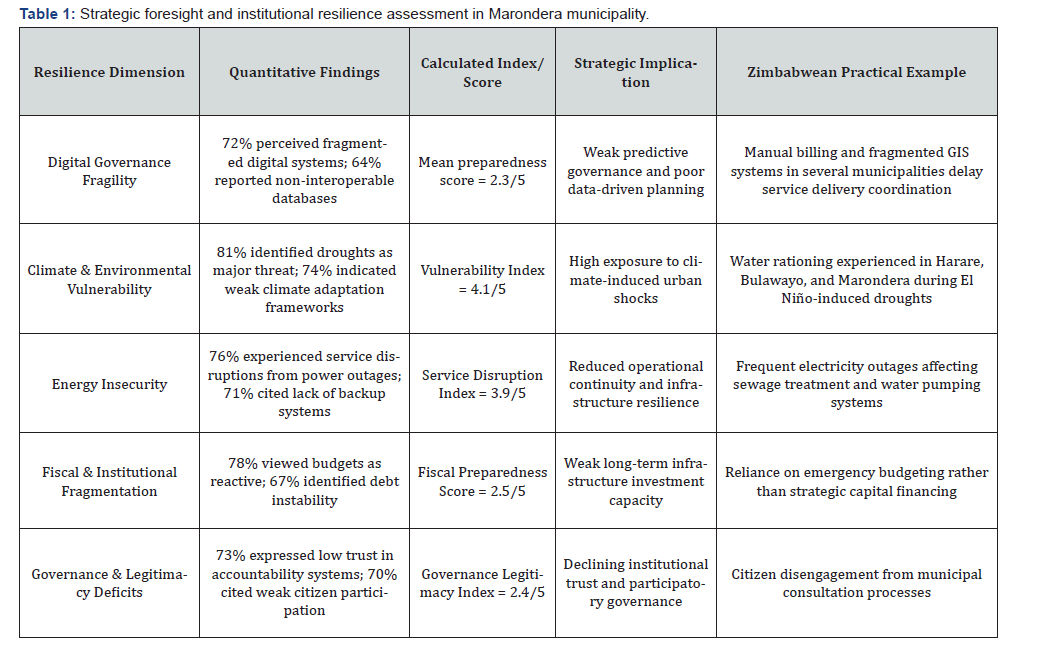
Quantitative Institutional Resilience Synthesis
The overall institutional resilience capacity of Marondera Municipality was computed using the composite average of the five governance dimensions:
The calculated institutional resilience score of 3.04/5 indicates a moderately vulnerable governance system characterized by weak adaptive preparedness, fragmented institutional coordination, and limited strategic foresight integration AfDB [65], World Bank [2]. Although some resilience structures exist, the municipality remains insufficiently prepared for future systemic shocks, particularly climate-related disruptions, energy instability, and fiscal uncertainty IPCC [69], IMF [67].
Institutional resilience and strategic foresight framework for urban local authorities in zimbabwe
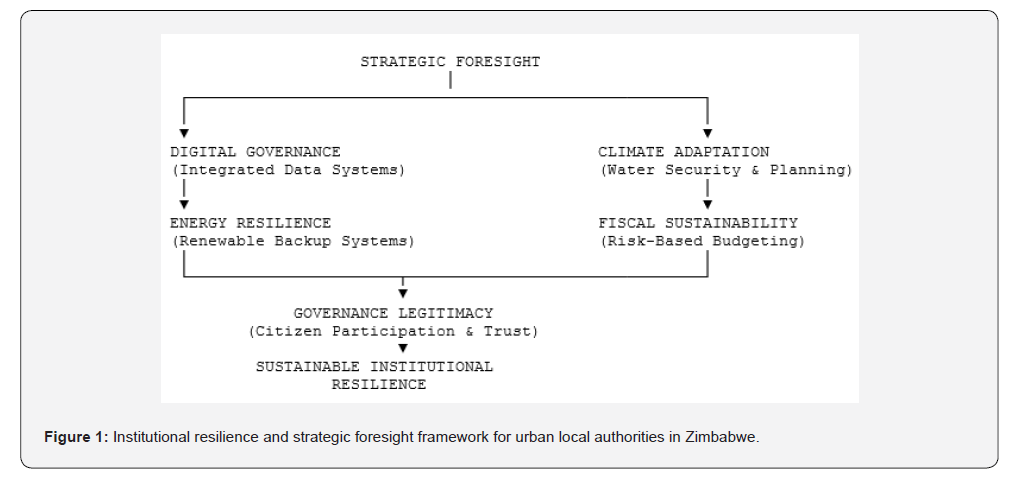
Critical analysis and synthesis
The findings critically demonstrate that institutional resilience within Zimbabwe’s urban local authorities cannot be achieved through isolated technical interventions alone UN-Habitat [1]. Instead, resilience emerges from the strategic integration of governance adaptability, anticipatory planning, technological modernization, fiscal sustainability, and participatory legitimacy OECD [66]. The evidence from Marondera Municipality reveals that digital governance fragility significantly constrains foresightdriven urban management because fragmented databases and manual administrative systems reduce institutional responsiveness and predictive planning capacity World Bank [2]. Similar governance weaknesses have also been observed in other Zimbabwean municipalities where limited interoperability undermines evidence-based decision-making and revenue optimization AfDB [65].
The World Bank emphasizes that digital transformation is fundamental for improving governance efficiency, transparency, and institutional resilience in developing economies, particularly within rapidly urbanizing African contexts World Bank [1]. The climate vulnerability findings further reveal that Marondera Municipality remains structurally exposed to recurrent droughts, water insecurity, and environmental shocks due to inadequate adaptation planning and overdependence on climate-sensitive reservoirs IPCC [69]. This demonstrates a reactive institutional culture that prioritizes crisis response rather than anticipatory climate resilience planning.
Energy insecurity similarly emerged as a major institutional vulnerability. Excessive dependence on Zimbabwe’s centralized electricity grid continues to expose municipalities to operational disruptions affecting water pumping, waste management, and sewage treatment systems IRENA [68]. The absence of decentralized renewable infrastructure demonstrates limited foresight integration within municipal energy governance frameworks. Evidence from IRENA shows that decentralized renewable energy systems significantly strengthen institutional resilience through operational continuity, adaptive flexibility, and improved service sustainability.
Furthermore, fiscal fragmentation and governance legitimacy deficits reveal deeper structural governance weaknesses undermining long-term resilience. Municipal budgeting systems remain predominantly compliance-driven and operationally reactive, limiting strategic infrastructure investment and adaptive innovation IMF [67]. Simultaneously, declining citizen trust and limited participatory governance weaken institutional legitimacy and collective ownership of resilience initiatives OECD [66]. These findings suggest that resilience-building requires not only financial and technological reforms but also democratic governance renewal capable of strengthening transparency, accountability, and citizen inclusion.
Overall, the study demonstrates that embedding strategic foresight within Zimbabwe’s urban local authorities requires a transition from reactive municipal administration toward anticipatory governance systems capable of integrating digital transformation, climate adaptation, decentralized energy planning, fiscal innovation, and participatory governance into a unified resilience framework UN-Habitat [1], World Bank [2]. Such transformation is essential for enabling sustainable institutional resilience in the face of increasing urban uncertainty, climate volatility, economic instability, and infrastructure pressures.
Discussion
This study integrates Resilience Theory, Adaptive Governance Theory, Strategic Foresight Theory, and Systems Theory to explain the relationship between strategic foresight and sustainable institutional resilience in urban local authorities. Resilience Theory conceptualizes resilience as the capacity of systems to absorb disturbance and reorganize while undergoing change Holling [70], while Adaptive Governance Theory emphasizes polycentric, learning-oriented institutions capable of responding to complex environmental and social change Folke [71]. Strategic Foresight Theory contributes an anticipatory dimension that enables institutions to systematically explore alternative futures and uncertainty OECD, [66], Rohrbeck & Kum [32], and Systems Theory provides an integrative lens for understanding interdependent institutional subsystems and feedback dynamics Meadows [72]. Collectively, these frameworks position resilience not as a static outcome, but as an evolving, system-wide governance capability.
This study demonstrates that embedding strategic foresight within urban local authorities represents a decisive shift from reactive resilience paradigms toward anticipatory and transformative governance OECD [66], World Bank [2]. Within the conceptual overlap of Resilience Theory, Adaptive Governance Theory, and Strategic Foresight Theory, resilience is no longer adequately understood as recovery capacity alone but as the institutional capability to continuously reconfigure in anticipation of uncertainty UNDP [73], OECD [66]. International governance scholarship increasingly supports this position, arguing that foresight-driven institutions outperform reactive systems in managing volatility, complexity, and systemic shocks OECD [66], World Bank [1]. In this regard, findings from Marondera Municipality reinforce the argument that fragmented digital systems, weak planning integration, and limited scenariobased decision-making constrain the municipality’s ability to operationalize foresight as a governance capability Chinongwa [74]. The persistence of reactive budgeting, crisis-driven infrastructure responses, and short-term planning confirms a misalignment between theoretical resilience aspirations and institutional realities, reflecting what UNDP (2020) describes as a “resilience implementation gap” in developing country municipalities.
At the institutional level, the Zimbabwean urban governance context reveals structural constraints that mediate the relationship between foresight and resilience World Bank [2]. The findings confirm that fiscal fragility, political centralization, and bureaucratic rigidity significantly undermine the institutionalization of anticipatory governance systems, consistent with prior studies on Zimbabwean municipalities Chinongwa [74]. While policy frameworks such as devolution and smart city agendas exist, their implementation remains largely technocratic and disconnected from embedded foresight capabilities UN-Habitat [1]. This reflects a broader Global South challenge where imported resilience frameworks often assume institutional capacities that do not exist in practice UN-Habitat [1]. The case of Marondera Municipality illustrates this contradiction: despite strategic ambitions toward smart-city transformation, governance practices remain anchored in incremental problemsolving rather than systemic anticipation OECD [66]. Moreover, weak institutional coordination and limited policy coherence mirror findings from the World Bank [2], which emphasizes that urban resilience in fragile economies is constrained less by technical deficits and more by governance architecture and institutional fragmentation.
A key analytical insight from the study is that institutional resilience in urban local authorities is fundamentally multidimensional, requiring the integration of digital governance, climate adaptation, energy security, fiscal sustainability, and governance legitimacy into a unified foresight system IRENA [75], IPCC [69]. The empirical evidence shows that each of these dimensions operates as an interdependent subsystem whose weaknesses reinforce overall institutional vulnerability Meadows [72]. For instance, fragmented digital infrastructure limits predictive analytics for water management, while energy insecurity disrupts service continuity and weakens municipal responsiveness IRENA [75]. These findings align with energy transition research by the International Renewable Energy Agency, which highlights decentralized renewable systems as critical enablers of institutional resilience in unstable energy environments. Similarly, climate vulnerability evidence corroborates the Intergovernmental Panel on Climate Change, which warns that African urban systems are increasingly exposed to compounding climate risks requiring anticipatory adaptation rather than reactive mitigation IPCC [69]. In this sense, strategic foresight emerges not as a standalone planning instrument but as a meta-governance capability that integrates fragmented institutional systems into a coherent adaptive framework OECD [66], Meadows [72].
From a theoretical and policy perspective, the study contributes to the reconceptualization of urban resilience as an anticipatory, learning-oriented, and systemically integrated governance process rather than a static outcome Folke [71], UNDP [73]. The findings extend Adaptive Governance Theory by demonstrating that foresight capabilities must be institutionalized across leadership structures, planning systems, and stakeholder networks to generate meaningful resilience outcomes OECD [66]. However, the study also reveals that foresight adoption in Zimbabwean municipalities is constrained by structural governance deficits, including limited institutional autonomy, weak accountability systems, and low public trust World Bank [2], Chinongwa [74]. These challenges suggest that embedding foresight requires simultaneous reforms in governance legitimacy and organizational learning systems UNDP [73]. The implications are significant for policy reform: municipalities must move beyond compliance-based strategic planning toward scenariodriven governance systems supported by digital transformation and participatory foresight platforms OECD [66], UN-Habitat [1]. Ultimately, strengthening sustainable institutional resilience in contexts such as Zimbabwe requires reorienting urban governance from crisis reaction to future anticipation, thereby positioning foresight as a core capability of resilient municipal systems rather than an auxiliary planning tool.
Conclusion
In conclusion, this study demonstrates that Southern African correctional systems, with particular reference to Zimbabwe, remain predominantly anchored in reactive governance logics that prioritize containment and crisis response over anticipatory and transformative institutional development. By synthesizing resilience theory, adaptive governance, and strategic foresight perspectives, the analysis advances the argument that sustainable correctional institutional performance depends not merely on operational efficiency or infrastructural adequacy, but on the cultivation of foresight-driven leadership innovation capable of anticipating systemic risks such as overcrowding, recidivism cycles, resource scarcity, and infrastructural decay. The Zimbabwean case illustrates a persistent misalignment between policy aspirations for modernized correctional reform and the actual governance architecture, which remains constrained by bureaucratic rigidity, fiscal limitations, and weak institutional learning systems. Existing literature on correctional governance in the Global South often privileges reactive security imperatives and administrative compliance, thereby under-theorizing the role of anticipatory capacity-building and strategic leadership in enabling long-term institutional resilience. This study therefore critiques such narrow framings and positions strategic foresight not as an auxiliary planning function but as a core governance capability that enables correctional institutions to transition from short-term crisis management to long-term system transformation. Ultimately, embedding foresight within leadership practices, organizational learning systems, and adaptive governance structures offers a pathway for reconstituting correctional institutions as futureoriented, resilient systems capable of continuous learning and structural adaptation in volatile socio-political environments.
Policy Recommendations
Institutionalize a municipal foresight unit
Marondera Municipality should establish a dedicated Municipal Foresight and Resilience Unit mandated to conduct horizon scanning, scenario planning, and systemic risk analysis OECD [66], World Bank [2]. Unlike conventional planning departments that are often constrained by short-term budgeting cycles, this unit should be embedded within the municipal executive structure to ensure that anticipatory intelligence informs strategic decision-making UN-Habitat [1]. The recommendation aligns with emerging governance scholarship that positions foresight as a “meta-capability” for resilience, enabling institutions to anticipate disruption rather than merely respond to it OECD [66], World Bank [2]. However, its effectiveness depends on overcoming Zimbabwe’s institutional fragmentation, where planning, finance, and engineering departments often operate in silos UN-Habitat [1]. Therefore, the foresight unit must function as an integrative node linking data analytics, policy coordination, and executive decision support to avoid becoming an isolated technocratic addon.
Integrate foresight into budgeting and infrastructure planning
Municipal budgeting systems should be restructured to incorporate multi-scenario fiscal forecasting and climate-riskinformed capital investment planning World Bank [2], UNDP [73]. This shifts municipal finance from reactive expenditure allocation toward anticipatory resource prioritization, ensuring infrastructure investments remain robust under conditions of uncertainty such as droughts, inflation shocks, or energy disruptions UNDRR [76]. Evidence from development governance literature shows that risk-informed budgeting enhances longterm infrastructure resilience and reduces stranded asset risks in volatile economies World Bank [2], UNDP [73]. In the Zimbabwean context, where municipalities frequently rely on emergency budgeting, embedding foresight into fiscal governance would require institutional reforms that align capital planning with scenario-based climate, demographic, and energy projections, thereby reducing systemic underinvestment in critical urban infrastructure UN-Habitat [1].
Accelerate digital integration
Urban resilience requires interoperable digital governance systems that unify billing, asset management, GIS mapping, and citizen reporting into a single data ecosystem World Bank [2], UN-Habitat [1]. Marondera Municipality’s fragmented digital infrastructure limits predictive governance capacity and weakens evidence-based decision-making, reinforcing reactive service delivery patterns UN-Habitat [1]. Digital transformation is increasingly recognized as a foundational enabler of institutional resilience because it improves transparency, efficiency, and anticipatory planning capabilities World Bank [2]. However, digitalization must move beyond digitizing existing inefficiencies and instead focus on building integrated urban data architectures that support real-time analytics, early warning systems, and performance monitoring OECD [66]. Thus, without this systemic integration, digital initiatives risk reproducing existing bureaucratic fragmentation in digital form.
Promote climate-smart urban infrastructure
Municipal infrastructure planning should prioritize climateresilient systems such as drought-resistant water supply networks, rainwater harvesting infrastructure, permeable urban surfaces, and green-blue infrastructure corridors IPCC [69], UN-Habitat [1]. These interventions are critical given the high vulnerability of Zimbabwean urban centers to recurring droughts and water stress, as evidenced in Marondera, Harare, and Bulawayo IPCC [69]. The Intergovernmental Panel on Climate Change emphasizes that African urban systems require anticipatory adaptation strategies rather than reactive disaster responses IPCC [69]. Therefore, climate-smart infrastructure should be mainstreamed into all municipal capital projects through mandatory climate risk screening and resilience impact assessments, ensuring that urban development contributes to long-term ecological and institutional sustainability rather than reinforcing vulnerability UNDRR [76].
Transition toward renewable energy solutions
Municipalities should invest in decentralized renewable energy systems, particularly solar microgrids, hybrid energy systems, and solar-powered water infrastructure, to reduce dependence on the unstable national electricity grid IRENA [68], World Bank [2]. Energy insecurity has been identified as a major constraint on service continuity in water supply, sanitation, and waste management systems IRENA [68]. Evidence from the International Renewable Energy Agency demonstrates that decentralized renewable systems enhance institutional resilience by ensuring operational continuity during grid failures and reducing long-term energy costs IRENA [68]. In Zimbabwe, where power outages are frequent, municipalities must move beyond ad hoc generator reliance toward structured energy transition planning integrated into urban resilience strategies.
Strengthen participatory governance
Enhancing institutional resilience requires strengthening participatory governance mechanisms through digital engagement platforms, community planning forums, participatory budgeting, and structured stakeholder feedback systems UN-Habitat [1], UNDP [73]. The empirical findings indicate low levels of public trust and weak civic participation, which undermines governance legitimacy and collective ownership of resilience strategies UNHabitat [1]. In line with adaptive governance theory, resilience is strengthened when institutions embed citizen knowledge into decision-making processes, thereby improving responsiveness and accountability UNDRR [76]. However, participation must move beyond symbolic consultation toward institutionalized co-production of urban services, ensuring that communities are active contributors to foresight-driven planning rather than passive recipients of municipal decisions.
Critical synthesis of policy direction
Collectively, these recommendations demonstrate that institutional resilience in Zimbabwean urban local authorities cannot be achieved through sector-specific reforms alone but requires systemic integration of foresight across governance, finance, infrastructure, and legitimacy structures OECD [66], UNDRR [76]. The dominant limitation identified in Marondera Municipality is not merely technical undercapacity but the absence of anticipatory governance architecture capable of linking fragmented systems into a coherent strategic intelligence framework UN-Habitat [1]. Existing literature from the OECD, World Bank, UNDP, IPCC, UNDRR, and IRENA consistently converges on the view that resilience in volatile urban environments depends on integrated foresight systems that combine data-driven governance, climate adaptation, decentralized energy, and participatory legitimacy IPCC [69], IRENA [68], World Bank [2].
The synthesis therefore suggests that strategic foresight should not be treated as an isolated planning tool but as a governing logic that restructures municipal decision-making systems toward anticipation, learning, and adaptation OECD [66]. Without embedding foresight into institutional DNA, particularly budgeting systems, infrastructure planning cycles, and digital governance platforms, resilience reforms risk remaining fragmented and reactive UNDRR [76]. Consequently, the transformation of Zimbabwe’s urban local authorities requires simultaneous reforms in governance architecture and institutional culture to shift from crisis management to anticipatory resiliencebuilding.
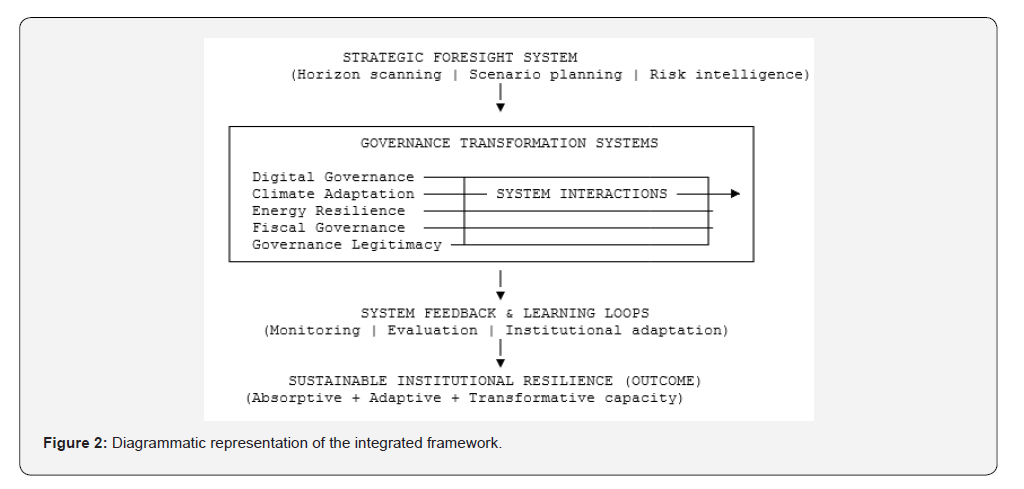
The diagrammatic representation of the integrated framework illustrates the systemic relationship between strategic foresight, governance transformation systems, institutional learning processes, and sustainable institutional resilience within Zimbabwe’s urban local authorities, with specific reference to Marondera Municipality. The framework conceptualizes resilience as an emergent outcome generated through the interaction of interconnected governance subsystems operating within a complex adaptive municipal environment Mannucci [77], Eakin [16]. Anchored in Systems Theory, Adaptive Governance Theory, Strategic Foresight Theory, and Resilience Theory, the model demonstrates how anticipatory governance mechanisms strengthen institutional capacity to manage uncertainty, absorb shocks, adapt to change, and transform governance structures in response to evolving socio-economic and environmental risks Yasmin [78], Krishnan [79], (Figure 2).
Strategic Foresight System
At the apex of the framework is the Strategic Foresight System, which functions as the anticipatory intelligence mechanism that informs governance decision-making Vecchiato 2015. Krishnan [79]. This system incorporates horizon scanning, scenario planning, and risk intelligence as critical tools for identifying emerging threats, uncertainties, and future opportunities affecting urban governance systems Rohrbeck & Kum [32], Walker [80]. Through the integration of predictive analytics, climate projections, and strategic risk assessment, foresight transforms local authorities from reactive institutions into proactive and adaptive governance systems capable of preparing for long-term disruptions Miller & Waller 2023, Mannucci [77]. In the context of Marondera Municipality, the framework suggests that the limited institutionalization of foresight mechanisms contributes significantly to weak preparedness capacities and fragmented crisis response systems.
Governance transformation systems
The second component of the framework comprises Governance Transformation Systems, which serve as the mediating institutional structures through which foresight intelligence is operationalized. These systems include digital governance, climate adaptation, energy resilience, fiscal governance, and governance legitimacy structures. Digital governance enhances institutional responsiveness through integrated information systems, GIS technologies, and evidence-based decision-making platforms Fastiggi [20]. Climate adaptation systems strengthen municipal preparedness through environmental risk screening, disaster preparedness planning, and water resilience strategies Ni’mah [81] Urban Climate Governance Review, 2025). Energy resilience systems promote operational continuity through decentralized energy infrastructure and renewable energy alternatives, while fiscal governance systems improve financial sustainability through risk-based budgeting and scenario-informed resource allocation (Walker [80]). Governance legitimacy systems strengthen social resilience by promoting transparency, accountability, citizen participation, and collaborative governance arrangements Meerow [82], Fitzgibbons & Mitchell [83]. Collectively, these interdependent subsystems demonstrate that institutional resilience cannot be achieved through isolated sectoral reforms, but rather through integrated governance transformation processes (Catalyzing Governance Transformations, 2020).
System interactions within governance subsystems
The framework further emphasizes the existence of dynamic system interactions among governance subsystems, reflecting the principles of Systems Theory. These interactions are nonlinear, interconnected, and mutually reinforcing, meaning that weaknesses in one subsystem may generate cascading vulnerabilities across the broader institutional environment Mannucci [77], Eakin [16]. For example, deficiencies in fiscal governance may undermine climate adaptation investments, while weak digital governance systems may reduce the effectiveness of disaster response coordination and public communication mechanisms (Urban Climate Governance Review, 2025). Conversely, strengthened governance legitimacy may improve public trust and enhance stakeholder cooperation during periods of crisis Fitzgibbons & Mitchell [83]. Thus, the framework therefore illustrates that resilience emerges from systemic coherence, institutional integration, and coordinated governance processes rather than from isolated institutional capacities.
System feedback and learning loops
The framework incorporates System Feedback and Learning Loops as the dynamic regulatory mechanism that sustains institutional adaptation and continuous improvement. This component includes monitoring systems, evaluation mechanisms, institutional feedback processes, and adaptive recalibration strategies that enable municipalities to learn from past experiences and adjust governance practices in response to changing conditions Walker [80], Krishnan [79]. Drawing from Adaptive Governance Theory, the framework highlights the importance of institutional flexibility, decentralized decisionmaking, and continuous learning in enhancing resilience under uncertainty Yasmin [78]. Feedback loops reduce governance blind spots, improve institutional memory, and facilitate evidence-based policy adjustments, thereby strengthening the municipality’s ability to respond effectively to future crises and systemic disruptions Eakin [16].
Sustainable Institutional Resilience
The final component of the framework is Sustainable Institutional Resilience, conceptualized as the emergent outcome of foresight-enabled adaptive governance systems. Resilience within this framework encompasses absorptive capacity, adaptive capacity, and transformative capacity Meerow [82], Krishnan [79]. Absorptive capacity refers to the municipality’s ability to withstand and maintain core functions during shocks, adaptive capacity reflects the institution’s ability to adjust governance systems in response to evolving risks, and transformative capacity denotes the ability to fundamentally restructure governance arrangements to achieve long-term sustainability Folke [84], Walker [80]. The framework therefore argues that sustainable institutional resilience is not solely dependent on resource availability, but rather on the extent to which strategic foresight is embedded within interconnected governance systems supported by continuous learning and adaptive institutional processes Mannucci [77].
Theoretical significance of the integrated framework
The integrated framework contributes theoretically by extending Resilience Theory through the incorporation of strategic foresight as a pre-crisis governance capability that enhances anticipatory resilience. It further advances Adaptive Governance Theory by embedding future-oriented intelligence systems into institutional decision-making processes, while simultaneously extending Systems Theory through the integration of dynamic feedback mechanisms and non-linear governance interactions Yasmin [78], Eakin [16]. The framework therefore provides a multidimensional analytical lens for understanding how urban local authorities can transition from crisis-driven governance models toward anticipatory, adaptive, and resilience-oriented governance systems capable of navigating uncertainty and complexity Krishnan [79], Mannucci [77].
Empirical and policy relevance to marondera municipality
Empirically, the framework provides an explanatory basis for understanding Marondera Municipality’s moderate institutional resilience score of 3.04/5 by linking institutional vulnerabilities to weak foresight integration, fragmented governance systems, and insufficient adaptive learning mechanisms Fastiggi [20], Urban Climate Governance Review, 2025. The framework demonstrates that resilience deficits within Zimbabwe’s urban local authorities are largely systemic rather than sector-specific, arising from weak coordination between governance subsystems and limited institutionalization of anticipatory planning practices Ni’mah [81]. From a policy perspective, the framework justifies the establishment of municipal foresight units, integrated digital governance platforms, climate-smart infrastructure planning systems, and risk-based fiscal governance mechanisms as essential interventions for strengthening long-term institutional resilience and sustainable urban governance (Catalyzing Governance Transformations, 2020; Yasmin [78] [85-110].
References
- UN-Habitat (2022) World cities report 2022: Envisaging the future of cities. United Nations Human Settlements Programme.
- World Bank (2023) Building resilient infrastructure systems: Governance, risk, and public investment management. World Bank Group.
- Moyo T, Ncube B (2023) Urban governance and resilience under economic instability in Zimbabwe. Journal of Southern African Studies 49(2): 233-249.
- OECD (2021) Anticipatory governance and strategic foresight for better policies. Organization for Economic Co-operation and Development.
- UNDP (2022) Governance and institutional resilience in Africa. United Nations Development Programme.
- European Commission (2022) Competency framework for strategic foresight. European Union.
- Conway M (2021) Strategic foresight: Improving governance and public policy resilience. Foresight 23(5): 521-534.
- Raunio M, Nordling N (2023) Anticipatory governance and resilient urban systems in developing economies. Urban Studies 60(11): 2140-2158.
- Chatiza K (2022) Urban local governance and service delivery challenges in Zimbabwe. Development Governance Institute.
- Chigudu D (2021) Governance and urban resilience in Zimbabwean municipalities. African Journal of Public Affairs 12(3): 45-60.
- Chinongwa I (2024) Strategic management and organizational resilience in Zimbabwean urban councils. Journal of African Local Governance 8(1): 77-94.
- Government of Zimbabwe (2021) National development strategy 1: 2021-2025. Government Printers.
- Marondera Municipality (2023) Integrated urban water management master plan 2023-2030. Municipality of Marondera.
- OECD (2021) Foresight and anticipatory governance. OECD Publishing.
- OECD (2021) Foresight and anticipatory governance in resilient cities. Organization for Economic Co-operation and Development. OECD Publishing.
- Eakin H, Hamann R, Ziervogel G (2023) Emergent governance responses to shocks to critical provisioning systems. npj Urban Sustainability 3(42): 1-12.
- Zivhave M, Chatiza K, Bvuma TE, Zimunya W, Musvoto G, et al. (2025) The role of spatial planning in strengthening human settlement resilience to nature-induced disasters in Chimanimani District, Zimbabwe. Discover Sustainability 6(88).
- Brooke A, Fenner RA (2023) Improving urban water management and building water supply resilience in the city of Harare, Zimbabwe – A systems view. Civil Engineering and Environmental Systems 40(4): 195-228.
- Matamanda AR, Chirisa I, Mazanhi P, Toriro P (2024) The interface between politics, ethics and urban planning: The case of land and space barons in Harare, Zimbabwe. Urban Studies EPC 43(1).
- Fastiggi M, Meerow S, Miller TR (2021) Governing urban resilience: Organizational structures and coordination strategies in 20 North American city governments. Urban Studies 58(6): 1262-1285.
- Seeliger L, Turok I (2014) Averting a downward spiral: Building resilience in informal urban settlements through adaptive governance. Environment and Urbanization 26(1): 184-199.
- Munyoro G (2026) Strategic foresight and institutional resilience in local authorities’ systems: Future-proofing Murewa Rural District Council, Murewa. Academic Journal of Politics and Public Administration 2(5).
- Nyikadzino T, Vyas DS (2024) Transforming cities: The role of local government-university collaborations in urban governance in Zimbabwe. International Journal of Business Ecosystem & Strategy 6(4): 493-501.
- Marumahoko S, Moyo T, Tashu KT (2025) Data-driven urban governance: Opportunities and challenges in Zimbabwean cities. Zimbabwe Journal of Business, Economics and Management 4(2).
- Uguet J, Tollin N, Morato J (2026) Transforming crises into opportunities: From chaos to urban antifragility. arXiv.
- Mentges, A., Halekotte, L., Schneider, M., Demmer, T., & Lichte, D. (2023). A resilience glossary shaped by context: Reviewing resilience-related terms for critical infrastructures. arXiv.
- Krueger EH, Borchardt D, Jawitz JW (2019) Resilience dynamics of urban water security and potential for tipping points. Earth’s Future 7(10): 1167-1191.
- Matambo F, Nyagadza B, Marembo M (2026) Impact of adaptive leadership on urban governance and service delivery innovation in local authorities: A systematic literature review. Strategic Business Research 2(1): 100131.
- Morgan DL (2020) Pragmatism as a paradigm for social research. Qualitative Inquiry 20(8): 1045-1053.
- Creswell JW, Plano CVL (2018) Designing and conducting mixed methods research (3rd ed.). Sage.
- Mertens DM (2020) Research and evaluation in education and psychology (5th ed.). Sage.
- Rohrbeck R, Kum ME (2018) Corporate foresight and its impact on firm performance: A longitudinal analysis. Technological Forecasting and Social Change 129: 105-116.
- Tashakkori A, Teddlie C (2021) Foundations of mixed methods research. Sage.
- Creswell JW, Creswell JD (2023) Research design: Qualitative, quantitative and mixed methods approach (6th ed.). Sage.
- Yin RK (2018) Case study research and applications (6th ed.). Sage.
- Stake RE (2020) The art of case study research. Sage.
- Denzin NK, Lincoln YS (2018) The Sage handbook of qualitative research (5th ed.). Sage.
- Van dWG (2021) Urban resilience and adaptive governance in African municipalities. Africa’s Public Service Delivery and Performance Review 9(1): 1–11.
- Bowen GA (2009) Document analysis as a qualitative research method. Qualitative Research Journal 9(2): 27-40.
- Patton MQ (2015) Qualitative research and evaluation methods (4th ed.). Sage.
- Creswell JW, Poth CN (2018) Qualitative inquiry and research design (4th ed.). Sage.
- Saunders M, Lewis P, Thornhill A (2019) Research methods for business students (8th ed.). Pearson.
- Uriacombe C, Van dWG (2020) Municipal governance and resilience in Southern Africa. Routledge.
- Hair JF, Black WC, Babin BJ, Anderson RE (2022) Multivariate data analysis (9th ed.). Cengage.
- Bryman A (2016) Social research methods (5th ed.). Oxford University Press.
- Field A (2020) Discovering statistics using IBM SPSS statistics (5th ed.). Sage.
- Marondera Municipality Annual Report (2023) Annual performance and governance report. Marondera Municipality.
- World Bank (2021) Urban resilience and municipal governance in developing economies. World Bank.
- Bryson JM, Crosby BC, Bloomberg L (2018) Public value governance: Moving beyond traditional public administration and the New Public Management. Public Administration Review 74(4): 445-456.
- Etikan I, Bala K (2017) Sampling and sampling methods. Biometrics & Biostatistics International Journal 5(6): 215-217.
- Taherdoost H (2020) Sampling methods in research methodology. International Journal of Academic Research in Management 5(2): 18-27.
- Flick U (2022) An introduction to qualitative research (7th ed.). Sage.
- Denzin NK (2017) The research act: A theoretical introduction to sociological methods. Routledge.
- Voros J (2003) A generic foresight process framework. Foresight 5(3): 10-21.
- Miller R (2018) Transforming the future: Anticipation in the 21st century. Routledge.
- Braun V, Clarke V (2021) Thematic analysis: A practical guide. Sage.
- Nowell LS, Norris JM, White DE, Moules NJ (2017) Thematic analysis. International Journal of Qualitative Methods 16(1): 1-13.
- Castleberry A, Nolen A (2018) Thematic analysis of qualitative research data. Currents in Pharmacy Teaching and Learning, 10(6): 807-815.
- Fetters MD, Curry LA, Creswell JW (2013) Achieving integration in mixed methods designs. Health Services Research 48(6): 2134-2156.
- Lincoln YS, Guba EG (1985) Naturalistic inquiry. Sage.
- Resnik DB (2020) What is ethics in research and why is it important? National Institute of Environmental Health Sciences.
- Orb A, Eisenhauer L, Wynaden D (2001) Ethics in qualitative research. Journal of Nursing Scholarship 33(1): 93-96.
- Israel M, Hay I (2006) Research ethics for social scientists. Sage.
- Wiles R (2013) What are qualitative research ethics? Bloomsbury.
- AfDB (2022) Zimbabwe infrastructure report. African Development Bank (AfDB).
- OECD (2023) Government at a glance 2023. Organization for Economic Co-operation and Development.
- International Monetary Fund (IMF) (2023) Regional economic outlook: Sub-Saharan Africa- Navigating economic shocks and policy trade-offs. IMF.
- International Renewable Energy Agency (IRENA) (2023) Renewable energy and cities: Unlocking resilient urban development. IRENA.
- Intergovernmental Panel on Climate Change (IPCC) (2022) Climate change 2022: Impacts, adaptation and vulnerability (Working Group II contribution to the Sixth Assessment Report). Cambridge University Press.
- Holling CS (1973) Resilience and stability of ecological systems. Annual Review of Ecology and Systematics 4: 1-23.
- Folke C, Hahn T, Olsson P, Norberg J (2005) Adaptive governance of social-ecological systems. Annual Review of Environment and Resources 30: 441-473.
- Meadows DH (2008) Thinking in systems: A primer. Chelsea Green Publishing.
- United Nations Development Programme (UNDP) (2020) Human development report 2020: The next frontier - Human development and the Anthropocene. UNDP.
- Chinongwa T (2024) Urban governance constraints and municipal service delivery in Zimbabwean local authorities (Unpublished manuscript/report).
- International Renewable Energy Agency (IRENA) (2023) World energy transitions outlook 2023: 1.5°C IRENA.
- United Nations Office for Disaster Risk Reduction (2022) Global assessment report on disaster risk reduction 2022: Our world at risk.
- Mannucci S (2025) Beyond sustainability: Paradigms for complexity and resilience in the built environment. Urban Science 9(6): 212.
- Yasmin T, Farrelly M, Rogers BC (2020) Adaptive governance: A catalyst for advancing sustainable urban transformation in the global South. International Journal of Water Resources Development 36(5): 818-838.
- Krishnan S, Aydin NY, Comes T (2024) TIMEWISE: Temporal dynamics for urban resilience- Theoretical insights and empirical reflections from Amsterdam and Mumbai. npj Urban Sustainability 4(4): 1-13.
- Walker WE, Marchau VAWJ, Kwakkel JH (2020) Adaptive planning under deep uncertainty. Cities 106: 102866.
- Ni’mah NM, Wibisono BH, Roychansyah MS (2021) Urban sustainability and resilience governance: Review from the perspective of climate change adaptation and disaster risk reduction. Journal of Regional and City Planning 32(1): 79-98.
- Meerow S, Newell JP, Stults M (2016) Defining urban resilience: A review. Landscape and Urban Planning 147: 38-49.
- Fitzgibbons J, Mitchell CL (2021) Inclusive resilience: Examining a case study of equity-cantered strategic planning in Toronto Canada. Cities 108: 102997.
- Folke C, Carpenter SR, Walker B (2010) Resilience thinking: Integrating resilience, adaptability and transformability. Ecology and Society 15(4): 20.
- AfDB (2022) African economic outlook 2022: Supporting climate resilience and a just energy transition in Africa. African Development Bank (AfDB).
- Ansell C, Sørensen E, Torfing J (2023) Public governance as co-creation: A strategy for revitalizing the public sector. Oxford University Press.
- Bertalanffy L (1968) General system theory. George Braziller.
- Boin A, Hart P (2022) Governing after crisis. Cambridge University Press.
- Boin A, Lodge M (2021) Responding to cascading crises. Oxford University Press.
- Duchek S (2020) Organizational resilience: A capability-based conceptualization. Business Research 13: 215-246.
- Intelligence Council (2021) Global trends 2040. US National Intelligence Council.
- International Renewable Energy Agency (2023) Renewable energy and resilience in developing economies.
- IRENA (2024) Renewable energy and urban resilience. International Renewable Energy Agency.
- OECD (2015) Strategic foresight for public policy. OECD Publishing.
- OECD (2020) Government at a glance. OECD Publishing.
- OECD (2023) Public governance outlook 2023. OECD Publishing.
- Senge P (2006) The fifth discipline. Doubleday.
- Uguet J, Tollin N, Morató J (2025) Post crisis strategies: Antifragility principles as catalysts for urban evolution towards sustainability. arXiv.
- UN (2024) Pact for the Future. United Nations.
- UNDP (2023) Futures and foresight for public institutions. United Nations Development Programme.
- UN-Habitat (2024) World cities report 2024. United Nations Human Settlements Programme.
- United Nations Development Programme (2021) Financing for sustainable development: Risk-informed public investment approaches. UNDP.
- United Nations Human Settlements Programme (2022) World cities report 2022: Envisaging the future of cities. UN-Habitat.
- van dVGS, Essens P, Wahlström M, George G (2015) Managing risk and resilience. Academy of Management Journal 58(4): 971-980.
- World Bank (2022) Digital government for development: A framework for transformation. World Bank.
- World Bank (2023) Resilient cities: Urban development and disaster risk management in a changing climate. World Bank.
- World Bank (2023) Urban resilience and infrastructure in Sub-Saharan Africa: Challenges and opportunities. World Bank.
- World Bank (2023) Zimbabwe economic update: Delivering a future-ready urban infrastructure system. World Bank.
- World Bank (2023) Zimbabwe urban service delivery assessment. World Bank.
- Zimbabwe National Statistics Agency (2022) 2022 population and housing census preliminary report. ZIMSTAT.

























