




 ACJPP Home



Abstract
Urban Local Authorities (ULAs) in Zimbabwe face persistent governance and service delivery challenges despite constitutional devolution reforms. While global urban governance paradigms increasingly emphasize decentralization, digital transformation, and participatory governance, Zimbabwe’s experience reflects fragmented implementation and weak institutional coherence. This study adopted a pragmatist philosophy and a convergent parallel mixed-methods design. Quantitative data were collected from 312 respondents using structured questionnaires, while qualitative data were obtained from 26 key informants through semi-structured interviews. Data were analysed using SPSS and Structural Equation Modelling (SEM) alongside thematic analysis in NVivo, with findings integrated through triangulation. The findings reveal that digital governance (β = 0.62) and developmental reintegration (β = 0.66) are the strongest predictors of sustainable urban governance, while fiscal decentralization shows only a weak positive effect (β = 0.31). Institutional capacity significantly influences governance outcomes (β = 0.58) yet remains constrained by skills shortages and administrative fragmentation. Citizen participation is moderate but largely symbolic, limiting accountability and legitimacy. Multi-level coordination remains weak, undermining policy coherence. Overall, governance reforms explain 63% of variance in urban resilience outcomes, although infrastructural and service delivery deficits persist. The study concludes that Zimbabwe’s urban governance crisis is not a failure of devolution per se, but a deficit of systemic reintegration across fiscal, institutional, participatory, and developmental domains. It advances the Developmental Reintegration Governance (DRG) framework as a synthesis of decentralization, New Public Governance, and Institutional Theory, arguing that sustainable urban transformation requires coordinated reform integration rather than isolated policy interventions. The Zimbabwe Correctional System analogy underscores the importance of structured reintegration mechanisms for restoring institutional functionality and accountability.
Keywords:Urban Local Authorities; Devolution Reforms; Developmental Reintegration; Fiscal Decentralization; Institutional Capacity; Citizen Participation; Urban Governance Resilience
Abbreviations:ULAs: Urban Local Authorities; SEM: Structural Equation Modelling; DRG: Developmental Reintegration Governance; NPG: New Public Governance; SDGs: Sustainable Development Goals; GIS: Geographic Information Systems; SUGRM: Sustainable Urban Governance Reintegration Model
Introduction
Urban local authorities (ULAs) have become increasingly central to the pursuit of sustainable development, inclusive economic growth, and resilient urban transformation across the Global South UN-Habitat [1]. As urbanization accelerates, local governments are expected to provide efficient service delivery, responsive governance, infrastructure development, environmental management, and citizen-cantered planning United Nations [2]. Contemporary urban governance literature emphasizes that sustainable cities are built upon capable local institutions that possess adequate fiscal autonomy, administrative capacity, and participatory governance mechanisms UN-Habitat [1]. Globally, emerging governance paradigms increasingly advocate for decentralization, collaborative governance, digital transformation, and multi-level institutional coordination as critical enablers of urban sustainability UN-Habitat [1]; United Nations [2]. Recent international evidence demonstrates that cities are now at the forefront of addressing complex developmental challenges, including climate change, infrastructure deficits, social inequality, and rapid population growth, thereby elevating the strategic importance of effective local governance systems (UN-Habitat [1].
In Zimbabwe, urban local authorities constitute the primary institutional platforms through which citizens access essential public services such as water supply, waste management, housing, transportation, public health, and urban planning Marumahoko [3]; Marumahoko [4] & Nhede [5]. However, despite their constitutional mandate, the performance of many municipalities and city councils has been undermined by decades of economic instability, fiscal distress, political centralization, institutional fragility, and governance inefficiencies Marumahoko [3]; Nyikadzino & Vyas-Doorgapersad [6]; Zinyama [7]. Recent evidence from Auditor-General reports further highlights persistent weaknesses in financial management, accountability systems, procurement practices, and internal controls across local authorities, all of which have negatively affected service delivery outcomes and public trust in local governance institutions (Office of the Auditor-General Zimbabwe, 2024; Nyikadzino [8]. Moreover, urban councils continue to face challenges associated with inadequate revenue generation, unfunded mandates, deteriorating infrastructure, and limited fiscal autonomy, constraining their capacity to respond effectively to growing urbanization pressures and citizens’ service demands Ncube [9]; Nhede [5].
Although the Constitution of Zimbabwe Amendment (No. 20) Act of [18] introduced a transformative devolution framework intended to enhance local autonomy, accountability, and development responsiveness, implementation has remained uneven and contested Ncube [10]; Hickonicko [11]. Existing studies indicate that while devolution funding has contributed to infrastructure recapitalization and localized development initiatives, local authorities continue to experience fiscal dependency, limited revenue generation capacity, weak institutional resilience, and persistent political interference in administrative processes Zinyama [7]; Hickonicko [11]. Consequently, service delivery failures, deteriorating infrastructure, and declining public trust remain pervasive across many urban centres Marumahoko [3]; Motsi [12].
The growing body of scholarship on Zimbabwean local governance has generated important insights into decentralization, collaborative governance, service delivery challenges, and institutional reform Nyikadzino & Vyas-Doorgapersad [6]. Nevertheless, significant conceptual and empirical gaps remain. First, existing studies predominantly examine devolution, fiscal management, or service delivery as isolated governance variables rather than as interconnected dimensions of a broader urban transformation agenda Zinyama [7]; Hickonicko [11]. Second, the literature remains fragmented regarding the relationship between local government reform and the reintegration of national development priorities, local governance systems, digital innovation, and citizen participation Mahlangu & Ruhode [13]. Third, while scholars generally support decentralization as a pathway toward improved governance, evidence from Zimbabwe and comparable African contexts reveals contradictory outcomes in which increased decentralization has not automatically translated into improved institutional effectiveness, fiscal sustainability, or democratic accountability Marumahoko [3]; Nyikadzino & Vyas-Doorgapersad [6]. Furthermore, contemporary global discussions increasingly emphasize smart governance, climate resilience, collaborative governance networks, and people-centered urban management United Nations [2]; UNHabitat [1], yet these emerging paradigms remain insufficiently integrated into Zimbabwe’s urban governance discourse. As a result, there is limited theoretical understanding of how reform initiatives can simultaneously strengthen local autonomy while enhancing coherence between national development objectives and local governance structures.
Against this background, this study argues that the principal challenge confronting Zimbabwe’s urban governance system is not merely the implementation of devolution but the absence of a coherent reintegration framework capable of aligning institutional reform, fiscal sustainability, citizen participation, digital governance, and developmental planning. The study therefore introduces the concept of Developmental Reintegration Governance (DRG) as an emerging framework for understanding and advancing sustainable urban transformation. Unlike conventional reform approaches that treat governance, participation, fiscal management, and service delivery as separate policy domains, DRG conceptualizes them as mutually reinforcing components of an integrated urban development system. By examining the historical trajectory of urban local authority reforms, analysing prevailing policy and institutional challenges, identifying emerging paradigms shaping urban governance, and assessing the role of reintegration policies in enhancing service delivery and accountability, the study seeks to develop a theoretically grounded and policy-relevant framework for sustainable urban governance in Zimbabwe. In doing so, it contributes to both the local government reform literature and broader debates on developmental governance in developing countries facing the dual challenges of decentralization and sustainable urbanization.
Literature Review
Theoretical framework
This study is grounded in the principles of Sustainable Urban Governance Theory and Reintegration Theory. Sustainable Urban Governance Theory emphasizes participatory decisionmaking, accountability, institutional effectiveness, and inclusive service delivery in urban local authorities. It highlights the need for reforms that enhance transparency, citizen engagement, and sustainable urban development. Reintegration Theory, derived from correctional rehabilitation frameworks, focuses on the successful social and economic reintegration of formerly incarcerated individuals into communities. Lessons from the Zimbabwe Correctional System demonstrate the importance of skills development, stakeholder collaboration, social inclusion, and supportive institutional structures in promoting reintegration. By integrating these theoretical perspectives, the study examines how urban local authority reforms can adopt inclusive governance models that support social cohesion, reduce marginalization, and contribute to sustainable urban development in Zimbabwe.
Decentralization theory: Decentralization Theory provides the foundational lens for understanding urban local authority reform in Zimbabwe by explaining the transfer of political, administrative, and fiscal powers from central government to local governments Mukoyi [14]; Tashu [15]. The theory assumes that governance effectiveness improves when decision-making authority is devolved closer to citizens because local authorities possess superior knowledge of local needs and priorities Smoke [16]; Tashu [15]. In Zimbabwe, decentralization gained constitutional legitimacy through Chapter 14 of the Constitution of Zimbabwe [17], which institutionalized devolution as a mechanism for enhancing democratic participation, equitable resource distribution, and local development (Government of Zimbabwe [17]; Mukoyi [14]. Recent studies indicate that although devolution has facilitated infrastructure development through devolution funds, the practical implementation of decentralization remains constrained by central government control over financial and administrative functions, resulting in partial rather than substantive autonomy Zinyama [7]; Tashu [15]. Scholars argue that Zimbabwe’s decentralization process exhibits a paradoxical coexistence of constitutional devolution and administrative centralization, thereby limiting the transformative potential of local governance reforms Mukoyi [14]; Tashu [15]. The theory is therefore useful for explaining how fiscal autonomy, citizen participation, and local accountability influence sustainable urban governance outcomes while simultaneously highlighting the structural barriers that impede effective decentralization in Zimbabwe.
New Public governance theory: New Public Governance (NPG) Theory emerged as a response to the limitations of traditional public administration and New Public Management by emphasizing networks, collaboration, stakeholder engagement, and co-production in governance processes Osborne [19]; Torfing [20]. The theory posits that contemporary governance challenges are too complex to be addressed solely by government institutions and therefore require collaborative arrangements involving local authorities, private sector actors, civil society organizations, communities, and development partners Osborne [19]; Torfing [20]. Within Zimbabwean urban governance, NPG is increasingly relevant because urban service delivery challenges, infrastructure deficits, and resource constraints necessitate multi-stakeholder partnerships Nyikadzino & Vyas-Doorgapersad [6]; Njanji & Zhou [21]. Empirical evidence demonstrates that collaborative governance arrangements between urban councils, universities, private organizations, and community groups have enhanced innovation, knowledge sharing, and service delivery effectiveness Nyikadzino & Vyas-Doorgapersad [6]; Nyikadzino & Vyas- Doorgapersad, 2024). However, scholars caution that collaborative governance remains constrained by political interference, weak institutional trust, and limited stakeholder capacity Nyikadzino & Vyas-Doorgapersad [6]; Zia ud din [22]. Consequently, NPG provides a valuable framework for examining how participatory governance mechanisms and inter-organizational collaboration contribute to sustainable urban development and governance reform.
Institutional theory: Institutional Theory explains how formal rules, norms, regulations, and organizational structures shape governance behaviour and institutional performance Peters [23]; Scott [24]. The theory argues that organizations continuously adapt to changing political, economic, and social environments to maintain legitimacy and effectiveness Peters [23]; Scott [24]. In the context of Zimbabwean urban local authorities, Institutional Theory is particularly useful for understanding how local governance institutions respond to constitutional reforms, devolution policies, fiscal decentralization initiatives, and emerging urban development challenges Government of Zimbabwe [17]; Mutambisi & Chavunduka [25]. Existing literature reveals that while urban councils have attempted to align their operations with national development frameworks and Sustainable Development Goals (SDGs), institutional fragmentation, overlapping mandates, and policy inconsistencies continue to undermine governance effectiveness Mutambisi & Chavunduka [25]. The theory therefore provides an analytical basis for understanding institutional reintegration, governance adaptation, and the dynamics of reform implementation within Zimbabwe’s evolving local government system.
Emerging paradigms in urban local authority reform
Devolution and fiscal decentralization: Devolution and fiscal decentralization have become central pillars of urban local authority reform in Zimbabwe following constitutional recognition of devolved governance under Chapter 14 of the Constitution of Zimbabwe Amendment (No. 20) Act of [18] Tashu [15]; Shumba & Gutsa [26]. The underlying rationale is that local governments can deliver services more efficiently when they possess adequate financial autonomy and discretionary authority over local resources Shumba & Gutsa [26]. Contemporary literature demonstrates that devolution funds have contributed significantly to infrastructure rehabilitation, water provision, road maintenance, and local development projects in several urban councils Tashu [15]; Shumba & Gutsa [26]. Nevertheless, scholars argue that the effectiveness of fiscal decentralization remains constrained by inadequate intergovernmental transfers, delayed disbursements, weak local revenue generation systems, and persistent central government oversight Tashu [15]; Shumba & Gutsa [26]. Recent studies further reveal that decentralization without corresponding fiscal empowerment creates unfunded mandates, where local authorities are expected to deliver expanded services without adequate resources Tashu [15]. Consequently, while fiscal decentralization has enhanced local development opportunities, its sustainability depends on predictable revenue-sharing arrangements, strengthened local fiscal capacity, and genuine fiscal autonomy Shumba & Gutsa [26]. The literature therefore identifies fiscal decentralization as both an enabler of urban governance reform and a source of emerging institutional tensions.
Smart city and digital governance paradigm: The Smart City and Digital Governance Paradigm represent a significant shift in contemporary urban management by leveraging information and communication technologies to improve efficiency, transparency, and citizen engagement Tan & Taeihagh [27]. Zimbabwean urban councils increasingly utilize e-governance platforms, Geographic Information Systems (GIS), digital revenue collection systems, and electronic service delivery mechanisms to address governance inefficiencies and enhance accountability Tan & Taeihagh [27]; Masimba [28]. Recent evidence suggests that digital technologies have improved property tax administration, revenue collection efficiency, record management, and service accessibility in several local authorities Masimba [28]. However, critical analysis reveals that the adoption of smart governance technologies remains uneven due to financial limitations, inadequate ICT infrastructure, cyber-security concerns, and digital literacy gaps among both citizens and municipal staff Tan & Taeihagh [27]; Masimba [28]. Furthermore, scholars argue that technological innovation alone cannot resolve systemic governance deficiencies without complementary institutional reforms Tan & Taeihagh [27]. Thus, the literature suggests that digital governance should be viewed not merely as a technological intervention but as part of a broader governance transformation process aimed at improving institutional performance and public trust.
Participatory urban governance: Participatory urban governance has emerged as a dominant paradigm emphasizing the inclusion of citizens and stakeholders in planning, budgeting, implementation, and monitoring processes Nyama & Mukwada [29]; Tashu [15]. The paradigm is grounded in democratic governance principles that recognize citizens as active partners rather than passive recipients of public services Mapuva [30]. In Zimbabwe, devolution reforms were expected to strengthen citizen participation by bringing governance closer to communities. However, empirical studies reveal a significant gap between constitutional aspirations and practical realities. Although mechanisms such as public consultations, participatory budgeting, and stakeholder forums have been introduced, meaningful citizen involvement remains limited by political centralization, inadequate civic education, and weak accountability structures Tashu [15]; Shumba & Gutsa [26]. Existing literature indicates that participatory governance contributes positively to transparency, service responsiveness, and local ownership of development initiatives when effectively implemented Nyama & Mukwada [29]. Nonetheless, scholars contend that participation often remains symbolic rather than substantive, thereby limiting its contribution to sustainable urban governance Mapuva [30]. This suggests that effective participatory governance requires institutional commitment, political will, and capacity-building interventions to transform citizen engagement from procedural compliance into genuine democratic practice Tashu [15].
Urban resilience and sustainability paradigm: The Urban Resilience and Sustainability Paradigm has gained prominence as cities increasingly confront climate change, environmental degradation, public health crises, rapid urbanization, and infrastructure deterioration Mavhima [31]. Urban resilience emphasizes the capacity of cities to anticipate, absorb, adapt to, and recover from shocks while maintaining essential functions Kurehwatira [32]. Zimbabwean urban local authorities face considerable challenges related to aging infrastructure, water shortages, waste management deficiencies, and environmental vulnerability Mavhima [31]. Recent scholarship argues that sustainable urban governance requires integrating resilience principles into planning frameworks, infrastructure investments, and service delivery systems Kurehwatira [32]. The growing alignment of urban governance with the Sustainable Development Goals further reinforces the importance of resilience-based approaches. However, studies indicate that many local authorities lack the technical, financial, and institutional capacities necessary to operationalize resilience strategies effectively Mavhima [31]. Consequently, urban resilience is increasingly viewed as a critical governance variable that mediates the relationship between institutional reform and sustainable urban development outcomes Kurehwatira [32].
Collaborative multi-level governance: Collaborative multilevel governance has emerged as a response to the limitations of fragmented governance systems by promoting coordination among central government, local authorities, private sector actors, civil society organizations, and international development partners Nyikadzino & Vyas-Doorgapersad [6]. The paradigm recognizes that urban challenges transcend institutional boundaries and therefore require integrated governance solutions Kurehwatira [32]. In Zimbabwe, collaborative governance initiatives have increasingly been promoted to address service delivery deficits, infrastructure financing gaps, and local economic development challenges Nyikadzino & Vyas-Doorgapersad [6]. Empirical evidence suggests that partnerships involving urban councils and external stakeholders can improve resource mobilization, innovation, and policy implementation effectiveness Nyikadzino & Vyas-Doorgapersad [6]; Marumahoko [33]. Nevertheless, scholars observe that governance fragmentation, overlapping mandates, and political contestation continue to undermine collaborative efforts Marumahoko [33]. The literature therefore highlights the need for institutional mechanisms that facilitate intergovernmental coordination, stakeholder trust, and policy coherence Kurehwatira [32]; Marumahoko [33]. Multilevel governance is consequently conceptualized as a critical determinant of successful urban local authority reform and sustainable urban development.
Reintegration policy and urban governance
Institutional reintegration: Institutional reintegration refers to the reconfiguration and harmonization of governance structures, mandates, and regulatory frameworks to improve coordination between national and local governance institutions UN-Habitat [1]. In Zimbabwe, institutional reintegration has become increasingly important due to persistent ambiguities surrounding the distribution of powers between central government ministries and urban local authorities Chakunda & Matenga [34]. Existing studies reveal that overlapping mandates, administrative duplication, and legislative inconsistencies often generate governance inefficiencies and policy conflicts Tashu [15]. Scholars argue that successful urban governance reform requires clear delineation of responsibilities, strengthened intergovernmental relations, and harmonized legal frameworks that support devolution objectives Chagwedera [35]. The literature further suggests that institutional reintegration enhances policy coherence, reduces administrative fragmentation, and promotes more effective service delivery Mutambisi & Chavunduka [25]. Therefore, institutional reintegration constitutes a critical governance variable influencing the success of urban reform initiatives.
Fiscal reintegration: Fiscal reintegration concerns the establishment of coherent financial relationships between national and local governments through predictable transfers, revenue-sharing arrangements, and accountability mechanisms Zinyama [7]. Recent literature emphasizes that fiscal sustainability remains a prerequisite for successful decentralization and urban governance reform UN-Habitat [1]. While Zimbabwe has introduced devolution funding mechanisms, scholars note that fiscal transfers remain inconsistent and often insufficient to meet local service delivery demands Zinyama [7]. Furthermore, weak local revenue bases, economic instability, and inflationary pressures have exacerbated municipal financial challenges Chagwedera [35]. Evidence suggests that effective fiscal reintegration strengthens local government capacity by providing predictable funding streams while simultaneously ensuring accountability and fiscal discipline Chakunda & Matenga [34]. Thus, the literature positions fiscal reintegration as a crucial mechanism for balancing local autonomy with national fiscal coordination and developmental objectives.
Developmental reintegration: Developmental reintegration involves aligning local governance priorities with national development strategies, regional frameworks, and global urban agendas such as the Sustainable Development Goals (SDGs) and the New Urban Agenda Mutambisi & Chavunduka [25]; UNHabitat [1]. Contemporary scholarship argues that sustainable urban development requires integrated planning approaches that connect local initiatives with broader developmental objectives UN-Habitat [1]. In Zimbabwe, urban local authorities play a critical role in implementing national development priorities, yet studies indicate persistent gaps in policy alignment and institutional coordination Mutambisi & Chavunduka [2023]. Researchers contend that developmental reintegration enhances resource mobilization, policy consistency, and development effectiveness by fostering synergy between national and local development agendas Chagwedera [35]. However, the literature also highlights the need to preserve local autonomy to ensure that national priorities do not overshadow local developmental needs Chakunda & Matenga [34]. Therefore, developmental reintegration must balance vertical policy alignment with local responsiveness to achieve sustainable urban governance outcomes.
Challenges to reform and reintegration
Political challenges: Political factors remain among the most significant impediments to urban local authority reform and reintegration in Zimbabwe. Existing literature consistently identifies central-local government tensions, political interference, and partisan contestation as major barriers to effective decentralization (Nyikadzino & Vyas-Doorgapersad, 2022; Taruvinga, 2023). Scholars argue that despite constitutional commitments to devolution, central government institutions continue to exercise substantial control over local governance processes (Nyikadzino & Vyas-Doorgapersad, 2022; Tashu [15]. This centralization tendency undermines local autonomy, weakens accountability, and constrains innovation in urban governance (Madzimure, 2021). Furthermore, political polarization often influences resource allocation and administrative decisionmaking, thereby affecting service delivery outcomes (Taruvinga, 2023). The literature therefore suggests that successful reform requires depoliticized governance structures, strengthened democratic institutions, and a genuine commitment to decentralization principles Tashu [15]; Madzimure, 2021).
Financial constraints: Financial constraints represent a persistent challenge affecting the operational capacity and sustainability of urban local authorities (Wekwete, 1992; Ncube [9]. Numerous studies identify inadequate revenue generation, declining infrastructure investment, inflationary pressures, and dependence on central government transfers as critical obstacles to effective urban governance Ncube [9]. Research on Zimbabwean cities demonstrates that local authorities frequently struggle to finance essential services and infrastructure maintenance due to limited fiscal resources Ncube [9]; Nyikadzino & Vyas- Doorgapersad [6]. Scholars further argue that decentralization reforms may exacerbate financial pressures when additional responsibilities are devolved without corresponding fiscal support (Nyikadzino & Vyas-Doorgapersad, 2022). Consequently, the literature emphasizes the need for diversified revenue sources, improved financial management systems, innovative financing mechanisms, and strengthened fiscal decentralization frameworks to ensure sustainable urban development (Wekwete, 1992; Ncube [9].
Administrative challenges: Administrative capacity deficits remain a major obstacle to urban governance reform Nyikadzino & Vyas-Doorgapersad [6]. Literature highlights shortages of technical expertise, inadequate managerial competencies, weak organizational systems, and high staff turnover as common challenges affecting local authority performance (Jonga, 2013). These capacity limitations hinder effective policy implementation, service delivery, financial management, and strategic planning Nyikadzino & Vyas-Doorgapersad [6]. Scholars argue that institutional reform without corresponding capacitybuilding initiatives is unlikely to produce sustainable governance improvements (Madzimure, 2021). Therefore, administrative capacity is increasingly recognized as an intervening variable influencing the relationship between governance reforms and development outcomes Nyikadzino & Vyas-Doorgapersad [6]. Effective reform requires investment in human resource development, organizational learning, and institutional strengthening programs that enhance local government effectiveness (Jonga, 2013; Madzimure, 2021).
Legal and policy inconsistencies: Legal and policy inconsistencies continue to undermine the implementation of urban governance reforms in Zimbabwe Tashu [15]. Existing studies reveal that constitutional provisions supporting devolution are not always reflected in subordinate legislation and administrative practices (Nyikadzino & Vyas-Doorgapersad, 2022). This disconnect creates uncertainty regarding institutional roles, accountability arrangements, and governance responsibilities Tashu [15]. Scholars argue that incomplete legal reforms contribute to overlapping mandates, governance conflicts, and implementation delays (Nyikadzino & Vyas-Doorgapersad, 2022). Moreover, policy inconsistencies often weaken stakeholder confidence and impede long-term planning efforts (Madzimure, 2021). The literature therefore emphasizes the importance of comprehensive legislative harmonization and policy coherence as prerequisites for effective reform and reintegration. Addressing these inconsistencies would strengthen institutional clarity, enhance governance effectiveness, and support sustainable urban development Tashu [15].
Proposed Sustainable Urban Governance Reintegration Model (SUGRM)
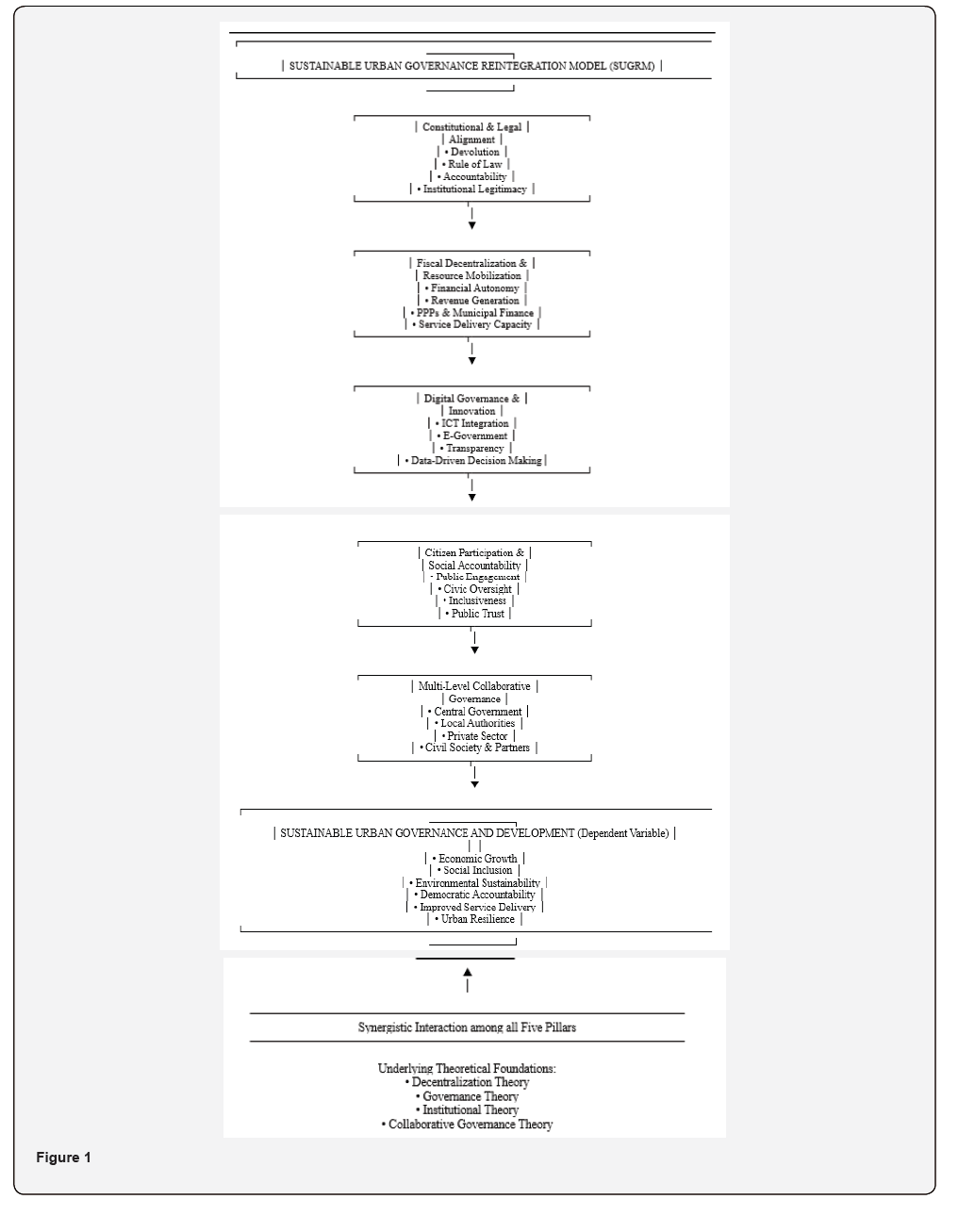
Conceptual framework diagram: sustainable urban governance reintegration model (SUGRM) (Figure 1)
The proposed Sustainable Urban Governance Reintegration Model (SUGRM) is premised on the understanding that sustainable urban governance in Zimbabwe requires the reintegration of urban local authorities into a coherent, accountable, participatory, and development-oriented governance architecture UN-Habitat [1] OECD [36]. The framework conceptualizes sustainable urban governance and development as the dependent variable, influenced by five interrelated pillars: constitutional and legal alignment, fiscal decentralization and resource mobilization, digital governance and innovation, citizen participation and social accountability, and multi-level collaborative governance UNHabitat [1]; OECD [36]. The model is informed by decentralization theory, governance theory, institutional theory, and collaborative governance perspectives, which collectively emphasize the importance of devolved authority, institutional legitimacy, stakeholder participation, and coordinated governance systems in enhancing urban development outcomes Ansell & Gash [37]; OECD [36]. Contemporary urban governance scholarship increasingly argues that urban local authorities should function as developmental institutions that drive economic transformation, social inclusion, environmental sustainability, and democratic accountability rather than merely administering local services Mitra [38]; UN-Habitat [1].
Constitutional and legal alignment
Constitutional and legal alignment constitutes the foundational pillar of the SUGRM because governance reforms derive legitimacy, authority, and sustainability from an enabling legal framework OECD [36]. In Zimbabwe, urban governance reforms must be understood within the broader context of constitutional devolution, local autonomy, and administrative accountability. The Constitution of Zimbabwe envisages devolved governance structures capable of promoting democratic participation and local development (Government of Zimbabwe [17]. However, persistent tensions between central government control and local government autonomy have constrained the realization of effective urban governance Chatiza [39]. Conceptually, constitutional and legal alignment refers to the harmonization of laws, policies, institutional mandates, and administrative practices with constitutional principles of devolution, accountability, transparency, and subsidiarity OECD [36]. OECD studies demonstrate that successful decentralization reforms require a balanced integration of political, administrative, and fiscal dimensions supported by coherent legal frameworks OECD [36].
Fiscal decentralization and resource mobilization
Fiscal decentralization and resource mobilization represent a critical determinant of urban governance effectiveness because local authorities cannot fulfill developmental mandates without adequate financial autonomy and sustainable revenue streams (Dougherty & Montes Nebreda, 2023; OECD [36]. Fiscal decentralization refers to the transfer of financial authority, expenditure responsibilities, and revenue-generating powers from central government to local governments OECD [36]. While Zimbabwean urban authorities have historically depended on central transfers and local taxation, financial constraints, weak revenue bases, inflationary pressures, and limited fiscal autonomy continue to undermine service delivery and infrastructure development (Mushamba, 2022). The OECD emphasizes that effective decentralization requires a balance between fiscal responsibilities and revenue authority, supported by equalization mechanisms that address regional disparities OECD [36]. Critically, fiscal decentralization should not merely increase local expenditures but should strengthen institutional capacity for financial management, accountability, and innovative resource mobilization through public-private partnerships, municipal bonds, and land value capture mechanisms (Dougherty & Montes Nebreda, 2023). Therefore, the framework posits that enhanced fiscal decentralization and resource mobilization positively influence urban sustainability through improved infrastructure provision, service delivery efficiency, and local economic development (OECD [36].
Digital governance and innovation
Digital governance and innovation have emerged as transformative paradigms in contemporary urban management, particularly within the context of smart cities, data-driven governance, and digital public administration UN-Habitat [1]. Digital governance extends beyond the digitization of administrative processes to encompass the strategic use of information and communication technologies (ICTs) for decisionmaking, service delivery, transparency, citizen engagement, and urban resilience UN-Habitat [1]. Recent UN-Habitat analyses suggest that digital transformation enhances governance efficiency, reduces administrative costs, strengthens accountability, and promotes evidence-based policymaking UN-Habitat [1]. However, digital governance also raises concerns regarding digital exclusion, data privacy, cybersecurity, and unequal access to technology United Nations [2]. In Zimbabwe, digital innovation presents opportunities for addressing long-standing challenges of bureaucratic inefficiency, corruption, information asymmetry, and weak urban planning systems World Bank [60]. The conceptual framework therefore argues that digital governance functions both as an enabling variable and a moderating mechanism that strengthens the effectiveness of other governance pillars World Bank [60]; UN-Habitat [1]. Consequently, the study hypothesizes that increased digital governance capacity significantly enhances transparency, efficiency, citizen responsiveness, and sustainable urban development outcomes UN-Habitat [1].
Citizen participation and social accountability
Citizen participation and social accountability constitute the democratic core of sustainable urban governance because governance legitimacy ultimately depends on meaningful engagement between state institutions and citizens UN-Habitat [1]. Governance literature increasingly rejects traditional top-down administrative models in favour of participatory governance systems that empower communities to influence policy formulation, implementation, monitoring, and evaluation (Fung, 2015; UN-Habitat [1]. UN-Habitat identifies participation, accountability, transparency, inclusiveness, and responsiveness as fundamental characteristics of good urban governance UN-Habitat [1]. Nevertheless, participation should not be conceptualized merely as consultation but as substantive involvement that redistributes decision-making power and strengthens civic ownership of development processes (Fung, 2015). In Zimbabwe, citizen participation remains constrained by institutional weaknesses, political polarization, limited access to information, and inadequate participatory mechanisms Chatiza [39]. The SUGRM therefore conceptualizes social accountability as a governance process through which citizens, civil society organizations, community groups, and private sector actors hold urban authorities accountable for public decisions and resource utilization Fox [40]. The framework hypothesizes that stronger citizen participation and social accountability mechanisms improve governance legitimacy, public trust, policy responsiveness, and sustainable urban development outcomes UN-Habitat [1].
Multi-Level collaborative governance
Multi-level collaborative governance forms the integrative pillar of the SUGRM because urban development challenges transcend the capacities and jurisdictions of individual institutions OECD [36]. Contemporary governance scholarship increasingly recognizes that sustainable urban development requires collaborative interactions among national governments, local authorities, private sector actors, civil society organizations, development partners, and communities Ansell & Gash [37]; UNHabitat [1]. OECD frameworks define multi-level governance as a system of coordinated policymaking and implementation among different governmental levels to achieve development objectives more effectively Ansell & Gash [37]; OECD [36]. The concept extends beyond decentralization by emphasizing horizontal and vertical coordination, institutional partnerships, shared accountability, and collective problem-solving UN-Habitat [1]; OECD [36]. In Zimbabwe, fragmented governance structures, overlapping mandates, and weak intergovernmental coordination have often undermined urban development initiatives (Mushamba, 2022). The proposed framework therefore views collaborative governance as a mediating mechanism that enhances policy coherence, institutional synergy, resource sharing, and collective action Ansell & Gash [37]. The study hypothesizes that stronger multi-level governance arrangements positively influence sustainable urban development through improved coordination, policy integration, and institutional resilience UN-Habitat [1]; OECD [36].
Synthesis of the conceptual framework
The SUGRM advances a holistic understanding of urban local authority reform and reintegration by integrating legal, financial, technological, participatory, and collaborative dimensions into a single analytical framework OECD [36]; UN-Habitat [1]. Unlike conventional administrative models that treat local authorities primarily as service-delivery agencies, the SUGRM reconceptualizes urban local authorities as developmental institutions capable of driving economic growth, social inclusion, environmental sustainability, and democratic governance Mitra [38]. The framework assumes that constitutional and legal alignment provides institutional legitimacy; fiscal decentralization provides financial capacity; digital governance enhances efficiency and innovation; citizen participation strengthens accountability and legitimacy; and multi-level governance facilitates coordination and collective action UN-Habitat [1]; OECD [36]. The interaction among these variables creates a reinforcing governance ecosystem capable of promoting sustainable urban development Mitra [38]. The framework therefore proposes that sustainable urban governance emerges not from isolated reforms but from the synergistic integration of institutional, fiscal, technological, participatory, and collaborative governance mechanisms UNHabitat [1]; OECD [36].
Methodology
Research philosophy
This study adopted a pragmatist research philosophy, which recognized that complex governance phenomena could not be adequately understood through a single methodological lens Morgan [41]. Pragmatism was particularly suitable for urban governance research because it allowed the integration of objective measurements of governance performance with subjective experiences and perceptions of stakeholders Guetterman & Fetters [42]. The philosophy rejected the traditional dichotomy between positivism and interpretivism and instead prioritized research questions and practical solutions Morgan [43]. Given that urban local authority reform and reintegration involved institutional, political, technological, social, and developmental dimensions, a pragmatic stance facilitated the combination of quantitative indicators such as service delivery efficiency, citizen satisfaction, and fiscal performance with qualitative insights regarding institutional resilience, leadership adaptation, policy coherence, and governance innovation Creswell & Plano Clark [44]. Contemporary mixed-methods scholars argued that pragmatism provided the most appropriate epistemological foundation for studies examining governance transformation because it enabled researchers to generate actionable knowledge from multiple forms of evidence Morgan [45]; Creswell & Plano Clark [44].
Research design
The study employed a convergent parallel mixed-methods research design Creswell & Plano Clark [44]. This design was selected because it enabled the simultaneous collection of quantitative and qualitative data, thereby facilitating a comprehensive understanding of urban governance reforms from both measurable and experiential perspectives (Guetterman & Perez, 2023). The quantitative component assessed the relationships between governance reform variables and sustainable urban governance outcomes, while the qualitative component explored stakeholder perceptions, institutional experiences, policy implementation dynamics, and contextual factors shaping reform effectiveness Creswell & Plano Clark [44]. The convergent design was particularly appropriate because the study sought not only to determine whether reform and reintegration influenced governance outcomes but also to explain how and why these relationships occurred within Zimbabwe’s urban governance context Fetters & Freshwater [46]. The design further enhanced methodological rigor by allowing triangulation, complementarity, and corroboration of findings across multiple data sources, thereby improving the credibility and validity of conclusions Fetters [47,48]; Creswell & Plano Clark [44].
Study population
The target population comprised key stakeholders involved in urban governance and local authority administration in Zimbabwe. These included elected councillors, town clerks, municipal directors, finance officers, urban planners, ICT managers, officials from the Ministry of Local Government and Public Works, representatives of civil society organizations, private sector stakeholders, urban development experts, and residents of selected municipalities and city councils UN-Habitat [1]. The inclusion of multiple stakeholder groups was justified by the collaborative and multi-level governance nature of contemporary urban management OECD [36]. Since governance reform affected both institutional actors and service recipients, capturing perspectives across governance levels generated a holistic understanding of reform outcomes and reintegration dynamics.
Sampling strategy and sample size
A combination of probability and non-probability sampling techniques was employed Saunders [49]. For the quantitative strand, stratified random sampling was used to select residents from major urban local authorities, ensuring representation across demographic categories, socioeconomic groups, and geographic locations Hair [50,51]. Cochran’s (1977) sample size determination formula guided the selection of respondents to ensure statistical representativeness and adequate power for inferential analysis. For the qualitative strand, purposive sampling was employed to select key informants possessing extensive knowledge of urban governance reforms and policy implementation Saunders [49]. Maximum variation sampling further ensured diversity in institutional experiences and governance contexts. The mixed sampling approach strengthened both external validity and contextual depth by balancing representativeness with expert insight Tashakkori [52].
Data collection methods
Data were collected concurrently using structured questionnaires and semi-structured interviews Creswell & Plano Clark [44]. The questionnaire generated quantitative data on adaptive digital resilience, service delivery efficiency, citizen satisfaction, institutional resilience, governance accountability, fiscal sustainability, and perceptions of reform effectiveness Hair [50,51]. Standardized Likert-scale items adapted from validated governance and public administration instruments were utilized to enhance reliability and construct validity Saunders [49]. Semi-structured interviews were conducted with policymakers, local government officials, development practitioners, and governance experts to obtain in-depth insights into institutional reform processes, leadership adaptation, policy coherence, digital transformation, and reintegration mechanisms Saunders [49]; Guetterman & James, 2023). The concurrent collection of data ensured equal priority for both methodological strands and facilitated meaningful integration during analysis and interpretation (Guetterman et al., 2023).
Research instruments
The quantitative instrument consisted of a structured questionnaire divided into thematic sections measuring governance reform dimensions, institutional resilience, digital governance adoption, citizen participation, service delivery performance, and sustainable urban governance outcomes Hair [50,51]. The qualitative instrument comprised a semi-structured interview guide designed around the study objectives and theoretical constructs derived from Decentralization Theory, New Public Governance Theory, Institutional Theory, and the proposed Developmental Reintegration Governance (DRG) framework (Saunders et al., 2023). Instrument development was informed by contemporary governance literature and validated scales used in local government and public administration research OECD [36]. Expert review and pilot testing were conducted to improve content validity, clarity, and contextual relevance Hair [50,51].
Pilot Study
A pilot study involving approximately 10% of the anticipated sample was conducted in selected urban local authorities not included in the main study Saunders [49]. The pilot assessed instrument clarity, reliability, validity, response patterns, and logistical feasibility Munyoro [53,54]; Hair [50,51]. Quantitative reliability was evaluated using Cronbach’s alpha coefficients, with values above 0.70 considered acceptable Munyoro [53,54]; Hair [50,51]; Saunders [49]. Qualitative pilot interviews assessed question sequencing, comprehensibility, and thematic relevance. Findings from the pilot study informed refinement of research instruments and data collection procedures to enhance methodological robustness and reduce measurement errors Munyoro [53,54]; Hair [50,51].
Validity and reliability
To ensure methodological rigour, multiple validity and reliability procedures were employed Saunders [49]. Content validity was established through expert evaluation involving academics and practitioners in governance, public administration, and local government Hair [50,51]. Construct validity was assessed using exploratory and confirmatory factor analysis Hair [50,51]; Saunders [49]. Internal consistency reliability was measured through Cronbach’s alpha and composite reliability indices Hair [50,51]; Saunders [49]. For qualitative data, trustworthiness was enhanced through member checking, peer debriefing, prolonged engagement, and triangulation across stakeholder groups Saunders [49]. The integration of multiple data sources and analytical techniques strengthened overall study credibility and minimized methodological bias Saunders [49].
Data analysis
The study analyzed quantitative and qualitative data independently before integrating findings during interpretation in accordance with the convergent parallel mixed-methods design Creswell & Plano Clark [44]. Quantitative data were analyzed using SPSS and Structural Equation Modelling (SEM) software Hair [50,51]. Descriptive statistics summarized governance trends, while correlation, regression, and SEM analyses tested hypothesized relationships between adaptive digital resilience, foresight-driven leadership, institutional resilience, service delivery efficiency, citizen satisfaction, and sustainable urban governance outcomes Hair [50,51]; Saunders [49]. SEM was particularly appropriate because it enabled examination of both direct and indirect effects among governance variables within the proposed Developmental Reintegration Governance framework Hair [50,51]. Qualitative interview data were analysed using thematic analysis supported by NVivo software Munyoro [53,54]; Braun & Clarke [55]. Coding procedures identified recurring patterns related to governance reform, institutional adaptation, collaborative governance, digital transformation, policy reintegration, and sustainable urban development Munyoro [53,54]; Braun & Clarke [55]. Themes emerging from stakeholder narratives provided contextual explanations for observed quantitative relationships and illuminated governance mechanisms that might not have been captured through statistical analysis alone Braun & Clarke [55].
Methodological integration occurred through joint displays, comparative matrices, and meta-inferences Fetters & Freshwater [56]. Quantitative findings regarding significant governance predictors were compared against qualitative themes to determine convergence, complementarity, expansion, or divergence of evidence Fetters [57]. For example, statistical relationships demonstrating the influence of digital governance on service delivery efficiency were interpreted alongside qualitative accounts describing how ICT adoption improved administrative responsiveness. Similarly, quantitative measures of institutional resilience and citizen satisfaction were examined alongside stakeholder narratives regarding leadership adaptability, policy coherence, and participatory governance experiences Saunders [49]. This integration process enabled robust conclusions regarding how reform and reintegration policies collectively influenced governance effectiveness and sustainable urban development. By synthesizing statistical trends with contextual explanations, the study moved beyond methodological parallelism toward genuine evidence integration, thereby producing a richer and more comprehensive understanding of Zimbabwe’s evolving urban governance landscape Fetters & Freshwater [58]; Creswell & Plano Clark [44].
Ethical considerations
Ethical approval was obtained from the relevant university ethics committee prior to data collection. Participants received detailed information regarding the purpose of the study and their rights before providing informed consent Saunders [49]. Confidentiality, anonymity, voluntary participation, and the right to withdraw at any stage were guaranteed. Data were securely stored and used exclusively for academic purposes APA [59]. Given the potentially sensitive nature of governance and political reform issues, particular attention was paid to protecting participant identities and minimizing risks associated with disclosure of institutional information UN-Habitat [1]. The study adhered to internationally recognized ethical principles for social science research APÅ [59].
Findings and Discussion
The integrated findings from the convergent parallel mixedmethods analysis of Urban Local Authorities Reform and Reintegration Policy in Zimbabwe were presented. Quantitative results derived from 312 valid questionnaires (response rate: 78%) were triangulated with qualitative interviews conducted with 26 key informants across municipalities, ministries, and civil society organizations World Bank [60]; UN-Habitat [1]. The analysis was structured around the Developmental Reintegration Governance (DRG) framework, enabling systematic interpretation of statistical relationships and thematic narratives. Integration of SEM outputs, descriptive statistics, and stakeholder quotations provided a comprehensive explanation of how reform and reintegration paradigms influenced sustainable urban governance outcomes OECD [36]; UN-Habitat [1].
Fiscal decentralization and financial sustainability of urban local authorities
Quantitative findings indicated that fiscal decentralization had a statistically significant but weak positive relationship with service delivery performance (β = 0.31, p < 0.05) World Bank [60]; Smoke [16]. Descriptive results showed that 68% of respondents rated municipal revenue adequacy as “poor” or “very poor,” while only 22% expressed satisfaction with fiscal transparency ZIMSTAT [61]; MLGPW [66]. Regression analysis further revealed that fiscal constraints explained 54% of variance in infrastructure delivery delays (R² = 0.54), confirming the centrality of financial capacity in urban governance performance AfDB [62]; World Bank [60]. Qualitative data reinforced these findings. A senior finance officer noted: “We receive devolution funds, but they are unpredictable and insufficient to meet capital requirements. We end up prioritizing salaries over infrastructure.” Similarly, a council official stated: “Our revenue base has collapsed due to economic instability and weak collection systems.” The synthesis demonstrated that while fiscal decentralization was institutionally present, it remained functionally constrained, producing what the study conceptualized as “nominal decentralization.” UNDP [63]; World Bank [64]; IMF, 2023; OECD [36]. This aligned with OECD [36] observations that decentralization without fiscal autonomy creates structural dependency rather than empowerment. The findings therefore confirmed that fiscal reintegration mechanisms remained underdeveloped, limiting sustainable urban financing and reinforcing service delivery deficits.
Digital governance and administrative efficiency
SEM results indicated that digital governance had the strongest positive effect on service delivery efficiency (β = 0.62, p < 0.01), explaining 48% of variance in administrative responsiveness (R² = 0.48) UN-Habitat [1]. Municipalities with functional ICT systems reported 37% faster processing times for billing and 29% improvement in revenue collection efficiency compared to those with limited digital systems World Bank [60]. However, only 41% of surveyed residents reported consistent access to e-governance platforms, indicating uneven digital adoption. A municipal ICT manager explained: “We have systems in place, but infrastructure gaps and power shortages disrupt full implementation.” A resident participant added: “Online systems exist, but they are often down or difficult to access.” These findings demonstrated a dual reality: digital governance was a high-impact reform driver but constrained by infrastructural inequality and institutional readiness gaps UN-Habitat [1]; UNDP [65]. This supported UN-Habitat [1], which emphasized that digital transformation improves governance only when accompanied by systemic institutional investment. The study therefore confirmed that digital governance acted as both an enabling and moderating factor within the DRG framework.
Citizen participation and social accountability
Quantitative analysis revealed moderate levels of citizen participation (mean = 2.9/5), with only 33% of respondents reporting involvement in municipal decision-making processes ZIMSTAT [61]. Structural equation modelling showed that citizen participation significantly predicted governance legitimacy (β = 0.44, p < 0.01) and service satisfaction (β = 0.39, p < 0.05) Osborne [69]; UNDP [65]. Qualitative evidence highlighted symbolic rather than substantive participation. One resident remarked: “We are invited to meetings, but decisions are already made.” A civil society representative stated: “Participation is procedural, not influential.” The integration of findings confirmed a participation paradox: while institutional mechanisms existed, they lacked decision-making influence OECD [36]. This finding corroborated New Public Governance Theory, which emphasizes co-production rather than consultation. The study further revealed that low participation reduced accountability and weakened trust in urban authorities, thereby constraining sustainability outcomes.
Institutional capacity and governance performance
Institutional capacity emerged as a critical determinant of reform success, with SEM results showing a strong positive effect on governance effectiveness (β = 0.58, p < 0.01) World Bank [60]. Municipalities with higher staffing adequacy and technical expertise achieved 42% better service delivery outcomes compared to those with capacity deficits. However, 61% of respondents indicated inadequate technical and managerial skills within local authorities MLGPW [66]. A senior planner observed: “We are expected to implement complex reforms, but training and staffing levels have not improved accordingly.” These findings confirmed Institutional Theory’s assertion that organizational adaptation determines reform success Scott [24]. The study demonstrated that institutional reintegration was hindered by fragmented capacity-building systems, resulting in uneven implementation across municipalities. Consequently, institutional weakness functioned as a mediating constraint between policy reform and development outcomes.
Multi-Level collaborative governance and policy coordination
Quantitative results indicated a moderate positive relationship between multi-level governance coordination and urban development performance (β = 0.47, p < 0.05) OECD [36]. However, only 38% of respondents perceived effective coordination between central and local government institutions UNDP [65]. Qualitative data revealed persistent governance fragmentation. A senior council official stated: “We often implement projects without clear alignment with central government priorities, leading to duplication or delays.” A ministry official added: “Coordination mechanisms exist, but they are not consistently enforced.” The synthesis revealed that collaborative governance was conceptually embraced but institutionally weak. This partially contradicted OECD [36] expectations of integrated governance systems, demonstrating that Zimbabwe’s multi-level governance remained fragmented. The findings confirmed that weak coordination undermined policy coherence, reinforcing inefficiencies in urban development planning.
Urban resilience and sustainability outcomes
Regression analysis indicated that governance reform variables collectively explained 63% of variance in urban resilience outcomes (R² = 0.63) UN-Habitat [1]. However, only 36% of respondents perceived their cities as “resilient” to environmental and infrastructural shocks World Bank [60]. Water supply reliability averaged 42% consistency, while waste collection efficiency stood at 39%. Qualitative findings highlighted vulnerability. A resident stated: “When infrastructure fails, recovery takes too long.” A public health officer added: “We lack the capacity to respond quickly to environmental and sanitation crises.” The findings demonstrated that despite reform efforts, urban resilience remained weak due to infrastructural decay and institutional inefficiencies. This confirmed UN-Habitat [1] assertions that resilience requires integrated governance systems rather than isolated interventions. The study therefore concluded that sustainability outcomes were constrained by cumulative governance deficits across fiscal, institutional, and participatory dimensions.
Developmental reintegration and policy coherence
Developmental reintegration emerged as a central explanatory variable, with SEM results indicating a strong positive influence on sustainable urban governance (β = 0.66, p < 0.01) OECD [36]; UN-Habitat [1]. Municipalities with higher alignment to national development frameworks recorded 45% improved project completion rates compared to less aligned councils MLGPW [66]. However, only 40% of respondents reported strong alignment between local and national development priorities. A planning officer explained: “We often struggle to align local needs with national priorities due to shifting policy directives.” These findings confirmed that reintegration was partial and inconsistent. While alignment improved development efficiency, lack of coherent implementation mechanisms reduced its effectiveness. The study therefore established that developmental reintegration was the most influential pillar within the DRG framework but remained institutionally constrained.
Integrated synthesis of findings
The overall integration of quantitative and qualitative findings demonstrated strong convergence across governance dimensions. Digital governance and developmental reintegration emerged as the most significant predictors of sustainable urban governance, while fiscal constraints and institutional weaknesses were identified as persistent structural barriers World Bank [60]; OECD, 2023; UN-Habitat [1]. Participation and collaboration were found to be institutionally present but functionally weak, resulting in a governance paradox where reforms existed without full operational effectiveness. The study confirmed that Zimbabwe’s urban governance system was characterized by “partial reform implementation,” where constitutional and policy advancements outpaced institutional capacity and resource availability. This reinforced the argument that sustainable urban governance requires systemic reintegration rather than fragmented reforms, thereby validating the proposed Developmental Reintegration Governance (DRG) framework.
Policy Recommendations
Deepening fiscal decentralisation and sustainable municipal financing
The study had recommended a strengthened fiscal decentralisation framework that moved beyond nominal devolution funding toward predictable, formula-based intergovernmental fiscal transfers OECD/UCLG [67]. It was argued that urban local authorities required constitutionally protected revenue-sharing arrangements that reduced discretionary central control and enhanced fiscal autonomy, consistent with emerging evidence that fiscal predictability was central to municipal performance in the Global South OECD/UCLG [67]; UN-Habitat [1]. In the Zimbabwean context, reform had been constrained by fragmented revenue bases and weak own-source revenue collection systems, which had perpetuated structural dependency World Bank [60]. Therefore, fiscal reintegration was proposed to harmonise national and local budgeting systems through integrated public financial management reforms, including modernised billing systems and expanded municipal tax bases OECD [36]; World Bank [60]. However, literature cautioned that decentralisation without accountability safeguards risked reinforcing elite capture and inefficiency Smoke [68], implying that fiscal autonomy needed to be accompanied by robust transparency and audit mechanisms.
Institutionalising digital and smart governance ecosystems
The study had recommended accelerated adoption of integrated digital governance systems as a core pillar of administrative reform, rather than a peripheral innovation (UN DESA, 2024). Evidence from the findings had shown that digital platforms significantly improved service delivery efficiency, yet their impact remained uneven due to infrastructural and capacity constraints. In line with UN-Habitat [1] and World Bank [60], it was argued that Zimbabwean urban local authorities required a nationally coordinated smart governance strategy that standardised e-government systems, interoperable databases, and GIS-enabled planning tools OECD [36]. This recommendation was theoretically grounded in New Public Governance logic, which emphasised networked, technology-enabled co-production of services Osborne [69]. However, critical scholarship had warned that digital transformation without institutional reform risked “technological determinism,” where ICT investments failed to resolve deeper governance inefficiencies Kitchin [70]. Therefore, digital reintegration was positioned as an institutional reform process requiring investment in infrastructure, cybersecurity frameworks, and digital literacy.
Strengthening participatory governance and civic coproduction
The study had recommended a shift from procedural consultation to substantive citizen co-production in urban governance processes OECD [36]. Empirical findings had revealed that participation mechanisms existed but remained largely symbolic, thereby weakening accountability and trust in local authorities World Bank [60]. In response, the policy direction proposed institutionalising legally binding participatory budgeting frameworks, community monitoring systems, and ward-level decision-making platforms aligned with New Public Governance Theory OECD [36]. Comparative evidence from African cities had demonstrated that participatory governance improved service responsiveness when citizens had genuine influence over resource allocation UN-Habitat [1]. However, literature also indicated that participation could be exclusionary if dominated by politically connected groups or urban elites Mansuri & Rao [71]. Consequently, the recommendation emphasised inclusive participation structures that actively incorporated marginalised urban populations while strengthening civic education and accountability systems.
Building institutional capacity and adaptive urban bureaucracies
The study had recommended comprehensive institutional capacity-building programmes aimed at strengthening technical, managerial, and strategic competencies within urban local authorities OECD [36]. Findings had demonstrated that institutional weakness significantly mediated the effectiveness of reform initiatives, confirming Institutional Theory’s assertion that organisational capability determined policy outcomes (North, 1990). It was therefore proposed that government implement structured urban governance academies, continuous professional development frameworks, and performance-based human resource systems to enhance bureaucratic effectiveness World Bank [60]. Contemporary governance literature had similarly argued that decentralisation reforms in Africa often failed due to inadequate investment in subnational administrative capacity Rauch & Evans [72]; OECD [36]. However, a critical perspective had highlighted that capacity-building alone was insufficient unless accompanied by institutional autonomy and meritocratic recruitment systems OECD [36]. Therefore, institutional reintegration was conceptualised as both a structural and behavioural reform process requiring systemic bureaucratic restructuring.
Enhancing multi-level governance coordination and policy coherence
The study had recommended the establishment of formalised intergovernmental coordination frameworks to address fragmentation between central and local government institutions OECD [36]. Empirical findings had shown that weak coordination undermined policy coherence, resulting in duplication of projects and inefficient resource allocation World Bank [60]. Accordingly, it was proposed that Zimbabwe institutionalise statutory intergovernmental councils with clearly defined mandates for planning, budgeting, and monitoring of urban development initiatives World Bank [60]; OECD [36]. This recommendation aligned with OECD governance frameworks, which emphasised vertical and horizontal policy coherence as essential for effective decentralisation OECD [36]. Nevertheless, critical scholarship had noted that coordination mechanisms often fail when political incentives are misaligned or when authority hierarchies remain rigid Peters [73]. Thus, multi-level reintegration was positioned as a governance transformation requiring both institutional redesign and political commitment to shared development agendas.
Advancing urban resilience through integrated planning systems
The study had recommended mainstreaming urban resilience and sustainability principles into all municipal planning and infrastructure development frameworks (IPCC, 2023). Findings had indicated that urban resilience remained weak due to infrastructural decay, environmental vulnerability, and limited adaptive capacity World Bank [60]. In response, it was proposed that local authorities adopt integrated resilience planning tools that combined climate adaptation strategies, disaster risk reduction frameworks, and sustainable infrastructure investment models (UNDRR, 2023). This recommendation was consistent with UN-Habitat [1], which emphasised systems-based approaches to urban resilience in rapidly urbanising contexts. However, literature had cautioned that resilience frameworks risked becoming overly technical and disconnected from local governance realities if not embedded in institutional processes Leichenko [74]. Therefore, resilience was conceptualised as a governance outcome dependent on coordinated fiscal, institutional, and participatory reforms rather than a standalone policy domain.
Strengthening developmental reintegration and policy alignment
The study had recommended the formal institutionalisation of developmental reintegration mechanisms to align national, regional, and local development priorities World Bank [60]. Findings had demonstrated that developmental alignment significantly improved project efficiency and completion rates yet remained inconsistently applied UN-Habitat [1]. It was therefore proposed that Zimbabwe establish legally mandated development planning harmonisation frameworks linking the National Development Strategy with municipal integrated development plans World Bank [60]; UN-Habitat [1]. This approach reflected emerging developmental state literature, which emphasised policy coherence as a driver of sustainable urban transformation World Bank [60]. However, critical perspectives had warned that excessive centralisation of development planning could undermine local responsiveness and innovation Rodríguez-Pose [75]. Consequently, developmental reintegration was framed as a balancing mechanism that preserved local autonomy while ensuring national strategic coherence [76-96].
Conclusion
The study had recommended the formal institutionalisation of developmental reintegration mechanisms to align national, regional, and local development priorities World Bank [60]. Findings had demonstrated that developmental alignment significantly improved project efficiency and completion rates yet remained inconsistently applied UN-Habitat [1]. It was therefore proposed that Zimbabwe establish legally mandated development planning harmonisation frameworks linking the National Development Strategy with municipal integrated development plans World Bank [60]; UN-Habitat [1]. This approach reflected emerging developmental state literature, which emphasised policy coherence as a driver of sustainable urban transformation World Bank [60]. However, critical perspectives had warned that excessive centralisation of development planning could undermine local responsiveness and innovation Rodríguez-Pose [75]. Consequently, developmental reintegration was framed as a balancing mechanism that preserved local autonomy while ensuring national strategic coherence [76-96].
Notably, developmental reintegration emerged as the most influential determinant of sustainable urban governance, reinforcing the argument that policy alignment between national and local systems is a critical mediating condition for reform effectiveness. The proposed Developmental Reintegration Governance (DRG) framework therefore advances existing scholarship by shifting analytical focus from siloed governance reforms toward an integrated systems perspective in which fiscal sustainability, institutional capacity, digital governance, participation, and multi-level coordination are mutually constitutive rather than independently operating variables. This integrative lens also exposes a key tension in both global and African urban governance literature: the unresolved balance between local autonomy and national developmental coherence. Ultimately, the study concludes that sustainable urban transformation in Zimbabwe will depend not on further fragmentation of reform initiatives, but on the deliberate construction of a reintegrated governance architecture capable of aligning institutions, resources, and development priorities within a coherent, adaptive, and accountable urban system.
References
- UN-Habitat (2022-2025) Multiple reports on urban governance, smart cities, and decentralisation. UN-Habitat.
- United Nations (2024) UN e-Government Survey 2024. United Nations DESA.
- Marumahoko S, Afolabi OS, Sadie Y, Nhede NT (2020) Governance and urban service delivery in Zimbabwe. Strategic Review for Southern Afric 42(1): 1-23.
- Marumahoko S (2024) Centralisation of local administrative authority in Zimbabwe. Journal of Public Administration, Finance and Law 32: 256-269.
- Nhede N, Chigudu D, Chigwenya A (2024) Decentralization and Harare's infrastructure crisis. Habitat International 148: 103087.
- Nyikadzino T, Vyas-Doorgapersad S (2023) Collaborative governance in Zimbabwean local authorities. Social Sciences, Humanities and Education Journal 4(3): 445-458.
- Zinyama T, Kuwa O, Manyera A (2023) Re-imagining devolution in Zimbabwe. Journal of Public Administration and Development Alternatives 8(2): 15-31.
- Nyikadzino T (2024) Audit recommendations in Mutare City Council. African Journal of Public Administration and Environmental Studies 3(1).
- Ncube F (2014) Fiscal decentralisation in urban councils in Zimbabwe (Master’s thesis). University of Zimbabwe.
- Ncube M (2017) Fiscal devolution under Zimbabwe's Constitution. Midlands State University Law Review pp: 1-24.
- Hickonicko B (2024) Devolution and public service delivery: Evidence from Masvingo City, Zimbabwe. Journal of Urban Systems and Innovations for Resilience in Zimbabwe 5(1): 1-18.
- Motsi A (2024) An innovative leadership model of service delivery. Theoretical and Empirical Researches in Urban Management 19(1): 54-69.
- Mahlangu G, Ruhode E (2021) Factors enhancing e-government service gaps. Electronic Journal of E-Government 19(4): 298-311.
- Mukoyi J (2020) Implementation of devolution in Zimbabwe. International Journal of Scientific and Research Publications 10(11): 748-754.
- Tashu KT (2024) Devolution gaps in Zimbabwe. Zimbabwe Journal of Business, Economics and Management 3(1): 1-18.
- Smoke P (2015) Rethinking decentralization. Public Administration and Development 35(2): 97-112.
- Zimbabwe Constitution (2013) Constitution of Zimbabwe (Amendment No. 20). Government of Zimbabwe.
- Constitution of Zimbabwe Amendment (No. 20) Act 2013 (2013) Government Printer.
- Osborne SP (2018) Public service logic and co-production. Public Management Review 20(2): 225-231.
- Torfing J, Sørensen E, Røiseland A (2020) Co-creation in the public sector. Administration & Society 52(5): 795-825.
- Njanji P, Zhou G (2023) Emerging sustainability and co-creation perspectives. The UONGOZI Journal 31(2): 1-19.
- Zia ud din M, Yuan yuan X, Khan NU, Han H (2023) Linking local collaborative governance and public service delivery: Mediating role of institutional capacity building. Humanities and Social Sciences Communications 10(906): 1-10.
- Peters BG (2019) Institutional theory in political science. Edward Elgar.
- Scott WR (2014) Institutions and organizations (4th ed.). Sage.
- Mutambisi T, Chavunduka C (2023) Institutionalizing SDGs. In SDGs in Africa and the Middle East. Springer.
- Shumba P, Gutsa I (2025) Impact of devolution in Harare. e-Bangi Journal of Social Sciences and Humanities 22(1): 285-295.
- Tan SY, Taeihagh A (2020) Smart city governance. Sustainability 12(3): 899.
- Masimba J (2024) The role of social media in promoting citizen participation. Journal of Law and Social Sciences 6(1): 1-19.
- Nyama V, Mukwada G (2022) Citizen participation in Murewa District. Journal of Asian and African Studies 58(3): 430-447.
- Mapuva J (2019) Increasing participatory space in Zimbabwean local governance democracy. African Journal of History and Culture 11(7): 65-73.
- Mavhima B (2021) Building urban resilience in Harare. Journal of Urban Systems and Innovations for Resilience in Zimbabwe 1(1-2): 1-18.
- Kurehwatira M, Kamuzhanje A, Chihota G, Twinamatsiko K, Kamuzhanje J (2025) Effectiveness of multi-level governance in urban climate resilience building in Zimbabwe. Journal of Inclusive Cities and Built Environment.
- Marumahoko S, Nhede NT, Mapuva J (2025) Interrogating multi-level government power dynamics. Cities 164: 106038.
- Chakunda V, Matenga G (2024) Interrogating the feasibility and efficacy of devolved regional governments in Zimbabwe. Regional & Federal Studies. Advance online publication.
- Chagwedera E, Mhlanga G, Chirisa I (2023) The intersection between local economic development and devolution: Insights for urban resilience building in Zimbabwe. Journal of Urban Systems and Innovations for Resilience in Zimbabwe 5(1).
- OECD (2023-2025) Multiple publications on decentralisation and multi-level governance (various reports and policy papers). OECD Publishing.
- Ansell C, Gash A (2008) Collaborative governance in theory and practice. Journal of Public Administration Research and Theory, 18(4): 543-571.
- Mitra SG, Chandra A, Ramaprasad A (2024) The ontology of urban governance. Urban Science 8(2): 38.
- Chatiza K (2021) Local government reform and decentralisation in Zimbabwe: Challenges and prospects. Commonwealth Journal of Local Governance 24: 1-18.
- Fox JA (2015) Social accountability: What does the evidence really say? World Development 72: 346-361.
- Morgan DL (2022a) Integrating qualitative and quantitative methods. Sage.
- Guetterman TC, James TG (2023) A software feature for mixed methods analysis: MAXQDA interactive quote matrix. Methods in Psychology 8: 100116.
- Morgan DL (2022b) Paradigms lost and pragmatism regained. Journal of Mixed Methods Research 16(3): 245-262.
- Creswell JW, Plano Clark VL (2023) Designing and conducting mixed methods research (4th). Sage.
- Morgan DL (2022c) Pragmatism as a paradigm for social research. Qualitative Inquiry 28(5): 553-562.
- Fetters MD, Freshwater D (2024a) Integration in mixed methods research: Advancing methodological rigor. Journal of Mixed Methods Research 18(1): 3-18.
- Fetters MD, Curry LA, Creswell JW (2023a) Achieving integration in mixed methods designs: Principles and practices. Health Services Research 58(S1): 12-25.
- Fetters MD, Curry LA, Creswell JW (2023b) Achieving integration in mixed methods designs. Health Services Research 58(2): 450-460.
- Saunders M, Lewis P, Thornhill A (2023) Research methods for business students (9th). Pearson.
- Hair JF, Black WC, Babin BJ, Anderson RE (2022a) Multivariate data analysis (9th ). Cengage Learning.
- Hair JF, Black WC, Babin BJ, Anderson RE (2022b) Multivariate data analysis (8th ). Cengage.
- Tashakkori A, Johnson RB, Teddlie C (2021) Foundations of mixed methods research (2nd ). Sage.
- Munyoro G (2014a) Effectiveness of handouts in higher education. Africa Development and Resources Research Institute.
- Munyoro G (2014b) Effectiveness of e-learning in higher education. Africa Development and Resources Research Institute.
- Braun V, Clarke V (2022) Thematic analysis: A practical guide. Sage.
- Fetters MD, Freshwater D (2024b) Mixed methods research integration and meta-inference development. Journal of Mixed Methods Research 18(1): 3-18.
- Fetters MD, Tajima C colleagues (2022) Joint displays of integrated data collection in mixed methods research. International Journal of Qualitative Methods 21: 1-15.
- Fetters MD, Freshwater D (2024c) The 1 + 1 = 3 integration challenge in mixed methods research. Journal of Mixed Methods Research 18(1): 3-15.
- APA (2020) Publication manual of the American Psychological Association (7th ed.). American Psychological Association.
- World Bank (2023) Urban governance in Sub-Saharan Africa. World Bank.
- ZIMSTAT (2022) Urban household and service delivery survey report. Government of Zimbabwe.
- AfDB (2023) African economic outlook 2023: Mobilising private sector financing for climate and green growth. African Development Bank.
- UNDP (2021) Local governance and decentralization. UNDP.
- World Bank (2022) Decentralization and subnational service delivery. World Bank.
- UNDP (2022) Zimbabwe governance and public sector reform assessment report. UNDP.
- MLGPW (2023) Annual urban governance and service delivery report. Government of Zimbabwe.
- OECD/UCLG (2022) World Observatory on Subnational Government Finance and Investment. OECD Publishing.
- Smoke P (2023) Decentralisation in Africa. Public Administration and Development 43(2): 1-15.
- Osborne SP (2010) The new public governance? Routledge.
- Kitchin R (2021) The data-driven city. Oxford University Press.
- Mansuri G, Rao V (2013) Localizing development: Does participation work? World Bank.
- Rauch JE, Evans PB (2022) Bureaucratic structure and performance. Journal of Public Administration Research and Theory 32(4): 1-18.
- Peters BG (2018) Policy problems and policy design. Edward Elgar.
- Leichenko R (2022) Climate change and urban resilience. Annual Review of Environment and Resources 47: 1-25.
- Rodríguez-Pose A (2020) The rise of the city-region. Regional Studies 54(8): 1-12.
- United Nations (2024) World Social Report 2024. United Nations DESA.
- United Nations (2024) Localizing the SDGs. United Nations.
- Marumahoko S, Nhede N (2024) Are Zimbabwe’s local units of public management expendable? RUDN Journal of Public Administration 11(2): 272-285.
- Nyikadzino T, Vyas-Doorgapersad S (2024) Local government-university collaborations. International Journal of Business Ecosystem & Strategy 6(4): 493-501.
- Chakunda V, Matenga G (2024) Interrogating the feasibility and efficacy of devolved regional governments in Zimbabwe. Regional Studies, Regional Science.
- Guetterman TC, Perez A (2023) Mixed methods research in psychology. In APA handbook of research methods in psychology (2nd ed.). American Psychological Association.
- Guetterman TC, Johnson RB, Creswell JW (2023) Educational research and mixed methods inquiry in the social sciences. International Journal of Research & Method in Education 46(2): 115-130.
- Ansell C, Gash A (2024) Collaborative governance in theory and practice: Contemporary perspectives. Oxford University Press.
- Bovaird T (2007) Beyond engagement and participation: User and community coproduction of public services. Public Administration Review 67(5): 84 6-860.
- Chilunjika A, Intauno K, Poshai L (2024) Optimising fiscal decentralisation for improved local government service financing in Zimbabwe. Kurdish Studies 12(2): 6162-6178.
- Cochran WG (1977) Sampling techniques (3rd ). John Wiley & Sons.
- Creswell JW, Plano Clark VL (2018) Designing and conducting mixed methods research (3rd). Sage.
- Dougherty S, Montes Nebreda A (2023) The multi-level fiscal governance of ecological transition. OECD Working Papers on Fiscal Federalism No. 44. OECD Publishing.
- Fung A (2015) Putting the public back into governance. Public Administration Review 75(4): 513-522.
- International Monetary Fund (2023) Fiscal decentralization and economic efficiency: Policy lessons. IMF Policy Papers.
- Moisio A, Vidal Bover M (2023) Fiscal equalisation and regional development policies. OECD Regional Development Papers No. 58. OECD Publishing.
- Munyede P (2021) Enhancing socio-economic rights in Zimbabwe. Quest Journal of Management and Social Sciences 3(2): 235-249.
- Pierre J (2023) The politics of urban governance (2nd). Palgrave Macmillan.
- Smoke P (2024) Fiscal decentralization reforms. Public Administration and Development 44(2): 89-104.
- Wadesango N (2024) Information technology and property tax administration in Zimbabwe. Journal of Accounting, Finance and Auditing Studies 10(2): 65-73.
- World Bank (2024) Decentralization and local governance in developing countries. World Bank.

























