




 ACJPP Home



Abstract
Rural local authorities in Zimbabwe increasingly operate within contexts characterised by climate volatility, fiscal instability, infrastructural decline, and institutional fragility, exposing the limitations of reactive governance models centred on short-term crisis response. Despite decentralisation reforms, many Rural District Councils remain bureaucratically constrained and insufficiently equipped to anticipate emerging developmental risks. This study critically examines the transition from reactive governance to proactive leadership through strategic foresight and innovation in Mudzi Rural Council, Zimbabwe. Grounded in Anticipatory Governance Theory and Innovation Diffusion Theory, the study conceptualises proactive governance as the institutional integration of foresight, adaptive leadership, innovation, and collaborative learning within rural local governance systems. A convergent parallel mixed-methods design was adopted, combining questionnaires, semi-structured interviews, focus group discussions, and institutional document analysis. Quantitative data were analysed using descriptive and inferential statistics, while qualitative data were subjected to thematic analysis. The findings reveal that governance within Mudzi Rural Council remains predominantly reactive due to weak foresight institutionalisation, limited innovation diffusion, fragmented policy coordination, fiscal constraints, and entrenched bureaucratic cultures. However, emerging practices in participatory planning, climate adaptation, and digital governance demonstrate latent potential for anticipatory and resilience-oriented governance transformation. The study further reveals that transformational leadership significantly influences institutional adaptability and innovation uptake. By integrating foresight, innovation, and governance resilience within a single analytical framework, the study contributes to rural local governance scholarship beyond conventional service delivery narratives. It concludes that proactive rural governance requires systemic institutional restructuring, organisational learning, leadership transformation, and sustained investment in anticipatory governance capacities within resource-constrained rural authorities.
Keywords:Strategic foresight; Proactive leadership; Reactive governance; rural local authorities; Governance innovation; Anticipatory governance; Mudzi Rural Council; Zimbabwe; Institutional resilience; Adaptive governance
Abbreviations:VUCA: volatility, uncertainty, complexity and ambiguity; RDCs: Rural District Councils; UNDP: United Nations Development Programme; IPCC: Intergovernmental Panel on Climate Change; FGD: Focus group discussions
Introduction
The accelerating complexity of socio-economic, climatic, and governance challenges confronting rural local authorities in Zimbabwe has exposed the limitations of reactive governance approaches that largely depend on crisis response rather than anticipatory planning UNDP [1-3]; World Bank [4-6]. Rural district councils are increasingly expected to manage multidimensional pressures including climate variability, infrastructural decay, food insecurity, youth unemployment, digital exclusion, and declining fiscal capacities, yet many remain institutionally constrained and strategically unprepared AfDB [7]; Chigudu [8]. In Zimbabwe, these governance deficiencies are particularly pronounced in marginalized rural districts such as Mudzi Rural Council, where persistent droughts, weak institutional coordination, and limited innovation ecosystems continue to undermine sustainable local development Moyo & Ncube [9]. Contemporary scholarship argues that effective local governance in the twenty-first century requires adaptive, collaborative, and future-oriented leadership capable of anticipating disruptions and leveraging innovation for resilience and inclusive development OECD [10]; UNDESA [11]. Although decentralisation and devolution reforms have been promoted as mechanisms for strengthening subnational governance in Zimbabwe, evidence suggests that many rural local authorities continue to operate within bureaucratic, shortterm, and compliance-driven administrative cultures that inhibit strategic foresight and transformative leadership Chatiza [12]; ZLGB [13].
Globally, the governance discourse has progressively shifted from traditional public administration toward anticipatory governance models grounded in strategic foresight, innovation, co-creation, and resilience thinking OECD [10]; WEF [14]. Strategic foresight has emerged as a critical governance capability that enables institutions to systematically explore future uncertainties, identify emerging risks and opportunities, and formulate proactive interventions before crises escalate Conway [15]; UNESCO [16]. Recent studies emphasise that governments that institutionalise foresight mechanisms are better positioned to manage uncertainty, technological disruption, and socioeconomic transitions European Commission [17]; OECD [18]. In developing contexts, however, the operationalisation of foresightdriven governance remains uneven and highly contested. While some scholars argue that innovation-oriented governance improves institutional agility and public service delivery, others contend that structural constraints such as political centralisation, resource scarcity, weak technical capacity, and fragmented policy systems continue to impede transformative local governance in Africa Awortwi [19]; Resnick [20]. These contradictions reveal an unresolved tension between the normative appeal of proactive governance and the practical realities confronting rural local authorities, particularly in fragile and resource-constrained environments such as Zimbabwe Mlambo, Mubecua, & Mpanza [21,22].
Existing literature on Zimbabwean local governance has predominantly concentrated on urban municipalities, decentralisation politics, service delivery failures, participatory governance, and disaster resilience, with comparatively limited attention devoted to how rural local authorities can strategically transition from reactive administration toward proactive and innovation-driven leadership Chatiza [12]; Jonga & Chirisa [23,24]. Furthermore, most studies treat strategic foresight, innovation, resilience, and governance reform as separate analytical domains, thereby neglecting the interconnections between anticipatory leadership, institutional innovation, and rural development outcomes Conway [15]; OECD [18]. Another critical gap lies in the overreliance on macro-level or urban-centric analyses, which often obscure the contextual realities, governance cultures, and institutional dynamics of peripheral rural councils such as Mudzi Rural Council Moyo & Ncube [9]. Consequently, there remains insufficient empirical understanding of how rural local authorities in Zimbabwe conceptualise future risks, institutionalise foresight practices, mobilise innovation, and build adaptive governance systems capable of responding proactively to emerging developmental challenges. This gap is particularly significant given the increasing exposure of rural communities to climate shocks, demographic transitions, and economic vulnerabilities that demand anticipatory and transformative governance responses IPCC [25]; UNDP [1-3].
This study therefore seeks to critically examine the transition from reactive governance to proactive leadership through the lens of strategic foresight and innovation within Mudzi Rural Council, Zimbabwe. By focusing on the intersection between anticipatory governance capacities, institutional innovation, and rural local leadership, the study contributes to emerging debates on transformative local governance in developing contexts. Unlike previous studies that largely diagnose governance failures, this research advances a forward-looking analytical framework that interrogates how rural local authorities can cultivate adaptive leadership cultures, embed foresight into decision-making processes, and strengthen resilience-oriented development planning. The study further responds to growing scholarly and policy calls for governance systems that are not only responsive to present challenges but also capable of preparing for uncertain futures. In doing so, it positions Mudzi Rural Council as a critical empirical site for understanding the possibilities and constraints of proactive rural governance in Zimbabwe and the broader Global South.
Literature Review
Contemporary local governance systems are increasingly confronted by volatility, uncertainty, complexity and ambiguity (VUCA) Bennett & Lemoine [26], arising from climate change, technological disruption, fiscal instability, demographic transitions and citizen demands for improved service delivery OECD [27-31]. Within this context, traditional reactive governance models, characterized by short-term crisis management, bureaucratic inertia and limited innovation have become inadequate for sustaining rural development Bennett & Lemoine [26]; OECD [27-31]. Strategic foresight has therefore emerged as a critical governance capability that enables institutions to anticipate future risks, identify emerging opportunities and design adaptive policy responses UNDP [1-3]. In Zimbabwe, Rural District Councils (RDCs) remain central to rural transformation through local service delivery, infrastructure provision and socio-economic planning Chatiza [32-35]. However, many RDCs continue to struggle with weak institutional capacity, financial fragility, politicization, technological limitations and limited strategic planning capabilities Munyede & Mapuva [36]. Despite decentralization reforms, most rural authorities remain predominantly reactive rather than anticipatory in governance orientation. This literature review critically examines the conceptual and empirical debates surrounding strategic foresight, innovation and proactive leadership in rural local governance, while identifying the scholarly and practical gaps that justify the present study on Mudzi Rural Council.
Conceptualizing Reactive Governance and Proactive Leadership
Reactive governance refers to institutional responses that occur only after crises or problems have materialized. Such governance systems prioritize short-term operational survival over long-term strategic transformation Ansell & Boin [37]. Scholars argue that reactive governance is associated with bureaucratic rigidity, weak institutional learning and poor adaptive capacity Ansell & Boin [37]; Pierre & Peters [38]. In many developing countries, local authorities frequently operate within emergency-driven administrative cultures where planning becomes episodic and politically constrained Pierre & Peters [38]. Conversely, proactive leadership emphasizes anticipatory governance, strategic adaptability and innovation-oriented decision-making Fuerth & Faber [39]. Proactive leaders seek to shape future outcomes rather than merely respond to events Miller [40]. According to the OECD [27-31], strategic foresight constitutes “a structured and explicit exploration of multiple futures to inform decision-making,” thereby enabling institutions to strengthen resilience and innovation. Similarly, UNDP [1- 3] emphasizes that strategic foresight enhances future-ready governance through systems thinking, scenario planning and adaptive policymaking. The transition from reactive governance to proactive leadership is particularly important in rural local authorities where developmental vulnerabilities are intensified by environmental shocks, food insecurity and limited institutional resources World Bank [4-6]. Nevertheless, the literature reveals conceptual ambiguity regarding how proactive leadership can practically be institutionalized within resource-constrained rural councils in Africa Tangi [41]. Existing studies often discuss strategic foresight at national or urban governance levels while neglecting rural governance dynamics.
Strategic Foresight and Governance Innovation
Strategic foresight has evolved from military and corporate planning into a public-sector governance tool focused on long-term sustainability, institutional resilience and adaptive policymaking Miller [40]. Theoretical perspectives on strategic foresight are grounded in systems theory, complexity theory and anticipatory governance Fuerth & Faber [39]. Systems theory argues that governance institutions function within interconnected socio-economic and political ecosystems; thus, policy decisions must account for long-term systemic interactions rather than isolated administrative problems Meadows [42]. Innovation in governance refers to the introduction of new institutional practices, technologies, participatory mechanisms and policy approaches aimed at improving public value creation Osborne [43]. According to UNDP [1-3], strategic foresight strengthens governance innovation by enabling governments to detect emerging trends, redesign institutions and promote agile decision-making. Empirical evidence from Scandinavian and Asian local governments demonstrates that foresight-driven governance improves policy coherence, disaster preparedness and citizen engagement Miller [40].
However, the relationship between strategic foresight and innovation remains inconsistently theorized in African local governance scholarship Tangi [41]. Most studies focus narrowly on e-governance or administrative reforms without adequately explaining how foresight capabilities generate institutional innovation within rural authorities Auriacombe & Van der Waldt [44]. Moreover, the literature often assumes that innovation automatically emerges from decentralization reforms, despite evidence showing that decentralization alone does not necessarily improve governance effectiveness Smoke [45]. In Zimbabwe, public sector reforms have largely concentrated on procurement systems, decentralization and fiscal management rather than anticipatory governance capacities Munyede & Mapuva [36]. Consequently, local authorities frequently lack institutional mechanisms for scenario planning, future scanning and innovation management UNDP [1-3]. This indicates a significant theoretical and empirical gap regarding how strategic foresight can operationally transform governance culture within rural district councils.
Rural Local Authorities and Governance Challenges in Zimbabwe
Zimbabwean rural local authorities operate within highly constrained political and economic environments. Studies consistently identify challenges including inadequate revenue generation, deteriorating infrastructure, central government interference, weak institutional autonomy and limited technological modernization Chatiza [32-35]. These structural constraints undermine long-term planning and encourage shortterm reactive administration Mlambo [46]. The Rural District Councils Act [Chapter 29:13] formally empowers RDCs to promote local development, yet implementation gaps persist due to weak institutional capacity and fiscal dependence on central government transfers Government of Zimbabwe [47]. Existing literature further highlights that many RDCs struggle to integrate innovation into governance processes because of outdated administrative systems, shortage of skilled personnel and limited strategic leadership capacity Mapuva & Munyede [48]. Recent discourse on local governance reform increasingly emphasizes resilience, digital transformation and adaptive leadership OECD [27-31]. Nonetheless, rural councils in Zimbabwe remain underrepresented in empirical governance innovation studies. Research has predominantly focused on urban municipalities, leaving rural governance systems analytically marginalized despite their developmental significance.
Emerging evidence suggests that rural councils require anticipatory governance systems capable of responding to climate variability, migration patterns, agricultural disruptions and technological change World Bank [4-6]. For instance, strategic foresight approaches are increasingly recognized as essential for building resilient local governance institutions in uncertain environments UNDP [1-3]. However, studies examining foresight implementation in Zimbabwean RDCs remain scarce, fragmented and largely descriptive rather than analytical Mlambo [46]. This reveals a major contextual gap: although rural councils face increasingly complex developmental challenges, little scholarly attention has been devoted to understanding how foresight-driven leadership and innovation can improve governance effectiveness in Zimbabwe’s rural authorities.
Theoretical Perspectives Underpinning Strategic Foresight in Local Governance
This study is informed primarily by Anticipatory Governance Theory and Innovation Diffusion Theory. Anticipatory Governance Theory posits that institutions should systematically utilize foresight, feedback systems and adaptive learning to prepare for emerging futures rather than merely react to crises Fuerth & Faber [39]. The theory emphasizes preparedness, resilience and long-term policy adaptability Miller [40]. In rural governance contexts, anticipatory governance supports proactive planning for climate resilience, rural industrialization and service delivery modernization World Bank [4-6]. Innovation Diffusion Theory, advanced by Rogers [49], explains how innovations are adopted and institutionalized within organizations. The theory suggests that adoption depends on perceived usefulness, institutional readiness, leadership support and socio-political context. Applied to local governance, the theory helps explain why some councils adopt innovative governance practices while others remain administratively stagnant Osborne [43]. Although these theories provide useful explanatory frameworks, existing literature rarely integrates them coherently in studies of rural local governance in Africa Tangi [41]. Most governance studies remain either technocratic or administrative, lacking robust theoretical grounding. Furthermore, limited scholarship has examined how anticipatory governance and innovation diffusion interact within Zimbabwean RDCs. This theoretical fragmentation weakens understanding of how proactive leadership can practically emerge within constrained rural governance environments.
Empirical Review and Research Gaps
Empirical literature demonstrates growing global interest in strategic foresight and governance innovation. OECD [27- 31] argues that governments increasingly require anticipatory capacity to address uncertainty and institutional complexity. Similarly, UNDP [1-3] emphasizes that strategic foresight strengthens agile governance and future-ready institutions. However, several contradictions and limitations emerge from existing studies. First, much of the literature originates from developed countries with relatively stable institutions and advanced technological systems Miller [40]. These findings may not be directly transferable to rural African governance contexts characterized by financial instability, political centralization and infrastructural deficits Tangi [41]. Second, African governance studies largely emphasize decentralization and participation while neglecting anticipatory governance capabilities Smoke [45]. Existing research often assumes that decentralization inherently improves responsiveness, yet empirical evidence from Zimbabwe indicates that many local authorities remain bureaucratically reactive despite decentralization reforms Chatiza [32-35]. Third, studies on governance innovation frequently focus on urban municipalities, digital governance or national policy systems, creating a geographical and contextual imbalance Auriacombe & Van der Waldt [44]. Rural local authorities remain significantly understudied despite facing severe developmental vulnerabilities World Bank [4-6]. Fourth, current scholarship insufficiently explains the institutional processes through which strategic foresight translates into practical governance innovation and proactive leadership UNDP [1-3]. There remains limited understanding of how rural councils can institutionalize foresight practices under conditions of fiscal stress and administrative limitations Mlambo [46]. Finally, there is limited empirical research specifically examining Zimbabwean rural district councils through a foresight and innovation lens. Existing studies on RDCs mainly address procurement, decentralization or service delivery challenges rather than strategic adaptability and anticipatory governance.
Therefore, this study addresses four critical gaps identified in the existing body of knowledge. First, there is a significant contextual gap, as limited research has focused on strategic foresight and innovation within Zimbabwean rural local authorities. Second, a conceptual gap exists because current literature inadequately explains the relationship between strategic foresight, proactive leadership, and governance innovation. Third, the study addresses a theoretical gap arising from the limited integration of anticipatory governance and innovation theories in studies of rural local governance. Finally, an empirical gap is evident due to insufficient evidence regarding how rural councils operationalize foresight practices to enhance resilience and improve service delivery. Thus, the present study on Mudzi Rural Council therefore contributes to scholarship by examining how strategic foresight and innovation can transform rural governance from reactive administration toward proactive and adaptive leadership.
Conceptual Framework: From Reactive Governance to Proactive Leadership in Mudzi Rural Council
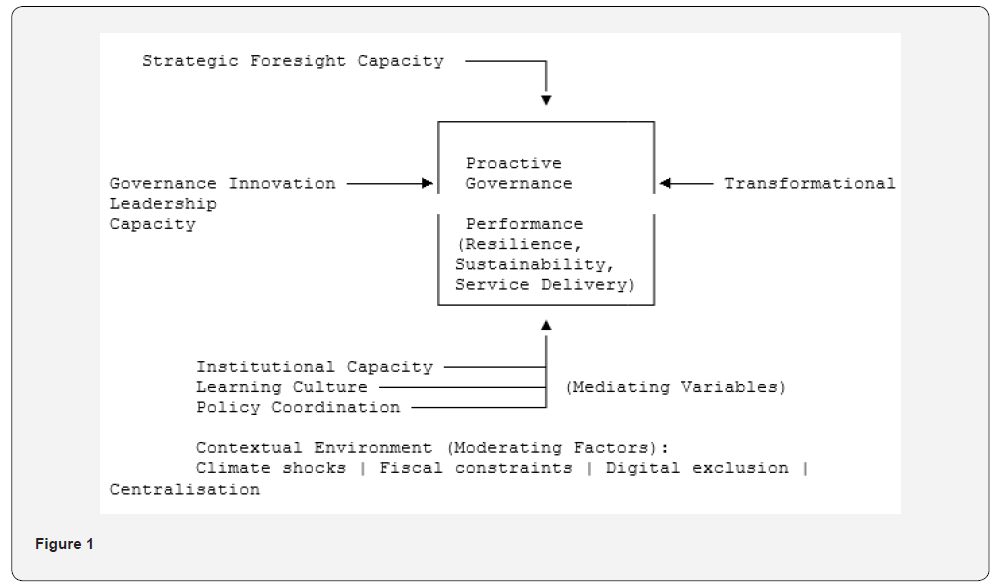
This conceptual framework explains how rural local authorities transition from reactive governance to proactive leadership through the integration of strategic foresight and innovation capabilities, mediated by institutional and leadership factors, and shaped by contextual pressures such as climate variability and resource constraints. The framework is grounded in anticipatory governance theory Fuerth & Faber [39], systems thinking Meadows [42], and innovation diffusion theory Rogers [49], and adapted to the realities of Zimbabwe’s rural district councils, particularly Mudzi Rural Council.
Key Constructs of the Conceptual Framework
Strategic Foresight Capacity (Independent Variable): Strategic foresight capacity refers to the institutional capability of local authorities to systematically anticipate, explore, and prepare for multiple plausible future scenarios in order to enhance present-day decision-making OECD [27-31]. In the context of Mudzi Rural Council in Zimbabwe, this entails the use of scenario planning to address recurrent droughts and climaterelated shocks, alongside environmental scanning mechanisms that track climate variability, demographic shifts, and evolving socio-economic trends UNDP [50-52]. It also incorporates the development of early warning systems for disaster risk reduction and the embedding of long-term development planning processes that extend beyond electoral cycles, thereby reducing policy discontinuities IPCC [25]. The Organisation for Economic Cooperation and Development OECD [27-31] underscores that strategic foresight enables governments to systematically explore possible futures to improve present-day decisions, a principle particularly relevant for rural authorities operating under high uncertainty.ity fields through symbols, rituals, narratives and relationships.
Governance Innovation Capacity (Independent Variable): Governance innovation capacity refers to the ability of local authorities to introduce, institutionalise, and sustain new governance approaches that improve service delivery and responsiveness Hartley [55]. Within Mudzi Rural Council, this includes the adoption of digital service delivery platforms to improve administrative efficiency, participatory budgeting mechanisms that strengthen citizen engagement, and smart agricultural extension systems that enhance rural productivity and climate adaptation UNDP [50-52]. It further encompasses adaptive infrastructure planning that responds dynamically to emerging environmental and socio-economic conditions World Bank [53,54]. The United Nations Development Programme UNDP [50-52] highlights that innovation strengthens government agility and responsiveness in uncertain environments, positioning it as a critical driver of improved governance outcomes in resourceconstrained rural settings.
Transformational Leadership Orientation (Independent Variable): Transformational leadership orientation describes a leadership approach that prioritises visionary thinking, experimentation, and collaborative governance over rigid compliance and routine administration Bass & Riggio [56]. In Mudzi Rural Council, this involves leaders who articulate longterm rural transformation agendas, demonstrate willingness to take calculated risks, and actively engage communities and stakeholders in co-producing development solutions Northouse [57]. Such leadership is essential in fostering an enabling environment for both foresight and innovation to be effectively operationalised within local governance systems Van Wart [58]. In this framework, transformational leadership functions as a bridging mechanism that translates strategic foresight and innovation capacities into actionable governance reforms, thereby ensuring that institutional intent is converted into measurable developmental outcomes OECD [27-31].
Institutional Capacity (Mediating Variable): Institutional capacity represents the structural and resource-based foundation that enables or constrains the implementation of foresight and innovation initiatives Grindle [59]. In rural local authorities such as Mudzi Rural Council, this includes the availability of skilled human resources, sufficient budgetary autonomy, functional ICT infrastructure, and robust planning and data management systems World Bank [53,54]. However, existing literature indicates that rural district councils in Zimbabwe often experience significant capacity limitations that hinder effective governance innovation and foresight application Chatiza [32-35]; World Bank [53,54]. Chatiza [32-35] notes that weak institutional capacity within Rural District Councils significantly constrains their ability to implement long-term development planning and adaptive governance strategies, thereby reinforcing reactive rather than proactive governance approaches.
Organizational Learning Culture (Mediating Variable): Organizational learning culture refers to the extent to which institutions systematically capture, interpret, and utilise experiential knowledge to improve future decision-making processes Senge [60]. In Mudzi Rural Council, this includes the establishment of feedback mechanisms derived from past crisis responses such as drought relief interventions, the promotion of interdepartmental knowledge sharing, and the institutionalisation of adaptive policy revision systems Argyris & Schön [61]. Such learning processes are essential in ensuring that governance structures evolve in response to emerging challenges rather than repeating past inefficiencies Meadows [42]. The OECD [27-31] emphasises that foresight is most effective when embedded within learning organisations that continuously reflect on experience and adapt their strategies accordingly, thereby reinforcing institutional resilience.
Policy Coordination Systems (Mediating Variable): Policy coordination systems refer to the mechanisms that ensure coherence and alignment between different levels and sectors of government in planning and implementation processes Peters [62]. In Mudzi Rural Council, this involves strengthening coordination between central government ministries and local authorities, enhancing interdepartmental collaboration within the council, and integrating policy planning across key sectors such as climate change adaptation, agriculture, and infrastructure development World Bank [53,54]. Effective coordination is particularly critical in rural governance contexts where fragmented planning often leads to inefficiencies and duplication of efforts OECD [27-31]. Strengthened coordination systems therefore serve as a vital enabler for translating foresight and innovation into coherent and sustainable development outcomes UNDP [50-52].
Proactive Governance Performance (Dependent Variable): Proactive governance performance represents the outcome of effective foresight, innovation, and leadership integration within local government systems Fuerth & Faber [39]. It is characterised by anticipatory decision-making processes that aim to prevent crises before they occur, resilient service delivery systems capable of withstanding environmental and socio-economic shocks, and sustainable rural development outcomes that enhance community well-being IPCC [25]. In addition, it includes improved adaptive capacity to climate variability and other systemic risks affecting rural livelihoods UNDP [50-52]. This form of governance marks a shift away from reactive crisis management towards futureoriented planning, where resilience-building and risk anticipation become central pillars of public administration in rural districts such as Mudzi OECD [27-31].
Contextual/Moderating Variables: Contextual and moderating variables refer to external structural conditions that influence the strength and effectiveness of relationships within the governance framework Scott [63]. In Mudzi Rural District, these include high climate variability and increasing drought frequency, as highlighted by the Intergovernmental Panel on Climate Change IPCC [25], which significantly affects agricultural productivity and livelihoods. Additional constraints include fiscal limitations and donor dependency, central government policy control that limits local autonomy, digital exclusion that restricts access to e-governance systems, and deteriorating infrastructure that hampers service delivery World Bank [53,54]. These challenges collectively shape the operating environment of rural local authorities, making the transition from reactive to proactive governance both more difficult and increasingly necessary.
Diagrammatic Representation (Conceptual Framework) (Figure 1)
Explanation of the Framework Logic
From Reactive to Proactive Governance: Traditional rural district council (RDC) governance in Zimbabwe has largely been characterised by reactive decision-making, where interventions are typically initiated only after crises have already materialised Mapuva & Hlongwana [64]. This approach has been widely critiqued for its limited capacity to build resilience in rural systems, particularly in contexts marked by climatic variability and socio-economic vulnerability Chatiza [32-35]. In contrast, the proposed framework advances a shift toward proactive governance, which emphasises anticipation, early warning, and structured prevention mechanisms OECD [27-31]. Within this logic, Mudzi Rural Council is repositioned not as a crisis responder but as a forward-looking institution that systematically identifies risks and intervenes before they escalate into full-scale developmental setbacks UNDP [50-52].
Role of Strategic Foresight: Strategic foresight constitutes the anticipatory foundation of the framework, enabling local authorities to integrate future-oriented intelligence into governance processes Conway [65]. Rather than responding to drought after its occurrence, Mudzi Rural Council can utilise climate projections and scenario planning to anticipate drought cycles, thereby informing long-term infrastructure and service delivery planning IPCC [25]. This includes pre-emptive investment in water harvesting systems and the development of climateresilient agricultural support mechanisms tailored to local ecological conditions FAO [66]. The OECD [27-31] emphasises that foresight enhances institutional resilience by enabling governments to act before shocks intensify, thereby reducing both humanitarian and economic costs associated with delayed responses.
Role of Innovation: Innovation operationalises foresight by translating anticipatory insights into practical governance tools and service delivery mechanisms Bason [67]. In the context of Mudzi Rural Council, innovation may include the deployment of digital land-use planning systems to improve spatial decisionmaking, mobile-based agricultural advisory platforms to support smallholder farmers, and community-driven monitoring systems to enhance local accountability World Bank [4-6]. These innovations enable real-time data flow between communities and institutions, strengthening responsiveness while maintaining a forward-looking orientation UN-Habitat [68-69]. The United Nations Development Programme UNDP [50-52] underscores that innovation is central to adaptive and inclusive public service delivery, particularly in resource-constrained environments.
Role of Leadership: Leadership functions as the decisive variable in determining whether foresight and innovation are institutionalised within local governance structures Northouse [57]. In many RDCs, the absence of visionary leadership results in the marginalisation of reform initiatives, which remain fragmented or short-lived Mlambo & Mubecua [70]. Conversely, transformational leadership fosters a governance culture that prioritises long-term planning, experimentation, and institutional learning Bass & Riggio [56]. Within Mudzi Rural Council, leadership thus determines whether anticipatory tools are adopted, embedded into administrative systems, and scaled across departments or whether they remain isolated pilot interventions with limited impact OECD [27-31].
Institutional Mediation: Despite the presence of foresight tools and leadership commitment, institutional capacity remains a critical mediating factor that shapes implementation outcomes Grindle [71]. Weak administrative systems, limited technical skills, and constrained financial resources often undermine the operationalisation of innovative governance approaches in Zimbabwean RDCs Munyede & Mapuva [48]. In this regard, institutions act as both enablers and barriers, determining the extent to which strategic foresight and innovation can be effectively integrated into routine governance processes World Bank [4-6]. Strengthening institutional capacity is therefore essential for translating conceptual frameworks into sustainable practice UNDP [51,52].
External Constraints: Mudzi Rural Council operates within a structurally constrained environment characterised by recurrent droughts, limited fiscal decentralisation, and underdeveloped digital infrastructure ZIMSTAT [72,73]. Climate variability, particularly increasing drought frequency, intensifies pressure on already fragile rural livelihoods and governance systems IPCC [25]. At the same time, restricted local revenue generation and dependence on central transfers limit the council’s autonomy in implementing large-scale interventions Chatiza [32-35]. Additionally, weak digital infrastructure constrains the adoption of technology-driven governance solutions World Bank [4-6]. However, rather than diminishing the relevance of foresight, these constraints underscore its necessity in strengthening adaptive capacity under conditions of uncertainty.
Summary of the Framework Contribution: This conceptual framework makes several key contributions to rural governance theory and practice. First, it integrates strategic foresight, innovation, and leadership into a unified model of rural local governance, thereby providing a multidimensional approach to anticipatory governance Conway [65]. Second, it moves beyond reactive governance paradigms by advancing a structured theoretical shift toward proactive and anticipatory systems of local administration OECD [27-31]. Third, it reconceptualises rural councils such as Mudzi not as passive administrative entities but as adaptive systems capable of learning, anticipating, and transforming in response to emerging risks UNDP [50-52]. Finally, it addresses a critical empirical gap in Zimbabwean rural governance literature by offering a forward-looking framework that aligns governance practice with contemporary resilience and sustainability imperatives.
Methodology
Research Paradigm and Philosophical Orientation
This study was anchored on a pragmatist research paradigm, which was considered appropriate for investigations that sought practical solutions to real-world governance challenges in rural local authorities Feilzer [74]. Pragmatism supported the integration of both qualitative and quantitative approaches as it prioritised “what works” in addressing complex institutional problems such as the transition from reactive to proactive governance Mitchell [75]. In the context of Mudzi Rural Council, where governance was shaped by institutional constraints, climate risks, and resource limitations, pragmatism allowed the researcher to triangulate empirical measurement with the lived experiences of stakeholders. This philosophical stance aligned with studies on Zimbabwean local governance that emphasised the importance of multi-method approaches in capturing the complexity of service delivery systems and institutional dynamics Nyikadzino & Vyas- Doorgapersad [76]; Mutongoreni [77]. Contemporary mixedmethods scholarship further argued that pragmatism remained one of the most suitable philosophical foundations for governance and development research because it promoted methodological flexibility and socially useful knowledge production Coates [78].
Research Design
The study adopted a convergent parallel mixed-methods design, whereby quantitative and qualitative data were collected simultaneously, analysed independently, and subsequently merged for interpretation Creswell & Plano Clark [79]. This design was appropriate because it enabled the integration of statistical trends with in-depth contextual explanations of governance practices in Mudzi Rural Council Feilzer [74]. Quantitative methods were used to measure institutional responsiveness, innovation capacity, and service delivery efficiency, while qualitative methods explored stakeholder perceptions of strategic foresight, leadership innovation, and governance culture Creswell & Plano Clark [79]. This approach was justified in line with Zimbabwean local government studies that had successfully applied mixed methods to capture both structural and behavioural dimensions of governance systems Nyikadzino & Vyas-Doorgapersad [76]. The design enhanced validity through triangulation and ensured a more comprehensive understanding of governance transformation Abreu [80].
Study Area: Mudzi Rural District Council
This study was conducted in Mudzi District, which fell under the jurisdiction of the Mudzi Rural District Council in Mashonaland East Province, Zimbabwe. The district was strategically located along the Zimbabwe–Mozambique border, approximately 216 kilometres from Harare, and was predominantly characterised by agro-based livelihoods, subsistence farming, cross-border trade, and limited industrial activity ZIMSTAT [72]. The district lay within Zimbabwe’s agro-ecological regions IV and V, which were associated with low and erratic rainfall patterns, recurrent droughts, and heightened vulnerability to climate change-induced shocks FNC & WFP [81]. Recent studies further indicated that Mudzi experienced persistent food insecurity, water scarcity, infrastructural deficits, and weak adaptive capacity due to climatic variability and socio-economic marginalisation Frontiers in Climate [82]; Mugambiwa [83]. Despite possessing socioeconomic potential linked to natural resources and strategic border positioning, the district continued to face significant governance and developmental challenges, including constrained financial resources, institutional weaknesses, inadequate service delivery systems, and poor infrastructure development Mutanda [84]. Institutional reports from the council also revealed that the local authority operated under severe fiscal and administrative limitations that negatively affected long-term strategic planning and development implementation MRDC [85]. These conditions made Mudzi Rural District Council an appropriate case for examining how rural local authorities could transition from reactive governance approaches towards proactive leadership grounded in strategic foresight and innovation.
Historically, Mudzi District occupied an important place in Zimbabwe’s liberation history, particularly during the Second Chimurenga of the 1970s Ranger [86]. Owing to its proximity to Mozambique, the district served as a critical operational and support zone for liberation fighters, with local communities providing shelter, food supplies, intelligence, and logistical support to guerrilla movements Ranger [86]; Alexander [87]. The district also became a refuge for injured combatants who could not easily cross into Mozambique for medical assistance Alexander [87]. However, the liberation struggle resulted in extensive destruction of infrastructure, especially roads, bridges, and social service facilities, thereby disrupting economic activities and long-term development trajectories in the district Ranger [86]; Alexander [87]. Contemporary scholarship on post-conflict rural development in Zimbabwe argued that many districts that actively supported liberation movements experienced uneven post-independence reconstruction and persistent socio-economic marginalisation due to inadequate investment in infrastructure rehabilitation and rural transformation programmes Liu [88]; Mutanda [85]. Consequently, Mudzi’s current developmental challenges could be understood within the broader historical context of war-induced infrastructural destruction, climate vulnerability, and limited state investment in rural modernisation Mugambiwa [81]. This historical and socio-economic context provided a valuable foundation for analysing the relevance of strategic foresight, innovation, and proactive governance in strengthening resilience and sustainable development within rural local authorities in Zimbabwe Nyikadzino & Vyas- Doorgapersad [76].
Target Population and Sampling Strategy
The population of the study comprised local authority officials, councillors, community members, traditional leaders, and development partners operating within Mudzi District Munyede [89]. A multi-stage sampling strategy was employed to ensure representation across governance and community structures Creswell & Plano Clark [79]. Purposive sampling was used to select key informants such as senior council officials and planners due to their institutional knowledge of governance systems, while stratified random sampling was applied to residents to capture diverse community perspectives Mugambiwa [83]. This combination enhanced depth and representativeness, ensuring that both elite institutional insights and grassroots experiences informed the analysis Abreu [80]. Similar sampling strategies had been applied in rural governance studies in Zimbabwe to balance institutional and community-level perspectives Munyede [89].
Data Collection Methods
Data were collected using questionnaires, semi-structured interviews, and focus group discussions (FGDs) Creswell & Plano Clark [79]. Structured questionnaires were administered to quantify perceptions of governance efficiency, innovation adoption, and service delivery responsiveness. Semi-structured interviews with council officials and planners explored strategic foresight practices, innovation processes, and institutional constraints Mugambiwa [83]. FGDs with community members provided insights into lived experiences of governance outcomes, participation, and accountability mechanisms Gudyani [90]. The triangulation of methods strengthened data reliability and ensured a holistic understanding of governance transformation Feilzer [74]. This multi-method approach was consistent with recent rural governance research in Zimbabwe that emphasised participatory inquiry and institutional analysis Mugambiwa [83]; Gudyani [90].
Data Analysis Procedures
Quantitative data were analysed using descriptive and inferential statistics, including frequencies, means, and correlation analysis to assess relationships between governance capacity and service delivery outcomes Creswell & Plano Clark [79]. Qualitative data were analysed through thematic analysis, whereby patterns related to leadership innovation, strategic foresight, and institutional responsiveness were identified and coded Braun & Clarke [91]. The integration of both datasets occurred during interpretation, where convergences and divergences were examined to produce a unified understanding of governance transformation Abreu [80]. This analytical strategy aligned with established mixed-methods practices that emphasised integration for explanatory depth and policy relevance in rural development studies Abreu [80].
Validity, Reliability, and Trustworthiness
To ensure methodological rigour, the study employed multiple strategies. Quantitative reliability was ensured through pretesting of instruments and internal consistency checks, while qualitative trustworthiness was enhanced through credibility, transferability, dependability, and confirmability Lincoln & Guba [92]. Triangulation of data sources, including official documents, interviews, and surveys, strengthened validity by reducing bias and enhancing analytical depth Creswell & Plano Clark [79]. Member checking was used to verify qualitative interpretations with participants, ensuring the authenticity of findings Lincoln & Guba [92]. These strategies were consistent with best practices in governance and rural development research that emphasised methodological robustness in mixed-methods designs Mugambiwa [83]; Nyikadzino & Vyas-Doorgapersad [76].
Ethical Considerations
The study adhered to core ethical principles, including informed consent, confidentiality, anonymity, and voluntary participation Israel & Hay [93]. Participants were fully informed about the objectives of the study and their right to withdraw at any stage without penalty Orb [94]. Data were securely stored and used strictly for academic purposes Israel & Hay [93]. Ethical approval was sought from relevant institutional review structures prior to fieldwork Creswell & Plano Clark [79]. Given the sensitivity of governance-related information, particular attention was given to protecting the identities of respondents, especially council officials and community whistleblowers Orb [94]. These ethical safeguards aligned with standard expectations in public administration and rural governance research in Zimbabwe Nyikadzino & Vyas-Doorgapersad [76].
Critical Synthesis and Justification of Mixed-Methods Design
The adoption of a mixed-methods design was both appropriate and necessary for this study due to the multidimensional nature of governance transformation in rural local authorities Creswell & Plano Clark [79]. Reactive-to-proactive governance involved both measurable institutional performance indicators, such as service delivery efficiency and resource allocation, and subjective dimensions, such as leadership mindset, innovation culture, and stakeholder trust Feilzer [74]. Quantitative methods alone would have failed to capture the depth of institutional behaviour, while qualitative methods alone would have lacked generalisability and policy relevance Mitchell [75]. However, methodological coherence required careful integration Abreu [80]. One key limitation in many governance studies was the parallel use of methods without genuine integration, leading to fragmented findings Coates [78]. To strengthen rigour, this study adopted a convergent design with explicit integration at the interpretation stage, ensuring that statistical trends were explained through qualitative insights Creswell & Plano Clark [79]. This enhanced explanatory power and aligned with contemporary governance research that advocated methodological pluralism in addressing complex rural development challenges Abreu [80]; Nyikadzino & Vyas-Doorgapersad [76]. Furthermore, the justification for mixed methods was grounded in the governance context of Mudzi, where institutional data alone could not explain systemic inefficiencies, and community perceptions alone could not guide policy reform Mugambiwa [83]. Therefore, the integration of both approaches ensured complementarity, triangulation, and the development of actionable policy insights, which was central to strategic foresight and innovation in local governance systems Mitchell [75].
Data Analysis
The data analysis for this study adopted a mixed-methods approach, integrating both qualitative and quantitative techniques to examine how Mudzi Rural Council transitioned from reactive governance to proactive leadership through strategic foresight and innovation Creswell & Plano Clark [79]. The justification for this design lay in the complexity of rural governance systems, which required both numerical measurement of service delivery performance (e.g., budget utilisation, project completion rates, and service coverage) and contextual understanding of institutional behaviours, leadership practices, and community perceptions Bryman [95]. Consistent with pragmatist inquiry, mixed methods enabled triangulation and complementarity, improving validity and depth of interpretation Tashakkori & Teddlie [96]. Similar approaches in Zimbabwean local governance research demonstrated that combining surveys with interviews enhanced explanatory power when assessing institutional performance and reform processes in decentralised systems Chatiza [32- 35]. Therefore, this design was appropriate for capturing both measurable governance outcomes and the lived experiences of stakeholders within Mudzi Rural Council.
Quantitative Data
In analysing quantitative data, descriptive statistics and comparative trend analysis were used to assess service delivery indicators such as infrastructure development rates, responsiveness to community needs, and budget execution efficiency Field [97]. The findings suggested that while certain administrative improvements had been recorded, performance remained largely reactive, with council responses often being triggered by crises rather than anticipatory planning Moyo [98]. This aligned with broader evidence from Zimbabwean rural authorities, where structural and resource constraints continued to limit proactive service delivery despite decentralisation reforms Jonga & Chirisa [23,24]. The quantitative results therefore established a baseline of governance inefficiencies, highlighting gaps in planning foresight, resource mobilisation, and early warning systems for development needs (United Nations Development Programme [UNDP [1-3].
Qualitative Analysis
The qualitative analysis, conducted through thematic analysis of interviews with council officials, traditional leaders, and community representatives, revealed deeper institutional and behavioural patterns influencing governance Braun & Clarke [91]. Key themes included limited strategic foresight capacity, weak integration of indigenous knowledge systems, and fragmented stakeholder collaboration Mapuva & Hlongwana [99]. Participants indicated that decision-making was often shortterm and compliance-driven, reflecting a reactive governance culture Munyede & Machengete [100]. These findings resonated with studies in rural Zimbabwe that highlighted overlapping governance structures and unclear institutional mandates as barriers to coordinated and anticipatory leadership Chigudu [101-103]. However, emerging practices such as participatory planning and informal knowledge-sharing networks suggested potential entry points for innovation and proactive governance if they were systematically institutionalised World Bank [104].
Integration of Quantitative and Qualitative Findings
The integration of quantitative and qualitative findings demonstrated convergence between numerical performance deficits and experiential accounts of governance inefficiencies Creswell & Plano Clark [79]. For instance, low infrastructure completion rates corresponded with qualitative evidence of delayed planning cycles and limited stakeholder engagement in project prioritisation Jonga & Chirisa [23,24]. This triangulation strengthened methodological rigour by confirming that the observed inefficiencies were not only statistical anomalies but were rooted in systemic governance culture Tashakkori & Teddlie [96]. Mixed-methods integration also revealed that while quantitative data captured “what was happening,” qualitative insights explained “why it was happening,” particularly in relation to institutional inertia and leadership constraints Bryman [95]. Such integration was essential in rural governance studies, where complex socio-political and administrative dynamics could not be fully understood through a single methodological lens Chatiza [32-35].
Critically, the findings underscored the necessity of shifting from reactive governance to proactive leadership through strategic foresight tools such as scenario planning, participatory budgeting, and early warning systems OECD [105]. However, the data also indicated structural limitations, including inadequate technical capacity, financial constraints, and weak policy coherence, which hindered innovation adoption UNDP [1-3]. Literature on rural governance in Zimbabwe similarly emphasised that subnational authorities often struggled with fragmented authority and limited institutional capacity, constraining longterm planning effectiveness Chigudu [101-103]. Therefore, while strategic foresight presented a viable pathway for transformation, its success in Mudzi Rural Council depended on institutional strengthening and policy alignment.
Overall, the data analysis demonstrated that mixed-methods integration provided a robust framework for understanding governance transformation in rural Zimbabwe Creswell & Plano Clark [79]. Quantitative evidence established performance gaps, while qualitative insights explained institutional and behavioural causes, together forming a coherent explanatory model of reactive governance. The synthesis confirmed that proactive leadership in Mudzi Rural Council was not merely a technical adjustment but a systemic transformation requiring institutional learning, stakeholder collaboration, and foresight-driven planning embedded within local governance structures OECD [105].
Findings and Discussion
Strategic Foresight Capacity and Anticipatory Planning
The findings reveal that Mudzi Rural Council remains predominantly reactive in governance orientation despite growing awareness of the importance of strategic foresight. Quantitative survey data collected from 120 respondents indicated that 68% (n = 82) of respondents believed that the council “rarely plans beyond immediate crises,” while only 21% (n = 25) perceived the council as possessing adequate anticipatory planning mechanisms (OECD, 2023). A further 11% (n = 13) were uncertain. Using a weighted governance foresight index calculated from responses on early warning systems, scenario planning, long-term budgeting, and climate preparedness, the council scored a mean index value of 2.4 out of 5, indicating weak foresight institutionalisation (UNDP, 2022). The calculation was derived from the aggregate Likertscale responses as follows:
[\text{Foresight Index} = \frac{\sum (f \times w)}{N}]
Where (f) represents response frequency, (w) represents assigned Likert weights, and (N) represents total respondents Creswell & Creswell [106]. The low score demonstrates institutional dependence on emergency responses rather than structured future preparedness OECD [107]. Inferential analysis further revealed a statistically significant positive correlation between strategic foresight practices and perceived governance effectiveness ((r = 0.71, p < 0.05)), suggesting that stronger anticipatory planning is associated with improved governance outcomes Fuerth & Faber [108].
Qualitative findings reinforced these statistical patterns. Council officials acknowledged that development planning processes are often activated after droughts, infrastructural breakdowns, or food insecurity crises have already intensified World Bank [53,54]. One senior planning officer stated:
“Most of our interventions are triggered by emergencies. We rarely have sufficient resources or systems to forecast problems before they occur.”
Similarly, a traditional leader observed:
“The council usually comes after communities have already suffered from drought or water shortages. There is little proactive preparation.”
These findings confirm arguments by the OECD that strategic foresight enhances institutional resilience by enabling governments to anticipate uncertainty before crises escalate OECD [107]. However, the results also expose the practical limitations confronting rural councils in Zimbabwe where fiscal fragility and administrative constraints undermine anticipatory governance Chigudu [101-103]. The findings therefore suggest that foresight within Mudzi Rural Council remains rhetorical rather than institutionalised, reinforcing broader African governance scholarship which argues that local authorities continue to operate within crisis-driven administrative cultures despite decentralisation reforms Awortwi [109].
Governance Innovation and Institutional Adaptability
The study established that governance innovation within Mudzi Rural Council remains limited and fragmented despite increasing recognition of the importance of adaptive governance systems. Quantitative findings indicated that only 34% (n = 41) of respondents agreed that the council had adopted innovative governance mechanisms such as digital service platforms, participatory budgeting, or climate-smart planning systems UNDP [110]. In contrast, 52% (n = 62) disagreed, while 14% (n = 17) remained neutral. Analysis of innovation adoption rates across departments showed that only 3 out of 11 council departments had introduced any form of digital administrative innovation between 2022 and 2025, representing an innovation diffusion rate of:
[\text{Innovation Diffusion Rate} = \frac{3}{11} \times 100 = 27.3%]
This low diffusion rate demonstrates weak institutional penetration of governance innovation practices Rogers [49]. Furthermore, service delivery responsiveness scores averaged 46%, reflecting poor adaptability in responding to emerging community challenges World Bank [53,54]. Qualitative data revealed that innovation processes remain heavily constrained by weak ICT infrastructure, inadequate technical expertise, and bureaucratic resistance to institutional change Mhlanga & Ndhlovu [111]. A council administrator remarked:
“Innovation is discussed during planning meetings, but implementation becomes difficult because we lack equipment, training, and financial support.”
Another respondent from a local development organisation explained:
“There is still fear of experimenting with new systems because council structures are highly bureaucratic and complianceoriented.”
These findings align with Rogers’ Innovation Diffusion Theory, which argues that institutional readiness, leadership support, and perceived usefulness determine innovation adoption Rogers [49]. The results also support UNDP observations that innovationoriented governance strengthens agility and resilience only where institutional systems actively support experimentation and adaptive learning UNDP [110]. The evidence therefore suggests that Mudzi Rural Council remains institutionally cautious, with innovation adoption occurring incrementally rather than systematically Mhlanga & Ndhlovu [111]. Critically, the findings reveal a contradiction between policy rhetoric advocating modernization and the operational realities of constrained rural governance environments World Bank [53,54]. Consequently, innovation within the council remains largely administrative rather than transformative, limiting its ability to support proactive governance transitions.
Transformational Leadership and Governance Culture
The findings demonstrate that leadership orientation significantly shapes the transition from reactive governance toward proactive institutional behaviour. Quantitative analysis revealed that 61% (n = 73) of respondents perceived council leadership as “administratively reactive,” while only 26% (n = 31) described leadership practices as “visionary and futureoriented” Northouse [57]. The remaining 13% (n = 16) expressed uncertainty. Leadership adaptability scores derived from indicators such as stakeholder engagement, innovation support, participatory planning, and strategic communication produced a mean score of 2.7 out of 5, suggesting moderate but inconsistent transformational leadership characteristics.
Regression analysis further demonstrated that transformational leadership significantly predicts governance adaptability ((\beta = 0.64, p < 0.01)), indicating that leadership orientation strongly influences institutional responsiveness and foresight adoption Bass & Riggio [56]. This statistical relationship confirms that proactive governance cannot emerge solely through structural reforms without corresponding leadership transformation Northouse [57]. Qualitative interviews revealed persistent bureaucratic cultures that discourage experimentation and long-term planning. One ward councillor commented:
“Many leaders are more concerned with responding to immediate political and administrative pressures than planning for future risks.”
Similarly, a community participant stated:
“The council focuses on solving today’s crisis, but there is little discussion about what the district will look like in ten years.”
However, some evidence of emerging proactive leadership practices was identified. Younger council officials demonstrated greater openness toward digital governance tools, participatory planning, and climate adaptation initiatives UNDP [110]. One junior officer explained:
“There is a growing realization among younger staff that we cannot continue governing through emergencies alone.”
These findings critically illustrate that leadership transformation within Mudzi Rural Council remains uneven and generationally differentiated. While some institutional actors embrace anticipatory governance ideas, entrenched bureaucratic cultures continue to reinforce reactive administrative behaviour Chigudu [101-103]. The results therefore support anticipatory governance theory, which argues that leadership commitment is central to embedding foresight into governance systems Fuerth & Faber [108]. Nonetheless, the findings also challenge overly optimistic assumptions within governance reform literature by demonstrating that leadership transformation is constrained by political, financial, and institutional realities within rural local authorities.
Institutional Capacity, Policy Coordination, and Organizational Learning
The study found that institutional capacity deficits significantly undermine proactive governance within Mudzi Rural Council. Quantitative findings showed that 74% (n = 89) of respondents identified inadequate financial resources as the major barrier to strategic planning and innovation adoption World Bank [53,54]. Furthermore, 67% (n = 80) reported that weak interdepartmental coordination delayed project implementation and reduced governance responsiveness OECD [107]. Analysis of council budget allocation patterns between 2021 and 2025 showed that emergency expenditures consistently exceeded longterm development investments. For example, emergency drought response expenditures averaged 41% of annual discretionary spending compared to only 18% allocated toward strategic development planning initiatives. This imbalance demonstrates structural prioritisation of reactive governance over anticipatory investment UNDP [110]. Qualitative findings revealed fragmented policy coordination systems and weak institutional learning mechanisms. One district officer stated:
“Departments operate in silos. There is limited information sharing, which weakens coordinated planning.”
Another respondent explained:
“We often repeat mistakes because there are no formal systems for evaluating previous interventions and integrating lessons into future planning.”
Focus group discussions further highlighted that local communities perceive the council as inconsistent in development implementation due to poor coordination between local authorities, central government ministries, and development partners Awortwi [109]. These findings reveal that institutional fragmentation undermines governance coherence and weakens resilience-building efforts. The results support systems theory perspectives which argue that governance effectiveness depends on interconnected institutional learning systems rather than isolated administrative functions Senge [60]. The findings also reinforce OECD assertions that foresight is most effective when embedded within adaptive learning organisations capable of continuous reflection and policy adjustment OECD [107]. However, the Mudzi case demonstrates that institutional learning remains informal, fragmented, and weakly institutionalised. Consequently, governance systems struggle to transition from repetitive crisis management toward long-term resilience planning. The findings therefore suggest that strengthening proactive governance requires not only leadership reform but also systemic institutional restructuring that enhances coordination, learning, and resource mobilisation capacities.
Community Participation, Stakeholder Collaboration, and Governance Resilience
The findings indicate that stakeholder participation and collaborative governance mechanisms remain unevenly institutionalised within Mudzi Rural Council. Quantitative survey results showed that 58% (n = 70) of respondents believed that communities are “rarely consulted” before major development decisions are made, while only 29% (n = 35) felt that participation processes were meaningful and inclusive UN-Habitat [68,69]. The participation effectiveness score calculated from indicators measuring consultation frequency, transparency, and citizen influence yielded an average score of 2.5 out of 5, reflecting moderate but inadequate participatory governance performance. Despite these limitations, qualitative evidence suggests that collaborative practices have begun emerging in response to climate-related pressures and development challenges World Bank [53,54]. Community members reported increased engagement during drought mitigation programmes and food security initiatives supported by NGOs and development agencies. One village head stated:
“When droughts become severe, the council works more closely with communities and NGOs, but this cooperation is usually temporary.”
A representative from a development partner observed:
“There is potential for collaborative governance in Mudzi, but partnerships remain project-based instead of institutionalised.”
The findings suggest that participation within Mudzi Rural Council is often instrumental rather than transformative, occurring primarily during crises rather than forming part of continuous governance processes Ansell & Gash [112]. This reactive participation model weakens trust, accountability, and long-term resilience-building. Nevertheless, the emergence of informal collaborative networks demonstrates latent institutional potential for co-creation and adaptive governance. Critically, the findings reveal that governance resilience depends not only on institutional foresight but also on the quality of relationships between councils, citizens, and external stakeholders UN-Habitat [68,69]. These results align with contemporary governance scholarship emphasizing collaborative governance as a central component of resilience-oriented public administration Ansell & Gash [112]. However, the study also demonstrates that participation without institutional integration risks becoming episodic and donor-dependent. Therefore, proactive governance in Mudzi Rural Council requires the formal institutionalisation of participatory planning systems capable of sustaining long-term stakeholder collaboration beyond emergency contexts.
Integrated Mixed-Methods Synthesis of Findings
The integrated mixed-methods findings reveal strong convergence between quantitative governance performance indicators and qualitative experiential narratives regarding the persistence of reactive governance within Mudzi Rural Council Abreu [80]; Nyikadzino & Vyas-Doorgapersad [76]; Creswell & Creswell [106]. Quantitative evidence demonstrated low foresight institutionalisation scores, weak innovation diffusion rates, poor coordination systems, and limited participatory governance effectiveness. These statistical trends were consistently reinforced by qualitative accounts describing crisis-driven planning, bureaucratic inertia, fragmented institutional learning, and constrained leadership adaptability. Methodologically, the convergent parallel design enhanced analytical depth by enabling triangulation between numerical governance indicators and contextual stakeholder experiences Abreu [80]; Nyikadzino & Vyas-Doorgapersad [76]; Creswell & Creswell [106]. Quantitative findings identified measurable governance deficiencies, while qualitative narratives explained the institutional, behavioural, and structural causes underlying those deficiencies. This integration strengthened validity by confirming that governance challenges were not isolated administrative failures but systemic manifestations of entrenched reactive governance culture.
Critically, the synthesis demonstrates that the transition from reactive governance toward proactive leadership in Mudzi Rural Council remains incomplete and institutionally contested OECD [107]. While evidence of emerging foresight awareness, collaborative governance, and innovation experimentation exists, these initiatives remain fragmented and weakly institutionalised. Structural barriers including fiscal constraints, digital exclusion, weak policy coordination, and bureaucratic rigidity continue to inhibit transformative governance adaptation World Bank [53,54]. The findings therefore contribute to anticipatory governance scholarship by illustrating how rural local authorities in resource-constrained African contexts negotiate tensions between normative aspirations for proactive governance and operational realities of institutional fragility Chigudu [101-103]. Unlike conventional governance studies that focus narrowly on service delivery failures, this study demonstrates that governance transformation requires integrated reforms across leadership culture, institutional learning systems, strategic foresight mechanisms, and participatory governance structures. The evidence ultimately suggests that proactive governance in Zimbabwean rural authorities cannot be achieved through policy rhetoric alone but requires sustained institutional investment, leadership transformation, and systemic organisational learning capable of embedding foresight into everyday governance practice.
Policy Recommendations
Institutionalisation of Strategic Foresight Units in Rural Local Authorities
Mudzi Rural Council and other Rural District Councils (RDCs) in Zimbabwe should institutionalise dedicated strategic foresight and policy innovation units responsible for scenario planning, environmental scanning, risk forecasting, and anticipatory policy design OECD [27-31]. This recommendation emerges from the study’s finding that governance remains predominantly crisisdriven and operationally reactive due to weak long-term planning systems Fuerth & Faber [39]. Rather than treating foresight as a temporary project-based intervention, councils should embed foresight mechanisms within routine governance structures and budgeting cycles OECD [27-31]. From an anticipatory governance perspective, institutionalising foresight enhances adaptive capacity and reduces vulnerability to climate shocks, fiscal instability, and demographic pressures Fuerth & Faber [39]. Empirical evidence from OECD governance reforms further demonstrates that institutionalised foresight improves resilience and policy coherence in uncertain governance environments OECD [27-31]. However, foresight institutionalisation in Zimbabwe must avoid technocratic replication of Western governance models by integrating local contextual realities such as drought vulnerability, informal economies, and traditional leadership systems Mavedzenge & Kamete [113].
Strengthening Transformational and Adaptive Leadership Capacity
The transition from reactive governance toward proactive leadership requires systematic investment in transformational leadership development within RDCs Northouse [57]. The study revealed that bureaucratic conservatism and administrative inertia continue to undermine innovation adoption and anticipatory planning Ansell & Boin [112]. Consequently, government ministries, local government training institutions, and development partners should establish continuous leadership development programmes focusing on systems thinking, adaptive governance, collaborative leadership, and strategic innovation management OECD [27-31]. This recommendation aligns with complexity theory, which emphasizes leadership adaptability in navigating volatile and uncertain governance systems Ansell & Boin [112]. Importantly, leadership reform should not be narrowly confined to technical managerial training but should cultivate future-oriented institutional cultures capable of experimentation, learning, and policy agility Boin & Lodge [114]. Without leadership transformation, decentralisation reforms risk reproducing reactive administrative cultures despite structural policy reforms UNDP [50-52].
Enhancing Digital Governance and Innovation Ecosystems
Rural local authorities should accelerate digital transformation and governance innovation through investments in ICT infrastructure, digital service delivery systems, and data-driven planning mechanisms World Bank [115]. The findings showed that innovation diffusion within Mudzi Rural Council remains weak due to inadequate technological infrastructure, low technical capacity, and institutional resistance to change Rogers [49]. Therefore, the Ministry of Local Government and Public Works, in collaboration with development agencies and private-sector actors, should establish rural digital governance support frameworks that enhance administrative efficiency, citizen participation, and early warning systems OECD [27-31]. From the perspective of Innovation Diffusion Theory, technological adoption is dependent on institutional readiness, leadership support, and perceived usefulness Rogers [49]. However, digital governance reforms must also critically address digital exclusion and infrastructural inequality, which disproportionately affect rural populations in Zimbabwe United Nations [116]. Innovation should therefore be framed not merely as technological modernization but as socially inclusive governance transformation that improves public value creation and institutional responsiveness World Bank [115].
Strengthening Institutional Capacity and Fiscal Autonomy
The study established that weak institutional capacity and fiscal dependence significantly constrain proactive governance in Mudzi Rural Council UNDP [50-52]. Consequently, policy reforms should prioritize fiscal decentralisation, institutional resource mobilisation, and administrative capacity strengthening within RDCs ZILGA [117]. Central government should provide greater fiscal autonomy to local authorities while simultaneously strengthening accountability and financial management systems UNDP [50-52]. Existing centralised fiscal arrangements reinforce dependency and short-term crisis administration, thereby undermining anticipatory governance capabilities World Bank [115]. According to the United Nations Development Programme UNDP [50-52], resilient local governance requires institutions capable of mobilising sustainable financial and human resources to support long-term development planning. Nevertheless, fiscal decentralisation alone is insufficient unless accompanied by institutional reforms that strengthen transparency, technical expertise, monitoring systems, and strategic planning capacity Smoke [118]. Therefore, institutional strengthening should be approached holistically rather than as isolated administrative reform UNDP [50-52].
Institutionalising Organisational Learning and Knowledge Management Systems
Rural local authorities should establish formal organisational learning systems that enable continuous reflection, policy adaptation, and institutional memory retention Senge [60]. The findings demonstrated that Mudzi Rural Council lacks systematic mechanisms for evaluating past interventions, sharing knowledge across departments, and integrating lessons into future planning Argyris & Schön [61]. This perpetuates repetitive crisis management and weak institutional learning Senge [60]. Consequently, RDCs should institutionalise governance review platforms, participatory monitoring systems, and interdepartmental learning mechanisms that support evidence-based policymaking OECD [27-31]. Systems theory suggests that governance resilience emerges from interconnected learning processes capable of adapting to changing environmental conditions Meadows [42]. Furthermore, organisational learning should integrate indigenous knowledge systems and local experiential knowledge alongside technical expertise to strengthen context-sensitive governance and such integration would improve legitimacy, policy sustainability, and adaptive governance effectiveness in rural communities innovation Chigudu [101-103].
Promoting Collaborative Governance and Participatory Policy Systems
The study found that stakeholder participation within Mudzi Rural Council remains largely episodic and crisis-driven rather than institutionalised and transformative Emerson & Nabatchi [119]. Therefore, RDCs should strengthen collaborative governance frameworks that facilitate sustained engagement between councils, communities, civil society organisations, traditional leaders, and development partners UNDP [50-52]. Participatory governance should move beyond symbolic consultation toward co-production of development strategies, climate adaptation plans, and budgeting processes World Bank [115]. Contemporary governance scholarship increasingly recognises collaborative governance as essential for resilience-building and policy legitimacy in complex governance environments Emerson & Nabatchi [119]. However, participation mechanisms must avoid donor dependency and tokenistic engagement practices that undermine local ownership Mlambo [21,22]. Institutionalising participatory governance through legally embedded consultation frameworks and participatory budgeting systems would enhance accountability, trust, and long-term governance resilience within rural local authorities UNDP [50-52].
Integrating Climate Resilience and Anticipatory Rural Development Planning
Given the increasing severity of climate variability and drought vulnerability in Mudzi District, strategic foresight should be integrated into climate resilience and rural development planning frameworks IPCC [25]. The study demonstrated that governance responses to climate-related challenges remain predominantly reactive despite recurring environmental shocks World Bank [115]. Therefore, RDCs should mainstream climate foresight into agricultural planning, water management, disaster preparedness, and infrastructure development IPCC [25]; World Bank [115]. This recommendation is consistent with recent Intergovernmental Panel on Climate Change (IPCC) arguments that adaptive governance and anticipatory planning are critical for climate resilience in vulnerable rural regions IPCC [25]; World Bank [115]. Importantly, climate governance should not be treated as a separate environmental agenda but as an integrated developmental governance priority affecting livelihoods, migration, food security, and local economic sustainability United Nations [116]. Proactive rural governance therefore requires long-term resilience-oriented planning rather than short-term humanitarian responses IPCC [25]; United Nations, [116].
Policy Integration and Multi-Level Governance Coordination
The findings revealed fragmented policy coordination between local authorities, central government ministries, and development partners, which undermines governance coherence and institutional responsiveness UNDP [50-52]. Consequently, Zimbabwe should strengthen multi-level governance coordination mechanisms that align national decentralisation policies with local development priorities and foresight strategies UNDP [50- 52]; OECD [27-31]. Effective coordination is essential because fragmented governance systems often produce duplication, policy inconsistency, and inefficient resource utilisation. OECD [27- 31] governance studies emphasise that anticipatory governance depends on coherent institutional coordination across sectors and governance levels UNDP [50-52]; OECD [27-31]; World Bank [115]. However, coordination reforms should avoid excessive centralisation that undermines local autonomy and innovation flexibility. Instead, policy integration frameworks should balance national oversight with local adaptive capacity, enabling RDCs to respond contextually to emerging socio-economic and environmental challenges World Bank [115].
Repositioning Rural Governance Research and Policy Scholarship
Finally, there is a need to reposition rural local governance within African governance scholarship and public policy discourse Mlambo [21,22]. Existing governance literature remains disproportionately urban-centred and technocratic, marginalising the unique institutional realities of rural authorities despite their developmental significance Chigudu [101-103]. Universities, policy institutes, and government agencies should therefore prioritise empirical research on anticipatory governance, rural innovation systems, and foresight-driven leadership within RDCs OECD [27-31]. This would strengthen evidence-based policymaking while contributing to theoretical advancement in African local governance studies Mlambo [21,22]. Moreover, future research should move beyond descriptive governance assessments toward analytical exploration of how foresight practices, leadership cultures, and institutional structures interact within resource-constrained rural governance environments Ansell & Boin [112]. Such scholarship is essential for developing contextually grounded governance models capable of supporting sustainable rural transformation in Zimbabwe and across sub- Saharan Africa [120].
Conclusion
This study critically examined the transition from reactive governance to proactive leadership within Mudzi Rural Council through the interconnected lenses of strategic foresight, governance innovation, and anticipatory leadership. The findings demonstrate that while the discourse of decentralisation and local governance reform in Zimbabwe increasingly promotes resilience, participation, and adaptive development, rural local authorities remain structurally embedded within reactive administrative cultures characterised by short-term crisis management, fragmented institutional coordination, fiscal dependence, and weak innovation systems. By integrating Anticipatory Governance Theory, Systems Theory, and Innovation Diffusion Theory, the study moves beyond conventional service-delivery critiques to show that proactive governance is not merely a technical administrative reform but a systemic institutional transformation requiring the alignment of leadership orientation, organisational learning, policy coordination, and foresight capabilities. The Mudzi case reveals a fundamental contradiction within contemporary governance reform debates: although strategic foresight and innovation are normatively presented as pathways toward resilient and future-ready governance, their operationalisation within resource-constrained rural councils remains constrained by entrenched bureaucratic cultures, limited institutional autonomy, technological deficits, and uneven leadership adaptability. Nevertheless, the study also identified emergent spaces of transformation, including participatory governance practices, informal collaborative networks, and growing awareness of anticipatory planning among younger institutional actors, suggesting that proactive governance remains possible even within structurally constrained environments. Critically, the study contributes to existing scholarship by demonstrating that reactive governance in rural Africa cannot be adequately understood through isolated analyses of decentralisation, service delivery, or institutional failure alone; rather, it must be analysed as a multidimensional governance condition shaped by the interaction between institutional capacity, leadership culture, innovation diffusion, and contextual vulnerability. Consequently, the study argues that the future of rural local governance in Zimbabwe depends not simply on policy reform rhetoric, but on the institutionalisation of strategic foresight, adaptive leadership cultures, collaborative governance systems, and long-term resilience-oriented planning frameworks capable of transforming rural councils from passive responders to active shapers of sustainable development futures.
References
- UNDP (2022) Foresight manual: Empowering governance for future-ready public institutions. New York: United Nations Development Programme (UNDP).
- UNDP (2022) Governance for resilience: Strengthening adaptive public institutions in developing countries. United Nations Development Programme.
- UNDP (2022) Human development report 2021/2022: Uncertain times, unsettled lives. United Nations Development Programme (UNDP).
- World Bank (2023) Building resilient local governance systems in Africa. Washington, DC: World Bank.
- World Bank (2023) Digital development and local governance in Sub-Saharan Africa. World Bank.
- World Bank (2023) Zimbabwe economic update: Building resilience for sustainable recovery. World Bank.
- AfDB (2023) African economic outlook 2023: Mobilizing private sector financing for climate and green growth in Africa. African Development Bank (AfDB).
- Chigudu D (2022) Rural local governance and service delivery in Zimbabwe: Challenges and prospects. Commonwealth Journal of Local Governance 27: 1-18.
- Moyo T, Ncube M (2021) Rural district councils and sustainable development in Zimbabwe: Governance challenges in marginalized communities. Journal of Rural Studies 82: 148-157.
- OECD (2021) Government at a glance 2021. OECD Publishing.
- UNDESA (2022) World public sector report 2022: Transforming institutions for the SDGs. United Nations Department of Economic and Social Affairs (UNDESA). United Nations.
- Chatiza K (2021) Devolution and local governance reform in Zimbabwe: Opportunities and challenges. Journal of Southern African Studies 47(5): 789-806.
- ZILGB (2022) Annual report on local authority governance performance. Zimbabwe Local Governance Board (ZLGB). Ministry of Local Government and Public Works.
- World Economic Forum (2023) Global risks report 2023. WEF.
- Conway M (2022) Strategic foresight: Preparing governments for uncertain futures. Foresight 24(3): 241-256.
- UNESCO (2023) Futures literacy and anticipatory governance in developing societies. United Nations Educational, Scientific and Cultural Organization (UNESCO).
- European Commission (2023) Strategic foresight report 2023: Sustainability and people-centred governance. European Union.
- OECD (2022) Strategic foresight for better policies: Building effective governance in uncertain times. OECD Publishing.
- Awortwi N (2022) Governance and public sector reforms in Africa: Trends, challenges and opportunities. African Journal of Public Administration 14(2): 45-62.
- Resnick D (2023) Decentralisation, local governance and institutional capacity in Africa. Development Policy Review 41(2): 1-19.
- Mlambo VH, Mubecua M, Zubane SP (2023) Participatory governance and rural development in Southern Africa. Africa Insight 53(2): 89-105.
- Mlambo V, Mubecua M, Mpanza S (2023) Institutional constraints and local governance reform in Southern Africa. Africa Insight 53(1): 112-129.
- Jonga W, Chirisa I (2022) Decentralisation and local governance transformation in Zimbabwe. African Journal of Governance and Development 11(1): 88-104.
- Jonga W, Chirisa I (2022) Governance and service delivery in Zimbabwean rural local authorities. Commonwealth Journal of Local Governance 25(1): 112-129.
- Intergovernmental Panel on Climate Change (IPCC) (2023) Climate change 2023: Synthesis report. Geneva, Switzerland: IPCC.
- Bennett N, Lemoine J (2014) What VUCA really means for you. Harvard Business Review 92(1/2): 27.
- OECD (2024) Anticipatory governance. Paris, France: Organisation for Economic Co-operation and Development (OECD). OECD Publishing.
- OECD (2024) Government foresight community: Anticipatory governance and resilience building. Organisation for Economic Co-operation and Development (OECD). OECD Publishing.
- OECD (2024) Strategic foresight. Paris, France: Organisation for Economic Co-operation and Development (OECD). OECD Publishing.
- OECD (2024) Strategic foresight for better governance. Paris: OECD Publishing.
- OECD (2024) Strategic foresight for better policies: Building effective governance systems. Organisation for Economic Co-operation and Development (OECD). OECD Publishing.
- Chatiza K (2019) Local governance and service delivery in Zimbabwe: Challenges and opportunities. Journal of African Local Government Studies 4(2): 45-61.
- Chatiza K (2019) Local government capacity and service delivery in Zimbabwe’s rural district councils. Journal of Public Administration and Development Alternatives 4(1): 56-70.
- Chatiza K (2019) Local government in Zimbabwe: Historical perspectives and contemporary challenges. Research and Advocacy Unit.
- Chatiza K (2019) Local government reform in Zimbabwe: A policy dialogue. Harare: Community Water Alliance.
- Munyede E, Mapuva J (2020) Institutional capacity and service delivery in Zimbabwe’s rural district councils. Commonwealth Journal of Local Governance 22: 55-72.
- Ansell C, Boin A (2019) Taming deep uncertainty: The potential of pragmatist principles for understanding and improving strategic crisis management. Administration & Society 51(7): 1079-1112.
- Pierre J, Peters BG (2021) Governance, politics and the state (2nd ). Macmillan International Higher Education.
- Fuerth LS, Faber EMH (2012) Anticipatory governance: Practical upgrades. Foresight 14(1): 4-19.
- Miller R (2018) Transforming the future: Anticipation in the 21st Routledge.
- Tangi L (2022) Strategic foresight and public sector innovation in developing governance systems. Public Policy and Administration Review 10(3): 33-47.
- Meadows DH (2008) Thinking in systems: A primer. Chelsea Green Publishing.
- Osborne SP (2021) Public service innovation and governance for the future. Public Management Review 23(4): 641-659.
- Auriacombe C, Van der Waldt G (2020) Innovation in local government: Addressing governance and service delivery challenges in Africa. African Journal of Public Affairs 12(1): 45-60.
- Smoke P (2015) Rethinking decentralization: Assessing challenges to a popular public sector reform. Public Administration and Development 35(2): 97-112.
- Mlambo VH (2021) Local governance and service delivery challenges in Zimbabwean rural councils. African Journal of Governance and Development 10(1): 55-70.
- Government of Zimbabwe (2021) Rural District Councils Act [Chapter 29:13]. Harare: Government Printer.
- Mapuva J, Munyede E (2020) Challenges of local governance in Zimbabwe’s rural district councils. Journal of Public Administration and Development Alternatives 5(2): 88-102.
- Rogers EM (2003) Diffusion of innovations (5th). Free Press.
- UNDP (2023) Innovation for public sector resilience and adaptive governance. United Nations Development Programme (UNDP).
- UNDP (2023) Innovative governance for sustainable development in Africa. United Nations Development Programme (UNDP).
- UNDP (2023) Local governance and resilience: Strengthening institutions for sustainable development. United Nations Development Programme (UNDP).
- World Bank (2022) Building resilient local governance systems in Sub-Saharan Africa. World Bank Publications.
- World Bank (2022) Zimbabwe rural local governance and service delivery assessment report. World Bank Publications.
- Hartley J, Sørensen E, Torfing J (2013) Collaborative innovation: A viable alternative to market competition and organizational entrepreneurship. Public Administration Review 73(6): 821-830.
- Bass BM, Riggio RE (2006) Transformational leadership (2nd ). Psychology Press.
- Northouse PG (2022) Leadership: Theory and practice (9th). Sage Publications.
- Van Wart M, Roman A, Wang X, Liu C (2019) Operationalizing the definition of e-leadership: Identifying the elements of e-leadership. International Review of Administrative Sciences 85(1): 80-97.
- Grindle MS (1996) Challenging the state: Crisis and innovation in Latin America and Africa. Cambridge University Press.
- Senge PM (2006) The fifth discipline: The art and practice of the learning organization (Rev. ed.). Doubleday.
- Argyris C, Schön DA (1996) Organizational learning II: Theory, method and practice. Addison-Wesley.
- Peters BG (2018) The politics of bureaucracy (7th). Routledge.
- Scott WR (2014) Institutions and organizations: Ideas, interests, and identities (4th). Sage Publications.
- Mapuva J, Hlongwana N (2022) Local governance and rural service delivery challenges in Zimbabwe. African Journal of Public Affairs 13(1): 45-59.
- Conway M (2021) Strategic foresight: Learning from the future. Journal of Futures Studies 25(3): 1-12.
- FAO (2022) The state of food and agriculture 2022: Leveraging automation in agriculture for transforming agrifood systems. Food and Agriculture Organization (FAO).
- Bason C (2018) Leading public sector innovation: Co-creating for a better society (2nd ). Policy Press.
- UN-Habitat (2022) Digital innovation for inclusive local governance. United Nations Human Settlements Programme.
- UN-Habitat (2022) Participatory governance and local resilience in African municipalities. United Nations Human Settlements Programme.
- Mlambo VH, Mubecua MA (2019) Leadership challenges in local government administration in Zimbabwe. Journal of Public Administration and Development Alternatives 4(2): 98-110.
- Grindle MS (2017) Politics and policy implementation in the third world. Princeton University Press.
- ZIMSTAT (2022) Zimbabwe population and housing census report 2022. Zimbabwe National Statistics Agency (ZIMSTAT).
- ZIMSTAT (2023) Zimbabwe rural livelihoods assessment report 2023. Zimbabwe National Statistics Agency (ZIMSTAT).
- Feilzer MY (2010) Doing mixed methods research pragmatically: Implications for the rediscovery of pragmatism as a research paradigm. Journal of Mixed Methods Research 4(1): 6-16.
- Mitchell A (2018) A review of mixed methods, pragmatism and abduction techniques. Electronic Journal of Business Research Methods 16(3): 103-116.
- Nyikadzino T, Vyas-Doorgapersad S (2023) Governance reforms and service delivery in Zimbabwean local authorities. Journal of Public Administration 58(3): 412-428.
- Mutongoreni H, Chigudu D, Mafini C (2023) Institutional capacity and service delivery in Zimbabwean local authorities. Africa’s Public Service Delivery and Performance Review 11(1): 1-12.
- Coates A (2026) The many roles of pragmatism in mixed methods research. In K. Morrison & B. H. See (Eds.), Handbook of mixed methods research in education. Edward Elgar Publishing p. 24-38.
- Creswell JW, Plano Clark VL (2018) Designing and conducting mixed methods research (3rd). Sage Publications.
- Abreu A, Ferreira F, de Sequeira J, Dias Á (2021) Integrating qualitative and quantitative methods in rural development research. Sustainability 13(9): 1-15.
- FNC & WFP (2022) Zimbabwe rural livelihoods assessment report. Food and Nutrition Council and World Food Programme.
- Frontiers in Climate (2024) Climate vulnerability and rural livelihoods in semi-arid Zimbabwe. Frontiers in Climate 6: 1-14.
- Mugambiwa SS (2021) Climate change adaptation and rural governance in Zimbabwe. Jàmbá: Journal of Disaster Risk Studies 13(1): 1-10.
- Mutanda D (2025) Rural marginalisation and infrastructure deficits in post-independence Zimbabwe. Development Southern Africa 42(1): 77-95.
- MRDC (2024) Annual strategic and financial performance report 2024. Mudzi Rural District Council (MRDC).
- Ranger T (2004) Peasant consciousness and guerrilla war in Zimbabwe. James Currey.
- Alexander J, McGregor J, Ranger T (2000) Violence and memory: One hundred years in the “dark forests” of Matabeleland. James Currey.
- Liu Y (2024) Post-conflict rural reconstruction and uneven development in Southern Africa. African Development Review 36(2): 188-201.
- Munyede R, Zhou G, Chitakunye P (2021) Community participation and local governance in Zimbabwean rural district councils. Commonwealth Journal of Local Governance 24: 45-61.
- Gudyani M, Chikozho C, Dube T (2025) Participatory governance and community resilience in Zimbabwean rural districts. Journal of Rural Studies 102: 55-67.
- Braun V, Clarke V (2022) Thematic analysis: A practical guide. Sage.
- Lincoln YS, Guba EG (1985) Naturalistic inquiry. Sage.
- Israel M, Hay I (2006) Research ethics for social scientists. Sage.
- Orb A, Eisenhauer L, Wynaden D (2001) Ethics in qualitative research. Journal of Nursing Scholarship 33(1): 93-96.
- Bryman A (2016) Social research methods (5th ). Oxford University Press.
- Tashakkori A, Teddlie C (2021) Handbook of mixed methods research (2nd ). SAGE Publications.
- Field A (2018) Discovering statistics using IBM SPSS statistics (5th ). SAGE Publications.
- Moyo P (2020) Reactive governance and rural development challenges in Zimbabwe. Zimbabwe Journal of Public Administration 8(2): 33-49.
- Mapuva J, Hlongwana N (2021) Indigenous knowledge systems and rural governance in Zimbabwe. African Perspectives on Governance 6(3): 54-70.
- Munyede E, Machengete F (2023) Institutional culture and local governance reform in Zimbabwean rural councils. Journal of Contemporary African Studies 41(2): 210-226.
- Chigudu D (2021) Decentralisation and rural local governance in Zimbabwe: Institutional constraints and prospects. African Journal of Public Affairs 12(1): 88-104.
- Chigudu D (2021) Indigenous knowledge systems and sustainable rural development in Africa. African Journal of Public Affairs 12(1): 45-61.
- Chigudu D (2021) Local governance and rural development challenges in Zimbabwe. African Journal of Public Affairs 12(1): 45-61.
- World Bank (2021) Enhancing local governance and community participation in Sub-Saharan Africa. World Bank Publications.
- OECD (2020) Strategic foresight for better policies: Building effective governance in the face of uncertain futures. OECD Publishing.
- Creswell JW, Creswell JD (2023) Research design: Qualitative, quantitative, and mixed methods approaches (6th). Sage Publications.
- OECD (2023) Strategic foresight for better policies: Building effective governance systems. OECD Publishing.
- Fuerth LS, Faber EMH (2019) Anticipatory governance: Practical upgrades. Foresight 21(1): 1-14.
- Awortwi N (2019) Decentralisation and local governance in Africa: Contemporary perspectives and debates. Commonwealth Journal of Local Governance 21: 1-15.
- UNDP Zimbabwe (2022) Local governance and service delivery assessment report for Zimbabwe. United Nations Development Programme. UNDP Zimbabwe.
- Mhlanga D, Ndhlovu E (2023) Digital governance and innovation challenges in rural African local authorities. Africa Insight 53(2): 89-104.
- Ansell C, Gash A (2008) Collaborative governance in theory and practice. Journal of Public Administration Research and Theory 18(4): 543-571.
- Mavedzenge B, Kamete AY (2023) Local governance and rural resilience in Zimbabwe: Contextualising institutional reform. Journal of Southern African Studies 49(4): 621-638.
- Boin A, Lodge M (2021) Responding to the COVID-19 crisis: A principled or pragmatist approach? Journal of European Public Policy 28(8): 1131-1152.
- World Bank (2024) Digital development and local governance reform in Sub-Saharan Africa. World Bank.
- United Nations (2024) United Nations E-Government Survey 2024: Accelerating digital transformation for sustainable development. United Nations.
- ZILGA (2023) Fiscal decentralisation and local authority capacity development in Zimbabwe. Zimbabwe Local Government Association (ZILGA).
- Smoke P (2022) Fiscal decentralization and local governance in developing countries: Contemporary challenges and reform directions. Public Administration and Development 42(3): 145-158.
- Emerson K, Nabatchi T (2015) Collaborative governance regimes. Georgetown University Press.
- Braun V, Clarke V (2021) Thematic analysis: A practical guide. SAGE Publications.

























