




 ACJPP Home



Abstract
In several Nigerian conflict theatres, armed command is not produced only by formal state forces. It is also enacted by insurgents, vigilantes, community defence formations and bandit networks that organise obedience, fear, protection and belonging. This article investigates how non-state armed groups in Nigeria produce cultures of command, and how these cultures shape identity, power and authority beyond the formal state. Drawing on a qualitative comparative analysis of Boko Haram and the Islamic State West Africa Province, vigilante and community defence formations, and bandit networks in the North West, the article develops cultures of command as a framework for analysing the symbolic, ritual, disciplinary and relational practices through which armed groups make command socially meaningful. The analysis triangulates military culture studies, armed group governance and African public authority scholarship, while examining three corresponding pathways: insurgent ritual authority, vigilante belonging and coercive bandit command. It argues that insurgent groups sacralise command through religious discipline, punishment, martyrdom and anti-state narratives; vigilante formations localise command through protection, sacrifice, patrol routines, spiritual practice and community recognition; and bandit formations coerce command through fear, hostage-taking, ransom negotiation, mobility and reputational violence. The Nigerian case shows that military culture is not confined to barracks, uniforms or formal chains of command. It also emerges in contested spaces where non-state armed actors convert insecurity into authority, protection, fear and identity. The article contributes to military culture studies, Nigerian security studies and African public authority debates by showing how command is culturally produced beyond the state.
Keywords:Non-state armed groups; Military culture; Cultures of command; Ritual authority; Nigeria; Boko Haram; ISWAP; Vigilantism; Banditry; Public authority
Introduction
In several Nigerian conflict theatres, the command that civilians encounter may arrive as an insurgent injunction, a vigilante patrol or a ransom phone call. Each is different, but each reveals the same analytical problem: armed authority is not only issued through formal military institutions. It is also made through practices that teach people who can command, who must obey, who belongs, who is protected and who may be punished. Military culture is often imagined through the formal institutions of the state. It is associated with barracks, uniforms, drill, hierarchy, discipline, sacrifice, ceremonies, memorial practices, regimental memory and the professional codes through which soldiers are socialised into armed service Builder [1], King [2], Soeters [3]. This association is understandable. Modern military institutions have been central to state formation, national defence, sovereignty, citizenship and the organisation of legitimate violence. Yet this state-centred view leaves an important part of contemporary armed life insufficiently examined.
These actors do not merely carry weapons. They often create rituals, symbols, internal hierarchies, initiation practices, spiritual codes, moral narratives, gendered identities, punitive orders, uniforms, titles, funerary practices, territorial memories and claims to protection. They may lack the bureaucratic structure and legal mandate of formal militaries, but they frequently generate military-like cultures. They socialise recruits, discipline members, construct enemies, reward sacrifice, regulate fear and create belonging. Their violence is therefore not only operational. It is also meaningful to those who perform it, endure it, resist it or depend on it for protection. This is consistent with broader work showing that armed organisations are social worlds as well as instruments of coercion Kalyvas [4], Mampilly [5], Weinstein [6].
Nigeria offers a powerful setting for examining this problem. In the North East, Boko Haram and the Islamic State West Africa Province have produced insurgent worlds shaped by religious absolutism, moral separation, punishment, martyrdom, gender control and rejection of the Nigerian state Higazi [7], International Crisis Group [8], Pérouse de Montclos [9], Thurston [10], Zenn [11]. In the same region, and elsewhere, community defence formations such as the Civilian Joint Task Force, hunters, vigilantes and Yan Sakai have mobilised around locality, sacrifice, masculine courage, spiritual protection, neighbourhood loyalty and community recognition Agbiboa [12,13]; International Crisis Group [14]; Okoli [15]. In the North West, bandit formations have generated coercive authority through fear, hostage-taking, mobility, cattle wealth, ransom negotiation, revenge narratives, territorial familiarity and armed reputation GI-TOC and ACLED [16]; International Crisis Group [17]; Ojo [18]; Osasona [19].
These formations differ sharply. Boko Haram and ISWAP are insurgent-jihadist organisations. Vigilantes and community defence groups often claim to protect communities and support state security forces, even when their conduct raises concerns about abuse, accountability and demobilisation Agbiboa [13]; International Crisis Group [14]. Bandit formations are associated with kidnapping, cattle rustling, rural predation, extortion and coercive extraction GI-TOC and ACLED [16]; International Crisis Group [17]; Ojo [18]. Yet each formation produces command in ways that are not merely tactical or organisational. Their authority is also cultural. It is made through ritual, discipline, protection claims, masculine identity, coercive reputation and narratives of grievance, salvation, survival, revenge or abandonment.
This article asks: how do non-state armed groups in Nigeria produce cultures of command, and how do these cultures shape identity, power and belonging beyond the formal state? The question shifts attention from armed groups as agents of violence to armed groups as producers of social order. It speaks directly to the study of military culture by showing that identity, power and belonging are not produced only within formal armed forces, but also within non-state armed formations that create their own rituals, hierarchies and moral communities. It does not deny the brutality of insurgency, vigilantism or banditry. Nor does it romanticise non-state violence. Rather, it examines how such formations endure by creating practices of command that bind members, intimidate civilians, claim legitimacy, organise obedience and transform insecurity into authority.
The article defines cultures of command as the symbolic, ritual, disciplinary and relational practices through which armed groups produce obedience, hierarchy, identity and belonging. Command is not only a formal relationship between superior and subordinate. It is also a cultural relationship. People obey, follow, fear, sacrifice, defect, endure or identify with armed groups because command is embedded in meaning. Command becomes durable when it is ritualised, narrated, embodied, performed and socially recognised. This formulation draws from military culture studies, ritual theory, armed group governance and African public authority scholarship Arjona [20]; Bell [21]; Geertz [22]; Lund [23]; Mampilly [5]; Meagher [24]; Turner [25].
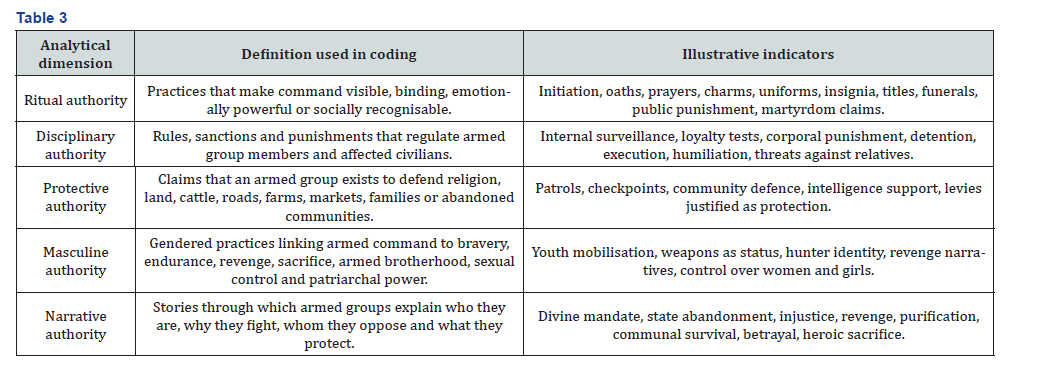
The article identifies five dimensions of cultures of command. Ritual authority includes initiation, oaths, charms, prayers, uniforms, insignia, titles, ceremonies, martyrdom claims and symbolic practices of loyalty. Disciplinary authority includes punishment, internal surveillance, movement control, loyalty tests and sanctions for betrayal. Protective authority refers to the claim that an armed group exists to defend something valuable, such as religion, land, cattle, territory, markets, roads, farms, family or abandoned communities. Masculine authority captures the gendered practices through which armed command is associated with bravery, endurance, revenge, sacrifice, armed brotherhood and patriarchal control Enloe [26]; Goldstein [27]; Higate [28]. Narrative authority refers to stories of divine mandate, injustice, state abandonment, revenge, purification, communal survival, betrayal or heroic sacrifice.
The argument proceeds through a qualitative comparative analysis of three non-state armed formations in Nigeria: Boko Haram and ISWAP as insurgent formations; vigilante and community defence formations, including the Civilian Joint Task Force, hunters, Yan Sakai and local vigilantes; and bandit formations in the North West. This comparative approach avoids treating all non-state armed groups as the same. It also avoids reducing Nigerian insecurity to terrorism, criminality, governance failure or state weakness alone. These categories matter, but they do not exhaust the problem. Each formation shows that command beyond the state has a cultural life. It is built through rituals, meanings, memories, performances, loyalties, punishments and claims to protection.
The article contributes to four bodies of scholarship. First, it extends military culture studies beyond formal state armed forces King [2,29]; Soeters [3]. Second, it contributes to Nigerian security studies by shifting attention from violence as event to violence as social order Agbiboa [12,13]; Higazi [7]; International Crisis Group [8,14,17]; Ojo [18]; Pérouse de Montclos [9]; Thurston [10]; Zenn [11]. Third, it contributes to debates on public authority and hybrid governance in Africa, where authority is often plural, negotiated and contested rather than monopolised by the state Bierschenk and Olivier de Sardan [30]; Hagmann and Péclard [31]; Lund [23]; Meagher [24]. Fourth, it contributes to armed group governance literature by showing that non-state armed groups govern not only through coercion, taxation or territorial control, but also through symbols, rituals, stories, gendered codes and embodied practices of command Arjona [20]; Mampilly [5]; Staniland [32]; Weinstein [6].
Military culture beyond formal armed forces
Military culture is commonly understood as the shared values, norms, rituals, symbols, habits, identities and institutional practices through which armed organisations produce discipline, cohesion, obedience, sacrifice and belonging Builder [1]; King [2]; Soeters [3]. In formal state militaries, such culture is visible through drill, uniforms, rank, ceremonies, regimental memory, weapons training, codes of honour, memorialisation and the socialisation of recruits into a disciplined collective. Military culture is therefore not reducible to strategy, doctrine or organisational structure. It is a social and symbolic order through which people learn how to see themselves as members of an armed institution.
This state-centred focus becomes limiting where the state does not monopolise organised violence. In many contemporary conflicts, command, discipline, sacrifice and armed belonging are produced not only in barracks but also in forests, borderlands, villages, displaced persons’ camps, religious communities, vigilante posts, cattle routes, mining zones and rural corridors. Armed authority may be generated by insurgents, militias, vigilantes, hunters, self-defence groups, criminal armed networks, separatist formations, pastoralist defence groups and hybrid security actors. These groups may not possess formal legality, bureaucratic coherence or professional doctrine, but they often possess cultural systems of command Arjona [20]; Mampilly [5]; Meagher [24]; Staniland [32].
In this sense, non-state armed groups are not only military or criminal actors. They are also cultural formations. They create internal worlds. They produce symbols of rank and authority. They establish rituals of entry and loyalty. They circulate stories of grievance, purity, revenge, protection, abandonment or divine mission. They mark bodies through dress, weapons, scars, charms, uniforms, headbands, amulets or other signs of belonging. They regulate gender relations and often construct masculinity around courage, hardness, endurance, domination and sacrifice Enloe [26]; Goldstein [27]; Higate [28].
This point is crucial for Nigeria. Boko Haram and ISWAP rely on religious language, moral separation, punishment, recruitment narratives, martyrdom claims, gender regulation and symbolic violence Higazi [7]; Pérouse de Montclos [7]; Thurston [10]; Zenn [11]. Vigilantes, hunters, the Civilian Joint Task Force, Yan Sakai and other community defence formations draw on locality, neighbourhood recognition, youth masculinity, protective sacrifice, spiritual practice and terrain knowledge Agbiboa [12,13]; International Crisis Group [14]; Okoli [15]. Bandit formations in the North West rely on fear, reputation, hostagetaking, mobility, armed wealth, coercive negotiation and revenge narratives GI-TOC and ACLED [16]; International Crisis Group [17]; Ojo et al. [18]; Osasona [19].
The study of military culture beyond formal armed forces also forces a reconsideration of legitimacy. Formal militaries are typically legitimated through law, national service, constitutional authority and public narratives of defence. Non-state armed groups operate under more unstable conditions. Some claim religious legitimacy. Some claim communal legitimacy. Some claim protective legitimacy. Some rule through fear without broad legitimacy. Others combine coercion and recognition in ambiguous ways. Legitimacy, in this context, is a practical and cultural relationship through which people comply, support, tolerate, fear, negotiate with or depend on armed actors Lund [23]; Mampilly [5]; Meagher [24].
Public authority, armed group governance and cultures of command
The article’s conceptual framework sits at the intersection of military culture, armed group governance and African public authority. Military culture scholarship shows that armed organisations produce identity, cohesion, discipline, sacrifice and belonging Builder [1]; King [2,29]; Soeters [3]. Armed group governance scholarship shows that non-state armed actors may regulate civilians, extract resources, administer order, punish disobedience and govern through coercion, negotiation and selective provision Arjona [20]; Kalyvas [4]; Mampilly [5]; Staniland [32]; Weinstein [6]. Public authority scholarship shows that authority in many African settings is plural and produced through overlapping state, customary, religious, communal, coercive and informal actors Bierschenk and Olivier de Sardan [30]; Hagmann and Péclard [31]; Lund [23]; Meagher [24].
These literatures are rarely placed in direct conversation. Military culture studies often privilege formal state institutions. Armed group governance studies often focus on the functions of rule, such as taxation, dispute settlement, territorial control, service provision and civilian regulation. Public authority studies often examine how state and non-state actors negotiate power in everyday life. Each literature offers important insights. Yet taken separately, they do not fully explain how non-state armed groups make command culturally meaningful.
Cultures of command are the symbolic, ritual, disciplinary and relational practices through which armed groups produce obedience, hierarchy, identity and belonging. The concept rests on one central claim: command is not only an organisational relationship between superior and subordinate. It is also a cultural relationship. People obey, follow, fear, sacrifice, defect, endure or identify with armed groups because command is embedded in meaning. Command becomes durable when it is ritualised, narrated, embodied and socially recognised. This approach draws on ritual theory’s insight that repeated symbolic practices help produce authority, belonging and social order Bell [21]; Geertz [22]; Turner [25]. Ritual authority refers to the practices through which armed groups make command visible, binding, emotionally powerful or socially recognisable. These practices may include initiation, oaths, charms, prayers, religious instruction, uniforms, insignia, names, titles, ceremonies, funerals, public punishments or symbolic displays of weapons. Ritual marks the boundary between ordinary life and armed belonging. It tells members that they have crossed into a different moral and social world. It also tells civilians who commands, who belongs, who threatens and who must obey.
Disciplinary authority refers to rules, sanctions and punishments that regulate behaviour. Every armed group faces the problem of control. Members may disobey orders, steal, defect, betray secrets, refuse operations or challenge commanders. Formal militaries discipline through legal codes, rank structures, courts martial and professional norms. Non-state armed groups often rely on personal loyalty, fear, religious rules, peer pressure, corporal punishment, spiritual sanctions, execution, detention, public humiliation or threats against relatives Kalyvas [4]; Mampilly [5]; Weinstein [6]. These forms of discipline may be crude, violent and inconsistent, but they are central to command. Protective authority refers to the claim that an armed group exists to defend something valuable: religion, land, cattle, roads, farms, markets, women, family, territory, ethnic identity, moral order or abandoned populations. Protection is one of the most powerful languages through which armed groups justify themselves. It can create obligation. Those who are protected may be expected to obey, provide information, offer food, pay levies, give shelter, supply recruits or remain silent. Protection can therefore become a route to extraction and domination Mampilly [5]; Meagher [24].
Masculine authority refers to the gendered practices through which armed command is associated with bravery, endurance, hardness, revenge, sacrifice, armed brotherhood, sexual control and patriarchal power. Young men may join armed groups to gain respect, income, protection, revenge, status or a sense of purpose. Weapons can transform social identity. A marginal youth may become a defender, commander, fighter, scout, executioner, informant or feared local actor. Armed masculinity offers recognition where ordinary social pathways are blocked or degraded Enloe [26]; Goldstein [27]; Higate [28]. Narrative authority refers to the stories through which armed groups explain who they are, why they fight, whom they oppose, what they protect and why their violence matters. Narratives turn violence into mission, punishment into justice, death into sacrifice, revenge into obligation and fear into order. These stories may be religious, ethnic, communal, revolutionary, criminal, historical or personal. Their power lies not only in factual accuracy but in their ability to organise emotion and action.
The framework is relational rather than mechanical. It does not claim that every armed group possesses all five dimensions equally. Some groups rely heavily on ritual and narrative. Others rely more on fear and discipline. Some produce real social belonging. Others produce coerced compliance. Some seek recognition from communities. Others thrive on distance and terror. The concept is useful because it allows comparison across different armed formations without assuming that they are the same. The concept also connects directly to debates on public authority. Public authority concerns the capacity to make rules, enforce decisions, claim legitimacy, provide order and shape social conduct. In many African settings, public authority is not monopolised by the formal state. It is negotiated among state agencies, chiefs, religious leaders, local elites, vigilantes, militias, development actors, criminal networks and communities Bierschenk and Olivier de Sardan [30]; Hagmann and Péclard [31]; Lund [23]; Meagher [24]. Cultures of command show how armed actors enter this field not only by controlling territory or imposing violence, but by producing symbols, rituals, narratives and relationships that make their authority socially visible. This does not mean that all armed authority is legitimate. It means that authority is socially produced. Even fear-based authority must be communicated, remembered and recognised. Even illegitimate command must be performed in ways that people understand. Cultures of command therefore help explain how armed groups become part of everyday political order, even when they remain outside legality.
Methods and Materials
This article adopts a qualitative comparative case-study design. It examines three types of non-state armed formation in Nigeria: Boko Haram and the Islamic State West Africa Province, vigilante and community defence formations, and bandit networks in the North West. The cases were selected because they represent analytically distinct pathways of command within the same national setting: insurgent-sacral, vigilante-protective and bandit-coercive. This design makes it possible to compare armed formations that differ in ideology, legitimacy and relationship to civilians without reducing them to a single category of insecurity. The analysis draws on documentary materials, peer-reviewed scholarship, institutional reports, policy documents and publicly available media sources. Academic sources are used to situate the study within debates on military culture, armed group governance, public authority, insurgency, vigilantism and banditry.
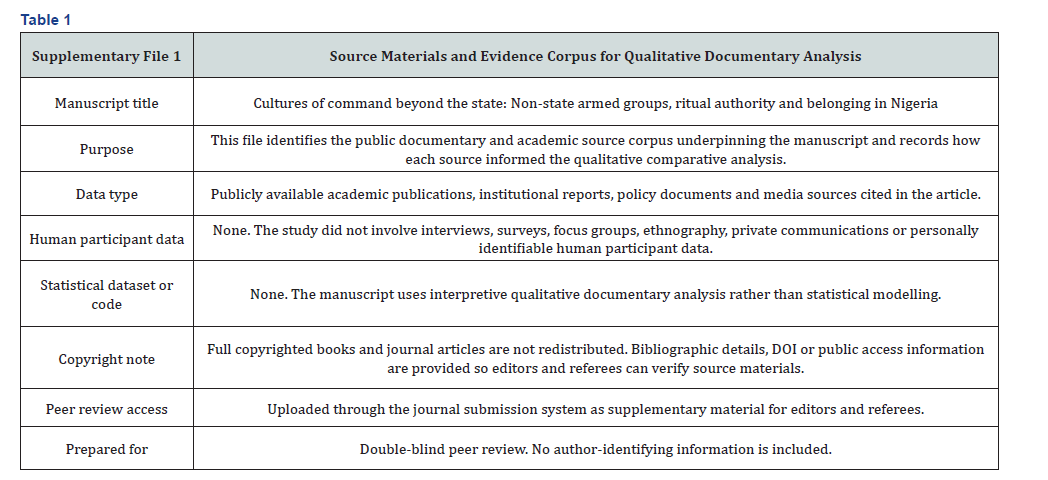
Institutional and policy sources are used to triangulate empirical claims about the organisation, practices and effects of non-state armed groups in Nigeria. Media sources are used selectively where they provide evidence of visible practices such as patrol routines, public punishment, ransom negotiation, community defence, abduction, funerary practices, symbolic display or armed-group messaging. The study uses interpretive cultural analysis rather than statistical inference. It does not seek to measure the prevalence of armed-group practices across Nigeria. Instead, it analyses how repeated practices of ritual, discipline, protection, masculinity, narrative and fear produce command within different armed formations. Following the article’s comparative logic, the analysis triangulates three corresponding aspects: the cultural production of insurgent authority, the local socialisation of vigilante protection, and the coercive ordering of bandit violence. The aim is to identify mechanisms through which non-state armed groups make command socially meaningful. The study does not involve interviews, surveys, focus groups, ethnography, private communications or personally identifiable human participant data. It relies on publicly available documents and published materials. The analysis is therefore limited by the uneven availability of reliable information on clandestine and violent organisations. Claims about armed-group practices are treated cautiously and triangulated where possible across scholarly, institutional and documentary sources.
Nigeria’s non-state armed landscape
Nigeria’s contemporary security landscape is marked by the multiplication of armed actors outside the formal state. These actors differ in ideology, organisation, territorial reach, social embeddedness and relationship to civilians. Some operate as insurgent movements. Some function as community defence formations. Some emerge as vigilante groups, hunters’ associations, ethnic militias or informal security providers. Others operate as predatory armed networks engaged in kidnapping, cattle rustling, extortion, illegal taxation, rural raiding or coercive extraction Agbiboa [12,13]; GI-TOC and ACLED [16]; International Crisis Group [14,17]; Ojo [18]; Osasona [19]. Their differences are substantial. Yet together they show that armed authority in Nigeria is no longer produced only through the formal institutions of the state.
Nigeria’s contemporary security landscape is marked by the multiplication of armed actors outside the formal state. These actors differ in ideology, organisation, territorial reach, social embeddedness and relationship to civilians. Some operate as insurgent movements. Some function as community defence formations. Some emerge as vigilante groups, hunters’ associations, ethnic militias or informal security providers. Others operate as predatory armed networks engaged in kidnapping, cattle rustling, extortion, illegal taxation, rural raiding or coercive extraction Agbiboa [12,13]; GI-TOC and ACLED [16]; International Crisis Group [14,17]; Ojo [18]; Osasona [19]. Their differences are substantial. Yet together they show that armed authority in Nigeria is no longer produced only through the formal institutions of the state.
Three broad formations are especially relevant. The first is the insurgent formation associated with Boko Haram and ISWAP. Boko Haram emerged in northeastern Nigeria and became one of the most destructive insurgent movements in Africa. Its violence has targeted civilians, state institutions, schools, religious communities, markets, roads, security forces and symbols of secular authority Higazi [7]; Pérouse de Montclos [9]; Thurston [10]; Zenn [11]. ISWAP, which later emerged from factional dynamics within the insurgency, developed a more structured territorial and administrative orientation in parts of the Lake Chad region International Crisis Group [8]; Samuel [33]. The second formation consists of vigilante and community defence actors. These include the Civilian Joint Task Force in the North East, hunters’ groups, Yan Sakai formations in the North West, local vigilantes, neighbourhood security groups and other community-based armed actors. These formations often emerge where communities perceive that the state cannot adequately protect them. They may provide local intelligence, patrol neighbourhoods, identify suspected insurgents or bandits, guide state forces, defend markets and villages, and reassure threatened populations Agbiboa [12,13]; Higazi [7]; International Crisis Group [14]. Their authority is usually rooted in proximity. They know the terrain, families, roads, languages, forests and social histories of the communities they claim to protect.
The third formation consists of bandit networks and rural armed groups, especially in the North West. These groups are commonly associated with kidnapping for ransom, cattle rustling, village raids, sexual violence, forced levies, extortion and attacks on farming communities GI-TOC and ACLED [16]; International Crisis Group [17]; Ojo [18]; Osasona [19]. Their organisation is often fluid. Some formations revolve around known commanders, forest camps, kinship ties, cattle economies, patronage, revenge narratives and access to weapons. Unlike vigilante groups, bandit formations generally do not rely on public recognition as protectors. Their authority is produced primarily through fear, reputation, hostage control, mobility and the capacity to punish communities that resist or fail to pay. These three formations reveal different pathways through which non-state command is produced. Insurgent command is built through religious authority, moral absolutism, punishment and anti-state identity. Vigilante command is built through locality, protection, sacrifice, masculine courage and community recognition. Bandit command is built through fear, hostage-taking, mobility, ransom, territorial reputation and coercive wealth. Each formation produces a different relationship between armed actors and civilians. Each also produces a different form of belonging.
Insurgent ritual authority: Boko Haram and ISWAP
Boko Haram and ISWAP represent the insurgent dimension of Nigeria’s non-state armed landscape. Their significance for this article lies not only in the violence they have generated, but in the cultural worlds of command they have produced. Both formations have used religion, discipline, punishment, martyrdom, gender control, territorial memory and anti-state narratives to create armed communities of meaning Higazi [7]; International Crisis Group [8]; Pérouse de Montclos [9]; Thurston [10]; Zenn [11]. This form of ritual authority sacralises obedience. Discipline is not presented only as operational necessity. It is tied to religious obligation, moral purity and spiritual consequence. The commander is not merely an armed superior. He may appear as a religious guide, interpreter of doctrine, judge of loyalty and guardian of the group’s moral boundary. Obedience becomes a spiritual act. Disobedience becomes betrayal, apostasy, cowardice or contamination.
Punishment is another core element. Boko Haram’s violence has included public killings, forced displacement, abductions, sexual enslavement, destruction of schools, attacks on markets and punishment of perceived collaborators Higazi [7]; Pérouse de Montclos [9]; Thurston [10]. These practices are often analysed as terror, and correctly so. But they also function as performances of command. Public punishment teaches civilians and members what the group claims authority over. It dramatises the cost of disobedience. It turns violence into a message. Gender control also forms part of insurgent command culture. Armed groups frequently regulate women’s bodies as a way of regulating the moral community. Boko Haram’s treatment of women and girls, including abduction, forced marriage, sexual violence, coerced domestic labour and gendered discipline, reveals how patriarchal control is embedded in the group’s imagined order Enloe [26]; Goldstein [27]; Higate [28]; Sjoberg and Gentry [34]. Women are not incidental to insurgent culture. They are central to how the group performs domination, reproduction, purity, punishment and symbolic power.
ISWAP complicates the analysis further. While Boko Haram under Abubakar Shekau became associated with extreme indiscriminate violence, doctrinal rigidity and spectacular brutality, ISWAP has often been described as adopting a more strategic approach to civilian relations in some areas under its influence International Crisis Group [8]; Samuel [33]. This difference should not be overstated. ISWAP remains an insurgent organisation committed to violent opposition to the Nigerian state and its regional allies. Yet its relative emphasis on taxation, territorial administration, regulation of civilian life and selective engagement with local populations shows another dimension of insurgent command culture.
ISWAP’s authority illustrates how ritual and administration can converge in non-state armed governance. Command may be produced not only through spectacular violence but also through rules, levies, dispute settlement, controlled markets, mobility regulation, religious instruction and claims of order International Crisis Group [8]; Samuel [33]. In such contexts, civilians may obey not because they believe in the group, but because the group has made itself present, predictable, feared and administratively relevant. The anti-state dimension of insurgent command is also central. Boko Haram and ISWAP do not merely oppose the Nigerian state as a military enemy. They challenge the state’s moral and symbolic authority. Schools, courts, police stations, military bases, local government offices, traditional rulers and electoral structures become targets not only because they are strategically useful, but because they represent a rival order Higazi [7]; Pérouse de Montclos [9]; Thurston [10]. Attacking them is a way of rejecting the state’s claim to define law, knowledge, protection, punishment and citizenship.
Fear should not be underestimated. Insurgent ritual authority is not sustained by belief alone. It is sustained by terror. Many civilians comply because refusal can mean death, abduction, displacement, confiscation or collective punishment. Many recruits may remain because escape is dangerous. Many communities may negotiate because the state cannot guarantee protection. Yet fear itself must be organised. It must be communicated through memory, rumour, spectacle and repeated violence. Boko Haram and ISWAP show that insurgent command is a cultural system. It is made through practices that convert violence into moral order, terror into governance, discipline into obedience and death into sacrifice. The insurgent commander commands not only because he has weapons, but because command is embedded in symbols, threats, stories, rituals, punishments and claims to divine order.
Vigilante belonging and community defence
Vigilante and community defence formations represent a different culture of command from insurgent organisations. Unlike Boko Haram and ISWAP, they do not usually define themselves through rejection of the Nigerian state. Many present themselves as protectors of communities, auxiliaries of state security forces, defenders of neighbourhoods, hunters of criminals and local actors responding to state incapacity Agbiboa [12,13]; International Crisis Group [14]. Their authority is rooted less in religious absolutism than in locality, proximity, sacrifice, terrain knowledge, masculine courage and community recognition. Yet they too produce cultures of command. The rise of vigilante and community defence groups in Nigeria must be understood against the background of insecurity and uneven state protection. In many affected communities, the formal security agencies are experienced as distant, overstretched, slow, under-resourced, abusive or unfamiliar with local terrain Agbiboa [13]; International Crisis Group [14]; Meagher [24]. Soldiers and police may enter communities during operations, but they often lack intimate knowledge of local languages, kinship ties, forest paths, farming routes, cattle corridors and histories of grievance. Community defence formations emerge in this gap. They claim to know the people, the roads, the suspects, the hideouts, the strangers, the families and the rumours.
The Civilian Joint Task Force illustrates this dynamic. It emerged in the context of the Boko Haram insurgency, when local youths began assisting security forces with intelligence, identification of suspected insurgents, patrols, arrests and community defence Agbiboa [12,13]; Higazi [7]. Its members possessed knowledge that formal forces often lacked. They could identify strangers, decode local relationships, recognise suspicious movement and interpret neighbourhood rumours. This knowledge became a source of command. It gave local youths a new status as security actors and transformed the relationship between civilians, the military and insurgents. The CJTF’s authority was produced through protection and recognition. Communities under threat could see its members as those who stood between civilians and insurgent violence. State forces could treat them as useful intermediaries. Young men who might otherwise have been socially marginal could acquire status, discipline, income, influence and masculine recognition. The vigilante became a figure of armed belonging. He was not a professional soldier, but he was no longer an ordinary civilian. He occupied an ambiguous space between the community and the state, between youth and fighter, between protector and potential threat.
This ambiguity is crucial. Vigilante command is often morally unstable. Community defence groups may protect civilians from insurgents, bandits, kidnappers or criminals, but they may also engage in extortion, arbitrary punishment, abuse of suspects, political intimidation, personal revenge and unauthorised violence Agbiboa [13]; International Crisis Group [14]. Their authority may begin as local necessity but later become entrenched. Once armed youths acquire recognition, weapons, access to state forces and local influence, demobilisation becomes difficult. The culture of command they produce can outlive the emergency that created it. Ritual authority is central to this process. Vigilante groups often rely on visible signs of belonging such as uniforms, armbands, headgear, identity cards, patrol vehicles, whistles, Dane guns, cutlasses, charms, amulets and insignia. These objects mark the body as authorised, brave, dangerous, protected or available for command. They separate the vigilante from the ordinary civilian. They tell the community that this person now belongs to an armed order.
Masculine authority is especially pronounced in vigilante command. Community defence formations often draw young men into armed roles by appealing to courage, anger, revenge, honour and the duty to defend family and land. The ability to confront danger becomes a test of manhood. The armed youth may gain respect from elders, fear from rivals, recognition from security agencies and admiration from peers. Armed service can become a route to social adulthood where unemployment, poverty, displacement and insecurity have blocked conventional paths to status Enloe [26]; Goldstein [27]; Higate [28]. Protective authority is the core of vigilante belonging. Vigilante groups usually derive social justification from the claim that they protect communities. This claim speaks directly to everyday fear. In insecure environments, protection concerns the ability to farm, travel, trade, sleep, attend school, worship, collect firewood, visit relatives and remain alive. When formal security fails to guarantee these basic conditions, vigilante protection can acquire immediate moral force.
Yet protection can become extraction. Communities that rely on vigilantes may be asked to provide food, money, information, shelter, recruits or political support. Vigilantes may impose levies, control movement, punish alleged collaborators or decide who is trustworthy. The protector may become a local authority. The boundary between service and domination may narrow. This is why vigilante command must be studied not only as community resilience but also as a potential form of informal coercive power Meagher [24]. Vigilante belonging is produced through shared risk. Members patrol together, sleep in dangerous conditions, identify suspects, confront armed groups, bury comrades and face reprisals. These experiences create bonds that can resemble military brotherhood, even without formal military training. Commanders acquire authority not only by appointment but by reputation, courage, age, spiritual knowledge, battlefield experience or connection to state forces and local elites. The Nigerian experience shows that vigilante belonging is neither simple heroism nor mere criminality. It is a complex cultural formation produced at the intersection of insecurity, local identity, masculine recognition, spiritual practice, state weakness and community survival.
Banditry, fear and coercive command
Bandit formations in Nigeria’s North West represent a third culture of command. Unlike insurgent groups such as Boko Haram and ISWAP, they do not usually claim a comprehensive religious project or seek to replace the Nigerian state through an alternative ideological order. Unlike vigilante and community defence formations, they do not normally derive authority from public recognition as protectors of threatened communities. Their command is more openly coercive. It is produced through fear, armed mobility, hostage-taking, ransom negotiation, cattle wealth, revenge narratives, territorial familiarity and reputational violence GI-TOC and ACLED [16]; International Crisis Group [17]; Ojo [18]; Osasona [19].
Banditry is often described as criminality, and this description is necessary. Armed bandit formations have been associated with kidnapping for ransom, cattle rustling, village raids, road ambushes, sexual violence, forced levies, extortion, murder and attacks on farming communities GI-TOC and ACLED [16]; Ojo [18]; Osasona [19]. These practices are predatory and destructive. They have devastated rural life, disrupted agriculture, closed schools, displaced communities, weakened local markets and turned ordinary movement into a dangerous act. However, to describe banditry only as criminal violence is analytically insufficient. Bandit formations also create coercive orders. They organise fear, regulate movement, create reputations, impose payments, negotiate from positions of violence and produce commanders, followers, scouts, informants, negotiators and victims.
The central question is how criminal violence becomes command. How does fear become authority? How does ransom become a ritual of domination? How does territorial reputation become a form of rule? How do armed networks produce loyalty, obedience and belonging in the absence of public legitimacy? These questions matter because bandit formations in the North West are not random gatherings of armed men. Many operate through identifiable commanders, forest camps, kinship ties, patronage relations, cattle economies, weapon networks, local informants and negotiated relationships with surrounding communities (GI-TOC and ACLED [16]; International Crisis Group [17]; Ojo [18]; Osasona [19]. Fear is the foundation of bandit command. Villages may comply because they fear attack. Families may pay ransom because they fear the death of abducted relatives. Farmers may abandon land because they fear ambush. Schools may close because they fear mass abduction. Travellers may avoid roads because they fear checkpoints, kidnapping or execution. Fear becomes a social infrastructure. It reorganises behaviour even when bandits are not physically present.
Ransom negotiation is one of the clearest rituals of bandit command. It is often treated as a transaction: a victim is abducted, a demand is made, money is paid and release may follow. Yet ransom is not merely economic. It is performative. The phone call, the threat, the crying voice of the hostage, the naming of a price, the deadline, the beating of captives, the demand for proof of seriousness, the instruction on where to deliver money and the uncertainty of release all become ritualised elements of domination. The captor uses the body of the hostage to command the emotions, resources and obedience of the family and community. Through ransom, bandits extend command into households far from the forest. Parents sell land, cattle, jewellery, grain or business assets. Relatives borrow from neighbours. Communities contribute. Negotiators emerge. Religious leaders intervene. Local officials may be contacted. Security agencies may be avoided because families fear reprisal. The bandit commander becomes present in the family economy, the village meeting, the market and the prayer gathering. Ransom converts private grief into public submission.
Territorial mobility is another source of bandit command. Bandit formations often operate through forests, rural corridors, borderlands, grazing routes, abandoned settlements and difficult terrain. Their authority does not always depend on fixed control of towns. It may depend on the ability to appear, disappear, strike, retreat, relocate captives and evade formal security operations. Mobility becomes power. The state may hold official jurisdiction, but bandits may control practical access to roads, farms, schools and villages through their capacity to interrupt movement. Reputation is central to this authority. Bandit commanders often become known through stories of brutality, generosity to followers, revenge, wealth, mystical protection or military capacity. Names circulate through markets, villages, security briefings, media reports and family conversations. These reputations can be exaggerated, but their social effect is real. A feared name can discipline communities before any attack occurs. Reputation reduces the need for constant violence because memory does some of the work of command.
Territorial mobility is another source of bandit command. Bandit formations often operate through forests, rural corridors, borderlands, grazing routes, abandoned settlements and difficult terrain. Their authority does not always depend on fixed control of towns. It may depend on the ability to appear, disappear, strike, retreat, relocate captives and evade formal security operations. Mobility becomes power. The state may hold official jurisdiction, but bandits may control practical access to roads, farms, schools and villages through their capacity to interrupt movement. Reputation is central to this authority. Bandit commanders often become known through stories of brutality, generosity to followers, revenge, wealth, mystical protection or military capacity. Names circulate through markets, villages, security briefings, media reports and family conversations. These reputations can be exaggerated, but their social effect is real. A feared name can discipline communities before any attack occurs. Reputation reduces the need for constant violence because memory does some of the work of command.
Bandit command differs from insurgent command in its limited ideological horizon. It usually does not seek to create a comprehensive religious or political order. It is also different from vigilante command because it lacks a stable claim to communal protection. Yet it still produces belonging. Fighters may develop loyalty to commanders, dependence on spoils, fear of punishment, shared identity as armed men, kinship bonds, revenge commitments and group pride. These bonds may be unstable, but they are not meaningless. They create a predatory brotherhood organised around violence, wealth, fear and survival. The North West banditry case therefore expands the concept of cultures of command by showing that command need not rest on ideological legitimacy or communal recognition. It can also be produced through coercive reputation. The bandit commander commands because people believe he can harm them, because his threats have memory, because his name travels, because his violence has pattern, because his fighters obey, because his informants listen, because his hostages suffer and because the state cannot always prevent his reach.
Comparative discussion
The three cases show that non-state armed groups in Nigeria produce command through different cultural logics. Boko Haram and ISWAP sacralise command through religious discipline, moral separation, punishment, martyrdom, gender control and antistate narratives. Vigilante and community defence formations localise command through protection, sacrifice, masculine courage, spiritual practice, community recognition and terrain knowledge. Bandit formations coerce command through fear, hostage-taking, ransom negotiation, territorial mobility, cattle wealth, revenge narratives, armed masculinity and reputational violence. These differences are important. They show that nonstate armed groups cannot be collapsed into a single category of insecurity.
Yet the comparison also reveals a common pattern. In all three formations, command is not produced by weapons alone. It is made through symbols, rituals, stories, embodied practices, punishments, loyalties, reputations and relationships with surrounding communities. Armed authority beyond the state therefore has a cultural life. It must be performed, narrated, remembered and made visible to members, enemies, civilians, rivals and the state. One comparison concerns the source of authority. Insurgent command is built around religious and ideological authority. Boko Haram and ISWAP claim to act in the name of a higher moral order. Their command culture depends on the classification of enemies, the regulation of obedience, the promise of martyrdom and the rejection of the Nigerian state as morally illegitimate. Vigilante command is built around protective and local authority. Its power depends on the claim that community members must defend themselves where formal security is absent, inadequate or distrusted. Bandit command is built around coercive authority. It does not require deep public legitimacy. It requires the credible capacity to harm, abduct, extort, punish and return.
Another comparison concerns ritual authority. Boko Haram and ISWAP use religious instruction, oaths of loyalty, martyrdom claims, punishment and symbolic violence to sacralise command. Vigilantes use uniforms, charms, oath-taking, patrol routines, checkpoints, funerals, community ceremonies and hunter traditions to localise command. Bandits use ransom calls, hostage displays, commander reputations, territorial naming, threats and exemplary violence to ritualise fear. Ritual therefore does not belong only to religious or formal military settings. It appears wherever repeated practices make command socially recognisable. A further comparison concerns masculinity. All three formations produce armed masculinities, but in different registers. Insurgent masculinity is tied to religious struggle, discipline, martyrdom, control of women and the willingness to fight in the name of divine command. Vigilante masculinity is tied to local defence, courage, sacrifice, hunter identity, youth mobilisation and the protection of families and communities. Bandit masculinity is tied to weapons, wealth, cattle, sexual domination, revenge, mobility and the capacity to inspire fear. These masculinities shape recruitment, violence, loyalty and public perception.
The comparison also clarifies the difference between coercion and culture. Culture does not mean consent. It does not imply that people willingly accept armed authority. Culture refers to the meanings, rituals, symbols and practices through which authority is made intelligible. A hostage family may hate the bandits who abducted their child, but they still understand the ritual of ransom. A village may resent vigilantes, but still recognise the patrol routine. A civilian may reject insurgent ideology, but still know what behaviour the insurgents punish. Armed culture can organise compliance even without moral acceptance. The analytical payoff extends beyond Nigeria. Many contemporary conflicts involve armed actors that are neither conventional armies nor simple criminal gangs. Militias, vigilantes, rebels, paramilitaries, self-defence forces, extremist groups and criminalpolitical networks often operate in spaces where state authority is partial, contested or violent.
The Nigerian case suggests that these actors should be studied not only through their military capacity, financing, ideology or relationship to the state, but also through the cultural practices that make their command durable. Nigeria’s insurgents, vigilantes and bandits show three distinct pathways. Insurgent command sacralises authority. Vigilante command localises authority. Bandit command coerces authority. Each pathway produces identity, power and belonging. Each also reveals the instability of armed life beyond the state. Insurgent command can fragment through doctrinal and leadership disputes. Vigilante command can slide from protection into abuse. Bandit command can collapse into factional violence or provoke military retaliation. Cultures of command are powerful, but they are also contested and unstable (Table 1-3).

Conclusion
This article has argued that non-state armed groups in Nigeria should be understood not only as security threats, criminal networks, insurgent organisations or informal providers of protection, but also as producers of armed culture. Their authority is not sustained by weapons alone. It is produced through rituals, symbols, discipline, narratives, masculinities, protection claims, fear, memory and practices of belonging. These cultural practices make command visible, intelligible, feared, tolerated, resisted or sometimes recognised by those who live within and around armed violence. The article developed the concept of cultures of command to capture this process. Cultures of command are the symbolic, ritual, disciplinary and relational practices through which armed groups produce obedience, hierarchy, identity and belonging. The concept shifts attention from command as a purely organisational structure to command as a cultural relationship. People obey, fear, follow, sacrifice, negotiate with or resist armed groups not only because force is present, but because force is embedded in meaning. Command becomes durable when it is ritualised, narrated, embodied, performed and socially recognised.
Nigeria’s non-state armed landscape illustrates this argument with particular force. Boko Haram and ISWAP produce insurgent command through religious discipline, moral separation, punishment, martyrdom, gender control, enemy-making and antistate narratives. Vigilante and community defence formations produce command through locality, protection, sacrifice, masculine courage, spiritual practice, patrol routines, terrain knowledge and community recognition. Bandit formations in the North West produce command through fear, hostage-taking, ransom negotiation, armed mobility, cattle wealth, revenge narratives, informant networks and reputational violence. The article makes three contributions. First, it contributes to military culture studies by extending the analysis of command, discipline, sacrifice, identity and belonging beyond formal state armed forces. Second, it contributes to Nigerian security studies by shifting attention from violence as event to violence as social order. Third, it contributes to debates on public authority and hybrid security governance in Africa by showing how armed actors become part of local authority fields through symbols, rituals, narratives and relationships.
The argument also carries an important caution. To study the culture of non-state armed groups is not to legitimise their violence. Armed culture can protect, but it can also brutalise. It can produce solidarity, but it can also produce exclusion. It can honour sacrifice, but it can also normalise death. It can claim protection, but it can also justify extortion, abduction, revenge, sexual violence and terror. Cultures of command are therefore morally ambivalent. They must be analysed with care, not romanticised. The broader implication is that armed life must be studied through its meanings as well as its operations. Weapons, money, terrain, state weakness and political patronage matter. But rituals, symbols, memories, bodies, stories, funerals, oaths, uniforms, charms, threats, ransom calls and reputations also matter. They are not decorative. They are part of how armed groups organise obedience and make violence socially consequential. Military culture does not end at the gate of the barracks. It extends into the contested spaces where armed actors produce order, identity, fear, protection and belonging beyond the state. Nigeria’s insurgents, vigilantes and bandits show that command can be sacred, local, coercive, protective, predatory, masculine, ritualised and unstable at the same time. Their cultures of command reveal the deeper social life of armed power in contemporary insecurity.
Data availability
Supplementary File 1, titled ‘Source Materials and Evidence Corpus for Qualitative Documentary Analysis’, has been uploaded with this submission for editors and referees. It contains the documentary evidence corpus and coding log used for the qualitative comparative analysis, including source type, full citation, access information or identifier where available, case assignment, evidence use in the manuscript, analytical coding dimension and raw material status. The study did not generate statistical datasets, interview transcripts, survey records, field notes, experimental materials, formulae or computational scripts. No interviews, surveys, focus groups, ethnography, private communications or personally identifiable human participant data were collected or analysed. All underlying materials are publicly available academic publications, institutional reports, policy documents and media sources cited in the article. Where copyrighted books, book chapters or journal articles are cited, the full texts are not redistributed; instead, the supplementary evidence corpus provides bibliographic details, DOI or access information sufficient for verification by editors and referees.
References
- Builder CH (1989) The masks of war: American military styles in strategy and analysis. Johns Hopkins University Press, Baltimore.
- King A (2006) The word of command: Communication and cohesion in the military. Armed Forces & Society 32(4): 493-512.
- Soeters J, Winslow D, Weibull A (2006) Military culture. In: Caforio G (ed) Handbook of the sociology of the military. Springer, New York pp. 237-254.
- Kalyvas SN (2006) The logic of violence in civil war. Cambridge University Press, Cambridge.
- Mampilly ZC (2011) Rebel rulers: Insurgent governance and civilian life during war. Cornell University Press, Ithaca.
- Weinstein JM (2007) Inside rebellion: The politics of insurgent violence. Cambridge University Press, Cambridge.
- Higazi A (2015) Mobilisation into and against Boko Haram in North-East Nigeria. In: Pérouse de Montclos M-A (ed) Boko Haram: Islamism, politics, security and the state in Nigeria. African Studies Centre, Leiden pp. 305-358.
- International Crisis Group (2019) Facing the challenge of the Islamic State in West Africa Province. International Crisis Group, Brussels.
- Pérouse de Montclos M-A (ed) (2016) Boko Haram: Islamism, politics, security and the state in Nigeria. African Studies Centre, Leiden.
- Thurston A (2018) Boko Haram: The history of an African jihadist movement. Princeton University Press, Princeton.
- Zenn J (2020) Unmasking Boko Haram: Exploring global jihad in Nigeria. Lynne Rienner, Boulder.
- Agbiboa DE (2020) Vigilante youths and counterinsurgency in northeastern Nigeria: The Civilian Joint Task Force. Oxford Development Studies 48(4): 360-372.
- Agbiboa DE (2021) The precariousness of protection: Civilian defence groups countering Boko Haram in northeastern Nigeria. African Studies Review 64(1): 192-216.
- International Crisis Group (2022) Managing vigilantism in Nigeria: A near-term necessity. International Crisis Group, Brussels.
- Okoli CR (2024) Yan Sakai vigilantism and community response to armed banditry in Nigeria's North West. In: Ojo JS, Aina F, Oyewole S (eds) Armed banditry in Nigeria: Evolution, dynamics and trajectories. Palgrave Macmillan, Cham pp. 251-277.
- GI-TOC and ACLED (2024) Non-state armed groups and illicit economies in West Africa: Armed bandits in Nigeria. Global Initiative Against Transnational Organized Crime and Armed Conflict Location & Event Data Project, Geneva.
- International Crisis Group (2020) Violence in Nigeria's North West: Rolling back the mayhem. International Crisis Group, Brussels.
- Ojo JS, Oyewole S, Aina F (2023) Forces of terror: Armed banditry and insecurity in North-west Nigeria. Democracy and Security 19(4): 319-346.
- Osasona T (2023) The question of definition: Armed banditry in Nigeria's North-West in the context of international humanitarian law. International Review of the Red Cross.
- Arjona A (2016) Rebelocracy: Social order in the Colombian civil war. Cambridge University Press, Cambridge.
- Bell C (1992) Ritual theory, ritual practice. Oxford University Press, Oxford.
- Geertz C (1973) The interpretation of cultures. Basic Books, New York.
- Lund C (2006) Twilight institutions: Public authority and local politics in Africa. Development and Change 37(4): 685-705.
- Meagher K (2012) The strength of weak states? Non-state security forces and hybrid governance in Africa. Development and Change 43(5): 1073-1101.
- Turner V (1969) The ritual process: Structure and anti-structure. Aldine, Chicago.
- Enloe C (2000) Maneuvers: The international politics of militarizing women's lives. University of California Press, Berkeley.
- Goldstein JS (2001) War and gender: How gender shapes the war system and vice versa. Cambridge University Press, Cambridge.
- Higate P (ed) (2003) Military masculinities: Identity and the state. Praeger, Westport.
- King A (2013) The combat soldier: Infantry tactics and cohesion in the twentieth and twenty-first centuries. Oxford University Press, Oxford.
- Bierschenk T, Olivier de Sardan J-P (eds) (2014) States at work: Dynamics of African bureaucracies. Brill, Leiden.
- Hagmann T, Péclard D (2010) Negotiating statehood: Dynamics of power and domination in Africa. Development and Change 41(4): 539-562.
- Staniland P (2012) States, insurgents, and wartime political orders. Perspectives on Politics 10(2): 243-264.
- Samuel M (2019) Economics of terrorism in Lake Chad Basin. Institute for Security Studies, Pretoria.
- Sjoberg L, Gentry CE (2007) Mothers, monsters, whores: Women's violence in global politics. Zed Books, London.

























