




 ACJPP Home



Abstract
Correctional reform and reintegration policy in Zimbabwe reflects a paradigmatic transition from punitive incarceration toward a rights-based and rehabilitative correctional framework. Historically shaped by colonial penal doctrines privileging deterrence and incapacitation, Zimbabwe’s prison system has undergone normative transformation following the Constitution of Zimbabwe Amendment (No. 20) Act, 2013 and subsequent reforms within the Zimbabwe Prisons and Correctional Service. This article critically examines the historical evolution, theoretical foundations, contemporary legislative reforms, reintegration programming, and structural constraints characterising this emerging correctional paradigm. Employing a qualitative doctrinal and policy analysis grounded in primary legislative sources, parliamentary records, and official institutional reports (2022–2023), alongside secondary literature and international normative instruments and particularly the United Nations Office on Drugs and Crime guidelines and the United Nations Standard Minimum Rules for the Treatment of Prisoners, the study therefore, situates Zimbabwe’s reforms within broader global correctional trends. The findings reveal significant institutional developments, including the formal adoption of parole, expansion of community service orders, establishment of open prison facilities, vocational and psychosocial rehabilitation programmes, and gender-responsive and juvenile justice reforms. Nonetheless, persistent challenges such as overcrowding, fiscal limitations, institutional culture, data deficits, and socio-economic vulnerabilities, which undermine the consolidation of sustainable reintegration outcomes. The article argues that durable correctional transformation requires enhanced legislative coherence, institutional capacity-building, multisectoral coordination, and measurable accountability frameworks. By interrogating the interplay between normative reform and structural realities, the study contributes to scholarship on post-colonial penal reform and reintegration governance in the Global South.
Keywords:Correctional Reform; Reintegration Policy; Restorative Justice; Parole System; Community Service Orders; Human Rights; Penal Reform; Post-Colonial Governance; Rehabilitation; Zimbabwe Prisons and Correctional Service
Introduction
Correctional reform and reintegration policy encompass coordinated legal, institutional, and social strategies aimed at transforming detention systems from primarily punitive institutions into rehabilitative and rights-based structures that facilitate successful re-entry into society Cullen et al. [1- 3]; UNODC [4]. Across jurisdictions, correctional philosophy has increasingly shifted from retributive and incapacitative models toward evidence-informed and human rights–oriented paradigms that emphasise dignity, proportionality, rehabilitation, and recidivism reduction Bottoms [5]; PRI [6]. Accordingly, foundational international standards, notably the guidelines of the United Nations Office on Drugs and Crime and the United Nations Standard Minimum Rules for the Treatment of Prisoners (the Nelson Mandela Rules), articulate minimum benchmarks for humane treatment, access to health and education, and structured reintegration planning United Nations [7]; UNODC [4,8]. These instruments therefore, reflect a broader normative transformation in global penal governance that recognizes rehabilitation and social reintegration not as discretionary privileges, but as central components of legitimate and effective correctional systems PRI [6]; UNODC [4]. Contemporary criminological scholarship further affirms that rehabilitative and restorative approaches, when implemented with fidelity and community support, are more likely to enhance public safety and reduce reoffending than purely punitive strategies Cullen et al. [1-3]; PRI [6].
Thus, within this global reform milieu, Zimbabwe has undertaken notable, albeit complex, efforts to reposition its correctional framework. The adoption of the Constitution of Zimbabwe marked a significant normative turning point by entrenching rights to human dignity, equality before the law, and freedom from inhuman or degrading treatment (Government of Zimbabwe [9]). The institutional transformation from the Zimbabwe Prison Service to the Zimbabwe Prisons and Correctional Service symbolised a deliberate shift from a custodial orientation to a correctional and rehabilitative mandate (ZPCS [10]). Subsequent reforms have included the operationalisation of parole mechanisms, expansion of community service orders, development of open prison facilities, and the strengthening of vocational training, educational programming, and faith-based initiatives within custodial settings (ZPCS [11]; PRI [6]). These measures align conceptually with continental and international calls for alternatives to incarceration and structured re-entry systems that mitigate the criminogenic effects of imprisonment (UNODC [4]; PRI [6]).
Notwithstanding these reforms, Zimbabwe’s correctional system continues to grapple with structural and historical constraints (PRI [6]). Colonial penal legacies, chronic overcrowding, limited fiscal resources, aging infrastructure, and broader socio-economic volatility present persistent obstacles to the realisation of a fully rehabilitative model (UNODC [9]). Overcrowding and resource scarcity, in particular, constrain individualised programming, mental health support, and postrelease supervision are therefore, key pillars of evidencebased reintegration policy (Cullen et al [1-3]; UNODC [4]). Moreover, stigma against formerly incarcerated persons, limited employment opportunities, and fragmented community support structures complicate sustainable reintegration (PRI [6]). These dynamics underscore the tension between progressive normative frameworks and the material realities of implementation in resource-constrained contexts. Emerging paradigms in Zimbabwe therefore reflect a hybrid landscape in which rights-based constitutionalism, restorative justice principles, and communityoriented correctional practices intersect with enduring institutional and socio-economic challenges (ZPCS [10,11]; PRI [6]). Increasing engagement with civil society organizations, faith-based actors, and international partners signals a gradual movement toward multi-stakeholder reintegration governance (UNODC [8]). At the same time, questions remain concerning policy coherence, monitoring and evaluation mechanisms, and the measurable impact of reforms on recidivism and social reintegration outcomes.
Therefore, this article critically examines the evolving paradigms shaping correctional reform and reintegration policy in Zimbabwe. It analyses the constitutional, legislative, and policy developments underpinning correctional transformation; evaluates the extent to which Zimbabwe’s reforms align with international human rights standards and contemporary criminological theory; assesses structural and institutional constraints affecting implementation; and explores the implications of these reforms for reintegration effectiveness and recidivism reduction. By situating Zimbabwe’s experience within broader debates on penal reform in the Global South, this study contributes to comparative scholarship on correctional governance, restorative justice, and the practical realization of rights-based rehabilitation in post-colonial and resource-limited settings.
Literature Review
Global Trends in Correctional Reform
Contemporary correctional scholarship has increasingly questioned the efficacy of punitive incarceration models, highlighting their limited deterrent impact and significant socioeconomic costs. Empirical research grounded in the Risk–Need– Responsivity (RNR) framework demonstrates that interventions targeting criminogenic needs such as education, vocational skills, substance abuse treatment, and cognitive-behavioural therapy are more effective in reducing recidivism than purely custodial approaches (Andrews & Bonta [12]; Cullen et al. [1-3]). These findings have catalysed a global shift toward evidencebased corrections that prioritize rehabilitation and structured reintegration. International normative frameworks reinforce this transformation. The United Nations Standard Minimum Rules for the Treatment of Prisoners (the Nelson Mandela Rules) articulate minimum standards for humane treatment, healthcare access, discipline, and reintegration planning (United Nations [13]). Similarly, the United Nations Office on Drugs and Crime (UNODC) advocates non-custodial measures, proportional sentencing, and community-based corrections to mitigate overcrowding and promote sustainable reintegration (UNODC [8]). These standards situate correctional reform within a human rights– based paradigm, emphasizing dignity, legality, and accountability (United Nations [13]; UNODC [8]).
Restorative justice scholarship further expands the reform discourse by foregrounding dialogue, victim participation, and community healing (Braithwaite [14]; Zehr [15]). Braithwaite’s [14] reintegrative shaming theory posits that accountability mechanisms grounded in respect and social reintegration are more conducive to long-term desistance than stigmatizing punishment. In African contexts, restorative justice often resonates with indigenous dispute-resolution traditions that prioritize reconciliation and communal harmony Moyo [16]. The convergence of international human rights standards and culturally embedded restorative practices has thus shaped emerging paradigms in correctional reform globally and regionally ACHPR [17].
African and Southern African Perspectives
Across Sub-Saharan Africa, penal reform efforts confront persistent structural constraints, including overcrowding, limited fiscal resources, and colonial-era infrastructure Muntingh & Redpath [18]. Nonetheless, Southern African states have progressively adopted community service orders, parole systems, and open prison models to alleviate congestion and strengthen rehabilitative capacity (UNODC., [8]. Accordingly, regional bodies such as the African Commission on Human and Peoples’ Rights have reinforced these reforms through soft-law instruments and monitoring mechanisms that promote compliance with continental human rights standards ACHPR [17]. Zimbabwe’s reform trajectory parallels broader regional developments but is shaped by distinctive economic and political dynamics. The reconstitution of the prison service as the Zimbabwe Prisons and Correctional Service (ZPCS) symbolized an institutional commitment to rehabilitation and reintegration Dambazau [19]. Constitutional reforms under the Constitution of Zimbabwe Amendment (No. 20) Act, 2013 entrenched principles of human dignity, equality, and humane treatment of detained persons (Government of Zimbabwe [9]). However, scholarly assessments caution that implementation gaps persist amid resource constraints, infrastructural deficits, and fluctuating macroeconomic conditions Chikadzi & Zireva [20]. Thus, while policy frameworks increasingly align with international and regional standards, operational realities continue to mediate reform outcomes.
Reintegration and Desistance
Desistance theory provides a conceptual foundation for reintegration policy Maruna [21]; McNeill [22]. Maruna [21] emphasizes that cessation of offending is a gradual social process shaped by identity transformation, stable employment, and pro-social relationships. Contemporary scholarship underscores the importance of “throughcare” models that ensure continuity between prison-based interventions and post-release supervision UNODC [8]; McNeill [22]. Such approaches integrate risk assessment, pre-release planning, and community-based support mechanisms to minimize relapse into criminal behaviour. In Zimbabwe, empirical data on recidivism remain limited, reflecting broader monitoring and evaluation gaps Chikadzi & Zireva [20]). Nevertheless, qualitative studies suggest that stigma, unemployment, and inadequate post-release support constitute significant reintegration barriers Chitando & Machingura [23]. Reintegration is further complicated by structural economic challenges that constrain labour market absorption. Consequently, emerging paradigms advocate holistic frameworks that link correctional programming with social protection, family reunification, and community engagement strategies (UNODC., [8]; McNeill [21]).
Historical Overview of Correctional Policy in Zimbabwe
Colonial and Immediate Post-Independence Era
Zimbabwe’s correctional system evolved from colonial penal institutions primarily designed for incapacitation and labour extraction; rehabilitation and human rights considerations were largely peripheral (Dambazau [19]). Following independence in 1980, the state inherited this punitive institutional architecture. While policy discourse gradually incorporated rehabilitative rhetoric, implementation was constrained by institutional continuity and resource limitations. The persistence of overcrowding and custodial emphasis well into the 21st century underscores the enduring legacy of colonial penal philosophy.
Policy and Legislative Framework
The principal statute governing correctional administration is the Prisons and Correctional Service Act (Chapter 7:23), which outlines institutional mandates and operational procedures (Government of Zimbabwe., 1996, as amended). Recent amendments and policy directives seek to harmonize domestic law with international frameworks, including the Nelson Mandela Rules and regional human rights instruments (ACHPR [17]). Constitutional guarantees under the 2013 Constitution reinforce the normative shift toward dignity and equality in detention contexts. Despite progressive legal provisions, effective translation into practice depends on institutional capacity, fiscal sustainability, and inter-sectoral coordination Chikadzi & Zireva [20].
Persistent Structural Challenges
Structural impediments continue to constrain reform. Chronic overcrowding, aging infrastructure, inadequate healthcare services, and underfunded rehabilitation programs undermine humane treatment and transformative outcomes. Studies across Southern Africa demonstrate that overcrowded facilities intensify criminogenic conditions, diminish staff capacity, and impede program delivery Muntingh & Redpath [18]. In Zimbabwe, fiscal volatility has further complicated reform efforts, reinforcing tensions between aspirational policy commitments and operational feasibility Chikadzi & Zireva [20].
Conceptual Framework
Correctional Reform and Reintegration Policy in Zimbabwe Diagram Figure 1 Correctional Reform and Reintegration Policy in Zimbabwe Explication
This study developed a multi-theoretical conceptual framework to interrogate correctional reform and reintegration policy in Zimbabwe. The framework integrates four interrelated paradigms: punitive, rehabilitative, restorative justice, and human rights–based approaches in order to provide a comprehensive analytical lens for examining emerging correctional paradigms within the Zimbabwe Prisons and Correctional Service (ZPCS). This integrated approach recognizes that contemporary correctional governance is neither monolithic nor ideologically static but instead reflects normative contestations between punishment, transformation, accountability, and dignity (Garland [24]; UNODC [25]). Zimbabwe’s correctional reforms, particularly following the adoption of the Constitution of Zimbabwe and subsequent policy realignments, illustrate a transition from a predominantly punitive prison model toward a correctional and reintegrationoriented system (Dziva & Runhare [26]; Sarkin [27]). However, implementation gaps, resource constraints, overcrowding, and institutional inertia complicate this transformation (PRI., 2023). The proposed conceptual framework captures these tensions and provides an evaluative structure for assessing both policy intentions and operational realities.
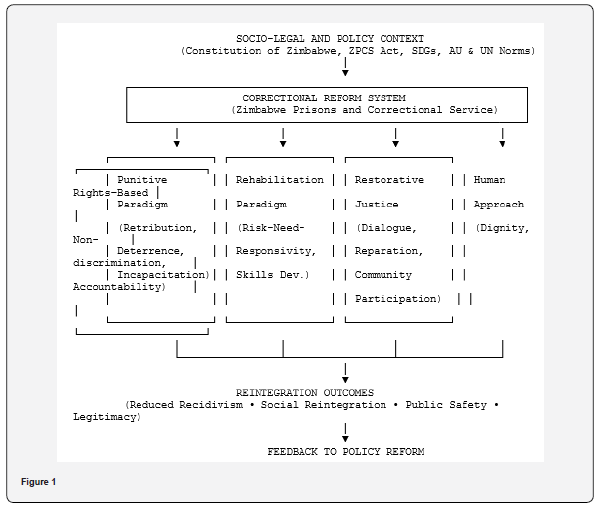
The Punitive Paradigm: The punitive paradigm represents the traditional foundation of correctional systems globally Garland [24] and is rooted in classical criminology, emphasizing retribution, deterrence, and incapacitation as mechanisms for maintaining social order Tonry [28]. Within Zimbabwe’s historical prison system, particularly prior to the institutional rebranding from “Prisons” to ZPCS, punitive logic largely dominated institutional practice Dziva & Runhare [26]. Under this paradigm, imprisonment serves primarily as punishment proportional to the offense and as a deterrent to potential offenders Tonry [28], while incapacitation aims to protect society by physically removing offenders from the community. While punitive measures contribute to immediate public safety objectives, extensive research indicates that overreliance on incarceration without rehabilitative support does little to reduce long-term recidivism (Cullen [1-3]; Travis et al. [29]). In Zimbabwe, the persistence of overcrowding, limited non-custodial sentencing, and infrastructural constraints reflects the enduring influence of punitive correctional logic (PRI., 2023). The framework therefore positions the punitive paradigm as both a historical baseline and a continuing structural force shaping reform trajectories.
The Rehabilitation Paradigm: The rehabilitation paradigm shifts the focus from punishment to behavioural transformation and is grounded in evidence-based correctional psychology, particularly the Risk-Need-Responsivity (RNR) model advanced by Andrews and Bonta. The RNR model posits that effective correctional interventions must match service intensity to risk level, target criminogenic needs, and be responsive to individual characteristics (Andrews & Bonta., 2017).
Within Zimbabwe’s emerging correctional policy, rehabilitation is reflected in vocational training programmes, educational initiatives, faith-based counselling, and reintegration partnerships with community stakeholders (Munyoro & Uzhenyu [30]; Munyoro & Chihobvu [31]). The renaming of the prison service to ZPCS symbolically signals this paradigm shift from custody to correction (Dziva & Runhare [26]). Empirical literature demonstrates that structured rehabilitation programmes significantly reduce reoffending when properly implemented (Lipsey et al. [32]; Travis et al. [29]). However, the effectiveness of rehabilitation in Zimbabwe is mediated by resource limitations, staff capacity, and infrastructural deficits (PRI., 2023). The framework thus conceptualizes rehabilitation as a normative aspiration requiring institutional investment, policy coherence, and sustained evaluation (UNODC [25]).
The Restorative Justice Paradigm: The restorative justice paradigm reconceptualizes crime as harm to relationships rather than merely a violation of law Zehr [15], emphasizing dialogue, accountability, victim participation, and community engagement Braithwaite [14]. Braithwaite’s theory of reintegrative shaming underscores the importance of social reintegration rather than stigmatization Braithwaite [14]. Restorative approaches align closely with African communitarian philosophies such as Ubuntu, which stress reconciliation, relational dignity, and collective responsibility Sarkin [21]. In Zimbabwe, restorative justice principles resonate with traditional community courts and customary dispute-resolution mechanisms embedded within local governance systems Dziva & Runhare [26]. Globally, restorative programmes have been shown to enhance victim satisfaction and reduce recidivism when effectively implemented (Sherman & Strang [33]; UNODC [34]. Within Zimbabwe’s context, restorative justice is particularly relevant for juvenile justice and communitybased corrections, though formal institutionalization within ZPCS remains limited (Penal Reform International., 2023).
Human Rights–Based Approach: The human rights– based approach (HRBA) situates correctional reform within international normative frameworks such as the United Nations Standard Minimum Rules for the Treatment of Prisoners (the Nelson Mandela Rules) and the Sustainable Development Goals, particularly SDG 16 on peace, justice, and strong institutions. This paradigm affirms that incarceration does not extinguish fundamental rights except those lawfully limited by the sentence (UN General Assembly., 2015). Zimbabwe’s Constitution of Zimbabwe explicitly enshrines human dignity and protection from inhuman or degrading treatment, constitutionally anchoring correctional reform within rights discourse. Recent global scholarship emphasizes that human rights compliance enhances institutional legitimacy and supports reintegration outcomes (UNODC [35]; PRI., 2023). However, overcrowding and fiscal constraints continue to challenge full compliance with international standards. Thus, the HRBA functions both as a normative benchmark and an evaluative criterion within the conceptual framework.
Integration of the Four Paradigms
The integration of punitive, rehabilitative, restorative, and human rights–based paradigms reflects an evolving hybrid governance model that reconciles accountability with reintegration imperatives Garland [24]; UNODC [25]. Rather than operating as mutually exclusive approaches, these paradigms function in a complementary and dialectical relationship. The punitive paradigm maintains the state’s obligation to uphold public safety and proportional accountability under the Constitution. The rehabilitative paradigm addresses criminogenic needs through evidence-based interventions aligned with RNR principles (Andrews & Bonta., 2017). The restorative paradigm advances victim–offender mediation and community participation consistent with African normative traditions and the African Charter on Human and Peoples’ Rights Garland [24]; UNODC [25]. Underpinning these is the HRBA grounded in the Nelson Mandela Rules. Within Zimbabwe’s socio-legal environment shaped by constitutional jurisprudence, African Union norms, and international treaty obligations, these paradigms interact dynamically, producing feedback loops in which reintegration outcomes, reduced recidivism, improved social functioning, enhanced legitimacy-inform iterative reform processes (Travis et al. [29]; UNODC [25]).
Emerging Paradigms in Zimbabwe
Zimbabwe’s correctional transformation reflects a measurable shift toward a rights-oriented and reintegration-based correctional governance model (Dziva & Runhare [26]). Recent reforms, including the reintroduction of structured parole mechanisms and community-based reintegration initiatives, demonstrate increasing institutional embrace of non-custodial measures (PRI., 2023). Emerging institutional collaborations supporting education, psychosocial services, and post-release employment pathways further signal alignment with rehabilitation and restorative justice principles Munyoro & Uzheyu [30]; Munyoro & Chihobvu [31]. Policy innovations such as pilot conjugal rights initiatives reflect expanded recognition of dignity and relational integrity as reintegration factors, consistent with the Nelson Mandela Rules Dziva & Runhare [26]; PRI., 2023. Despite these normative advances, implementation gaps persist, underscoring the need for empirical implementation research, sustained institutional capacity building, and resource mobilization to translate reform commitments into lived correctional practice (UNODC [25]; PRI., 2023).
Methodology
Research Design
This study utilises a qualitative doctrinal and policy analysis research design to critically examine the legal and institutional frameworks governing correctional reforms in Zimbabwe. Doctrinal legal research, defined as the systematic identification, interpretation, and synthesis of legal rules and principles from primary and secondary legal sources, forms the core of this design (Hutchinson & Duncan [36]). This approach prioritises deep engagement with authoritative legal texts, including the Constitution of Zimbabwe (2013) and the Prisons and Correctional Services Act (Chapter 7:23), and is used to elucidate statutory obligations, institutional mandates, and normative tensions inherent in the penal framework (Majeed [37]). Doctrinal inquiry, as a mode of qualitative research, rejects statistical measurement in favour of detailed textual interpretation, conceptual analysis, and normative clarification (Mitchell [38]). When combined with policy analysis, this design enables a holistic assessment of both formal legal structures and the interpretive meanings embedded in policy discourse, thereby generating insights into how legislative intent and implementation intersect in contexts marked by limited quantitative data (Saunders et al. [39]).
Data Sources and Collection
Primary Legal Sources: Primary legal sources for this study were systematically identified and collected to establish a robust doctrinal framework for analysing custodial administration and oversight within Zimbabwe’s penal system. Central to this effort were statutory instruments, most notably the Prisons and Correctional Service Act (Chapter 7:23) and subsidiary regulations issued under its authority, which delineate the formal powers, duties, and institutional obligations of the Zimbabwe Prisons and Correctional Service (ZPCS) and related criminal justice agencies Majeed et al. [40]. These statutory texts were further situated within the broader constitutional architecture governing the protection of fundamental rights, institutional accountability, and procedural safeguards, particularly where custodial practices intersect with constitutional guarantees Mitchell [41]. Official protocols and operational directives promulgated by the ZPCS were also reviewed to understand how statutory mandates are operationalised in daily custodial practice. Taken together, these primary legal sources provided the doctrinal bedrock for interpreting penal governance, administrative norms, and the legal contours of incarceration in Zimbabwe Hutchinson & Duncan [36].
Secondary Policy and Oversight Documents: To contextualise doctrinal findings within contemporary policy and institutional oversight realities, this study drew on a suite of secondary sources that combine empirical, evaluative, and normative perspectives. Foremost among these were oversight reports and inquiries by Zimbabwe’s parliamentary committees, including the Joint Portfolio Committee on Justice, Legal and Parliamentary Affairs and the Thematic Committee on Human Rights’ Report on the State of Prisons in Zimbabwe, which documented conditions of incarceration, congestion levels, and human rights compliance through site assessments and oral evidence hearings, revealing persistent overcrowding and infrastructural deficits across ZPCS facilities (Parliament of Zimbabwe [42]).
International normative frameworks, particularly the United Nations Standard Minimum Rules for the Treatment of Prisoners (the Nelson Mandela Rules) adopted by the United Nations General Assembly, provided globally recognised benchmarks for humane prison management and informed comparative evaluation of Zimbabwe’s statutory regime (UNODC [13]). Analytical reports and policy briefs from civil society and research organisations, including Penal Reform International, offered critical insights into regional trends and best practices in penal governance that enriched the interpretation of Zimbabwe’s legal and policy frameworks (PRI [43]). Through this triangulation of primary and secondary sources, the study ensured that doctrinal conclusions were grounded both in legal authority and in policy-relevant analyses of penal system performance.
Analytical Framework
The analytical framework for this study is rooted in thematic analysis, a flexible yet rigorous qualitative technique that enables systematic interpretation of complex legal and policy texts through iterative reading, coding, and theme development Nowell et al. [44]. Grounded in the foundational work of Braun and Clarke [45,46] and elaborated in recent methodological literature, thematic analysis is particularly apt for qualitative legal inquiry because it facilitates the identification of recurring patterns, normative tensions, and institutional narratives that are often obscured in doctrinal sources Braun & Clarke [46]; Saunders et al. [47].
The process began with compiling a structured corpus of relevant statutes, case law, policy instruments, and scholarly commentary, followed by open coding to detect preliminary concepts relating to legal mandates, custodial rights, oversight mechanisms, and institutional accountability Nowell et al. [44]. Focused thematic development refined these categories into broader patterns reflective of systemic compliance gaps, rights protection dilemmas, and normative ambiguity in reform discourse. Finally, interpretive synthesis situated thematic findings within broader scholarly debates on penal reform and governance, emphasizing interpretive depth and reflexivity over statistical generalisation, consistent with qualitative doctrinal practice Braun & Clarke [46]; Saunders et al. [47].
Ethical Considerations in Methodology
Although this study did not involve the collection of primary data from human subjects, ethical considerations inherent in research methodology remain central to the credibility and integrity of doctrinal and policy analysis Nowell et al. [44]. Integrity and accuracy in textual interpretation require that legal materials and policy documents be represented faithfully without decontextualization or selective emphasis, thereby upholding academic honesty and avoiding inadvertent bias UK Data Service [49]. Responsible use of secondary information underscores the necessity of handling sensitive institutional reports and case law with due diligence, respecting privacy, and clearly acknowledging data origins to maintain transparency and academic credibility Saunders et al. [47]. Normative respect and avoidance of re-stigmatisation highlight the ethical imperative to interpret and critique correctional frameworks in ways that do not reinforce negative stereotypes or further marginalise vulnerable populations PRI [43]. Researcher reflexivity and reporting integrity require critical reflection on interpretive biases and disclosure of analytic limitations, contributing to methodological rigour and scholarly trustworthiness even in the absence of direct ethical review processes Braun & Clarke [46]. These considerations align with contemporary discussions on ethical research practice across qualitative paradigms Saunders et al. [47].
Challenges and Limitations in Data Collection
Researchers confronted substantial challenges in data collection that constrained empirical robustness. Official prison statistics are frequently limited in scope, inconsistently disaggregated, subject to publication delays, or entirely unpublished, undermining reliability and timeliness across jurisdictions. Such constraints are well documented in global prison research and criminal justice statistics literature PRI [43]; UNODC., 2023). Variability in definitions of key indicators, such as remand versus sentenced populations, complicates cross-document comparison and alignment with international monitoring frameworks Munyoro [48]. These challenges are exacerbated in low- and middle-income settings where technological and infrastructural capacities are limited, contributing to gaps in data quality and interoperability UNODC [25]. Consequently, researchers increasingly rely on methodological pluralism, doctrinal analysis, and interpretive insight when quantitative datasets are insufficient Saunders et al. [47].
Data Analysis
Thematic Analysis as Primary Analytical Technique
Thematic analysis was selected as the principal analytical technique to interpret patterns emerging from Zimbabwe’s penal law and policy texts, doctrinal materials, and secondary institutional reports. Thematic analysis systematically identifies, organises, and interprets patterns of meaning within qualitative data, foregrounding interpretive depth rather than statistical inference Braun & Clarke [45,46]; Nowell et al. [44]. It is particularly suited to legal and policy research where data are textual and discursive, enabling identification of normative tensions and governance logics embedded in statutory frameworks Saunders et al. [47]. Through iterative coding, thematic clustering, and constant comparison, the analysis elucidated structural limitations, rights-based tensions, and accountability dynamics within Zimbabwe’s correctional governance system.
Rationale for Methodological Choice
The predominance of qualitative and doctrinal analysis is grounded in recognised constraints on comprehensive, standardised statistical data within Zimbabwe’s correctional context Munyoro [48]; Saundaers et al., 2019. Research on prison systems across sub-Saharan Africa highlights persistent data limitations, including inconsistent definitions, lack of national estimates, and poor-quality health and population data PRI [43]; UNODC [25] In the absence of harmonised longitudinal datasets, thematic analysis provides an appropriate avenue for examining how law and policy construct institutional meaning and shape penal governance. Qualitative analysis thus complements incomplete empirical records with nuanced interpretive insights into institutional priorities and normative orientations Braun & Clarke [46].
Data Collection and Ethical Considerations
Data were collected through triangulation of primary legal texts (Constitution of Zimbabwe; Prisons and Correctional Services Act), parliamentary committee reports, international standards, and scholarly analyses. This triangulation ensured legal precision and contextual depth while situating Zimbabwe’s legal order within comparative discourse Saunders et al. [47]. Recognising the ethical complexities of prison research and particularly issues of vulnerability, consent, and power asymmetry and this study therefore, prioritised secondary textual analysis rather than primary fieldwork involving incarcerated persons, consistent with established ethical guidance in correctional research (PRI [43]).
Analytical Challenges and Limitations
Significant analytical challenges relate to data transparency and consistency Munyoro [48]. Across sub-Saharan prison research, basic indicators such as health status, population counts, and service access are often unavailable or non-standardised UNODC [25]. These limitations complicate rigorous quantitative analysis and fortunately enough thematic analysis accommodates such constraints by leveraging textual and discursive data to generate interpretive insights Munyoro [50]; Braun & Clarke [46]. Nonetheless, the absence of comprehensive statistical records underscores the need for methodological pluralism and cautious interpretation, where qualitative analysis complements rather than substitutes for future empirical inquiry Braun & Clarke [46].
Findings
The findings demonstrate that Zimbabwe’s correctional system is undergoing a substantive paradigm shift, rooted in constitutional mandates and emerging institutional practices aimed at fostering rehabilitation and reintegration UNODC [35]; ZPCS [10]. The transformation of the traditional punitive prison model toward a rehabilitation-centred framework is evident in the legislative overhaul represented by the Prisons and Correctional Service Act and the operational rebranding of the Zimbabwe Prisons and Correctional Service (Government of Zimbabwe, 2020; ZPCS [10]). These changes reflect a departure from purely custodial logics towards structured mechanisms such as parole and community correctional centres designed to reduce overcrowding and enhance reintegration capacities (ZPCS [10]). Thus, the development of Parole Regulations and associated early release systems signifies alignment with global correctional norms that prioritize humane treatment and community safety, as advocated in recent UNODC frameworks on alternatives to incarceration United Nations [7]; UNODC [35].
Rehabilitation programming within ZPCS has expanded notably, with vocational training in agriculture, carpentry, tailoring, and other trades gaining prominence alongside psychosocial counselling and education initiatives Munyoro & Uzheyu [30]; Munyoro & Chihobvu [31]. These programmes are increasingly framed as integral to self-reliance and reintegration, reflecting commitment to equipping inmates with tangible skills that facilitate post-release livelihood opportunities (ZPCS [10]). However, academic analyses highlight persistent operational challenges, including insufficient staffing, limited educational resources, and funding shortfalls that constrain the scale and quality of these interventions PRA., 2022; UNODC [35]. Research at Midlands Correctional Centres underscores how negative attitudes among staff and material deficits undermine the effectiveness of even well-intentioned rehabilitation efforts Munyoro & Chihobvu [31].
Reintegration support mechanisms are also evolving with greater institutional structuring. The establishment of the Pathways to Reintegration Foundation (PAREF) and initiatives such as structured parole supervision underscore efforts to bridge institutional care and community support realms ZPCS [10]. Partnerships with faith-based organisations, civic groups, and families illustrate recognition of the multifaceted nature of reintegration, extending beyond incarceration to psychosocial and economic dimensions UNODC [35]. These efforts signal a shift toward context-sensitive strategies leveraging community resources and social networks to support former inmates’ transitions (PRI [6]). Gender-responsive and juvenile justice reforms form a distinct component of the transformation, including maternal health support and diversion programmes emphasizing education and restorative practice (United Nations., [7]; UNODC [35]. Such initiatives align with broader human rights principles requiring detention conditions tailored to vulnerable populations (United Nations., [7]). While progressive, implementation remains uneven across facilities.
Despite normative gains, systemic constraints persist that hinder full realization of reform objectives (PPRI., [6]). Resource limitations impede programme expansion and infrastructure improvements, while entrenched punitive cultures and training gaps slow internalisation of rehabilitative philosophies among staff Munyoro & Uzhenyu [30]; Munyoro & Chihobvu [31]. Data and monitoring deficiencies weaken evidence-based policy refinement, limiting authorities’ ability to track recidivism and programme outcomes UNODC [35]. These findings corroborate broader scholarly critiques highlighting gaps between progressive legislation and on-the-ground performance (PRI [6]). Societal stigma further complicates reintegration, as former offenders encounter discrimination in employment and housing, undermining socio-economic stability critical to reducing recidivism UNODC [35]. Addressing such barriers is essential to ensure rehabilitative gains translate into sustainable reintegration.
Discussion
Zimbabwe’s correctional reform reflects movement from punitive incarceration toward a rights-based, rehabilitationcentred model, though implementation challenges temper progress (Government of Zimbabwe., 2020; UNODC [35]. Legislative reforms under the Prisons and Correctional Service Act underpin structured parole and supervised reintegration, complemented by the planned operationalisation of the Pathways to Reintegration Foundation UNODC [35]; ZPCS [10]. Operational innovations such as digitisation of inmate records and expanded family engagement initiatives reflect deliberate realignment toward humane correctional practice ZPCS [10]. However, empirical analyses in facilities such as Midlands Correctional Centres highlight structural barriers such as resource deficits, staffing shortages, limited training, and negative institutional attitudes and that constrain measurable outcomes in recidivism reduction and reintegration Munyoro & Chihobvu [31]; PRI [6]). Reintegration increasingly incorporates community and familial dynamics, including civic and faith-based collaboration (UNODC., 2021). Yet limited systematic recidivism data restricts robust impact assessment and adaptive policy reform (PRI [6]). Sustainable progress depends on institutional capacity strengthening, monitoring enhancement, and societal acceptance of returning citizens.
Policy Implications
Zimbabwe stands at a pivotal stage in consolidating correctional reform centred on rehabilitation and reintegration. The structured parole system and the Pathways to Reintegration Foundation signify a policy shift toward community-based outcomes and reduced recidivism ZPCS [10]. The State Parole Board framework addresses overcrowding while aligning with international standards such as the United Nations Standard Minimum Rules for the Treatment of Prisoners (United Nations [7]). Future reform should further harmonise domestic law with global norms, codifying alternatives to incarceration and strengthening community corrections UNODC [35]. Professionalisation through enhanced training, infrastructure investment, and academic partnerships will reinforce institutional capacity Munyoro & Uzhenyu [30]; Munyoro & Chihobvu [31]. Developing centralised data systems to monitor recidivism and parole outcomes is critical for evidence-based governance (PRI [6]). Finally, community engagement and stigma-reduction campaigns are essential to foster inclusive reintegration ecosystems and sustainable reductions in reoffending UNODC [35].
Conclusion
Zimbabwe’s correctional reform trajectory illustrates an emerging paradigm grounded in rehabilitation, restorative justice, and human rights. While progress is evident in legislative innovation and programming expansion, sustainable reintegration demands structural investment, institutional transformation, and coordinated stakeholder engagement. Thus, by consolidating normative commitments with measurable implementation strategies, Zimbabwe can advance a correctional system that promotes public safety while affirming the dignity and transformative potential of incarcerated persons [51-90].
References
- Cullen FT, Jonson CL, Nagin DS (2018) Prisons do not reduce recidivism: The high cost of ignoring science. The Prison Journal 98(3): 233-251.
- Cullen FT, Jonson CL, Nagin DS (2018) Prisons do not reduce recidivism: The high cost of ignoring science. The Prison Journal 98(3): 324-347.
- Cullen FT, Jonson CL, Nagin DS (2018) Prisons do not reduce recidivism: The high cost of ignoring science. The Prison Journal 98(3): 1-24.
- UNODC (2018) Handbook on the management of violent extremist prisoners and the prevention of radicalization to violence in prisons. United Nations Office on Drugs and Crime (UNODC).
- Bottoms A (2021) Penal theory and penal practice: The need for a normative framework. Punishment & Society 23(3): 315-332.
- PRI (2022) Global prison trends 2022. Penal Reform International (PRI).
- UNGA (2015) United Nations Standard Minimum Rules for the Treatment of Prisoners (the Nelson Mandela Rules). United Nations General Assembly (UNGA).
- UNODC (2022) UNODC guidelines; Penal Reform International reports.
- Government of Zimbabwe (2013) Constitution of Zimbabwe Amendment (No. 20) Act, 2013. Government Printer.
- ZPCS (2023) Annual report 2022–2023. Zimbabwe Prisons and Correctional Service (ZPCS).
- ZPCS (2023) Annual report 2023. Harare: Zimbabwe Prisons and Correctional Service (ZPCS).
- Andrews DA, Bonta J (2010) The psychology of criminal conduct (5th). Routledge.
- UNODC (2015) The United Nations Standard Minimum Rules for the Treatment of Prisoners (the Nelson Mandela Rules). United Nations Office on Drugs and Crime (UNODC).
- Braithwaite J (2002) Restorative justice and responsive regulation. Oxford University Press.
- Zehr H (2015) The little book of restorative justice (Revised ed.). Good Books.
- Moyo O (2020) Restorative justice and traditional dispute resolution in Africa. African Conflict and Peacebuilding Review 10(1): 1-18.
- ACHPR (2019) Guidelines on the conditions of arrest, police custody and pre-trial detention in Africa (Luanda Guidelines). African Commission on Human and Peoples’ Rights (ACHPR).
- Muntingh L, Redpath J (2016) Conditions of detention in Africa: Challenges and reform. Civil Society Prison Reform Initiative.
- Dambazau E (2019) Criminology and criminal justice in Zimbabwe. University of Zimbabwe Publications.
- Chikadzi V, Zireva D (2022) Challenges and prospects for prison reform in Zimbabwe. African Journal of Social Work 12(2): 45-58.
- Maruna S (2001) Making good: How ex-convicts reform and rebuild their lives. American Psychological Association.
- McNeill F (2016) Desistance and criminal justice in Scotland. Scottish Centre for Crime and Justice Research.
- Chitando E, Machingura F (2021) Religion, stigma and the reintegration of ex-prisoners in Zimbabwe. Exchange 50(3): 267-285.
- Garland D (2013) The culture of control: Crime and social order in contemporary society. University of Chicago Press.
- UNODC (2023) Data matters: Improving prison data systems in Africa. United Nations Office on Drugs and Crime (UNODC).
- Dziva C, Runhare T (2020) Prison reform in Zimbabwe: Challenges and prospects. African Journal of Public Affairs 11(2): 45-60.
- Sarkin J (2021) Human rights and prison reform in Africa. African Human Rights Law Journal 21(1): 1-25.
- Tonry M (2019) Punishment and human dignity. Oxford University Press.
- Travis J, Western B, Redburn FS (2021) The growth of incarceration in the United States: Exploring causes and consequences. National Academies Press.
- Munyoro G, Uzhenyu D (2025) Evaluating the Effectiveness of Open, Distance and Electronic Learning in Delivering Entrepreneurial Leadership Short Courses to the Security Sector: A Case Study of Zimbabwe Prisons and Correctional Services (ZPCS): Zimbabwe Journal of Business, Economics & Managment (ZBEM) 4(1): 796-807.
- Munyoro G, Chihobvu MCN (2026) The Role of Entrepreneurship in Synchronising Production, Business, and Operational Issues in the Zimbabwe Prison & Correctional Services (ZPCS), Asian Journal of Economics, Business & Accounting 26: 126-140.
- Lipsey MW, Landenberger NA, Wilson SJ (2020) Effects of cognitive-behavioral programs for criminal offenders. Campbell Systematic Reviews 16(2): 1-75.
- Sherman LW, Strang H (2007) Restorative justice: The evidence. Smith Institute.
- UNODC (2020) Handbook on restorative justice programmes (2nd ed.). United Nations Office on Drugs and Crime (UNODC).
- UNODC (2021) Handbook on strategies to reduce overcrowding in prisons. Vienna: United Nations Office on Drugs and Crime (UNODC).
- Hutchinson T, Duncan N (2018) Defining and describing what we do: Doctrinal legal research. Deakin Law Review 17(1): 83-119.
- Majeed N, Hilal A, Khan AN (2023) Doctrinal Research in Law: Meaning, Scope and Methodology. Bulletin of Business and Economics.
- Mitchell C (2022) Qualitative legal research: Methodological reflections and contemporary applications. Routledge.
- Saunders CH, Sierpe A, von Plessen C, Kennedy AM, Leviton LC, et al. (2023) Practical thematic analysis: A guide for multidisciplinary health services research teams. BMJ 381: e074256.
- Majeed R, Dar AH, Yousaf M (2023) Doctrinal research in legal studies: Revisiting methodology and relevance. Journal of Legal Studies 45(2): 215-230.
- Mitchell M (2022) Analyzing the law qualitatively. Qualitative Research Journal 23(1): 102-113.
- Parliament of Zimbabwe (2025) National Assembly Hansard 09 October 2025 Report of the Joint Portfolio Committee on Justice, Legal and Parliamentary Affairs on the State of Prisons in Zimbabwe 51(90).
- PRI (2025) Sub Saharan Africa overview of prison conditions and reform (Global Prison Trends 2024). Penal Reform International (PRI).
- Nowell LS, Norris JM, White DE, Moules NJ (2017) Thematic Analysis: Striving to meet the trustworthiness criteria. International Journal of Qualitative Methods 16: 1-13.
- Braun V, Clarke V (2006) Using thematic analysis in psychology. Qualitative Research in Psychology 3(2): 77-101.
- Braun V, Clarke V (2021) Thematic analysis: A practical guide. SAGE Publications.
- Saunders M, Lewis P, Thornhill A (2023) Research methods for business students (9th). Pearson.
- Munyoro G (2014) Evaluation of the Effectiveness of Handouts in Enhancing Teaching and Learning in Higher Education: Africa Development and Resources Research Institute 6(2): 95-107.
- UK Data Service (2026) Ethical obligations when working with secondary data.
- Munyoro G (2014) The Effectiveness of E-Learning in Higher Education: A Case Study of University of Dundee, Scotland, United Kingdom: Africa Development and Resources Research Institute 1(1): 1-11.
- African Union (1981) African Charter on Human and Peoples’ Rights. Organization of African Unity.
- Ako T, Plugge E, Mhlanga Gunda R, Van Hout MC (2020) Ethical guidance for health research in prisons in low and middle income countries: A scoping review. Public Health 186: 217-227.
- Davra T, Mazorodze W, Mabiza HJ, Gudyani S (2025) An analysis on the effectiveness of rehabilitation and reintegration programmes in Zimbabwe prison services: A case of Midlands Correctional Centres. African Social Science and Humanities Journal.
- GNPDCCC (2024) Prison data collection in Commonwealth countries: Challenges to collection and transparency of data. Guidance Note on Prison Data Collection in Commonwealth Countries (GNPDCCC).
- Government of Zimbabwe (2020) Prisons and Correctional Service Act [Chapter 7:23]. Harare: Government Printer.
- Macnamara J (2025) Human research ethics review challenges in the social sciences: A case for review. Journal of Academic Ethics 23: 141-157.
- Makombe SPM (2025) Efficacy of reintegration prison based vocational training initiatives at Harare Prison Workshop in Zimbabwe. Journal of Correctional Studies.
- Mbare Times (2025) ZPCS introduces modern digital database for prisoners. Mbare Times.
- McLeod F (2025) Prison health data collection: transforming prisons from public health risks to opportunities for global health equity. Social Science & Medicine pp. 312.
- Mhlanga Gunda R, Kewley S, Chivandikwa N, Van Hout MC (2020) Prison conditions and standards of health care for women and their children incarcerated in Zimbabwean prisons. International Journal of Prison Health 16(3): 319-336.
- Munyoro G (2014) The Significance of Group work in the Assessment of Students in Higher Education: A Case Study of University of Dundee, Scotland, United Kingdom: Africa Development and Resources Research Institute 11(2): 57-65.
- Parliament of Zimbabwe (2025) Report of the Joint Portfolio Committee on Justice, Legal and Parliamentary Affairs and Thematic Committee on Human Rights on the State of Prisons in Zimbabwe. Veritas Publications.
- Parliament of Zimbabwe (2025) Report of the Thematic Committee on Human Rights on the state of prisons in Zimbabwe. Government of Zimbabwe.
- Pearce LA, Southalan L, Kinner SA (2025) Prison health data collection: Transforming prisons from public health risks to opportunities for global health equity. Social Science & Medicine.
- Rehabilitation Revised (2024) The Struggle of Ex Convicts in Zimbabwe’s Societal Maze Right for Education. Rehabilitation Revised.
- Roldan Pacsoderon Torres J (2025) Navigating legal knowledge: Comparative analysis of legal research methodologies. SSRN.
- The Herald (2025) Nation champions correctional reform / Zimbabwe champions correctional reform. The Herald.
- The Herald (2025) Nation champions correctional reform. The Herald.
- UK Data Service (2026) Research ethics guidance. UK Data Service.
- UNODC (2021) Roadmap for the development of prison-based rehabilitation programmes. United Nations Office on Drugs and Crime (UNODC).
- UNODC (2022) Handbook on strategies to reduce overcrowding in prisons. United Nations Office on Drugs and Crime (UNODC).
- UNODC (2022) Roadmap for the development of prison-based rehabilitation programmes. United Nations Office on Drugs and Crime (UNODC).
- UNODC (2023) Handbook on strategies to reduce recidivism. United Nations Office on Drugs and Crime (UNODC. United Nations.
- UNODC (2023) Prison and penal reform: Global progress report. United Nations Office on Drugs and Crime (UNODC).
- UNODC (2024) Guidelines for the production of statistical data by the prison system. United Nations Office on Drugs and Crime (UNODC).
- ZBC News (2025) Regional correctional chiefs commend Zimbabwe’s open prison model.
- ZBC News (2025) Regional correctional chiefs commend Zimbabwe’s open prison model.
- ZimEye (2025) Inmates granted conjugal rights as Zimbabwe shifts from punishment to rehabilitation.
- ZBC News (2025) ZHRC welcomes improvements in Zimbabwe’s correctional system.
- ZBC News (2025) ZPCS reaffirms commitment to productive, rehabilitation centred correctional services. ZBC News
- ZDPPRF (2024) Clinical Research Regulation for Zimbabwe. Zimbabwe’s Data Protection and Privacy Regulatory Framework (ZDPPRF). DPAct, DPRegs.
- Zimba News (2025) VP Chiwenga launches Africa’s inaugural parole conference, calls for justice transformation. Zimba News.
- Zimbabwe Situation (2025) Zimbabwe Prisons and Correctional Service (ZPCS) introduce parole system. Zimbabwe Situation.
- Zimbabwean Patriot (2024) Zimbabwe Embarks on Prison Reforms: Introducing Parole and Community Correctional Centres, Zimbabwean Patriot.
- ZimEye (2025) Inmates Granted Conjugal Rights as Zimbabwe Shifts from Punishment to Rehabilitation, ZimEye.
- ZimEye (2025) Inmates granted conjugal rights as Zimbabwe shifts from punishment to rehabilitation.
- ZimEye (2025) Mnangagwa introduces prison parole system. ZimEye
- ZimEye (2025) New Prison System to Decongest Centres. ZimEye.
- ZPCS (2013) Prisons and Correctional Services Act (Chapter 7:23); ZPCS Official Publications (2022–2023).
- ZPCS (2025) Internal Stakeholders Workshop on Parole Regulations. Raoul Wallenberg Institute.

























