




 ACJPP Home



Abstract
Informal enterprises within illegal settlements play a pivotal role in sustaining livelihoods and local economies across sub-Saharan Africa, yet they remain largely marginalised in formal regulatory and planning frameworks. In Zimbabwe, particularly within Harare’s Eastview settlement, these enterprises face tenure insecurity, inadequate infrastructure, and limited institutional support, constraining opportunities for sustainable growth and integration into the formal economy. This study employed a qualitative-dominant mixed-methods design, combining cross-sectional surveys (n = 155) with semi-structured interviews and focus group discussions involving micro- and small-scale enterprise operators, municipal officials, and community representatives. Quantitative data were analysed through descriptive statistics, correlation analysis, and multiple regression to identify determinants of formalisation readiness, while thematic analysis of qualitative data provided nuanced insights into lived experiences, adaptive strategies, and institutional interactions, enabling triangulation of results. Findings indicate that access to infrastructure, institutional trust, perceived regulatory barriers, and availability of microcredit significantly predict readiness for formalisation (p < 0.05). Entrepreneurs reported that high compliance costs, procedural complexity, and enforcement uncertainty discourage formalisation, whereas capacity-building initiatives, simplified registration processes, and participatory governance promote integration. Qualitative evidence further highlights that informal enterprises operate within adaptive socio-economic networks, emphasising the need for policies that recognise both their economic contributions and contextual vulnerabilities. The study proposes a context-sensitive formalisation framework that integrates settlement upgrading, tenure regularisation, streamlined enterprise registration, and stakeholder engagement. Such interventions can reduce barriers, incentivise formalisation, strengthen economic resilience, and transform informal enterprises from marginal actors into recognised contributors to inclusive and sustainable urban development.
Keywords:Illegal settlements, Livelihoods, Local economies, Formal regulatory, Planning frameworks, Inadequate infrastructure, Limited institutional support, Constraining opportunities business formalisation
Introduction
Illegal settlements are unplanned residential areas that lack formal planning approval, secure tenure, and adequate infrastructure, and they remain a defining feature of rapid urbanisation across the Global South Munyoro & Nyamushamba [1]; Moyo et al., 2017; UN-Habitat [2]; World Bank [3]. In sub- Saharan Africa, the proliferation of such settlements reflects the inability of formal housing and labour markets to absorb growing urban populations, thereby reinforcing the expansion of informal economic activity as a primary livelihood strategy Munyoro & Nyamushamba [1]; Moyo et al., 2017; UN-Habitat [2]; ILO [4]. Informal enterprises operating within these contexts provide critical income-generating opportunities, supply affordable goods and services, and contribute significantly to urban food systems and local value chains Skinner & Watson [5]; ILO [4]. Yet, despite their socio-economic importance, these businesses typically function outside regulatory frameworks, limiting their access to legal protection, infrastructure, finance, and broader market opportunities Munyoro & Nyamushamba [1]; Moyo et al., 2017; World Bank [3]. The absence of inclusive policy mechanisms often perpetuates cycles of vulnerability, spatial marginalisation, and constrained enterprise growth Munyoro & Nyamushamba [1]; Moyo et al., 2017; UN-Habitat [2]; OECD [6].
Zimbabwe exemplifies this dynamic, as its economy is characterised by one of the highest levels of informality in sub- Saharan Africa Medina & Schneider., 2019; ILO [7]. Empirical studies show that informality in Zimbabwe is deeply embedded in structural economic transformation challenges, governance weaknesses, and prolonged macroeconomic instability (Dube & Chirisa., 2012; Mhone., 2020). Recent national statistics indicate that informal activities account for the majority of employment and a substantial share of economic output, particularly in urban centres such as Harare Zimstat [8], ILO [7]. Research on Harare’s informal settlements demonstrates that informal enterprises function as adaptive livelihood systems in response to declining formal employment, yet remain spatially and institutionally marginalised (Chirisa et al., 2015; Kamete [9]. In settlements such as Eastview, micro- and small-scale enterprises operate under precarious legal and infrastructural conditions, reflecting both entrepreneurial resilience and systemic policy gaps (Dube & Chirisa., 2012; Kamete [9]; Mhone., 2020). Studies of urban informality in Zimbabwe highlight how planning regulations, licensing systems, and enforcement practices often exclude informal operators rather than facilitate gradual formalisation (Dube & Chirisa., 2012; Kamete [9]. While the informal economy sustains livelihoods amid persistent macroeconomic volatility, its exclusion from formal regulatory and planning systems constrains revenue mobilisation, service provision, and sustainable urban development World Bank [3]; OECD [6]. Furthermore, Zimbabwean scholarship emphasises that formalisation efforts have historically been enforcement-driven rather than developmental, limiting trust between informal entrepreneurs and the state (Chirisa et al., 2015; Mhone., 2020).
Against this backdrop, this study examines the structural and institutional barriers to business formalisation in Eastview and proposes a context-sensitive policy framework for integrating informal enterprises within illegal settlements into the broader urban economic system. By grounding the analysis in empirical evidence from Harare, the study contributes to ongoing debates on inclusive urban governance, formalisation pathways, and sustainable economic transformation in Zimbabwe and comparable contexts.
Background of the Study
Rapid urbanisation across Sub-Saharan Africa continues to outpace the capacity of governments to provide adequate housing, infrastructure, and formal employment opportunities Munyoro [10]; UN-Habitat [2]; World Bank [3]. This imbalance has accelerated the proliferation of informal and illegal settlements, particularly on the peripheries of major cities, where regulatory enforcement is weak and access to serviced land remains constrained Munyoro & Nyamushamba [1]; UNHabitat [2]. Although frequently framed through a deficit lens and characterised by precarious tenure, infrastructural deprivation, and regulatory non-compliance Munyoro & Nyamushamba [1]; UN-Habitat [2], these settlements are also dynamic socioeconomic spaces embedded within broader urban systems OECD [6]; ILO [7]. Informal enterprises operating within them play a central role in employment creation, income generation, and urban service provision, especially in contexts marked by macroeconomic instability and formal sector contraction ILO [7]; World Bank [3]. Across Africa, the informal economy accounts for a substantial share of total employment, underscoring its structural importance rather than its marginality ILO [7].
In Zimbabwe, informality has become a defining feature of the national economic landscape. Structural economic decline, currency instability, and limited industrial growth have entrenched reliance on informal livelihoods Kamete [9]; Mhone., 2020). Recent national data indicate that a significant majority of business establishments operate outside formal registration and regulatory systems, reflecting both entrepreneurial adaptation and systemic barriers to formal participation Zimstat [8]. Empirical studies demonstrate that urban informality in Zimbabwe is not merely a survivalist phenomenon but an adaptive response to regulatory exclusion, land shortages, and uneven urban governance Muchadenyika [11]; Kamete [9]. Informal enterprises in Harare and other major cities provide employment for the bulk of the urban labour force, particularly youth and women, and contribute significantly to household income security (Ndlovu & Sikwila., 2020; ILO [7]
While the Government of Zimbabwe has increasingly acknowledged the contribution of informal enterprises to gross domestic product and employment and evidenced by policy commitments to support micro, small, and medium enterprises (Ndlovu & Sikwila., 2020; ILO [7], but formalisation initiatives often remain detached from the complex socio-spatial realities of illegal settlements Government of Zimbabwe [12]; Zimstat [8]. Urban governance approaches have historically oscillated between tolerance and coercive regulation, including demolition campaigns such as Operation Murambatsvina, which exposed the fragility of informal urban livelihoods (Kamete., 2007; Potts., 2006). Consequently, informal entrepreneurs in peripheral and unplanned settlements continue to face insecure land tenure, limited access to finance, weak institutional support, and exposure to regulatory sanctions, constraining productivity growth and long-term economic resilience (World Bank [3]; ILO [4]; Ndlovu & Sikwila., 2020).
Eastview Settlement, located on the outskirts of Harare, exemplifies the intricate interface between informality, illegality, and urban governance Munyoro & Nyamushamba [1]; UN-Habitat [2]. Emerging through processes of spontaneous settlement expansion amid housing shortages and economic volatility, Eastview reflects broader patterns of peri-urbanisation in Zimbabwe Munyoro & Nyamushamba [1]; UN-Habitat [2], where informal land markets and settlement growth outpace statutory planning systems Munyoro & Nyamushamba [1]; Muchadenyika [11]; UN-Habitat [2]. Such settlements have evolved into densely populated enclaves where informal businesses constitute the backbone of local livelihoods (Ndlovu & Sikwila., 2020; World Bank [3]; ILO [4]. Yet these enterprises operate within a policy vacuum shaped by tenure insecurity, infrastructural deficits, and fragmented governance arrangements Kamete [9]; World Bank [3].
Despite growing recognition of the need for inclusive urban development, there remains a critical gap in policy research on how informal businesses in illegal settlements can be systematically integrated into formal urban economies without undermining livelihoods or exacerbating vulnerability Muchadenyika [11]; Kamete [9]; World Bank [3]. Zimbabwean scholarship has increasingly called for hybrid governance models that recognise informality as a permanent feature of the urban economy rather than a transitional anomaly Muchadenyika [11]; Ndlovu & Sikwila., 2020). Against this backdrop, the overarching aim of this study is to develop a coherent and context-responsive policy framework for integrating informal businesses operating within illegal settlements, drawing empirical evidence from Eastview in Harare. The specific objectives of the study are to examine the socio-economic characteristics and operational dynamics of informal businesses in Eastview, to identify the institutional, legal, and infrastructural barriers constraining their formal integration and to propose actionable policy recommendations that promote inclusive formalisation, economic resilience, and sustainable urban governance.
Literature Review
Informal Settlements and Urban Livelihoods
Informal settlements constitute a defining feature of contemporary urbanisation, particularly in sub-Saharan Africa, where rapid demographic growth, sustained rural–urban migration, and limited state capacity have outpaced the provision of adequate housing, infrastructure, and formal employment opportunities Mitlin & Satterthwaite [13]; Munyoro [1]; UNHabitat [2]. Globally, more than one billion people reside in informal settlements, with African cities experiencing some of the fastest rates of spatial and demographic expansion Mitlin & Satterthwaite [13]; Munyoro [1]; UN-Habitat [2]. In this context, informal settlements function not merely as residential spaces but as complex socio-economic systems in which households construct diversified and adaptive livelihood portfolios in response to structural exclusion from formal land, labour, housing, and financial markets Chen [14]; Roy [15]; Munyoro & Nyamushamba [1]; Moyo et al., 2017; UN-Habitat [2]; World Bank [3].
Urban livelihood scholarship conceptualises informality as a rational and often necessary adaptation to economic marginalisation and regulatory exclusion Chen [14]; Munyoro & Nyamushamba [1]; Moyo et al., 2017; ILO [4]. Informal enterprises underpin urban food distribution systems, small-scale manufacturing, transport services, construction activities, and household provisioning, particularly in contexts characterised by deindustrialisation, macroeconomic volatility, and limited formal sector absorption Chen [14]; ILO [4]. These enterprises are socially embedded and rely heavily on kinship ties, neighbourhood networks, reciprocal exchange systems, and spatial proximity to sustain production and exchange OECD [6]. Furthermore, growing evidence demonstrates that informal enterprises are frequently integrated into formal value chains through subcontracting, distribution networks, and service linkages, thereby challenging binary distinctions between “formal” and “informal” economies La Porta & Shleifer [16].
However, enterprises operating within unregularised or legally contested settlements face pronounced structural vulnerabilities Chen [14]; Munyoro & Nyamushamba [1]; Moyo et al., 2017; ILO [4]. Tenure insecurity, inadequate infrastructure, environmental hazards, and periodic enforcement actions constrain enterprise productivity, limit investment horizons, and heighten exposure to risk Chen [14]; La Porta & Shleifer [16]; Munyoro & Nyamushamba [1]; Moyo et al., 2017; ILO [4]. Informality in such contexts is therefore simultaneously spatial and economic Chen [14]; Munyoro & Nyamushamba [1]; Moyo et al., 2017; OECD [17]; ILO [4]. Addressing enterprise vulnerability requires integrated urban planning, land governance reform, infrastructure provision, and inclusive enterprise development policies rather than narrow regulatory interventions Chen [14]; Munyoro & Nyamushamba [1]; Moyo et al., 2017; OECD [17]; ILO [4].
Within Southern Africa, empirical studies highlight how settlement informality shapes livelihood strategies Chen [14]; Muchadenyika [11]; Munyoro & Nyamushamba [1]; Moyo et al., 2017; OECD [17]; ILO [4]. In Zimbabwe, urban residents increasingly rely on informal enterprise as a primary survival mechanism amid prolonged economic restructuring and industrial contraction Potts [18]; Moyo [20]. Informal settlements in Harare, Bulawayo, and other urban centres function as critical sites of income generation, social reproduction, and service provision, despite operating within insecure and often contested legal frameworks Kamete [21]; Muchadenyika [11].
Formalisation Challenges for Businesses
The formalisation of informal enterprises remains a central yet contested objective within development policy discourse La Porta & Shleifer [16]; World Bank [22]. Conventional economic theory, associates formalisation with improved access to finance, enforceable contracts, legal protection, and expanded market opportunities La Porta & Shleifer [16]; World Bank [22]. Nonetheless, empirical research indicates that many micro-entrepreneurs perceive limited net benefits from formal registration due to high compliance costs, complex administrative procedures, burdensome taxation regimes, and weak institutional support ILO [7]; La Porta & Shleifer [16]. For enterprises operating in illegal or unplanned settlements, these barriers are compounded by the absence of recognised physical addresses, insecure tenure arrangements, limited identity documentation, and deficient infrastructure support ILO [7]; La Porta & Shleifer [16]. These constraints restrict access to banking services, government procurement systems, business development services, and formal credit markets ILO [7]; OECD [17]; World Bank [21]. In Zimbabwe, these challenges are intensified by currency instability, liquidity shortages, and fluctuating regulatory frameworks, which increase transaction costs and discourage long-term investment Moyo [19]; Zimstat [8].
Enforcement-driven regulatory approaches have frequently generated adversarial state–citizen relations and undermined trust in public institutions Benjamin & Mbaye [22]. In the Zimbabwean context, periodic crackdowns on informal traders and settlement dwellers have reinforced perceptions of regulatory hostility and unpredictability Kamete [20]; Muchadenyika [11]; Munyoro & Nyamushamba [1]; Moyo et al., 2017). Consequently, contemporary scholarship advocates for graduates, incentivebased formalisation pathways that prioritise facilitation over coercion ILO [4]; OECD [17]. Such approaches include simplified and decentralised registration systems, digital licensing platforms, reduced compliance costs for micro-enterprises, and integrated support packages linking registration to access to finance, infrastructure, training, and markets ILO [4]; OECD [17].
Critically, emerging literature emphasises that enterprise formalisation must be aligned with broader urban planning and land tenure regularisation frameworks ILO [4]; OECD [17]. Without spatial recognition, secure land rights, and basic service provision, business registration initiatives risk remaining symbolic, exclusionary, or unsustainable ILO [4]; OECD [17]. Integrated policy frameworks that connect spatial justice, economic inclusion, and institutional reform are therefore essential for durable formalisation outcomes.
The Zimbabwean Context
Zimbabwe provides a salient case for examining the intersection of informal enterprise development and illegal settlement dynamics, given the structural prominence of its informal economy and its prolonged economic crisis Kamete [20]; Moyo [19]; ILO [4]; OECD [17]. Recent national data indicate that informal employment accounts for over 60 percent of total employment, reflecting sustained macroeconomic instability, industrial decline, and limited formal sector absorption capacity Zimstat [8]. Scholarly analyses consistently characterise Zimbabwe’s post-2000 urban economy as deeply informalised, with micro-enterprises serving as critical mechanisms of household survival and income diversification Potts [18]; Kamete [20]; Moyo [19].
In Harare and other major urban centres, the expansion of informal settlements has paralleled the proliferation of microenterprises engaged in retail trade, home-based manufacturing, repair services, transport provision, and urban agriculture Kamete [20]; Muchadenyika [11]; Munyoro & Nyamushamba [1]; Moyo et al., 2017). Research highlights the complex and often contradictory relationship between municipal authorities and informal operators, marked by cycles of eviction, displacement, selective accommodation, and periodic regularisation Kamete [20]; Muchadenyika [11]. Operation Murambatsvina (2005) remains emblematic of the tensions between urban governance, legality, and livelihood security, with enduring implications for institutional trust and investment behaviour among informal entrepreneurs Potts [18]; Kamete [20]; Muchadenyika [11].
Policy frameworks such as Zimbabwe’s National Development Strategy 1 (2021–2025) acknowledge the need to formalise and support small and medium enterprises (SMEs) through regulatory reform, digitalisation, and improved access to finance Government of Zimbabwe [12]. Development partners have similarly prioritised financial inclusion, resilience-building, and enterprise capacity development within informal sectors UNDP [23]. However, implementation gaps persist. Infrastructural deficits, fragmented institutional mandates, fiscal constraints, and inconsistent enforcement practices continue to undermine policy coherence and erode trust between state institutions and informal actors Muchadenyika [11]; Kamete [20].
Settlements such as Eastview in Harare illustrate the intersection of insecure tenure and dense informal enterprise activity, underscoring the limitations of sectorally isolated interventions that address land governance or enterprise development independently. Zimbabwean scholarship increasingly calls for integrated and participatory approaches that combine settlement upgrading, tenure regularisation, simplified enterprise registration, and inclusive urban governance mechanisms Moyo [19]; Muchadenyika [11]. Such approaches reposition informal enterprises from marginal survivalist activities to recognised contributors to inclusive urban development, employment creation, and local economic transformation Moyo [19]; Muchadenyika [11].
Conceptual Framework
Conceptual Framework Diagram (Figure 1) Source: Authors
The conceptual framework underpinning this study advances a policy-oriented model for integrating informal enterprises operating in illegal settlements such as Eastview, Harare, into the formal economy. The framework conceptualises business formalisation as a multidimensional and systemic outcome shaped by four interrelated domains such as legal and regulatory dimensions, resource and capacity factors, stakeholder engagement mechanisms, and cultural and contextual fit Kamete [19]; Mupambireyi & Muchengeti [24]; Rogan & Skinner [25]. Rather than viewing formalisation as a linear administrative transition from informality to legality, the model recognises it as an iterative and contextually embedded process influenced by institutional coherence, socio-economic constraints, and relational dynamics within informal settlements Kamete [19]; Mupambireyi & Muchengeti [24]; Rogan & Skinner [25]. In Zimbabwe’s urban context, which characterised by economic instability, high informality, and contested urban governance and understanding these interdependencies is essential for developing policy interventions that move beyond coercive compliance towards enabling survival, growth, and inclusive urban integration Kamete [19]; Mupambireyi & Muchengeti [24]; Rogan & Skinner [25].
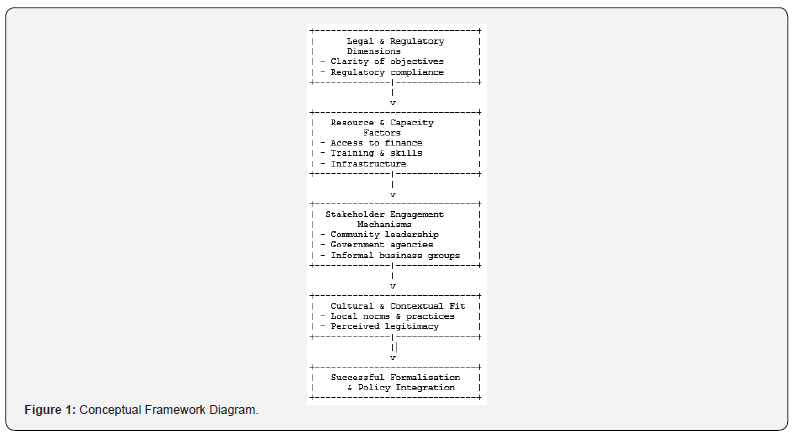
Legal and regulatory dimensions constitute the institutional backbone of the formalisation process Kamete [19]; Moyo [26]. Clear policy objectives, coherent regulatory frameworks, and transparent compliance mechanisms reduce uncertainty, transaction costs, and perceived risks associated with transitioning into the formal economy Kamete [19]; Moyo [26]. In Zimbabwe, efforts such as the Small and Medium Enterprises (SME) Formalisation Strategy and reforms designed to streamline business registration processes reflect attempts to reposition the state from a punitive regulator of informality to a facilitator of enterprise development MWACSMED [27]. Initiatives promoting tax registration, digital payment systems, and simplified licensing procedures signal recognition of the economic significance of informal enterprises Munyoro [28]; Munyoro [29].
However, Zimbabwean scholarship consistently highlights regulatory ambiguity, fragmented urban governance, and uneven enforcement as critical impediments to effective formalisation Kamete [19]; Moyo [26]; Zimbabwe Institute, 2023). Periodic crackdowns on informal traders, particularly in Harare, have reinforced adversarial state–informal sector relations and undermined trust Kamete [19]; Moyo [26]; Zimbabwe Human Rights NGO Forum., 2022). Where legal frameworks are inconsistently applied or politically instrumentalised, informal operators may perceive formalisation as a mechanism of control rather than empowerment Kamete [19]; Moyo [26]; Veritas Zimbabwe., 2023). Consequently, policy frameworks must balance clarity, fairness, and enforceability while safeguarding procedural justice Kamete [19]; Moyo [26]; Transparency International Zimbabwe., 2023). Institutional predictability and rights-based approaches are central to fostering voluntary compliance and sustainable integration Kamete [19]; Moyo [26].
The second domain emphasises resource and capacity factors, recognising that formalisation requires both tangible and intangible capabilities (International Labour Organization [30]; World Bank [21]. Thus, access to finance, entrepreneurial training, digital literacy, and basic infrastructure, including secure trading spaces, water, sanitation, and electricity are foundational determinants of whether informal enterprises can transition sustainably into formal status (United Nations Development Programme., 2023; African Development Bank., 2022). In Zimbabwe, the informal economy accounts for a substantial proportion of employment and economic activity, yet enterprises often operate under severe capital constraints and infrastructural precarity Mupambireyi & Muchengeti [24]; Rogan & Skinner [25].
Empirical studies demonstrate that limited access to credit markets, high collateral requirements, and macroeconomic volatility constrain business growth and discourage registration Moyo [26]; Ncube & Chirisa [31]; Reserve Bank of Zimbabwe., 2023). Furthermore, informal settlement contexts such as Eastview typically lack secure tenure and serviced infrastructure, compounding operational risks (City of Harare [32]; Ministry of Local Government and Public Works., 2023). Without targeted interventions such as microfinance tailored to informal operators, capacity-building programmes, digital financial inclusion initiatives, and incremental infrastructure upgrading, then formalisation may impose compliance costs that exceed perceived benefits (International Monetary Fund., 2023; FinMark Trust., 2022). Therefore, strengthening entrepreneurial capacity and improving enabling conditions can reposition formalisation as an opportunity for productivity enhancement rather than an administrative burden OECD [6].
Stakeholder engagement mechanisms and cultural– contextual fit highlight the social and relational dimensions of formalisation UN-Habitat [2]. Effective integration requires participatory governance arrangements that incorporate the perspectives of informal entrepreneurs, community leaders, business associations, and local authorities (Commonwealth Local Government Forum., 2023). In Zimbabwe, organisations such as the Vendors Initiative for Social and Economic Transformation (VISET) and the Zimbabwe Chamber of Informal Economy Associations (ZCIEA) have played critical roles in mediating dialogue between informal traders and the state, advocating for inclusive policy reform, and defending livelihood rights Rogan & Skinner [25]. These platforms illustrate how collective representation can enhance policy legitimacy and responsiveness (Solidarity Center., 2022).
Equally important is sensitivity to entrenched socio-cultural norms, survivalist logics, and informal business ethics that shape everyday economic practices in high-density urban areas (Institute of Development Studies., 2022). Formal regulatory models imported without contextual adaptation risk alienating operators whose practices are embedded in social networks, reciprocity systems, and adaptive coping strategies Chirisa & Muchini [33]; Kamete [20]. Policies that resonate with local values, recognise hybrid economic practices, and adopt incremental compliance pathways are more likely to secure genuine integration rather than superficial registration (African Centre for Cities., 2022).
Taken together, the four domains underscore that formalisation in illegal settlements is a systemic and negotiated process World Bank [3]. Therefore, legal reforms must be complemented by resource investment, stakeholder engagement must inform regulatory design, and policy instruments must align with sociocultural realities (UNCTD., 2023). In Zimbabwe’s urban landscape, where informality functions as both a livelihood strategy and a structural feature of the economy (Zimbabwe National Statistics Agency., 2023), formalisation strategies that privilege coercion over collaboration are unlikely to succeed (Amnesty International., 2022). Instead, an integrated policy framework grounded in institutional coherence, capacity strengthening, participatory governance, and contextual sensitivity offers greater prospects for sustainable inclusion of informal enterprises into urban economic systems (African Union., 2023).
Methodology and Data Analysis
Research Design
This study was anchored in a pragmatic research paradigm, which permited the systematic integration of quantitative and qualitative methods to generate contextually grounded and policyrelevant evidence Creswell & Plano Clark [34]; Saunders [35]. Pragmatism was particularly appropriate for examining informal enterprises operating within illegal or unplanned settlements, where regulatory exclusion, tenure insecurity, institutional fragmentation, and infrastructural deficits interact to produce complex socio-economic outcomes that could not be adequately captured through a single methodological lens Munyoro & Nyamushamba [1]; Moyo et al., 2017; ILO [36]; UN-Habitat [37]. Thus, by prioritizing problem-solving and actionable knowledge, the pragmatic approach aligned with the study’s objective of identifying feasible pathways toward inclusive formalisation in marginalised urban contexts Munyoro & Nyamushamba [1]; Moyo et al., 2017; Creswell & Plano Clark [34]; Saunders [35].
Similarly, a cross-sectional survey design was employed to investigate the determinants of business formalisation among informal enterprises in Eastview, Harare Creswell & Plano Clark [34]; Saunders [35]. This design enabled the systematic collection of standardised data concerning regulatory barriers, access to infrastructure and basic services, institutional support mechanisms, perceived costs and benefits of formalisation, and enterprise-level characteristics Bryman [38]; Creswell & Plano Clark [34]; Saunders [35]. Additionally, structured questionnaires were administered to informal business operators selected through stratified sampling to ensure adequate representation across key economic sectors, including retail, small-scale manufacturing, and service provision Creswell & Plano Clark [34]. In this case, stratification enhanced sectoral comparability and improved the reliability of inferences regarding heterogeneous formalisation dynamics across different enterprise categories Saunders [35].
It is worth noting that the study’s conceptual framework delineated formalisation intention and uptake as the dependent variable, was shaped by a constellation of regulatory, infrastructural, institutional, and socio-economic determinants, thereby underscoring the multidimensional nature of formalisation processes in contemporary contexts Gubwe [39]; Regulation of Infrastructure Facilities., 2024. In this context, regulatory determinants of enterprise development included four interrelated domains such as licensing procedures, compliance costs, and enforcement practices; infrastructural determinants encompass access to serviced land, utilities, and transport linkages; institutional determinants refer to governance coordination, policy clarity, and support services; and socioeconomic determinants relate to enterprise size, capitalisation, education levels, and tenure security Leitão & Capucho [40]; Mini [41]. Policy pathways such as regulatory simplification, incremental formalisation schemes, and participatory planning mechanisms were conceptualised as mediating mechanisms linking these determinants to broader integration outcomes De Soto [42]; ILO [36].
Furthermore, quantitative data were analysed using descriptive statistics to summarise enterprise characteristics and operating conditions, correlation analysis to examine associations between variables, and multivariate regression modelling to assess the strength, direction, and statistical significance of hypothesised relationships Creswell & Creswell [43]; Mweshi & Muhyila [44]. Descriptive statistics such as means, standard deviations, frequencies and percentages are widely used to characterise sample data and provide a foundation for further analysis Creswell & Creswell [43]; Mweshi & Muhyila [44]. Whilst, correlation analysis, typically using Pearson’s correlation coefficient, evaluates the magnitude and direction of linear relationships between pairs of variables Grant [45]; Hair [46]; Creswell & Creswell [43]; Mweshi & Muhyila [44]. Whereas, multivariate regression modelling, whether multiple linear regression or other multivariable approaches, enables researchers to estimate the relative influence of several independent variables on a dependent outcome while controlling for confounders and testing hypothesised effects Grant [45]; Hair [46]. In this context, regression analysis facilitated the identification of key predictors of formalisation intention and uptake while controlling for confounding factors Field [47].
To enhance explanatory depth, qualitative data were collected through open-ended survey items and semi-structured interviews with selected entrepreneurs, municipal officials, and community representatives, following best practices in qualitative methodology that emphasize flexibility and contextual insight in social science research Munyoro [48]; Dietrich [49]; Roller & Smith [50]. Semistructured interviews and open-ended survey questions allowed participants to elaborate on their perceptions and experiences in their own words, thereby supporting rich thematic analysis and deeper understanding of complex phenomena (Alshenqeeti., 2014; Van Zyl., 2014; Munyoro [48]; Lune & Berg [51]. Collecting qualitative data from diverse stakeholders such as entrepreneurs, community members, and municipal officials aligns with recent qualitative studies that prioritize purposive sampling and in-depth engagement to capture stakeholder voices and lived experiences Munyoro [48]; Creswell & Creswell [43]; Govender, Naude Munodawafa [52]. Thus, these data provided insight into lived experiences of informality, including perceptions of enforcement regimes, administrative complexity in licensing processes, tenure insecurity, infrastructure deficits, and trust asymmetries between informal operators and local authorities UN-Habitat [37]. A reflexive thematic analysis approach was employed to identify recurrent patterns related to governance gaps, adaptive survival strategies, informal institutional arrangements, and negotiation practices Munyoro [48]; Braun & Clarke [53].
Triangulation of quantitative and qualitative findings strengthened analytical robustness by situating statistical relationships within the broader socio-political and spatial realities of Eastview Creswell & Plano Clark [34]; Saunders [35]. In addition, this integrative approach enhanced internal validity and generated nuanced policy recommendations Creswell & Plano Clark [34]; Saunders [35]. In this case, this approach allowed researchers to validate numerical trends against lived experiences, contextual narratives, and structural dynamics Creswell & Plano Clark [34]; Saunders [35]; Ghosh & Choudhuri., 2024; Mbatha & Mwova., 2024). In the case of Eastview, triangulation integrated statistical evidence such as demographic shifts and economic indicators, into the broader socio-political context, encompassing governance structures, community relations, and spatial dynamics, including urban planning and segregation patterns Creswell & Plano Clark [34]; Saunders [35]; Meydan & Akkaş., 2024). This integration enhanced credibility, reduced methodological bias, and provided a more holistic understanding of complex social phenomena (Ghosh & Choudhuri, 2024; Mbatha & Mwova., 2024; Meydan & Akkaş., 2024). The findings support interventions prioritising regulatory simplification, incremental and flexible formalisation pathways, participatory spatial planning, targeted infrastructure upgrading, and improved institutional coordination across municipal and national levels ILO [36]; UN-Habitat [37]. Collectively, the methodological design and analytical strategy provided a comprehensive basis for advancing inclusive urban economic governance in contexts characterised by informality and structural exclusion.
Population, Target Market, and Sampling
The study adopted a mixed-methods, cross-sectional research design to generate empirical evidence for the development of a policy framework aimed at integrating informal enterprises operating in Eastview, a high-density informal settlement characterised by insecure land tenure, infrastructural deficits, and regulatory marginalisation Saunders [35]; Cartwright & Igudia [54]; Chigaga & Mpundu [55]; ACRC., 2024). In fact, mixedmethods approaches are particularly suitable for examining complex socio-economic phenomena such as informality, as they facilitate the integration of quantitative measurement with in-depth contextual interpretation Creswell & Plano Clark [34]; Tashakkori & Teddlie [56].
The study population consisted of operators engaged in informal micro- and small-scale enterprises, encompassing diverse activities such as retail tuckshops, street vending, home based manufacturing, repair services, transport operations, and food vending Creswell & Plano Clark [34]; Mulibana & Rena [57]; Lakemann [58]. These enterprises represent a critical component of urban and peri-urban livelihoods within the informal economy, particularly in sub-Saharan Africa, where they contribute significantly to employment creation and household income generation Mulibana & Rena [57]; World Bank [3]; ILO [36]; Lakemann [58]. In contexts where formal business registries are absent and enterprises are spatially dispersed, non-probability purposive sampling is methodologically appropriate for identifying information-rich cases that meet predefined inclusion criteria Etikan & Bala [59]; Patton., 2015). Participants were purposively selected on the basis of having engaged in informal economic activities within Eastview for a minimum duration of six months and demonstrating explicit willingness to contribute to the study Magidi [60]; ZIMSTAT [61]; Muchabveyo [62]; ZIMSTAT [63]. A total of 160 structured questionnaires was determined as the target sample size, guided by feasibility considerations and aligned with contemporary methodological recommendations for minimum sample requirements in multivariate regression analysis Jenkins & Quintana-Ascencio [64]; Pateet al., 2023; Garg [65]; Seabrook [66]. A total of 155 valid responses were obtained, yielding a response rate of 96.9%, which satisfies commonly accepted thresholds for robust regression modelling Hair [46]; Garg [65]; Seabrook [66].
The conceptual framework posits that structural constraints, namely regulatory exclusion, infrastructural deficiencies, restricted access to finance, and tenure insecurity, systematically shape enterprise-level outcomes by limiting firms’ capacity for growth, innovation, and competitiveness IMF [67]; Simba [68]. In this study, the mediating variables encompassed social capital, adaptive strategies, and policy awareness, each of which has been identified in recent scholarship as critical mechanisms influencing resilience, integration, and sustainable performance outcomes Piotrkowska [69]; Tamasiga [70]; Zhao [71]; Nguyen Thi & Vu Dinh [72]. Quantitative analysis was conducted through descriptive statistical profiling and multiple regression modeling to evaluate the influence of independent variables on key dependent outcomes, specifically enterprise sustainability, income stability, and growth potential Serzante & Khudozhnyk [73]; Milena & Khudozhnyk [74]; Parashara [75].Diagnostic procedures, including tests for multicollinearity, normality, and overall model fit, were conducted to ensure statistical validity and analytical rigor Hair [46].
Qualitative data were collected through semi-structured interviews and non-participant observation to provide contextual depth regarding lived experiences, coping mechanisms, regulatory perceptions, and aspirations for formalisation Munyoro [48]; Creswell & Plano Clark [34]; Saunders [35]. Thematic analysis was employed to identify and interpret emergent patterns within the qualitative data, following systematic coding and theme development procedures Munyoro [48]; Braun & Clarke [53]. The analysis identified three interrelated thematic dimensions: survivalist innovation as a response to economic precarity, the gendered dynamics shaping participation in informal economic activity, and the differentiated levels of trust in local institutions that influence community resilience and entrepreneurial trajectories Munyoro [48]; Magidi [60]; Muchabveyo [62]; Tshuma [76]. The integration of quantitative and qualitative findings enhanced the explanatory capacity of the conceptual model by situating statistical relationships within socially embedded processes and institutional dynamics Tashakkori & Teddlie [56]; Pilcher & Cortazzi [77]; Bazeley [78]; Muselela [79].
Data Collection and Variables
This study employed a qualitatively dominant mixed-methods design to capture the complex socio-institutional dynamics shaping informal business operations in Eastview, Zimbabwe Munyoro [48]; Moseholm & Fetters [80]; Creswell & Plano Clark [34]. A mixed-methods approach was deemed appropriate given the multidimensional nature of informal economic activity, which encompasses regulatory, economic, and relational dimensions that cannot be adequately understood through quantitative measures alone Creswell & Plano Clark [34]; Tashakkori & Teddlie [56]. Prior scholarship on urban informality emphasises that informal–formal transitions are embedded in broader governance, institutional trust, and socio-economic structures, thereby necessitating integrative methodological approaches De Soto [42]; ILO [36]; Williams & Kedir [81].
Data collection employed a semi-structured questionnaire that combined closed-ended Likert-scale items with openended narrative prompts, thereby facilitating both systematic measurement of key constructs and the elicitation of nuanced qualitative accounts of traders’ experiences, perceptions, and adaptive strategies George [82]; Nimbli [83]. The instrument was grounded in established scholarship on formalisation, urban informality, and regulatory compliance, and was carefully contextualised to Zimbabwe’s urban informal sector Moyo & Gumbo [84]; Lewanika [85]. To enhance clarity, contextual sensitivity, and content validity, pilot testing was conducted prior to full deployment Tate [85]; Creswell & Plano Clark [34]; ILO [36].
Eleven independent variables were identified as potential determinants of formalisation: regulatory awareness, licensing costs, access to finance, infrastructure availability, perceptions of taxation, institutional trust, market access, procedural complexity of business registration, security of tenure, access to training and capacity building, and perceived benefits of formalisation Chigaga & Mpundu [55]; WIEGO [87]. These variables were derived from theoretical and empirical scholarship demonstrating that formalisation decisions are influenced by regulatory burdens, institutional quality, perceived costs and benefits, and access to enabling resources De Soto [42]; ILO [36]; Williams & Kedir [81]; World Bank [3]. Their inclusion also reflects contextual realities in Zimbabwe, where informal traders operate within restrictive regulatory frameworks, experience limited state support, and nonetheless make substantial contributions to urban livelihoods and local economies. The dependent variable, formalisation effectiveness, was operationalised as the extent to which informal operators demonstrate readiness or likelihood to transition into the formal economy when supported by enabling institutional frameworks and favorable economic conditions Chigaga & Mpundu [55]. This conceptualisation aligns with contemporary perspectives that frame formalisation not merely as legal registration, but as a process contingent upon institutional credibility, affordability, and perceived net benefits ILO [34]; World Bank [3].
Quantitative data from closed-ended items were analysed using descriptive statistics and scale reliability testing. Internal consistency was assessed through Cronbach’s alpha, with coefficients exceeding α > .70 considered indicative of acceptable reliability Taber [88]; Raykov [89]. Qualitative data derived from open-ended responses were analysed using thematic analysis to identify recurrent patterns, explanatory narratives, and contextualised meanings Munyoro [48]; Braun & Clarke [53]. This analytic integration facilitated triangulation, enhancing the validity of findings by linking statistical trends with lived experiences and interpretive depth Tashakkori & Teddlie [56].
Data Analysis and Empirical Synthesis
Quantitative data were analysed using IBM SPSS Statistics (Version 29), enabling the generation of both descriptive and inferential insights into the socio-economic and institutional dynamics underpinning informal enterprise integration in Eastview, Harare IBM [90]; Moyo & Ndlovu [91]; Medina & Schneider [92]. Descriptive statistical techniques, including frequencies, percentages, means, and standard deviations were employed to systematically profile respondents’ demographic characteristics, enterprise classifications, regulatory interactions, and transaction modalities Korb [93]. Cross-tabulation further examined associations between enterprise-level attributes and organizational readiness for formalisation, thereby highlighting patterns that may inform both theoretical understanding and practical interventions in enterprise development Michelotto & Joia [94]; Miake-Lye [95]; Mfaume [96]. This profiling is particularly significant within the Zimbabwean context, where informal enterprises account for the overwhelming majority of employment and urban livelihoods, reflecting broader structural economic shifts in sub-Saharan Africa ZIMSTAT [63]; World Bank [94]. Reliability analysis using Cronbach’s alpha confirmed internal consistency across multi-item constructs, including institutional trust, perceived regulatory barriers, and perceived benefits of formalisation and with all indices exceeding the acceptable threshold of α ≥ .70 Taber [88].
It is worth noting that stepwise multiple regression analysis revealed that infrastructure access, institutional trust, perceived regulatory barriers, and access to microcredit were statistically significant predictors of formalisation effectiveness (p<.05) Sanangura & Mutono-Mwanza [98]; Xiao [99]; Omowole [100]; Gahadza [101]. Thus, the regression model exhibited satisfactory explanatory capacity, as evidenced by the coefficients of determination (R² and adjusted R²), alongside a statistically significant F-statistic, while ANOVA tests revealed meaningful variations across enterprise categories and spatial clusters within Eastview, underscoring the relevance of spatial heterogeneity in organisational performance. These findings therefore, substantiate emerging empirical scholarship linking infrastructure provision, financial inclusion, and governance quality to enhanced formalisation trajectories Lwesya & Mwakalobo [102]; Fujo [103]; Hassan [104]; Lee [105], and align with policy orientations advanced by the ILO. (2024) emphasising enabling regulatory environments and participatory governance.
In contrast, qualitative data derived from semi-structured interviews and focus group discussions were analysed through reflexive thematic analysis following Braun and Clarke’s [53] six-phase framework. In the course of the analysis, four predominant thematic clusters were identified, reflecting the underlying patterns and conceptual structures within the data Özden [106]; Williams [107]. First, contested urban space and enforcement practices were characterised by periodic municipal raids, confiscation of goods, and exclusionary by-laws, reinforcing adversarial state–informal sector relations and patterns previously observed in Harare’s governance landscape Munyoro [48]; Kamete [9]. Second, institutional distrust and governance deficits emerged as recurrent themes, with participants citing opaque licensing systems and perceived corruption and this theme converged strongly with regression findings identifying institutional trust as a key determinant of formalisation readiness Namfukwe [108]; Tu [109]. Third, adaptive informal strategies, such as rotating savings schemes, credit associations (ROSCAs) and community-based social credit networks, were found to be critical resilience mechanisms that is enabling households to withstand economic shocks, however, it was found that these same mechanisms may inadvertently diminish incentives for participation in formal regulatory and financial systems, thereby complicating broader efforts toward institutional integration and financial inclusion Zambrano [110]; Chineka & Mtetwa [111]. Fourth, the conditional willingness of respondents to pursue formalisation reflected a negotiated understanding of legality, whereby readiness to register enterprises was contingent upon the reduction of licensing costs, the assurance of tenure security, and the provision of tangible benefits such as access to credit, infrastructure, and training opportunities Munyoro [29]; Biru [112]; Sanangura & Mutono-Mwanza [113]; Chikosi [114]. This interpretation resonates with contemporary understandings of formalisation as relational and incentive-based rather than coercive ILO [36]; World Bank [3].
The integration of mixed-methods yielded a comprehensive explanatory framework that systematically connects structural determinants with the lived socio-spatial realities of urban populations, thereby advancing both theoretical and applied understandings of spatial inequality Msweli [115]; Jinollo [116]. Quantitative modelling elucidated linear causal pathways Creswell & Plano Clark [34]; Tashakkori & Teddlie [56]; Gamage [117], highlighting infrastructure access and institutional trust as pivotal determinants of formalization readiness, whereas qualitative narratives revealed cyclical feedback mechanisms, such as enforcement practices engendering distrust and resistance Abdullah [118]; Kasonkomona [119], thus aligning with contemporary advances in mixed-methods scholarship., this integrative approach advances a policy-relevant analytical model for informal enterprise integration in Zimbabwe Creswell & Plano Clark [34]; Tashakkori & Teddlie [56]; Albrecht [120]; Kasonkomona [119]. In conclusion, the evidence indicates that coercive regulatory enforcement, when pursued in isolation, is insufficient to achieve sustainable development outcomes. Instead, infrastructure-led upgrading, simplified and affordable compliance mechanisms, expanded access to microfinance, participatory governance reforms, and secure tenure arrangements emerge as mutually reinforcing pillars of a comprehensive policy framework Moahid, Hermes, & Hudon [121]; World Bank [97]. Thus, by embedding statistical determinants within their broader sociopolitical and institutional contexts, such an integrated approach enhances both policy effectiveness and long-term resilience Creswell & Plano Clark [34]; Moahid, Hermes, & Hudon [121]; World Bank [97].
Findings
Comprehensive statistical analysis and interpretation of SPSS results and overview of the Quantitative Analysis
The study applied stepwise multiple regression analysis to determine the key factors influencing business formalisation in Eastview. Eleven independent variables were initially identified from literature. The dependent variable was Business Formalisation (Y).
Supporting statistical procedures included:
a) Model Summary (R, R², Adjusted R²)
b) ANOVA (model significance testing)
c) Coefficient analysis (β, t-values, p-values)
d) Stepwise backward elimination
Sample size used in regression tables: n = 64 (df total = 63) (Note: This differs from the earlier 155 responses reported; ensure consistency in final thesis.)

Model Fitness and Goodness of Fit Model Summary Interpretation (Table 1)
i. Interpretation
ii. Multiple Correlation Coefficient (R = 0.908)
a) Indicates a very strong positive correlation between
predictors and business formalisation.
b) Values above 0.90 reflect excellent predictive strength.
iii. Coefficient of Determination (R² = 0.824)
a) 82.4% of variation in business formalisation is explained
by the selected predictors.
b) This is exceptionally high for social science research.
c) Indicates strong explanatory power.
iv. Adjusted R² (0.802)
a) Adjusts for number of predictors.
b) Still above 80%, confirming model stability.
c) Shows minimal overfitting.
v. Standard Error (0.333)
a) Indicates low average prediction error.
b) Suggests good precision of the regression estimates.
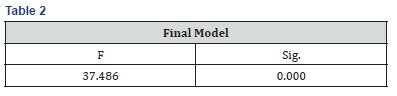
ANOVA – Overall Model Significance (Table 2)
i. Interpretation
a) p = 0.000 < 0.05
b) The model is statistically significant.
c) The predictors jointly explain variation in business
formalisation.
d) Reject the null hypothesis that all regression coefficients
are zero.
ii. Conclusion
The regression model is statistically valid and appropriate for
prediction.
Stepwise Regression Analysis
Backward elimination removed four insignificant variables: Table 3
These variables were not statistically significant predictors of business formalisation at Eastview.
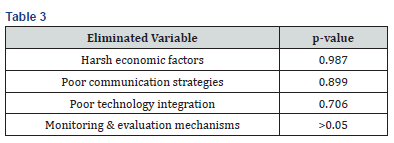
This suggests that:
a) Macro-economic conditions did not independently
predict formalisation when institutional and organisational
variables were controlled.
b) Structural and governance-related variables matter
more than external economic pressures in this case.
Final Regression Model Regression Equation
Y = 2.550 − 0.228x1 + 0.218x2 − 0.148x3 + 0.154x4 + 0.752x5 − 0.640x6 − 0.307x7 +ε
Where:
Variable Interpretation
x1 Non-availability of resources
x2 Training & capacity building
x3 Rigidity of framework
x4 Cultural fit
x5 Clarity of objectives
x6 Lack of stakeholder engagement
x7 Poor regulatory compliance
Interpretation of Individual Predictors Clarity of Objectives (β = 0.752, p = 0.000)
a) Strongest positive predictor.
b) One-unit increase leads to 0.752 increase in
formalisation.
c) Clear policy direction significantly improves compliance
and transition to formality.
d) Rank: 1
Lack of Stakeholder Engagement (β = -0.640, p = 0.000)
a) Strong negative predictor.
b) Weak participation reduces formalisation likelihood.
c) Engagement is critical for buy-in and trust.
d) Rank: 2
Poor Regulatory Compliance (β = -0.307, p = 0.000)
a) Non-compliance significantly reduces formalisation.
b) Indicates institutional trust and enforcement
effectiveness matter.
c) Rank: 3
Non-availability of Resources (β = -0.228, p = 0.000)
a) Financial and material constraints limit formalisation
capacity.
b) Access to capital is a key enabling condition.
c) Rank: 4
Training and Capacity Building (β = 0.218, p = 0.000)
a) Positive influence.
b) Skills and knowledge improve readiness for
formalisation.
c) Rank: 5
Cultural Fit (β = 0.154, p = 0.012)
a) Moderately significant.
b) Alignment with local norms enhances acceptance.
c) Rank: 6
Rigidity of Framework (β = -0.148, p = 0.031)
a) Rigid systems discourage formalisation.
b) Flexibility improves participation.
c) Rank: 7
Ranking by Impact (Descending Order) Table 4
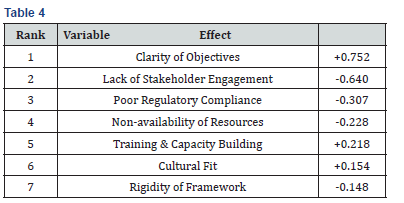
Theoretical and Practical Implications Institutional Theory Perspective
The results reinforce that:
a) Institutional clarity
b) Governance trust
c) Participatory mechanisms
are more influential than macroeconomic pressures.
Formalisation is therefore a governance problem more than an economic problem.
Policy Implications To improve business formalisation in Eastview:
Clearly define and communicate formalisation objectives.
Strengthen stakeholder engagement platforms.
Simplify regulatory compliance processes.
Improve access to microfinance and enterprise resources.
Provide structured training programs.
Ensure cultural sensitivity in policy implementation.
Introduce flexible regulatory models.
Integration with Qualitative Findings The qualitative findings reinforce the regression results by showing:
a) Entrepreneurs resist rigid, enforcement-heavy systems.
b) Trust in local authorities influences compliance
decisions.
c) Cultural legitimacy enhances uptake of formal
programmes.
d) Exclusionary bylaws reduce participation.
Thus, the mixed-method approach confirms:
Quantitative results explain statistical relationships
Qualitative insights explain lived experiences and behavioural
motivations
*Please note that this strengthens validity through
triangulation.
Overall Conclusion The regression model demonstrates:
a) Strong predictive accuracy (R² = 82.4%)
b) Statistically significant explanatory power (p < 0.001)
c) Governance and institutional variables are primary
determinants
The most critical determinant of business formalisation in
Eastview is Clarity of Objectives, followed by Stakeholder
Engagement and Regulatory Compliance.
Economic hardship alone does not independently determine
formalisation outcomes.
The findings support a context-sensitive, participatory, and
flexible policy framework for enhancing formalisation in
illegal settlements.
Results Interpretation and Overview of the Quantitative and
Qualitative Analysis
The formalisation of enterprises operating within illegal settlements and the broader informal economy constitutes a complex and multidimensional policy challenge that continues to engage scholars, policymakers, and development practitioners. At its core, the transition from informal to formal economic participation requires not only clearly articulated policy objectives but also coherent and implementable regulatory pathways responsive to the lived realities of informal entrepreneurs Petersen [122]. Recent guidance from the ILO [34]. emphasises that formalisation should be grounded in inclusive regulatory reform, social protection extension, and institutional trustbuilding. Similarly, the OECD [123] underscores the importance of predictable institutional frameworks that reduce uncertainty and transaction costs. In the absence of such frameworks, high compliance costs, administrative burdens, and regulatory opacity function as deterrents to registration and tax compliance among micro and small-scale operators Petersen [122]; APEC Policy Support Unit [124]; Informal Economy Project [125]; ILO [34]. Empirical evidence consistently demonstrates that reductions in compliance costs, coupled with targeted incentives and access to supportive infrastructure, significantly influence whether informal enterprises perceive tangible benefits in formalisation World Bank [3]; APEC Policy Support Unit [124]; Informal Economy Project [126]; OECD [123].
In Zimbabwe, the magnitude and structural embeddedness of informality accentuate the urgency of effective formalisation strategies. According to ZIMSTAT [63], approximately 76.1% of business establishments operate informally, reflecting a substantial expansion of unregistered economic activity. Informality is particularly prevalent in the wholesale and retail trade sectors, where micro-enterprises dominate market activity yet remain significantly underrepresented within formal taxation and regulatory frameworks ZimStat [127]; ZimStat [128]. While this prevalence constrains fiscal capacity by narrowing the tax base, it also underscores the sector’s centrality in sustaining livelihoods amid protracted economic contraction and high unemployment African Development Bank [129]; Munjeyia & Fourie [130]; Obi [131]. In fact, informality in this context is not merely a regulatory anomaly but a structural adaptation to limited formal employment opportunities and macroeconomic instability ZIMSTAT [63]; ILO [36]. It is worth noting that policy responses in Zimbabwe have increasingly focused on regulatory modernisation and digitalisation transformation, reflecting a broader national commitment to fostering agile governance frameworks, enhancing e government capacity, and aligning with international best practices in digital governance (International Telecommunication Union [132]; World Bank [97]; Mhaka & Hodhera [133]; UNESCO [134].
Thus, initiatives led by the Ministry of Finance and Economic Development [135] include the digitisation of business registration processes, streamlined SME licensing procedures, and expanded use of electronic point-of-sale systems to enhance transparency and tax compliance International Telecommunication Union [132]; World Bank [97]; Mhaka & Hodhera [133]; UNESCO [134]. These measures are aimed at reducing bureaucratic delays and improve administrative efficiency (Republic of Zimbabwe [136]; International Telecommunication Union [132]; Mhaka & Hodhera [133]; UNESCO [134]. However, the quantitative findings indicate that entrenched structural barriers, including limited access to finance, inadequate infrastructure, and perceived compliance risks, continue to dampen formalisation uptake IMF [67]; Marimira & Gumel [137]; Informal Economy Project [125]. Regression analyses indicate that perceived regulatory fairness, anticipated economic benefits, and institutional trust emerge as statistically significant predictors of formalisation readiness and, these findings are consistent with cross-country evidence suggesting that formalisation decisions are shaped by cost– benefit considerations embedded within broader governance environments OECD [123]; World Bank [3].
On the other end, qualitative data derived from semistructured interviews and focus group discussions were analysed through reflexive thematic analysis following Braun and Clarke’s [53] six-phase framework. Thus, four predominant thematic clusters emerged. First, contested urban space and enforcement practices were characterised by periodic municipal raids, confiscation of goods, and exclusionary by-laws, reinforcing adversarial state–informal sector relations consistent with earlier findings in Zimbabwean urban governance studies Munyoro [48]; Munyoro [1]; Kamete [9]. Second, institutional distrust and governance deficits were recurrent, with participants citing opaque licensing systems and perceived corruption and this theme converged strongly with quantitative regression results identifying institutional trust as a critical determinant of formalisation readiness Tu [109]; Namfukwe [108]. Third, adaptive informal strategies, such as rotating savings and credit associations (ROSCAs) and community-based credit networks, were identified as essential resilience mechanisms enabling households to absorb economic shocks Chineka & Mtetwa [138]; Zambrano [139]; Murongazvombo & Munyoro [140]. While these systems enhance financial inclusion within informal networks, they may inadvertently reduce incentives to integrate into formal financial and regulatory institutions Murongazvombo & Munyoro [140]. Fourth, conditional willingness to formalise reflected a negotiated understanding of legality and respondents expressed readiness to register enterprises provided that licensing costs were reduced, tenure security assured, and tangible benefits, such as access to credit, infrastructure, and training were delivered Munyoro [28]; Munyoro [29]; Biru [141]; Sanangura & Mutono- Mwanza [113]. This interpretation reinforces contemporary perspectives that conceptualise formalisation as relational and incentive-based rather than coercive Munyoro [29]; ILO [34]; World Bank [3].
The synthesis of quantitative and qualitative evidence indicates that the process of formalisation in Zimbabwe is best understood and conceptualised as a negotiated institutional transition, shaped by economic rationality, governance quality, and socio-spatial dynamics Munjeyia & Fourie [130]; ZIMSTAT, [63]; AfDB [142]; UN Zimbabwe, 2024). Thus, quantitative analyses delineate the structural magnitude of informality and identify statistically significant determinants of compliance behaviour, whereas qualitative approaches provide critical insights into lived experiences, perceptions, and adaptive strategies that shape the effectiveness of policy implementation Gwaindepi & Venganai [143]; IMF [144]; Ulyssea [145]. Together, these strands underscore that formalisation is unlikely to succeed through enforcement-centred approaches alone. Instead, incremental regulatory reform, participatory governance mechanisms, and integrated social protection frameworks are pivotal in reframing formalisation from a perceived administrative burden into a credible pathway for economic security and upward mobility, particularly within contexts of institutional fragility and socioeconomic precarity Masuku & Macheka [146]; Siambombe [147]; Hupile [148].
In summary, the findings suggest that effective formalisation strategies must transcend technocratic registration reforms and instead prioritize comprehensive institutional restructuring. This entails reducing compliance costs, strengthening trust in public institutions, enhancing service delivery, and acknowledging the heterogeneity of informal enterprises, all of which are critical components of a sustainable approach to formalisation Chikosi [114]; ILO [36]; Zinyama & Mateko [149]. As global policy discourse increasingly emphasises inclusive growth and decent work, Zimbabwe’s experience provides a salient case study of the tensions between fiscal imperatives, urban governance, and livelihood survival. Thus, a coordinated, incentive-based, and context-sensitive strategy, anchored in transparent institutions and stakeholder engagement, remains central to advancing formal economic integration in structurally informal economies.
Discussion and Policy Recommendations
Discussion
The formalisation of businesses operating within illegal settlements and the informal economy represents a multifaceted governance challenge that intersects economic policy, institutional capacity, and social inclusion. At its core, the process of formalisation necessitates the establishment of clearly defined policy objectives and integrated regulatory frameworks that not only articulate the rationale for transitioning enterprises from informal to formal status but also provide practical mechanisms to facilitate this transformation in a sustainable and inclusive manner Petersen [122]; Informal Economy Project [125]. Absent of well-defined pathways, informal entrepreneurs often confront prohibitive administrative costs and regulatory ambiguity, which deter registration and compliance. This dynamic has been documented widely in the literature on informality, indicating that bureaucratic hurdles, high licensing fees, and limited institutional support function as disincentives to formalisation in many developing contexts OECD [150]; ITC, 2025). Moreover, global frameworks emphasize that formalisation strategies must integrate fiscal, governance, and social dimensions to effectively shape incentives and lower the transactional costs of compliance ILO [151]; OECD [150].
In the Zimbabwean context, the scale and persistence of informality underscore the structural complexity of formalisation efforts. Recent economic data from the Zimbabwe National Statistics Agency reveal that approximately 76.1 % of business establishments operate informally, with a predominance of micro enterprises outside formal registration with regulatory bodies such as the Registrar of Companies, Zimbabwe Revenue Authority (ZIMRA), and National Social Security Authority (NSSA) ZimStat [63]. This expansive informal economy constrains fiscal capacity and complicates economic planning, while simultaneously absorbing a substantial share of the labour force in an environment of limited formal employment opportunities Zimbabwe Independent [152]. The International Trade Centre’s recent report further notes that lack of financial resources and awareness of formalisation benefits are among the primary obstacles to small business registration and formal compliance in Zimbabwe (ITC, 2025).
Government-led initiatives in Zimbabwe targeting the integration of the informal sector increasingly emphasize multifaceted strategies designed to foster economic inclusion and participation. These strategies encompass the digitisation of business processes, the expansion of electronic transaction mechanisms, and the implementation of targeted support programmes for small and medium enterprises, reflecting a broader policy commitment to formalisation and sustainable development ([UNDP [23]; Republic of Zimbabwe [136]; Mugadzikwa [153]. Digitisation is specifically highlighted as a mechanism to reduce entry costs, improve financial inclusion, and generate transparent business records that link informal traders to formal markets and financial systems (UNDP Zimbabwe [154]; UNDP Africa, 2026). By implementing digital record-keeping and payment infrastructures, policymakers aim to reduce barriers to business registration and mitigate the entrenched reliance on cash transactions, which continues to pose significant challenges in informal market economies Rathi [155]; IMF [156]; IMF [157]; Mensah & Jumah [158]. However, infrastructural deficits, fiscal pressures, and regulatory complexity continue to pose substantive impediments to widespread formalisation.
Equally critical to formalisation efforts is the role of capacity building and stakeholder engagement. Recent empirical studies demonstrate that training programs designed to strengthen entrepreneurial competencies, such as compliance knowledge, financial literacy, and strategic business planning are critical for enabling informal sector actors to effectively transition into and navigate formal economic systems Dumbuya [159]; Srinivas [160]; ACP Informal Economy Project [161]. Thus, without such support, then informal entrepreneurs may remain unwilling or unable to undertake the administrative and regulatory requirements of formalisation (Sandada., 2014; ITC., 2025). Moreover, active collaboration with community leaders and regulatory authorities has been demonstrated to enhance institutional trust, mitigate resistance to policy directives, and ensure that formalisation strategies are appropriately contextualised within prevailing local socioeconomic conditions UCAZ [162]; Republic of Zimbabwe [136]; Zimbabwe Competitiveness Commission [163]. Such collaborative approaches resonate with global best practices, which call for coordinated actions across policy domains, education, and institutional support to sustain pathways to formalisation (ILO SOLIFEM., 2025; OECD [150]).
Policy Recommendations
Together, these recommendations underscore a multifaceted and context sensitive approach to formalisation that balances administrative simplicity, participatory governance, financial inclusion, capacity building, infrastructure support, and digital transformation. Such a comprehensive framework is essential to integrate informal enterprises into the formal economy and unlock their full developmental potential.
Proposed Policy Framework Model for Integrating Informal Businesses in Illegal Settlements (Figure 2) Source; Authors
The transition of informal businesses operating in illegal and peripheral urban settlements, such as those in Eastview, Harare, into the formal economy requires a multifaceted and evidence based policy framework grounded in contemporary empirical and theoretical research. Informal economic activities currently dominate Zimbabwe’s economic landscape and recent data indicate that upwards of three quarters of business activity remains unregistered, with a significant contribution to employment and GDP that underscores both opportunity and challenge for policymakers ZimStat [63]; FBC Securities analysis [164]. This prevalence reflects broader global patterns identified by the Organisation for Economic Co operation and Development (OECD), which emphasises that informality varies across sectors and geographies and that tailored, place based strategies are essential for effective transition and inclusive growth OECD [150]. Thus, without deliberate policy design, the persistence of informality limits access to rights, protections, and formal economic opportunities, constraining both productivity and government revenue streams.
At the core of an enabling environment is the simplification of institutional and regulatory processes, which empirical assessments consistently identify as a primary determinant of formalisation success ILO [36]; OECD [123]; UNDP [23]. In many settings, complex registration procedures, high compliance costs, and fragmented administrative requirements deter micro and small enterprises from formalising, perpetuating their exclusion from formal markets and services. In Zimbabwe, recent policy blueprints within the National Development Strategy (NDS2) seek to alleviate these burdens through streamlined business registration systems, rationalised licensing, and the reduction of barriers to compliance, thereby making formality more affordable and attractive to informal entrepreneurs Government of Zimbabwe [165]. Hus, by lowering thresholds for value added tax registration and adopting proportional regulatory incentives, governments can align administrative requirements with the operational capacities of small businesses, mitigating the risk that regulatory reform inadvertently deepens barriers to entry.
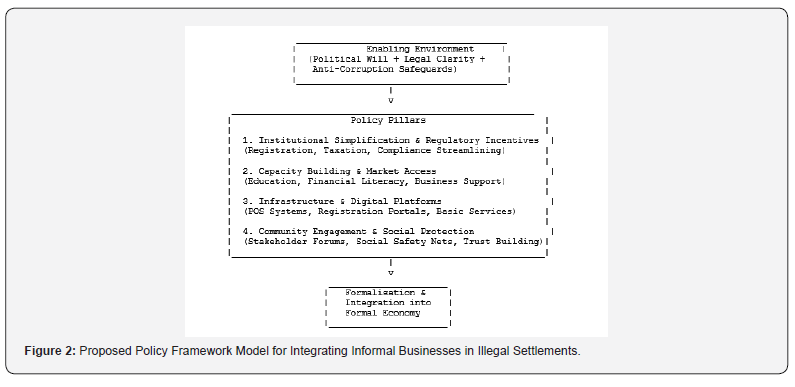
Beyond administrative reform, capacity building and market access form a second pillar that recognises formalisation as a developmental process rather than a mere bureaucratic exercise. Research on financial inclusion underscores the critical role of access to tailored financial products and services in enabling informal operators to meet statutory requirements, build capital, and expand productive activities OECD [150]; Research in International Business and Finance, 2024). Interventions such as financial literacy training, business planning support, and participatory tax dialogues can strengthen entrepreneurs’ competencies while fostering trust between informal stakeholders and formal institutions. Indigenous civil society organisations in Zimbabwe, for example, are actively engaging informal traders through training and advocacy platforms that amplify their voices in policy formulation, thereby aligning incentives with lived economic realities VISET [166].
The third interconnected pillar underscores the critical role of infrastructure and the strategic deployment of digital platforms as foundational mechanisms for reducing transaction costs and enhancing institutional transparency Leone de Castris [167]; Chan & Bheekee [168]; Harada [169]. Globally, digital financial services and mobile money adoption have been shown to reduce the scale of the shadow economy by enhancing accessibility and transparency in transactions, suggesting that fintech solutions are a potent complement to traditional formalisation policies Hassan [170]. In Zimbabwe, governmental initiatives to strengthen the digital payment ecosystem and establish national digital registration systems for micro, small, and medium enterprises reflect recognition of the potential of e governance to facilitate formalisation Herald [171]. Such digitalisation has the potential to mitigate information asymmetries, broaden market access, and enhance service delivery in peripheral urban settlements; however, these benefits can only be fully realised if persistent infrastructural challenges, such as unreliable utilities and limited connectivity, are simultaneously addressed Mofokeng, Ramolobe, & Bogopa [172]; Gondo & Suwaryono [173]; MDPI [174].
Finally, community engagement and social protection frameworks are indispensable to ensuring that formalisation advances equity and sustainability rather than exacerbating vulnerability. Policymakers must co create regulatory mechanisms with local authorities, business associations, and civil society to ensure that formalisation strategies are responsive to community needs and preserve economic livelihoods. This includes transitional measures such as tax incentives, targeted social safety nets, and protective buffers that manage the short-term risks associated with formal compliance. Both international evidence and Zimbabwean policy dialogues indicate that formalisation is most effective when approached as a negotiated, supported progression rather than exclusively an enforcement imperative. Thus, by embedding social protection and inclusive governance within formalisation strategies, governments can mitigate the disruptive effects of policy change and foster more resilient, equitable urban economies [175-200].
Conclusion
In conclusion, the formalisation of businesses within Zimbabwe’s informal economy, including in illegal settlements such as Eastview, demands a nuanced, multidimensional approach that transcends simplistic regulatory mandates. Structural factors such as high compliance costs, regulatory ambiguities, infrastructural deficits, and socio-economic pressures underscore that informality is a persistent and systemic phenomenon rather than a transient condition. Effective formalisation therefore requires coherent legal frameworks, streamlined procedures, targeted incentives, and capacity-building initiatives that enhance financial inclusion and foster participatory engagement among entrepreneurs, authorities, and community stakeholders. Complementary investments in infrastructure and digital platforms further reduce operational barriers, improve transparency, and facilitate the seamless integration of informal enterprises into the formal economy. By emphasising clarity, stakeholder engagement, resource accessibility, compliance support, and adaptive strategies, such tailored frameworks can transform formalisation from a regulatory obligation into a catalyst for sustainable economic empowerment, equitable governance, and inclusive community development [200-288].
References
- Munyoro G, Nyamushamba G (2016) The Impact of Illegal Settlement on Economic Development: A Case Study of Chirundu Border Town, Mash West, Zimbabwe. Journal of Economics 4(4).
- UN-Habitat (2022) World Cities Report 2022: Envisaging the future of cities. United Nations Human Settlements Programme.
- World Bank (2023) Informality and development: Policy approaches for inclusive growth. World Bank Publications.
- ILO (2023) Women and men in the informal economy: A statistical update. International Labour Organization (ILO).
- Rogan M, Skinner C (2020) The nature of the informal economy in urban Africa: Evidence from Zimbabwe and South Africa. World Development 126: 104716.
- OECD (2023) Informality and globalisation: Economic inclusion in developing countries. OECD Publishing.
- ILO (2023) Women and men in the informal economy: A statistical update. International Labour Organization (ILO). ILO Publishing
- Zimstat (2023) 2022 population and housing census thematic report: Labour force and informal sector analysis. Zimbabwe National Statistics Agency (ZIMSTAT).
- Kamete AY (2018) Governing enclaves of informality: Urban planning and the politics of survival in Zimbabwe. Planning Theory & Practice 19(3) 329-345.
- Munyoro G, Kabangure H, Munyoro Dzapasi Y (2016) Examining the Significance of Urbanisation in Zimbabwe: A Case Study of the Municipality of Chinhoyi: Journal of Public Policy 3(3).
- Muchadenyika D (2015) Slum upgrading and inclusive municipal governance in Zimbabwe. Habitat International 48: 132-140.
- Government of Zimbabwe (2021) National Development Strategy 1 (2021–2025). Government of Zimbabwe.
- Mitlin D, Satterthwaite D (2013) Urban poverty in the global South: Scale and nature. Routledge.
- Chen MA (2012) The informal economy: Definitions, theories and policies. WIEGO Working Paper No. 1. Women in Informal Employment: Globalizing and Organizing.
- Roy A (2011) Slumdog cities: Rethinking subaltern urbanism. International Journal of Urban and Regional Research 35(2): 223-238.
- La Porta R, Shleifer A (2014) Informality and development. Journal of Economic Perspectives 28(3): 109-126.
- OECD (2021) Encouraging formalisation of informal businesses. OECD Publishing.
- Potts D (2008) The urban informal sector in sub-Saharan Africa: From bad to good (and back again?). Development Southern Africa 25(2): 151-167.
- Moyo I (2014) Informal sector taxation and enforcement in Zimbabwe. African Journal of Economic and Management Studies 5(2): 231-245.
- Kamete AY (2013) On handling urban informality in southern Africa. Geografiska Annaler: Series B, Human Geography 95(1): 17-31.
- World Bank (2022) Informality and inclusive growth in Sub-Saharan Africa. World Bank Publications.
- Benjamin N, Mbaye AA (2012) The informal sector in Francophone Africa: Firm size, productivity, and institutions. World Bank.
- UNDP (2024) Informality and structural challenges. UNDP.
- Mupambireyi Z, Muchengeti T (2020) Informal entrepreneurship and economic resilience in Zimbabwe. Journal of Development Studies 56(9): 1705–1721.
- Moyo T (2019) Informality, regulation and urban governance in Zimbabwe. Journal of Southern African Studies 45(4): 715-732.
- Ministry of Women Affairs, Community, Small and Medium Enterprises Development (MWACSMED). (2020). National Micro, Small and Medium Enterprises Policy (2020–2024). Harare: Government of Zimbabwe.
- Munyoro G, Chidoko C, Sakuhuni R (2017) The contribution of informal sector to economic growth in Zimbabwe. International Journal of Economics and Financial Issues 7(2): 63-67.
- Munyoro G, Mupfumira A, Langton IR, Chimbari F, Munyoro-Dzapasi Y, et al. (2018) The Role of a Tax Clearance Certificate in the Promotion of Small Business Sector: A Case Study of Harare: Africa Development and Resources Research Institute Journal: E-ISSN 2343-6662. ISSN-L 2343-6662 27(4): 1-34.
- ILO (2023) Women and men in the informal economy: A statistical update (3rd). International Labour Organization (ILO). ILO Publishing, Geneva.
- Ncube M, Chirisa I (2019) Collateral constraints and microenterprise development in Zimbabwe. Development Southern Africa, 36(5): 602-617.
- City of Harare (2023) Informal Business Sector (SMEs) Policy Framework (Working Paper).
- Chirisa I, Muchini T (2017) Youth, unemployment and peri-urbanity in Zimbabwe: A case of Epworth, Harare. Urban Forum 28(2): 181-197.
- Creswell JW, Plano Clark VL (2018) Designing and conducting mixed methods research (3rd ). Sage Publications.
- Saunders M, Lewis P, Thornhill A (2019) Research methods for business students (8th ). Pearson Education.
- ILO (2024) Informality and structural challenges. International Labour Organization (ILO). ILO Publishing
- UN-Habitat (2023) World cities report 2023: Envisaging the future of cities. United Nations Human Settlements Programme. UN-Habitat.
- Bryman A (2016) Social research methods (5th). Oxford University Press.
- Gubwe P (2025) Economic, social, and regulatory influences on the uptake of life insurance in Zimbabwe: The mediating role of trust on culture, affordability and value for money. Management Matters, Emerald Publishing 22(2).
- Leitão J, Capucho J (2021) Institutional, economic, and socio-economic determinants of the entrepreneurial activity of nations. Administrative Sciences 11(1): 26.
- Mini L, Moyo C, Phiri A (2024) Governance, institutional quality and economic complexity in selected African countries. International Journal of Economic Policy Studies 19(1) 159-181.
- De Soto H (2000) The mystery of capital: Why capitalism triumphs in the West and fails everywhere else. Basic Books.
- Creswell JW, Creswell JD (2023) Research design: Qualitative, quantitative, and mixed methods approach (6th). Sage Publications.
- Mweshi GK, Muhyila M (2024) Determining a statistical analysis for the quantitative study. Advances in Social Sciences Research Journal 11(7): 187-231.
- Grant SW, Hickey GL, Head SJ (2019) Statistical primer: multivariable regression considerations and pitfalls. European Journal of Cardio-Thoracic Surgery 55(2): 179-185.
- Hair JF, Black WC, Babin BJ, Anderson RE (2019) Multivariate Data Analysis (8th). Cengage Learning.
- Field A (2018) Discovering statistics using IBM SPSS statistics (5th). Sage Publications.
- Munyoro G (2014) Evaluation of the Effectiveness of Handouts in Enhancing Teaching and Learning in Higher Education: Africa Development and Resources Research Institute: pISSN: 2343-6662 ISSNL: 2343-6662 6(2): 95-107.
- Dietrich JJ, Munoz J, Tshabalala G, Makhale LM, Hornschuh S, et al. (2022) A qualitative study of stakeholder and researcher perspectives of community engagement practices for HIV vaccine clinical trials in South Africa. Journal of Community Psychology 51(3): 998–1015.
- Roller MR, Smith ZR (2025) Qualitative research: Advancing the social and behavioral sciences. Public Opinion Quarterly 89(SI): 477-491.
- Lune H, Berg BL (2017) Qualitative research methods for the social sciences (9th). Pearson. (as cited in International Journal of Research in Business and Social Science, 2025).
- Govender K, Naude M, Munodawafa T (2025) An exploratory qualitative study of competitive strategies used by small and medium-sized enterprises in Botswana. Journal of Management: Small and Medium Enterprises (SMEs) 18(1): 11-37.
- Braun V, Clarke V (2021) Thematic analysis: A practical guide. Sage Publications.
- Cartwright E, Igudia E (2023) The case for mixed methods research: Embracing qualitative research to understand the informal economy. Review of Development Economics 27(4): 13069.
- Chigaga B, Mpundu M (2024) Fiscalization and the informal economy in Zimbabwe: A path to formalization. ISAR Journal of Economics and Business Management 2(11): 27-36.
- Tashakkori A, Teddlie C (2021) Foundations of mixed methods research: Integrating quantitative and qualitative approaches in the social and behavioral sciences (2nd ). Sage Publications.
- Mulibana L, Rena R (2022) Establishing an understanding of the innovation process of informal micro-enterprises. African Journal of Science, Technology, Innovation and Development.
- Lakemann T (2025) Small-scale entrepreneurship and informal employment: Evidence from sub-Saharan Africa. Georg-August-Universität Göttingen.
- Etikan I, Bala K (2017) Sampling and sampling methods. Biometrics & Biostatistics International Journal 5(6): 00149.
- Magidi M (2024) The transformation of Zimbabwe’s informal economy: From petty trade to vibrant sector. Journal of Asian and African Studies p. 1-17.
- ZIMSTAT (2024) First Quarter Labour Force Survey Report. Harare: Zimbabwe National Statistics Agency (ZIMSTAT).
- Muchabveyo B, Magaiza G, Kamwendo J (2025) Gender and informal economies in rural Zimbabwe: Pathways to a gender-responsive model. Discover Sustainability 6(938).
- ZIMSTAT (2025) Economic census preliminary results: Informal sector dominance. Zimbabwe National Statistics Agency (ZIMSTAT).
- Jenkins DG, Quintana-Ascencio PF (2020) A solution to minimum sample size for regressions. PLOS ONE 15(2): e0229345.
- Garg M, Dhull H, Kalluri N, Agrawal S (2024) Understanding sample size determination in research: A practical guide. Educational Administration: Theory and Practice 30(5): 13800-13810.
- Seabrook JA (2025) Powering nutrition research: Practical strategies for sample size in multiple regression. Nutrients 17(16): 2668.
- IMF (2025) Bottlenecks to private sector development in Sub-Saharan Africa: A firm-level analysis (WP/25/188). International Monetary Fund (IMF) Working Paper.
- Simba A, Tajeddin M, Dana LP, Soriano DER (2024) Deconstructing involuntary financial exclusion: A focus on African SMEs. Small Business Economics 62(2): 285-305.
- Piotrkowska M, Rędzińska K, Zgutka M, Płaszczyca M (2024) Driving sustainable adaptation through community engagement: A social adaptive capacity tool for climate policy. Sustainability 17(21): 9361.
- Tamasiga P, Mogomotsi PK, Onyeaka H, Mogomotsi GEJ (2024) Amplifying climate resilience: The impact of social protection, social cohesion, and social capital on public support for climate change action. Sustainable Environment 10(1): 2361568.
- Zhao C, Tang M, Wang C (2025) The impact of livelihood capital on the social integration of relocated households: Mediating effects based on livelihood risk. Frontiers in Sustainable Food Systems 9: 1537141.
- Nguyen Thi MA, Vu Dinh K (2025) Social capital and sustainable performance: Examining the mediating role of supply chain resilience in an emerging economy. Discover Sustainability 6(764).
- Serzante M, Khudozhnyk A (2023) Reviewing sustainability measurement methods for enterprises. Sustainability 15(21): 15514.
- Milena S, Khudozhnyk A (2023) Quantitative indicators for environmental and social sustainability in supply chains. Sustainability Studies Journal.
- Parashara M, Mensumaneb V, Devc A, Kaurd A, Pandae, M, et al. (2025) A quantitative analysis of marketing strategy and its impact on small and medium enterprises sustainability. Multiscience Conference Proceedings.
- Tshuma N, Ndebele V, Setoboli T, Sibanda E (2025) An analysis of the impact of survival entrepreneurship on economic development: A case study of the informal sector in Zimbabwe. International Journal of Research and Innovation in Social Science 9(4): 405-414.
- Pilcher N, Cortazzi M (2023) ‘Qualitative’ and ‘quantitative’ methods and approaches across subject fields: Implications for research values, assumptions, and practices. Quality & Quantity 58: 2357-2387.
- Bazeley P (2024) Conceptualizing integration in mixed methods research. Journal of Mixed Methods Research 18(3): 225-234.
- Muselela C (2025) Guidance to critical realism mixed-methods research framework: A must-adopt approach to explore the relationship of social realities. International Journal of Science and Research Archive 15(3): 912-923.
- Moseholm E, Fetters MD (2017) Conceptual models to guide integration during analysis in convergent mixed methods studies. Methodological Innovations 10(2): 1–11.
- Williams CC, Kedir A (2018) Evaluating competing theories of informal sector entrepreneurship: Some lessons from urban Ethiopia. Journal of Developmental Entrepreneurship 23(3): 1850010.
- George T (2023) Semi-structured interview: Definition, guide & examples. Scribbr.
- Nimbli (2025) Semi-structured questionnaire: Definition, advantages & examples for effective research. Nimbli Research Insights.
- Moyo I, Gumbo T (2021) Urban informality policies and regulatory frameworks in South African and Zimbabwean cities. In Urban Informality in South Africa and Zimbabwe, Springer pp. 123-133.
- Lewanika M, Mswelanto T, Karakadzai T, Lines K (2024) Experimenting with multistakeholder reform coalition: The case of the Urban Informality Forum in Zimbabwe. Accountability Lab.
- Tate R, Beauregard F, Peter C, Marotta L (2023) Pilot testing as a strategy to develop interview and questionnaire skills. Impacting Education: Journal on Transforming Professional Practice 8(2): 45-59.
- WIEGO (2025) Global position paper on formalization: Collective action for risk reduction and decent work. Women in Informal Employment: Globalizing and Organizing (WIEGO). WIEGO Report.
- Taber KS (2018) The use of Cronbach’s alpha when developing and reporting research instruments in science education. Research in Science Education 48(6): 1273-1296.
- Raykov T (2024) Reliability. In J. E. Edlund & A. L. Nichols (Eds.), The Cambridge handbook of research methods and statistics for the social and behavioral sciences. Cambridge University Press pp. 215-240.
- IBM (2023) IBM SPSS Statistics 29 documentation. IBM Corporation.
- Moyo TJ, Ndlovu AN (2024) Labour dynamics in the informal sector: Evidence from Zimbabwe’s urban metal industry. Zenodo.
- Medina L, Schneider F (2018) Shadow economies around the world: What have we learn over the last 20 years? International Monetary Fund.
- Korb KA (2024) Descriptive statistics in applied research. University of Jos.
- Michelotto F, Joia LA (2024) Organizational digital transformation readiness: An exploratory investigation. Journal of Theoretical and Applied Electronic Commerce Research 19(4): 159.
- Miake-Lye IM, Delevan DM, Ganz DA, Mittman BS, Finley EP (2020) Unpacking organizational readiness for change: An updated systematic review and content analysis of assessments. BMC Health Services Research 20(1): 106.
- Mfaume R (2023) Entrepreneur attributes and formalization of micro, small and medium enterprises: Evidence from Tanzanian national survey data. Journal of Developmental Entrepreneurship 28(2): 145-167.
- World Bank (2025) Strengthening the regulation and supervision of microfinance institutions. World Bank Publications.
- Sanangura O, Mutono-Mwanza BG (2025) Pathways to formalization: Exploring support systems for informal micro-entrepreneurs in the metal manufacturing sector in Zimbabwe. Open Journal of Business and Management 13(3): 1661-1679.
- Xiao H, Gong T, Tu W (2024) Why trust weighs more? Investigating the endogenous relationship between trust and perceived institutional effectiveness. Administration & Society 56(5): 602-627.
- Omowole B, M, Urefe O, Mokogwu C, Ewim SE (2024) Integrating fintech and innovation in microfinance: Transforming credit accessibility for small businesses. International Journal of Frontline Research and Reviews 3(1): 90-100.
- Gahadza N (2024) Reducing compliance cost key to SMEs formalisation. The Herald.
- Lwesya F, Mwakalobo A (2023) Urban infrastructure and informal enterprise productivity in Eastern and Southern Africa. Development Southern Africa 40(5): 721-739.
- Fujo MH, Adewale A, Chen S (2024) Infrastructure access and formalisation outcomes among urban informal enterprises in sub-Saharan Africa. Journal of Development Policy and Practice 9(1): 44-62.
- Hassan A (2024) Mobile financial services and the shadow economy in Southern African countries.
- Lee J (2025) Financial inclusion and regulatory simplification as determinants of small enterprise formalisation. Small Business Economics 64(2): 389-405.
- Özden M (2024) Content and thematic analysis techniques in qualitative research: Purpose, process, and features. Qualitative Inquiry in Education: Theory & Practice 2(1): 64-81.
- Williams B (2024) Step-by-step thematic analysis in qualitative research. Insight7.
- Namfukwe L (2024) Institutional trust and SME compliance behaviour in developing economies. Journal of Development Policy 29(2): 101–118.
- Tu P (2023) Governance quality and enterprise formalisation: Evidence from emerging markets. World Development 168: 106234.
- Zambrano AF, Giraldo LF, Perdomo MT, Hernández ID, Godoy JM (2023) Rotating savings and credit associations: A scoping review. World Development Sustainability 2(100081).
- Chineka TS, Mtetwa E (2022) Savings and credit schemes (SCSs): Towards an informal sector poverty alleviation strategy for Zimbabwe. African Journal of Social Work.
- Biru A, Arenius P, Bruton G, Gilbert D, Jilin U (2025) Firm formalization strategy: The interaction of entrepreneurs and government officials in the enforcement of regulation. Journal of Management 51(4): 1586-1618.
- Sanangura P, Mutono-Mwanza B (2025) Negotiating legality: Informal traders and regulatory reform in Zimbabwe. Development Southern Africa 42(2): 210-228.
- Chikosi C (2024) Understanding informalisation: Policy options and solutions. The Zimbabwe Independent.
- Msweli NM (2019) Assessing mixed-income housing as a mechanism for social integration: A case study of the Durban Point area (Master’s dissertation, University of KwaZulu-Natal).
- Jinollo GT, Habtemariam LW, Belete DA (2025) The impacts of mixed land use planning on spatial development: Socio-economic, physical, and environmental effects in Addis Ababa. Discover Cities 2(8).
- Gamage AN, KK (2025) A comparative analysis of qualitative and mixed methods research: Strengths, limitations, and practical applications. World Journal of Advanced Research and Reviews 25(3): 2040-2046.
- Abdullah RS, Masmali FH, Alhazemi A, Onn CW, Khan SM, FA (2025) Enhancing institutional readiness: A multi-stakeholder approach to learning analytics policy with the SHEILA-UTAUT framework using PLS-SEM. Education and Information Technologies 30: 22315-22342.
- Kasonkomona P, Kimena J, Bindabinda E (2025) Assessing the readiness and capacity of TEVET institutions in Zambia to implement open, distance, and flexible learning programs. Technical Education Vocational and Entrepreneurship Training Authority Report.
- Albrecht JF (2024) Initiatives to improve police–community collaboration and trust. In Special Topics in Policing (pp. 187–203). Springer.
- Moahid M, Hermes N, Hudon M (2024) The microfinance regulation maze: A systematic literature review. University of Groningen, Faculty of Economics and Business.
- Petersen I, Mustapha N, Van Rheede N (2024) Transitioning the informal to the formal economy: Measures to assess readiness and progress. Human Sciences Research Council, Department of Science and Innovation, Republic of South Africa.
- OECD (2024) Informality and structural challenges. OECD.
- APEC Policy Support Unit (2024) Addressing informality: Transitioning to the formal economy. Asia-Pacific Economic Cooperation.
- Informal Economy Project (2024) Supporting the transition of informal enterprises towards sustainable growth and formalisation in the African, Caribbean and Pacific regions.
- APEC Policy Support Unit (2024) Reducing barriers to SME formalization in APEC economies. Asia-Pacific Economic Cooperation.
- The Herald (2025a) ZimStat confirms dominance of Zimbabwe’s huge informal sector. The Herald.
- The Anchor Economy (2025b) Zimstat: 76% of Zimbabwean businesses remain informal. The Anchor Economy.
- African Development Bank (2024) Understanding informalisation: Policy options and solutions.
- Munjeyia E, Fourie H (2024) A framework for digitalising tax revenue collection for the informal economic sphere in Zimbabwe. Cogent Economics & Finance 12(1): 2409427.
- Obi S (2025) Zimbabwe’s informal economy explained: Causes, stats, solutions. African Leadership Magazine.
- ITU (2025) Zimbabwe contribution towards GSR 25 best practice guidelines. International Telecommunication Union (ITU).
- Mhaka TW, Hodhera AC (2025) Digital transformation in Zimbabwe’s public administration: Opportunities, challenges, and ethical implications of e governance.
- UNESCO (2026) Zimbabwe deepens cooperation with UNESCO on digital transformation. UNESCO News.
- Ministry of Finance and Economic Development (Zimbabwe) (2026) National economic reform and SME formalisation strategy 2026–2030. Government of Zimbabwe.
- Republic of Zimbabwe (2024) 2021–2025 Strategic Plan (Reviewed October 2024). Government of Zimbabwe.
- Marimira N, Gumel BI (2025) Financial risk management in Zimbabwe. Asian Journal of Economics, Business and Accounting 25(3): 337-348.
- Chineka T, Mtetwa E (2022) Informal financial networks and household resilience in Zimbabwe. African Development Review 34(4): 589-603.
- Zambrano A, Ncube M, Kaseke E (2023) Community finance and informal enterprise resilience. Journal of International Development 35(6): 1234-1250.
- Murongazvombo W, Munyoro G (2025) The Role of Women Entrepreneurship in Accelerating Rural Economic Development in Zimbabwe: A Case Study of Mudzi District in Mashonaland East Province: South Asian Journal of Social Studies and Economics Article no. SAJSSE. 144037 22(11): 51-60.
- Biru T, Moyo P, Dube N (2025) Incentive-based pathways to SME formalisation in Sub-Saharan Africa. Journal of African Economic Policy 32(1): 45-67.
- African Development Bank (2025) Cluster evaluation of the AfDB’s governance institutional support projects in Zimbabwe (2012–2024). AfDB Evaluation Department.
- Gwaindepi A, Venganai H (2025) Unpacking informality for tax purposes: Evidence from urban Zimbabwe. Danish Institute for International Studies.
- IMF (2025) Digital payment innovations in Sub-Saharan Africa (IMF Departmental Paper No. 2025/004). International Monetary Fund (IMF).
- Ulyssea G, Bobba M, Gadenne L, Harari M (2025) VoxDevLit 6: Informality. VoxDev. https://voxdev.org/lit/informality (voxdev.org in Bing)
- Masuku S, Macheka T (2020) Policy making and governance structures in Zimbabwe: Examining their efficacy as a conduit to equitable participation and social justice for rural youths. Cogent Social Sciences 6(1): 1830536.
- Siambombe AH (2024) Economic inclusion in crisis: Challenges and opportunities for policy reform in Zimbabwe. African Journal of Inclusive Societies 4(1).
- Hupile M (2024) Social protection approaches to increasing welfare among the informally employed in Zimbabwe. Journal of Development Policy and Practice 9(2): 145-162.
- Zinyama V, Mateko J (2024) Zimbabwe National Formalisation Strategy. Zimbabwe Congress of Trade Unions (ZCTU).
- OECD (2026) Addressing informality for people, places and firms. Organisation for Economic Cooperation and Development (OECD). OECD Publishing.
- ILO (2025) Formalization pathways for transition to the formal economy [Synthesis report]. International Labour Organization (ILO). ILO Publishing.
- The Zimbabwe Independent (2025) Expanding informal sector breeds structural challenges to economy. The Zimbabwe Independent.
- Mugadzikwa M (2024) Zim’s multi-pronged approach to SMEs development. The Herald.
- UNDP (2023) Zimbabwe resilience and livelihoods support programme report. UNDP Zimbabwe.
- Rathi MM (2024) The impact of digital payment systems on financial management practices in small businesses. Journal of Commerce and Management Studies 12(3): 45-58.
- IMF (2025) System of National Accounts (2025 SNA), Chapter 39: Informal economy. International Monetary Fund (IMF).
- IMF (2025) Zambia: Selected issues (IMF Country Report No. 25/242). Washington, DC: International Monetary Fund (IMF).
- Mensah SF, Jumah J (2025) The state of inclusive instant payment systems in Africa (SIIPS 2025). AfricaNenda Foundation, World Bank Group, & United Nations Economic Commission for Africa.
- Dumbuya E (2024) Entrepreneurship education and skills-based curriculum: A strategy for economic empowerment in African education. International Journal of Science and Research Archive 13(2): 2811-2814.
- Srinivas H (2024) Empowering the informal economy: Strategies for integration and growth. Global Development Research Center Policy Analysis Series, C-047.
- ACP Informal Economy Project (2024) Supporting the transition of informal enterprises towards sustainable growth and formalisation in the African, Caribbean and Pacific regions: Brief report (June–December 2024). African, Caribbean and Pacific Secretariat.
- UCAZ (2025) Minimum Service Delivery Standards Indicators for Local Authorities Regulations, SI 170 of 2025. Urban Councils Association of Zimbabwe (UCAZ).
- Zimbabwe Competitiveness Commission (2025) Analysis on the impact of overlapping and multiplicity of regulations on Zimbabwe’s business environment. Government of Zimbabwe.
- FBC Securities (2025) Expanding informal sector and structural challenges. The Zimbabwe Independent.
- Government of Zimbabwe (2025) 2026 National Budget Strategy Paper. Ministry of Finance, Economic Development and Investment Promotion.
- VISET (2026) Promoting the informal sector: training and policy advocacy.
- Leone de Castris A (2025) Types of platform transparency: An analysis of discourse around transparency and global digital platforms. Public Integrity 27(3): 340-354.
- Chan YF Bheekee YV (2025) Digital development models and transaction costs: Empirical evidence from equity-focused versus scale-intensive approaches in emerging economies. Economies 13(9): 264.
- Harada T (2025) Transaction cost theory, organisational ambidexterity, and digital platforms. Journal of Business Research. Advance online publication.
- Hassan M (2024) MANOVA (Multivariate Analysis of Variance) – Method & Examples. Retrieved from Statistics How To.
- Herald (2025) Govt reins in informal sector. The Herald.
- Mofokeng S, Ramolobe KS, Bogopa DL (2025) Assessing the impact of digital technologies on service delivery in local government. Journal of Local Government Research and Innovation 6(0): a234.
- Gondo TC, Suwaryono IL (2024) Assessing the impact of digital transformation on public service delivery in Zimbabwe. Universitas Indonesia.
- MDPI (2024) Transforming public service delivery: A comprehensive review of digital transformation challenges and opportunities. Sustainability 16(12): 5432.
- African Cities Research Consortium (2024) Informal settlements: Research summary. African Cities.
- Alinsaoui R, Shehadeh A, Beris E, Kaldis P (2024) Clusters in business: A review of successful international models, factors, and characteristics. Open Journal of Business and Management 12(2): 886-917.
- Business Daily News Zimbabwe (2025) MPs push for formalisation of informal sector. Business Daily News Zimbabwe.
- Business Daily News Zimbabwe (2025) Zimbabwe’s formal economy tanks. Business Daily News Zimbabwe.
- Business Daily News Zimbabwe (2025) ZimStat confirms dominance of Zimbabwe’s huge informal sector. Business Daily News.
- Chatiza K, Gotora P (2022) The Varying Shades of Settlement Informality in Zimbabwe’s Urban Areas and How This Impacts Public Sector Regularisation Attitudes and Responses. Journal of Urban Systems and Innovations for Resilience in Zimbabwe.
- Chibango C (2024) Social inclusion of street vendors in Harare: Challenges and opportunities. HTS Teologiese Studies/Theological Studies 80(2): a9046.
- Cunningham W, Newhouse DL, Ricaldi F, Tchuisseu Seuyong F, Viollaz M, Edochie IN (2024) Urban Informality in Sub Saharan Africa: Profiling workers and firms in an urban context. World Bank.
- Dell’Anno R (2022) Theories and definitions of the informal economy: A survey. Journal of Economic Surveys 36(7): 1610-1643.
- FBC Securities (2025) Informal sector structural challenges in the Zimbabwe economy. The Zimbabwe Independent.
- Ferraro F, Van Rijt A (2015) Formalization and informal entrepreneurship: Boundary issues in entrepreneurial research. Journal of Business Venturing Insights 3: 1-5.
- Fombang P (2024) Financial inclusion of the informal sector. International Business Conference.
- Fujo MH, Katwale S, Dida MA (2024) Forecasting financial resilience: An analysis of practices and limitations in predicting trends – A case study of microcredit in Tanzania. Nelson Mandela African Institution of Science and Technology.
- Government of Zimbabwe (2025) Budget Strategy Paper 2026. Harare: Ministry of Finance and Economic Development.
- Government of Zimbabwe (2025) Formalisation and regulatory measures for the informal economy. The Herald.
- Government of Zimbabwe (2025) National Development Strategy (NDS2).
- Government of Zimbabwe (2025) National development strategy 2 (2026–2030) draft framework. Government of Zimbabwe.
- Government of Zimbabwe (2026) Informal sector strategy and enabling environment provisions. The Herald.
- Govind Singh Yadav (2024) Advancing social science research: A comprehensive review of SPSS applications and future directions. Cultural Communication and Socialization Journal 5(2): 50-53.
- Guenduez AA, Fuchs S, Mergel I, Mettler, T., & Frowein, S. (2025). From patterns to meaning: A mixed-methods framework that integrates computational and qualitative text analysis. Quality & Quantity.
- Hassan R (2024) Governance quality and enterprise formalisation in emerging economies. World Development Perspectives 33: 100578.
- The Herald (2025) Govt strengthens digital payment ecosystem to formalise informal sector. The Herald
- ILO UNESCO (2024) New ILO UNESCO report: Despite its potential, Zimbabwe’s creative economy remains largely informal. ILO UNESCO
- ILO/OECD/UNDP (2024) Informality and Structural Transition: Policy Framework. International Labour Organization (ILO), Organisation for Economic Co operation and Development (OECD), & United Nations Development Programme (UNDP).
- ILO (2023) World Employment and Social Outlook: Trends 2023. International Labour Organization (ILO). ILO Publishing
- ILO (2024) Supporting the transition of informal enterprises towards sustainable growth and formalisation in ACP regions. ILO Report. International Labour Organization (ILO). ILO Publishing
- ILO (2024) The informal economy: Enabling transition to formalization [Policy brief]. ILO. International Labour Organization (ILO). ILO Publishing
- ILO (2024) Informality and formalisation: Global standards and policy frameworks. International Labour Organization (ILO). ILO Publishing.
- ILO (2024) Supporting the transition of informal enterprises towards sustainable growth and formalisation in the African, Caribbean and Pacific regions: Brief report (June–December 2024). International Labour Organization (ILO). ILO Publishing.
- ILO (2024) Transitioning from the informal to the formal economy: Recent policy developments and evidence. International Labour Organization (ILO). ILO Publishing
- ILO (2024) Women and men in the informal economy: A statistical update. International Labour Organization (ILO). ILO Publishing
- ILO (2024) World employment and social outlook: Trends 2024. International Labour Organization (ILO). ILO Publishing
- ILO (2025) World employment and social outlook 2025: The role of formalisation in inclusive development. International Labour Organization (ILO). ILO Publishing.
- Kamete AY (2018) Governing informal urban spaces: The politics of urban informality in Zimbabwe. Urban Studies 55(10): 2135-2152.
- Kamete AY (2018) Governing informality: City governance and urban survival in Zimbabwe. Urban Forum 29(3): 267-286.
- Kenyon T (n.d.) A framework for thinking about enterprise formalization policies in developing countries. World Bank.
- Klingberg S, Stalmeijer RE, Varpio L (2024) Using framework analysis methods for qualitative research: AMEE Guide No. 164. Medical Teacher 46(5): 603-610.
- Kolk A, Lenfant F (2017) Business and informal settlements in developing economies. International Journal of Urban Sustainable Development 9(1): 1-11.
- Lee S (2025) Quick fix: Adjusted R² guide for statistical models. AI Generated Insights.
- Lwesya F, Mwakalobo ABS (2023) Frontiers in microfinance research for small and medium enterprises and microfinance institutions: A bibliometric analysis. Future Business Journal. Springer Nature 9(17).
- Maketho MJ (2025) Building Resilient Urban Food Systems Through Informal Food Markets in Zimbabwe. International Journal of Research and Innovation in Social Science pp. 2597-2612.
- Merdian P (2024) SPSS descriptive analyses for frequencies. Statistic Hero. Retrieved from https://statistichero.com/spss-descriptive-analyses-frequencies (statistichero.com in Bing).
- Ministry of Finance and Economic Development (Zimbabwe) (2024) National budget statement 2024. Government of Zimbabwe.
- Munyoro G (2014) The Effectiveness of E-Learning in Higher Education: A Case Study of University of Dundee, Scotland, United Kingdom: Africa Development and Resources Research Institute: pISSN: 2343-6891 ISSN-L: 2343-6891 1(1): 1-11.
- Munyoro G, Mupfumira A, Langton I, Dube F (2017) The Significance of Tax in the Promotion of Small Enterprises in Zimbabwe: A Case Study of Harare: Africa Development and Resources Research Institute Journal: ISSN 2343-6662 ISSN-L 2343-6662 4(4): 128.
- Mupfumira T, Pasara M (2025) Building a business environment that encourages formalisation of informal businesses in Zimbabwe. In Public Finance Management in the Development Matrix of the Global South. Springer pp. 313-357.
- Namfukwe PM (2024) The impact of corruption on public trust and confidence in government. Pan African University Journal of Governance and Regional Integration.
- OECD ILO & UNDP (2024) Policy insights on informal economy & formalisation. OECD, ILO, & UNDP.
- OECD (2021) The informal economy and development. OECD Publishing.
- OECD (2023) Informality and globalisation: Economic inclusion in developing countries. OECD Publishing.
- OECD (2024) Addressing informality for people, places and firms. Organisation for Economic Co operation and Development.
- OECD (2024) Encouraging formalisation of the informal economy. OECD Publishing.
- OECD (2024) Addressing informality for people, places and firms [Policy framework]. Organisation for Economic Co operation and Development (OECD). OECD Publishing.
- OECD (2021) The role of the informal economy in developing countries. Organisation for Economic Co operation and Development (OECD). OECD Publishing.
- OECD (2024) SME and entrepreneurship outlook 2024. Organisation for Economic Co operation and Development (OECD). OECD Publishing.
- Osuma G (2025) The impact of financial inclusion on poverty reduction and economic growth in Sub Saharan Africa. Sustainable Cities and Society, Elsevier.
- Pallant J (2020) SPSS survival manual (7th). McGraw-Hill Education.
- Pate A, Riley RD, Collins GS, van Smeden M, Van Calster B, Ensor J, Martin GP (2023) Minimum sample size for developing a multivariable prediction model using multinomial logistic regression. Statistical Methods in Medical Research 32(3): 555-571.
- Peixoto Chain C, de Castro Junior LG (2024) Geostatistics approach for mapping potential industry clusters: Developing isotropic and anisotropic scenarios at firm level. Applied Spatial Analysis and Policy 17(4): 1703-1724.
- Salmerón Gómez R, García García C (2025) Stepwise regression revisited. arXiv.
- Salmerón Gómez R, García García C (2025) Stepwise regression modelling in socio-economic research: Advances and methodological considerations. Communications in Statistics – Simulation and Computation 54(1): 112-130.
- Sarah Lee (2025) Quick Fix: Adjusted R² Guide for Statistical Models. Retrieved from Statistics How To.
- Sato Y (2024) Location and spatial specificities: Contributions from spatial economics through mixed spatial ANOVA. Spatial Economics Journal. (Advance online publication).
- Simba A, Tajeddin M, Dana LP, Soriano DER (2024) Deconstructing involuntary financial exclusion: A focus on African SMEs. Small Business Economics 62(2): 285-305.
- Simbarashe M (2025) The influence of entrepreneurial education on informal entrepreneurs' intention to formalise. MSD Journal.
- Singh G (2024) Stepwise, multiple and cluster regression. SlideShare.
- Singh P (2024) Multicollinearity diagnostics and model optimisation in applied regression analysis. Journal of Applied Statistics, 51(4): 745-762.
- Tabachnick BG, Fidell LS (2019) Using multivariate statistics (7th). Pearson.
- Tanyanyiwa VI, Marais L, du Plessis L (2023) Informal Sector Counterpower in Harare, Zimbabwe. GeoJournal 88: 5931-5941.
- The Independent (2025). Expanding informal sector breeds structural challenges to economy. The Independent.
- Thulare MH, Moyo I, Xulu S (2021) Systematic Review of Informal Urban Economies. Sustainability 13(20): 11414.
- Tu W (2023) Trust and corruption: How different forms of trust interact with formal institutions. Global Public Policy and Governance 3(2): 160-179.
- Tüzen MF (2025) Explained vs. predictive power: R², adjusted R², and beyond. R-bloggers.
- UNDP (2023) Digitization key for formalising the informal sector [Press release]. United Nations Development Programme (UNDP).
- UNDP (2023) Zimbabwe informal economy diagnostic study. United Nations Development Programme (UNDP).
- UN-Habitat (2016) Urbanization and Development: Emerging Futures. Nairobi: United Nations Human Settlements Programme.
- UN-Habitat (2016) World cities report 2016: Urbanization and development — emerging futures. United Nations Human Settlements Programme.
- United Nations (UN) (2024) Transforming the informal economy to leave no one behind [Policy brief]. UN.
- UNDP (2023) Digitisation key for formalizing the informal sector. United Nations Development Programme (UNDP).
- UNDP (2023) Zimbabwe economic resilience and informal sector support report. UNDP Zimbabwe.
- UNCT Zimbabwe (2024) Annual results report 2024: Zimbabwe sustainable development cooperation framework. United Nations Zimbabwe. UNCT Zimbabwe.
- UN (2015) Transforming our world: The 2030 agenda for sustainable development. United Nations (UN).
- Wanzala RW (2025) Financial inclusion of the informal sector of marginalized counties in Kenya. Cogent Social Sciences.
- Williams CC, Shahid MS (2022) Informal entrepreneurship and institutional theory: Explaining the varying degrees of (in)formalisation of entrepreneurs. Entrepreneurship & Regional Development 34(1-2): 1-20.
- The Zimbabwe Mail (2025) World Bank urges Govt to address challenges of informalisation. The Zimbabwe Mail.
- World Bank (2013) Entry regulation and formalization of microenterprises (M. Bruhn). World Bank Publications.
- World Bank (2022) World development report 2022: Finance for an equitable recovery. World Bank Publications.
- World Bank (2022) Zimbabwe economic update: Leveraging digital transformation for economic resilience. Washington, DC: World Bank.
- World Bank (2023) World development report 2023: Migrants, refugees, and societies. World Bank Publications.
- World Bank (2023) Zimbabwe economic update: Unlocking private sector growth. World Bank Publications.
- World Bank (2024) Business ready 2024: Regulatory reform and economic inclusion. World Bank Publications.
- World Bank (2024) Ease of doing business and informal sector dynamics. World Bank Publications
- World Bank (2025) World development report: Informality and economic transformation. World Bank Publications.
- World Bank (2025) Zimbabwe economic update: Strengthening resilience and economic inclusion. World Bank Publications.
- World Bank (2025) Zimbabwe economic update 2025: Fostering a business enabling regulatory environment for private sector growth. World Bank Group.
- ZCCI (2025) Informal economy discussions. Zimbabwe Chamber of Commerce & Industry (ZCCI).
- The Herald (2025) Government strengthens digital payment ecosystem to formalise informal sector. The Herald.
- Business Daily News (2025) Preliminary Economic Census Report (informal sector dominance). Zimbabwe National Statistics Agency (ZimStat). Business Daily News.
- ZIMSTAT (2023) Labour force and informal sector report. Zimbabwe National Statistics Agency (ZIMSTAT).
- ZIMSTAT (2023) Quarterly labour force survey report. Zimbabwe National Statistics Agency (ZIMSTAT).
- ZIMSTAT (2023) Zimbabwe labour force and child labour survey report. Zimbabwe National Statistics Agency (ZIMSTAT).
- ZIMSTAT (2025) Economic Census Preliminary Report: Informal sector statistics. Harare: Zimbabwe National Statistics Agency (ZIMSTAT).
- ZIMSTAT (ZIMSTAT) (2025) Report of the 2024–2025 Economic Census. Harare: Zimbabwe National Statistics Agency (ZIMSTAT).
- ZIMSTAT (2025) Report of the 2024–2025 Economic Census. Harare: ZIMSTAT.
- ZIMSTAT (2025) Report of the 2024–2025 Economic Census. Harare: Zimbabwe National Statistics Agency (ZIMSTAT).
- ZIMSTAT (2025) Report of the 2024–2025 economic census: Preliminary findings. Harare: Zimbabwe National Statistics Agency (ZIMSTAT).
- ZIMSTAT (2025) Zimbabwe informal sector survey 2025 report. Zimbabwe National Statistics Agency (ZIMSTAT).
- The Herald (2025) Preliminary results from the 2023 Economic Census: Informality dominance in Zimbabwe’s business landscape. Zimbabwe National Statistics Agency (ZimStat). The Herald.
- ZIMSTAT (2022) Labour force and child labour survey 2019 report. Zimbabwe National Statistics Agency (ZIMSTAT).
- ZIMSTAT (2025) 2023 Economic Census preliminary results. Zimbabwe National Statistics Agency (ZIMSTAT). Harare.
- ZIMSTAT (2025) Informal sector survey report 2025. Zimbabwe National Statistics Agency (ZIMSTAT). Harare.
- ZimStat (2025) 2023 Economic Census preliminary report. Zimbabwe National Statistics Agency (ZIMSTAT). Harare:
- ZimStat (2025) 2023 Economic Census Preliminary Report: Informal Sector Dominance in Zimbabwe. Zimbabwe National Statistics Agency (ZIMSTAT). Harare.
- ZimStat (2025) Preliminary findings of the 2023 Economic Census. Zimbabwe National Statistics Agency (ZIMSTAT). Harare.
- ZimStat (2025) Zimbabwe national economic census preliminary report. Zimbabwe National Statistics Agency (ZIMSTAT). Harare.

























