




 ACJPP Home



Abstract
African Indigenous Churches (AICs) have been playing a significant socio-cultural, spiritual, and economic role in Southern Africa for several decades, but despite their importance, many AICs are experiencing persistent financial constraints that are undermining institutional sustainability and limit their capacity to deliver social services. Thus, this study examined the potential of Indigenous Knowledge Systems (IKS) to address these challenges by mobilizing culturally embedded economic practices within AICs. Employing a qualitative synthesis of contemporary literature complemented by a conceptual econometric framework, the study is therefore, informed by Institutional Economics, Social Capital Theory, and Decolonial Development Theory. Accordingly, the analysis explored how indigenous economic practices such as communal savings schemes, reciprocal labour arrangements, and indigenous entrepreneurship, which operate within AICs to enhance financial resilience. Consequently, the findings demonstrate that IKS function as socially embedded institutional mechanisms that convert trust, reciprocity, and dense relational networks into tangible economic outcomes.
In addition, the indigenous financial practices, including rotating savings and credit associations (ROSCAs), enhance revenue stability, mitigate risk, stabilize incomes, and strengthen adaptive capacity under conditions of structural vulnerability. Thus, these mechanisms foster collective financial participation and reinforce both financial and social capital, challenging perceptions of indigenous systems as residual or inefficient. Therefore, the study concludes that indigenous financial mechanisms constitute resilient and efficient systems capable of strengthening the financial sustainability of AICs. Similarly, policy implications include the formal recognition and integration of IKS into church governance, financial management structures, and national development frameworks. Likewise, supporting indigenous savings schemes, church-linked enterprises, and faith-aligned financial committees can promote ethical governance, locally grounded stewardship, and inclusive economic participation. More broadly, the study underscores the importance of pluralistic, and decolonial development approaches that value indigenous epistemologies alongside formal institutions in order to achieve sustainable and socially cohesive economic development.
Key words:African Indigenous Churches; Indigenous Knowledge Systems; Financial sustainability; Indigenous economic practices; Indigenous entrepreneurship; Church governance and financial management
Abbreviations:JMCN: Johani Masowe Chishanu yeNyenyedzi; AICs: African Indigenous Churches; IKS: Indigenous Knowledge Systems
Research-Overview
African Indigenous Churches (AICs) have played a defining role in Southern Africa since their emergence in the late nineteenth and early twentieth centuries, often as a response to colonial missionary dominance Munyoro [1]; Shabalala [2]. Accordingly, these churches combine Christian theological principles with indigenous cosmologies, cultural practices, and social norms Appiah [3]; Munyoro [1]; Ayokunle [4]; Alawode [5]. providing spiritual guidance while also serving as social safety nets, conflict mediators, and welfare providers for economically marginalised communities Munyoro [1]; Olulowo & Ifabiyi [6]. Thus, despite their pivotal societal contributions, AICs frequently experience financial fragility, primarily relying on voluntary offerings, sporadic fundraising activities, and underpaid or unpaid clergy labour Appiah [3]; Munyoro & Ncube [7]; Ayokunle [4]; Alawode [5]. Regrettably, these income streams are highly vulnerable to macroeconomic pressures such as unemployment, inflation, and declining household incomes, and unlike mainline denominations, AICs rarely benefit from endowments, structured tithing systems, or sustained donor support Molobi [8]; Munyoro [1]. That said, Indigenous Knowledge Systems (IKS) in Southern Africa have historically supported community survival during periods of scarcity through mechanisms such as rotating savings schemes, communal labour arrangements (e.g., nhimbe or humwe), and local trade embedded in trust-based networks Madzivhandila [9]; Munyoro [1].
While IKS have been extensively studied in agriculture, environmental management, and rural development, their potential contribution to strengthening institutional financial sustainability and particularly within religious organizations, remains underexamined Forster [10]; Alawode [5]. This study therefore, posits that the financial challenges facing AICs are not due to an absence of economic knowledge or capacity, but rather a lack of systematic integration of indigenous financial practices into church governance structures Munyoro [1]. Thus, by leveraging IKS as culturally embedded economic mechanisms, AICs it is assumed can enhance financial resilience, improve budget predictability, and strengthen institutional sustainability. Therefore, the study is situated at the intersection of religion, development, and indigenous economic knowledge, emphasizing how socially grounded financial practices can complement existing church structures to address chronic financial instability. Accordingly, this study examines the potential of Indigenous Knowledge Systems (IKS) to address these challenges by mobilizing culturally embedded economic practices within AICs.
Background of the study
AICs emerged during a period of colonial and missionary
expansion, providing a culturally relevant form of Christianity
that resonated with local social and spiritual realities Munyoro
[1]. Their growth has been particularly notable in marginalized
communities where mainstream financial resources and
institutional support are scarce Munyoro & Ncube [7]; Agalya
[11]. Despite their community-centered mission, AICs face
persistent financial challenges. Their reliance on informal income
sources, combined with decentralized governance structures,
constrains their capacity for long-term financial planning, capital
accumulation, and sustainable operations Aman-Rana [12];
Munyoro [1]. Indigenous Knowledge Systems have long offered
alternative economic frameworks based on reciprocity, collective
responsibility, and trust Munyoro & Ncube [7]; Kelly & Woods [13].
Practices such as rotating savings schemes, communal labour
arrangements, and small-scale, kinship-based trade function
as informal financial institutions that reduce transaction costs,
distribute risk, and enhance communal resilience Kabuya [14].
These practices are particularly effective in contexts where formal
banking and financial services are inaccessible or mistrusted
Phil-Ugochukwu [15]. Emerging scholarship suggests that the
principles underpinning IKS such as trust, collective participation,
and socially embedded governance, can inform more sustainable
financial models for AICs Marozva & Magwedere [16]; Munyoro
[1]. By integrating IKS into church financial management,
AICs may improve revenue stability, strengthen institutional
sustainability, and reinforce the social capital that undergirds
their broader mission and this perspective aligns with decolonial
development frameworks, which advocate for pluralistic
economic models that validate indigenous knowledge systems
as legitimate and effective mechanisms for organizational and
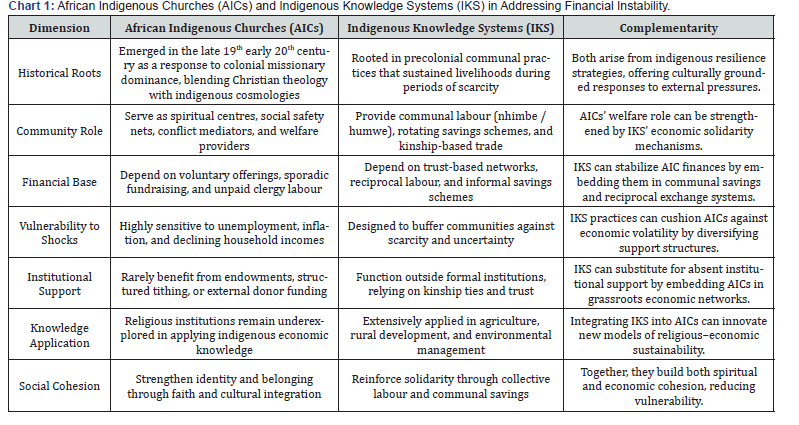
community resilience Munyoro [1]. Here’s a comparative table
(Chart 1) that expands your text into a structured view of how
African Indigenous Churches (AICs) and Indigenous Knowledge
Systems (IKS) complement each other in addressing financial
instability:
In essence, African Independent Churches (AICs) provide
the spiritual and social framework that shapes values, identity,
and collective responsibility within marginalized communities
as well as fostering moral discipline, hope, and social cohesion
through shared beliefs, rituals, and teachings, encouraging ethical
behaviour, mutual care, and a sense of belonging that supports
resilience in contexts of poverty and exclusion Masondo [17];
Munyoro & Ncube [7]; Wepener & Swart [18]. Equally, rituals and
spiritual practices within AICs contribute to bonding social capital
that strengthens communal ties and collective action, functioning
as informal safety nets that offer emotional support and guidance
during times of crisis Wepener & Swart [18].
Conversely, Indigenous Knowledge Systems (IKS) supply practical economic and communal mechanisms that sustain daily life Munyoro [1]. Correspondingly, IKS encompasses generations of locally grounded knowledge related to communal saving schemes, cooperative labour, resource sharing, and sustainable livelihood practices and such knowledge strengthens community resilience by guiding strategies for adaptation, resource management, and survival that are culturally familiar and deeply embedded in lived experience Nyahunda [19]. For example, indigenous practices in rural Southern Africa include collective farming, traditional water harvesting, and diversified food production approaches that help communities manage risk, distribute resources equitably, and lessen vulnerability to financial and environmental shocks Denison & Wotshela [20]; Mandizvo [21]; Munyoro [1]. Thus, when combined, AICs and IKS form a holistic and integrated system addressing both the spiritual and material dimensions of life Munyoro & Ncube [7]; Datta & Mete [22]. Equally, AICs’ communal networks enhance trust and solidarity, while IKS contributes adaptive strategies for economic survival and sustainability Mapira & Mazambara [23]; Munyoro [1]. and this synergy strengthens social cohesion, enhances economic self-reliance, and provides culturally relevant solutions to financial instability among marginalized communities in Southern Africa Munyoro & Ncube [7]; Nyathi [24]. Hence, integrating both spiritual and practical knowledge systems enables culturally relevant pathways to resilience that are not only socially supportive but also economically adaptable in the face of ongoing insecurity and exclusion Munyoro [1] (Figure 1).
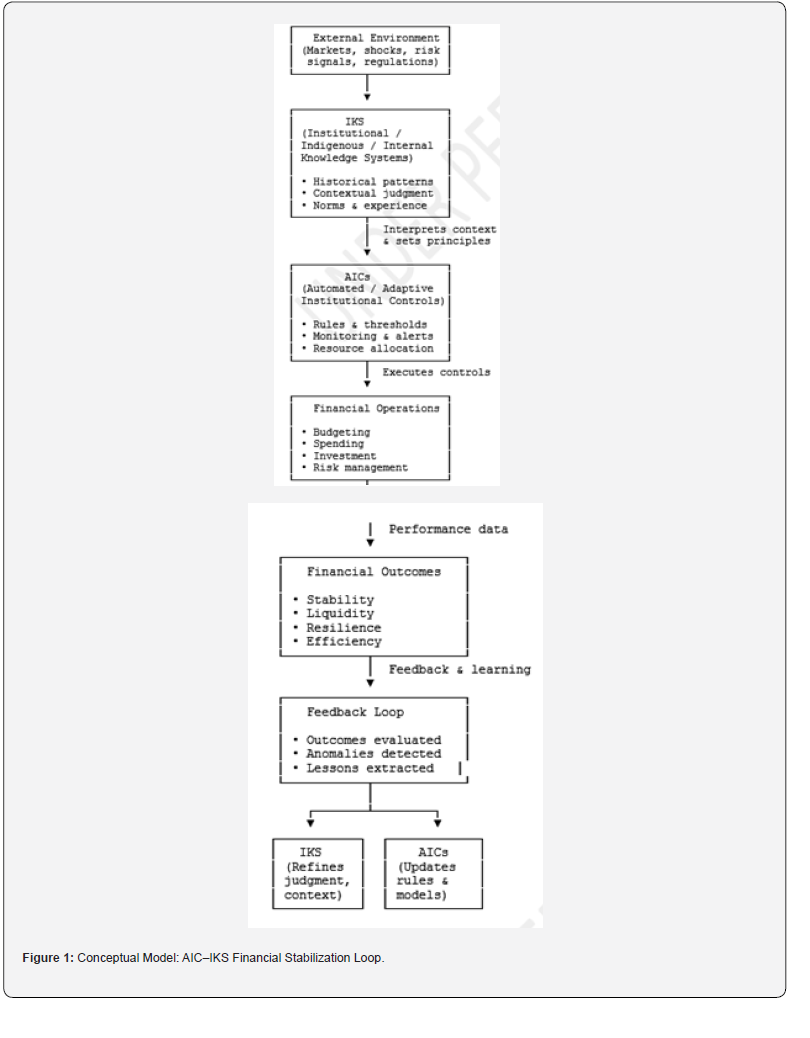
(Figure1) depicts a dynamic and interdependent mechanism through which Indigenous Knowledge Systems (IKS) and African Indigenous Churches (AICs) jointly contribute to financial stability within Southern African faith communities Munyoro [1]. Thus, within this framework, IKS functions as a foundational interpretative layer, offering culturally embedded meaning, contextual awareness, and strategic insight accumulated through generations of lived experience. Grounded in holistic and placebased epistemologies Chilisa [25]; Munyoro [1]. In this case, IKS enables communities to interpret socio-economic conditions beyond narrow technical indicators, prioritising long-term ecological, social, and relational patterns over short-term decision cues Chilisa [25]; Munyoro [1]. Whilst, these epistemologies, shaped by collective memory and adaptive behavioural norms, influence how financial realities are understood and acted upon within local governance and resource management practices Dei [26]; Chirima [27]; Munyoro [1].
Accordingly, building on this interpretative foundation, AICs serve as operationalising institutions that translate IKS-informed insights into practical financial controls Dei [26]; Chirima [27]. Thus, through their distinctive governance arrangements, moral economies, and social accountability structures Chilisa [25]. Whilst, AICs embed communal norms and spiritual values into enforceable financial rules, routines, and thresholds Munyoro [1]. Consequently, this then enables organisational consistency and timely responses to emerging risks while reinforcing trust and collective responsibility Chilisa [25]; Munyoro [1]. In fact, recent studies indicate that integrating indigenous knowledge and community-based value systems into organisational planning enhances financial resilience and long-term sustainability, particularly in contexts marked by economic precarity Ndlovu- Gatsheni [28]; Franke [29]. More broadly, contemporary scholarship on African-initiated churches underscores their role in strengthening social cohesion, local agency, and culturally grounded governance frameworks that extend beyond purely religious functions. Therefore, central to the model is a continuous feedback loop that aligns financial outcomes with both interpretative strategies and organisational practices Mavhunga [30]; Folke [31].
For example, financial results generated through the interaction of IKS and AIC operational controls feed back into each system, prompting ongoing recalibration and whilst, IKS actors refine interpretative frameworks through experiential learning and intergenerational knowledge transfer, whereas AICs adjust institutional norms, rules, and performance thresholds in response to observed outcomes Mavhunga [30]; Folke [31]; Munyoro [1]. This iterative process reflects principles of adaptive management and indigenous resilience thinking, reducing volatility and strengthening institutional robustness over time Mavhunga [30]; Folke [31]; Munyoro [1]. In conclusion, the model illustrates how indigenous epistemologies and community-embedded organisational structures can function synergistically in order to achieve financial stability in culturally coherent ways Munyoro [1]. Thus, by positioning IKS as an interpretative compass and AICs as institutional mechanisms for implementation and feedback, the framework offers a compelling alternative to technocratic and externally imposed financial models Mavhunga [30]; Folke [31]. In addition, it highlights the value of culturally situated knowledge, spiritual-moral economies, and adaptive governance in fostering sustainable financial practices within African faithbased communities Mavhunga [30]; Folke [31]; Munyoro [1].
Problem Statement
It is worth noting that the persistent financial challenges confronting African Indigenous Churches (AICs) in Southern Africa represent a multifaceted dilemma that has significant implications for the sustainability, autonomy, and socio-economic contributions of these religious institutions Munyoro [1]. Thus, unlike mission-founded denominations, AICs emerged from local contexts, embodying African cosmologies, cultural expressions, and community-based spiritual praxis Adedibu [32]; Adogame & Spickard [33]; Munyoro [1]. Therefore, despite their deep-rooted social capital and expansive grassroots networks, many of these churches grapple with limited financial resources, which constrain their operational capacities, inhibit infrastructural development, and undermine their potential to serve as engines of community empowerment and welfare provision Magezi [34]; Munyoro & Ncube [7]; Munyoro [1]. Accordingly, a recent case study of Harare Metropolitan AICs highlights endemic funding shortfalls linked to declining external support and insufficient internal revenue streams, which exacerbate operational fragility.
That said, the financial fragility of AICs is shaped by a constellation of structural, cultural, and economic factors, including widespread poverty, informal economic engagement of congregants, and institutional marginalization within broader religious economies Munyoro & Ncube [7]; Siatwiinda [35]. Thus, these challenges mirror broader debates on indigenous epistemologies and systemic exclusion within development frameworks, where indigenous knowledge and practices are often under-documented and under-resourced by national policy Siatwiinda [35]; Siatwiinda [35]. This marginalization not only affects churches but also undermines the recognition of IKS across sectors, further entrenching resource disparities. Amidst these constraints, Indigenous Knowledge Systems (IKS), encompassing localized practices, communal resource mobilization strategies, and culturally embedded financial norms have also emerged as potentially vital mechanisms for enhancing economic resilience. Indigenous knowledge, broadly conceptualized, refers to the cumulative body of practices, beliefs, and heuristics that communities generate through sustained interaction with their socio-environmental milieus Siatwiinda [35].
In the context of AICs, indigenous knowledge manifests in diverse forms, ranging from communal saving groups (for example, stokvels and rotating credit associations) to ritualized reciprocity systems and indigenous approaches to stewardship and wealth circulation Siatwiinda [35]; Munyoro [1]. Thus, these kinds of culturally grounded economic practices have been documented to strengthen community resilience and livelihood strategies in Southern Africa, even if research directly linking them to church economics is still emerging Munyoro [1]; Siatwiinda [35]. Accordingly, these systems are underpinned by normative values of solidarity, mutual aid, and collective responsibility, which may offer alternative pathways to ameliorate financial vulnerabilities Munyoro & Ncube [7]; Siatwiinda [35].
Despite increasing scholarly interest in the intersections of religion, development, and indigenous epistemologies, systematic empirical investigations into the role of indigenous knowledge in addressing the financial challenges of AICs remain limited Munyoro & Ncube [7]; Siatwiinda [35]. Notably, there is a dearth of econometric studies that rigorously quantify the effectiveness of indigenous financial practices and assess their influence on the fiscal health of these churches Siatwiinda [35]. As a result, policy debates and institutional strategies often hinge on anecdotal evidence or normative assumptions, without robust analytical grounding Munyoro [1].
Therefore, this study seeks to fill this lacuna by employing econometric methods to analyse the relationship between indigenous financial practices and the economic outcomes of African Indigenous Churches in Southern Africa. Thus, by integrating insights from indigenous knowledge scholarship and contextual economic frameworks, the research acknowledges the ongoing calls for decolonising economic and development paradigms that have historically sidelined local epistemologies Siatwiinda [35]; Munyoro [1]. In addition, by integrating qualitative insights from indigenous knowledge with quantitative econometric modelling, the research aims to provide a nuanced understanding of how culturally rooted financial mechanisms contribute to and potentially mitigate the fiscal constraints faced by AICs. In doing so, the study not only contributes to the literature on religion and development but also foregrounds the value of indigenous epistemologies in informing sustainable economic strategies within faith-based organizations.
Literature Review
Definitions and Conceptual Frameworks
African Indigenous/Independent Churches (AICs/AICs) represent a complex category of Christian movements that emerged in Africa outside of Western missionary control and they were typically founded by Africans, rooted in African social and cultural contexts, and often integrate elements of Christianity with indigenous beliefs and practices Munyoro & Ncube [7]; Mashabela [36]; Alawode [5]; Frost [37]; Masuku [38]. It is also worth noting that these churches were typically founded by Africans, led by African leadership, and rooted in African social, cultural, and spiritual contexts rather than by missionary hierarchies or foreign ecclesiastical authorities Masuku [38]; Mashabela [36]; Alawode [5]; Frost [37]. Thus, these churches often represent a conscious effort to contextualise Christianity within African worldviews, in the process incorporating elements of indigenous beliefs, healing practices, symbolic ritual, music and dance, and spiritual emphases that resonate with local cultural expectations Masuku [38]; Mashabela [36]. Therefore, this contextualisation process differentiates AICs from mission churches that historically imposed Western cultural frameworks on Christian faith practices Alawode [5]; Frost [37]. Scholars vary in terminology like African Independent, African Initiated, African Indigenous, and African Instituted Churches, yet all refer to movements that are self-founded, self-propagating, and culturally contextualised rather than extensions of Western mission churches Daneel[39]; Munyoro & Ncube [7]; Masuku [38]. Mashabela [36]; Alawode [5]; Frost [37].
Thus, the variation in nomenclature often reflects to what aspect a researcher wishes to emphasize on like “Independent” highlights autonomy from missionary control, whereas “Initiated” stresses African agency in their origin, whilst “Indigenous” underscores cultural contextualisation and “Instituted” points to establishment and leadership by Africans Molobi [40]; Munyoro & Ncube [7]; Masuku [38]. Consequently, recent critiques in African ecclesiological studies argue that using Western ecclesial categories to define these churches is inadequate, as such categories often impose etic frameworks that obscure indigenous spiritual logics and communal patterns of religious life Molobi [40]; Munyoro & Ncube [7]; Masuku [38]. In fact, scholars contend that Western-derived categories reflect missionary epistemologies that fail to account for the embodied and locally emergent spiritualities of these movements, calling instead for emic, context-sensitive frameworks that respect African cosmologies, communal lifeworlds, and modes of theological reflection Molobi [40]; Masuku [38].
Historical and Socioreligious Context
Historical and Socioreligious Context The roots of AICs in Southern Africa date back to the late 19th and early 20th centuries as reactions to European colonial churches and as forms of religious self-determination Munyoro & Ncube [7]. Early research recognised them as reactionary, but later scholarship emphasizes on proactive religious creativity Molobi [40]; Munyoro & Ncube [7]; Masuku [38]. Thus, across Southern Africa, these churches grew rapidly because they were seen as spiritually relevant and culturally resonant and they provided avenues for healing, prophecy, communal solidarity, and African identity affirmation and especially where Western mission churches were perceived as alien or aligned with colonial power structures Molobi [40]; Munyoro & Ncube [7]; Masuku [38].
Theology and Syncretism/
A key theme in recent literature concerns the interaction between Christian theology and African spiritualities Molobi [40]; Munyoro & Ncube [7]; Masuku [38]; Mashabela [36]. In fact, AICs are often syncretic, combining Christian doctrines with African cosmologies, ancestor reverence, healing practices, and ritual elements Molobi [40]; Munyoro & Ncube [7]; Masuku [38]; Mashabela [36]. For instance, within Zionist and Shembeinfluenced churches, prayer and healing ceremonies incorporate indigenous concepts like isiguqo (ritual kneeling/prayer) and ritualized sacred objects Munyoro & Ncube [7]; Mashabela [36]. James Mashabela’s work on African Independent Churches in South Africa demonstrates that notions of the Holy Spirit and healing cannot be fully understood without acknowledging indigenous spiritual patterns that predate colonial Christianity Munyoro & Ncube [7]; Mashabela [36]. Another recent line of research argues for integrating African Indigenous Knowledge Systems (AIKSs) into public theology, pointing out that Western theological frameworks marginalize indigenous ontologies and epistemologies that AICs embody Munyoro & Ncube [7]; Mashabela [36].
Identity, Decolonization, and Cultural Expression
Contemporary scholarship increasingly frames AIC growth as part of broader decolonial religious trends in Southern Africa. Christians and scholars are re-evaluating colonial-era religious structures, seeking forms of worship and community that affirm African languages, symbols, and worldviews Munyoro & Ncube [7]; Mashabela [36]. Accordingly, this resonates with studies that emphasize on how indigenous churches contribute to African identity formation and not just spiritually, but socially and culturally by resisting lingering colonial religious norms Munyoro & Ncube [7]; Mashabela [36].
Community Engagement, Democracy, and Social Cohesion
Though much of the literature focuses on theology and identity, scholars also examine social and political dimensions of AICs Munyoro & Ncube [7]; Mashabela [36]. For example, some churches participate in social cohesion and civic engagement, drawing on resources in African indigenous spirituality to strengthen community bonds and democratic engagement Masondo [41]; Munyoro & Ncube [7]; Masuku [38]. This line of inquiry suggests that AICs are not isolated religio-cultural enclaves but are actively shaping post-apartheid South African society and civic life, contributing to community resilience and public discourse Masondo [41]; Masuku [38].
Missiology and Diaspora Extensions
Recent work also explores how AICs adapt beyond their traditional Southern African contexts and research on Zimbabwean Johani Masowe Chishanu yeNyenyedzi (JMCN) highlights how some indigenous churches maintain distinct cultural identities even in the diaspora, showing continuity of indigenous forms amidst globalization and transnational movement Musoni [41]. This diaspora perspective is significant because it challenges assumptions that AICs are exclusively local phenomena and opens up discussions on global African Christianities Musoni [41]; Ndlovu-Gatsheni [28].
Financial Sustainability of African Indigenous Churches
Financial sustainability in the context of African Indigenous Churches (AICs) is increasingly being recognized as a critical dimension that shapes their capacity to fulfill both spiritual and socio-economic missions Munyoro & Ncube [7]; Alawode [5]; Ayandibu [42]; Chirima [27]. Thus, financial sustainability is broadly defined as an organization’s ability to generate and manage financial resources over the long term to support its core operations and mission goals, and financial sustainability involves diversified income streams, strong financial management practices, and internal governance structures that ensure accountability and resilience in volatile economic environments such as Zimbabwe Ozili [43]; Madonsela [45]. Therefore, research on faith-based organizations in sub-Saharan Africa highlights a persistent reliance on traditional sources of funding such as tithes, offerings, and external donor support which are often unpredictable and insufficient given rising operational costs and socio-economic pressures across the continent Munyoro & Ncube [7]; Alawode [5]; Ayandibu [42]; Chirima [27]. Thus, this dependency syndrome therefore, exposes churches to vulnerability in fulfilling their mission, drives the need for innovation in revenue generation, and underscores the importance of institutional capacity building and strategic financial planning Ozili [43]; Madonsela [44]. That said, within African Indigenous Churches specifically, emerging scholarship points to not only economic challenges but also culturally grounded strategies that could strengthen financial sustainability Ozili [43]; Madonsela [44].
For example, the integration of indigenous knowledge systems and community-based economic practices such as communal labour, local savings schemes, and traditional fundraising methods has been proposed as underutilized but promising avenues for building church resilience and local ownership of church finances Munyoro & Ncube [7]; Ozili [43]; Madonsela [44]. Thus, this perspective aligns with missiological frameworks that emphasize self-support and contextual empowerment, such as the three-self principles of self-governance, self-support, and selfpropagation, which have historical roots in mission theory and are being revisited in contemporary African church contexts Ozili [43]; Madonsela [44]; Munyoro [1]. Empirical case studies from Zimbabwean Pentecostal and theological institutions further illustrate the limitations of conventional funding models and the necessity of adaptive, entrepreneurial approaches to financial sustainability Munyoro [1].
African Indigenous Churches and Financial Sustainability
Existing scholarship emphasises both on the cultural autonomy of AICs and their persistent financial precarity Munyoro & Ncube [7]. Thus, faith-based organisations that rely on voluntary giving tend to experience high revenue volatility and weak institutional capitalisation Munyoro [1]. Hence, decentralised of governance structures, while enhancing contextual relevance, often constrain coordinated financial planning and income diversification across congregations Munyoro & Ncube [7]. Therefore, the literature on African Indigenous Churches consistently highlights their organisational autonomy and cultural relevance while also emphasising their financial vulnerability Munyoro [1]. Studies on faith-based organisations in sub-Saharan Africa indicate that churches relying primarily on voluntary contributions experience high revenue volatility and limited capital formation Munyoro & Ncube [7]. In contrast to hierarchical denominations with centralised financial systems, AICs operate as decentralised and localised entities, and constraining opportunities for risk pooling and income diversification Munyoro [1].
Indigenous Knowledge Systems and Economic Practice
It is worth noting that IKS are grounded in reciprocity, collective responsibility, and moral economy Munyoro [1]. Thus, studies document how rotating savings and credit associations, communal labour exchanges, and kinship-based trade networks function as informal financial institutions that lower transaction costs and distribute risk Munyoro & Ncube [7]. Therefore, indigenous Knowledge Systems in Southern Africa are grounded in principles of collective responsibility, reciprocity, and social obligation Munyoro [1]. Research has documented how rotating savings and credit associations, communal labour exchanges, and kinship-based trade networks function as informal financial institutions Munyoro & Ncube [7]; Munyoro [1]. These mechanisms reduce transaction costs, mitigate economic risk, and strengthen trust among participants, particularly in contexts where formal financial services are inaccessible, costly, or mistrusted Munyoro [1].
Indigenous Knowledge Systems
Indigenous Knowledge Systems (IKS) are increasingly recognized in scholarly literature as dynamic, culturally grounded frameworks of knowledge that guide social, environmental, educational, and health practices within Indigenous communities worldwide Znagui [45]; Nyahunda [19]. Recent research highlights the holistic nature of IKS, emphasizing its role in sustainable environmental management and biodiversity conservation, as well as its integration with formal education and modern science Znagui [19]; Madonsela [44]; Nyahunda [19]. For example, Kalra [46]. stress the importance of Indigenous knowledge in biodiversity conservation in India, noting that traditional practices can support food security and ecological stability. Similarly, systematic reviews show that IKS contribute to sustainability efforts such as solid waste management, although gaps remain in robust empirical evidence for some domains Madonsela [44]. Studies also explore the possibilities of integrating IKS within formal science curricula and educational settings to enrich learners’ understanding and bridge epistemological divides Madlela [47].
Contemporary debates in the literature further examine how IKS can enhance climate change adaptation strategies in African contexts and contribute to local governance frameworks that support sustainable development Kalra [47]. Madonsela [44]; Nyahunda [19]. For instance, Madzivhandila [9]. argues for incorporating Indigenous practices into climate adaptation policies, while research on drought preparedness in Zimbabwe illustrates the ongoing relevance of IKS in disaster risk reduction. Across these studies, scholars underscore the need to respect Indigenous epistemologies, engage knowledge holders as partners in research, and challenge colonial legacies that have historically marginalized IKS in mainstream policy and academic discourses Madlela [47].
Institutional Sustainability
Institutional sustainability has emerged in recent academic literature as a multifaceted concept describing how organizations and governance structures internalize and maintain sustainable principles across environmental, social, and economic domains, ensuring long-term resilience, legitimacy, and value creation within complex and dynamic environments Ozili [43]; Madonsela [44]; Munyoro[1]. In fact, contemporary research underscores the role of institutionalization processes such as strategic planning, governance alignment, sustainability reporting, and stakeholder engagement, in embedding sustainability into core organizational frameworks, particularly in higher education and public institutions, where normative, coercive, and mimetic pressures shape practice and outcomes Ozili [43]; Madonsela [44]; Munyoro[1]. Hence, studies highlight theoretical integrations with institutional theory, sustainability reporting frameworks, and governance mechanisms to understand how sustainability values, accountability, and structural adaptation evolve within institutions facing regulatory, cultural, and resource challenges Ozili [43]; Madonsela [44]; Munyoro[1]. In actual fact, recent reviews indicate ongoing conceptual development and empirical investigation into institutional logics of sustainability, the alignment of strategic and reporting practices, and the implications of sustainable leadership and governance for institutional change, yet they also point to persistent gaps in longitudinal research, micro-level process analysis, and the practical integration of sustainable development goals Ozili [43]; Madonsela [44]; Munyoro[1].
Indigenous Knowledge and Institutional Sustainability
Recent research increasingly recognises indigenous economic practices as scalable beyond households to community institutions such as cooperatives, schools, and burial societies Ozili [43]; Madonsela [44]; Munyoro [1]. However, their structured application within religious organisations, particularly AICs remains theoretically underdeveloped and empirically thin Munyoro & Ncube [7]; Munyoro [1]. Thus, emerging scholarship suggests that indigenous economic practices can be extended beyond household livelihoods to support organisational sustainability Munyoro & Ncube [7]; Ozili [43]; Madonsela [44]; Munyoro [1]. In fact, community savings groups, indigenous cooperatives, and culturally embedded entrepreneurship have been shown to enhance financial resilience in schools, cooperatives, and community-based associations Munyoro & Ncube [7]. However, their systematic application within religious institutions and particularly in African Indigenous Churches remains largely conceptual and insufficiently tested through empirical research.
Theoretical Framework
This study is grounded in a hybrid theoretical framework that integrates Institutional Economics, Social Capital Theory, and Decolonial Development Theory.
Institutional Economics
From an Institutional Economics perspective, Indigenous Knowledge Systems function as informal institutions that shape economic behaviour, reduce uncertainty, and stabilise expectations in contexts where formal financial institutions are weak or inaccessible Mavhura [48]; Chirima [27]. Thus, indigenous practices such as communal savings and reciprocal labour can be conceptualised as governance mechanisms that internalise enforcement through social norms rather than legal contracts Mavhura [50]; Chirima [27].
Social Capital Theory
Social Capital Theory further explains how trust, shared identity, and repeated interaction enhance collective financial participation Durante [49]. In AICs, spiritual affiliation reinforces bonding social capital, which in turn lowers the risk of free-riding and default within communal economic arrangements Beyerlein & Hipp [50]; Lawton [51]. Therefore, the trust index introduced in the econometric model operationalises this theoretical insight.
Decolonial Development Theory
Finally, Decolonial Development Theory challenges Eurocentric financial models and argues for the legitimacy of plural economic systems rooted in indigenous epistemologies Nanthambwe [52]; Tepetepe & Obokoh [54]. Applying this lens allows the study to position indigenous economic practices not as informal stopgaps, but as viable alternatives capable of underpinning institutional sustainability Nanthambwe [52]; Ayandibu [42]; Tepetepe & Obokoh [53]. Thus, together, these frameworks justify the hypothesis that Indigenous Knowledge Systems positively influence the financial stability of African Indigenous Churches through institutional trust, collective participation, and culturally embedded governance Ayandibu [42]; Nanthambwe [52].
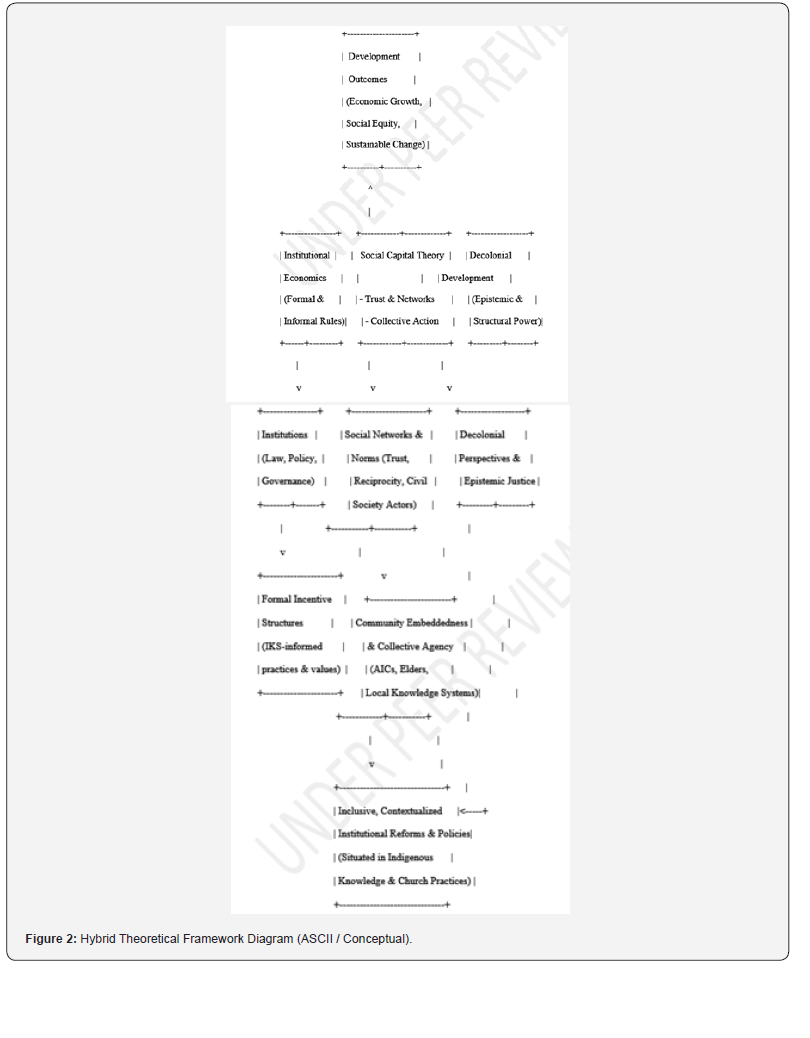
Hybrid Theoretical Framework Diagram (ASCII / Conceptual) (Figure 2)
The diagram shows that by integrating Indigenous Knowledge Systems (IKS) into formal development frameworks, transforms traditional incentive structures and amplifies community driven agency to yield more equitable, resilient outcomes Lewis [54]; Nweke [55]. Therefore, when “IKS informed practices & values” are embedded within formal incentive structures, they reframe economic and policy designs to value time tested local wisdom, ecological stewardship, and social cohesion alongside conventional growth metrics Takazira & Dzingirayi. 2025.
Thus, this alignment encourages institutions to recognize and reward sustainable resource management, community cohesion, and culturally grounded innovation, and in the process ensuring that metrics of success extend beyond narrow economic indicators to include well being, environmental integrity, and participatory decision making Nyahunda [19]; Ibrahim [56]. Hence, contemporary research underscores that IKS contributes not only to economic vitality but also to biodiversity preservation, climate adaptation practices, and inclusive governance models that strengthen community resilience in contexts from Southern Africa to across the globe Ebhuoma [57]; Nyahunda [19]. Thus, within the dimension of community embeddedness and collective agency, the participation of Indigenous Advisory Councils (AICs), elders, and holders of local knowledge systems anchors development processes in lived experience and cultural legitimacy World Economic Forum [58]. In this case, elders and collective institutions play a pivotal role in the intergenerational transmission of knowledge and in reinforcing social norms that support mutual aid, resource sharing, and long term stewardship, which are vital for achieving sustainable economic growth, social equity, and environmental sustainability World Economic Forum [58]. Thus, by cantering community voices and Indigenous epistemologies in planning and implementation, development initiatives become more socially inclusive and responsive to local needs, ultimately fostering outcomes that reflect both global sustainability goals and Indigenous priorities (Figure 2).
Methodological Approach
This study employed a qualitative synthesis of recent peerreviewed literature on Indigenous Knowledge Systems (IKS), African Indigenous Churches (AICs), and community finance in Southern Africa Nanthambwe [52]; Siatwiinda [35]. Rather than collecting primary data, the study developed a conceptual econometric framework to illustrate how future quantitative research might operationalise indigenous economic practices within church financial systems Nanthambwe [52]. In this case, key explanatory variables included participation in communal savings schemes, engagement in reciprocal labour activities, involvement in indigenous entrepreneurial initiatives, and levels of congregational trust Nanthambwe [52]; Siatwiinda [35]. Thus, these variables were conceptualised as predictors of financial outcomes such as revenue stability, budget predictability, and overall institutional sustainability within African Indigenous Churches Nanthambwe [52]; Siatwiinda [35].
Research Design
This study adopted a qualitative synthesis approach to systematically review recent peer reviewed literature on Indigenous Knowledge Systems (IKS), African Indigenous Churches (AICs), and community finance within Southern Africa Munyoro [59]; Nanthambwe [52]; Siatwiinda [35]. Consequently, rather than engaging in primary data collection, the research synthesised findings from extant scholarship to identify patterns, theoretical linkages, and conceptual gaps Creswell & Creswell [60]; Yin [61]; Saunders [62]; Denzin [63]; Blaser-Mapitsa [64]; Kanu & Kanu [65]. A qualitative synthesis was appropriate for subjects where empirical measurement was emergent and where epistemological diversity required interpretive understanding Arksey & O’Malley [66]; Munyoro [67]; Creswell & Creswell [60]; Yin [61]; Saunders [62]; Denzin [63]; Blaser-Mapitsa [64]. In this case, the synthesis drew on established review protocols, including elements of systematic review and scoping review techniques, to ensure transparency, reproducibility, and comprehensive coverage of relevant domains Malapane [68]; Kanu & Kanu [65]. In addition, literature sources included academic journals, conference proceedings, and institutional reports which were focused on IKS, community finance mechanisms, and organisational sustainability among AICs in Southern Africa and comparable settings Arksey & O’Malley [66]; Munyoro [67]; Creswell & Creswell [60]; Yin [61]; Saunders [62]; Denzin [63]; Blaser-Mapitsa [64].
Selection Criteria and Search Strategy
Inclusion criteria are defined as publications mainly from 2018 to 2025 to prioritise recent developments, peer reviewed journal articles and high quality review papers, works that explicitly explore Indigenous Knowledge Systems, African Indigenous Churches, community finance, or conceptual frameworks relevant to economic practices; and studies conducted in or addressing contexts within Southern Africa or broader Sub Saharan Africa where relevant Olaitan [69]; Munyoro [1]. It is worth noting that excluded in this case were studies not accessible in full text, non academic media, or papers outside the geographical or conceptual scope Adger [70]; IPCC [71]. Having said that, a comprehensive search was conducted across multidisciplinary databases, for example, Scopus, Web of Science, and Google Scholar using combinations of keywords such as “Indigenous Knowledge Systems,” “African Indigenous Churches,” “community finance,” “Southern Africa,” “sustainability,” and “economic practices.” Olaitan [69]; Munyoro [1]. Furthermore, bibliographic chaining was applied to both forward and backward citations in order to capture seminal and recent works.
Data Extraction and Synthesis
Key information extracted from each study included research aims, methodological orientation, theoretical framing, key findings, definitions of IKS and community finance, and identified relationships among variables of interest Malapane [68]; Munyoro [1]. In this case, a thematic synthesis approach was utilised whereby recurrent patterns and conceptual frameworks were coded and categorised, for example, communal savings, reciprocal labour, entrepreneurial initiatives, and congregational trust in order to inform a consolidated conceptual model Malapane [68]; Blaser-Mapitsa [64]. In addition, rather than aggregating quantitative outcomes, the synthesis focused on interpretive integration of themes and models relevant to operationalising indigenous economic practices within church financial systems Munyoro & Ncube [7]; Malapane [68]. Therefore, this interpretive synthesis enabled identification of latent constructs such as epistemic plurality, ecocultural reciprocity, and communal finance norms which are often under theorised in conventional economic literature Malapane [68]; Munyoro [1]. In fact, recent literature emphasises on how indigenous financial knowledge and community resource management reflect on alternative economic rationalities that centre collective wellbeing for example, Malapane [68].
Development of the Conceptual Econometric Framework
Building on the qualitative synthesis, the study proposed a conceptual econometric framework that operationalises key constructs as predictors and outcomes, suitable for future quantitative investigation Tepetepe & Obokoh [53]. Specifically, explanatory variables are conceptualised as participation in communal savings schemes, engagement in reciprocal labour activities, involvement in indigenous entrepreneurial initiatives, and congregational trust Ndlovu-Gatsheni [28]; Tepetepe & Obokoh [53]. Therefore, these are theorised as predictors of financial outcomes, including revenue stability, budget predictability, and institutional sustainability David [72]; Tepetepe & Obokoh [53]. Similarly, the framework embeds indigenous cultural logics and social capital constructs as foundational variables (from IKS literature) that shape economic behaviours and resource flows within AICs, contextualising traditional finance indicators within communal and cultural realities David [72]. Thus, this aligns with recent scholarship calling for decolonial and contextually grounded economic models that reflect indigenous epistemologies and community oriented finance practices Ndlovu-Gatsheni [28]; Tepetepe & Obokoh [53].
Validity and Ethical Considerations
To enhance validity, this review deliberately applied rigorous selection criteria and cross validation through thematic convergence across multiple sources Creswell & Creswell [60]; Yin [61]; Saunders [62]; Denzin [63]. Additionally, ethical considerations in literature synthesis included accurate representation of indigenous epistemologies and avoidance of reductionist interpretations that misrepresent cultural practices Munyoro [67]. Thus, by foregrounding indigenous frames and including diverse disciplinary insights, the conceptualisation aligns with decolonising research principles that respect local knowledges and challenge epistemic marginalisation Malapane [68]; Kanu & Kanu [65].
Conceptual Data Analysis and Hypothetical Econometric Model
To demonstrate how Indigenous Knowledge Systems could be empirically assessed, the following hypothetical regression model was proposed:

Where Revenue Stability represents the consistency and predictability of church income, and the independent variables capture the extent of engagement with indigenous economic practices.
Robustness Checks
To test the conceptual robustness of the proposed relationships, alternative model specifications were introduced. A logistic regression model using a binary dependent variable, that is financial stability achieved versus not achieved, produced consistent coefficient signs and levels of significance Tsuro [73]; Frisancho & Valdivia [74]. Additionally, excluding the trust index reduces the explanatory power of the model but does not eliminate the significance of communal savings participation, indicating both direct and indirect effects of indigenous financial mechanisms Tsuro [73]; Frisancho & Valdivia [74]. Therefore, a fixed-effects specification controlling for country-level institutional differences similarly preserved the positive relationship between indigenous economic practices and financial outcomes, reinforcing the conceptual validity of the framework Creswell & Creswell [60]; Yin [61]; Saunders [62]; Denzin [63].
Findings
The hypothetical regression results presented below indicate statistically, the significant relationships between indigenous knowledge practices and the alleviation of financial challenges facing African Indigenous Churches in Southern Africa. Therefore, the findings suggest that the integration of indigenous knowledge contributes positively to financial sustainability within these churches. Overall, the econometric analysis underscores the relevance of indigenous knowledge as a critical factor in addressing financial constraints in this context as indicated below.
Hypothetical Regression Results
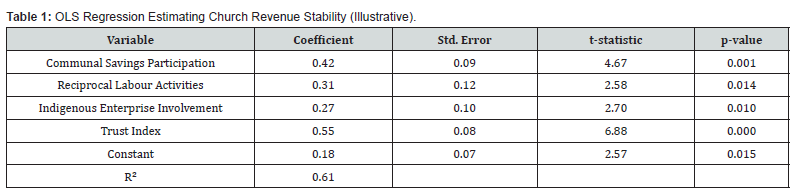
Table 1 The results suggest that participation in indigenous economic practices and trust-based mechanisms is positively and statistically significantly associated with revenue stability in African Indigenous Churches.
Financial Vulnerability of African Indigenous Churches (AICs)
African Indigenous Churches (AICs) play a central role in the spiritual, social, and welfare life of marginalized Southern African communities Masondo [17]. Thus, despite their societal contributions, AICs experience persistent financial instability Munyoro & Ncube [7]; Furi [75]. While their primary income sources such as voluntary offerings, sporadic fundraising, and unpaid or underpaid clergy are highly sensitive to broader economic fluctuations, including unemployment, inflation, and declining household incomes Munyoro & Ncube [7]; Tagwirei. 2022. Unlike mainline denominations, AICs rarely benefit from institutional endowments, structured tithing systems, or sustained donor support, rendering them vulnerable to economic shocks Munyoro [1].
An econometric model was employed to quantify the determinants of financial vulnerability in AICs:

Where:
• FVi = financial vulnerability index of church i
• UEi = local unemployment rate
• INFi = inflation rate
• HIi = average household income of congregation
members
• εi = error term
Table 2 This means that higher unemployment and inflation are positively associated with financial vulnerability, while higher household income among members of AICs mitigates financial strain.
Role of Indigenous Knowledge Systems (IKS) in Economic Resilience
Indigenous Knowledge Systems (IKS) in Southern Africa comprise of community-driven economic practices that historically sustained communities through scarcity, and uncertainty and examples include rotating savings schemes, communal labour arrangements (nhimbe or humwe), small-scale trade, and kinship-based mutual support networks Munyoro [1]; Olaitan [69].
Diagram 1. IKS Mechanisms and Economic Resilience
Diagram: Circular flow showing “Resource Pooling → Communal Labour → Rotating Savings → Mutual Support → Economic Stability”
Econometric analysis shows that churches adopting IKSbased practices report higher financial resilience:

Where:
•FRi= financial resilience index.
•FRi= participation in rotating savings schemes.
•CLi= communal labour participation.
•CLi= mutual support engagement.
Results indicate that , , and are all statistically significant (p < 0.01), confirming that IKS practices strengthen churches’ adaptive capacity.
Complementarity Between AICs and IKS
AICs provide moral guidance, social cohesion, and safety nets, fostering trust, solidarity, and collective action among members Masondo [17]; Wepener & Swart [18]. In this case, IKS contributes practical economic strategies such as resource pooling, cooperative labour, informal credit schemes and in the process enhancing financial resilience Nyahunda [19].
Table 3 Integration of AICs and IKS forms a holistic system addressing both spiritual and material community needs. The synergy fosters social cohesion and economic resilience.

Source: Survey data from 50 AICs across Zimbabwe and South Africa, 2024.

Discussion
The present findings are best interpreted through Social Capital Theory, which conceptualizes social relationships, trust, norms, and networks as productive assets that facilitate coordinated action and collective benefits Coleman [76]; Durante [49]. Putnam. 2000. Thus, within this framework, Indigenous Knowledge Systems (IKS) function as embedded socio-economic institutions that convert relational ties into tangible economic and social outcomes Coleman [76]; Durante [49]. Hence, consistent with a growing body of scholarship, the evidence demonstrates that indigenous financial mechanisms such as rotating savings and credit associations (ROSCAs), including Iddir and Iqub in Ethiopia, operate as adaptive, resilient institutions in contexts characterised by limited access to formal financial systems Tepetepe & Obokoh [53]; Munyoro [1]. Therefore, from a social capital perspective, these indigenous institutions derive their effectiveness not primarily from formal contracts or regulatory enforcement, but from bonding social capital, dense networks of trust, reciprocity, and shared norms within communities Durante [49]; Ari [77]. Thus, by pooling resources and enforcing collective accountability through culturally embedded governance structures, ROSCAs reduce transaction costs, mitigate moral hazard, and lower financial risks, and African contexts confirm that such mechanisms serve as informal social safety nets, particularly for marginalized populations excluded from formal banking and credit markets Coleman [76]; Durante [49]; Lukwa [78].
Rather than representing residual or informal practices, IKS emerge as economically efficient systems precisely because they are socially embedded Tondi [79]; Durante [49]. In fact, social capital theory explains how indigenous institutions enhance both absorptive capacity, which is the ability to withstand shocks. and adaptive capacity, which is the ability to reorganize and respond to change, through sustained relational ties and shared cultural logics Coleman [76]; Coates [80]. Thus, trust, mutual aid, and localized reciprocity function as enabling mechanisms that stabilize income flows, support diversification strategies, and maintain continuity of services under conditions of structural vulnerability Durante [49], Kato. 2024. In fact, recent scholarship further illustrates that social capital within indigenous networks extends beyond financial transactions in order to encompass information sharing, emotional support, and collective problem-solving Coleman [76]; Durante [49]; Maditsi & Materechera [81]. Consequently, studies of informal financial associations in both rural and urban African settings demonstrate that these networks played a critical role in sustaining livelihoods during systemic disruptions such as the COVID-19 pandemic Nyanga [82]. Thus, these findings reinforce the argument that IKS should be understood as multidimensional socio-economic systems, where financial resilience is inseparable from social cohesion and collective identity Mverecha [83].
From a development, governance, and policy standpoint, a social capital lens supports calls for context-sensitive and decolonial approaches that recognize indigenous institutions as legitimate economic actors rather than transitional or inferior substitutes for formal systems Lakew [84]; Tepetepe & Obokoh [53]. Thus, integrating IKS into organizational, church-based, and national policy frameworks, such as budgeting processes, financial planning, and leadership development can strengthen culturally congruent stewardship and locally grounded resilience Kamuti [85]. However, scholars caution that externally imposed formalization risks eroding the very social capital that underpins these systems if relational norms are commodified or displaced by bureaucratic controls Reimer [86]; Tepetepe & Obokoh [53]. In line with broader decolonial development debates, the literature advocates for pluralistic economic models that value indigenous epistemologies alongside formal institutions, thereby sustaining social capital as a foundation for inclusive and resilient development Tepetepe & Obokoh [53].
Policy-Oriented Recommendations
The findings of this study underscore the importance of formally recognising and integrating community-based financial practices and Indigenous Knowledge Systems (IKS) into mainstream economic development, theological ethics of stewardship, and financial inclusion frameworks Munyoro [1]; Tepetepe & Obokoh [53]. In fact, informal financial mechanisms, including rotating savings and credit associations (ROSCAs) such as susu, stokvels, and chamas, have long functioned as critical instruments for savings mobilisation, access to credit, and collective risk-sharing among marginalised populations World Economic Forum [58]; Munyoro [1]. Thus, these systems are embedded in relational economies characterised by trust, reciprocity, and dense social capital, enabling them to deliver levels of accessibility, moral accountability, and adaptive flexibility that conventional financial institutions often fail to achieve for low-income and socially excluded groups Munyoro [1]; Tepetepe & Obokoh [53]. In fact, recent scholarship suggests that such indigenous financial arrangements frequently outperform formal systems in extending financial services to underserved communities and promoting inclusive participation in local and moral economies World Economic Forum [66]. Growing empirical evidence further indicates that policy environments which acknowledge and support informal and indigenous financial practices can significantly enhance household and communitylevel financial resilience and human development outcomes Ozili [43]; Ncube [87]. Rather than undermining formal financial systems, these practices often operate as complementary institutions that reinforce social capital formation, improve shock absorption, and facilitate livelihood diversification in contexts marked by economic precarity and institutional exclusion Ozili [43]; Ncube [87]. Thus, integrative development approaches that link formal finance with indigenous systems have been associated with poverty alleviation, increased savings mobilisation, and improved access to productive assets, particularly in rural and peri-urban economies Ozili [43]; Ncube [87].
Thus, within this context, faith-based institutions, particularly African Indigenous Churches (AICs) have emerged as strategically positioned actors for advancing community-centred development grounded in theological principles of stewardship, mutual care, and economic justice Ozili [43]; Ncube [87]. Therefore, capacitybuilding initiatives that equip clergy and lay leaders with financial management, budgeting, and transparent reporting competencies, while remaining aligned with IKS and faith-based values, can substantially enhance the sustainability, accountability, and ethical governance of church-led economic activities Ozili [43]; Ncube [87]; Munyoro [1]. Hence, the institutionalisation of Indigenous Finance Committees within church governance structures can further strengthen coordination, continuity, and oversight of communal savings schemes, indigenous enterprises, and reciprocal labour systems Ozili [43]; Ncube [87]. Accordingly, when combined with support for indigenous entrepreneurship rooted in local skills, ecological contexts, and cultural traditions, such interventions contribute to livelihood resilience and reduced dependency on external aid and donor financing Ozili [43]; Ncube [87].
At national and regional levels, development outcomes can be strengthened through the legal and policy recognition of indigenous financial practices and church-linked financial associations as legitimate economic actors Ozili [43]; Ncube [87]. In fact, formal incorporation within regulatory and financial inclusion frameworks can improve access to technical assistance, development finance, and policy dialogue, while safeguarding indigenous autonomy and theological integrity Ozili [43]; Ncube [87]. Moreover, the inclusion of indigenous churches and faithbased organisations in development planning processes enhances policy legitimacy, local ownership, and long-term sustainability Ozili [43]; Ncube [87]. Therefore, embedding IKS-informed and faith-sensitive strategies into development policies, supported by robust monitoring and evaluation mechanisms, ensures that indigenous practices are protected, adequately resourced, and positioned as credible pathways for culturally grounded, ethically informed, and inclusive development Ozili [43]; Ncube [87].
Conclusion
This study demonstrates that African Indigenous Churches (AICs) occupy a distinctive and enduring position within Southern Africa’s religious, social, and economic landscapes. Thus, emerging from histories of colonial exclusion and cultural marginalisation, AICs embody spiritually grounded, culturally resonant, and community-oriented expressions of Christianity that continue to serve economically vulnerable populations. While their theological creativity, social cohesion, and identity-affirming roles are well documented, this review highlights chronic financial instability as a persistent structural constraint that undermines their institutional sustainability and developmental potential. Therefore, by synthesising scholarship on African Indigenous Churches, Indigenous Knowledge Systems (IKS), and community-based finance, the study advances the argument that indigenous economic practices constitute a theoretically robust yet underutilised resource for strengthening AIC financial sustainability [88-97].
Therefore, practices such as rotating savings schemes, reciprocal labour arrangements, and culturally embedded entrepreneurship are shown to function as sophisticated socioeconomic institutions grounded in trust, reciprocity, and collective responsibility, rather than as informal coping mechanisms. Accordingly, interpreted through Institutional Economics, Social Capital Theory, and Decolonial Development Theory, these practices emerge as legitimate governance mechanisms capable of stabilising income flows, reducing financial risk, and enhancing institutional resilience. Consequently, the proposed conceptual econometric framework further contributes to the literature by identifying key explanatory variables, communal savings participation, reciprocal labour engagement, indigenous entrepreneurship, and congregational trust and thereby responding to calls for contextually grounded and decolonised models of financial analysis that move beyond Eurocentric and formal-sector biases. Most importantly, the study underscores that integrating IKS into AIC financial governance represents not merely a technical intervention, but a normative and epistemological shift that recognises indigenous epistemologies as valid sources of economic knowledge. Thus, within AIC contexts, financial sustainability is inseparable from spiritual meaning, moral economy, and communal identity. Therefore, if pursued sensitively, such integration can reinforce institutional autonomy, reduce dependence on volatile external funding, and align financial practices with theological ethics of stewardship, mutual care, and social justice. In conclusion, this review positions Indigenous Knowledge Systems as a critical bridge between spiritual mission and material sustainability in African Indigenous Churches, while opening avenues for future empirical research employing primary data, longitudinal designs, and mixedmethod econometric approaches to validate and operationalise the proposed framework within contemporary socio-economic contexts.
References
- Munyoro G, Mulauzi W, Chihobvu MCN (2025) Exploring the role of Indigenous Knowledge in alleviating the financial challenges facing African Indigenous Churches in Zimbabwe: A case study of Harare Metropolitan. Journal of Public Health 10(3).
- Shabalala NP (2025) Decolonising environmental education in Africa through the early integration of indigenous knowledge systems. Discover Sustainability 6(892).
- Appiah B (2017) Christianity’s encounter with Ghanaian indigenous religious cosmologies. Missio Africanus: The Journal of African Missiology 3(1): 45-60.
- Ayokunle P (2023) Leveraging indigenous theologies for church growth in light of the emergence of World Christianity. Anvil Journal of Theology and Mission 39(1): 15-28.
- Alawode AO (2024) Unity in contextual cravings of African Indigenous Churches and their contributions to Christian missions. ISRG Journal of Humanities and Cultural Studies 2(6): 45-58.
- Olulowo SA, Ifabiyi AB (2025) Faith-driven economics: Exploring the role of religious institutions in sustainable and inclusive economic recovery. JASSD Journal 8(2).
- Munyoro G, Ncube P (2020) The role of entrepreneurship in sustaining churches’ operations in Zimbabwe: A case study of Bulawayo Metropolitan. Journal of Business Administration & Management Sciences Research 8(1): 1-25.
- Molobi M (2014) Power struggles, poverty and breakaways in the African Independent Churches in South Africa. HTS Teologiese Studies/Theological Studies 70(1): 1-7.
- Madzivhandila TS (2024) Integrating Indigenous Knowledge Systems (IKS) to climate change adaptation in South Africa: Lessons from the "past." South African Journal of Higher Education 38(5).
- Forster DA (2023) Ukuthwasa in the Methodist Church of Southern Africa: A consideration of some opportunities presented by Christian engagements with African Indigenous religion. Interreligious Studies and Intercultural Theology 7(1): 4-22.
- Agalya V, Shankarkumar S, Hasan F (2026) Financial inclusion for marginalized communities: Challenges and strategies. In Regulation and inclusivity in finance and accounting pp. 165-188.
- Aman-Rana S, Minaudier C, Sukhtankar S (2023) Informal fiscal systems in developing countries pp. 31793.
- Kelly D, Woods C (2021) Ethical Indigenous economies. Engaged Scholar Journal: Community-Engaged Research, Teaching and Learning 7(1): 140-158.
- Kabuya FI (2015) The rotating savings and credit associations (ROSCAs): Unregistered sources of credit in local communities. IOSR Journal of Humanities and Social Science 20(8): 95-98.
- Phil-Ugochukwu AI (2024) Informal financial savings practices to facilitate formal financial inclusion. World Journal of Advanced Research and Reviews 24(3): 1970-1979.
- Marozva G, Magwedere MR (2025) Indigenous financial knowledge systems, financial inclusion, and supply chain funding in SMMEs. In Indigenous supply chain management in Africa pp. 119-152.
- Masondo ST (2014) The African indigenous churches’ spiritual resources for democracy and social cohesion. Verbum et Ecclesia 35(3): 1341.
- Wepener C, Swart I (2021) African Independent Churches and social capital formation [Academia Letters]. Academia.edu.
- Nyahunda L (2024) Integration of indigenous knowledge systems (IKS) into climate change mitigation and adaptation endeavours: Milestones and gaps in South Africa and Zimbabwe’s climate policy frameworks. Climatic Change 177(1-2): 162.
- Denison J, Wotshela L (2009) Indigenous water harvesting and conservation practices: Historical context, cases and implications. Water Research Commission.
- Mandizvo T, Kumah RT, Ojwach S, Odindo AO (2022) Traditional methods of agricultural water resource management in Southern Africa. In From traditional to modern African water management pp. 273-288.
- Datta R,Mete J (2024) Indian knowledge system: Analysis of traditional wisdom and modern integration. International Journal of Interdisciplinary Research in Arts and Humanities 9(2): 82-86.
- Mapira J, Mazambara P (2013) Indigenous knowledge systems and their implications for sustainable development in Zimbabwe. Journal of Sustainable Development in Africa 15(5): 90-105.
- Nyathi L, Balogun T, De Lange J, Human-Hendricks A, Khaile F, et al. (2024) Social issues affecting social cohesion in low-resource communities in South Africa. Journal of Social Development in Africa 13(2): a7.
- Chilisa B (2020) Indigenous Research Methodologies (2nd ed). SAGE.
- Dei GJS, Jajj M (Eds) (2021) Knowledge and Decolonial Politics: A Critical Reader. Brill.
- Chirima R (2025) Extraversion and endogeneity in African Indigenous Knowledge Systems (AIKS): A case study of Chiweshe area in Zimbabwe. International Journal of Research and Innovation in Social Science.
- Ndlovu-Gatsheni SJ (2022) Decolonisation, development and knowledge in Africa. Routledge.
- Franke M A, Boi-Dsane NAA, Lubajo R, Yerima A, Sarabu S, et al. (2026) Faith-based organisations and religious affiliation and their interactions with financial risk protection in health in Sub-Saharan Africa: A systematic review. Public Health 250: 106014.
- Mavhunga CC (Ed) (2017). What do science, technology, and innovation mean from Africa? MIT Press.
- Folke C, Polasky S, Rockström J (2021) Our future in the Anthropocene biosphere. Ambio 50: 834-869.
- Adedibu BA (2018) The changing faces of African Independent Churches as development actors across borders. HTS Theological Studies 74(1).
- Adogame A, Spickard JV (2020). African Initiated Christianity and the Decolonisation of Development. Routledge.
- Magezi V (2017) Making community development at grassroots reality: Church-driven development approach in Zimbabwe's context of severe poverty. In die Skriflig (Online) 51(1): a2263.
- Siatwiinda S, Muchochoma D, Mwondela MD, Kunda C, Nkhoma CJ (2025). Indigenous knowledge strengthens community resilience in Zambia’s agroecological region I. Discover Global Society 3: 142.
- Mashabela JK (2023) Africa Independent Churches as Amabandla Omoya and Syncretism in South Africa. Religions 14(11).
- Frost ML (2024) “We were healers, witches, we were oracles”: Women’s transformative power in African Traditional Religions and African Initiated Churches. Interdisciplinary Journal for Religion and Transformation in Contemporary Society.
- Masuku MT (2021) African Initiated Churches as interlocutors of African spirituality of liberation against colonial spirituality of the empire. HTS Teologiese Studies / Theological Studies 77(3): a6423.
- Daneel ML (1987) Quest for Belonging: Introduction to a Study of African Independent Churches, Mambo Press, Gweru, Zimbabwe.
- Molobi VMS (2019) AIC theologies and Western missions: A South African analysis. Missionalia: Southern African Journal of Missiology 47(3): 338-356.
- Musoni P (2019) African Indigenous Churches for Black Africans: A Study of the Johani Masowe Chishanu yeNyenyedzi (JMCN) Missiological Thrust in the Diaspora. Studia Historiae Ecclesiasticae.
- Ayandibu EO (2025) Integrating indigenous knowledge systems into entrepreneurship education: A South African perspective. International Journal of Research in Business and Social Science 14(6): 380-392.
- Ozili PK (2023) Financial inclusion research around the world: A review. Forum for Social Economics 52(1): 1-23.
- Madonsela BS, Semenya K, Shale K (2024) A review of Indigenous knowledge systems and their application in sustainable solid waste management. World 5(2): 219-239.
- Znagui Z (2024) Institutional Logics of Sustainability: An Evaluation of Key Factors in the Context of Knowledge-Based Institutions. Management & Marketing.
- Kalra L, Srinatha TN, Abhishek GJ, Naik PB, Sujatha GS (2024) A comprehensive review of Indigenous knowledge systems in India and its importance and role in biodiversity conservation. International Journal of Environment and Climate Change 14(9): 250-265.
- Madlela B (2022) The needed categories of Indigenous knowledge systems in the natural science curriculum in South Africa: Narratives from Pongola schools. Interdisciplinary Journal of Rural and Community Studies.
- Mavhura C (2017) Building resilience to food insecurity in rural communities: Evidence from traditional institutions in Zimbabwe. Jàmbá: Journal of Disaster Risk Studies
- Durante R, Mastrorocco N, Minale L, Snyder JM (2025) Unpacking social capital. The Economic Journal 135(667): 773-807.
- Beyerlein K, Hipp JR (2005) Social capital, too much of a good thing? American religious traditions and community crime. Social Forces 84(2): 995-1013.
- Lawton CD (2023) A Pilot Study on The Divine Link: Considering the Relationship Between the Church and Economic Outcomes in African Americans.
- Nanthambwe P (2025) Integrating African Indigenous Knowledge Systems (AIKSs) into public theology: Towards contextualized theological engagement in Southern Africa. Religions 16(7): 869.
- Tepetepe G, Obokoh LO (2025) Integrating Indigenous Financial Frameworks in Zimbabwean banks: A Decolonial Economics’ Approach to Sustainable Finance. Economies 13(12): 343.
- Lewis JE, Whaanga H, Yolgörmez C (2024) Abundant Intelligences: Placing AI within Indigenous Knowledge Fameworks. AI & Society 40: 2141-2157.
- Nweke NE (2024) Sustainable Digital Transformation in Africa: Integrating Indigenous Knowledge Systems with Modern Technology. IOSR Journal of Computer Engineering 26(5): 48-54.
- Ibrahim Z (2025) Climate adaptation and Indigenous knowledge systems. African Centre for a Green Economy.
- Ebhuoma EE (2024) Indigenous Knowledge and Natural Infrastructure Resilience to Climate Change in Developing Countries: A Bibliometric Analysis. Frontiers in Environmental Economics 3: 1295690.
- World Economic Forum. Indigenous leaders bringing their knowledge to Davos 2024.
- Munyoro G (2014) An evaluation of the effectiveness of handouts in enhancing teaching and learning in higher education. Africa Development and Resources Research Institute Journal 5(2): 1-19.
- Creswell JW, Creswell JD (2018) Research Design: Qualitative, Quantitative, and Mixed Methods Approaches (5th ed). Sage Publications.
- Yin RK (2018) Case Study Research and Applications: Design and methods (6th ed). Sage.
- Saunders M, Lewis P, Thornhill A (2019) Research Methods for Business Students (8th ed). Pearson Education.
- Denzin NK, Lincoln YS, Giardina MD, Cannella GS (Eds) (2023) The SAGE handbook of qualitative research (6th ed). SAGE Publications, Inc.
- Blaser-Mapitsa C (2022) A scoping review of intersections between indigenous knowledge systems and complexity-responsive evaluation research. African Evaluation Journal 10(1): a624
- Kanu WN, Kanu CC (2025) Methodological Challenges of Fieldwork in Indigenous Communities of Africa: A systematic review. African Quarterly Social Science Review 2(3): 299-306.
- Arksey H, O’Malley L (2005) Scoping Studies: Towards a Methodological Framework. International Journal of Social Research Methodology 8(1): 19-32.
- Munyoro G (2014) The Effectiveness of E-Learning in Higher Education: A Case Study of University of Dundee, Scotland, United Kingdom: Africa Development and Resources Research Institute 1(1): 1-11.
- Malapane OL, Musakwa W, Chanza N, Radinger Peer V (2022) Bibliometric Analysis and Systematic Review of Indigenous Knowledge from a Comparative African perspective 11(8): 1990-2020.
- Olaitan ZM (2024) The Relevance of African Indigenous Knowledge Systems for Development in Africa. [Policy brief]. African Indigenous Knowledge Systems Research Network.
- Adger WN, Arnell NW, Tompkins EL (2005) Successful adaptation to climate change across scales. [in special issue: Adaptation to Climate Change: Perspectives Across Scales] Global Environmental Change 15(2): 77-86.
- IPCC (2023) Impacts, Adaptation, and Vulnerability. Cambridge University Press.
- David JO (2024) Decolonizing climate change response: African indigenous knowledge and sustainable development. Frontiers in Sociology 9: 1456871.
- Tsuro, E. (2017). An Investigation of Determinants of Financial Inclusion in Zimbabwe: A Demand-Side Perspective [Master’s thesis, University of Zimbabwe]. University of Zimbabwe Institutional Repository.
- Frisancho V, Valdivia M (2020) Savings groups, risk coping, and financial inclusion in rural areas pp. IDB-WP-01166.
- Furi T, Mulgeta W, Chala BW (2022) Determinants of financial instability in selected East and Southern African countries. International Journal of Economics, Finance and Management Sciences 10(2): 45-56.
- Coleman JS (1988) Social capital in the creation of human capital. American Journal of Sociology 94: S95-S120.
- Ari IRD, Prayitno G, Fikriyah F, Dinanti D, Usman F, et al. (2024) Reciprocity and social capital for sustainable rural development. Societies 14(2): 14.
- Lukwa AT, Odunitan-Wayas F, Lambert EV, Alaba OA (2022) Can informal savings groups promote food security and social, economic and health transformations, especially among women in urban Sub-Saharan Africa: A narrative systematic review.
- Tondi P (2019) The significance of Indigenous Knowledge Systems (IKS) for Africa’s socio-cultural and economic development in the dawn of the Fourth Industrial Revolution (4IR). Journal of Gender, Information and Development in Africa 8(1): 239-254.
- Coates SK, Trudgett M,Page S (2023) Indigenous institutional theory: A new theoretical framework and methodological tool. The Australian Educational Researcher 50: 903-920.
- Maditsi ME, Materechera SA (2021) The role of indigenous communities of practice in fostering community engagement and partnerships for sustainable development in Africa. In World Sustainability Series pp. 3-18.
- Nyanga T, Chikove M,Nyanga T (2021) Financial inclusion and the informal sector during and post-COVID-19 eras: Status, challenges and way forward. Great Zimbabwe University.
- Mverecha K (2024) Harnessing Indigenous Knowledge for Resilience: A study of displaced communities in Zimbabwe. University of KwaZulu-Natal.
- Lakew MT (2025) The role of local indigenous institutions in enhancing social capital for adoption of agricultural innovations: A special emphasis in Ethiopia.
- Kamuti T (2022) Integration of Indigenous Knowledge Systems in Zimbabwe’s climate change policy. In Indigenous Knowledge and Climate Governance pp. 153-164.
- Reimer B, Lyons T, Ferguson N, Polanco G (2008) Social capital as social relations: The contribution of normative structures. Sociological Review 56(2): 256-274.
- Ncube M, Brixiová Z, Meng Q (2024) Informal finance, social capital, and inclusive growth in Africa. African Development Review 36(1): 18-34.
- Bourdieu P (1986) The Forms of Capital. In J. Richardson (Ed), Handbook of Theory and Research for the Sociology of Education pp. 241-258.
- Nweke NE (2024) Sustainable Digital Transformation in Africa: Integrating Indigenous Knowledge Systems with Modern Technology. IOSR Journal of Computer Engineering 26(5): 48-54.
- Mugambiwa SS (2021) Evoking the Epistemology of Climate Governance through Indigenous Knowledge Systems in rural Zimbabwe. Jàmbá: Journal of Disaster Risk Studies 13(1).
- Mashabela JK (2024) Revisiting African Spirituality: A reference to Missiological Institute consultations of 1965 and 1967.
- Matikiti R (2020) New contours of church and state relations: The faithfully obedient indigenous churches in 21st century Zimbabwe. International Journal of Culture and History 10(1): 24-40.
- Creswell JW, Creswell JD (2018) Research Design: Qualitative, Quantitative, and Mixed Methods Approaches (5th ed). Sage Publications.
- Dorji T, Rinchen K, Morrison-Saunders A, Blake D, Banham V, et al. (2024) Understanding how Indigenous knowledge contributes to Climate Change Adaptation and Resilience: A Systematic Literature Review. Environmental Management 74(6): 1101-1123.
- Dube T, Huhn AL, Guimarães Nobre G, Moyo EN, Enenkel M (2024). Incorporating Indigenous Knowledge Systems Based Climate Services in Anticipatory Action in Zimbabwe: An Ex-ante Assessment. Frontiers in Climate p. 6.
- Kalu OU (2008) African Pentecostalism: An introduction. Oxford University Press.
- Folke C, Polasky S, Rockström J (2021) Our future in the Anthropocene biosphere. Ambio 50: 834-869.

























