




 ACJPP Home



Abstract
This qualitative research paper focuses on exploring the socio-economic and political impacts of privatizing the port in weak, post-conflict West Africa, as illustrated by the Sierra Leone concession of the Freetown Container terminal in 2010. Beyond efficiency-based assessment and a political settlement and institutional hybridity perspective, the study examines the role of privatization in redefining power, equity and the institutional governance. A collection of data was performed in the form of 42 semi-structured interviews, three focus groups discussion, and document analysis with different stakeholders. The results are a two-sided story: although operational gains are recognized, efficiency gains have been monopolized as both private rent and not socialized, thus putting small traders at a disadvantage and the regulation in a poorer position. Regulatory atrophy, social dislocation of port workers and informal workers, and the presence of informal adaptations are found to be the main results of the study. We find that privatization of ports is not merely a technical issue in fragile states but a polarized process with high-trade off distributional and sovereignty as well as argue in favor of evaluative frameworks that would view equity, institutional capacity and social legitimacy, alongside efficiency indicators. This study can be relevant to the field of political economy, development by offering an in-depth, qualitative study of infrastructure privatization in an under-researched setting and providing a contribution to the reconsideration of privatization designs in weak states.
Keywords:Sierra Leone; Port privatization; Fragile states; Political economy; Regulatory governance; Equity; Post-conflict development; Qualitative research
Abbreviations:AGL: Africa Logistics; SLPA: Sierra Leone Ports Authority
Introduction
Ports are not only logistic nexus, but also capital gateways, labor locations, and centers of sovereignty. Privatization of ports world-wide has been the global trend fueled by the capitalism of efficiency, modernization and fiscally relieved and has been well documented Cullinane & Song [1]; Demianchenk [2]; Sherman [3]. Nevertheless, the scholarly and policy discussion is more technocratic, which favors quantitative indicators, such as throughput, turnaround times, labor productivity, making the reality, power relations, and distributional issues behind such changes less noticeable Alderton [4]; Baird [5]. This epistemological disjuncture is especially sharp in weak and postwar countries such as Sierra Leone, where institutional history, social confidence, and economic institutionalization are sharply contrasted with the conditions of stability, which the privatization paradigms were created in Kurz [6]; Mustapha [7]. In 2010, Sierra Leone entered into a historic public-private initiative, and gave a 25-year concession to Bollore Africa Logistics (AGL) to manage Freetown Container Terminal. The reform was presented as a means of recovery in the aftermath of war and was expected to bring efficiency, investment, and competitiveness in the region GoSL [8]. Over ten years later, the official reports suggest that the measurable results could be seen: the container throughput increased two-fold and the turnaround time of vessels was dropped by half GoSL [9].
However, behind this facade is a more refined and dispute ridden reality with long grievances of excessive prices, shadowing management, poor regulation, and an alienation of the local business and labor Wijaya [10]. The argument of this paper is that methodological and analytical pluralism is necessary to comprehend privatization in such situations. Although quantitative research is able to provide an answer to what has changed, the qualitative methodology is needed to give an answer to the question of how changes are encountered, perceived, and negotiated by various actors, and by whom reforms ultimately succeed. In order to answer this, we consider three interrelated questions, namely, how do various stakeholders in Sierra Leone experience, interpret, and negotiate the effects of port privatization? What institutional structures, power relations arise out of such a reform, and how does this restructure regulatory government? What are the social and livelihood impacts on port workers, minute traders as well as the informal economy around the port? This work throws light over the social, political and institutional aspects of the events whose outcomes are frequently eclipsed by the efficiency reports by prefiguring the voices and perceptions of people who are directly impacted. We argue that privatization is not a neutral process but rather a transforming process, which restructures the relationships between the state, the capital, the labor and the citizens. The purpose of our findings lies in offering critical guidance to policymakers and scholars struggling with the issue of how to work out the infrastructure reforms that are not only efficient but also equitable and legitimate in the complicated post-conflict setting.
Literature Review: Beyond the Efficiency Paradigm
The Dominating Efficiency Story
The body of literature regarding port privatization is huge but skewed. The dominant one that is based on the agency theory and new public management measures reforms by the lens of economic efficiency, whether or not private ownership lowers cost and enhances productivity Megginson & Netter [11]; Trujillo & Nombela [12]. Empirical research, especially of Asian and Latin American ports, tends to confirm these technical benefits, but at the same time tends to point to the social costs involved such as labour displacement Estache [13]; Micco & Pérez [14]. The relevance of this literature has laid valuable standards concerning performance measurement but it has the disposition of exploring efficiency as a goal in itself as opposed to an instrument to the developmental objectives.
The Critical Political Economy Viewpoints
The second strand, the critical one, questions the results of privatization in terms of politics economy. Scholars point to the fact that privatization may increase the power of monopoly, allowing operators to usurp the efficiency gains as economic rents instead of transferring them to users Cullinane [15]; Estache & Burns [16] Studies in the African context show that the results depend on the prior institutional capacity, the strength of the regulations, and the power of the state and the concessionaire Alderton [4]; Ferrari [17]; Munim & Schramm [18]. This literature indicates the possibility of regulatory capture, whereby weak institutions of the state become dependent on strong private players, and distributional failure, whereby the benefits go to elites and the costs are socialized.
The Qualitative Discrepancy in Fragile State Situations
In spite of these developments, there still exist wide gaps. There are limited studies that use profound qualitative approaches to deepening the understanding of privatization processes on the ground in fragile state settings. The experiences, perception, and agency of local stakeholders, the traders who make the payments, the workers whose lives are changed, the officials who have to be regulators are commonly pushed to the footnotes of the research that is dominated by econometric analysis Baird [5]; Forster & Mouly [19]. As a result, we do not have much of the contextual, in-depth knowledge of the process of landing, negotiating, and living global privatization models in the specific socio-political landscape of states such as Sierra Leone, with its history of conflict, patrimonial politics, and aid dependency Ganson & M’cleod [20].
This work is founded on critical traditions of political economy but colored with interpretivist, qualitative sensibilities. We are not trying to gauge the extent of change in efficiency, but we want to know what privatization means and what social implications it has on people who have been affected directly. In such a manner, we close the gap that Mosse [21] finds is missing between the intention of the policy and the reality on the ground in development interventions.
Theoretical Framework: Privatization as Social Reconfiguration
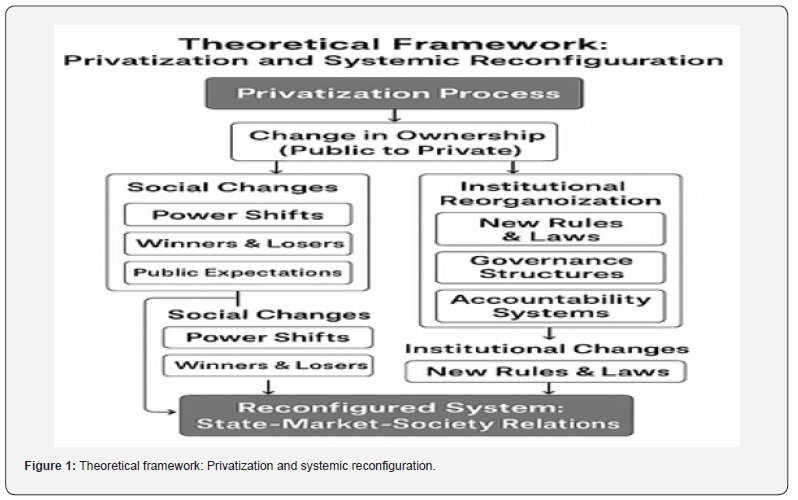
In order to have the meaning of our results, we appeal to an eclectic theoretical approach that does not just define privatization as a shift in ownership but as a process of social and institutional reorganization (Figure 1). Figure 1: The theoretical framework demonstrates the causal pathway between privatization and reconfiguring the whole system. The diagram starts with the privatization process which results in a shift of ownership to a partnership with privatization. The shift initiates two divergent lines of change social reorganization (power changes, losers and winners, and expectations of the people) and institutional reorganization (new rules and laws, governance, and systems of accountability). The result of all these changes is a reformed system of state-market-society relationships. Arrows are used to show direction of influence and causal direction.
Hybrid Governance and the Institutional Theory
Privatization has a tendency of forming institutional hybrids in fragile states Middlebrook [22]; Radić [23]. The private operator does not merely operate a terminal but can take over some of the traditional state roles - security, infrastructure planning, quasijudicial dispute resolution. This creates a blur between the public and the private where new governance arrangements that must be analyzed outside the formal terms of a contract emerge. We use the institutional bricolage theory to explore how actors integrate new institutional aspects with the prevailing norms and practices Cleaver [24].
Political Settlement Theory
We analyze the balance of power among elites and social grouping that forms the foundation of stability in Sierra Leone based on post-war political settlement with referencing to Khan [25] analysis of how the port concession fits within the context of the political settlement. The concession is a political deal in itself and not merely an economic one between the domestic elites, international donors and the private operator. It is important in understanding the sustainability and legitimacy of this deal to be aware of what groups support, gain or lose out of this deal or are marginalized by the deal Miranda [26].
The Politics of Agency, Livelihoods, and Resistance
Leaving the sphere of structural analysis, we think of the agency of various actors Dayrobi [27]; Lippuner & Werlen [28]. What are the strategies that small traders can modify to overcome new costs? What is the negotiation level of port workers in the process of transitioning to the privatized job? Such an approach makes the analysis humanized, showing resilience, resistance, and unintended consequences that other structural approaches may fail to understand.
Critical Discourse Analysis
Even the words that are used to rationalize and explain privatization, such as efficiency, modernization, public-private partnership is by itself a place of power Mirhosseini [29]; Nayak [30]. We look at how these frames of discourse have been used by various actors to justify some results and muting others. This assists us in knowing how the official narrative of privatization success is being made and challenged. It is a multi-theoretical framework that drives our investigation into an enigmatic nexus of structure and agency, global paradigms, and local realities, formal contracts, and informal practices that characterize the experience of privatization of the port in Sierra Leone.
Methodology: A Constructivist, Qualitative Approach
Philosophical Orientation
This paper is based on interpretivist constructivist paradigm Creswell & Poth [31] that is premised on the notion that reality is constructed socially through language, experience, and interaction. We do not intend to generate generalizable truths but rather we will create well-rounded, contextualized insights into how various actors think about privatization in Sierra Leone. We use what Flyvbjerg [32] describes as a phronetic approach, or, in other words, is concerned with the practical wisdom of what is good to the society in particular situations.
Research Design
Our design was an embedded multiple case study Yin [33], in which the Freetown privatization was our main case, but we analyzed embedded sub-cases within the case (different stakeholder groups). This method enables the depth of the understanding in groups and the comparative analysis between the groups. Information was collected in eight months (March- October 2024) and methodological triangulation on three information sources was applied.
Population and Sampling
Purposive maximum variation sampling Patton [34] was our sampling method to consider different opinions among stakeholder groups. A total of 42 individuals across five categories made up the end sample (Table 1) and the sampling process was repeated until theoretical saturation was achieved Saunders et al. [35].
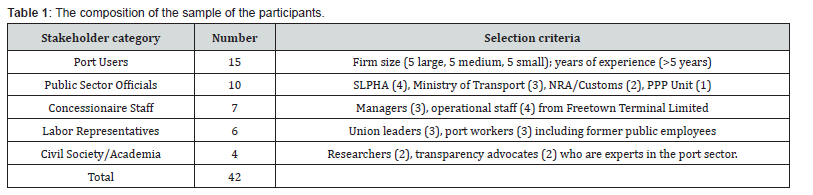
Source: Field Survey, 2024.
Data Collection Methods
Semi-Structured Interviews: The interviews were conducted
using a guide that was designed by some of the main themes:
change experiences, perception of costs, regulatory encounters,
and impacts of livelihood. Sample questions included:
a) How has your experience of using the port been since
2010?
b) What do you consider to be the greatest advantages and
issues of privatization?
c) What do you think of the association between
concessionaire and port authority?
d) What impact have you felt on your business/livelihood
in these changes?
The interviews were in English or Krio (whichever preferred)
and were audio-taped with permission (45-90 minutes).
Focus Group Discussions: Three FGDs (6-8 participants
each) were used to have an interactive discussion about collective
experiences:
a) FGD 1: SME traders on the effect of cost and business
adaptations
b) FGD 2: Transporters and logistics providers on supply
chain changes
c) FGD 3: Civil society on governance and transparency
issues
Document Analysis: The sources on which we analyzed were: the 2010 Concession Agreement, parliamentary debates (2008-2010), World Bank reports, SLPHA annual reports (2005- 2022), media reports, and the internal memoranda retrieved as a result of access-to-information requests.
Ethical Considerations: Plain language forms were used to get informed consent. Since there were delicate talks concerning influential players, the anonymity via codes, such as P1, P2, and the safety of storing data was ensured.
Data Analysis
All the interviews and FGDs were transcribed verbatim,
Krio parts were translated with the help of a bilingual research
assistant and checked. We used NVivo 14 to do reflexive thematic
analysis Braun & Clarke [36] with six stages:
i. Familiarization with data
ii. Generating initial codes
iii. Searching for themes
iv. Reviewing themes
v. Defining and naming themes
vi. Producing the report
The analysis was a process of going back and forward between information, themes and theories. Some of the ways we increased rigor were by: peer debriefing with the West Africa specialists, member checking with chosen participants, and having an audit trail of the decision made during the analysis.
Findings
This analysis shows that there exists a topography of deep contradiction between what port privatization is supposed to bring about in the way it has actually been lived through and the topography of exclusion, regulatory decline, and new forms of sovereignty. The themes that are always present in the stakeholder accounts are a dual narrative of success versus extraction, regulatory atrophy in the context of institutional hybridity, and social dislocation and resilient adaptation.
The Dual Narrative: Rents vs. Efficiency
There was a sharp contrast between the official discourse of transformational success and the experience of port users. Modernization was stressed by the public officials and concessionaire managers and one of the top managers has claimed, we have brought this port out of the dark ages to the 21st century (P22). It presented infrastructure and digitalization, better operational ratios, and made privatization an unqualified success, with this discourse.
This markedly contrasts with the reports of financial pressure and disempowerment by the users especially the small and medium traders. The port is quicker, yes, said a lamenting female importer. However, I am paying thrice the amount to empty my container. Where is the gain for me?” (P8). Most of them reported that although the turnaround times in vessels were enhanced, their general logistics expenses were raised by 30-50% because of high terminal handling fees. This conflict is what we call the efficiency-extraction paradox: it is efficiency gains that have been privatized through the concessionaire instead of being socialized in the form of cheaper user costs or better social services. The control of the handling of the terminals by the operator made it a monopolistic market that had limited regulation so that the improvement of operation could be taken as the personal gain.
Institutional Hybridity and Regulatory Atrophy
The repeated pattern of interviews was that the Sierra Leone Ports Authority (SLPA) could be regarded as a weak regulator. The respondents characterized a capacity inversion: the technically competent private operator faced an ever-growing capacity to define the agenda, whereas the resource-starved public authority was unable to implement the contractual terms. This dynamic was symbolically described by one of the customs officials: SLPA is a landlord, who has rented his sole house and now sleeps in the verandah (P15). It was an institutional hybridity, in which the property of the law was social, yet the power of operation had become predominantly privateistic, which resulted in what a number of officials called regulatory capture by expertise. One of the former SLPA engineers told me, they come with reports, data, legal arguments that our small team is not in a position to counter. Technical and legal outgunned (P18). As the staff allegedly reduced to less than 300 by 2020, not 1,200 as before the privatization, the state evolved into more of a spectator who can still complain but never alter the game (P5).
Social Dislocation and Livelihood Transformation
The privatization reorganized the social ecology of the port transforming the labor relations and informal economies. Exemployees of the public sector mentioned the shift of the culture of the public service to the culture of performance measures and profitability. One of the former SLPA crane operators commented, “Previously there was a feeling of community service... At this point, it is KPIs, profit, and pressure only. The human touch is gone” (P31). Although a part of the workers received increased wages, the representatives of the unions stated that permanent workers were now reduced by about 60 percent, with casualized contract labor taking the place of permanent workers. The informal economy in the vicinity of the port, such as porters or food sellers, small-scale agents, was met with active exclusion. A leader of a porters’ association reported, they constructed strong walls and provided their own security. Our space is gone. Our generation of folks here is now referred to as unauthorized persons” (P36). This geographical and financial marginalization is an indication of how privatization in order to seek the best practice in the world, destroyed the local livelihoods that used to play a crucial role as a social and economic cushion.
Informality and Adaptation: Resilience in the Face of institutional Change
In spite of the official concession system, informal activities and systems of relation networks were still necessary in order to get through the port system. Merchants talked about using personal contacts to short-cut procedures, what is known as connection work. According to a clearing agent, there is a contract, but when it comes to the ground, it is who you know that will get your container out (P12). This shadow system was running alongside official procedures where it discloses the boundaries of institutional transfer and the existence of localized rule. Adaptive livelihood strategies were also devised by the small traders, including shipment consolidation to share costs, diversification of supply routes by use of land borders, and timing of shipment to avoid paying high charges. These modifications evidencing agency and strength are also an indication of hidden transaction costs not reflected in formal measures of efficiency. A combination of these results portrays a borderland on which the technical success of privatization is erodible through regulatory failure, social exclusion, and the tenacious, but expensive, informality of routine everyday performance.
Discussion: Three Dilemmas of Privatization in Fragility
Our findings create an image of a reform which worked only on very specific and technical levels though it did not conform to the developmental view of a post-conflict state. We argue that the Sierra Leone experience throws light on three important dilemmas of privatization in weak settings.
The Sovereignty-Efficiency Trade-off
This agreement handed over not only operations, but also major economic sovereignty to an entity owned by a foreigner. The ownership of one of the key national ports was open to the business logic and stock price. Although this injected capital and expertise, it cast the major issue of national control in times of crisis (as seen in Ebola and COVID-19 where port activity was at the heart of the response). As one of the government officials had been privately quoted: In the case of Ebola, we had to have flexibility on medical supplies. Pandemics were not considered in the contract. Everything had to be negotiated by us (P19, Ministry Official). This crisis is reminiscent of what dependent development theorists have always pointed to: efficiency through foreign investment tends to be at the cost of sovereignty Evans [37]. In weak states that continue to claim post-conflict sovereignty, these are especially politically weighty costs.
Building Markets vs. Rebuilding states
Neoliberal reform models consider the establishment of efficient markets. Nevertheless, in post-conflict Sierra Leone, the pressing activity can be the reconstruction of adequate and legitimate state institutions. The privatization can have led to unintentional destruction of one of the primary opportunities of institutional learning, capacity building, and revenue generation in the state by outsourcing a core state activity. It has formed what might be called a two-level institutional terrain: a highcapacity enclave (the terminal) and a set of low-capacity public agencies. Such a dynamic is potentially aggravating, but not corrective, of state fragility, posing what Fukuyama [38] terms as state fragility problems, in which the state does not have the elementary implementation capability. Our findings indicate that the concession model presupposed the presence of a competent regulator or its emergence, which our results indicated could have been prevented.
Whose Development? Equity as Political Choice
The case sharply brings out the fact that equity is not an incidental result of efficiency, but it must be chosen intentionally and structured through political decisions and institutions. The reformation was aimed at investment attraction and better indicators, and there were not many active mechanisms to defend vulnerable customers or displaced employees. This has led to spatially concentrated (in the terminal), sectorally narrow (enriching capital-intensive logistics) and socially exclusive development. This brings serious concerns regarding the lines of compatibility between the models that emphasize concession and pro-poor development agendas that prevail in post-conflict policy. Inclusive development demands the adoption of redistributive policies and political settlements that insert the marginalized groups- aspects highly lacking in Sierra Leone port privatizationas put forward by Hickey [39].
Evaluation of Alternative Interpretations
Although we focus on negative consequences in our findings, we do not ignore possible counterarguments. There may be some efficiency benefits which later may create greater economic benefits by way of greater quantities of trade. The new buzzy port can have supplementary investments. But such possible gains are yet to be achieved by the majority of Sierra Leoneans, as far as they fall victims of the monopoly system and the failure to pull down. These competing hypotheses should be quantitatively tested in future research [40].
Conclusion and Future Studies
This work criticizes the prevailing efficiency-based discourse of port privatization because it shows that it is essentially a political, redistributive process in weak states. Using a qualitative analysis of the case of Sierra Leone Freetown Container Terminal concession, we show that privatization restructured institutional power, institutionalized rent capture, excluded local actors, and triggered the stagnation of the regulatory environment. Although there was an improvement in operational measures, these were privatized instead of being socialized, which points to a severe contradiction between technical efficiency and developmental equity. Our results add to a number of theoretical discourses. To start with we contribute to the literature on the political economy of development by explaining how the models of global privatization interact with and in many cases strengthen local power imbalances in fragile political settlements. Second, we also deepen the institutional theory as we trace how institutional hybridity is formed in post-conflict situations when formal contracts are indistinct between formal and informal governance. The study methodologically justifies the interpretive methodologies of the qualitative, to reveal the lived experience, coping mechanism, and informal bargaining which cannot be captured in a role of quantitative evaluation of reform.
There are practical policy implications of the analysis. Reform of the future infrastructure in fragile settings should: (1) initiate stringent political economy diagnostics so as to map power structures and distributional hazards; (2) integrate explicit equity safeguards, e.g. independent tariff policy, local content rule, transitional support fund, etc., into concession design at its outset; (3) think of regulatory capacity building as a precondition not an afterthought of privatization; (4) consider hybrid forms of governance, e.g. graded joint venture, performance-based management contract, etc., that permit incrementative. We admit some weaknesses of a single case study that is rich in contexts. Even though our results shed light on the important dynamics in the post-conflict environment in Sierra Leone, they cannot be made statistically generalizable. The future studies must take several avenues that have potential. Comparative analysis of different weak states (e.g., Liberia, Guinea, Mozambique) would be able to figure out contextual factors that predetermine different privatization results. The quantitative test of relationships proposed by our qualitative findings would be best done by mixed-methods research, especially on the cost pass-through and employment implications. A longitudinal study that spans a time more than the period of the first concession should be conducted to determine the sustainability and change in the effects of privatization. Lastly, a study of counterfactual instances of privatization that have been successful in terms of efficiency and equity may inform less biased reform agendas.
Finally, the research paper demands a paradigm re-evaluation of the concept of infrastructure privatization and its assessment in weak, post-conflict environments. It should not be confined to imitating international best practice models of operation but rather should be geared towards the development of contextually specific, politically viable, and socially acceptable institutional patterns. The infrastructure decisions in Sierra Leone and other countries like it will permanently determine recovery, inclusion patterns and relations between the state and society. These are not just technical choices but significant political choices concerning the types of societies which are being constructed, choices which require the subtle, grounded insight which only qualitative inquiry can offer.
References
- Cullinane K, Song DW (2002) Port privatization policy and practice. Transport Reviews 22(1): 55-75.
- Demianchenko A, Dergausov M, Ryabchuk V (2021) The impact of Privatization on the Port Systems of the World. Economic Herald of the Donbas 3(65): 110-114.
- Sherman RB (1995) Privatization and its Implications for U.S. Public seaport agencies.
- Alderton PM (2018) Chapter 9: Port Commercialization and Privatization. In Port Business. De Gruyter pp. 243-252
- Baird AJ (2002) The Economics of Container Transhipment in Northern Europe. International Journal of Maritime Economics 4(3): 249-280.
- Kurz CP (2010) What You See is What You Get: Analytical Lenses and the Limitations of Post-Conflict Statebuilding in Sierra Leone. Journal of Intervention and Statebuilding 4(2): 205-236.
- Mustapha M (2010) Global Inequalities and Peace in Postwar Sierra Leone.
- GoSL (2010) National ports privatization and concession framework.
- GoSL (2020) Annual Performance Reports.
- Wijaya AF (2008) The Inequitable Impacts of a Corrupt Governance System on the Poor.
- Megginson WL, Netter JM (2001) From State to Market: A Survey of Empirical Studies on Privatization. Journal of Economic Literature 39(2): 321-389.
- Trujillo L, Nombela G (1999) Privatization and Regulation of the Seaport Industry. The World Bank.
- Estache A, González M, Trujillo L (2002) Efficiency Gains from Port Reform and the Potential for Yardstick Competition: Lessons from Mexico. World Development 30(4): 545-560.
- Micco A, Pérez N (2002) Determinants of Maritime Transport Costs. SSRN Electronic Journal.
- Cullinane K, Ji P, Wang T (2005) The relationship between privatization and DEA estimates efficiency in the container port industry. Journal of Economics and Business 57(5): 433-462.
- Estache A, Burns P (1999) Information, Accounting, and the Regulation of Concessioned Infrastructure Monopolies. The World Bank.
- Ferrari C, Parola F, Tei A (2015) Governance models and port concessions in Europe: Commonalities, critical issues and policy perspectives. Transport Policy 41: 60-67.
- Munim ZH, Schramm HJ (2018) The impacts of port infrastructure and logistics performance on economic growth: the mediating role of seaborne trade. Journal of Shipping and Trade 3(1): 1.
- Forster HT, Mouly VS (2006) Privatisation in a developing country: insights from the Gambia. Journal of Organizational Change Management 19(2): 250-265.
- Ganson B, M’cleod H (2019) Private sector development and the persistence of fragility in Sierra Leone. Business and Politics 21(4): 602-631.
- Mosse D (2004) Cultivating Development: An Ethnography of Aid Policy and Practice.
- Middlebrook P (2012) Building a “Fragile Consensus”: Liberalisation and State Fragility.
- Radić M, Ravasi D, Munir K (2021) Privatization: Implications of a Shift from State to Private Ownership. Journal of Management 47(6): 1596-1629.
- Cleaver F, Franks TR, Maganga F, Hall K (2013) Institutions, Security, and Pastoralism: Exploring the Limits of Hybridity. African Studies Review 56: 165-189.
- Khan MH (2010) Political Settlements and the Governance of Growth-Enhancing Institutions.
- Miranda N (2007) Concession Agreements: From Private Contract to Public Policy. The Yale Law Journal 117(3): 510.
- Dayrobi Mhd, Usqo HU, Lubis F (2024) The Relationship Between Structuration Theory and Agency According to Giddens and Walters. PKM-P 8(2): 348-353.
- Lippuner R, Werlen B (2009) Structuration Theory. International Encyclopedia of Human Geography Volume 1-12, 1–12, V11-39-V11-49.
- Mirhosseini SA (2006) Norman Fairclough, Analyzing discourse: Textual analysis for social research</i>. Language in Society 35(4): 620-624.
- Nayak BS (2019) Reconceptualising Public Private Partnerships (PPPs) in global public policy. World Journal of Entrepreneurship, Management and Sustainable Development 15(3): 259-266.
- Creswell JW, Poth CN (2018) Qualitative Inquiry and Research Design Choosing among Five Approaches. (4th Edition). SAGE Publications, Inc., Thousand Oaks.
- Flyvbjerg B (2006) Five Misunderstandings About Case-Study Research. Qualitative Inquiry 12(2): 219-245.
- Yin RK (2018) Case study research and applications: design and methods. (Sixth edition.). Sage.
- Patton M (2015) Qualitative Research and Evaluation Methods: Vol 4th Sage Publications, Thousand Oaks.
- Saunders B, Sim J, Kingstone T, Baker S, Waterfield J, et al. (2018) Saturation in qualitative research: exploring its conceptualization and operationalization. Quality & Quantity 52(4): 1893-1907.
- Braun V, Clarke V (2023) Toward good practice in thematic analysis: Avoiding common problems and be(com)ing a knowing researcher. International Journal of Transgender Health 24(1): 1-6.
- Evans P (2018) Dependent Development. Princeton University Press.
- Fukuyama F (2004) State-Building: Governance and World Order in the 21st Cornell University Press.
- Hickey S, Sen K, Bukenya B (2014) The Politics of Inclusive Development (S. Hickey, K. Sen, & B. Bukenya, Eds.). Oxford University PressOxford.
- Bourke B (2014) Positionality: Reflecting on the Research Process. The Qualitative Report.

























