




 ACJPP Home



Abstract
With the recent and ongoing incidents of high way robbery, attacks, kidnapping and abduction, it appears that efficiency in the transportation sub sector in Nigeria is important following growing insecurity. While there has been recent awareness in strengthening effective public service delivery among Ministries Departments and Agencies (MDAs) in Nigeria, the question of collaboration with relevant stakeholders to strengthen effective road transport service delivery remains unresolved. This paper follows collaborative development framework and qualitative field data through interviews and Focus Group Discussions (FGDs) and offers an analysis that explores Akwa Ibom State Transport Company (AKTC)-a thriving state owned company. Findings suggest that despite the potentials for effective service delivery, insecurity has been a major factor undermining efficiency in the transportation sector as collaboration is neglected. The paper analyses dimensions of the insecurity on the high ways. In the alternative, recommends a wide range of collaborative strategies for dealing with the various problems of insecurity and inefficiency in service delivery in the transport sector as well as their implications for broader organizational efficiency, thereby filling an important research gap and informing public administrators, managers and policy makers on how best to deal with poor collaboration for effective transport service delivery. The analysis of strengthening effective service delivery and its wider public policy implications, uncovers an overlooked policy issue that is important for understanding transport sector transformation and its managerial implications.
Keywords:Public Administration; Efficiency; Service Delivery; Transportation; AKTC
Abbreviations:MDAs: Ministries Departments and Agencies; FGDs: Focus Group Discussions; AKTC: Akwa Ibom State Transport Company; KIIs: Key informant Interviews
Introduction
In most developing countries such as Nigeria, transportation has been important not only to facilitate the conveyance of humans, goods and other materials from one location to the other but a source economic development Banister [1]; Essien & Cyrus [2]; Udonguak [3]. For example, in most rural areas where agricultural products are produced, transportation has made its conveyance to the urban centres possible thereby contributing to economic growth Akpan, Umorem & Akpan [4]. Thus, transportation either road, rail, air or sea is central to the task of economic development of Nigeria.
Despite its relevance, recent studies have shown the challenge of road infrastructural decay and increasing problems of insecurity along the highways Dimnwobi, Nwokoye, Ekesiobi & Igbanugo [5]; Okafor [6]; Musa [7]; Yusufu, more so, is the problem of decay of road infrastructure linked to the question of poverty Ibanga & Ituen [8]. For example, since January 2021, more than 10 incidents of abduction of commuters including school children involving over 1,000 victims have occurred. It has been emphasized that improvised vehicle checkpoints are used to abduct commuters amidst intermittent invasion of rural communities mainly for looting and abduction Musa [8]; Amadi and Ugwu [9]. In the month of September 2024, a luxurious bus along Nigeria’s highway travelling from eastern Nigeria to Lagos was intercepted by armed highway criminals around Ore. The driver and passengers were matched into the forest. Several women were raped and other passengers including men were robbed. Others were held in hostage and ransom was demanded from the families.
Another incident occurred along the highway to Abuja from Eastern Nigeria somewhere around Kogi in north central Nigeria, a Bus with commuters traveling to Abuja, Nigeria’s capital was hijacked by armed bandits and commuters were also matched inside e the forest Musa [8]. These occurrences which depict insecurity in Nigeria’s high way has implications for efficiency in the transport sector. Thus, little is known about the importance as well as role of strengthening collaboration for effective transportation to enable economic development and efficient service delivery system in Nigeria’s road transportation sub sector. In public administration and management studies, as well as in practice, road transportation issues have been given a low priority. Minimal attention has been paid by researchers to understanding the persistent challenges in strengthening collaboration for effective service delivery in road transportation sector.
The highway insecurity suggests the urgent need to strengthen collaboration for effective road transport service delivery, as well as the broader administration and management implications of road transportation as well as commuters’ safety and satisfaction on the highways Nwachukwu [10]. Research on the relationship between effective stakeholder collaboration for improved transportation has largely focused on the need to overcome complex challenges that impact transportation both household vulnerability issues Choy, Teik, Jarkarni, & Subra [11]; Amos, Akpan, & Ogunjobi [12]. In the particular context of road transportation in Akwa Ibom , studies have examined a number of issues such as the state of road infrastructure (Akpan et al. 2024), road travel and relevance to smallholder farmers Akpan & Morimoto [4], sustainable transportation, condition of the vehicle, insecurity on the highways, bad road conditions as an internal mechanism to protect commuters Litman & Burwell [13]. In a related account, Badejo [14] highlights the need to develop integrated transport system and management in Akwa – Ibom state to meet the needs of commuters. The study examined the various ways in which transportation is essential to economic growth and the need to take cognizance of the challenges to effective transportation systems and the effectiveness of enforcement of various policies that could strengthen efficiency in public transport service delivery.
In a similar study, Afolabi, Hassan, and Age, [15] identified behavioral pattern of commercial public transport passengers as common elements to the explanation of the different challenges in public transportation in terms of insecurity and in particular how well commuters are protected by law. Thus, policies promoting efficiency in public transportation must take cognizance of the security needs of commuters. Hilling (1996) discusses some of the fundamental challenging trends in transportation in the developing countries. In comparative context drawing on Nigeria and Egypt, Faajir and Zidan [16] elaborated on some of the issues and challenges of transportation. Correspondingly, studies in the field of public service delivery suggest that road transport service delivery has several advantages and in particular can drive human and economic development Ashikodi [17]; Banister [1]. However, despite the importance of road transportation, there has been recent rise of insecurity in Nigeria’s high way and the question of effective service delivery in the transportation sector is not reflected in existing practice or research. It is thus unclear whether the theoretical findings about the relationship between collaboration and road transportation hold in Nigeria, given the prevalence of high way robbery, kidnapping or abduction of commuters for ransom, weak capacity for effective security along the high ways, inadequate and pliable road networks etc., It is likely that poor transport service system will, in fact, undermine public service delivery on account of negative effects of insecurity, which has adverse implications for economic development and effective public administration.
Against this backdrop, this study demonstrates the need to strengthen collaboration for effective service delivery in the transportation sector and related public service, administration and management especially in the developing countries of the Global South with increasing challenges of inefficiency. It raises the question; how has non-strengthening of collaboration undermined effective road transportation service delivery? To answer this question, the study draws on the context of AKTC a commercial transport company to identify the patterns and dimensions of such collaboration or otherwise and alternatively, proposes strategies and policy recommendations to redress the complex challenges of non- collaboration in transportation. The contribution of this study is in three fold. First, it seeks to fill research gaps on collaboration by proposing strategies to bring together relevant stakeholders to identify and promote safety on the highways in the developing countries drawing on the AKTC in Nigeria. Secondly, it demonstrates that insecurity has increasingly undermined road transportation administration and management which has implications for efficiency in road transport service delivery and thirdly, it reinforces the need for improved road infrastructure for economic growth and development of Nigeria. The rest of the paper is structured as follows; theoretical framework, methodology, discussion of findings, implications for public administration, finally conclusion and recommendations.
Theoretical Framework: Collaborative Development Theory
There is a growing perception that the current trends, issues and dynamics of road transportation cannot be theoretically explained using the conventional framework of service delivery that primarily focuses on the provision of services without adequate exploration of its broader implications to efficiency in serve delivery and the wider stakeholders Berg, Blankespoor & Selod [18]. The dominant theoretical perspectives adopt geo-social relations logic of transportation to explain the movement of people and goods from one geographical location to the other Acker, Wee, & Witlox [19]; Njoh [20]. A substantially new conjuncture of administration and management conditions and forces have emerged in road transportation management as well as road maintenance as a result of a combination of persistent local distortions on the highways and the neglect of various stakeholders such as commuters who re increasingly vulnerable to high way attacks. As a result, a new dynamic of interactions for collaboration among stakeholders is emerging, characterized by the need to promote and sustain effective and efficient road transport service delivery, which has increasingly constituted a major significant administrative and management problem in the public sector.
To explain this emerging scenario, we aim to demonstrate how strengthening collaboration among stakeholders could promote effective service delivery. The paper develops a new analytical framework for examining the dynamics, drivers and trends of collaboration for effective service delivery drawing on AKTC. First, the theory of collaborative development is adopted to understand the administrative-management processes of road transportation Levine & Moreland [21]. For the purpose of explaining the AKTC context, the study follows the theoretical perspective which holds that road transportation along the Niger Delta high ways is often faced with complex problems ranging from deplorable road conditions, traffic, robbery and congestion on the highways Poopola, Abiola & Adedeji [22]; Sani [23]. These challenges suggest the need for collaboration to overcome the growing problems of road transportation and foster economic development.
These analyses of collaborative development offer insights into understanding the dynamic processes and outcomes of systemic changes in road transportation and the impacts of these changes on the economic, social and cultural lives of commuters especially in rural areas. However, the concept of collaboration has not been adequately adopted to study the transportation sector in Nigeria. To fully understand the new transportation–society relationships emerging in Nigeria through the current highway insecurity, scholars must move beyond these social-economic analyses alone and establish intertwined relationships between the transportation sector and the people and the changes taking place along the highways and how the theoretical remit of collaborative development could offer deeper understanding of transformation of the transportation sub sector.
Some scholars have explored the connections between growing insecurity and poor policy response, explaining the growing tension and crises between most commuters and highway insecurity in Nigeria Ali [24]; Aderamo and Atomode [25]. However, to develop a more comprehensive understanding of the contemporary commuter-highway interactions in Nigeria, we must view the processes of road transportation in relation to the evolving dynamics of robbery attacks, kidnapping etc. Second, the concept of collaboration provides an analytical framework to explain the trajectory of road transportation use change in relation to the socio-economic changes in a specific context. A collaborative development involves a wide range of stakeholders across a broad spectrum of perspectives but with similar or shared values for a common goal, namely development. Booch and Brown [26] defined development collaboration as a space where stakeholders may discuss, negotiate brainstorm, share knowledge and generally labour together to carry out some tasks mainly to create an executable deliverable and its supporting artefacts. Development collaboration refers to the dynamics of interaction among relevant stakeholders for the achievement of specific development goals. Such collaboration according to Kourliorous [27] explores the drivers and processes of economic development, conditions, composition and overall dynamics. The concept of collaborative development can be extended to explain the processes and dynamics of change in socio-economic dynamics and their interlinkages with changes in evolving a more transformative social order and practices. Nigeria’s road transportation sector since independence in 1960 has had a weak connection to economic development. Such weak economic development linkages include poor or deplorable condition of the roads.
Since 1999, following Nigeria’s nascent democracy he major political campaign promise of political office seekers has been to build roads and to provide electricity, yet the issues of effective road networks and more importantly, secured road systems where high way hijackers, kidnappers and armed robbers cannot operate have been a challenge. Whereas the current patterns in road construction and maintenance is linked to electoral promises of political office seekers there is marginal transformation in real development terms. Proponents such as Booch and Brown [26] posit that, for collaborative development to take place there must be an enabling environment where stakeholders can leverage to collaborate. Kourlirous [27] asserts that the failure of the federal government to provide essential services at the local level has made collaboration for local development inevitable Bowen [28] argues that for collaborative development to take place there must be a convergence of development focused collaboration among various stakeholders and that such collaboration must four interrelated processes; identifying problems and priorities(ii),motivating and mobilizing(iii),working together and (iv)creating an enabling environment. Bowen further highlights that the underlying stakeholder involvement suggests that collaboration increases the productivity of resources and creates the conditions for community- driven development.
In public administration, arguments for collaborative development hold that collaborative governance is essential for the actualization f collaborative development. For example in an elaborate study Ansil and Gash [29] argue that collaborative governance brings public and private stakeholders together in collective forums with public agencies to engage in consensus oriented decision making, To Stephen B Fawcett, and Adrienne Paine –Andrews [30] community empowerment is essential building in collaborative partnerships for development. Arguably, there is a strong connection between Nigeria’s road system with insecurity resulting in the recent rise of highway kidnapping and armed robbery. However, collaborative development concept alone cannot explain this new vice as this concept is confined to economic transformation as an indicator of new commuter–road transportation interactions. The current road transportation system is a consequence of failed State system creating a condition of insecurity and commuters’’ vulnerability along the highways. This new highway insecurity indicates different and new socio-economic practices and evolving changes in associated with road transportation such as high way robbery, abduction and related uncertainties on the highways. We also draw attention to the dominant infrastructural development on discourse that emphasizes democracy and new infrastructural development in Nigeria. With less emphasis on building new security along the highways to protect commuters. The consequences of this superficial perspective have been the marginalization of the security challenges of commuters in research and policy. Thus, development collaboration offers a fresh theoretical perspective to understand the need for stakeholders’ engagement to build a new road transport system dynamics where issues of insecurity, deplorable road condition, highway abduction, and new network or synergy among stakeholders could be strengthened. The theory of collaborative development is premised on the assumption that development must be inclusive in order to make desired impact. In this context all facets of development and stakeholders must be put into consideration as well as the recipients of such intervention. In the context of our study, public administrators, policy makers, road transport workers, commuters, drivers and security agencies as a matter of necessity must converge to charge a collaborative development initiative and mitigation of ongoing highway and insecurity. This way, the fundamental assumptions and ideals of collaborative development theory could be achieved, we strengthen this theoretical model in this study.
Methodology
Study Sites
Akwa Ibom Transport Company – (AKTC) is known for providing bus transportation service in the last two decades. It has over 34 branches across Nigeria. The specific sites for this study include Uyo Main Park, Akwa Ibom State, Waterlines Park, Port Harcourt, Rivers State and Calabar Main Park, Cross Rivers State. These are some of the major routes of AKTC. Qualitative field data was collected from commuters and literate park officials from these selected sites of the study.
Approach
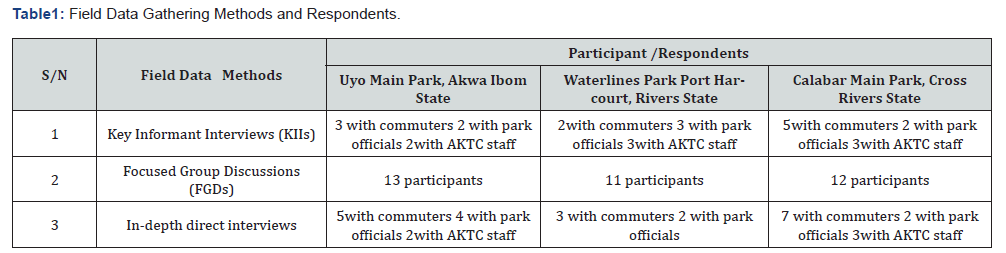
This study was based on qualitative fieldwork using Key informant Interviews (KIIs), FGDs and direct interviews conducted with commuters in three different AKTC terminals (Uyo in AkwaIbom, Calabar in Cross Rivers State and Port Harcourt in Rivers State) and selected management staff of AKTC and examined their perception on strengthening collaboration for effective service delivery in the road transportation sector. We conducted 15 direct interviews to understand the experience of commuters and their encounters with high way robbers, kidnappers, poor road infrastructure, condition of service of AKTC and the type of problems they faced. Further, we conducted 5 focus group meetings in the study sites to understand the views of both commuters and park officials on the patterns and extent of road transport service and efficiency and in particular, to explore local responses to the problems of strengthening collaboration for effective transport service delivery in contexts linked to road transportation. The participants of the focused group meetings consisted of commuters, motor park officials and staff of AKTC. These interactions which were anonymous and voluntary helped for the validation of our field-based findings as well as collecting data and insights for policy responses Table 1.
Source: Field Work (2025).
All interviews were transcribed in English and thematically analyzed using NVivo software. We identified all instances in the responses where participants expressed their general perceptions of road transportation, insecurity on the highways, efficiency or inefficiency in road transport service delivery. Based on this analysis, we inductively identified the opportunities and constraints of possible collaboration to strengthen public service delivery in the transport sub sector.
The sample size was determine using the Taro Yamane formula;

Where: N is the population (44112908)
1 is constant
e is the sampling error
n is the sample size
Adopting substitution method

The major instrument for data collection was questionnaire, secondary data collected from books, periodicals, magazines, journals, internet materials etc. The questionnaire was structured in 4 point Likert scale type of: strongly agreed, agreed, disagreed, and strongly disagreed. The use of table was employed to analyze data generated from the social survey. The responses from the respondents were arranged, grouped, tabulated and analyzed using the simple percentage statistical method. Thus:

Where: N
f= frequency of response
N= number of respondents
By this method, it means that the degree of percentage score of one response to another or others was determined by the acceptability or rejection of a particular statement while hypotheses was tested using Chi-Square (X2). The formula for Chi- Square

Where: O = Observed frequencies E = Theoretical or expected frequencies The degree of freedom for Chi-Square is calculated using df = (R-1) (C-1) at 0.05 level of significance
Presentation of Data
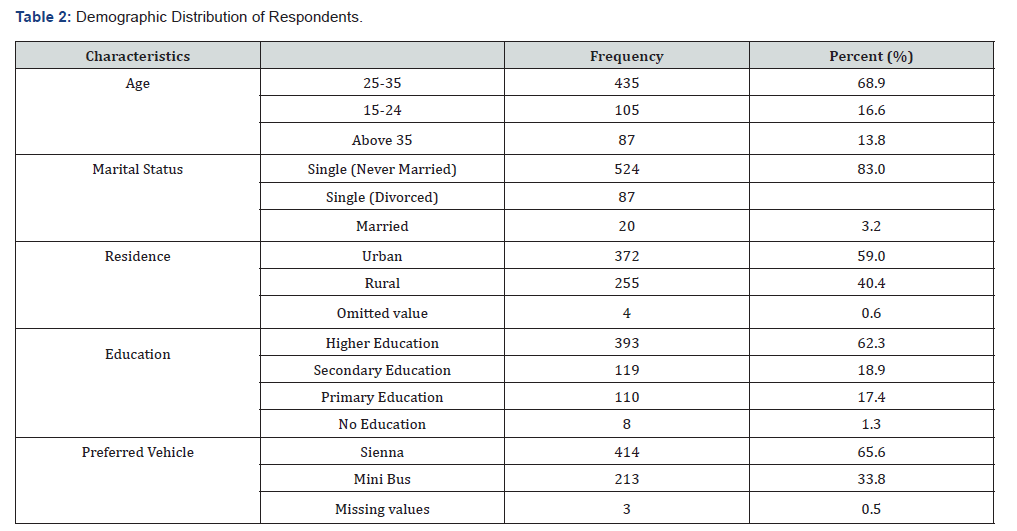
Source: Field Data (2025).
i. Central Research Question: What are the challenges of road transportation by AKTC and collaboration among stakeholders to overcome such challenges for effective service delivery?
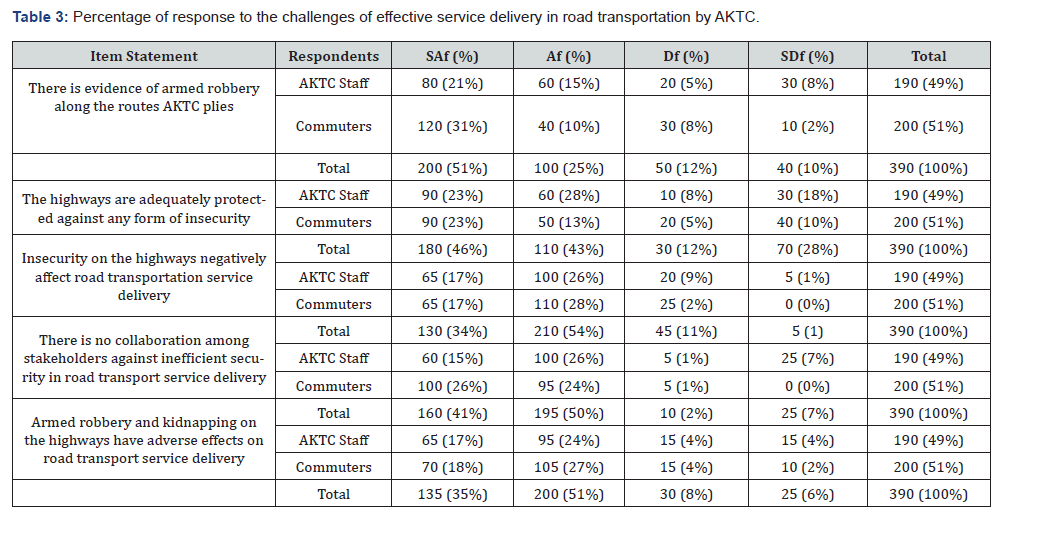
ii. Central Hypothesis: There is no significant relationship between challenges of road transportation by AKTC and collaboration among stakeholders for effective service delivery (Table 3).
Source: Field Work (2025).
Hypothesis
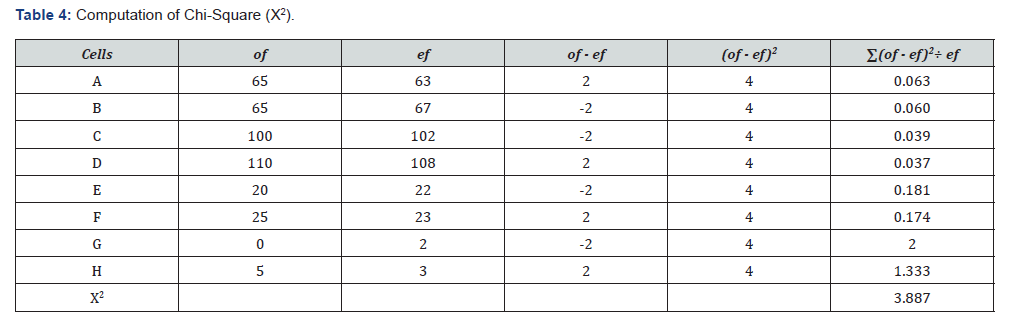
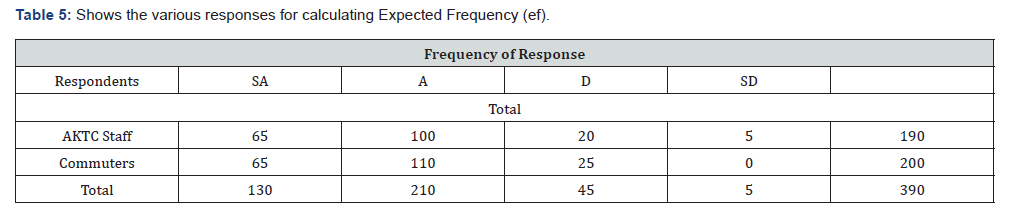
There is no significant relationship between challenges of road transportation by AKTC and collaboration among stakeholders for effective service delivery. Item 3 of table 3 of the questionnaire which states that there is no collaboration among stakeholders against inefficient security in road transport service delivery was employed with chi square (X2) thus:

Source: Field Survey Data, (2025).
Degree of Freedom (df) = (R-1) (C-1) = (2-1) (4-1) = 3.
Level of Significance = 5% (0.05)
Table Value = 7.81
Chi-Square (X2) = 3.887
Source: Survey Data, (2025).
The null hypothesis is rejected if the value of X2 is greater than the critical value. This indicates that there is a significant relationship between collaboration among security agencies and stakeholders and effective service delivery in road transportation sector in Nigeria since the calculated value of X2 (3.887) is less than the critical value of 7.81.
Discussion of Findings
Table 3 Shows the views of respondents on the challenges of effective service delivery in road transportation by AKTC. In their views on evidence of armed robbery along the routes AKTC plies, the table shows that 200 respondents which represent 51% of the 390 respondents strongly agreed with 100 respondents representing 26% agreed that there are evidence of armed robbery along the routes AKTC plies. However, 50 (13%) “Disagreed” while 40 (10%) “Strongly disagreed” that evidence of armed robbery along the routes AKTC plies. This suggests that there is evidence of armed robbery along the routes AKTC plies. The table also reveals that 180 (46%) and 110 (28%) respon dents confirmed to “strongly agreed” and “agreed” that the highways are not adequately protected against any form of insecurity. 30 respondents representing 8% disagreed with 70 respondents, which represents 18% strongly disagreed with the statement that the highways are adequately protected against any form of insecurity. The responses imply that the highways are not adequately protected against any form of insecurity.
On whether, insecurity on the highways negatively affect road transportation service delivery, 130 (33%) respondents strongly agreed, and 210 respondents representing 54% agreed that insecurity on the highways negatively affect road transportation service delivery. While 45 respondents represent 18% disagreed with 5 respondents representing 1% strongly disagreed. This implies that Insecurity on the highways negatively affect road transportation service delivery. On whether there is collaboration among stakeholders against inefficient security in road transport service delivery , the table above shows that 160 (42%) respondents strongly agreed and 195 (50%) agreed that there is no collaboration among stakeholders against inefficient security in road transport service delivery 10, representing 2% and 25 representing 6% of the respondent’s state that there is collaboration among stakeholders against inefficient security in road transport service delivery. This implies that there is no collaboration among stakeholders against inefficient security in road transport service delivery. The question of whether armed robbery and kidnapping on the highways have adverse effects on road transport service delivery, the table shows that 175 respondents representing 45% “strongly agreed” and 190 which represents 49% “agreed” that armed robbery and kidnapping on the highways have adverse effects on road transport service delivery. 20 respondents which represent 5% disagreed while 5 respondents with 1% strongly disagreed that armed robbery and kidnapping on the highways have adverse effects on road transport service delivery, Majority of the respondents agreed that armed robbery and kidnapping on the highways have adverse effects on road transport service delivery.
While there has been recent awareness in strengthening effective public service delivery among MDAs in Nigeria Ali [13], the ongoing analysis in this study points to the question of collaboration with relevant stakeholders to strengthen effective road transport service delivery. Our findings suggest that efficiency in transportation has been rather neglected. There are organizational problems and poor managerial responses to pressing transportation challenges that confront commuters. This has been partly as a result of bureaucratic bottleneck that characterizes public corporations and systemic corruption in the public sector. Another major challenge is poor or weak road network. Yusuf (2025) reports on the persistence of insecurity, poor infrastructure, which make road travel difficult in Nigeria. The report found complex dimensions of insecurity along the high ways across eight major commercial hubs; Abuja, Calabar, Hos, Kano, Lagos, Maiduguri, Onitsha and Port Harcourt.
Collaboration as a challenge of effective service delivery in road transportation entails involvement of various stakeholders for quality road transport service delivery and in particular to stimulate efficiency. Consequently, the free movement of commuters along the highways will be further complicated if security threats are not checked. Our data analysis indicates that 180 respondents which represent 77% of the 390 respondents infers that there is evidence of highway robbery along the routes AKTC plies. Also, 290 respondents representing 74% indicates that the highways are not adequately protected against any form of insecurity. On whether insecurity on the highways negatively affect road transportation service delivery, 250 respondents representing 87% accept that insecurity on the highways negatively affect road transportation service delivery while 335 respondents representing 83% affirm that there is no collaboration among stakeholders against inefficient security in road transport service delivery. Finally, the question of whether, armed robbery and kidnapping on the highways have adverse effects on road commercial transport service delivery, majority of the respondents were in the affirmative.
In line with the above analysis, qualitative literature on public transportation in Nigeria and in particular Akwa Ibom State, corroborate our findings Ibanga, & Ituen [8]; Akpan, Umorem & Akpan, 2021. Our study sheds light on the importance of strengthening collaboration in the commercial transport service delivery sector, particularly the importance of such collaboration in effective public service delivery. According to some studies in the literature, road transportation in Nigeria is marred by insecurity (Yusufu, 2025). New security architecture on the highways is an effective internal mechanism of public service delivery, and, in wide geographical area like Nigeria characterized by weak institutional settings, such as inefficient transport systems, a new security architecture helps for ease of road transportation. In fact, in countries with less-efficient, transportation system like Nigeria, the involvement of a broader stakeholders including security agencies, civil society groups and road transport workers etc. will boosts the performance of transportation companies. Thus, in such cases, collaboration can be viewed as a productive tool that extends to wide range of stakeholders.
Previous studies have examined various aspects of effective transport systems (Kangrot & Adeyi, 2022; Yusufu, 2025). Similar perspective have assessed the efficiency and integrity of transport companies as they engage in transportation businesses, particularly high way commuters. Such studies have examined the conditions under which transportation business thrive Nwafor & Onwa [31]. Another study argued that the quality of transportation service delivery like every other business is based on two elements: statutory provisions (de jure protection) and the degree to which statutes are enforced (de facto protection) Dahya, Dimitrov, & Mc- Connell [32].
In contexts characterized by in efficiency, the relationship with transportation appears to be stronger. Nigeria’s public trans portation sector is fundamentally in a bad corporate governance system. Our findings suggest that the adverse effects of poor transport service delivery affect not just commuters but the sector generally including the government and the investors in the sub sector. Moreover, Onokala and Olajide (2020) have identified a number of problems facing transportation in Nigeria as well as their economic effects on the economic development of Nigeria. Their study found that while road transportation is overused and wrongly used that the waterways are under-utilized while railways which were used in the past are now underutilized and airways are used but need to be expanded and improved. Regards sea ports their study found that the problem of inefficiency at the ports have undermined the level of patronage n seas ports. Afolabi and Gbadamosi [15] have identified road traffic as a major problem of rad transportation in Nigeria. In such cases, robbers and similar criminal attacks n the high ways could be possible. Onokala (2012) argued that the beyond road traffic are issues of road accidents which pose threats to road transportation in Nigeria.
Conclusion and Recommendations
This study identifies three processes through which collaboration strengthens effective service deliver (i) Protection of human lives on the high way, (ii) Employment generation and (iii) Source of revenue generation for the State. The study therefore analyzed the increasing need to strengthen collaboration for effective service delivery in the transportation sub sector in Nigeria. It drew on the lessons from AKTC and original field data and explored highway problems and responses arising from poor collaboration in transport service delivery. The field data identified the need for collaboration among key stakeholders to strengthen effective transport service delivery. The aim is to protect human lives on the high ways, boost employment opportunity and in particular, foster efficiency in public administration through quality public service delivery. Nevertheless, the foundational importance of transportation to broader economic development indicates that strengthening effective road network should be strategic in promoting security along the highways and protect the lives of commuters. While this reflects the urgent need for collaboration our finding shows that such finding have been largely missing in Nigeria. Our study reinforced the lessons from AKTC and suggests that insecurity confronts Nigeria’s transportation system. There is need to reposition the road transportation sector, it is equally important to consider the broader public administration implications of efficient transportation. In contexts in which public administrators and managers should be able to redress the increasing challenges of public transport management and improved service delivery to counter highway insecurities, broader commuter–service delivery relations. Thus, the basic importance of effective transportation service delivery must be emphasized. Efforts to strengthen transportation, stand as a potentially critical development point for transforming public transportation administration.
Against the backdrop of increasing insecurity and inefficiency as our field data and exiting literature suggest, and based on the relevance of collaboration, the study recommends a wide range of processes through which effective transportation service delivery strategies offers new ways for dealing with the various problems of inefficiency in service delivery in the transport sector. It further demonstrates the implications for broader organizational efficiency, thereby informing public service providers, public administrators, managers and policy makers on how best to deal with poor collaboration for effective transport service delivery. The analysis of strengthening effective service delivery and its wider public policy implications, uncovers an overlooked policy issue that is important for understanding transport sector transformation and its managerial implications generally. Thus, the wide range of constraints to service delivery system, rising profile of inefficiency in the road transport sector such as highway robbery, kidnapping for ransom, killings, abduction etc. have serious implications for effective administration and management of the road transport sector as well as quality of service delivery. These challenges have made a new policy response that aims to foster collaboration to tackle the increasing problems of insecurity and overall inefficiency in service delivery inevitable.
Based on the findings, the following recommendations were made
Following ongoing insecurity along Nigeria’s federal highways,
government should set up a new strategic plan against highway
insecurity through setting up commissions to strategically
tackle issues of kidnapping for ransom along the high ways, hijacking,
high way robbery, killings and maiming of human beings
such as community policing which could strengthen stakeholder
collaboration for improved transportation. Idiong and Essien [33]
have suggested Public-Private Partnership (PPP) as a sine qua non
for positive change in road network improvement.
i. There is need to mitigate the distressing issues of serial
criminal attacks and robbery on Nigeria’s highways through the
improvement of high way security domain awareness with the
adoption of computer vision technology, which includes technology
based services such as mobile circuit television that could vide
and record happenings along the highways. Such technological
innovation could help identify the culprits and take punitive measure
[34,35].
ii. The issue of bad roads, poor policy implementation on road
maintenance, minimal road security and persistent criminality on
the high ways should be urgently addressed by new legislation
and policy frameworks to guarantee safety on the high ways and
ensure that all federal and feeder roads are rid of highway criminals.
New laws and punitive measures should be enacted against
highway criminals, this will help forestall future occurrence and
effectively prosecute culprits
iii. Administration and road maintenance for results: Issues of
inefficiency as evident with poor policy intervention, ineffective
monitoring system on the roads and the security of commuters
has made the question of administration- for -results ever more
important. Thus, a results based public administration model is
suggested where some level of monitoring and evaluation and
reporting system is recommended where daily reports along the
federal high ways such could be periodically provided and used as
a guide to understand the flashpoints and proffer urgent solutions
iv. A robust transportation policy which cuts across all the facets
of transportation including airman and sea should be initiated
and implemented by the government to all forms of criminality in
the transportation sub sector. Badejo [14] recommends integrated
transport system and management in Akwa – Ibom State.
v. Funding: Periodic funding of rod infrastructure by the Federal
government is essential. A recent study found that the adoption
of a robust and strategic framework for funding and financial
mobilization as well as easy access to such funds considering that
the transport infrastructure is capital intensive and easily affected
by technological changes is important.
Adopting technological innovation through accelerated communication by building seamless networks among drivers and security agencies and use of security gadgets such as circuit television devices along the high ways could check the rising incidents of armed robbery and high way attacks, therefore government and policy makers should provide a more technology compliant road transportation service system
vi. Policy makers and relevant stakeholders should strengthen
public service delivery in the transport sector by incentivizing the
services of road transporters through the provision of functional
vehicles and periodic assessment of the condition of the vehicle
as well as incentives to drivers such as improved remuneration
and more public private partnership that could add value to the
sub sector
vii. The government should also strengthen collaboration with
relevant security agencies including the police force the armed
forces, the federal civil defense corpse and more importantly the
road safety corpse. A new collaboration that will involve the security
agencies and local community policing will take over a robust
and effective strategy to check the rising menace of road transport
insecurity. This collaboration would curd the rate of corruption,
rye of armed gang attacks on the roads and general insecurity on
the high ways.
viii. The systemic corruption that has been endemic Nigeria
has largely undermined efficiency in public administration generally
and service delivery in particular, therefore corruption should
be tackled to identify who are the true culprits perpetuating the
criminal activities along Nigeria’s major high ways.
References
- Banister D (2012) Transport and Economic Development: Reviewing the Studies Transport Review 32(1): 1-2.
- Essien E, Cyrus S (2019) Detection of Urban Development in Uyo (Nigeria) Using Remote Sensing. Land 8(6): 102.
- Udonguak A (2023) Akwa Ibom: Good road network as an enabler of economic development.
- Akpan U, Morimoto R (2022) Motorized travel mode choices of smallholder farmers in Akwa Ibom State, Nigeria Transportation Research Interdisciplinary Perspectives 13(2022): 10056.
- Dimnwobi S, Nwokoye E, Ekesiobi C, Igbanugo C (2019) Transportation Infrastructure and Diversification of the Nigeria Economy: Implication for the Developmental State. Nigeria Journal of Economics and Social Studies 59(3).
- Okafor O (2020) A critical Assessment of Road Infrastructure Development in Akwa Ibom State, Nigeria African research Review 14(1): 179-193.
- Musa S (2021) Nigeria’s ‘bandits’ are not ‘unknown gunmen’: why the label matters The Conversation.
- Ibanga IJ, Ituen UJ (2019) Activities of Inter-State Road Transportation Companies and Poverty Reduction in Akwa Ibom State, Nigeria. International Journal of Social Sciences 13(4): 12-24.
- Amadi L, Ugwu C (2025) State Fragility and Armed Banditry in North Central Nigeria: Greed or Grievance? African Security Review.
- Nwachukwu AA (2014) Assessment of Passenger Satisfaction with Intra-city Public Transport Services in Abuja. Nigeria. Journal of Public Transportation 17(1): 99-119.
- Choy P, Teik L, Jarkarni F, Subra K (2020) Road Infrastructure and Economic growth. IOP Conference Series, Material Science & Engineer 512: 012045.
- Amos E, Akpan U, Ogunjobi K (2015) Households’ perception and livelihood vulnerability to climate change in a coastal area of Akwa Ibom State, Nigeria. Environ. Dev. Sustain 17(4): 887-908.
- Litman T, Burwell D (2006) Issues in sustainable transportation. International Journal of Global Environmental 6: 331-347.
- Badejo B (2011) Developing Integrated Transport System and Management in Akwa – Ibom State. Nigeria being A Paper Presented at the NPCC-AKS Maritime Summit held at Uyo, Akwa Ibom State 23rd November 2011.
- Afolabi OJ, Hassan AM, Age LO (2017) Behavioral pattern of commercial public transport passengers in Lagos metropolis. J Sustain Dev Transp Logistics 2(1): 40-50.
- Faajir A, Zidan ZH (2016) An Analysis of the Issues and Challenges of Transportation in Nigeria and Egypt. The Business and Management Review 7: 18-29.
- Ashikodi T (2010) Tourism Development in the Coastal Region of Nigeria: Economics of Tourism Development, A Shift from Oil Dependence. Global Journal of Social Science 2(3): 38-47.
- Berg CN, Blankespoor B, Selod H (2018) Roads and rural development in Sub- Saharan Africa. J Dev Stud 54(5): 856-874.
- Acker VV, Wee BV, Witlox F (2010) When transport geography meets social psychology: toward a conceptual model of travel behavior. Trans Rev Trans Transdiscip J 30(2): 219-240.
- Njoh A (2019) The Development Theory of Transportation Infrastructure Examined in the Context of Central and West Africa. The Review of Black Political Economy 36(3): 227-243.
- Levine J, Moreland R (2004) Collaboration: The Social Context of theory development Personality and Social Psychology Review 8(2): 164-172.
- Poopola Abiola, Adedeji (2013) Traffic Congestion on Highways in Nigeria Causes Effects and Remedies International Journal of Agricultural Civil and Construction Sciences 7(11): 854-859.
- Sani J, Hassan I, Musa A, Musa M (2020) Traffic Congestion on highways in Nigeria Roads, Causes, Effects Remedies: A Case of Polytechnic Road Tudun Wada Kaduna. Academy journal of Science and Engineering 14(1): 88-106.
- Ali A (2013) The Aftermath of Transportation Insecurity in Nigeria 1960-2012 in The Security Sector and Conflict management in Nigeria. Ibadan peace and Conflict Studies pragramme Institute of African Studies University of Ibadan pp. 425-433.
- Aderamo A and Atomode T (2011) Traffic Congestion at Road Intersection in Ilorin, Nigeria. Australian Journal of basic and Aplied Sciences 5(9): 1439-1448.
- Booch G, Brown A (2003) Collaborative development environments Ads Computer 59(1): 1-27.
- Kourliorous E (2013) Local Development and Collaborative Planning: A theoretical framework of Analysis. Journal of Regional Socio-Economic Issues 3(1): 1-26.
- Bowen G (2005) Local –level stakeholder collaboration: A substantive theory of community –driven development Community –development 36(2): 73-88.
- Ansell and Alison Gash (2008) Collaborative governance in theory and practice. Journal of public administration research and theory 18(4): 543-571.
- Fawcett S, Paine –Andrews (1995) Using empowerment theory in collaborative partnerships for community health and development. American Journal of Community Psychology 23(5): 697-677.
- Nwafor E, Onya V (2019) Road Transportation Service in Nigeria: problems and Prospects. Advance Journal of Economic and Marketing Research 4(3): 108-115.
- Dahya J, Dimitrov O, McConnell JJ (2008) Dominant shareholders, corporate boards, and corporate value: a cross-country analysis, Journal of Financial Economics 87(1): 73-100.
- Idiong E, Essien K (2013) Road Infrastructure and Socio-economic Transformation in Akwa Ibom State, Nigeria International Journal of Economic Development Research and Investment 13(1): 1-17.
- Gredig D, Heinsch M, Amez-droz P, Huttemann M, Rotzetter F, et al. (2020) Collaborative Research and Development: A Typology of linkages between researchers and practitioners. European Journal of Social Work 24(6): 1066-1082.
- Jaakko V (2007) Collaborative development of a new concept for an activity Activities 4(4-2).

























