




 ACJPP Home



Abstract
Numerous countries in Latin America, Europe, and West Africa are genuinely interested in the Gulf of Guinea (GoG). The reason for this is because these nations rely on this area to conduct business. The majority of these nations use the Atlantic Ocean to import and export goods. When minerals like oil were discovered in this coastal area, more business was conducted there, which aided in the growth of the local economy. But it also brought the growth of criminal activities, including armed robbery, piracy, and illegal marine operations in this corridor, which have had a negative impact on the region’s maritime security. The Gulf of Guinea region’s marine governance and regional collaboration are then examined in this study, with an emphasis on the prospects and difficulties for advancing sustainable development, peace, and security. Our facts were developed based on a historical approach of analysis using a collection of both public and unpublished works. The study found that this region’s geostrategic significance comes with both significant opportunities and risks. Across other issues, political instability, a lack of coordination across projects, a lack of state and regional people and asset capability, a great deal of mistrust among the governments in the region, and a lack of money have all made it difficult for all parties to respond to security governance. According to the article’s conclusion, the Gulf of Guinea will maximise its vast marine resources, guarantee security, and foster the growth of a sustainable blue economy for the benefit of the state and the region if these issues are properly resolved.
Keywords:Regional cooperation; Maritime governance; Gulf of Guinea; ECOWAS; ECCAS
Abbreviations:GoG: Gulf of Guinea; UN: United Nations; EU: European Union; IUU: Illegal, unregulated, and undeclared; ECOWAS: Economic Community of West African States; ECCAS: Economic Community of Central African States; DR Congo: Democratic Republic of the Congo; GCLME: Gulf of Guinea Current Large Marine Ecosystem; IHO: International Hydrographic Organization; MOWCA: Maritime Organization for West and Central Africa; MOU: Memorandum of Understanding; PPP: public-private partnerships; CCDS: Committee of Chiefs of Defence Staff
Introduction
An important maritime route for global trade, the Gulf of Guinea (GoG) spans more than 6,000 kilometres from Senegal to Angola and is made up of sixteen countries: Nigeria, Guinea, Gabon, Angola, Ghana, Benin, Cameroon, Gambia, Ivory Coast, Congo, Equatorial Guinea, Sierra Leone, Guinea-Bissau, São Tomé and Príncipe, Togo, and the Republic of Congo. With 132 piracy occurrences recorded in 2021, maritime security is the most perilous sector for such operations, raising concerns in the GoG. The waters off Nigeria, Benin, Togo, Cameroon, and Ghana are the sites of the most common assaults. These attacks, which frequently entail ship hijackings and the kidnapping of crew members for ransom, cause shipping corporations to suffer large financial losses as well as higher maritime insurance premiums. International institutions like the United Nations (UN) and the European Union (EU) are striving to enhance regional maritime security to prevent piracy. The safety and security of ships operating in the GoG region are still seriously threatened by piracy despite these efforts. All maritime players throughout the world are still very concerned about the Gulf of Guinea’s maritime security issues. Its waters are vulnerable to the growth of illegal activities carried out by local and international networks of criminal gangs, which frequently function with the cooperation of citizens and high-ranking officials in the Gulf of Guinea countries. This is because the region is one of the most lucrative maritime areas in terms of economic and ecological wealth as well as geostrategic position.
These attacks reflect the profound security and governance issues that each nation in the area is currently dealing with. The Gulf of Guinea encompasses two large geographic, political, and economic regions: The Economic Community of West African States (ECOWAS) and the Economic Community of Central African States (ECCAS). Socioeconomic disparities and poor economic opportunities, along with high unemployment, especially among youth, are some of the factors that contribute to social tensions or the reversion of certain social groups to illegal activities like piracy, criminal gangs, or dangerously dangerous illegal migration.
Threats to maritime security in the Gulf of Guinea, and eventually to the region’s economic growth, include piracy, armed robbery at sea, abduction of seafarers, illicit fishing, smuggling and trafficking, and international organized crime. The Security Council passed several significant Resolutions in 201859, 203960, and 263461 regarding the threat that piracy, armed robbery, and illegal, unregulated, and undeclared (IUU) activities at sea in the Gulf of Guinea pose to international navigation, security, and the economic development of states in the region. These resolutions addressed the need for the international community to use the seas for peaceful purposes and to establish a collective security system in the maritime spaces of the Gulf of Guinea. Thus, after a conceptual clarification, it would be interesting to proceed with the identification of these respective maritime threats, early initiatives put in place to promote maritime security cooperation, constraints related to maritime security and the way forward for a better security architecture in the Gulf of Guinea.
Conceptual Clarifications
In this section, it shall be apt to provide some basic explanations and clarification on keywords used throughout this paper. In this regard, we shall give an expletory force on three of them, that is to say, the Gulf of Guinea, Cooperation, and Maritime Security.
Understanding the Gulf of Guinea Region
Common allusions to the “Gulf of Guinea” in current international discourse, especially in UN official documents, could give the idea that the Gulf of Guinea’s geographic extent is certain. This is not at all the case, though. The physical and geographical boundaries of the Gulf of Guinea vary according on the specific situation or interest at hand; therefore it is by no means a regularly defined region. The difficulties of promoting successful maritime security cooperation are exacerbated by the region’s diverse meanings, which translate into divergent policy viewpoints. To arrive at a definition for the paper, the following discussion looks at the various viewpoints on the Gulf of Guinea under three general topics. One of the most cited works on the Gulf of Guinea is Ricardo de Oliveira’s book, Oil and Politics in the Gulf of Guinea [1]. Although the book has no specific definition of the Gulf of Guinea, it contains a map depicting eight coastal states, from Nigeria to Angola, and the landlocked states of Chad and the Central African Republic, as Gulf of Guinea States. In the absence of a clear definition, it can be inferred that the writer views the ten states as constituting the Gulf of Guinea region. James Forest and Mathew Sousa also provide an identical map in their book, Oil and Terrorism in the New Gulf, but leave out the Central African Republic [2]. Thus, although the authors differ on the total number of states that constitute the Gulf of Guinea, their shared focus on oil and gas resources leads to a common understanding of the Gulf of Guinea as a region of coastal and landlocked states banded together.
The International Crisis Group’s latest security analysis takes a different tack when it comes to the Gulf of Guinea. Although the Gulf of Guinea region is defined and restricted to just eight coastline states, the study focusses on the same geographic area as the two volumes. Raymond Gilpin describes the Gulf of Guinea as having only littoral states because of its same coastal inclination [3]. However, for Gilpin, the region comprises eleven states, from Ghana to Angola. According to Freedom Onouha, the Gulf of Guinea comprises nineteen states from Gambia to Angola, all of which are coastal except one, while Kamal-Deen Ali and Martin Tasmania have broadened the coastal definition to include Cape Verde [4]. There are also notable differences in institutional definitions and interpretations of the Gulf of Guinea. The most limited view of the Gulf of Guinea region is presented by the Gulf of Guinea Commission (GGC). The Commission is composed of only eight states (Angola, Cameroon, Congo, Equatorial Guinea, Gabon, Nigeria, and Sao Tome and Principe), even though its name has somewhat monopolized the phrase “Gulf of Guinea” [5].
The definition of the region by the International Hydrographic Organization (IHO) is also quite narrow but broader than that of the GGC. The IHO defines the Gulf of Guinea in its 1953 publication titled Limits of Oceans and Seas as the area from Cape Palmas in Liberia to Cape Lopez in Gabon (0°38′ S, 8°42′ E) [6]. Ten states Liberia, Cote d’Ivoire, Ghana, Togo, Benin, Nigeria, Cameroon, Equatorial Guinea, Sao Tome and Principe, and Gabon are included in the area, which has been preserved since the 2002 edition. Therefore, the Democratic Republic of the Congo (DR Congo), Congo-Brazzaville, and Angola all of which are highly significant in other conceptions of the region do not fit the IHO criteria [7]. The Gulf of Guinea is defined by the Gulf of Guinea Current Large Marine Ecosystem (GCLME) Project as consisting of sixteen coastal states, ranging from Guinea to Angola, in contrast to the limited perspectives discussed above. An even more comprehensive perspective for the Gulf of Guinea is offered by the Maritime Organisation for West and Central Africa (MOWCA). In practice, MOWCA has determined that its twenty-five member states Angola, Benin, Cameroon, Cape Verde, Congo, Cote D’Ivoire, Democratic Republic of Congo, Equatorial Guinea, Gabon, Gambia, Ghana, Guinea, Guinea Bissau, Liberia, Mauritania, Nigeria, Sao Tome and Principe, Senegal, Sierra Leone, and Togo make up the Gulf of Guinea region, despite the fact that the organisation does not have a clear definition for the region. Burkina Faso, Central Africa Republic, Chad, Mali, and Niger are among the landlocked nations. This can be discerned from the feasibility study on its integrated regional coast guard network, as well as the accompanying Memorandum of Understanding (MOU) on the coast guard network [8]. Although this broad definition is unique, it has commonalities with those conceptions of the Gulf of Guinea that include landlocked states within the geographic scope of the region. Since the focus of this paper is on regional cooperation and maritime governance in the Gulf of Guinea, this paper adopts a working definition of the Gulf of Guinea in the context of UNSC Resolutions 2018 and 2039, comprising twenty-five states and four regional organizations that is, ECOWAS, ECCAS, MOWCA and the Gulf of Guinea Commission (GGC). Indeed, the four regional organisations mentioned in the resolutions are regarded as the drivers of maritime security cooperation, so this definition facilitates an evaluation of their suitability for delivering effective maritime security cooperation in the region. See the map below (Map 1). There is still ongoing debates and acceptance on the real definition of the Gulf of Guinea. This is as the result of different historical moments the African continent encountered. On the other hand, it is because of different universal opinions (Scholars, Institutional definitions, Project definitions, international organisations, business world etc.,) each look at it differently and this has resulted to different mappings.
Cooperation
Keohane [9] defines cooperation as mutual adjustment of policies by two or more states, which Franke finds to be generally accepted in the international relations field. To Perrez [10], cooperation has to be distinguished from parallel interests or harmony. When there is harmony, the independent and selfinterested policies of the actors automatically help the others achieve their goals; however, cooperation necessitates that the various actors’ behaviour be brought into line with one another through coordination and negotiation. Cooperation, then, happens when individuals are willing to behave against their own short-term self-interest in order to conform their conduct to the preferences of others or to the general desires. Cooperation in marine security is the main topic of this essay. This is characterised as states working together to prevent certain detrimental acts that occur at sea such as those listed in the Yaoundé Code of Conduct from endangering their respective land and marine territories, infrastructure, economies, environments, and societies. It is acknowledged that collaboration can involve a variety of tasks, including as exchanging information, obtaining intelligence, and conducting joint patrols. It has no restrictions on the number of states, duration, or procedures employed. It suggests that the maximum number of states should be involved since it reflects the realities of the threat, but it does not preclude collaboration between smaller governments because they could serve as a springboard for more extensive cooperation. This is consistent with van Rooyen that cooperation is essential to ‘optimally use scarce resources [11].
Gullett and Shi find: High levels of bilateral or multilateral security cooperation could be advantageous for coastal governments in two general situations. The first is when it would try to enforce its rules on behaviour on a foreign ship that tries to evade arrest by escaping to another state’s waters or the high seas. Respecting the jurisdictional rights and protections of surrounding states necessitates international collaboration. In the second scenario, a coastal state would gain from resource sharing with its neighbours since it lacks the monitoring and enforcement capabilities necessary to control its maritime zone [12]. High-level cooperation is also required where sovereignty and jurisdiction are unsettled.
Concept of Maritime Security
This part examines the concept of maritime security. It will assess the application of the concept deduced from various definitions and approaches to the concept of maritime security. Based on a review of the relevant literature, three authors have addressed the relationship between the two concepts: one very remotely, another indirectly, and the third directly. Geoffrey Till [13], is primarily about naval strategy, covering naval concepts of war and the projection of naval power, which are traditional issues of security. This current work stipulates four attributes of the sea: the sea as a resource, the sea as a means of transportation, the sea as a means of gaining and exchanging information, and the sea as an area of dominion. The book analyses key threats to these attributes, including piracy and illicit drug trafficking by sea. The book also notes that “the concept of ‘security’ has widened…from traditional, ‘hard’ national defence concerns to issues of marine safety” [14]. Although this statement is made in passing, and no further discussion of a conceptual link is provided, Till has shown by this statement that the bounds of the concept of security have expanded to include maritime security concerns. The necessity of challenging the notion of security in the study of maritime security is implied by several sentences in the book’s first chapter by Nathalie Klein.
By outlining the book’s scope, Klein reveals her ultimate goal, which is to demonstrate how security interests have shaped the evolution of the law of the sea. Klein continues by saying that maritime security needs to be viewed from the larger framework of international relations rather than only as a legal concept. In addition to expanding on many definitions of maritime security, the book examines some security studies ideas, such as human security. Klein does not, however, offer a more thorough examination of the relationship between security principles and maritime security [15]. Nonetheless, it is clear from Klein’s approach in the book that the concept of security, as espoused in security studies, is relevant to the maritime domain, but the extent to which it is relevant remains in doubt. Unlike the methods, Chris Rahman has offered a thorough examination of the idea of security and how it relates to maritime security. The work of Rahman begins with a thorough analysis of the broad notion of security. It then goes on to discuss the development of the concept, its numerous applications, and its component parts. The link between the concepts of security and marine security is also examined in this article. Rahman assumes that each of the security dimensions may be relevant to the maritime environment and that maritime security may be viewed as a security dimension in and of itself [16]. The stance taken in this study is comparable to Rahman’s. The author specifically adopts the stance that the idea of maritime security can be applied similarly to the degrees and dimensions of security in security studies. It is maintained that the dynamics surrounding the pursuit of all interstate interests will be mirrored in the maritime domain since the ocean environment serves nations’ political, economic, and strategic goals. This idea makes it feasible to look into how threats to marine security impact economic, regional, national, and even food security, as well as how various security issues might conflict with one another.
Maritime Threats in the Gulf of Guinea
Activities in the Gulf of Guinea that call for security measures are viewed as diverse and complex manifestations, ranging from piracy, illegal trafficking of goods, and illegal fishery activities along the Gulf of Guinea maritime premises.
Complexes of Piracy and Robbery
The nature of maritime insecurity is complicated, multilayered, and multidimensional. Depending on the maritime zone in which the offence was committed, modern international maritime law distinguishes between two types of marine violence:
(a) piracy, which is committed on the high seas, and
(b) armed theft at sea. Crimes against maritime security,
military, and commercial infrastructures could be added to
these. As a result, maritime insecurity presents a serious
security challenge to governments throughout the GoG as well
as to the administration of the region’s extensive marine zone.
However, because they all include the same kind of players,
employ comparable methods of operation, and frequently have
the same unfavourable outcomes, these acts are closely related.
Another challenge to implementing an effective maritime security
governance strategy is that institutions and governments in the
GoG are generally ill-equipped and poorly placed to recognise the
distinctions and manage them [17]. Aspects of marine security
are already partially privatised or handled through public-private
partnerships (P.P.P.) in a few nations, albeit to differing degrees.
For example, in Cameroon, the government has formed several
alliances with a commercial organisation, the Rapid Intervention
Battalion (RIB-Delta), an armed force unit, to safeguard ships and
oil installations in the nation’s marine area. Such an innovation
points in the direction of how persistent issues related to the
state’s lack of capacity could be addressed, even though it may
not be long-term viable. In the long run, marine security in the
GoG and throughout Africa in general requires an integrated and
comprehensive regional approach [18].
Trafficking in Narcotics, Fake and Substandard Pharmaceuticals
A recent study by the United Nations Office on Drugs and Crime (UNODC) found that organised transnational crimes have been increasing along the coast of West (and Central) Africa since early 2000. These crimes include theft, oil bunkering, trafficking in small arms and light weapons (SALW) and their ammunition, illegal migration, and human trafficking. Even though these crimes have been largely accepted in public discussions, their profound effects are frequently disregarded and not sufficiently addressed. In addition to being a destination for counterfeit and inferior medications originating from Asia and the Far East, the GoG has emerged as one of the most popular transit hubs in the global trade in drugs and psychotropic substances, primarily from South America [19]. Colombia, Peru, and Bolivia are the three main countries from which cocaine enters West Africa, according to the UNODC. In a same vein, Guinea-Bissau and other Lusophone West African nations have long relied on Brazil as a supplier of goods, which has led to re-exportation to a few other nations in the region. As the primary regional hub for containerised goods, Nigerian ports have emerged as crucial locations for the transhipment of huge quantities of drugs from South America into Europe, North America, and Asian markets, according to the research. Therefore, the GoG region faces formidable obstacles that could jeopardise already sluggish and occasionally agonising development efforts, given its status as a major hub in the global drug trafficking and other illicit commercial operations. The fact that more people are developing an addiction to drugs like cocaine, heroin, and methamphetamine is one example of this. The spread of counterfeit and inferior medications is also having a negative impact on health in several regions of West and Central Africa. In 2012 alone, 37 tonnes of illegal medicines were found in West Africa, primarily in Benin and Togo [20].
Illegal Fishing and Ecological Risks
A weak legal and regulatory framework on fisheries management, a weakly policed maritime domain, and a lack of national shipping capacity to fish for export and local consumption have all contributed to the GoG waters being a haven for international fishing trawlers. Although experts estimate that 11 to 26 million tonnes of marine products are extracted yearly through illicit, unregulated, and undeclared (IUU) fishing, it is nearly impossible to determine the true impact of this practice [21]. All things considered, IUU fishing is the main cause of unsustainable fishery resource management, which deprives coastal communities of protein and other vital nutrients and causes a significant loss of income for coastal states that once benefited greatly from the granting of fishing rights on their waters. IUU fishing may put rare and fragile species at jeopardy, further threatening coastal ecosystems and biodiversity, though the evidence is still preliminary. Finally, because harmful methods and poisonous chemicals are frequently used, IUU fishing may pose a threat to the ecosystem [22].
Response to the Threats in the Gulf of Guinea
Given the complexity of national, regional, continental and global sources and ramifications of maritime insecurity facing the GoG today, lasting solutions will only be found by understanding, mobilising and harmonising actions at the different levels. The challenge is to implement interventions that are integrated and holistic, rather than those in which actors at the different levels pursue disconnected and divergent measures capable of undermining effective solutions in the short, medium and long terms.
At the National or Domestic Level
As was previously mentioned, GoG nations typically lack the ability to effectively govern their coastal and deep offshore domains. Given the vast amount of coastal seas to cover and the constraints of their largely weak and ill-equipped national navies, which must contend with occasionally more resourced and vicious criminal organisations, this is especially noticeable in the maritime sector. Internal political instability exacerbates the situation and often gives an increasing number of non-state actors a pretext to commit violent and criminal acts. The oil-rich Niger Delta region of Nigeria is a clear but by no means unique example. According to the International Crisis Group (ICG), it has long been the epicentre of maritime crime, where decades of oil production have created a “paradox of plenty” where wealth has sadly failed to translate into meaningful and sustainable development. Rather, the country’s developmental crisis has gotten worse and there has been careless looting of wealth because of oil exploitation [23]. Oil revenues have primarily benefited the central government and oil firms, as well as the local corporate, political, and traditional elites, as social conflicts and environmental pollution have escalated. Violence against the state is frequently used by those shut out of the shady and mostly opaque reward schemes, either to vent their frustration or to establish a foothold in the crooked network of oil revenue distribution. The excluded have organised illicit operations, such as the theft of crude oil, the construction of covert cottage refineries, and the “black market” trade in petroleum resources, because they are compelled to circumvent the government in order to obtain even a little portion of this wealth. The current increase in the value of the illegal segment of that industry, which is notoriously evident in official figures which state that more than 15% of oil production is lost to oil theft or bunkering, has allowed economic crime to blossom in Nigeria [24].
Furthermore, no other GoG nation faces such a severe and ongoing challenge to its authority from armed groups that make conflicting claims on national sovereignty, except for Angola, where the Cabinda separatist group has been engaged in a protracted battle against the central government in Luanda. It is difficult for other nations in the region to concentrate on “distant” marine security issues until the risks become more expensive because they are also dealing with significant internal security (and stability) difficulties. For instance, since the contentious 2010 elections, there have been more risks to marine security along the nation’s waters in Côte d’Ivoire [25]. While Togo and Benin saw sporadic marine security breaches during times of national unpredictability associated with political transitions and worsening economic crises, Ghana, a comparatively more stable nation, is also seeing an increase in the threat. All these nations, at one point or another, have had to confront the possibility that their budgetary existence and the peace and security of their own countries could be jeopardised by ignorance and/or a slow response to maritime security issues. The region’s marine security issues are made more difficult to handle by what could be called a lengthy history of “policy blindness” towards coastal waterways, both in terms of security and sustainable development planning. State institutions and the rule of law are weak in most of these countries, and unless these organised crimes are tackled, instability is likely to persist and increase, the UNODC correctly stated in the report on narcotics and transnational crime in West Africa that was previously mentioned [26].
On a Regional Scale
Countries in the GoG have started organising to reduce or eliminate the hazards since the waterways there have emerged as a major location for maritime threats. However, in terms of the level of attention and actions done thus far, there have been apparent geographical differences between West and Central Africa. Even if there is a good chance that the two regions would soon collaborate, initiatives by nations in the Economic Community of Central African States (ECCAS) have advanced more quickly than those of their ECOWAS counterparts. Comparatively speaking, ECCAS’s maritime security program and agenda are stronger and more developed than those of its West African counterpart. The Regional Coordination Centre for the Maritime Security of Central Africa (CRESMAC) in Pointe-Noire, the Democratic Republic of Congo, is the institutionalised entity for the ECCAS maritime program, which was started more thoroughly in 2009 [27]. The centre is in charge of combining the different military and civilian capabilities of the member states and using them to develop an integrated maritime security policy that can effectively address new threats. The main reasons why ECCAS’s approach aligns with the larger continental perspective are that it encourages information exchange and management, cooperative maritime space patrol and surveillance, harmonizing maritime operations, establishing a regional maritime tax system, acquiring equipment for shared use, and institutionalizing a regular maritime conference [28]. The enormous Central African portion of the GoG is divided into three zones (A, B, and D) for operational purposes under the ECCAS maritime security policy. These zones extend from Angola to the maritime borders of Nigeria and Cameroon. Zone D, which includes Cameroon, Gabon, Equatorial Guinea, and São Tomé and Príncipe, is the most vulnerable and, ironically, the most flourishing. The establishment of a coordinating centre in Douala, Cameroon, which doubles as a regional centre for antipiracy operations, is one of the ECCAS model’s strong points. Despite these advancements, a significant obstacle remains because ECCAS’s ability to address the escalating maritime security threats is still severely limited. This element occasionally compels the organization’s member nations to request and rely nearly solely on foreign naval and military support. In fact, ECCAS established an inventory of naval assets and joint patrols in May 2009 that might support the region’s weaker navies in an effort to close this gap and combine their resources in ever-more-effective and efficient ways [29].
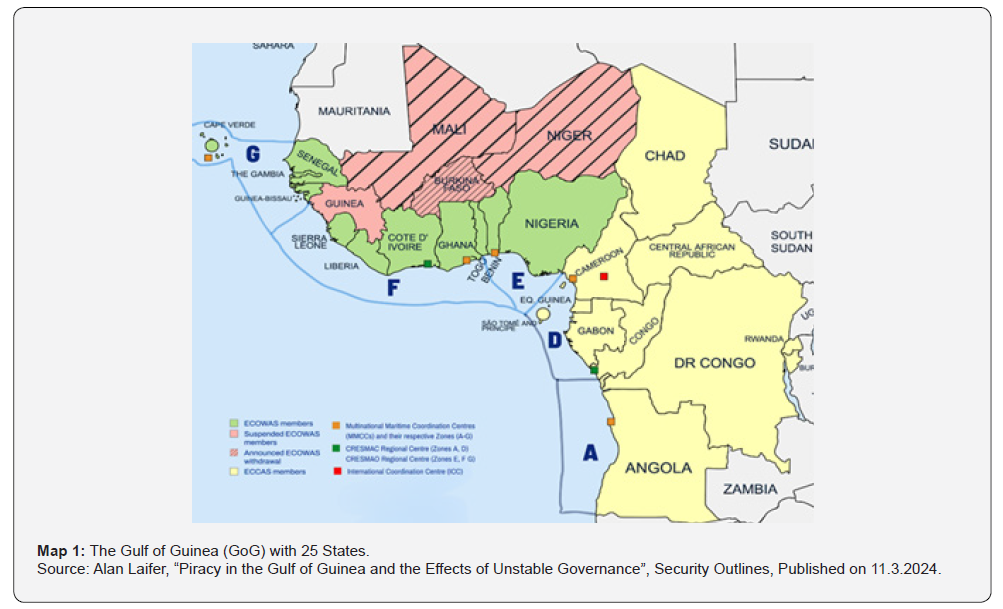
In contrast, ECOWAS has only recently begun to fully understand the implications and realities of the marine aspects of its regional security architecture, which has long been driven by an overriding obsession with land-based security. The Committee of Chiefs of Defence Staff (CCDS) only discussed the core of its maritime policy at a meeting in Cotonou in April 2010, despite the fact that it is a more developed regional economic community than the other four on the continent. The early, pervasive belief that the region’s marine issues were primarily Nigerian in nature, fuelled mostly by protracted insurgent operations in the Niger Delta, may have contributed to this delay. Maritime security concerns have, at best, been discussed in broad and aspirational terms or have been excluded from the regional agenda because of this limited perspective [30]. ECOWAS was forced to start thinking seriously about the regional aspects of maritime security threats due to the increase in violent attacks and piracy that have spread beyond the immediate area of the Nigerian coastline into Togolese, Beninese, and even Ghanaian waters. In addition to essentially embracing the ECCAS approach, ECOWAS has signalled the importance of a stronger commitment to asset coordination, integration, and information exchange. Nigeria, Niger, Benin, and Togo formed Zone E as the Community’s first operational zone in 2012. The proximity of this new operational zone to ECCAS’ zone D is instructive; taken together, they form the choke point for piracy and other illegal activity along the GoG waters. Member states in the specified zones are expected to coordinate their marine activities, exchange information, and generally pool resources, much like the ECCAS model [31].
On a Worldwide Scale
The adoption of two significant United Nations Security Council (UNSC) resolutions in as little as four months, 2018 (October 2011) and 2039 (February 2012), both of which call for increased regional action in response to the growing threat of piracy, best demonstrates the global concern over the growing maritime insecurity in the GoG. It is simple to infer the limited priorities of the international community with regard to maritime security in the GoG from the two resolutions as well as several other international instruments and activities. Furthermore, it’s clear that these goals could not align well enough with those of the nations and local populations in the area. The international community’s top concerns have been to properly address challenges to global energy security, permit unrestricted maritime trade, fight terrorism worldwide, and stop the illegal trafficking of people, narcotics, and firearms, in no order [32]. Global powers that also set the agenda for maritime security in the GoG and throughout Africa are eager to take military action in response to these worries rather than using soft intervention, which focusses on human security and development as long-term solutions to maritime security issues. They also view the fundamental components of maritime safety and security differently, emphasising the need to combat violent extremism, WMDs, and piracy, as well as to promote energy security and respond quickly to fatal contagion. Despite their apparent importance, these priorities are not only unduly top-down in their approach, but they are also wholly unrelated to the pressing issues that governments or even regular communities in the GoG are dealing with in relation to governance, livelihoods, and security in general, which includes state and human security. Put another way, the international community’s concerns about the safety of maritime shipping and, consequently, the world’s energy supplies, are largely at odds with the objectives of coastal communities, who frequently view their ostensibly unlawful actions as a justifiable way to deal with the burdens imposed by governance deficiencies [33].
The general implication of the trends is that the GoG’s responses to marine security issues must consider the implications on a national, regional, and international level. In addition, answers should take into account the variety of outside interests that influence the various but overlapping spaces. Therefore, important nations and regional cooperation mechanisms inside the GoG can provide more capacities than are accessible either domestically or internationally, even when it is based on a robust regional framework. Unfortunately, a globalised international environment has made it possible for a wide range of state and non-state actors to emerge and converge within the GoG. These actors and interests, in and of themselves, represent important components of the region’s complex maritime security template, and it is challenging to bring them together and meet their conflicting interests. Ultimately, while designing and implementing suitable policies and strategies to address marine security in the GoG, the global environment must be viewed as both a benefit and a drawback.
Challenges and Limitations in Maritime Governance
However, the region is still seriously threatened by navigational issues in the GoG, including illegal weapon trafficking, kidnapping, and piracy. Many problems still exist in the GoG despite the adoption of international treaties and conventions to enhance maritime security, and the Maritime Organisation for West and Central Africa (MOWCA) needs to get past structural and geopolitical barriers that impede security facilitation. Issues of institutional responsibility and governance are rarely brought up in discussions about maritime security. The structural, geopolitical, and governance-related issues were separated into three groups by the Centre for Maritime Law and Security (2023). The inability of the regional governments to deal with these challenges is a major problem in the area. The proliferation of weapons, a lack of coordination among the member states, and insufficient finance are some of the issues the GoG faces in the regulation of maritime security. By addressing these problems, we can utilise maritime resources, improve state and regional economy, and promote global peace and development. It is crucial to remember that the challenges posed by maritime security threats are actually a result of the constraints of land-based administration. Put another way, peace at sea reflects peace within states, and vice versa, chaos within states will probably manifest itself in threats to maritime security or, at the very least, encourage the escalation of such threats. Consequently, strong governance is necessary to improve marine security; regional cooperative frameworks alone are insufficient, and the success of regional initiatives is contingent upon the calibre of administration at both the national and regional levels [34]. Several governance concerns and their connection to maritime security cooperation are examined in the section that follows. Naturally, the conversation is not all-inclusive due to the variety of governance challenges in the Gulf of Guinea. However, the analysis aims to demonstrate that open recognition and systematic resolution of governance challenges are necessary for the successful scoping of maritime security cooperation in the Gulf of Guinea.
Instability, Political Leadership and Insecurity
The debate of geopolitical concerns has made reference to the Gulf of Guinea region’s susceptibility to intrastate and interstate conflicts. It goes without saying that instability breeds chaos, which erodes states’ core interests, including collaboration on maritime security. However, more research is necessary to fully understand how instability affects maritime security. Conflict and instability act as a trigger for additional insecurity, including challenges to maritime security, because they reveal governments’ incapacity to uphold a tranquil and orderly society [35]. However, instability also denotes a high degree of insecurity, which draws government leadership’s focus away from other dangers like drug trafficking, piracy, and other illegal activities. Members of the political leadership in Africa are known to become beneficiaries of illegal “services” once instability and disorder spread, giving rise to malicious actors and illegal activities. This undermines their authority and, consequently, their capacity to combat crime [36]. For instance, Nigerian politicians are accused of using sections of MEND, the primary pirate organisation in the Gulf of Guinea, to threaten political rivals. This mutually beneficial relationship often serves to justify additional crimes committed by these organization’s. Attacks of armed robbery and piracy in the Gulf of Guinea have already hit all-time highs in 2013, and it is predicted that the number of occurrences would rise further in 2014 and 2015. Nigeria’s 2015 presidential election is a significant risk factor that influences these estimates but isn’t specifically addressed in the research. Election-related events are expected to rekindle the ties between criminal organization’s and the political class, undermining governments’ will and commitment to stop ransomware, piracy, and offshore oil theft [37]. The Gulf of Guinea’s governance-instability maritime security chain has an additional significant component. Because most of the battles in the region are internal, the governments of the Gulf of Guinea states prioritise their land forces over their fleets and coast guards. Conflict and instability are hence the cause of the poor condition of the coast guards and navies in the area. In fact, a reconnaissance of the area would show that coast guards and navies have been assimilated into land forces, particularly during times of conflict, leaving the area’s ocean space and maritime borders exposed [38].
Institutional Effectiveness and Coordination
The proficiency of national institutions determines how well regional maritime security cooperation works. In consequence, stable and well-organised governance structures are necessary for national institutions to function effectively. As a result, public institutions and governance frameworks are interdependent. While dysfunctional institutions tend to make governance issues, including the achievement of security goals, worse, inadequate governance results in public sector institutions that operate badly [39]. Additionally, the achievement of regional cooperation goals depends on institutional coordination because maritime security is a shared duty among various national agencies. The IMO and MOWCA commissioned a feasibility study in 2006, but it found flaws in the way national agencies in the Gulf of Guinea coordinated. According to the research, national bodies may have conflicting roles, and in many situations, there is very little interaction between the many institutions tasked with maritime security duties. For maritime security cooperation to be effective, these institutional weaknesses must be filled [40].
Corruption and Lack of Transparency
Corruption is another important governance issue that impacts maritime security. States in the Gulf of Guinea have a very high corruption index. In addition to encouraging criminal activity, corruption impairs the effectiveness of public institutions and has an impact on the provision of governance imperatives, such as security. In fact, a national-regional mentality that sees crime as a lucrative endeavour is likely to arise if politicians and other members of the ruling class let greed control how they handle public affairs. Therefore, it is not shocking that the analysis in chapter three identifies corruption as a factor that encourages IUU fishing and illegal drug trafficking. The goals of maritime security cooperation will be compromised if these governance concerns are not resolved as part of the regional cooperative process [41]. Additionally, there is a connection between the development of strategic alliances to improve marine security in the Gulf of Guinea and corruption. As was previously shown, Gulf of Guinea states face significant challenges in enforcing maritime security due to a lack of capabilities. Therefore, in order to finance and support the expense of marine security enforcement, regional nations are probably turning to donor organisations and outside collaborations. The existence or lack of corruption is one of the key elements that will determine if donors and partners are ready to provide the required assistance.
Security Culture, Governance, and Reform
The administration of security itself presents the last governance obstacle to maritime security cooperation in the Gulf of Guinea. When security efforts are focused on improving societal well-being, they are most effective. However, this is only feasible if the welfare of the people that governments represent is the primary motivator for their initial desire to seek cooperation [42]. Although the goals of the ECCAS maritime security framework are comprehensive, a review of its history shows that the seaborne assault on Equatorial Guinea’s Presidential Palace served as the catalyst for action among ECCAS member states. This demonstrates how some regimes’ political leadership puts regime and personal security ahead of other security considerations. Additionally, it poses two important but conflicting questions that need to be addressed. These are: Are security issues that have an immediate effect on political power and income the primary motivators for maritime security cooperation? Furthermore, do the governments of the Gulf of Guinea actually intend to address security concerns that affect communities and society as a whole, like the depletion of living resources? According to the author, it is imperative to look for a governance strategy that centres maritime security cooperation around society. This strategy calls for reforms to the institutions of the security sector as well as some adjustments to the security cultures of some states [43].
However, several security risks may arise from offshore resources, such as declining fisheries resources. Therefore, managing offshore resources both living and non-living is essential to maintaining maritime security. Tensions over the management of oil and gas resources are the origin of the insurgency in the Niger Delta. Therefore, depending on how Gulf of Guinea states handle these resources and the money they produce, the growing offshore oil and gas finds in the region might either be a source of security or insecurity [44]. Despite the UN Security Council’s endorsement of the GGC and MOWCA as platforms for maritime security cooperation, the two organizations face significant structural and geopolitical obstacles that hinder their ability to play a crucial role in the region, as demonstrated by the analysis in this section. However, they still have advantages that can be added to the ECCAS and ECOWAS institutional frameworks, which have both been demonstrated to be better venues for collaboration. In fact, the member states of ECCAS have already developed a framework for maritime security cooperation that is rooted in the region’s larger political and economic systems. In the future, ECOWAS member nations could do the same. However, it is clear that for maritime security cooperation to be successful in the region, three different kinds of structural, geopolitical, and governance-related challenges need to be addressed. However, we restricted our difficulties to governance-related issues for the sake of this paper. The following section then discusses how all of its members and partners may move forward for improved security governance in the Gulf of Guinea.
Solutions Suggested for Improved Collaboration
These proposals vary from domestic, regional, and global frameworks.
Establish a Regional Maritime Security Framework
a) Develop a comprehensive framework outlining clear
objectives, priorities, and actions for maritime security, building
on existing initiatives like the Yaoundé Code of Conduct (GGC,
2013).
b) Ensure coordination and cooperation among regional
countries and organisations, including ECCAS and the Gulf of
Guinea Commission.
Strengthen Institutional Capacity
a) Provide training and capacity-building programmes
for regional institutions, focusing on areas like maritime law
enforcement and crisis management (UNODC, 2020).
b) Enhance technical capabilities, including surveillance
and response systems, to improve maritime domain awareness.
Enhance Information Sharing and Coordination
a) Establish a regional maritime information sharing
system, leveraging technology and existing networks (IMO, 2020).
b) Foster real-time coordination among countries and
organisations to facilitate swift responses to maritime security
threats.
Foster International Cooperation
a) Strengthen partnerships with international
organisations, such as the United Nations and the European
Union, to leverage expertise and resources (EU, 2020).
b) Collaborate with countries outside the region to share
best practices and address transnational maritime security
challenges.
Address Root Causes of Maritime Security Threats
a) Implement economic and social development
programmes to address underlying issues like poverty and
unemployment (World Bank, 2020).
b) Support initiatives that promote sustainable livelihoods
and reduce the appeal of illicit activities.
Promote Maritime Domain Awareness
a) Raise awareness about the importance of maritime
security and the role of regional cooperation in addressing
maritime security threats (IMO, 2020).
b) Educate stakeholders, including policymakers, law
enforcement agencies, and the general public, on the benefits of
regional cooperation.
Develop a Regional Maritime Strategy
a) Outline clear objectives, priorities, and actions for
improving maritime governance and security in the Gulf of Guinea
region.
b) Identify responsibilities and timelines for
implementation.
Encourage Bilateral and Multilateral Agreements
a) Foster cooperation and coordination among countries in
the region through bilateral and multilateral agreements (ECCAS,
2020).
b) Develop joint initiatives and projects to address common
maritime security challenges.
Establish a Regional Coast Guard or Maritime Security Force
a) Enhance response capabilities and improve coordination
among countries in the region.
b) Develop a framework for cooperation and coordination
with international partners.
Implement a Monitoring and Evaluation System
a) Track progress and effectiveness of regional cooperation
initiatives.
b) Identify areas for improvement and adjust strategies
accordingly.
The Gulf of Guinea region can improve marine governance and foster regional cooperation by putting these suggestions into practice, which would ultimately increase security and stability.
Conclusion
This paper has historically examined regional cooperation and maritime governance in the Gulf of Guinea region, highlighting the complexities and challenges of promoting peace, security, and sustainable development. The study has demonstrated that regional cooperation and maritime governance are crucial for addressing the maritime security challenges facing the region, including piracy, armed robbery, and illegal fishing. The Yaoundé Code of Conduct is one of several recent important frameworks for advancing marine governance and regional cooperation in the Gulf of Guinea. However, several obstacles must be overcome for the Code to be implemented, such as limitations on funds and resources, coordination issues, and capacity. Notwithstanding these obstacles, the study has found ways to improve marine governance and regional cooperation in the Gulf of Guinea area. Capacity building, more financing and resources, and improved coordination and collaboration between member states and regional bodies are some of these potentials. Clear policy goals and achievements are necessary for maritime security cooperation at the regional level. Regional states must specify the fundamental interests that need to be safeguarded, the procedures for doing so, and the crucial reactions that will support improved collaboration. Threats to maritime security extend beyond national and regional borders. Therefore, third-party involvement and foreign participation should be accommodated in regional maritime security cooperation. Three levels of action are thus available to us: national, regional, and global. The requirement for a clear cooperative approach and a shared understanding of the idea of maritime security is reinforced by the harmonisation of these levels.
References
- Agubamah E (2024) Nigeria’s Role in the Promotion of Peace and Security in the Gulf of Guinea through Multilateral Cooperation 2001-2022, Atras Journal 5(1): 102-116.
- Ahorsu K (2024) Maritime Piracy and its Implications on Security in the Gulf of Guinea, Eastern African Journal of Humanities and Social Sciences 3(2): 1-10.
- Ajeagah FN (2022) Combating piracy in the Gulf of Guinea: Understanding the challenges of the Yaoundé Architecture for Maritime Security, Technical Report, Master’s Thesis, Naval Postgraduate School, Monterey, CA.
- Ali Kamal-Deen (2014) Maritime security cooperation in the Gulf of Guinea: prospects and challenges, PhD Thesis, Australian National Centre for Ocean Resources and Security (ANCORS), University of Wollongong pp: 349-350.
- Attacks in West Africa to Double in 2014, 25 November 2013, Paramount Group.
- Barto Peter (2024) The Tides of Maritime Security in the Gulf of Guinea, International Relations Review.
- Côrte-Real J (2022) Maritime Security in the Gulf of Guinea, threats, and challenges, Negócios Estrangeiros 22: 61-72.
- Emeka E Okafor (2011) Dynamics of Niger Delta Struggles and the State Responses: The State of Terrorism and Terrorism of the State, Journal of Sustainable Development in Africa 13(2): 88-105.
- Fonkoua Mbah Sylvestre (2013) The Multinational Centre of Coordination, Zone D. Presentation delivered at OPV Africa Conference, Lagos, Nigeria, August p: 26-29.
- Gullett Warwick, Shi Yubing (2015) Cooperative Maritime Surveillance and Enforcement’ in Robin Warner & Kaye Stuart (eds), Routledge Handbook of Handbook of Maritime Regulation and Enforcement.
- Ilufoye S Ogundiya (2009) Domestic Terrorism and Security Threats in the Niger Delta Region of Nigeria. Journal of Social Science 20(1): 31-42.
- International Crises Group (2012) The Gulf of Guinea: The New Danger Zone. Africa Report pp. 196.
- International Hydrographic Organisation (2002) Limits of Oceans and Seas. Draft 4th
- Keohane Robert (1984) After Hegemony: Cooperation and Discord in the World Political Economy, Princeton University Press p: 51-54.
- Klein Natalie (2011) Maritime Security and the Law of the Sea, Oxford, Oxford University Press.
- Luntumbe M (2012) Insécurité Maritime dans le Gulf de Guinée: vers une stratégie régional intégrale intégrée? note d’analyse du GRIP.
- Makinda M Samuel, Okumu Wafula F (2007) The African Union: Challenges of Globalization, Security, and Governance, New York, Routledge.
- Moe Terry M (1990) Political Institutions: The Neglected Side of the Story. Journal of Law, Economics, and Organizations 6: 215-53.
- MOWCA (2008) Memorandum of Understanding on the Establishment of a Sub-Regional Integrated Coast Guard Network in West and Central Africa.
- Onuoha Freedom C (2010) The Geo-strategy of Oil in the Gulf of Guinea: Implications for Regional Stability. Journal of Asian and African Studies 45: 370-371.
- Palma Mary Ann, Tsamenyi Martin, Edeson William (2010) Promoting Sustainable Fisheries: The International Legal and Policy Framework to Combat Illegal, Unreported and Unregulated Fishing, Leiden, Martinus Nijhoff.
- Perrez Franz Xaver (2000) Cooperative Sovereignty: From Independence to Interdependence in the Structure of International Environmental Law. Kluwer Law International.
- Rahman Chris (2009) Concepts of Maritime Security: A strategic perspective on alternative visions for good order and security at sea. Centre for Strategic Studies, New Zealand, Discussion Paper No.07/09 p: 5-27.
- Reno William (2000) Clandestine Economies, Violence and States in Africa. Journal of International Affairs 53(2): 433-59.
- Reno William (2009) Understanding Criminality in West African Conflicts. International Peacekeeping 16(1): 47-61.
- (2006) Report on the Mission on Evaluation and Assessment of the Feasibility to Establish an Integrated Coast Guard Network in the West and Central African Region, IMO Programme TC/0046-01-2000.
- Rooyen van Frank C (2007) Africa’s Maritime Dimension: Unlocking and Securing the Potential of its Seas Interventions and Opportunities. African Security Review 16(2): 109-119.
- Soares de Oliveira Ricardo (2007) Oil and Politics in Gulf of Guinea, London, Hurst.
- The Rise and Rise of Piracy in the Gulf of Guinea (2013) Think Africa Press.
- Till Geoffrey, Seapower (2009) A Guide for the 21st Century, New York, Routledge pp: 286-321.
- Ukeje Charles, Mvomo Ela Wullson (2013) African approaches to Maritime Security - The Gulf of Guinea, Friedrich-Ebert-Stiftung, Regional Office Abuja pp: 21-22.
- United Nations Adopting Resolution 2634 (2022) Security Council Calls on Gulf of Guinea Countries to Criminalize Piracy, Armed Robbery at Sea under Domestic Laws UN Press.
- UNODC (2013) Transnational Organised Crime in West Africa: A Treat assessment. UNODC.
- Vidjingninou F (2014) La bonne forme du port de Cotonou, Jeune Afrique.
- Williams Paul, Haacke Jurgen (2008) Security Culture, Transnational Challenges and the Economic Community of West African States. Journal of Contemporary African Studies.

























