




 PMCIJ Home




A Brief History 0f Educational Psychology: Universals or Particulars?
Anoop Gupta*
Faculty of Education and Department of Psychology, University of Windsor ON, N9B 3P4 Canadaa
Submission:October 30, 2026;Published: November 23, 2026
*Corresponding author: Anoop Gupta, Faculty of Education and Department of Psychology, University of Windsor ON, N9B 3P4 Canada
How to cite this article: Anoop G. A Brief History 0f Educational Psychology: Universals or Particulars?. Palliat Med Care Int J. 2026; 5(3): 555663. DOI: 10.19080/PMCIJ.2026.05.555663
Abstract
An analysis of how some of the key thinkers in educational psychology can be configured on a spectrum of attending to either the particular experiential aspects of learning, or the universal, biological components was attempted. An analysis is presented in (Table 1), “A Brief History of Educational Psychology: Learning as Rooted in Particular Experiences or a Universal Biology,” (henceforth, “Table 1”), from which discussion proceeded. Each figure in the table was commented upon, and finally, it was suggested that neither side the top or bottom-is more desirable than the other. Specifically, looking at what theories are more inclusive, using the intelligence wars for the purpose of illustration, it was argued the best place to be situated is in the middle, represented by bio-ecological models that take into account both the vicissitudes of particular experiences and culture, as well as universal biological structures and needs. Looking at what theories are more inclusive, I argued the best place to be located with where experiential and biological concerns intersect for preservice teacher training programs.
Keywords: Educational Psychology; History of Intelligence Debates; Inclusion
Rationale For This Study
Accounts of the history of psychology are more robust than those of than those about educational psychology; the present study looks at figures in the later field.
Why the New Findings Matter
The current study of figures in the field of educational psychology provide pause to consider the pros and cons of both sides of theoretical debates-about universals and particulars-as well as policy matters related to social justice.
Implications
Progressive policies in education often rely upon work done in psychology [1]. The historical overview provided is analyzed with an eye to how theoretical underpinnings, and changes therein, influence current debates about inclusion and animal rights [2]. A To grasp the difference between Universal and Particular, consider that some dress better to impress a single, specific person than an entire crowd. (Taleb, 2015, p. 71) There are many accounts of the history of psychology, and fewer that focus on the past of educational psychology. What I endeavour here is an analysis of how some of the key thinkers in the field can be configured on a spectrum of attending to either the particular-experiential aspects of learning-or the universal, biological components, and what that may hold for preservice learning education programs [3].
I present my analysis in Table 1, “A Brief History of Educational Psychology: Learning as Rooted in Particular Experiences or a Universal Biology,” (henceforth, “Table 1”), from which my analysis proceeds [4]. I comment briefly on each figure in the table, and finally, suggest that neither side-the top or bottom-is more desirable than the other. Rather, looking at what theories are more inclusive, using the intelligence wars for the purpose of illustration-is intelligence the result of biology or experience I argue the best place to be located with where experiential and biological concerns intersect for preservice teacher training programs. My account is chronological [5]. I have added some select philosophical figures to provide orientation, even though they proceed the birth of educational psychology, which is usually pegged to Thorndike (1874-1949). I use historical traditions to create two broad categories: First, “nominalism” whose adherents’ pay credence to the reality of particular things, the most famous being Aristotle, and their modern corollary, “empiricists.” Second, “Platonism” is used to designate those committed to universal truths, and whose modern adherents are “rationalists.”
The metaphysical preoccupations of the ancients what is real was translated into epistemological concerns in the modern period-what can be known to be true unto perhaps psychological matters more recently how do we come to know [6]. Thus, using philosophical categories that were primarily about metaphysical debates, is designed to capture psychological orientations towards learning as either focusing on particular experiences or universal biological needs and structures. In what follows I shall endeavour to justify each thinker’s place in (Table 1) in Column 2, “Remarks.” To be sure, each placement is “round about,” but the overall picture is intended to show us something about the relationship of thinkers in the history of educational psychology in terms of how they view the nature of learning [7].
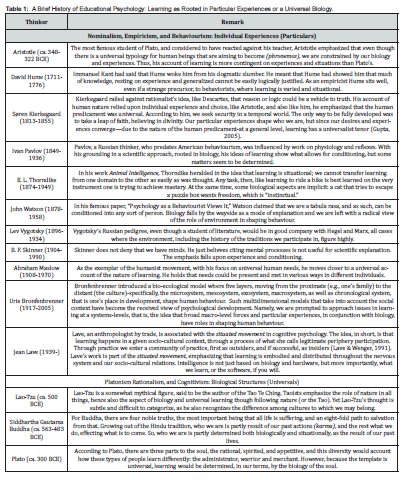
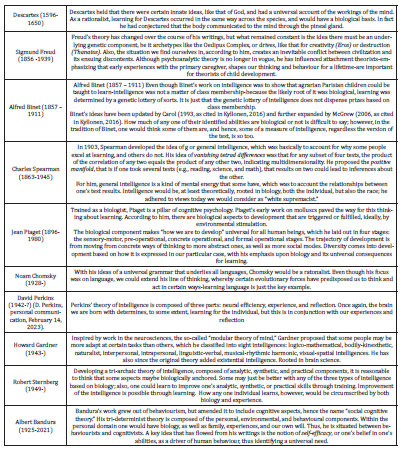
The fact that the section of experiential thinkers ends with the situation-oriented Jean Lave (1939-) and the universalist Bandura (1925-2021) tells us a great deal of where we are today [8]. The emphasis upon experience, culture, and technological change looms large in our understanding about the nature of learning, and this is true as much for one side of the spectrum as the other. Both sides of the myriad debates had proponents that were reductive in their own ways: For Aristotle, it was the forms, for empiricist, sense data, for behaviourists stimulus-response events; for Plato it was the one, for rationalist, innate ideas, and for cognitivists, some core set of biological needs or structures [9]. The challenge to reductionism came with ecology, the idea that complex systems had to be understood on their own terms and could not be usefully simplified to some set of more basic principles [10].
Bronfenbrenner’s bio-ecological model and other such multidimensional accounts are indeed reflected in both Lave’s and Bandura’s work by their proponents’ emphasis upon the social context of development, as well as being integrative of a host of factors, running the gamut from the experiential to the biological. Either way, multidimensional accounts, in the tradition of Bronfenbrenner, like those of Lave and Bandura, jettison reductionism as it has been traditionally employed, and seek to understand complex social phenomenon, like learning, on its own terms, merging the particular individual experiences and universal needs or structures in a multitude of ways [11].
Perhaps the difference is in foundations. Nominalists, empiricists and behaviourists see experience and culture as the driving force of learning; whereas Platonists, rationalists and cognitivists view growth as an expression of an organ of reason or, in the contemporary scene, some fundamental proclivity [12].
Some Consequences for Teacher Training Programs
There is nothing deemed harmful (in general) that cannot be beneficial in some particular instances, nothing deemed beneficial that cannot harm you in some circumstances [13]. The more complex the system, the weaker the notion of Universal. (Taleb, 2015, p. 72) In the history of ideas, we often categorize thinkers by what movement they are part of, and who their adversaries were. The cognitivists spurn behaviourism, and before them we are to choose camps, too, those of Aristotelians or Platonists, empiricists or rationalists, and so on. Yet, in the intelligence wars, for example, no one side seems to have the correct account of the smarts more than the other. It is commonplace to think with the advance of epigenetics that there is a confluence of biological and experiential factors interacting in complex ways throughout the lifecycle determining who we are. We can neither say that intelligence is purely a matter of biology or experience. For unique individuals, of course, one factor could way more heavily than another [14].
Further, no one side, nominalism or Platonism, seems more attractive than the other in practice. Consider the implications of both sides for the idea of inclusion, which is the cornerstone of progressive education, the idea that we should try to help everyone reach their potential. On the one hand, those emphasising on the experiential nature of learning should be more inclusive because one is not determined at birth to be “academic” or “non-academic.” At the very least behaviourists are free from the weight of the idea that “biology is destiny,” since, according to them, what we are is based upon our experiences. Recall, for Watson it does matter what one’s race, gender, and so on is, since one can be trained, in principle, to be anything, a soldier or schoolteacher. The hostility towards the role of biology in shaping human behavoiur in the social sciences is captured by Pinker’s (2002) convincing rejoinder in The Blank Slate: The Modern Denial of Human Nature, where he argued that indeed there is such a role, looking at studies of twins raised apart [15].
Implications for Inclusion
Historically, the remedy to adhering to a model of universal learning rooted in biology that could not be well-justified was behaviourism, which is likely a pyric victory. Even if behaviourism frees us from the tragic history associated with cognitive-biological accounts of intelligence, being equal before the laws of reinforcement and punishment is inclusive, but at a very high cost because many do not find this an adequate account of learning; it just misses so much of what we experience when we think of our own learning, namely our minds. After all, behaviorism is the very anathema of humanism. In sum, it is not clear that any one side behaviorist or cognitivist at least in the current educational psychological setting brings with it a more attractive inclusive pedagogy than the other [16].
The cognitive theorists are saddled with a tragic history, using biology and eugenics to herald in what their progenitors thought a better, albeit, utopian society. According to their intellectual forefathers, like Galton, and at least inspired by Darwin, many early theorists of intelligence though we could just breed our way to the perfect human. However, inspired by research in the neurosciences, Gardner is more inclusive than at least Spearman, by allowing for a variety of intelligences. So, cognitivists can, in principle, free themselves from a sketchy history associated with racism.
Both extremes, however, Watson or Spearman, do not bode well for inclusion. Watson’s account is “ethics’ free,” since we can make up ourselves anyway, we want there is no way we are intended to be. Spearman because we are condemned by biology at a group level, provided a well-worn justification for racism common in the twentieth century, as well as allowing for individual diversity of general intelligence. For him, no amount of support is necessarily pivotal to help to an individual, because again, when it comes to intelligence, “biology is or could be destiny.”
Non-Human Animals
To test implications, we can usefully expand our discussion of inclusion to include non-human animals. On this score, behaviourists are well known to have conducted questionable experiments on animals. On the biological side, Descartes held that animals were just machines and thus engaged in vivisection with few qualms. Even other theorists committed to a biological approach would, or could, be amenable to animal experimentation. There is no logical reason that moderate views would bring with them more considerate approaches. However, one could hope that being aware of the similarities in cognition and biology, especially our shared evolutionary past, between humans and animals, could help expand our circle of ethical inclusion [17].
The Middling Road
Some examples of middle-of-the-road theories are Bandura, whose tri-deterministic theory allows us to capture the biology, environment and habit as factors influencing learning. We can allow that there are some universal aspects to learning, but they are differentiated biologically and experientially in individuals. In addition, Perkin’s theory of intelligence has a similar contour; our neural intelligence maybe to some extent given, as well as our learning and experiences. Some amount of plasticity is possible and implicit in his theory. And even Maslow, though providing a general taxonomy of human needs, allows us to consider how they are present and met in various people: making us sensitive to human diversity of individuals, hence, potentially, prompting us to be inclusive in our pedagogical practices. We try to meet individual where they are, recognizing they have different brains, families, experiences, and cultures. Acknowledging that there are biological components that shape behaviour, an idea we can find in thinker as diverse as Plato and Chomsky is valuable. Acknowledging that the human predicament shapes who we are is reflected in thinkers as diverse as Aristotle, Kierkegaard and Buddha. Acknowledging that how we learn is shaped by our unique situations in the world, in terms of family, culture, religion, and the time in which we live, is reflected in thinkers as diverse as Lave and Vygotsky. Being inclusive may require having the right theory: one that captures the role of experience has in allowing us to “overcome,” to some extent the brains we are born with through processes like experiential dependent neural pruning where what we do, like playing tennis or doing mathematics creates and strengthens certain pathways in our grey matter as well as biological factors such as expectant dependent pruning where when we are provided the correct stimulation, such as exposure to language at the right time, similar processes occur. That is to say, we can indeed shape our brains through learning and experiences, through process like neural plasticity.
In the social sciences, judging theory has an additional burden not found in its natural brethren: we must be concerned with both truth as well as what sort of world we want to live in. Happily, the world we want to live in is based on the past, with its residues in our experience and biology, in cycles that foretell of our future, which will be a blend of the particular and universal.
References
- Benjafield, JG (2015) A history of psychology (4th) Oxford University Press.
- Coron L, Anderman EM(Eds.) Handbook of educational psychology (3rd) Routledge.
- Danziger K (1990) Constructing the subject: Historical origins of psychological research. Cambridge University Press.
- Ellenberg H (1981) The discovery of the unconscious: The history of dynamic psychiatry. Basic Books.
- Gardner H (1987) The mind’s new science: A history of the cognitive revolution. Basic Books.
- Gupta A (2005). Kierkegaard’s romantic legacy: two theories of the self. University of Ottawa Press.
- Kyllonen PC (2016) Human cognitive abilities: Their organization development and use In L Coron & E M Anderman (Eds.) Handbook of educational psychology (3rd ed., pp. 121-134). Routledge.
- Lave J, Wenger E (1991) Situated learning: Legitimate peripheral participation. Cambridge University Press.
- Lawson RB, Graham JE, Baker KM (2006) A history of psychology: Globalisation, ideas and applications. Routledge.
- Mandler G (2007) A history of modern experimental psychology: From James and Wundt to cognitive science. MIT Press.
- Munger M (Ed.) (2003) History of psychology: Fundamental questions. OUP.
- O’Boyle CG (2006) History of psychology: A cultural perspective. Psychology Press.
- Pickren W, Rutherford A (2010) A history of modern psychology in context. Wiley.
- Pinker S (2002) The blank slate: The modern denial of human nature. Viking.
- Taleb NN (2015) The bed of Procrustes: Philosophical and practical aphorisms. Random House.
- Woolfolk, AE, Usher EL, Perry NE, Winne PH (2024). Educational psychology (8th ) Pearson.
- Zimmerman BJ, Schunk DH (Eds.) (2003). Educational psychology: A century of contributions. Routledge.