




 PMCIJ Home



From Function to Values: Using Functional Change as a Trigger for Advance Care Planning in Palliative Care
Satoru Sagaea*, Syuhei Ohkurab , Rika Ohhirac , Ayumi Tanimotod , Arisa Konishid , Ayako Iizukae , Aiki Takedae, Mikiko Ogasawaraf, Riyo Shinyag and Yoshihito Ohharah
aDepartment of Internal Medicine, Palliative Care, Sapporo Kojinkai Memorial Hospital, Sapporo, Japan
bDepartment of Rehabilitation, Cancer Rehabilitation, Sapporo Kojinkai Memorial Hospital, Sapporo, Japan
cDepartment of Rehabilitation, Clinical Psychology, Sapporo Kojinkai Memorial Hospital, Sapporo, Japan
dDepartment of Pharmacy, Sapporo Kojinkai Memorial Hospital, Sapporo, Japan
eDepartment of Nursing, 6 East Ward, Sapporo Kojinkai Memorial Hospital, Sapporo, Japan
fDepartment of Nutrition, Sapporo Kojinkai Memorial Hospital, Sapporo, Japan
gDepartment of Medical Coordination, Sapporo Kojinkai Memorial Hospital, Sapporo, Japan
hDepartment of Medical Oncology, Sapporo Kojinkai Memorial Hospital, Sapporo, Japan
Submission:September 04, 2026;Published: September 15, 2026
*Corresponding author: Satoru Sagae, MD PhD Department of Internal Medicine, Palliative Care Sapporo Kojinkai Memorial Hospital Miyanosawa 2-1-16-1, Nishi-ku, Sapporo, 060-0052, Japan
How to cite this article: Satoru Sagae, Syuhei Ohkura , Rika Ohhira , Ayumi Tanimoto, Arisa Konishi, et al. From Function to Values: Using Functional Change as a Trigger for Advance Care Planning in Palliative Care. Palliat Med Care Int J. 2025; 5(3): 555662. DOI: 10.19080/PMCIJ.2026.05.555662
Abstract
Sapporo Kojinkai Memorial Hospital Miyanosawa 2-1-16-1, Nishi-ku, Sapporo, 060-0052, Japan
Keywords: Palliative Care;Advance Care Planning; Healthcare; End of life; Rehabilitation
Introduction
Advance care planning (ACP) is increasingly recognized as an ongoing process through which patients with serious illness clarify their values, goals, and preferences and share them with families and healthcare professionals [1,2]. In clinical practice, however, ACP discussions may still focus predominantly on future medical treatments, resuscitation, or preferred place of care. These discussions matter, but they may not fully capture what matters to patients in their everyday lives. For many patients receiving palliative care, concerns are expressed in more immediate and functional terms: “I want to walk to the bathroom by myself,” “I want to return home,” or “I want to sit at the table with my family.” These seemingly simple goals may reflect deeper values related to autonomy, dignity, identity, relationships, and meaning. Functional assessment may therefore provide clinicians with a practical window into what matters most to the patient [3].
Importantly, function is not static. Decline, recovery, stabilization, or new dependency may alter what patients consider achievable and meaningful. Such changes may provide natural opportunities to revisit goals and preferences rather than waiting for a predetermined “ACP conversation” [1]. This Mini Review explores how functional assessment and changes in function may help connect everyday clinical care with patients’ values and proposes functional change as a practical trigger for iterative, multidisciplinary ACP in palliative care.
Introduction
Introduction
Function as a Window into Values
Function is often assessed in palliative care as an indicator of disease progression, prognosis, or the need for supportive care. However, function also has a more personal dimension. The ability to walk, eat, communicate, perform self-care, or participate in family life may represent not only physical capacity but also autonomy, identity, dignity, and connection with others [3]. Recent evidence supports this broader understanding of function. In a multicenter prospective study of 364 patients receiving palliative care, Maddocks et al. examined 645 patient-defined functional goals. Of these goals, 71% related to activity and participation, extending beyond mobility to self-care, general daily tasks, and community and social life [4]. Importantly, progress toward individualized goals was observed even among patients with deteriorating health or severe functional limitations [4].
These findings suggest that asking about function may reveal priorities that conventional discussions about treatment preferences do not always capture. A wish to walk independently may reflect a desire to preserve autonomy; a wish to eat at the family table may represent connection and belonging; and a wish to return home may express identity, security, or the desire to remain within a familiar community. Thus, functional goals should not be viewed solely as rehabilitation outcomes. They can give healthcare professionals a practical, accessible way to understand what patients value in their remaining lives. In this sense, function can serve as a window into patient values.
Functional Change as a Trigger for ACP
If function provides a window into patient values, changes in function may signal a need to revisit those values and goals. In palliative care, functional trajectories are rarely linear. Patients may experience progressive decline, temporary stabilization, unexpected recovery after treatment, or new dependency resulting from symptoms or disease progression. Each change may alter what is both achievable and meaningful to the patient. Recent work has emphasized the importance of incorporating functional priorities into ACP, revisiting them as patients’ conditions evolve, and involving rehabilitation professionals more consistently in end-of-life care [5]. However, functional assessment may contribute to ACP not only by identifying current priorities, but also by detecting moments when those priorities should be reconsidered.
In our recent case series of eight patients with advanced cancer, rehabilitation professionals were continuously involved across different functional trajectories, including functional decline, recovery or stabilization, symptom-driven progression, and psychological changes near the end of life [6]. Progressive loss of mobility helped patients and families reconsider realistic care options, whereas functional improvement after treatment sometimes reopened possibilities and led to reconstruction of previously discussed goals. Symptom-related changes also created opportunities for patients to express priorities that had not emerged during formal ACP discussions [6]. These observations suggest that the clinical value of function lies not only in its absolute level but also in its trajectory. A meaningful change in function, whether deterioration, recovery, stabilization, or new dependency, may represent a natural point at which healthcare professionals ask whether the patient’s goals remain unchanged. Thus, functional change may serve as a practical clinical trigger for revisiting values, goals, and ACP.
From Rehabilitation to Multidisciplinary Practice
Recognizing functional change as an ACP trigger does not mean that rehabilitation professionals should conduct ACP independently. Rather, their observations can become part of a broader multidisciplinary process [3,5]. Because rehabilitation professionals frequently observe patients during everyday activities, they may identify subtle changes in mobility, self-care, communication, or participation, as well as the hopes and concerns that accompany these changes. Nurses may recognize similar changes through daily care, while physicians can interpret them in the context of disease trajectory, prognosis, and treatment options.
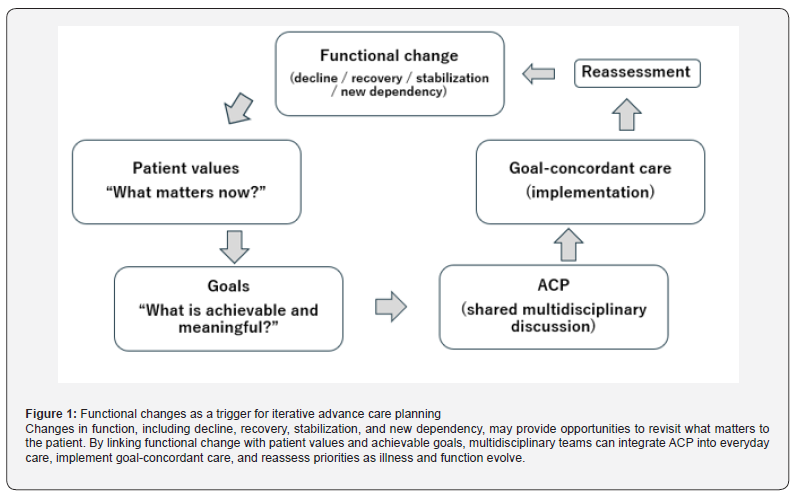
The key step, then, is not simply assessment but sharing. A functional change becomes clinically meaningful for ACP when professionals communicate observations across disciplines and connect them to the patient’s values and goals (Figure 1). summarizes this iterative process. For example, a decline in walking ability may lead to discussion about whether returning home remains feasible and what support would be required. Conversely, unexpected functional recovery may reopen possibilities previously considered unrealistic. In either situation, multidisciplinary discussion can help translate functional changes into goal-concordant care. Such an approach positions ACP within everyday clinical practice rather than as an isolated conversation conducted only at major treatment transitions or near the end of life. Rehabilitation professionals, nurses, physicians, and other team members may each provide different windows into what matters to the patient. By sharing these perspectives and reassessing them as illness and function change, ACP can become a dynamic process that evolves alongside the patient [1,2].
Conclusion
Functional assessment may provide a practical window into what matters most to patients with serious illness. Functional goals often reflect not only physical abilities, but also deeper values related to autonomy, dignity, identity, relationships, and participation in meaningful life. Importantly, these goals are not static. Changes in function-whether decline, recovery, stabilization, or new dependency-may provide natural opportunities to revisit patients’ values, goals, and preferences. Recognizing functional change as an ACP trigger may help embed ACP within everyday multidisciplinary care. Through repeated reassessment of function, values, and goals, ACP can evolve alongside changes in illness and patient priorities, supporting care that remains aligned with what matters most to the individual. ACP may sometimes begin not by asking how a patient wishes to die, but by asking what they still hope to do.
References
- Sudore RL, Lum HD, You JJ, Hanson LC, Meier DE, et al. (2017) Defining advance care planning for adults: a consensus definition from a multidisciplinary Delphi panel. J Pain Symptom Manage 53(5): 821-832.e1.
- Rietjens JAC, Sudore RL, Connolly M, van Delden JJ, Drickamer MA, et al. (2017) Definition and recommendations for advance care planning: an international consensus supported by the European Association for Palliative Care. Lancet Oncol 18(9): e543-e551.
- Cheville AL, Morrow M, Smith SR, Basford JR (2017) Integrating function-directed treatments into palliative care. PM R 9(9S2): S335-S346.
- Maddocks M, Fettes L, Takemura N, Bayly J, Talbot-Rice H, et al. (2025) Functional goals and outcomes of rehabilitation within palliative care: a multicentre prospective cohort study. BMC Palliat Care 24: 172.
- Wilson CM, Henshaw AM, Navin MC (2026) The right to function at end of life: aligning advance care planning with palliative rehabilitation. Ann Palliat Med 15(4): 60.
- Ohkura S, Sagae S, Someki N, Tanimoto A, Konishi A, et al. (2026) Trajectory-Driven Advance Care Planning Through Rehabilitation in Palliative Cancer Care: A Retrospective Case Series. Ann Phys Med Rehabil 17(1).

























