




 JYP Home



Abstract
This perspective provides a comprehensive overview of yoga, exploring its historical origins, philosophical foundations, and global dissemination as both spiritual and physical practice. Beginning with the universal human experience of stress, the authors position yoga as a profound method for self-adaptation and stress relief, emphasizing its relevance in modern society. The text traces the evolution of yoga from ancient Indian traditions, highlighting the development of key schools such as Jñāna, Karma, Bhakti, Rāja, and Haṭha yoga, and discusses the integration of yoga into various cultural contexts, including its spread to Europe, America, and Japan. The document details the core principles of yoga, particularly the Eight Limbs (Aṣhṭānga) outlined in Patañjali’s Yoga Sutra, and explains their significance for personal discipline, physical health, and mental well-being. It also examines the role of meditation, the transformative experiences associated with advanced yogic states, and the potential risks and cultural interpretations of mystical experiences. The work concludes by reflecting on the enduring value of yoga as a holistic path for self-realization and harmonious living, supported by both traditional wisdom and contemporary scientific research.
Keywords: Patañjali’s Yoga Sutra; Jñāna, Karma; spiritual; Animals, Plants and Microbes; Buddha Mahāvīra; jñāna yōga
Abbreviations: CAM: Complementary and Alternative Medicine; MHLW: Ministry of Health, Labour and Welfare; FMRI: Functional Magnetic Resonance Imaging
Introduction
Who needs yoga? People - who are caught up in the whirlwind of a fast-paced stressful life? People - who frequently have difficulties coping with stress and cease to act any more. Yoga exists for all those people. We have good reasons to state this clearly. All living creatures exist under stress. We sometime withstand intense stress and live. There are no exceptions. Animals, plants and microbes, all undergo stress to live. Human beings seem to react differently to a stressful environment. We feel uneasy and uncomfortable living in a stressful world, not because we are weak with stress, but because we have the inner self that remembers past stresses and foresees how things will turn out. We believe yoga is one of the particularly outstanding forms of wisdom human beings have ever engendered, to overcome anguish. Human beings are highly intelligent to devise many efficient ways to cope with stress. We have altered surroundings and developed civilization and culture. In some sense, it worked. We, however, also added to new types of stress. Complex and diversified problems such as crime, war, nuclear energy issues, and environmental changes (pollution, climate) have emerged.
Living in a highly convenient modern society, we still have conflicts, frictions, financial difficulties and concern over our health, which never seem to be resolved. The growing concern is sometimes heightened as it may ruin us. We have no other places to escape into. Earth became as small as never before. Ironically, we strive to improve our state of living, and we, at the same time, create new problems in our surroundings. Can we make this vicious circle come to an end? Here, we would like to remind you human beings have great wisdom to relieve stress by adapting ourselves to our surroundings, not by changing the environment. It begins with an acceptance of ourselves as we are. You cannot teach this process to others, nor learn from others. Each person must explore one’s own way to encounter “who I am”. The process requires effort and yoga is one of the best practices to make what you obtain well worth the effort. Buddhism, which started in India and spread widely over the Asian and other continents, is classified as one form of yoga. The doctrine and community apart, one can hardly ever differentiate true nature of yoga and Buddhism in terms of physical practices and philosophy.
What is Yoga?
History of Yoga
How were the Yogic Postures Started?
Archaeology suggests the origin of Āsana (Yogic Postures) can be traced back to the seal discovered in Mohenjo-Daro that flourished nearly 4500 years ago. The truth is rather difficult to get at. The history of yoga philosophy and spiritual practices is also difficult to trace through reading written materials. We can hardly ever determine when those ancient Indian text materials were written. Even to make rough estimate of the age seems to be highly demanding. One thing we see clearly is an idea for exploring the inner self sprouted in the 8th and 7th century BC, and the idea is reminiscent of yoga philosophy. In the 6th century BC, the concept of exploring the inner self had advanced considerably and people were reported to practice Āsana (Yogis Postures) and meditation. Buddha, Mahāvīra, and other sages formulated an outstandingly revolutionary and practical philosophy of life.
Buddhism founded by Gautama Buddha waned considerably in India but widely spread over the Asian continent from the Central, South and North, and to the Far East. Gautama Buddha, Buddhism and yoga have close similarities in a body-mind concept and practice. Indian body-mind concept stated here is not the same as Indian philosophy. Indian philosophy comprises diversified and tangled concepts such as dualism, monism, materialism and idealism. It is thought to have originated in the ancient Vedas and developed many schools including the Buddhist philosophy. People often categorize yoga as dualism called Samkhya; however, some literature contains inconsistency. Rather than focusing on the inconsistency, people focus on understanding yoga philosophy. An enormous number of research have been conducted in many languages such as Indian local languages, English and Japanese. This must be, because practice, rewards and experience of meditation when you do yoga are more important than discussion about its philosophy.
In this study, body-minded concepts cannot be defined by any one of above-mentioned philosophies, which are merely pure learning. It is a practical theory based on the concept that body and mind are one and is defined as follows: “The goal of body-mind concept in India is to realize full potential of our lives. It helps to liberate ourselves from distress caused by difficulties and troubles we face in our daily lives”. Meditation, the way of life and physical practice are all to dispense wisdom to achieve this goal. Gradually, people began to call the concept Yoga. The wisdom has been matured in India into Yoga we see today. A coherent philosophical system emerged and established yoga branches such as jñāna yōga (ज्ञानयोग), rāja yōga (राजयोग), bhakti yōga (भक्तियोग), karma yōga (कर्मयोग) and haṭha yōga (हठयोग).
For most people haṭha yōga (हठयोग) simply means yoga in general. Hatha yoga is known to comprise āsana (आसन) sitting posture practiced with the concept that mind and body are one, slow body movements and a method of breathing. Hatha yoga has gradually been systematized from the 3rd century through the 8th century. It was not until the end of the 13th century; yoga developed into the well-systematized form as we see today. We can apply the body-mind concept and practical method of Hatha yoga to daily physical exercise, sport, dance, play, tea ceremony and Budo (the Japanese martial ways), Sado (the way of tea ceremony), and also academic activities, research work and all human activities we conduct in our daily lives. Naṭyayōga (नाट्ययोग) or Dance of Yoga is one example of the application. Without Naṭyayōga, Indian dance called the Bharatanāṭyam (भरतनाट्यम) cannot be performed. Yoga created a great impact on martial arts as well [1]. Another example can be Āyurveda, a type of Complementary and Alternative Medicine (CAM) that originated in India. Although Āyurveda and yoga are different, both have close relationship in terms of the body-mind concept.
How was Yoga Spread all over the World?
Yoga was introduced into Europe through England who colonized India. Yoga was then introduced and accepted in Europe as an ideology and a health management system. After the two world wars erupted in the European continent, people gradually lost their belief in Christian civilization and scientific achievements. Along with other oriental spiritual practices (Gyoho), yoga came to the considerable attention of European people. Facing protracted struggles and the defeat in Vietnam, the war made American society, which was at the top of modern civilization seek “something new” in the 1960s and the 1970s. A characteristic example is the hippie movement that became active especially among the youth. They were fascinated by spiritual practices (Gyoho) and started to practice Yoga, Tibetan Tantric Buddhism, and Japanese Zen. Buddhism was born out of yoga. Consequently, Tibetan Tantric Buddhism and Japanese Zen can be categorized as the form of yoga. This is discussed in more detail in a later chapter.
At first, Za-zen (Zen-meditation), a spiritual practice of Zen Buddhism, gained popularity among hippies due mainly to activities of Suzuki Daisetsu (1870-1966) who vigorously delivered lectures on spiritual practices (Gyoho), thoughts of Zen and wrote articles in English [2-6]. Hippies practiced Hatha-yoga and Transcendental Meditation (one of the yoga meditation styles), read “The Tibetan Book of the Dead” and gradually accepted broad variety of oriental thoughts. Many influential Indian teachers (guru) successively visited the United States to disseminate the aspects of yoga. It provided a solid basis for the reception of yoga in the American society. Oriental spiritual practices (Gyoho) including Theravāda Buddhism Vipassana were accepted and practiced globally by people regardless of their political ideologies, religions or races. The popularity of yoga has risen constantly as the next generation of hippies carried on practising Gyoho and popular actresses and martial arts masters deserved the rewards of yoga practices. Yoga has grown to be big business. Yoga as a form of successful business influenced Japan and it led to the Yoga boom in the country.
Today, an overwhelming number of people from all over the world visit India to learn yoga practices. Yoga has sprouted into a practice done by anyone from all races, religions, political beliefs and countries. In India, the original country of yoga, yoga classes are conducted from elementary schools to high schools (depending on the schools). Indian government also endeavours to disseminate yoga over the entire world. On 11th December 2014, a resolution establishing 21st June as “International Day of Yoga” was approved by the United Nations. The first International Day of Yoga, supported by the Indian government, was held world over in 190 countries on 21st June 2015. Admittedly, we observe that yoga has become an important cultural asset to the entire world.
A History of Yoga in Japan
Buddhism is said to have been introduced to Japan in 538 AD. During the Nara period (710 -794 AD), Yuga practice [7] was imported into Japan as one of the spiritual practices (Gyoho) of Buddhism. Yuga is a phonemically transcribed word of Sanskrit and is pronounced as “yoga”. Integrated with Chinese Taoism and Confucianism, Buddhism has been transformed from generation to generation in Japan. A well-known example is that Hakuin (1686-1769), an influential Zen Buddhist monk in the Edo period, used to suffer from a nervous breakdown and alleviated this through Taoistic practices. Yōjōkun (The Book of Life-nourishing Principles) was written by Kaibara Ekken (1630-1714) and the spiritual practices (Gyoho) took root in Japan as health management systems for body and mind [8].
In the Meiji period, current “harmonious breathing” method a way of breathing using an abdominal muscle, advocated by Fujita Reisai (1868-1957) predominated over the public [9,10]. A Zen Buddhist monk, Nukariya Kaiten, who accelerated the widespread introduction of yoga, integrated Zen, Esoteric Buddhism, and yuga (瑜伽) practices and authored “Renshin jutsu” (The Art to Train One’s Mind) [11] In this book, he pointed out that World’s Parliament of Religions held in Chicago in 1893 provided a further basis for the reception of yoga in Western countries. The event marked a very important milestone in the history of yoga. Wearing very humble clothes like a beggar, Indian yoga practitioner named Swami Vivēkānanda (स्वामी विवेकानन्द) (1863 -1902) took part in the assembly on the spur of the moment and delivered a lecture on the universality of the world’s religions. His speech captivated not only American but entire world’s religious groups. The history of oriental practices such as yoga and Zen-meditation entered a new era. People of all races, scientific thoughts, religions and political ideologies began to accept oriental practices and the popularity has risen markedly.
Yoga in Japan has been promoted by predecessors such as Nakamura, Tempu (1876 -1968), Oki, Masahiro (1919-1985)who have studied yoga in India, and Sahoda, Tsuruji (1899-1986) who was an Indian philosophy professor at Osaka University throughout the Taisho and Showa periods. They provided greater depth of understanding of Indian thoughts of “body and mind” through their sensibility and supported by Japanese cultural background such as Buddhism. Influenced by the 1995 sarin gas attack on Tokyo’s subway system by Aum Shinrikyo, yoga in Japan had fallen into a decline. However, around 2005, the yoga boom in the United State fueled the American style of yoga activities practiced by various yoga schools. Now yoga is a popular practice at the gymnasiums, public halls, hospitals and nursing homes. It is being used to improve the performance of sports and professional skills and health of the mind.
With a research grant provided by the Ministry of Health, Labour and Welfare (MHLW), Dr. Oka Takakazu (Department of Psychosomatic Medicine, Graduate School of Medical Sciences, Kyushu University) intensively verified medical effects of yoga and mindfulness practices. In the MHLW grants system database, he concludes his research, ‘Utility of integrated treatment for stress-related diseases and the establishment of its scientific basis’, 9 June 2015, as follows: “It is acknowledged that integrated treatment of modern medicine, yoga and AT (Autogenic Training) is generally safe and effective in stress-related diseases” [12].
His statement has strongly backed the concept of CAM that physical and mental exercises such as yoga assist in curing difficult sickness, e.g., dementia, depression and other mental illnesses and dietary lifestyles disease. It is interesting that the result of an FMRI (functional Magnetic Resonance Imaging) scan findings suggests the activity of the ventromedial prefrontal cortex and frontal part of the insular cortex is positively correlated with practicing yoga, meditation and autogenic training. This indicates there is a strong link between emotional fluctuations and physical sensation. The research is only one of numerous researches conducted worldwide; however, it is noteworthy that a public organization began to evaluate yoga. It implies yoga began to get effectively established in Japan at long last.
Schools of Yoga and the Significance
Yoga is the way or a path having the same meaning as we use the word “way” in Budo (the Japanese martial ways) and Sado (the way of tea ceremony). Yoga and the way have profound significance in common. The name of “yoga” comes from the Sanskrit verb “yuj” (युज्) which can be translated “to unite, to join, or to pay attention to”; and, the original meaning of “yuj” is a yoke fastened to a carriage and a neck of an animal, which refers to a device used to control the movements of animals freely. Yoga is, therefore, to unite mind and body or a reality and a dream that exists apart, and to control and refine one’s body and mind as well. This connotes the way or a path is to unite current and destined places, so that “to pave a way” sometimes implies “try to attain something worthwhile”.
Classical yoga is mainly classified into the following 5 schools:
· Jñāna yōga (ज्ञानयोग): yoga of wisdom
· Karma yōga (कर्मयोग): yoga of action
· Bhakti yoga (भक्तियोग): yoga of spiritual devotion and worship
· Rāja yōga (राजयोग): yoga of meditation
· Haṭha yoga (हठयोग): yoga of physical exercise
Some other schools are Mantra yōga (मंत्रयोग), Laya yōga (लययोग) and Kuṇḍalinī yōga (कुंडलिनी योग). There also are broad types of yoga schools that were named by the original practitioners as yoga has widely spread over western countries as well as Japan since the 20th century. Yoga has a long history and been practiced by substantial number of people. Naturally many schools have started as it became popular.
Yoga Education in Modern India
In India, “yoga is already taught as an optional subject in government-run schools…under the co-scholastic activity of Physical Education -The Human Resource Development Ministry…released course material and syllabus for yoga designed by NCERT for classes (VI-X) upper primary and secondary, while also introducing yoga as a training module in teacher education programmes” [13]. They teach yoga as not merely one of the health practices. They teach yoga as wisdom to assist people understanding what it to live as human beings is. What people learn in childhood will establish an influential role as personal and social character building for their entire life. We have an Indian yoga textbook for the third grade at elementary school (Divya/Patanjali, Haridwar, India). When the lead author first looked at this textbook with the title, “Come! Let’s learn yoga!” (Āo Sīkhen Yōga आओ सीखें योग), he was amazed at a contrast to a Japanese physical education textbook.
The Indian textbook starts with the words praising Mother Nature. Poems in the textbook bless divinities manifest in nature including the sun, the moon, mountains, rivers, grasses and trees. We should not read poems as forms of pantheism or philosophy. They must be written out of genuine feelings that the divine essence we have inside ourselves resides in all human and material existence. Then the textbook tells how we should put Ahiṃsā (nonviolence, compassion) and veracity into practice followed by the sentences that the truth needs to be learned with great wisdom and depth. It also observes living creatures such as plants surrounding us and how we live harmoniously with them. Then, at last, we find the part of yoga practice. Yoga is not merely a way to keep your health.
Hatha Yoga and Its Systems
It is regarded that Yōga sūtra (योगसूत्र) compiled by Patañjali (पतञ्जलि) is the oldest yoga practice textbook [14] and was accomplished around 200 BC; however, yoga sutra does not contain any specific Āsanas and postures we practice today. Haṭha yōga (हठयोग) is not listed in the textbook. It is obscure if Haṭha yōga (हठयोग) has already existed ‘embryonically’ during Patañjali days; however, we can speculate that early yoga was for meditation but not as a practice for physical exercises. Some yogis might have realized to relax the muscles of the whole body before the meditation allowed them to reach comfortable and deep state of mind more easily. As the practices were fully beneficial, people started to modify them. This can be the origin of the Hatha yoga (Haṭha yōga) history. There are many Hatha yoga texts including Gheranda Samhita (Gheraṇḍasamhitā घेरंडसंहिता) and Shiva Samhita (Shivasamhitā शिवसंहिता). Among them, Hatha Yoga Pradipika (Haṭhayōgapradīpikā हठयोगप्रदीपिका) composed by Svatmarama (Svātmārāma स्वात्माराम) in the 15th and 16th centuries are said to be fundamental. The text fully and explicitly specifies wide variety of Āsanas and purification techniques [15,16].
The Eight Limbs of yoga(Aṣhṭānga अष्टांग)
In Yoga Sutra of Patañjali (पतञ्जलि), Aṣhṭānga (Eight Limbs) are described. They are 1) Yama, 2) Niyama, 3) Āsana, 4) Pranayama, 5) Pratyahara, 6) Dharana, 7) Dhyana and 8) Samadhi, and these Aṣhṭānga (Eight Limbs) act as guidelines on how to live and they serve as prescriptions for self-discipline. I would like to point out the Aṣhṭānga (Eight Limbs) are not sequential but rather are essential components of the perfect yoga. From the beginners to consummate practitioners, all these limbs are indispensable to practice yoga. The reason is very simple. Even a yoga practitioner who attains the highest level should be back where he/she has started. No one can stay at the top of the “mountain” forever. This is against human nature. Patañjali’s Yoga Sutra serves the basic principles of current Raja yoga, and it has been inherited by Hatha yoga.
Therefore, for these types of yoga, “to practice yoga” refers to “to devote oneself to the Aṣhṭānga” in a true sense. Those who live devoting themselves to the Aṣhṭānga are real yogis. Yoga is not something people practice only during lessons at yoga classes. “Yogis” do not imply people who hold the yoga instructor licences, nor are gurus nor the grandmasters. Rather, “yogis” are people who practice the Aṣhṭānga, regardless of whether they are qualified yoga instructors or not. This should be emphasized with the intention of including the lead authors (Genboku Takahashi) own self-discipline (Genboku reference). For the purpose of assisting in understanding the common features in oriental mental and physical practices, namely “control posture, breath and mind” which will be further described in later chapter, eight steps are classified into four categories: 1) -control over the way of living, 2) -control over the body condition, 3) -control over the breath, 4) -control over the state of mind.
Control over the Way of Living
1) Yama: Five characteristics of Yama (यमः) (Universal morality)
1. Ahiṃsā (अहिंसा) (Compassion for all living beings): Talk, think and act as you do no harm to others
2. Satya (सत्य) (Commitment to truthfulness): Be truthful about what you say and think. Live with absolute truth.
3. Asteya (अस्तेय) (Non-stealing): Do not take anything that has not been freely given.
4. Brahmacharya (ब्रह्मचर्य) (Fidelity): The word implies two meanings: to control our senses with respect to the truth and to avoid indulgence of the senses.
5. Aparigraha (अपरिग्रह) (Non-greediness): Do not act greedy to hoard wealth. Be free from the attachment to visible things. We should only take what we have earned.
2) Niyama: Five characteristics of Ṇiyama (णियम) (Personal Observances)
1. Shaucha (शौच) (Purity): Preserve purity in body and mind.
2. Santoṣha (संतोष) (Contentment): Cultivate contentment to accept what happens to us.
3. Tapa (तप) (Discipline, self-control and persistence): Develop a strong resolve and enthusiasm for our practice and life’s work.
4. Svādhyāya (स्वाध्याय) (Self-study): Continue learning to cultivate self-reflective consciousness.
5. Ishwara praṇidhāna (ईश्वर प्रणिधान) (Surrender to the higher existence): Celebrate the spiritual existence that guides and directs the course of our lives.
Control over the Body Condition
3) Āsana: (आसन) (Yogic postures, Body postures)
Yoga Sutra only specifies body poses for meditation; however, Hatha yoga Āsanas also comprise postures, movements, balance and poses. Āsana practice will control our bodies and maintain desired state of health (niyantraṇa नियन्त्रण).
Control over the Breath
4) Pranayama: (prāṇāyāma प्राणायाम) (Breath Control) To control the breath.
Prana (prāṇa प्राण) means spirit, air, life, and energy.
Control over the State of Mind
5) Pratyahara: Control the senses (Pratyāhāra प्रत्याहार)
This refers to controlling the sense of organs, such as of sight, hearing, smell, taste, and touch, as well as controlling the system which conveys the messages from organs to the brain. In a normal state of consciousness, external stimulation is transmitted from sense organs, through nerves, to the brain where its values are measured in accordance with criteria such as likes or dislikes, profits or losses, and winning or losing. Therefore, desire, arrogance, persistence, and obsession are aroused and become a source of distress.
To control the senses is the withdrawal of senses aimed at preventing those organs from undergoing this process. Although emotions are evoked in mind, we can control senses by controlling physical organs. This is the reason why controlling senses is regarded as something different from meditation in the Indian body-mind concept such as yoga. Even so, controlling senses is different from practicing physical exercises, in which the above mentioned - ‘Control over the Body Condition’ and ‘Control over the Breath’ are categorized. Rather, to control senses is classified under “to control over the state of mind” because we will withdraw ourselves from sensing a source of distress [17].
Below 6), 7), and 8) are the states of mind in the pure sense. Yoga Sutra states saṃyamah (संयमः), or binding, to integrate these three states.
6) Dharana: Concentration of the mind (dhāraṇā धारणा)
To direct the mind and keep it.
7) Dhyana: Attention (dhyāna ध्यान)
To concentrate and keep attention to the mind having a one-point focus.
8) Samadhi: “Mushin” (samādhi समाधि)
To attain trans-like bliss state of mind.
It is possible to perceive approximate meaning of Pratyāhāra (control over the senses), Dhāraṇā (concentration of the mind), Dhyāna (Attention), and Samādhi (Mushin) by seeing and hearing explanations; however, to practice them is not easy. It is recommended you repeat practicing them, based upon verbal understanding, and experience the true meaning of these words.
Meditation
What is Meditation?
In general, the word “meditation” may imply that sitting still with eyes closed or half-closed gazing at one point and holding the position for a long time. People practice meditation to go beyond the limitation of habitual living and achieve something special as a state of consciousness apart from day-to-day consciousness. Many meditate to pursue the state of Mushin (the state where ego does not exist), altered state of consciousness, and paranormal consciousness. Among Aṣhṭānga (Eight Limbs) in yoga, this refers to saṃyamah (binding); however, Pratyāhāra (control the senses) also can be classified as a form of meditation. While practicing meditation, people attain a particular state of consciousness. Anyone who started practising Hatha yoga and follows Āsana (yogic postures) and Pranayama (breath control), can achieve this state of meditation rather easily. This is also possible even when people do not concentrate on meditation but keep moving and doing everyday chores dispassionately without worrying about the results of their action. As it will be explained in another study, the same goes for Japanese concept of “Dou” (the way), such as Budo (the way of martial arts), Kado (the way of flower arrangement), Shodo (Japanese calligraphy), and the Noh plays.
Moreover, sports players also attain the state of meditation. Some perfect game pitchers as well as Olympic athletes who delivered astonishing performances say, “Before I knew what happened, I had completed the game”. This is a state of meditation. Another example in the sports world is that after winning her gold medal in the women’s marathon in the Sydney Olympics 2000, Naoko Takahashi was asked to give a message for Japanese people during the interview and said she had quite enjoyed the 42 KM. Presumably she reached the state of meditation while running. Those who run customarily may experience “runner’s high” which also is a state of meditation. Experience written in “The Zen of Running” [18], a downloadable free book, is the same as what we experience during meditation of Karma yoga, which will be separately discussed. As we sit still in Lotus posture, the common posture for meditation, and meditation, we gradually reach the deeper state of meditation. We will find out more about this as follows:
Experience of Meditation and Transformation in Life
We will experience Pratyahara (Control of the senses), Dharana (Concentration of the mind) and Dhyana (Attention) among Eight Limbs as the mediation goes deeper. The deepest state of meditation, Samādhi (Mushin) is classified into several steps according to the depth. The last step in Yoga Sutra is regarded as the attainment of Samādhi, however, yoga practice never concludes with Samādhi. This is simply because we start our day-to-day lives after meditation. Here, we will see more details on this point.
Samādhi (Mushin)
Ultimately Samādhi refers to the state where ego (ahankāra अहंकार) does not exist. We do not lose our consciousness but there is no ego inside us. In Japan, we call this state “Mushin”; however, the meaning of Samadhi is not always the same between Hatha yoga or Raja yoga and Zen. In case of Yoga Samadhi there is no response to a stimulus from the surroundings or the external world. But in Zen, there is quick response to a surrounding or an external stimulus; however, the response instantly and immediately returns to normal [19]. Why is there such a difference? Zen is aiming to establish a view of life, and it has so much in common with Bhakti yoga or Karma yoga, as written in the “Bhagavad Gita”.
Ego is the consciousness of “This is me” and it separates “self” from “non-self”. Ego is important. Without having ego, no one can live in a way as a human being. As we grow up, we mature physically and mentally. This is a process of developing our ego. Based on firm ego, we spend our whole life building the strength of our character. During meditation, when we attain the state of Samādhi, the consciousness of our ego disappears but we never lose clear consciousness. Is the subliminal consciousness or unconsciousness raised? No, it is not true. We are not usually aware of the subliminal consciousness and unconsciousness that exist in innermost part of our minds.
They come out in a dream, and we remember our memories or realize subconscious desires. We are not referring to “clear consciousness” and “the subliminal consciousness or unconsciousness” is the same. The “clear consciousness” does not have any specific pattern nor has a dictionary definition. It is sometimes expressed as “Being” or just “It”, because after attaining Mushin (Samadhi), our day-to-day ego consciousness comes back and we realize “Being” or “It” exists within ourselves. You must think it should be meaningful and beneficial to make our important ego to be ‘fading away’ even temporarily during meditation.
Mushin (Samadhi) does not mean to fall unconscious. When you greatly enjoy doing something or dedicating yourselves to research work or work in general, are you conscious of what you are doing? If so, you are not thoroughly enjoying nor are totally devoted. When we savour, concentrate, dedicate, we are not aware of ourselves. We become oblivious to the boundary between self and non-self. We devote ourselves to what we are doing. This is the state of Mushin (Samadhi). During practicing yoga and Za-zen (Zen-meditation), we attain Samadhi that has several stages depending on the depth. Regardless of its stage, a reward of Samadhi is a change in our perception of our life.
We realize life is worth living. We feel great joy of living. We are surrounded by the perfectly pleasant world. With full of joy, we accept people around us, living creatures, the world and ultimately the whole universe. People who have attained Samadhi hoped to share great joy with others and started talking about their experience. Widespread expectations about Samadhi can be the possible reason for the development of the yoga and Za-zen (Zen-meditation) culture. Yoga is an outstanding practice, but it entails risks. To be aware of the risks that will be described in the following is requisite when we practice yoga.
Experience in Meditation
Mystical experience
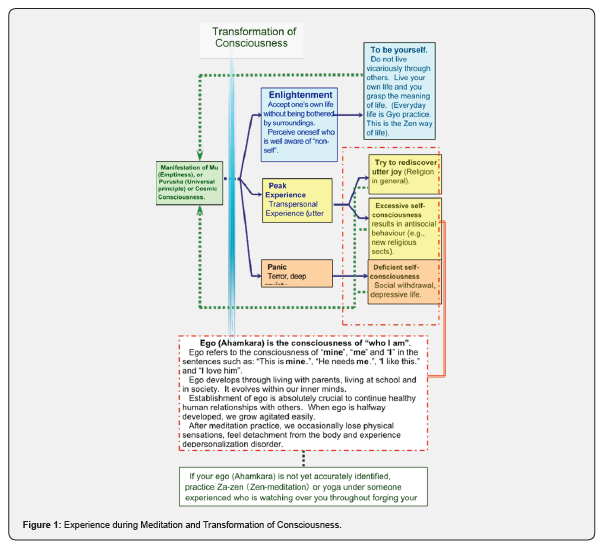
Practicing yoga or Za-zen (Zen-meditation) sometimes brings so-called mystical experiences. What does it refer to? During mediation, yoga practitioners attain the deepest state of Samadhi but cannot live in the state forever. Sooner or later, they will start their day-to-day lives. At this point, they sometimes have an intense experience(while staying on Samadhi for a while or a long time) that meditation brings. The intense experiences (or mystical experiences) are classified approximately into three types: Satori (enlightenment), peak experience, and panic.
Many people refer to Samadhi changed their perception and the way of life. What are the changes? In the state of deep Samadhi, one goes beyond complete consciousness. After returning to everyday life, some do not remember what they have experienced during Samadhi, and some maintained overwhelming impressions. As many kept records of the episodes, we find their experiences vary substantially. Interestingly, their ideologies and cultural backgrounds affect how they describe their experiences. Christians and Islamists may express “I encountered God”. Buddhists may explain “Union with Buddha”. Hindus may describe it as “I was embraced by Shiva”.
To be aware of self that had great experience can be acceptable; however, a problem arises if one is conceited and thinks the experience is very special and becomes elitist. That type of person may establish a new religious sect and, in the worst case, may pose a serious social problem. “Now, I discern the absolute truth and am emancipated. People should obey me”. This illusory perception, or excessive self- consciousness, is the salient characteristic of a cult. One quintessential example is a Japanese cult, the ‘Aum Shinrikyo’ that lured followers to have illusory enlarged egos. What will happen if one is seized by panic? A feeling of sheer terror will remain and that person will struggle desperately against the terror. Due to the repeated anomalous behaviour, the person could be regarded as ‘mentally ill’.
Makyo or “devil’s cave” is a Zen term referring to the condition one clings to peak experience and panic that occur within Zen meditation practices. So, Zen masters firmly warn their meditating students not to be manipulated by Makyo [20]. One well-known example of Makyo or “Devil’s cave” is the experience Hakuin Ekaku, a Zen master, had in his young days and who was regarded as the great reviver of Zen Buddhism in the Edo period [21]. During Za-zen (Zen-meditation), he had peak experience and thought he had reached an intense awakening. His excessive self-consciousness made him arrogantly confident. A fellow monk Sokaku worried about it and suggested him to study under Shoju Rojin (Dokyo Etan).
Shoju Rojin; however, not only ignored Hakuin for a while but also shattered Hakuin’s self-confidence completely. Hakuin desperately wanted to be enlightened and dedicated himself to Za-zen (Zen-meditation), religious mendicancy, and life in the Zen temple. One day he visited house to house begging for offerings. He was absorbed in chanting a Buddhist sutra, standing in front of a house. An old woman of the house scowled at him and said: “Go away!” He paid no attention and continued chanting. She severely beat him unconscious with her broom. When he awakened, he was totally enlightened. He acknowledged his real self and realized he was one of the ordinary people.
Zen Buddhism emphasizes the importance of relentless practices after attaining Satori (enlightenment) [22]. After reaching an intense awakening, they disappeared from their abodes. Time has passed and some ten years later, many monks spread all over the country to seek the master because they regarded him as a successor to the top-ranked monk at the temple. Daito Kokushi, for instance, lived with a group of beggars at the foot of Gojo-ohashi Bridge in Kyoto. Another master, Kanzan Egen lived as a woodcutter in a hovel deep in the mountains. He aided village people when necessary. Many people begged him for coming back to Honnzan (the head temple). At long last, he returned to the temple and started to train his Zen students. Well-known monks such as Ikkyu and Ryokan also devoted themselves to daily practices even after they were enlightened. There seems to be something in common in life after Satori (enlightenment).
What do we see in yoga history?
In Hinduism, a life is divided into four Ashramas (आश्र) (phases or life stages): Brahmacharya (ब्रह्मचर्य आश्रम) (student), Grihastha (गृहस्थ आश्रम) (householder), Vānprastha (वानप्रस्थ आश्रम) (retired) and Sanyāsa (संन्यास आश्रम) (renunciation). Based on the stages, people are requested to pursue their goals of life. Brahmacharya is a stage of study. During Grihastha, people lead their family-centred life, carrying out work, maintaining a household, raising a family, educating children and so on. Vānprastha refers to the retirement stage; people hand over household responsibilities to the next generation and practice Gyo to calm one’s mind. Sanyāsa is a state of disinterest and detachment from material life, practising all alone to prepare for the last moment of life. With this cultural background, many Hindus meditate habitually. It is presumed they have proper solutions to potential problems caused by practising meditation.
In addition, as the person who repeated the meditation experience, Ramakrishna (1836-1886) is a well-known example. He is a legendary Yogi (yoga practitioner) in India in the 19th century. While he was repeatedly having mystical experiences, he encountered gods of various religions. At last, he experienced a non-personality god, that is, the truth itself. All his experiences led him to the certitude that the essential quality of religions as well as human beings is “god” itself. Swami Vivekananda, who is an internationally famous yogi was one of Ramakrishna’s disciples. Ramakrishna was born in the poor farming village of Bengal. At the age of six, he lost consciousness and had the first mystical experience.
Repeating the experiences of same nature, he grew up surrounded by family and villagers who watched over him fondly. If he had lived in Japan of the same era, he could have been thought insane and been kept in a room to avoid people’s attention throughout his whole life. Or, if he were alive, he should be deemed mentally ill and should suffer from over-prescription of medicine. Luckily, he grew up as an ordinary boy who loved all people as well as gods of all religions, then went on the path of a religious leader who were beloved by all who knew him [23]. The story, his mystical experiences and generous attitudes of people around him, never ceases to amaze the lead author on how inclusive and generous the spirit of India is. A chart on the next page shows transformational types of consciousness during meditation, Yoga and Za-zen (Zen-meditation) practices (Figure 1).
What we experience after Satori (Enlightenment)
Using an example of Zen, the previous section investigated the meaning of Satori (enlightenment), and this section will explore what people experience after attaining Satori (enlightenment). To attain Satori (enlightenment) is nothing more than to make one happy unless one goes further. To be enlightened and become happy -Is this egoistic idea the ultimate aim of Zen and yoga? No, not at all! The aim of Zen is to lead a life in a state of Mushin (the state where ego does not exist) that makes people happy. One good example is Kakuan’s Ten Ox Herding pictures. The pictures connote the ultimate aim of Zen is “Entering the City with Bliss-bestowing Hands” [24] as Suzuki Daisetsu interpreted. This is the state of life Zen is aiming at.
A person goes through a simple life, such as interacting with others and doing day-to-day chores, and it will bring physical and mental pleasure to all other people. It is not a life people strive for, but it is a spontaneous way of life. You can find many writings about Ten Ox Herding pictures. Further, detailed information is available on the Internet (https://en.wikipedia.org/wiki/Ten_Bulls; http://www.columbia.edu/cu/weai/exeas/resources/oxherding.html). In the world of yoga, “Satori (enlightenment)” also refers to the absolute peace of mind which leads people to the state of Mushin. We also find this aim in “The Bhagavad Gita”. In fact, Swami Sachidananda (1914-2002) has stated in his commentary [25,26] on Yoga Sutra, “Normally, yogis do actions only for the mind is suffering. Consequently, Yogis will be liberated from the influence of sufferings. This is Karma yoga”.
Conclusion
This document outlines the foundational principles of yoga, emphasizing its role as a holistic path for self-realization and stress adaptation. Central to yoga are the Eight Limbs (Aṣhṭānga) described in Patañjali’s Yoga Sutra: Yama (ethical restraints), Niyama (personal observances), Āsana (postures), Pranayama (breath control), Pratyahara (withdrawal of senses), Dharana (concentration), Dhyana (meditation), and Samadhi (absorption or bliss). These principles guide practitioners in uniting mind and body, cultivating discipline, and achieving mental clarity. The document explains how yoga integrates physical, mental, and ethical practices to foster well-being and self-mastery, making it a timeless system for personal growth and harmonious living.
Limitations and Future Research Directions
As the article presents a theoretical view open the topic “The Basic Principle of Yoga: History, Concept, and Systems”, there are gaps in context of what yoga research should look like in the future. And, the purpose of writing this article is to take the theory and present opportunities for further research, practical guides, and critical analysis. These are described below:
Scientific Evidence and Empirical Research
Gap: There are some references on scientific studies (e.g., fMRI research, Japanese government grants) but lacks a comprehensive, systematic review of empirical evidence on yoga's benefits and risks.
Further Research: Conduct meta-analyses and systematic reviews of clinical trials on yoga's effects on physical and mental health. Investigate the mechanisms behind yoga's impact using neuroimaging, physiological, and psychological measures. Example: A large-scale study comparing stress biomarkers in yoga practitioners versus non-practitioners.
Practical Application and Modern Adaptation
Gap: The philosophical foundations are outlined but provide limited practical guidance for integrating yoga into modern lifestyles, especially for beginners.
Further Research: Develop and test structured yoga programs tailored for different populations (e.g., office workers, students, elderly). Evaluate the effectiveness of digital or app-based yoga instruction. Example: Pilot studies on workplace yoga interventions for stress reduction.
Risks and Contraindications
Gap: Risks are briefly mentioned (e.g., psychological effects of mystical experiences), but there is little detail on physical risks, contraindications, or safety guidelines for vulnerable groups.
Further Research: Systematically document adverse events and contraindications associated with various yoga practices. Create evidence-based safety guidelines for populations such as pregnant women, elderly, or those with chronic illnesses. Example: A registry of yoga-related injuries and their contexts.
Diversity of Yoga Practices
Gap: The perspective focuses on classical schools and the Eight Limbs, with less attention to the diversity of modern yoga styles and their unique adaptations.
Further Research: Comparative studies of traditional versus contemporary yoga styles (e.g., Vinyasa, Iyengar, Bikram) in terms of philosophy, practice, and outcomes. Example: Surveys of practitioners' experiences and preferences across different yoga schools.
Cultural and Social Contexts
Gap: While the global spread of yoga is discussed, there is limited critical analysis of how yoga is adapted, interpreted, or commercialized in different cultures.
Further Research: Ethnographic studies on the adaptation of yoga in various cultural settings. Examine issues of cultural appropriation, commercialization, and the impact of yoga as a global business. Example: Case studies of yoga's integration into Western wellness industries.
Measurement of Outcomes
Gap: The study does not provide frameworks or tools for assessing the effectiveness of yoga practices.
Further Research: Develop standardized outcome measures for yoga interventions, including subjective (well-being, stress) and objective (health metrics) indicators. Example: Validated questionnaires for tracking progress in yoga practice.
merging Research Questions Based on the Identified Gaps
These research questions address the document's main gaps and provide a roadmap for future studies (authors and others) to make yoga practice safer, more effective, and more accessible, while also deepening scholarly understanding of its principles and global impact. These are:
· What are the physiological and psychological effects of regular yoga practice, as measured by objective health indicators and validated psychological scales? How do different yoga practices (e.g., Hatha, Raja, Bhakti) compare in their effectiveness for stress reduction and mental well-being?
· What are the most effective methods for integrating the Eight Limbs of Yoga into daily routines for beginners and busy professionals? How do digital or app-based yoga programs compare to traditional in-person instruction in terms of user engagement and health outcomes?
· What are the most common physical and psychological risks associated with various yoga practices, and how can these be mitigated for vulnerable populations (e.g., elderly, pregnant women, individuals with chronic illnesses)? What guidelines can be developed to ensure safe yoga practice across diverse demographic groups?
· How do modern yoga styles (e.g., Vinyasa, Iyengar, Bikram) differ from classical schools in philosophy, practice, and health outcomes? What motivates practitioners to choose specific yoga styles, and how do these choices affect their experiences and benefits?
· How is yoga adapted and interpreted in different cultural settings, and what are the implications for authenticity, cultural appropriation, and commercialization? What role does yoga play in community building and social cohesion in various societies?
· What standardized tools or frameworks can be developed to assess the effectiveness of yoga interventions for physical, mental, and social well-being? How can subjective experiences (e.g., states of meditation, Samadhi) be reliably measured and compared across practitioners?
Acknowledgements
This text as part of a larger volume of work by Genboku Takahashi is also used to instruct graduate students at the Graduate General Education Course (GGEC) program at University of Tsukuba. Also, lectures and workshops utilize variations of the text (in a lecture format) for Tsukuba Yoga for All, social innovation project. Authros thank all those who are part of YOGA LEARNING, EDUCATION and RESEARCH.
References
- Ito Takeshi (2004) Unveiled Martial Arts of India. Kawasaki: Shuppansinsha.
- Suzuki Daisetsu, Erich Fromm, De Martino (1960) Zen Buddhism and Psychoanalysis. Osaka: Sogensha.
- Suzuki, Daisetsu, Sumiko Kudo (translation) (1965) Zen Buddhism, Tokyo: Chikumashobo Ltd.
- Suzuki Daisetsu, Momoo Kitagawa (translation) (1940) Zen and Japanese Culture (Iwanami Shinsho). Tokyo: Iwanami Shoten Publishers.
- DT Suzuki (1972) Living by Zen: A Synthesis of the Historical and Practical Aspects of Zen Buddhism. Cape Neddick: Samuel Weiser, Inc.
- DT Suzuki (2019) Zen and Japanese Culture (first published in 1959). Princeton Classics/Boullingen Series: Princeton University Press.
- Nakamura Hajime, Saegusa Mitsuyoshi (n.d.). Baudda: Bukkyō (Japanese Edition). Shōgakkan.
- Kaibara Ekken (2009) Yojokun: Life Lessons from a Samurai (The Way of the Warrior Series). Translated by William Scott Wilson. Kodansha, USA.
- Sato Koji, Sahoda Tsuruji (1967) “Encouragement for Sitting in Silence”. Osaka Sogensha.
- Hiromasa Muraki (1971) “Tanden Breathing Health Methods – Introduction to Harmonious Breathing”. Osaka Sogensha.
- Kaiten Nukariya (1926) Renshin-jutsu (The methods to cultivate mind). (in Japanese) Chusei-do.
- MHLW Grants System Database 201315072A (2015) Utility of integrated treatment for stress-related diseases and the establishment of its scientific basis (In Japanese).
- Tiwari Ruhi (2015) Smriti Irani releases ‘syllabus for yoga’ in govt schools.
- Larson Gerald M (2008) The Encyclopedia of Indian Philosophies, Volume 12. Yoga: India's Philosophy of Meditation. Motilall Banarsidass.
- Sahota Tsuruji (1978) “Yoga Basic Sutra”. Hirakawa Shuppan.
- Sahota Tsuruji (1983) “Yoga Basic Sutra 2”. Hirakawa Shuppan.
- Kishimoto Hideo (1958) Religious Mysticism –Thoughts of Yoga and Psychology, Tokyo: Taimeido.
- Rohe Fred (1975) The Zen of Running. Verlag Bodymind 1978, Germany.
- Hirai Tomio (1982) Science of Zen Meditation – Mechanism from the View of Brain Waves, Tokyo: Kodansha. P: 207.
- Ohmori Sogen (1964) Introduction to Zen Practice, Tokyo: Shunjusha Publishing Company.
- Nomura, Mizuki, Fuboku Kosakai (1927) Hakuin and Yasenkanwa, Kyoto: Jinbun Shoin.
- Tsutomu Mizukami (1988) Zen – It was Started with Bodhidharma (Shincho Sensho), Tokyo: SHINCHOSHA.
- Rolland Romain (1962) Research on India, Tokyo: Misuzu Shobo.
- Satyam Savita Ma (1987) Search for Your Oun Bull (Paintings and poems). Poems translated by Swami Anand Monju and Ma Prem Arpana. Japan: The Institute for Zen Studies Hanazono College.
- Satchidananda Sri Swami (1979) The Yoga Sutras of Patanjali, Integral Yoga Publications.
- Satchidananda Sri Swami (1989) Integral Yoga, Tokyo: Merkmal Publisher.

























