




 JYP Home



Abstract
Mental health recovery is increasingly understood as a personal and multidimensional process extending beyond symptom reduction. This perspective paper examines how movement-based rehabilitation may contribute to physical and psychological recovery when considered through an interdisciplinary lens. Drawing on the biopsychosocial model, the World Health Organization International Classification of Functioning, Disability and Health (ICF), self-efficacy theory and recovery-oriented practice, the paper explores complementary contributions from yoga, physiotherapy, psychology, occupational therapy, nursing and physical wellbeing practice. A conceptual Movement–Recovery–Participation Framework is proposed, linking movement and rehabilitation with physical capability, experiences of achievement, confidence and self-efficacy, psychological wellbeing, participation, functional independence and quality of life. The framework is intentionally non-linear and is presented as a conceptual proposition rather than a validated causal pathway. The paper argues that the significance of physical rehabilitation may extend beyond physical outcomes when activity is connected to personally meaningful goals and supported through collaborative interdisciplinary practice. Future research should examine whether changes in physical function and self-efficacy are associated with participation, independence and quality of life, while incorporating lived experience alongside quantitative outcomes.
Keywords: Mental Health Recovery; Rehabilitation; Physiotherapy; Yoga; Self-Efficacy; Interdisciplinary Practice
Abbreviations: CHIME: Connectedness, Hope and Optimism, Identity, Meaning in Life and Empowerment; ICF: International Classification of Functioning, Disability and Health; WHO: World Health Organization
Aims
This perspective paper aims to examine the relationship between movement, physical rehabilitation and mental health recovery through an interdisciplinary lens. It explores how yoga and physiotherapy may contribute to holistic recovery when considered alongside psychology, occupational therapy, nursing and other rehabilitation disciplines. The paper proposes a conceptual framework linking movement, physical confidence, self-efficacy, psychological wellbeing, participation, independence and quality of life. Drawing on the biopsychosocial model, the World Health Organization's International Classification of Functioning, Disability and Health (ICF), self-efficacy theory and recovery-oriented practice, the paper argues that physical rehabilitation should not be considered separately from psychological and social recovery. The central proposition is that movement may provide one pathway through which people can experience capability, achievement and confidence, potentially supporting wider participation and independence. The proposed framework is conceptual and is intended to stimulate interdisciplinary discussion and future empirical research rather than establish causal relationships.
Background
Mental health recovery is increasingly understood as a personal and multidimensional process extending beyond the reduction of psychiatric symptoms. Recovery can involve developing hope, identity, meaning, connectedness and empowerment, alongside increased participation, autonomy and quality of life [1]. This understanding has important implications for rehabilitation, where the goal is not simply to manage impairment but to support people to develop the skills and confidence required to participate in meaningful aspects of life. The World Health Organization (WHO) defines rehabilitation as a set of interventions designed to optimise functioning and reduce disability in interaction with the person's environment. Its purpose extends to enabling people to remain as independent as possible and participate in education, employment and meaningful life roles [2]. Contemporary WHO guidance also emphasises that rehabilitation is human-centered, goal-oriented and holistic, and commonly requires collaboration between multiple professional groups.
The International Classification of Functioning, Disability and Health (ICF) provide an important framework for this perspective. Rather than conceptualising health solely in terms of disease or impairment, the ICF considers functioning within the context of body functions and structures, activities, participation and environmental factors [3]. This distinction is particularly relevant to mental health rehabilitation. A person does not experience their physical health, psychological wellbeing and social participation as separate professional domains. They experience them simultaneously. This provides an important rationale for interdisciplinary working. The biopsychosocial model proposed by Engel [4] similarly challenged an exclusively biomedical understanding of illness by emphasising the interaction between biological, psychological and social dimensions.
Design
This article is a conceptual perspective/position paper. It does not report original empirical data and is not presented as a systematic review. The discussion synthesises established theoretical and clinical perspectives concerning biopsychosocial practice, the ICF, self-efficacy, recovery-oriented rehabilitation, yoga, physiotherapy and interdisciplinary working. These perspectives are brought together to develop a conceptual framework describing how movement may contribute to physical confidence, psychological wellbeing, participation, independence and quality of life. The framework is presented as a proposition for clinical discussion and future research. It does not imply that movement, yoga or physiotherapy independently causes psychological recovery or that these approaches should replace established psychological, medical or pharmacological interventions.
Method
The issues considered in this perspective were approached through a narrative integration of established theoretical frameworks, professional guidance and relevant contemporary evidence concerning rehabilitation and yoga-based interventions.
Five complementary perspectives were used to inform the proposed framework:
1. The biopsychosocial model;
2. The International Classification of Functioning, Disability and Health;
3. Self-efficacy theory;
4. Recovery-oriented mental health practice; and
5. Person-centered and interdisciplinary rehabilitation.
These perspectives were considered in relation to the potential contribution of yoga and physiotherapy to mental health rehabilitation. The intention was not to establish an evidence hierarchy or estimate intervention effectiveness. Rather, the purpose was to examine how established concepts from different disciplines might be integrated to provide a coherent explanation of why movement may have significance beyond physical function.
Movement and the Biopsychosocial Perspective
The biopsychosocial model provides a useful foundation for considering the relationship between physical and psychological recovery. Engel (1977) [4] argued that health and illness cannot be adequately understood through biological processes alone. Psychological and social factors also influence how illness is experienced and managed. Within mental health rehabilitation, this perspective challenges the separation of physical and psychological care. Physical inactivity, deconditioning, reduced mobility and poor physical confidence may influence participation.
At the same time, anxiety, depression, low motivation, negative self-perception or previous experiences may influence willingness to engage in physical activity. The relationship can therefore operate in both directions. Reduced physical activity may contribute to physical deconditioning. Deconditioning may contribute to reduced confidence. Reduced confidence may contribute to reduced participation. Reduced participation may further restrict opportunities for achievement, social connection and meaningful occupation. This suggests that rehabilitation should consider not simply the individual's physical capability, but the interaction between capability, psychological experience and participation.
The ICF: from Impairment to Participation
The ICF provides a particularly valuable framework for this discussion because it distinguishes between health conditions, body functions and structures, activities, participation and contextual factors [3]. This encourages a shift from asking, 'What impairment does this person have?' towards asking, 'How does this affect what the person wants or needs to do?'. For example, reduced lower-limb strength may be identified as an impairment. However, the rehabilitation significance of that impairment may be better understood by asking whether it affects walking, self-care, social activity, employment, education or community participation. This distinction is central to recovery-oriented rehabilitation. Rehabilitation becomes particularly meaningful when physical improvement translates into improved participation.
Physiotherapy and Physical Confidence
Physiotherapy contributes specialist expertise in movement, physical function, exercise, rehabilitation and functional independence. Within mental health rehabilitation, this contribution may be particularly important because physical health and functional limitations can become significant barriers to participation. However, the potential contribution of physiotherapy extends beyond physical measurements. A person who develops improved mobility, strength, balance or endurance may also experience a change in their perception of what they can achieve.
This is where the concept of physical confidence becomes relevant. Physical confidence is proposed here as an individual's developing belief that they can move, participate and engage in physical challenges within their capabilities. It should not be regarded as a formally established clinical construct equivalent to self-efficacy. Rather, it is used as an accessible term describing an aspect of perceived capability that may be relevant to rehabilitation. The purpose of physiotherapy is not to provide psychological treatment through physical exercise. Rather, appropriately graded physical rehabilitation may create opportunities for experiences that have psychological meaning. A person who initially believes that a particular movement or activity is beyond their capability may, with appropriate support, experience successful completion. That experience may become significant because it provides evidence for the person that change is possible.
Self-Efficacy as the Psychological Bridge
Bandura's theory of self-efficacy provides a useful theoretical bridge between physical achievement and psychological processes. Self-efficacy refers broadly to an individual's belief in their ability to organise and execute actions required to manage situations [5]. Bandura identifies mastery experiences as an important source of efficacy beliefs. This concept has relevance to rehabilitation. Consider the difference between: 'I completed the exercise' and 'I thought I couldn't do it, but I did.'
Physical action may be identical; the psychological meaning may be very different. The second statement represents an experience of mastery and a potential change in self-perception. It is therefore proposed that appropriately graded movement may provide opportunities for mastery experiences which can contribute to perceived capability and self-efficacy. This proposition should be tested empirically rather than assumed. Nevertheless, it provides a plausible theoretical mechanism through which physical rehabilitation could contribute to wider recovery processes.
Yoga as a Complementary Mind-Body Approach
Yoga provides an additional perspective because it may combine physical movement with breathing, attention, mindfulness and body awareness. Practice therefore offers opportunities to attend simultaneously to physical and psychological experiences. Evidence concerning yoga and mental health is developing. Systematic reviews have reported potentially beneficial effects for anxiety and depressive symptoms, although certainty of evidence varies and studies differ in intervention type, duration and methodological quality.
Evidence has also emerged concerning schizophrenia and other serious mental health conditions, including reported improvements in symptoms, quality of life and social functioning in some studies. However, heterogeneity and limitations in the evidence require cautious interpretation. Yoga is not a single standardised intervention. Styles, duration, intensity, practitioner training and participant characteristics vary considerably. Evidence concerning one form of yoga cannot automatically be generalised to every yoga-based intervention. Yoga should therefore be positioned as a complementary approach within an individual's wider care and rehabilitation plan rather than as a replacement for established psychological or medical interventions.
Recovery-Oriented Practice
Recovery-oriented practice provides the person-centered foundation for the proposed framework. Leamy et al. [1] identified five interconnected processes within personal recovery: Connectedness, Hope and optimism, Identity, Meaning in life and Empowerment (CHIME). Movement may intersect with several of these processes. Participation in an activity can create opportunities for connectedness. Achievement can contribute to hope. Developing physical capability may contribute to a changing sense of identity.
Meaningful activity can support purpose. Learning that one's actions can influence outcomes can contribute to empowerment. This does not mean that physical activity automatically produces recovery. Rather, it suggests that movement can provide experiences through which recovery processes may be expressed and developed. Recovery is not something delivered to a person by a professional. It is a personal journey supported by relationships, opportunities, environments and interventions.
Rehabilitation, Independence and Meaningful Activity
NICE guidance for adults with complex psychosis provides a relevant UK context. Rehabilitation should support people to progress from more intensive support towards greater independence while recognising that some individuals may require ongoing supported accommodation. Recovery-oriented approaches should build strengths, support personal goals, develop self-esteem and confidence, identify meaningful occupations and celebrate progress [6-10].
Importantly, multidisciplinary rehabilitation can bring together different professional perspectives, including physiotherapy and physical exercise expertise alongside psychology, nursing, occupational therapy and other contributions. Physical rehabilitation does not sit outside mental health rehabilitation. It can be one component of it. Likewise, independence should not necessarily be understood as an absence of professional support. Independence may instead represent an individual's increasing capacity for choice, participation, self-management and meaningful activity, with support adjusted according to need.
The Interdisciplinary Perspective
The greatest potential contribution of this framework may lie in its interdisciplinary nature. Different professionals see different aspects of the same individual. The physiotherapist may identify a physical limitation. The psychologist may identify anxiety affecting engagement. The occupational therapist may identify a meaningful activity that could provide motivation. The nurse may understand the person's day-to-day presentation and therapeutic relationship. The physical wellbeing practitioner may identify an accessible opportunity for movement. The person themselves knows what matters to them.
No single perspective is sufficient. Together, however, these perspectives can create a more complete understanding of the recovery journey. Contemporary rehabilitation principles support this broader multidisciplinary perspective. WHO identifies rehabilitation as involving a range of professional groups and notes that multiprofessional collaboration is often required according to the individual's needs. The interdisciplinary question therefore becomes: 'What can we collectively do to support this person's recovery?' rather than 'What can my profession provide?'. This represents more than a semantic change. It encourages professionals to see their interventions as complementary components of a shared recovery plan.
A Proposed Movement–Recovery Framework
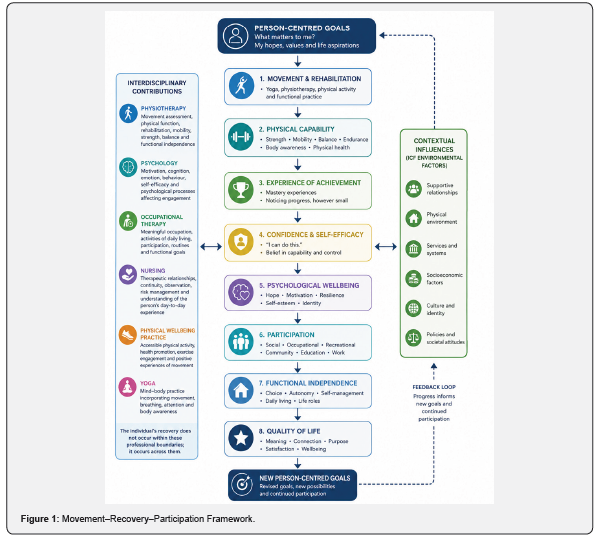
Based on the theoretical perspectives considered above, this paper proposes the following conceptual framework. The framework is intentionally circular rather than linear. Recovery is not necessarily a progression from one fixed stage to another. Individuals may move forwards and backwards depending on changes in health, environment, relationships, motivation and circumstances (Figure 1).
The framework illustrates a proposed, non-linear relationship between movement-based rehabilitation and wider recovery outcomes in mental health care. Movement may contribute to physical capability and experiences of achievement, which may influence confidence and self-efficacy. These experiences may support psychological wellbeing and participation, potentially contributing to greater functional independence and quality of life. Interdisciplinary contributions and contextual influences are shown as interacting with the pathway.
Note: The framework is conceptual and does not imply a deterministic or causal sequence.
ICF = International Classification of Functioning, Disability and Health.
From Movement to Confidence
The proposed framework places physical confidence between physical capability and wider psychological and social outcomes. This is deliberate. Physical function alone does not guarantee participation. An individual may have the physical capacity to undertake an activity but lack confidence, motivation or perceived safety to do so. Conversely, an individual may have modest physical capability but demonstrate considerable confidence when supported appropriately. Consequently, rehabilitation should consider not only, 'What can this person physically do?' but also, 'What does this person believe they can do?' and 'What would they like to be able to do?' These questions introduce the individual's perspective into physical rehabilitation and help connect professional assessment with personal recovery goals.
Participation as the Bridge to Quality of Life
The proposed model places participation between psychological wellbeing and independence. This reflects the broader purpose of rehabilitation. Physical improvement becomes meaningful when it enables engagement in life. A person may improve their balance because they want to walk independently to an activity. They may improve their endurance because they want to participate in a community outing. They may develop confidence using exercise equipment because they want to establish a routine. They may practice breathing and movement because they want to develop strategies for managing difficult experiences. In each example, physical activity is connected to a personally meaningful outcome. This is consistent with the ICF emphasis on functioning and participation and with recovery-oriented rehabilitation that encourages meaningful occupation and individualized activity.
Quality of Life as an Outcome
The ultimate relevance of rehabilitation lies in its contribution to people's lives. Improved strength, mobility, balance or endurance are important outcomes. However, their value may be better understood by considering what they enable. Can the person participate more? Can they make more choices? Can they undertake more activities independently? Can they reconnect with interests? Can they develop relationships? Can they experience a stronger sense of identity beyond illness? Can they experience greater hope? WHO identifies functioning, independence, participation and quality of life as important dimensions of rehabilitation. Consequently, rehabilitation evaluation should not rely exclusively on impairment-level measures. A more holistic evaluation might consider physical functioning; self-efficacy and confidence; psychological wellbeing; participation; activities of daily living; independence; social functioning; and quality of life.
Implications For Interdisciplinary Clinical Practice
The proposed framework has several implications for practice. First, physical and psychological needs should be considered together. Comprehensive biopsychosocial assessment within multidisciplinary rehabilitation should incorporate physical health, psychological and psychosocial history, daily living skills and social circumstances. Second, goals should be developed collaboratively with the person. The goal should not simply be 'improve fitness’ but rather connect physical development with something meaningful to the individual.
Third, professionals should recognise that small achievements may have significance beyond their immediate physical outcome. Fourth, physical confidence and self-efficacy may be useful outcomes to explore alongside physical function. Fifth, interdisciplinary communication should allow professionals to share observations about progress, barriers and opportunities. Sixth, yoga and physical activity should be offered appropriately and safely, with consideration of physical health, psychological presentation, preferences, risk and clinical context. Finally, services should consider whether their outcome measures capture the transition from physical capability to participation and quality of life.
Implications for Research
The framework generates several questions for future research. Does improvement in physical function predict increased physical confidence? Does physical confidence predict greater participation? Does increased self-efficacy mediate the relationship between rehabilitation participation and psychological wellbeing? Do interdisciplinary rehabilitation programs produce different outcomes from discipline-specific interventions? Do improvements in physical capability translate into greater independence? Most importantly, do these changes result in sustained improvements in quality of life? These questions could be explored using mixed methods and longitudinal research. Quantitative measures could examine changes in physical function, self-efficacy, psychological wellbeing, participation and quality of life. Qualitative research could explore what those changes mean to individuals themselves. This is particularly important because a numerical change in physical performance does not necessarily represent the same outcome for every person. Future research should therefore include both measurable outcomes and experience.
Limitations and Considerations
This perspective has several limitations. First, it is conceptual rather than empirical. The proposed movement–recovery framework has not been experimentally tested. Second, the evidence concerning yoga and mental health remains heterogeneous. Although systematic reviews report potentially beneficial effects, limitations concerning risk of bias, intervention heterogeneity and certainty of evidence require cautious interpretation. Third, the concept of 'physical confidence' is used here as a practical bridge between physical capability and self-efficacy rather than as a validated independent construct. Fourth, interdisciplinary working does not automatically produce better outcomes. Effective collaboration requires communication, shared goals, clear professional responsibilities, appropriate resources and organizational support. Finally, movement-based interventions must not be presented as substitutes for established psychological, medical or pharmacological treatment. The proposed model is therefore best understood as a framework for integrating, rather than replacing, existing approaches to mental health care.
Conclusion
Mental health recovery cannot be fully understood through physical or psychological outcomes considered independently. People experience their bodies, thoughts, emotions, relationships and environments simultaneously. The biopsychosocial model provides a foundation for recognising these interactions. The ICF provides a framework for understanding how health conditions influence functioning and participation. Self-efficacy theory offers a potential psychological mechanism through which experiences of achievement may influence perceived capability. Recovery-oriented practice places the person's goals, identity, meaning, hope and empowerment at the center.
Within this context, yoga and physiotherapy offer complementary opportunities for movement-based rehabilitation. Physiotherapy contributes specialist knowledge of movement and physical function. Yoga can provide a complementary mind–body approach incorporating movement, breathing, attention and body awareness. Psychology contributes understanding of motivation, cognition, emotion and behaviour. Occupational therapy connects capability with meaningful occupation. Nursing contributes therapeutic relationships, continuity and knowledge of the person's everyday experience. Physical wellbeing professionals can provide opportunities for accessible and meaningful physical activity. The value of these disciplines may therefore be greatest when their contributions are connected rather than separated.
The conceptual framework proposed in this paper can be summarised as: Movement → physical capability → confidence/self-efficacy → psychological wellbeing → participation → independence → quality of life.
This should not be interpreted as a universal or linear pathway. Rather, it represents a proposition that physical experiences may become meaningful components of psychological and social recovery when they are connected to personally valued goals. The central question should therefore extend beyond, 'Can yoga or physiotherapy improve physical health?' It should become: 'How can movement become part of a person's recovery, confidence, participation, independence and quality of life?'. The answer is unlikely to belong to one professional discipline. It belongs within the relationship between the person, their goals, their environment and the interdisciplinary team supporting their recovery.
Movement may begin with the body, but its meaning can extend far beyond it.
Relevance for Clinical Practice
An interdisciplinary approach to movement and mental health rehabilitation can help clinicians connect physical function with psychological wellbeing, participation, independence and quality of life. Physiotherapists, psychologists, occupational therapists, nurses, physical wellbeing practitioners and other professionals can contribute complementary expertise around personally meaningful goals. Yoga and physical activity should be considered complementary components of recovery-oriented care rather than replacements for established treatments. Recognising physical confidence and self-efficacy as potential rehabilitation outcomes may encourage teams to value achievement, participation and progress alongside conventional physical measures.
References
- Leamy M, Bird V, Le Boutillier C, Williams J, Slade M (2011) Conceptual framework for personal recovery in mental health: Systematic review and narrative synthesis. British Journal of Psychiatry 199(6): 445-452.
- World Health Organization (2017) Rehabilitation in health systems: Guide for action. Geneva: World Health Organization.
- World Health Organization (2001) International Classification of Functioning, Disability and Health (ICF). Geneva: World Health Organization.
- Engel GL (1977) The need for a new medical model: A challenge for biomedicine. Science 196(4286): 129-136.
- Bandura A (1997) Self-efficacy: The exercise of control. New York: WH Freeman.
- Martínez-Calderón J, Casuso-Holgado MJ, Muñoz-Fernandez MJ, Garcia-Muñoz C, Marcos Heredia-Rizo A (2023) Yoga-based interventions may reduce anxiety symptoms in anxiety disorders and depression symptoms in depressive disorders: A systematic review with meta-analysis and meta-regression. British Journal of Sports Medicine 57(22): 1442-1449.
- National Institute for Health and Care Excellence (2020) Rehabilitation for adults with complex psychosis (NG181). London: NICE.
- World Health Organization (2023) Rehabilitation: strengthening rehabilitation research and evidence. Geneva: World Health Organization.
- Wu Y, Yan D, Yang J (2023) Effectiveness of yoga for major depressive disorder: A systematic review and meta-analysis. Frontiers in Psychiatry 14: 1138205.
- J Yin, Y Sun, Y Zhu, H Alifujiang, Yi Wang, et al. (2024) Effects of yoga on clinical symptoms, quality of life and social functioning in patients with schizophrenia: A systematic review and meta-analysis. Asian Journal of Psychiatry 93: 103959.

























