




 JYP Home



Abstract
Yoga, in its original intention, was never merely physical. Its root is spiritual for connecting the self with awareness of surroundings, life, and non-life. Over time, yoga diversified into multiple entrances/paths. Traditional forms such as Genboku-style [1] original yoga offer profound depth, philosophical clarity, and life insight, but they are often “unsellable” in modern society because of a lack of the immediate experiential doorway to understand them. This creates a significant gap: traditional depth vs. modern accessibility. Importantly, the author, as the student of yoga master Genboku, gradually understands that the value of traditional yoga lies in its existence itself; it does not need to be commercial. Over the years, debates between traditional yoga and modern yoga have never ceased, and some even argue that they have become two entirely different things. However, both are equally valuable and inherently not separate, serving as tools for self-exploration. Modern yoga, particularly physical practice, can be understood as a whole in itself. Not everyone comes to yoga to address issues; many are drawn to it simply because the experience of yoga feels inherently spiritual, fostering a sense of awakening and inner connection. With such a background, a yoga school is envisioned, and seeks to use more effective tools to convey the different layers of yoga practice. And, the lead author’s aspiration in becoming a bridge between tradition and modernity, between the East and West, is a motivation for the current topic being presented, which will explore how to balance traditional value with commercial viability, not by diluting depth, but by increasing its width. Traditional yoga does not need to become superficial; it simply needs an entrance. The first (2023) and second (2025) ‘Summer Yoga Camps’ in Nagano position themselves as that bridge: modern experiential practice as the doorway, and traditional wisdom as the path/destination. Here, the authors outline such a yoga experience in Nakagawa-mura and other rural areas in Nagano prefecture, which reinforces the idea of creating a space and time for yoga for the people living in urbanized centers of Japan.
Keywords: Art; Culture; Creativity; Communication; Community; Embodied Yoga
Introduction
Summer Yoga Camp The Meaning of the - Yoga Experience
The performed yoga camp is the vastness/depth of the future yoga school. For some people, physical practice itself is already whole. Not everyone comes to yoga because something is broken. Many come simply because the practice itself feels alive and spiritual. Yoga asana is a complete bodily experience like dancing or any other embodied art where movement, breath, and attention come together, creating a sense of fullness in that specific moment. In this experience, the practice is meaningful/whole and complete in itself. For others, at a certain moment in life, a different question may quietly appear. This camp offers a space where practice does not have to end at feeling good, and thinking does not stay trapped/circled inside thinking. This camp exists for people who are eager to know deeper after the experience: “I feel something. I think something. Then now what? What is the next.” This yoga camp or the Genboku-yoga means “take a pause, going back to the root, seeing what is underneath.”
The Second Yoga Summer Camp Experience
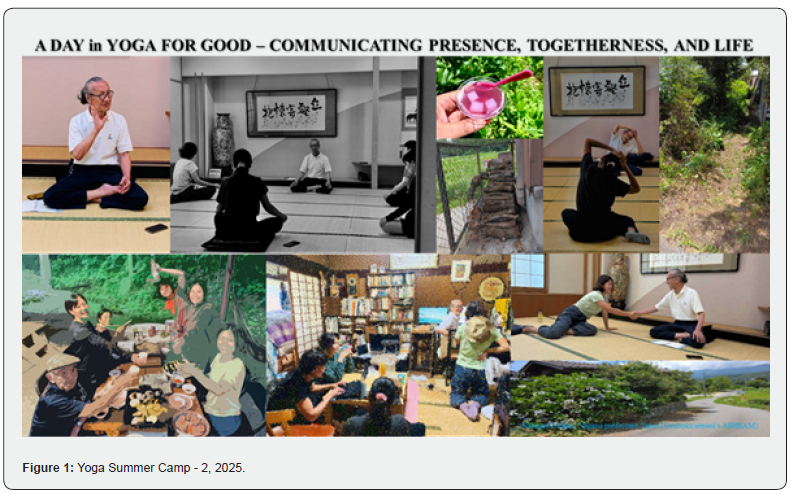
Since 2015, we have been conducting Yoga Classes-Workshops and Lunchtime-yoga as an off-shoot of the GGEC Yoga Course (University of Tsukuba) as social impact projects (TYfA/tYMC) – and we have considered the ‘Role of Yoga in Graduate School’ and as part of that first 10-day Yoga camp was conducted in August 2023, and a subsequent 2-day camp was held in July 2025 at Nakagawa-mura (village - https://www.vill.nakagawa.nagano. jp/) with International and Japanese students (Figure 1) [1].
“Samu” - The Hands-on-Experience
In Genboku’s house/ashram, there are many wild grasses/ bushes/trees (life is alive in the surroundings, our own surroundings, do we see our surroundings, do we feel it, experience it; sometimes we need to go out of our own near places to somewhere where our eyes actually open - that is Nakagawa-mura, in Nagano-prefecture), we went there to clean. Firstly, we entered the room and prepared the tools. We look at the land and make a simple plan: which part to clean first, and how. Why cleaning is important. First, it is about the ground/soil itself. Second, it reflects our daily life activity that we repeat every day. Third, cleaning is also a form of cleansing our messy mind. The messiness of the ground is like life itself. There are always many messy things waiting to be cared. Seen all at one, they can feel overwhelming. But we do not face the whole garden at once. We choose one small area. We focus only on what is in front of us. We clean, reorganize, and care for that part, and then move to the next. This is the training. Not escaping the vastness of life, but not being frightened by it either. From one small piece, we learn how to notice, clean, rebuild and again and again. Touching the soil also brings a deep sense of grounding. This is why agriculture has always been essential to human life. Through direct contact with the earth, the body remembers stability, weight, and presence. In ‘SAMU’, cleaning is not a task to finish, it is a way to learn to live, starting from what is right here, right now.
“Yoga Master” - The Physicality of Yoga
The original purpose of yoga was to reunite the body and mind. It was a pause, a moment to sit still, to sense, and to become aware of the body and the mind. Amid the messiness of life, whether in external situations or in our own thoughts, yoga originally offered a space of stillness. In its earliest form, this practice was simply sitting, allowing the body and mind to settle into a meditative state. Overtime, postures were introduced to help a stiff and tense body soften, so that stillness could become possible again. Let us experience the stillness, the peace.
Discussions in - Yoga
In the discussion part, students begin to notice the initial questions that are already present within them. What occupies the mind? What repeatedly draws attention away from what is right in front of us? What patterns continue without being seen or properly cared for? These questions arise naturally from practice and stillness. These all ask us one simple truth –Who are we and Where are we? What is here, what is life? The responses offered by Genboku sensei are not answers to be followed, but mirrors which reflecting what is already there, waiting to be seen. These experiences and Yoga programs (educational, research, social impact) over 10 years have strengthened our resolve to create a community-based program towards addressing not only societal challenges but also to support local-regional revitalization in rural Japan. And, Yoga-based communication is one of the many ways forward, and is presented below.
Yoga School: An Emerging Idea
A yoga school responds to what people deeply need by accompanying a slower, more attentive process of learning and transformation rather than by offering quick solutions in these fast-paced societies.
The Basics - Creating Own Meaning
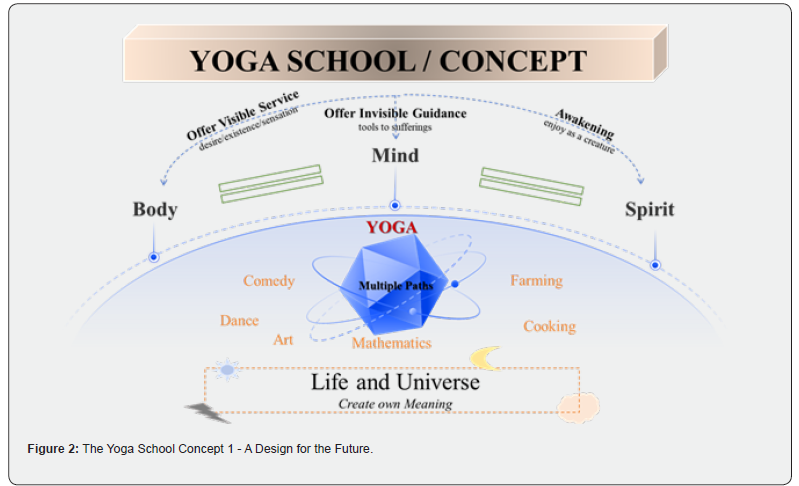
We are but a fleeting spark in this vast universe. All our struggles and endeavors may hold no meaning in the grand cosmic reality. Therefore, life itself has no absolute right or wrong and meaning is created by ourselves, under our own rules. There are countless ways to seek and experience life: dance, comedy, art, mathematics, farming and cooking, or yoga. The path is everywhere, and every path holds the potential for equal depth. Ultimately, art, psychology, philosophy, religion, and spirituality may all converge toward the same understanding of the universe. Yoga, at its essence, is the union of body, mind, and spirit. Historically, yoga did not include postures. As it evolved, yoga asana emerged to help practitioners sit more comfortably in meditation by releasing physical tension. In modern times, especially within the commercialized yoga world, asana practice has become widely popularized.
Here, the author does not seek to judge or define what yoga is today. Rather, the author believes: There is no deeper or shallower in yoga or life. If someone practices yoga asana throughout their life without delving into introspection, and that is enough for their life and sense of meaning because for them, it is already whole. Body, mind, and spirit are multiple entry points into yoga(self). Physical yoga can serve different intentions. While some practitioners approach it as a way to support health, selfimprovement, or a sense of embodied presence, others engage in physical yoga primarily for the quality of the experience itself. Here, practice is valued as an immersive sensory and somatic process, complete in its own moment, rather than as a step toward further psychological or philosophical inquiry. Physical yoga itself serves the purpose of returning to union as it begins from the outer layer of the human body, slows down movement, brings awareness to the breath, and releases tension stored from emotional experiences. Only when a person seeks to understand or release their suffering that yoga become a direct tool to face the inner heart and the self through guidance and support. Mind yoga works by speaking directly to the self, without the preliminary guidance of physical postures.
Facing oneself directly can be painful, which is why mind yoga itself is challenging to “sell” as it requires confronting oneself without any filter process. Spiritual yoga can be guided through physical practice: when body and mind unite, the spirit enters a wonderful state-an experience we, as living beings, as creatures, can enjoy in this lifetime. Thus, a future yoga school (as imagined by the lead author) is built upon this understanding. It is hoped to offer visible services that serve the beauty and health of the body, which also acts as a step toward facing and conversing with the self since direct self-inquiry (what may be called traditional or original yoga) can be painful and difficult to accept. It will also strive to provide invisible guidance as a tool toward understanding suffering. Finally, the aim is to an awakening spiritual experience which is a profound human joy that one can savor as vibrant, conscious beings (Figure 2).
The Module - Creating the Experience, Offering a Path
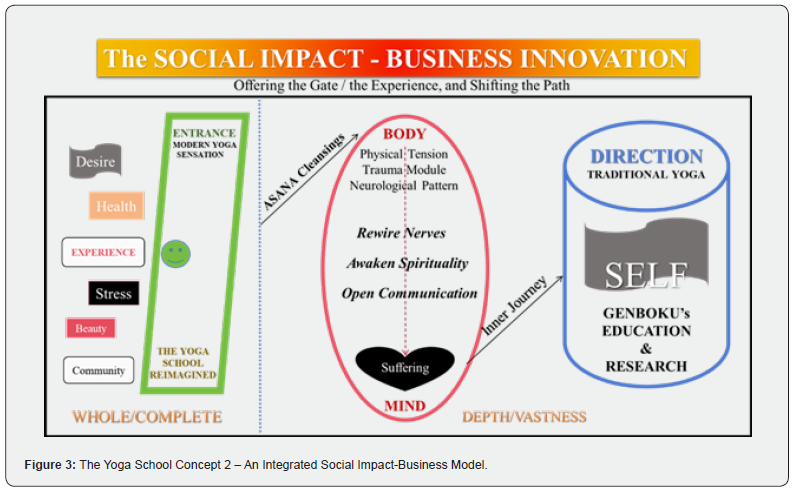
The future yoga school is built on two complementary paths, represented by Sumei (lead author) and Genboku (second author). The Entrance Gate (Sumei - Modern Yoga): This is the invitation of yoga. It meets people in their desire for health, beauty, stress relief, meeting community and experiencing yoga itself as a whole, etc. It uses the physical practice (asana) to awaken sensation, cleanse the body-mind, and provide spiritual enjoyment. This yoga entrance is marketable. It sells bodily sensory experience. It sells solutions to immediate “sufferings” like stiffness, anxiety, or lack of vitality. It sees the human desire “of being existing, being seen, being better.” This yoga module is already whole and completed. The Path to Inner Journey (Genboku - Traditional Yoga): It is the unsellable but permanent core/education. It represents the full depth of the philosophy, the eight limbs, and the ultimate goal of self-inquiry and liberation (moksha) (Figure 3).
It is not a product but a valuable experience. It exists for those who, having entered the gate, feel a deeper call to “truly face the self” to release fundamental suffering. This path is offered, not sold. It is the school’s depth/vastness. However, why can’t we skip the body/asana and go straight to the philosophical/spiritual/ traditional yoga? Because the self we wish to face/inquiry is living within this body and this nervous system. Suffering is not just remembered; it is embodied. The “trauma module” or tension is a physical and neurological pattern. It is the body’s memory of the past, which influences its reactions in the present. A stressful thought triggers a fearful memory tightens the diaphragm. The physical practice is not a mere filter or a pleasant entertainment. It is necessary preparatory work. It systematically cleanses the ‘annamaya’ kosha (physical sheath) and ‘manomaya’ kosha (mental/emotional sheath). By stretching, strengthening, and balancing, we literally alter the holding patterns where trauma resides. It creates a new, calm neurological pathway.
It teaches the nervous system the felt experience of safety, openness, and steadiness. Most importantly, in a yoga studio or any educational setting, it is often difficult for a person to listen deeply or to face themselves because the process can be painful. Students who have paid for a class naturally want to feel they are receiving something valuable in return. Sensation is key in this context, as it provides them with immediate, tangible experiences and feelings. This helps explain why more intense, advanced yoga asana class are often more popular than gentle styles like Yin yoga because people need to feel the yoga first. Furthermore, students need to trust and connect with their instructor/teacher. If a teacher focuses only on the philosophical depth of yoga in business world, it can create distance and close communication. Therefore, this physical cleansing is what makes the student receptive and open communication.
This is why after asana practice, people can open heart easier to listen, to connect, to communicate with the yoga educator or self. The educator or simply the true self is no longer seen as a distant philosopher, but as a guide they can trust. The physical practice builds the relational bridge and the psycho-physiological safety required for the vulnerable process of self-inquiry. This three layers elevates the school from a place that simply has both physical and philosophical offerings to an integrated somatic-philosophical pathway where each step is understood as biologically and spiritually essential. It makes the “gateway” therapeutically necessary, not just commercial. This is the depth that will attract true seekers and honor the ancient, holistic vision of yoga. In summary, a foundational pre-module for a future indepth yoga school is being established. This takes the form of a weekend yoga retreat in Nagano for Tokyo (urban cities)-based workers, created in collaboration with a traditional yoga master Genboku and an educator-researcher Randeep (Figures 1, 2, and 3).
Concluding Remarks
The Practical Details - Shall we Yoga?
The proposed Yoga School in Nagano, guided by Master Genboku Takahashi and coordinated by Sumei Huang, is rooted in traditional yoga wisdom, surrounded by a calm and pleasant nature, offering a deep self-reset away from cities like Tokyo’s noise. Tokyo workers often face endless workloads and constant pressure, long hours of sitting lead to body stiffness, and many feel pushed forward by life, with little space left to breathe. What is needed is not more effort, but a meaningful break: time to reconnect with oneself, physical relief combined with mental clarity, and a quiet space and time to pause, slow down, and reflect (who am I, why am I alive?). A weekend yoga workshop (school) hopes to combine modern experiential entrance with traditional wisdom depth, forming a multi-layered, human-centered path of transformation. And, it is linked to local communities, local food, and regional revitalization, and importantly local (people to people) communications. Shall we Yoga in Nagano-prefecture? And the third author (who was introduced to Yoga during her studies at the graduate school in the University of Tsukuba) mentions an important realization she herself experienced. She believes that when a person’s words and actions become disconnected from themselves, a large gap forms within them, leading to depression and mental instability.
Yoga allows one to rediscover the rhythm of one’s own heartbeat through breathing and to become aware of one’s entire body, from one’s fingertips to one’s toes. This brings one closer to our inner selves, allowing us to recognize our boundaries with the outside world and discover who we are and what we possess. Yoga is a space where one can recognize our inner self (separated by the outer covering, which we know as the skin), but it is also a space where, by organizing ourselves, we can feel connected to the outside world and the universe. Our own mind, body, and spirit connect, and then we connect with the outside world. This is a time one needs today in a society where information, people, and things fly at a dizzying pace. It is believed that the concept of this yoga school, with its ultimate goal of promoting traditional yoga values, will surely contribute to the physical and mental peace of people (and society).
Acknowledgements
The lead author would like to express her sincere gratitude to the TIAS 2.0 Program-an academic legacy initiative of the Tokyo 2020 Games, originating from the TIAS program under the Sport for Tomorrow Consortium and an initiative of the Japanese Government-for providing an invaluable opportunity to study at the University of Tsukuba. She appreciates the yoga community in Tsukuba, Nagano, and Japan, and networks therein for developing self. The authors thank the graduate students [both International and Japanese (especially Minori Suzuki and Shizuka Miyaji, and Chiang Kai Fang)] of the International-English based degree programs to join the camps and discussions therein.
References
- Huang S, Takahashi G, Inoue Y, Abe Y, Rakwal R (2024) Designing a Summer Yoga Camp for Graduate Student’s: The Need for Communicating Issues and Understanding Self for Navigating Academic- and Life-related Issues. Journal of Yoga and Physiotherapy 11(3): 555815.

























