



 JYP Home



Abstract
This idea was initiated by the lead author’s three-month yoga field, academic, and lived experiences in France. Herself a yoga practitioner and instructor with 7 years-experience, resulted in embracing the French yoga lifestyle with an openness not experienced before. And, seeing yoga within the French lifestyle as a type of yoga that aligns with art, self-expression, and joyful living. What inspired her is what is presented here along with a view for the future. Unlike the heavier and stricter yoga often encountered in Asia, French yoga offered lightness, beauty, and values that resonated with the author’s heart. Through the examination of body control which serves as a visible gateway to deeper yoga elements, it ultimately seeks to explore how different yoga cultures affect one’s self-management and health. In this context, France and Yoga are taken as a base to develop a research idea for exploring the French way of yoga. To do so, a socio-cultural lens using a multi-method ethnographic approach is proposed, and that is elaborated below.
Keywords: Art; Culture; Creativity; Communication; Embodied Yoga; Self-Focused; Spirituality; High-Efficiency; Stress-Free; Education
Introduction
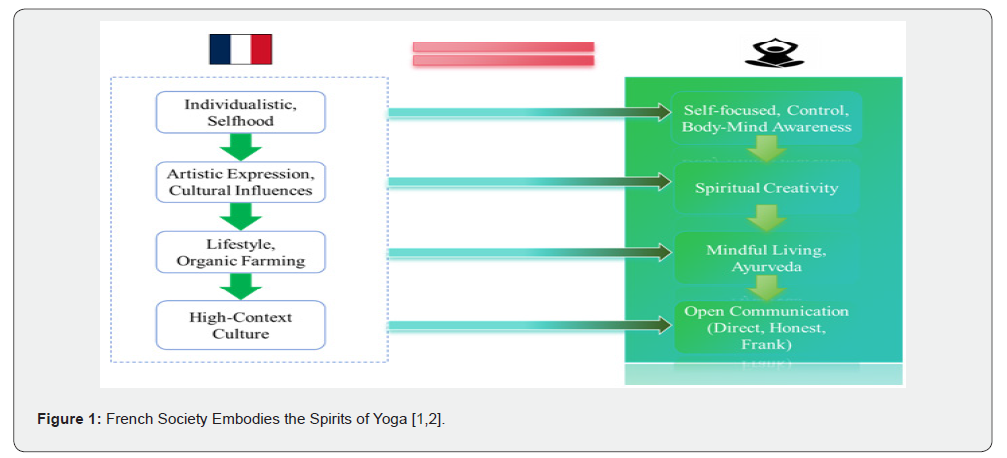
From the 7-years’ yoga experience (practitioner and instructor) in China and Japan the lead author brings a unique cross-cultural perspective to the idea discussed here, and leading to a proposal for a deeper study in France. Recently, in France, experienced a yoga quite different from the one she was used to, namely - one that is tune with the French lifestyle and culture. In other words, a type of yoga that aligns with the cultural values of French society that is based on ‘individualism’, ‘art’, ‘lifestyle’, and ‘communication’ (Figure 1). This figure illustrates the core values of France and its culture aligns closely with the spirit of yoga [1,2].
In France, there is a strong emphasis on individualism and a deep sense of selfhood which resonates deeply with yoga’s foundational principle: self-focused through body-mind awareness and control. Both encourage individuals to understand, care for, and express their inner world. This introspective focus naturally leads to artistic expression, which holds a prominent place in French society. Likewise, yoga practice can be viewed as a form of spiritual art: fluid, expressive, and deeply personal. Practicing yoga often evokes feelings of curiosity, creativity and beauty, much like engaging with or creating art. Consequently, yoga becomes a spiritual art that nurtures inner beauty and emotional depth/expression. With this beauty and balance cultivated within, a mindful and healthy lifestyle tends to follow.
French culture already values a slower, more intentional way of living, marked by self-respect, efficiency, and organic farming. These elements mirror yoga’s holistic lifestyle teachings, especially the integration of Ayurveda, an ancient Indian system of medicine that emphasizes balance in body, mind, and spirit through diet, lifestyle, and natural therapies. Finally, both France and yoga uphold the importance of open communication. While France is considered a high-context culture where communication is layered with non-verbal cues, shared understanding, and cultural nuance, interpersonal expression is still valued for being direct, honest, and intellectually engaging. This cultural characteristic aligns with the communal aspect of yoga, where practice extends beyond the self to foster dialogue, connection, and shared growth of the individual and country (Figure 1).
Why France?
The lead author had an internship at the University of Montpellier in 2024 (to 2025). And, was surprised by the open, creative spirit of French academic life and, observed how the ecosystem shapes individual mindset and creativity. An observation was that, a freer and innovative approach of the French education system allows to realize that work and learning flourish when individuals are given the freedom to think and express themselves openly. What impressed the most is that professors and students engage as equals, fostering an environment where diverse topics are discussed freely and thoughtfully. Students express their opinions confidently and express bravely and naturally upon disagreement with the professors’ opinions. These contrast sharply with Asia, where societal and educational pressures often inhibit creativity and personal growth.
The French lifestyle itself seemed to be centered on knowing self and living true selves. Whether it was in the classroom or on the streets, it was seen that people prioritized quality of life and art over commonalities. These values aligned perfectly with the lead author’s inner longing providing a fresh perspective on how yoga could be lived beyond practice. French yoga embodies the true spirit of yoga: artistic, free, emotionally alive, and connected to the present moment. After experiencing yoga and life here for three months, yoga was seen less as a tool and more as a lifestyle, deeply intertwined with French values. Yoga is art. It is beauty. It is communication with the self and the community. And in France, all of that is allowed and even encouraged.
Yoga in France
In France, there is a strong emphasis on being self-focused-a quality that resonates deeply with yoga’s foundational principle: connecting to self through body-mind awareness and control. Both encourage individuals to understand, care for, and express their inner world. Yoga is not only a solitary journey but also a shared experience where people connect, learn, and grow together. Similarly, in daily French life, discussions are lively and expressive, whether in classrooms or cafés. During the lead author’s time teaching yoga in Montpellier and Bayonne (South France), was surprised by the students. Some lay down during breath work; others skipped poses because they were simply following their feelings and needs rather than out of disrespect. One student even refused the instructor’s adjustment during classes, but later came up and said ‘she loved the class’, implying yoga is not only about obedience or compromising with the instructor, but about connection with the self.
As a participant-observer in suburban Paris, saw that yoga in France is not viewed as a discipline of limitation, but as an expression of freedom. In both French yoga and lifestyle, expressing feelings and ideas through art, movement, or speech is deeply valued. Even yoga becomes a kind of art. Spirituality in French yoga feels alive and personal. It is not just about peace, but about expressing one’s spirit through movement and life. In Asia, many instructors including the lead author focuses on imitating what elements are supposed to be in a yoga class, rather than embodying their personal values. This concern was shared with the students in France. One student’s words were moving: “We want to see YOU and what YOUR yoga is”, and that gave courage to teach from the heart, to integrate everything learned across cultures into something new and true.
In class, instructors and students talk freely. There is no pressure to be silent or perfect. Instead, there is an immediate communication between students and instructors, yet with a deep focus. This was a complete shift from the lead authors’ previous teaching experience in Asia, where silence and discipline were often the norm. As a yoga professional, it was then felt (a quiet intuition in the lead author), “yoga is France, and France is yoga”.
These experiences led to a recognition of the ‘yoga in France’, and an idea started to emerge on an exploration of yoga values and practices in France through the lens of an international yoga professional (lead author) from China, and within Japan as a graduate researcher, and briefly in France as an explorer of the new Yoga.
The Emerging Research Topic
Whole Yoga System: Positioning Body Control - A Conceptual Diagram
Traditionally, yoga as a holistic system rooted in Indian philosophy (as early as the 8th century BCE), was designed to unite the body, mind, and spirit. Individuals clarify their life purpose and practice yoga for its fulfillment. Health is not the goal of yoga, but rather a result obtained as a byproduct of practicing yoga (Genboku Takahashi, personal communication, 2025). Yoga spreads to the Western world triggered by Indian ideological reform movement (Ram Mohan Roy, Rabindranath Tagore, Ramakrishna, and Swami Vivekananda) in the latter half of the 19th century.
The fact that the Western society went through two world wars was one reason why the people started focusing on the Oriental, in particular, Yoga for healing. Patanjali’s yoga sutras make up the foundation of modern yoga practice, with its eight limbs (Ashtanga Yoga) guiding practitioners from ethical living (Yama, Niyama) to ultimate liberation (Samadhi) [3]. Yet in classical texts, postures (asana) were never the beginning, they were built on ethical foundations. Today, however, for many newcomers (to yoga), abstract ideas like non-attachment or spiritual liberation can feel distant or intimidating. In 21st century, many people encounter yoga through its physical dimension and physical benefits are primarily focused in the West.
However, one has to be careful in making this generalization as even in India the current trend can be said to go to yoga studios in a way similar to going to a fitness gym (Randeep Rakwal, personal communication, 2025). It can be stated that in France, the separation of body and mind has deep historical roots, largely influenced by Cartesian dualism. And it is only since the 1980s that the body is no longer viewed as secondary to the mind but is now seen as center to understand social and cultural thought [4-6], while Asia has long integrated body and mind through traditional practices such as Chinese Tai Chi and Japanese martial arts. Yoga in Asia similarly promotes a holistic approach with deeper integration of body and mind. Specifically, China emphasizes on internal energy regulation (Qi) [7], and Japan emphasizes on precise body alignment [8,9].
However, physical practice does not mean that the core values of yoga are erased. In fact, many instructors/teachers and practitioners are deeply aware of yoga’s philosophical roots and skillfully integrate them into daily practice [10,11]. Consistent physical practice and cleansing techniques naturally lead to inner wisdom and clarity, and the body is tangible and immediate [12]. It acts as a visible gateway into the deeper, often invisible layers of yoga and self. Through body control, people experience breath, sensation, focus, and even meditative state-sometimes without consciously aiming for them. This embodied path naturally awakens inner awareness, emotional regulation, and self-discipline [13].
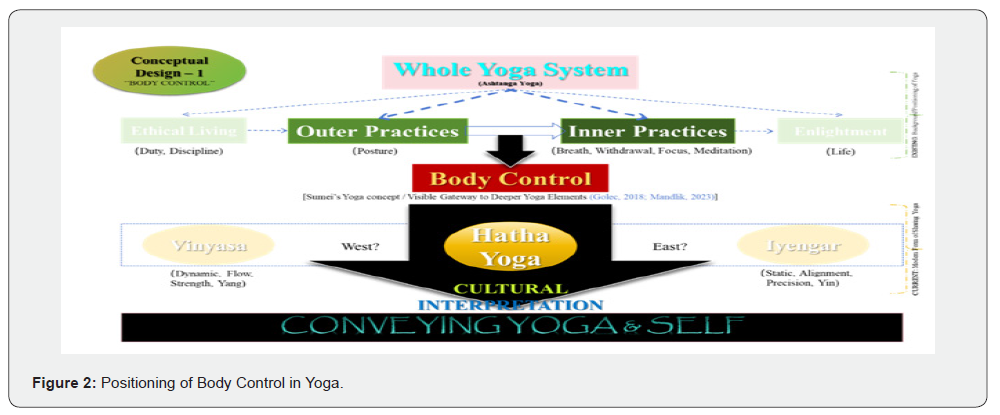
In this way, traditional values are preserved, but in a more accessible way. This research does not seek to limit yoga to the physical, but to explore and create a yoga practice that is both accessible and deeply rooted, one that honors tradition while serving today’s (21st century) needs. Beginning with the body is not a lesser choice; rather, it is a modern entry point into the full system of yoga. As illustrated in this conceptual image, body control serves as a bridge between the outer (asana) and the inner (breath, focus, meditation) practices (Figure 2). It is a visible starting point for deeper inner work [14]. The research motivated by lead author’s three-month internship in France, experienced a socio-cultural shift in her own (Asian) way of yoga thought and practice. Understanding yoga from the lens of French society and culture is a new awareness [15,16]. Vinyasa yoga emphasizes dynamic movement (Yang), often found in France where art and expression shape yoga culture, is her belief. In contrast, Iyengar yoga emphasizes precision and stillness (Yin), reflecting Asian preferences for subtle control and balance [17,18].
Positioned between these styles, Hatha yoga serves as a foundational middle path, combining effort and ease. By examining yoga’s cultural expressions-particularly in France, where yoga is integrated with lifestyle, art, and education [19], this research supports the development of a future yoga thought (new yoga school) that bridges East and West, tradition and modernity, philosophy and practice. The goal is to design a system that is accessible, affordable, and applicable (AAA+): one that is rooted in tradition, yet open and relevant to all.
Integration of Yoga, Self-Management and Health
Central to health, the research is to explore how yoga in France and Asia differs in its interpretation on body control, and how this (perception) shapes the well-being of a person and therein society and its overall harmony (Figure 3). Mind influences the body and a mindful (healthy) body reinforces the mind. Society and culture affect the mind shaping individual values and behavior. Yoga is control over the body but not separated from the mind. And, the practice of yoga has sustained since time immemorial, i.e., it has withstood the test of time. Now, human embraces yoga across cultures, globally. Yoga works through the body control in conjunction with the mind with a single-minded goal of keeping health, and good health is duty to both self and society. Body is the physical entity one sees (awareness through self-observation) and control is regulation (self-focused/directed action). In other words, self-management is what yoga actually is. A recent review on yoga interventions highlights the practice of yoga in achieving a balance and high-quality of body awareness/control [14] (Figure 3).
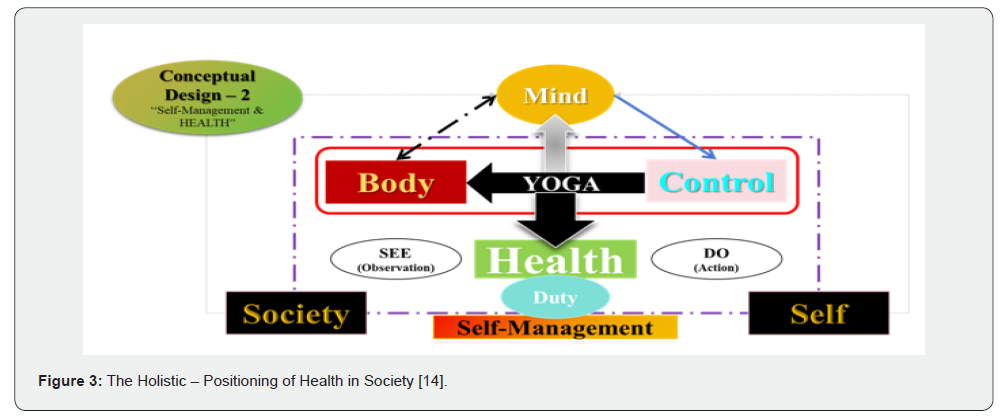
Definitions: Body = the physical structure (joints, muscles, movements); Control = the ability to move, align, and stabilize the body with awareness (breathing & circulation); Physical Control = How the body is aligned, moved, and stabilized in yoga practice; Health = a state of physical, mental, emotional, spiritual and social balance; Self-Management = how a person regulates their health through yoga practice and lifestyle. In other words, self-management is a guide to health.
Proposed Research Methodology
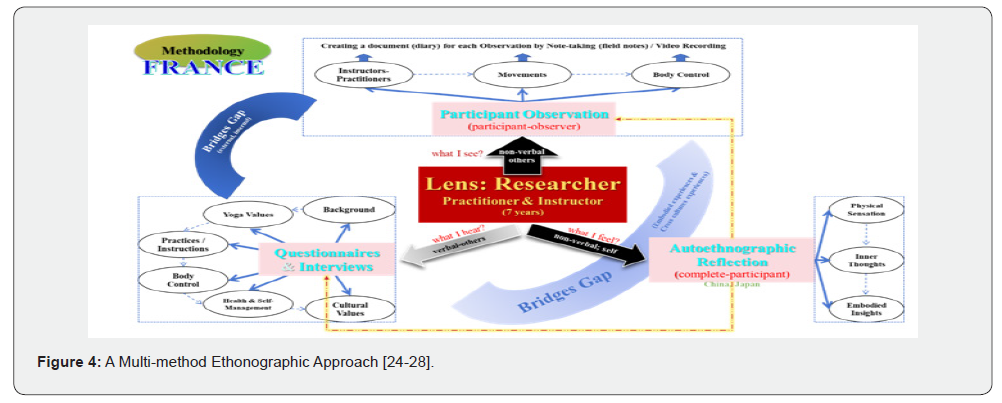
With this background, thus it is proposed that a multi-method ethnographic approach combining participant observation, questionnaires and interviews, and auto-ethnographic reflection be conducted in order to dwell on yoga ecosystem in France (Figure 4). This design aims to explore how cultural contexts influence yoga practice and body control across France. As a core method, participant observation focuses on non-verbal behaviors during yoga classes, such as instructor-practitioner interactions, body control, movements [20]. These observations are recorded through field notes and video to capture cultural and behavioral patterns that may not be expressed verbally. To access participants’ internal perspectives, questionnaires and interviews explore their personal background, yoga values, body control, health and self-management, cultural values [21]. This verbal method complements observation by adding depth to external behaviors and linking them to personal and cultural meanings.
With a yoga professional and research background, the author performs autoethnography to reflect on personal practice in different cultural settings. This includes recording physical sensa tions, emotions, and embodied insights that are hard to express but essential to understanding yoga [22-28]. These reflections highlight how cultural environments shape bodily experience, offering a unique perspective that local participants may not recognize themselves. Together, these methods form a triangulated approach that bridges two key gaps: the external-internal gap (between external behaviors and internal interpretations), and the interpreted-embodied gap (between observed others and own embodied experiences and cross cultures experiences). This design enables a rich, culturally sensitive understanding of how yoga and body control are experienced and shaped across cultures (Figure 4).
Concluding Remarks
This future research draws on two main inputs/rationales. The first is personal: the lead author’s experience as a yoga practitioner/ instructor and graduate-level researcher, her skills in communication and languages, her motivation to cross borders from China to Japan to France to pursue her passion in yoga, and her desire to contribute to health for all, including women. The second is global: an international mind shaped by Asian perspectives, her identity as a cross-cultural individual, and her understanding of yoga through sports science and medicine research. Good yoga practice and values for both self and others is the underlying principle that has moved this idea into a perspective article. “Good” refers to yoga that brings social benefits (beneficial) in a simplified (accessible) form that can be effectively shared and communicated to the general public. Learning from the way yoga is practiced in French society, it is the aim of the lead author to develop a yoga style, curricular and school, contributing to a broader understanding of yoga from both Western and Eastern sociological viewpoints. As a graduate researcher, is also actively engaging in expanding her ideas through research, publications, and building networks to connect countries and people.
Acknowledgements
The authors gratefully acknowledge Santesih UR_UM211, University of Montpellier, and Gabriel Bahtit, Stephanie Mamousse for their generous support of Sumei Huang during her internship in France. Sumei Huang also extends her sincere appreciation for the numerous opportunities provided in China and Japan, which have been instrumental in shaping and refining her research ideas.
References
- Bréchon P (2021) Individualisation rising and individualism declining in France: How can this be explained?. Fr Polit 19: 114-138.
- Kesse E (2022) Key findings of the French BioNutriNet project on organic food-based diets: Description, determinants, and relationships to health and the environment. Adv Nutr 13(1): 208-224.
- De E (2005) A history of modern yoga: Patanjali and western esotericism. Continuum, USA.
- Merleau-Ponty M (1945) Phenomenology of Perception. Gallimard, Paris.
- Foucault M (1975) Discipline and Punish: The Birth of the Prison (A Sheridan Trans). Pantheon Books, USA.
- Le Breton D (1990) Anthropologie du corps et modernité. Presses Universitaires de France, France.
- Kirkland R (2004) Taoism: The Enduring Tradition. Routledge, UK.
- Hurst GC (1998) Armed Martial Arts of Japan: Swordsmanship and Archery. Yale University Press, USA.
- Huang S (2025) Yoga as a global practice: Towards a comparative study of France and Asia’s approach to body control. J Yoga and Physio 12(3): 555836.
- Golec A, Lantos D, Bowden D (2017) Yoga poses increase subjective energy and state self-esteem in comparison to 'power poses'. Front Psychol 8: 752.
- Mandlik GV, Nguyen B, Ding D, Edwards KM (2023) Not all yoga styles are the same: An international survey on characteristics of yoga classes. J Integr Complement Med 29(5): 321-326.
- Fish A (2006) The commodification and exchange of yoga in the U.S. market. Int J Hindu Studies 10(1): 1-38.
- Alter JS (2004) Yoga in Modern India: The Body Between Science and Philosophy. Princeton University Press, USA.
- Camille LG, Katherine EG, Erika KO, Crystal LP (2025) Changes in body awareness in yoga interventions: A systematic review. Comp Therap in Clin Prac 59: 1744-3881.
- Ben HM (2021) Healing myths, yoga styles and social bodies: socio-logics of yoga as a health practice in the socially stratified city of Marseille, France. Anthropol Med 28(3): 374-394.
- Patrick T (2021) La pratique du yoga en France en 2021: Résultats de la grande enquête menée par le SNPY.
- Forseth B, Hunter SD (2020) Range of yoga intensities from savasana to sweating: A systematic review. J Phys Act Health 17(2): 242-249.
- Iyengar BKS (1966). Light on Yoga. New York: Schocken Books, USA.
- Strauss S (2005) Positioning Yoga: Balancing Acts Across Cultures. Berg Publishers, USA.
- Bevilacqua D (2020) Observing yoga: The use of ethnographic methodologies to develop yoga studies. Routledge Handbook of Yoga and Meditation Studies, England.
- Gard T, Noggle JJ, Park CL, Vago DR, Wilson A (2014) Potential self-regulatory mechanisms of yoga for psychological health. Front Hum Neurosci 8: 770.
- Wall S (2008) Easier said than done: Writing an autoethnography. Int J Qual Methods 7(1): 38-53.
- Tarisayi KS (2023) Autoethnography as a qualitative methodology: Conceptual foundations, techniques,benefits and limitations. Encyclopaideia 27(67): 53-63.
- Roller MR, Lavrakas PJ (2015) Applied Qualitative Research Design: A Total Quality Framework Approach. New York: Guilford Press, USA pp. 182-184.
- Bailly H (2014) Negotiating yoga: Between the sacred and the secular. Sites: A J Social Anthropology and Cultural Studies 11(2): 1-27.
- Ellis C, Adams TE, Bochner AP (2010) Autoethnography: An overview. Forum Qualitative Sozialforschung 12(1).
- Morrow F, Kettle M (2023) Putting the auto in ethnography: The embodied process of reflexivity on positionality. Qualitative Social Work 23(3): 554-565.
- Bril B (2018) Action, movement, and culture: Does culture shape movement? Kinesiol Rev 7(1): 1-9.

























