




 JRANN Home


Abstract
Massively parallel sequencing (MPS), commonly referred to as next-generation sequencing (NGS), has fundamentally altered the landscape of molecular biology and clinical medicine. By enabling simultaneous sequencing of millions to billions of DNA fragments, NGS has replaced the sequential limitations of Sanger sequencing and established a new paradigm of high-throughput genomic analysis. This technological shift has accelerated genome-scale research, improved diagnostic precision, and expanded translational applications across oncology, infectious diseases, and personalized medicine. Beyond throughput, NGS has catalyzed conceptual changes in biomedical science by making genomic information accessible at unprecedented speed and cost efficiency. Recent advances, including single-cell analysis, real-time sequencing, and massively parallel functional assays, illustrate the continued evolution of the field from descriptive genomics to mechanistic and therapeutic discovery. This editorial examines the technological principles, biomedical impact, and future directions of massively parallel sequencing, highlighting its role as a cornerstone of precision medicine and a driver of contemporary biomedical innovation.
Keywords: Next-generation sequencing; Massively parallel sequencing; Genomics; Precision medicine; Cancer genomics; Clinical dignostics; DNA sequencing; Translational medicine
Abbreviations: MPS: Massively parallel sequencing; NGS: Next-Generation Sequencing; Seq: sequence
Introduction
4. Editorial
The history of DNA sequencing has been marked by successive breakthroughs, yet few have been as transformative as the emergence of massively parallel sequencing. Introduced as a disruptive alternative to Sanger sequencing, NGS shifted the field from low-throughput, reaction-based analysis to simultaneous large-scale decoding of genetic material. This transition has reshaped genomic science, not merely by increasing speed but by changing the very scale at which biological questions can be addressed. The ability to sequence entire genomes in a single experiment has transformed genomics from a specialized research tool into an essential platform for medicine, biotechnology, and population health [1,2].
At the technological core of NGS lies parallelism. DNA fragments are distributed across sequencing substrates such as flow cells, clonally amplified or directly analyzed, and read simultaneously through highly automated chemistry and imaging systems. This architecture eliminated the physical fragment separation required by earlier methods and enabled a dramatic increase in throughput. Such parallelization has reduced sequencing costs by several orders of magnitude, allowing routine applications such as whole exome sequencing, whole genome sequencing, and targeted multigene panels. These developments have brought genomic analysis into routine clinical practice, especially in hereditary disorders and oncology [1,2].
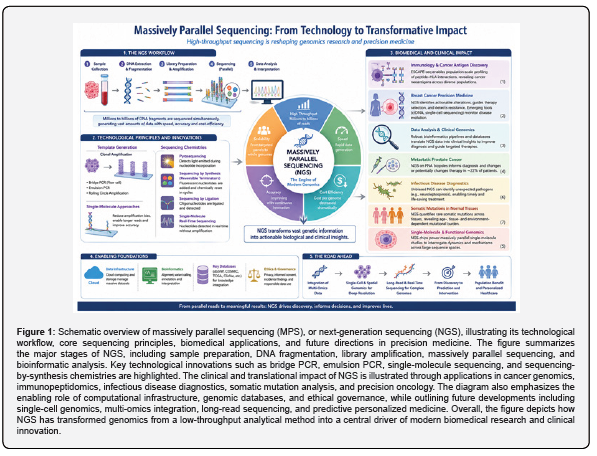
The sequencing workflow remains anchored in a series of fundamental steps: DNA extraction, fragmentation, library preparation, amplification, sequencing chemistry, and bioinformatic interpretation. Although these stages appear standardized, each remains a source of technical variability. Library preparation, in particular, continues to influence coverage uniformity, read quality, and downstream variant detection. Amplification methods such as bridge PCR, emulsion PCR, and rolling circle amplification have enabled signal enhancement, while single-molecule approaches are reducing amplification bias and permitting longer reads. These refinements underscore that NGS is not a single technology, but a family of evolving platforms united by scalability [2,3].
Sequencing chemistry has also diversified substantially. Pyrosequencing, sequencing by synthesis with reversible terminators, sequencing by ligation, and single-molecule real-time approaches each represent distinct solutions to the challenge of nucleotide detection. These systems balance trade-offs between read length, error profile, cost, and throughput. Recent innovations have gone further by transforming sequencing chips into experimental platforms for biological interrogation. Scientists demonstrated that next-generation sequencing chips can be repurposed for large-scale single-molecule dynamic analyses, allowing simultaneous mechanistic studies across vast sequence libraries. Such approaches extend NGS beyond sequence determination into functional biophysics and molecular engineering [3].
The biomedical consequences of NGS are particularly evident in oncology. Cancer is fundamentally a genomic disease, and NGS has enabled unprecedented characterization of tumor heterogeneity, clonal evolution, and therapeutic resistance. In breast cancer, NGS has revealed actionable alterations that inform prognosis, treatment selection, and monitoring, including the identification of resistance mechanisms to targeted agents such as trastuzumab and CDK4/6 inhibitors. The incorporation of circulating tumor DNA and single-cell sequencing further broadens the capacity to track disease evolution noninvasively and at cellular resolution, reinforcing the centrality of NGS in precision oncology [4].
Similarly, the clinical value of NGS is expanding in metastatic cancers where tissue availability may be limited. Scientists demonstrated the practical utility of NGS on fine-needle aspiration specimens from metastatic prostate cancer, where genomic findings altered or potentially altered treatment strategies in nearly one-quarter of patients. Such work illustrates how NGS is not only a discovery tool but also a direct determinant of patient management. The integration of genomic findings into diagnostic workflows is increasingly redefining pathology as a molecular discipline rather than solely a morphologic one [5].
The reach of NGS extends beyond oncology into infectious disease diagnostics, where its unbiased nature offers critical advantages. A landmark example remains the identification of neuroleptospirosis through metagenomic sequencing of cerebrospinal fluid in a child whose conventional diagnostic workup was inconclusive. The detection of a rare pathogen through sequencing enabled targeted antimicrobial therapy and clinical recovery. This case demonstrated the power of NGS as a hypothesis-free diagnostic tool, capable of identifying unexpected infectious agents when standard assays fail. It marked an early proof-of-concept for genomic medicine in acute clinical care [6].
Massively parallel sequencing has also deepened understanding of somatic variation in normal tissues. Scientists used a specialized NGS approach to quantify rare somatic mutations across human tissues, revealing substantial differences associated with age, environment, and tissue type. Their findings highlighted that mutational accumulation is a universal biological process and that the genomic distinction between normal and malignant tissues may be more quantitative than categorical. Such insights would have been inaccessible without the sensitivity and scale of massively parallel sequencing [7].
Recent developments show that NGS is moving from descriptive genomics to direct functional interrogation. ESCAPE-seq exemplifies this transition by combining massively parallel DNA sequencing with immunopeptidomics to evaluate antigen presentation across tens of thousands of peptide-HLA combinations. This platform provides population-scale insights into immune recognition and cancer antigen presentation, revealing candidate epitopes from oncogenic mutations and fusions. Such approaches position sequencing as an experimental engine for immunotherapy discovery and translational immunology [8].
Despite these advances, challenges remain. Data interpretation, storage, and ethical governance are increasingly significant barriers. The sheer volume of data generated by NGS necessitates robust computational pipelines, cloud-based infrastructure, and standardized variant annotation frameworks. Furthermore, issues related to informed consent, incidental findings, and genomic privacy are becoming central to implementation. The future of NGS will depend not only on sequencing chemistry but also on responsible data integration and ethical stewardship of genomic information [1].
The future trajectory of NGS is likely to be defined by convergence. Integration with transcriptomics, proteomics, epigenomics, and spatial analysis is creating a multi-dimensional understanding of biological systems. Single-cell approaches, in particular, promise to resolve cellular heterogeneity at unprecedented depth, while real-time and long-read technologies are expanding the ability to characterize structural variation and complex genomic architecture. As these platforms mature, genomics is shifting from retrospective analysis toward predictive and interventional science [1,4].
Conclusion
Massively parallel sequencing has moved beyond being a technological improvement over conventional sequencing; it has redefined the epistemology of biomedical science. By enabling comprehensive, scalable, and increasingly accessible genomic interrogation, NGS has accelerated discovery across cancer biology, infectious disease, immunology, and human genetics. Its evolution from sequence acquisition to functional and clinical integration marks a decisive turning point in modern medicine. The ongoing challenge lies not in generating genomic information, but in interpreting and applying it responsibly. As costs decline and analytical sophistication increases, NGS is poised not merely to support scientific progress, but to shape the future architecture of healthcare itself (Figure 1) [9-44].
Acknowledgment
The author acknowledges Mrs. Norri Zahra and Mr. Regragui Moumaris. The author thinks Nisen Abuaf and Said Youssouf Chanfi (Sorbonne University). The author thinks Jean-Michel Bretagne (AP-HP). The author thinks Marie-Hélène Maës and Monique Abuaf (Research and Development Company).
References
- Beura A, Manjunath GK, Mahalingam S, Rajguru MS, Dakal TC, et al. (2025) Next generation DNA sequencing data analysis and its application in clinical genomics. Pathol Res Pract 276: 156280.
- Georget M, Pisan E (2023) [Next Generation Sequencing (NGS) for beginners]. Rev Mal Respir 40(4): 345-358.
- Rivera AJ, Mao G, Sabantsev A, Panfilov M, Hou Q, et al. (2024) Massively parallel analysis of single-molecule dynamics on next-generation sequencing chips. Science 385(6711): 892-898.
- Mohd Zuhdi NF, Siddig A, Mohd Nafi SN, Md Salleh MS, Yahya MM, et al. (2025) Next-generation sequencing in breast cancer: current clinical applications and future directions. Ann Med 57(1): 2569989.
- Sirohi D, Ding CCK, Stohr BA, Balassanian R, Vohra P, et al. (2025) The utility of next-generation sequencing in metastatic prostate cancer FNA biopsies. Cancer Cytopathol 133(9): e70038.
- Wilson MR, Naccache SN, Samayoa E, Biagtan M, Bashir H, et al. (2014) Actionable diagnosis of neuroleptospirosis by next-generation sequencing. N Engl J Med 370(25): 2408-2417.
- Hoang ML, Kinde I, Tomasetti C, McMahon KW, Rosenquist TA, et al. (2016) Genome-wide quantification of rare somatic mutations in normal human tissues using massively parallel sequencing. Proc Natl Acad Sci USA 113(35): 9846-9851.
- Shi Q, Simon EP, Bozkus CC, Kaminska A, Velazquez L, et al. (2025) Massively parallel immunopeptidome by DNA sequencing provides insights into cancer antigen presentation. Nat Genet 57(8): 2062-2073.
- Moumaris M (2026) Plasmodium Biology: Scientific Classification, Glob. Open Access J Sci 2(1): 06-10.
- Moumaris M (2025) Exploring Magnetic Resonance Imaging Technology: Magnet Types, Imaging Innovations, and Advances in Diagnostic Precision. J of Life Sci Sys Tech 1(2): 1-4.
- Moumaris M (2025) Gene editing revolution: CRISPR/Cas and the future of cancer treatment. Journal of Biotechnology and Bioprocessing 6(6).
- Moumaris M (2025) Exploring magnetic resonance imaging technology: Magnet types, imaging innovations, and advances in diagnostic precision. Journal of Life Science Systems and Technology 1(2): 1-4.
- Moumaris M (2025) Advancing cancer immunotherapy: The promise and challenges of CAR-NK cell therapy. Journal of Biotechnology and Bioprocessing 6(4): 2766-2314.
- Moumaris M (2025) Organelle adaptations in Plasmodium: The targets for malaria treatments. International Journal of Zoology and Animal Biology 8(1): 000640.
- Moumaris M (2024) Cell membrane compartmentalization and membrane dynamics during Plasmodium infection. International Journal of Zoology and Animal Biology 7(6): 000637.
- Moumaris M (2024) Advancements in magnetic resonance imaging: Transforming non-invasive diagnosis and treatment monitoring in radiology. Journal of Life Science Research and Review 2(5): 1-3.
- Moumaris M (2024) Plasmodium's secret: How a complex endomembrane system drives malaria's deadly efficiency. International Journal of Zoology and Animal Biology 7(6): 000631.
- Moumaris M (2024) Malaria's hidden weapon: How Plasmodium transforms red blood cells to evade and invade. International Journal of Zoology and Animal Biology 7(6): 000629.
- Moumaris M (2024) Advancements in diagnosing and treating Plasmodium knowlesi: Challenges and innovations. International Journal of Zoology and Animal Biology 7(5): 000622.
- Moumaris M (2024) Confronting Plasmodium knowlesi: Challenges and strategies in malaria healthcare. International Journal of Zoology and Animal Biology 7(4): 000607.
- Moumaris M (2024) Unraveling the enigma: Tackling Knowlesi malaria in Southeast Asia. International Journal of Zoology and Animal Biology 7(2): 000585.
- Moumaris M (2024) Unveiling the enigmatic Plasmodium knowlesi: Insights, challenges, and promises in malaria research. International Journal of Zoology and Animal Biology 7(1): 000566.
- Moumaris M (2024) Lyme disease: A zoonosis tick-borne Borrelia bacterium [4/4]. International Journal of Zoology and Animal Biology 7(1): 000549.
- Moumaris M (2024) Unlocking the potential: Overcoming challenges in CAR-T cell therapy for cancer treatment. Journal of Biotechnology and Bioprocessing 5(2): 2766–2314.
- Moumaris M (2023) Revolutionizing malaria research: CRISPR unveils new frontiers. Journal of Biotechnology and Bioprocessing 4(5): 2766–2314.
- Moumaris M (2023) Lyme disease: A zoonosis tick-borne Borrelia bacterium [3/4]. International Journal of Zoology and Animal Biology 6(4): 000500.
- Moumaris M (2023) Lyme disease: A zoonosis tick-borne Borrelia bacterium [2/4]. International Journal of Zoology and Animal Biology 6(2): 000465.
- Moumaris M (2022) Lyme disease: A zoonosis tick-borne Borrelia bacterium [1/4]. International Journal of Zoology and Animal Biology 5(6): 000425.
- Moumaris M, Bretagne JM, Abuaf N (2020) Nanomedical devices and cancer theranostics. The Open Nanomedicine and Nanotechnology Journal 6: 1-11.
- Moumaris M, Bretagne JM, Abuaf N (2019) Biological membranes and malaria-parasites. The Open Parasitology Journal 7: 1-18.
- Moumaris M, Bretagne JM, Abuaf N (2018) Hospital engineering of medical devices in France. The Open Medical Devices Journal 6: 10-20.
- Moumaris M, Rajoely B, Abuaf N (2015) Fluorescein isothiocyanate-dextran can track apoptosis and necrosis induced by heat shock of peripheral blood mononuclear cells and HeLa cells. Open Biological Sciences Journal 1: 7-15.
- Moumaris M, Rajoely B, Abuaf N (2012) The naïve B cells are the lymphocytes with the highest anionic phospholipid binding ratios. The Open Immunology Journal 5: 27-35.
- Moumaris M, Abuaf N (2002) Use of labeled dextran for in-vitro assessment of increased cell permeability, cell death and apoptosis (Brevet n°00/09235). Bulletin Officiel de la Propriété Industrielle, 2811682, A3.
- Moumaris M, Benoliel S, Rouquette AM, Rajoely B, Abuaf N (2000) Phospholipid binding proteins on the plasma membrane of lymphocytes. Journal of Autoimmunity 15(2): 81-271.
- Moumaris M (1996) Erythrocyte membranes in malaria: Mouse–*Plasmodium berghei* ANKA study model (Doctoral thesis). Pierre and Marie Curie University, Paris, France.
- Moumaris M, Sestier C, Miltgen F, Halbreich A, Gentilini M, et al. (1995) Effect of fatty acid treatment in cerebral malaria-susceptible and nonsusceptible strains of mice. The Journal of Parasitology 81(6): 997-999.
- Moumaris M (2007) Magnetic resonance imaging at the Hôtel-Dieu of Paris (Thesis). Paris-Descartes University, Paris, France.
- Moumaris M (2005) Identification of a new molecule to monitor apoptosis (Thesis). Sorbonne-Paris-Nord University, Paris, France.
- Moumaris M (2003) Biomedical research and the law of bioethics relating to the donation and use of elements and products of the human body (Thesis). Paris-Descartes University, Paris, France.
- Moumaris M (1999) Characterization of B-cell adhering to the lamellar phospholipids. In Congress of Antiphospholipid Antibody (Conference proceedings). Paris, France.
- Sabolovic D, Moumaris M, Miltgen F, Sestier C, Halbreich A (1995) A subpopulation of red blood cells induced by bleeding or mosquito sucking. In Chinese National Congress of Medical Biophysics (Conference proceedings). Shanghai, China.
- Sabolovic D, Moumaris M, Miltgen F, Sestier C, Halbreich A (1995) Characterisation of subpopulation of red blood cells as a preferential target for malaria invasion. In Congress of Electrophoresis, Paris, France 19(7): 1215-1219.
- Moumaris M (1992) Lyme disease: Serological study (Thesis). University of Orleans and Regional Hospital Center of Orleans, France.

























