




 ARTOAJ Home



An Evaluation of Vitamin D Receptor (VDR), Telomerase and Citrate Synthase in Various Tissues after Treatment with the Biofield Energy Healing based Test Formulation in Vitamin D3 Deficiency Diet (VDD) Induced Animal Model
Mahendra Kumar Trivedi1, Alice Branton1, Dahryn Trivedi1 and Snehasis Jana2*
1Trivedi Global, Inc., USA
2Trivedi Science Research Laboratory Pvt. Ltd., India
Submission: May 4,2021; Published: June 14, 2021
*Corresponding author:Snehasis Jana, Trivedi Science Research Laboratory Pvt. Ltd., India
How to cite this article:Mahendra K T, Alice B, Dahryn T, Snehasis J. An Evaluation of Vitamin D Receptor (VDR), Telomerase and Citrate Synthase in Various Tissues after Treatment with the Biofield Energy Healing based Test Formulation in Vitamin D3 Deficiency Diet (VDD) Induced Animal Model. J of Pharmacol & Clin Res. 2021; 8(4): 555744. DOI: 10.19080/JPCR.2021.08.555744
Abstract
The study was evaluated the impact of Consciousness Energy Healing Treatment/Blessing (the Trivedi Effect®) on test formulation in rats under the influence of vitamin D3 deficiency diet (VDD). The following mechanistic biomarkers were estimated such as vitamin D receptor (VDR), telomerase, and citrate synthase enzymes. The test formulation’s ingredient was divided into two parts; one part was defined as untreated test formulation, while the other parts and the animals provided Biofield Energy Healing/Blessing Treatment by Mr. Mahendra Kumar Trivedi. The expression of VDR in liver was significant increased by 74.91%, 100.66%, and 64.25% in the G5 (VDD + Biofield Energy Treated test formulation), G6 (VDD + Biofield Energy Treatment per se to animals from day -15), and G7 (VDD + Biofield Energy Treated test formulation from day -15) groups, respectively as compared with the disease control (G2) group. Similarly, the expression of VDR in adipose tissue was significant increased by 268.6% (p≤0.001), 163.13% (p≤0.001), 92.42%, and 63.25% in G5, G6, G7, and G9 groups, respectively, than G4. However, the level of liver telomerase was reported to be increased by 59.09% (p ≤0.001), 68.18% (p ≤0.001), and 68.18% (p ≤0.001) in the G6, G7, and G8, respectively as compared to the G4. Similarly, the telomerase level in the thigh muscle was significant increased by 15.79% in the G7 group as compared with the G4 group. Besides, the level of citrate synthase was significantly increased by 5.89% in the G8 group as compared to the G2 group. Altogether, the Biofield Treated/Blessed test formulation and Biofield Treatment per se to the animals could be an effective approach to improve the functioning of VDR (liver and adipose tissue), telomerase enzyme (liver and thigh muscle), and mitochondrial activity in terms of citrate synthase (substrate of kreb’s cycle). Therefore, the findings could be used against bone-related disorders (osteoporosis, fracture, scoliosis, and bone cancer), deficiency of vitamin D3, and mitochondrial dysfunction in associate with age-related and neurodegeneration disorders such as Alzheimer’s disease, dementias, brain cancer, epilepsy and Parkinson’s. The data showed a significant reduction of disease progression and all other disease-related complications/symptoms in the preventive treatment groups viz. G6, G7, G8, and G9.
Keywords: Calcitriol; Biofield Treatment; Vitamin D Receptor; The Trivedi Effect®; Citrate synthase; Vitamin D3 deficiency diet
Introduction
A biomarker acts as an indicator in various pathological and biological processes. The mechanistic biomarker is used to guide the clinical management of different diseases [1]. Telomerase is a reverse transcriptase enzyme. It can restore DNA known as telomeres, otherwise shortened the telomere length, during cell division via mitosis. In humans, skeletal muscle telomere lengths remain stable from ages 23-74 years, hence muscular tissues are selected for the estimation of telomerase enzyme [2]. Besides, in human liver, hepatocytes show no age-related telomere shortening effect, hence liver tissue is also selected in this study for the estimation of telomerase enzyme level [3]. Studies on rats found that the deficiency in vitamin D receptor (VDR) may develop high blood pressure that are due to the activation of the renin-angiotensin-aldosterone system, as vitamin D acts as a negative regulator of renin synthesis [4]. Several biochemical measures of mitochondrial components are used as biomarkers of mitochondrial content and muscle oxidative capacity [5]. Citrate synthase activity is a validated biomarker for mitochondrial density in skeletal muscle. It is also used as a biochemical marker of the skeletal muscle oxidative adaptation [6].
Both pre-clinical and clinical trials have been focused to develop a novel proprietary test formulation that could be useful to maintain the overall health and quality of life. However, so far, no such novel herbal-based test formulation was designed that can improve the overall organ health using cell-based standard assay. With this respect, the formulation was designed as per best scientific literature, which is the best optimizable/possible combination of different minerals (zinc, selenium, copper, iron, magnesium, and calcium), vitamins (vit. C, vit. B12, vit. E, vit. D3, and vit. B6), cannabidiol isolate, Panax ginseng extract, and β-carotene. The novel proprietary test formulation is designed for maintain of overall health and quality of life in both healthy and pathologic conditions. Minerals and vitamins are included in the test formulation possesses excellent physiological support [7- 9]. Apart from, Panax ginseng is one of the best medicinal plants that improve cognitive, mental, and immunomodulatory potential [10,11]. Cannabidiol (CBD) isolates has been widely reported in many pharmacological functions [12,13].
Biofield Therapy was reported in multiple scientific studies and clinical trials for its beneficial effects on cervical cancer patients [14], massage therapy [15]. Complementary and Alternative Medicine (CAM) therapies have been reported that Biofield Therapies (or Healing Modalities) as one of the best preferred models of treatment with several benefits to enhance mental, physical, and emotional human wellness. National Centre of Complementary and Integrative Health (NCCIH) has been recognized and accepted Biofield Energy Healing as a CAM along with other therapies viz. Reiki, Qi Gong, Tai Chi, chiropractic/ osteopathic manipulation, deep breathing, yoga, meditation, massage, homeopathy, progressive relaxation, guided imagery, special diets, acupressure, acupuncture, relaxation techniques, healing touch, hypnotherapy, pilates, movement therapy, traditional Chinese herbs and medicines, Ayurvedic medicine, naturopathy, cranial sacral therapy, and aromatherapy.
Human Biofield Energy has subtle energy that has the capacity to work in an effective manner [16,17]. Biofield Energy Healing/Blessing Treatment (the Trivedi Effect®) results has been published in numerous peer-reviewed science journals with significant outcomes in many scientific fields on various models in the materials science [18,19], agriculture science [20], microbiology [21,22], biotechnology [23,24], and improved bioavailability of various compounds [25,26], skin health [27,28], nutraceuticals [29], cancer research [30], bone health [31- 33], overall human health and wellness. The present study was designed to study the various mechanistic biomarkers such as VDR and telomerase in liver tissues, VDR in adipose tissues, and telomerase in muscular tissues by ELISA assay under VDD diet and test formulation in male Sprague Dawley rats.
Materials and Methods
Chemicals
Cannabidiol isolate and Panax ginseng extract were obtained from Panacea Phytoextracts, India and Standard Hemp Company, USA, respectively. Copper chloride, cyanocobalamin (vitamin B12), calcium chloride, vitamin E (Alpha-Tocopherol), cholecalciferol (vitamin D3), iron (II) sulfate, and sodium carboxymethyl cellulose (Na-CMC) were procured from Sigma-Aldrich, USA. Calcitriol, pyridoxine hydrochloride (vitamin B6), magnesium (II) gluconate, zinc chloride, and β-carotene (retinol, provit A) were purchased from TCI, Japan. Ascorbic acid (vitamin C) and sodium selenate were obtained from Alfa Aesar, India.
Maintenance of animal
Male Sprague Dawley (SD) rats with body weight ranges (200 to 300 gm) were used in this experiment. The animals were obtained from M/s. Vivo Bio Tech, Hyderabad, India. Animals were randomly distributed into nine groups (n=6). The animals were maintained as per standard protocol throughout the experiment.
Consciousness energy healing strategies
Each ingredient of the novel test formulation was divided into two parts. One part of the test compound did not receive Biofield Energy Treatment/Blessing and were defined as the untreated or control sample; it was subjected by a “sham” healer. The “sham” healer did not have any knowledge about the Biofield Energy Treatment/Blessing. The second part of the test items and three group of animals were received the Biofield Energy Treatment/ Blessing by a renowned Biofield Energy Healer, Mr. Mahendra Kumar Trivedi under laboratory conditions for ~3 minutes. The Blessing/Treatment was given to the test items remotely in the laboratory of Dabur Research Foundation, near New Delhi, India. After blessing, the Biofield Treated/Blessed samples, animals, and untreated test samples were used as per the study plan.
Experimental procedure
The animals were randomized and grouped based on body weight after seven days of acclimatization. All the animals except G1 were fed with vitamin D3 deficient diet (VDD) from day -12 to till the end of the experiment. To induce CYP24A1 expression, to accelerate the catabolism of endogenous vitamin D3, the rats (Group G2 to G6) were received intraperitoneal injections of 40 ng of 19-nor-1,25-dihydroxyvitamin D2 (Paricalcitol) on days -12, -10, -8, -6, -4, -2, day 1, 3 and 5. Group G1 to G5 animals were dosed with respective formulations from Day 1 to till the end of the experiment. However, Group G6 were not dosed. Animals (50% of the animals from each group) were kept for overnight fasting on Day 56 (Tentative). However, remaining 50% animals were dosed with respective formulations and were kept for fasting on Day 57 (Tentative). After that, various tissues like liver, adipose, and thigh muscles were isolated, homogenized by standard in-house method for the estimation of VDR receptor, telomerase assay, and mitochondrial assay by ELISA method.
Preparation of tissue homogenate
About 100 mg of the liver and adipose tissue homogenate were prepared as per Trivedi et al. [34].
Quantification of vitamin D receptor (VDR) using Q-PCR in bone (MG-63) cells
The human bone osteosarcoma (MG-63) cells were counted using the hemocytometer were plated at a density of 2 X 10⁵ cells/ well in 6-well plates followed by overnight incubation. The cells were then sera starved for 24 hours and treated with the test formulation/positive control at the non-cytotoxic concentrations. The untreated cells that served as control that did not receive any treatment and were maintained in cell growth medium only. The treated cells were incubated for 24 hours and VDR expression was determined by Q-PCR using VDR specific primers. Cells were harvested by scrapping and washed with PBS. The cell pellets obtained were analyzed for VDR gene expression using human VDR specific primers: Forward: 5’-GCTGACCTGGTCAGTTACAGCA-3’, Reverse: 5’-CACGTCACTGACGCGGTACTT-3’. VDR gene expression was normalized using House-keeping (HK) reference. Relative quantification (RQ) of VDR gene in Biofield Energy Treated cells was calculated with respect to the untreated cells using Equation 8:
RQ = 2-N................ (8)
Where, N is the relative Threshold Cycle (CT) value of treated sample with respect to the untreated sample.
Estimation of citrate synthase enzyme in muscle
Muscles were subjected for the estimation of citrate synthase enzyme using ELISA method as per manufacturer’s recommended standard procedure.
Estimation of citrate synthase enzyme in muscle
Muscles were subjected for the estimation of citrate synthase enzyme using ELISA method as per manufacturer’s recommended standard procedure.
Statistical Analysis
The data were represented as Mean ± Standard Error of Mean (SEM) and subjected to statistical analysis using Sigma-Plot statistical software (Version 11.0). For multiple comparison Oneway analysis of variance (ANOVA) followed by post-hoc analysis by Dunnett’s test and for between two groups comparison Student’s t-test was performed. The p ≤0.05 was considered as statistically significant.
Results and Discussion
The effect of the test formulation on vitamin D receptors (VDRs)
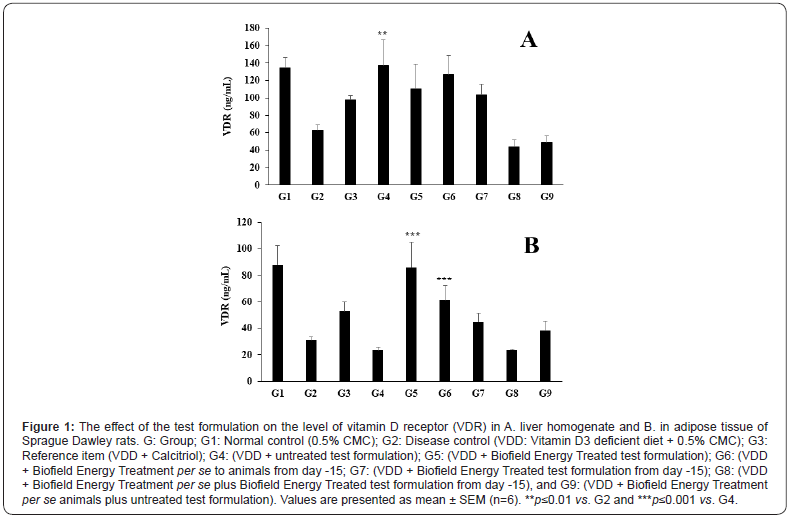
The human bone osteosarcoma cells (MG-63) were treated with the test formulation and the effect on VDR expression was determined using quantitative-polymerase chain reaction (Q-PCR) amplification. VDR-relative threshold cycle (VDR-CT) values were obtained from PCR amplification. Relative quantification (RQ) was calculated from the VDR-CT and house-keeping (HK)- CT values for MG-63 cells treated with test formulation and positive control is represented in Figure 1. The positive control (calcitriol) showed 54.93% increase of RQ of VDR as compared to the disease control group (G2) in the liver homogenate. The RQ of VDR was significantly increased by 117.39%, 74.91%, 100.66%, and 64.25% in the G4 group (VDD + untreated test formulation), G5 (VDD + Biofield Energy Treated test formulation), G6 (VDD + Biofield Energy Treatment per se to animals from day -15), and G7 (VDD + Biofield Energy Treated test formulation from day -15) groups, respectively as compared to the disease control (G2) group in the liver homogenate (Figure 1A).
The positive control (calcitriol) showed 70.12% increase of RQ of VDR as compared to the disease control group (G2) in the adipose tissue homogenate. The RQ of VDR was significantly increased by 176.84%, 97.62%, 44.52%, and 22.61% in the G5, G6, G7, and G9 (VDD + Biofield Energy Treatment per se animals plus untreated test formulation) groups, respectively as compared to the disease control (G2) group in adipose tissue homogenate. Moreover, the RQ of VDR was significantly increased by 268.6% (p≤0.001), 163.13% (p≤0.001), 92.42%, and 63.25% in the G5, G6, G7, and G9 groups, respectively as compared to the G4 group in adipose tissue homogenate (Figure 1B). The biologically active vitamin D metabolite is 1α, 25-dihydroxyvitamin D3 (1,25(OH)2D3), which functions as specific high-affinity ligand of the transcription factor of VDRs [35]. The active form of vitamin D [1α,25(OH) (2)D(3)] can binds and activates its specific nuclear receptor, i.e., the vitamin D receptor (VDR). Thus, this activated VDR can prevents the release of calcium from its storage in bone to serum by stimulating intestinal calcium absorption and renal reabsorption [36]. Overall, the Biofield Energy Treated/Blessed test formulation has significantly increased the expression of VDRs, which might be helpful to bind more active vitamin D3 metabolites and that ultimately can improve the more physiological functions of vitamin D and simultaneously improved bone cell growth and development.
Estimation of telomerase enzyme in liver and muscle
The telomerase activity in liver and muscles cells was measured in all the experimental groups and was graphically presented in the Figure 2. The level of liver telomerase activity was significantly increased by 52.38% in the positive control (calcitriol) group as compared to the disease control (G2) group. The level of telomerase activity in liver tissue was significantly increased by 4.76%, 23.81%, 66.67%, 76.19%, and 76.19% in the in the G4, G5, G6, G7, and G8 groups, respectively than G2. Further, the level of telomerase was significantly increased by 18.18%, 59.09% (p≤0.001), 68.18% (p≤0.001), and 68.18% (p≤0.001) in the G5, G6, G7 and G8 groups, respectively than G4 group in the liver (Figure 2A). Besides, the level of telomerase activity in thigh muscle was significantly increased by 5.26%, 5.26%, 15.79%, and 5.26%, in the G5, G6, G7, and G8 groups, respectively as compared to the G4 group (Figure 2B).
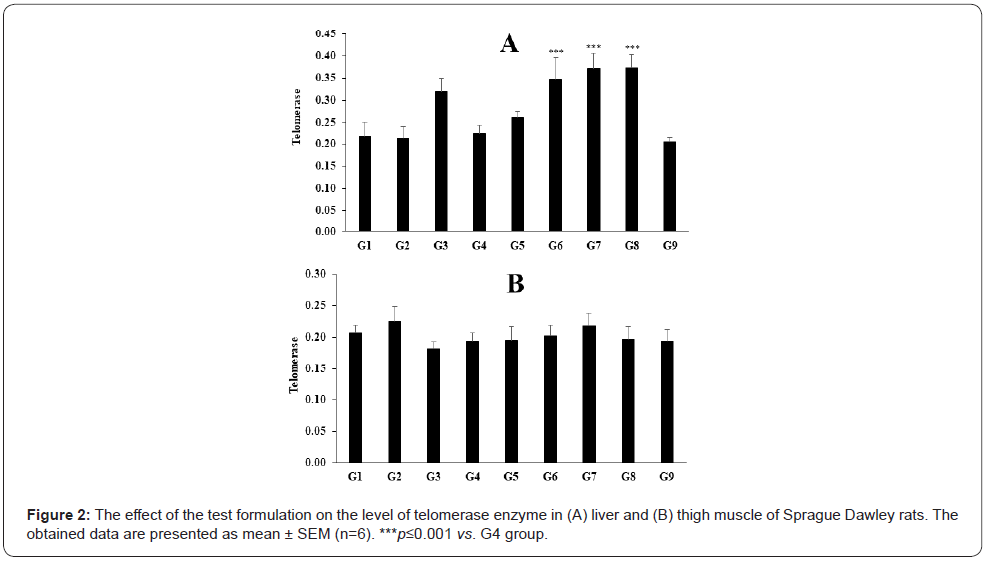
Chronic or long term stress contributes to various forms of diseases, which results in huge damage to telomeres, protective non-coding segments on the ends of chromosomes. Stress and altered telomerase activity results in stressed, depressed, anxious, or previously traumatized conditions, which hampers the overall activity of telomeres [37, 38]. In conclusion, the present data suggested that Biofield Energy Healing Treatment per se and the Biofield Energy Treated/Blessed test formulation play a significant role in telomerase assay in nervous system, which directly improved various stress disorders.
Estimation of citrate synthase enzyme in muscle
Mitochondria play a vital role in skeletal muscles functions and metabolic health. Citrate synthase is a key mitochondrial enzyme used as a biomarker of mitochondrial content and function in mammals [39]. The level of citrate synthase was significantly increased by 17.18% in the positive control (calcitriol) group as compared to the disease control (G2) group. Moreover, citrate synthase level was significantly increased by 4.36%, 3.85%, 5.89%, and 4.87% in the G5 (VDD + Biofield Energy Treated test formulation), G6 (VDD + Biofield Energy Treatment per se to animals from day -15), G8 (VDD + Biofield Energy Treatment per se plus Biofield Energy Treated test formulation from day -15), and G9 (VDD + Biofield Energy Treatment per se animals plus untreated test formulation) groups, respectively as compared to the disease control (G2) group. Further, Citrate synthase was increased by 4.09%, 3.58%, 5.63%, and 4.60% in the G5, G6, G8, and G9 groups, respectively as compared to the G4 group (Figure 3).
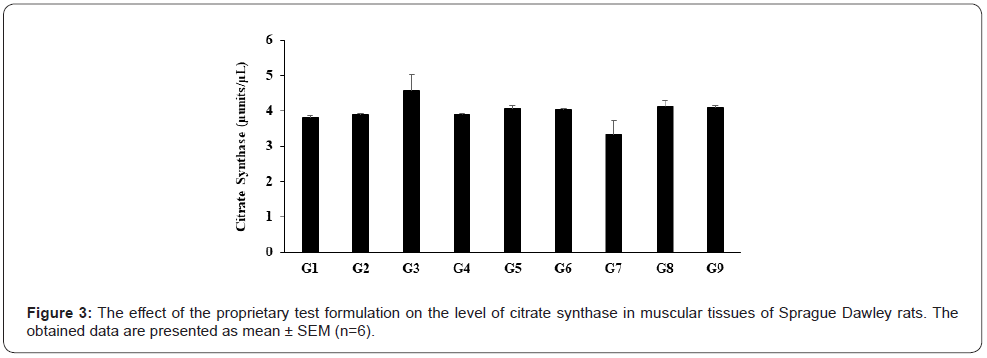
Here, four groups were considered as preventive maintenance groups such as G6, G7, G8, and G9. The current study data showed significant reduction of disease progression and all other disease-related symptoms/complications. Specifically, G6 group showed the desirable results as a preventive maintenance group. Altogether, it showed that the Biofield Energy Healing/Blessing Therapy was found to be most effective and beneficial to prevent and protect from different types of diseases in the rat model, which will ultimately improve the overall health and quality of life.
Conclusions
Based on the study outcomes, it was found that the expression of VDR liver tissue was significantly increased by 74.91%, 100.66%, and 64.25% in the G5, G6, and G7 groups, respectively than G2. The expression of VDR in adipose tissue was also significantly increased by 268.6%, 163.13%, 92.42%, and 63.25% in the G5, G6, G7, and G9 groups, respectively, as compared with the G4 group. Further, the level of liver telomerase was significantly increased by 59.09%, 68.18%, and 68.18% in the G6, G7, and G8, respectively as compared to the G4. The telomerase level in the thigh muscle was significant increased by 15.79% in the G7 group as compared with the G4 group. The level of citrate synthase was significantly increased by 5.89% in the G8 group as compared to the G2 group. Overall, results revealed that the Trivedi Effect® significantly increased the expression of vitamin D receptor (VDR), telomerase and mitochondrial enzyme functions by increasing cytochrome genes. This test formulation can be used against bone-related disorders (osteoporosis, fracture, scoliosis, and bone cancer), deficiency of vitamin D3, and mitochondrial dysfunction in associate with age-related and neurodegeneration disorders such as Alzheimer’s disease, dementias, brain cancer, epilepsy and Parkinson’s.
It could also be used other disorders such as systemic lupus erythematosus, Addison disease, multiple sclerosis, myasthenia gravis, pernicious anemia, psoriasis, rheumatoid arthritis, Crohn’s disease, as well as inflammatory disorders such as atherosclerosis, ulcerative colitis, hepatitis, dermatitis, and diverticulitis. However, Trivedi’s Biofield Therapy can also be used in the prevention of different kinds of brain disorders, and in the improvement of overall health and quality of life. Trivedi’s Biofield Therapy can also helped to reduce the disease progression and disease-related complications. Therefore, the Trivedi Effect® per se effect to the animals directly, which might be effective as extraplorative in healthy humans to sustain a good health, to boost overall health, to promote healthy aging and to increase the quality of life. In the presence of disease, the Biofield Energy therapy might reduce the severity of any acute/chronic disease (such as auto-immune related and inflammatory disorders) and / or slow the disease progression.
Acknowledgement
The authors are grateful to Dabur Research Foundation, Trivedi Science, Trivedi Global, Inc., and Trivedi Master Wellness for the assistance and support during the work.
References
- Robinson WH, Lindstrom TM, Cheung RK, Sokolove J (2013) Mechanistic biomarkers for clinical decision making in rheumatic diseases. Nat Rev Rheumatol 9(5): 267-276.
- Renault V, Thornell LE, Eriksson PO, Butler-Browne G, Mouly V, et al. (2002) "Regenerative potential of human skeletal muscle during aging" Aging Cell 1(2): 132-139.
- Verma S, Tachtatzis P, Penrhyn-Lowe S, Scarpini C, Jurk D, et al. (2012) "Sustained telomere length in hepatocytes and cholangiocytes with increasing age in normal liver" Hepatology 56(4): 1510-1520.
- Chen S, Sun Y, Agrawal DK (2015) Vitamin D deficiency and essential hypertension. J Am Soc Hypertens 9(11): 885-901.
- Larsen S, Nielsen J, Hansen CN (2012) Biomarkers of mitochondrial content in skeletal muscle of healthy young human subjects. J Physiol 590(14): 3349-3360.
- Vigelsø A, Andersen NB, Dela F (2004) The relationship between skeletal muscle mitochondrial citrate synthase activity and whole body oxygen uptake adaptations in response to exercise training. Int J Physiol Pathophysiol Pharmacol 6(2): 84-101.
- Byrne JH, Voogt M, Turner KM, Eyles DW, McGrath JJ, et al. (2013) The impact of adult vitamin D deficiency on behaviour and brain function in male Sprague-Dawley rats. PLoS One 8(8): e71593.
- Rayman MP (2000) The importance of selenium to human health. Lancet 356(9225): 233-241.
- Beard JL, Connor JR (2003) Iron status and neural functioning. Ann Rev Nutr 23: 41-58.
- Kang S, Min H (2012) Ginseng, the 'Immunity Boost': The effects of Panax ginseng on immune system. J Ginseng Res 36(4): 354-368.
- Yang Y, Ren C, Zhang Y, Wu X (2017) Ginseng: An nonnegligible natural remedy for healthy aging. Aging Dis 8(6): 708-720.
- Peres FF, Lima AC, Hallak JEC, Crippa JA, Silva RH, et al. (2018) Cannabidiol as a promising strategy to treat and prevent movement disorders? Front Pharmacol 9: 482.
- Nagarkatti P, Pandey R, Rieder SA, Hegde VL, Nagarkatti M (2009) Cannabinoids as novel anti-inflammatory drugs. Future Med Chem 1(7): 1333-1349.
- Lutgendorf SK, Mullen-Houser E, Russell D, Degeest K, Jacobson G, et al. (2010) Preservation of immune function in cervical cancer patients during chemoradiation using a novel integrative approach. Brain Behav Immun 24(8): 1231-1240.
- Ironson G, Field T, Scafidi F (1996) Massage therapy is associated with enhancement of the immune system's cytotoxic capacity. Int J Neurosci 84(1-4): 205-217.
- Jain S, Hammerschlag R, Mills P, Cohen L, Krieger R, et al. (2015) Clinical studies of biofield therapies: Summary, methodological challenges, and recommendations. Glob Adv Health Med 4(Suppl): 58-66.
- Rubik B (2002) The biofield hypothesis: Its biophysical basis and role in medicine. J Altern Complement Med 8(6): 703-717.
- Trivedi MK, Tallapragada RM (2008) A transcendental to changing metal powder characteristics. Met Powder Rep 63: 22-28, 31.
- Trivedi MK, Nayak G, Patil S, Tallapragada RM, Latiyal O (2015) Studies of the atomic and crystalline characteristics of ceramic oxide nano powders after bio field treatment. Ind Eng Manage 4: 161.
- Trivedi MK, Branton A, Trivedi D, Nayak G, Mondal SC, et al. (2015) Morphological characterization, quality, yield and DNA fingerprinting of biofield energy treated alphonso mango (Mangifera indica). Journal of Food and Nutrition Sciences 3(6): 245-250.
- Trivedi MK, Branton A, Trivedi D, Nayak G, Charan S (2015) Phenotyping and 16S rDNA analysis after biofield treatment on Citrobacter braakii: A urinary pathogen. J Clin Med Genom 3: 129.
- Trivedi MK, Patil S, Shettigar H, Mondal SC, Jana S (2015) Evaluation of biofield modality on viral load of Hepatitis B and C viruses. Journal of Antivirals & Antiretrovirals 7(3): 083-088.
- Trivedi MK, Patil S, Shettigar H, Bairwa K, Jana S (2015) Phenotypic and biotypic characterization of Klebsiella oxytoca: An impact of biofield treatment. J Microb Biochem Technol 7: 203-206.
- Nayak G, Altekar N (2015) Effect of biofield treatment on plant growth and adaptation. Journal of Environment and Health Sciences 1(2): 1-9.
- Branton A, Jana S (2017) The influence of energy of consciousness healing treatment on low bioavailable resveratrol in male Sprague Dawley rats. International Journal of Clinical and Developmental Anatomy 3(3): 9-15.
- Branton A, Jana S (2017) The use of novel and unique biofield energy healing treatment for the improvement of poorly bioavailable compound, berberine in male Sprague Dawley rats. American Journal of Clinical and Experimental Medicine 5(4): 138-144.
- Kinney JP, Trivedi MK, Branton A, Trivedi D, Nayak G, et al. (2017) Overall skin health potential of the biofield energy healing based herbomineral formulation using various skin parameters. American Journal of Life Sciences 5(2): 65-74.
- Singh J, Trivedi MK, Branton A, Trivedi D, Nayak G, et al. (2017) Consciousness energy healing treatment based herbomineral formulation: A safe and effective approach for skin health. American Journal of Pharmacology and Phytotherapy 2(1): 1-10.
- Trivedi MK, Branton A, Trivedi D, Nayak G, Plikerd WD, et al. (2017) A systematic study of the biofield energy healing treatment on physicochemical, thermal, structural, and behavioral properties of magnesium gluconate. International Journal of Bioorganic Chemistry 2(3): 135-145.
- Trivedi MK, Patil S, Shettigar H, Mondal SC, Jana S (2015) The potential impact of biofield treatment on human brain tumor cells: A time-lapse video microscopy. J Integr Oncol 4: 141.
- Anagnos D, Trivedi K, Branton A, Trivedi D, Nayak G, et al. (2018) Influence of biofield treated vitamin D3 on proliferation, differentiation, and maturation of bone-related parameters in MG-63 cell-line. International Journal of Biomedical Engineering and Clinical Science 4(1): 6-14.
- Lee AC, Trivedi K, Branton A, Trivedi D, Nayak G, et al. (2018) The potential benefits of biofield energy treated vitamin D3 on bone mineralization in human bone osteosarcoma cells (MG-63). International Journal of Nutrition and Food Sciences 7(1): 30-38.
- Stutheit ME, Trivedi K, Branton A, Trivedi D, Nayak G, et al. (2018) Biofield energy treated vitamin D3: Therapeutic implication on bone health using osteoblasts cells. American Journal of Life Sciences 6(1): 13-21.
- Trivedi MK, Branton A, Trivedi D, Jana S (2021) Evaluation of vitamin D3 metabolite (25-OH Vit D3), neurotransmitter (ACh), and the expression of proinflammatory cytokines (IL-6 and TNF-α) in tissue homogenate after administration of biofield energy healing-based novel proprietary test formulation and biofield treatment per se to the animals in vitamin D3 deficiency diet (VDD)-induced Sprague Dawley rats. Journal of Neurological Research and Therapy 3(4):1-11.
- Roseland JM, Patterson KY, Andrews KW, Phillips MM, Pehrsson PR, et al. (2016) Interlaboratory trial for measurement of vitamin D and 25-Hydroxyvitamin D [25(OH)D] in foods and a dietary supplement using Liquid Chromatography-Mass Spectrometry. Journal of Agricultural and Food Chemistry 64(16): 3167-3175.
- Yamamoto Y1, Yoshizawa T, Fukuda T, Shirode-Fukuda Y, Yu T, et al. (2013) Vitamin D receptor in osteoblasts is a negative regulator of bone mass control. Endocrinolog 154(3): 1008-1020.
- Mathur MB, Epel E, Kind S (2016) Perceived stress and telomere length: A systematic review, meta-analysis, and methodologic considerations for advancing the field. Brain Behav Immun 54: 158-169.
- Kiecolt-Glaser JK, Glaser R (2010) Psychological stress, telomeres, and telomerase. Brain Behav Immun 24(4): 529-530.
- Vaanholt LM, Al-Tarrah M, Gray SR, Speakman JR, Hambly C, et al. (2019) Low citrate synthase activity is associated with glucose intolerance and lipotoxicity. J Nutr Metab article ID 8594825.

























