




 JOJMS Home



Abstract
Slopes and landslides are one of the most common and most dangerous geological threats in Poland and beyond. They cause losses and destruction not only in infrastructure but also in the environment. They are a huge threat to people and their functioning in the environment. The presented document is aimed at presenting concepts and solutions for landslide protection and slope stabilization at existing damaged road sections. The main design task of this work is to restore to full technical efficiency the analyzed body of the existing poviat road No. 1475S Żywiec - Rychwałd in Żywiec at 0 + 405km to 0 + 455km by stabilizing an active landslide in the entire known range of its occurrence and ensuring safety for road users..
Calculation was made by the GEO5 program, the Slope Stability module, and Wall analysis. Firstly, the soils layers were averaged and defined. The object was included in the third geotechnical category in complex soil conditions. Then, soil parameters were assigned and modeled by geology. Finally, loads and groundwater levels were defined, and results were obtained. The shape of the slope was then given and calculations were made. It uses Bishop, Fellinius, Spencer, Janbu, and Morgenstern-Price methods for stability analysis. The calculations are mainly based on Eurocode 2, 3, and 7 and the technical design, in this case, is called the Tessin Wall.
Keywords:Slope; Landslide; Protection; Engineering; Construction; Pike; Soil; Eurocode 7
Introduction
Slopes and landslides are some of the most common and most dangerous geological threats in Poland and beyond. They cause losses and damage not only in infrastructure but also in the environment. They are a huge threat to people and their functioning in the environment [1].
In the vast majority of cases, the essence of the issue of stability of slopes is in the excess of soil shear strength over shear forces. The factors that have the greatest impact on the unfavorable arrangement of these values relative to each other are, among others, a large variety of soil layers, groundwater level, or slope [2]. Geotechnical assessment of phenomena in the ground depends on estimating the degree of cooperation between the building and the ground [3,4].
Both concepts, landslides, and escarpments function in close dependence and one phenomenon does not exist without the other. In Poland, the area most vulnerable to landslide phenomena is the south-eastern part of the country, especially the Carpathian regions. In addition, landslides often occur in the coastal area as well as in the Kielce and Masuria Voivodeships.
Theoretical Background
Methods of strengthening and reinforcement for slopes
There is a lot of methods and ideas for the most effective and long-term protection for slopes in the literature. The implementation of appropriate types of finishing and rehabilitation works or suitable constructions reduces to minimum activities related to the removal of erosive damage. Even a completely statically secured slope is exposed to soil erosion, which leads to the formation of dangerous landslides.
Methods of strengthening for slopes
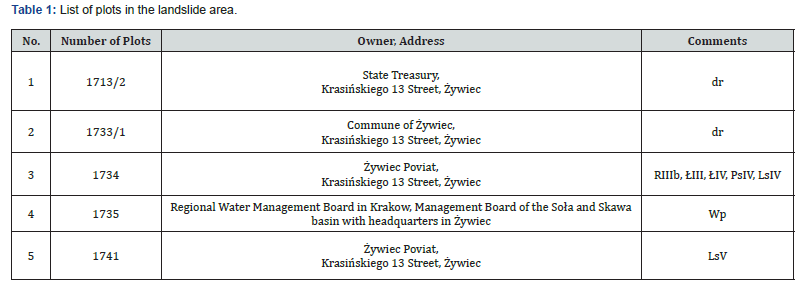
The first way may be geoagrotechnical protection of slopes. This method is based on securing slopes with chopped straw and a mixture of grass mixed with water, which, when unfolded on the slope, combine to form a whole, which gives them protective properties for the slope Table 1.
Another important activity for strengthening slopes is planting and compacting so that the vegetation receives 60 - 80% of rainwater.
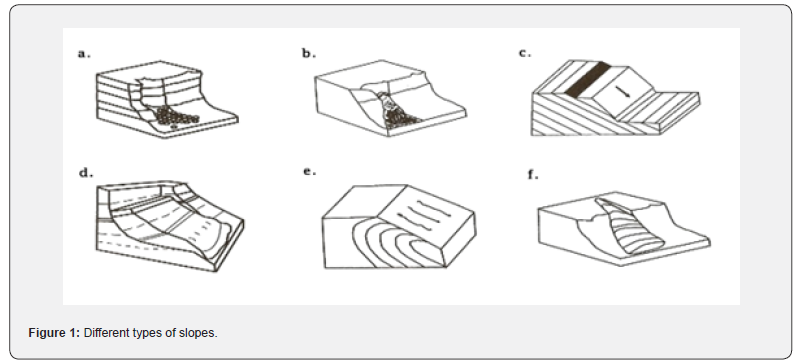
The fermentation process of sewage sludge and composts for strengthening slopes and slopes in the humus process should be the increasingly preferred method of securing slopes by modern engineers and designers, because this method is based on the use of renewable raw materials Figure 1.
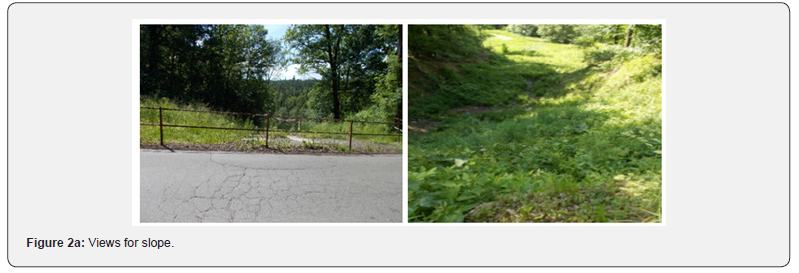
A common way to protect slopes and slopes is also the use of geotextiles and shading nets, at least 5 cm thick, which not only protects the slope from erosion, but also allows you to continue work at any time of the year [5-7].
Gabions are another popular solution for securing landslides and slopes. It is a system of meshes made of galvanized wires with a diameter of 2 - 3.5mm, which is filled with large aggregate and shaped in any way. Thanks to this structure, the bearing can freely drain and not plasticize the soil, and the gabions themselves are a great stabilizing load [8].
The Pneusol method is also popular in Poland and it is based on the use of worn tires from retaining wall structures [9].
Methods of reinforcement for slopes
The main method of strengthening slopes according to Eurocode are three types of retaining structures. The first method of securing slopes by Eurocode 7 concerns the use of massive (gravitational) retaining walls, which usually define several geotechnical parameters (ɣ, ϕ, c). The second type is walls recessed in the ground, e.g., sheet piling, mainly made of steel, reinforced concrete, or wood, which are often fixed with anchors or struts to the ground. The last type of retaining structure is a wall with a complex structure and it can fix the first and the second one method together [10].
It is also worth mentioning other methods of reinforcement, e.g., pinning, filter buttresses, concrete injections into the ground, drainage wells, the Tessin Wall technology, pikes, and micro spikes [3,4,6].
Methods for checking the stability of slopes
There are many methods in the literature for checking the stability of slopes. The most important factor determining the choice of the calculation method is the awareness of the occurrence of the largest number of factors taken into account in the calculation algorithm. The result of calculations is usually the safety factor, the most important for the assessment of slope stability Figure 2.
Limit balance methods
Empirical methods for determining the stability of slopes and
slopes can be divided into three sections:
i. limit balance
ii. stress limit state
iii. induced friction resistance
In practice, despite many proposed methods of analysis, several of them are most often used. Usually, these methods are derived from the analysis of the limit equilibrium of forces acting parallel to the slip surface, for which the equilibrium index F is determined:

where:
Ui - generalized holding forces,
Zi - generalized loading forces.
Slope stability consisting of cohesive soils should be separately tested for irrigated and dry soil [1]. In the case of irrigated soil, drainage pressure should be taken into account, while for dry soil the most important to maintain balance is the slope angle, which should be equal to or less than the angle of internal friction of the soil. In the case of cohesive soils, stability testing is a more complex calculation process.
Methods for checking the stability of slopes from cohesive soils
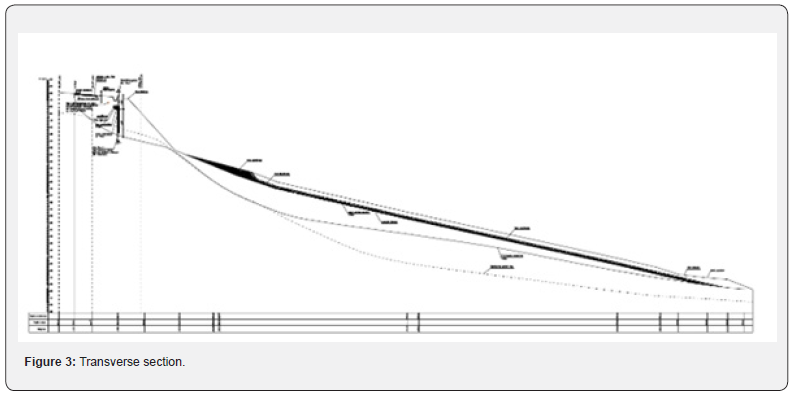
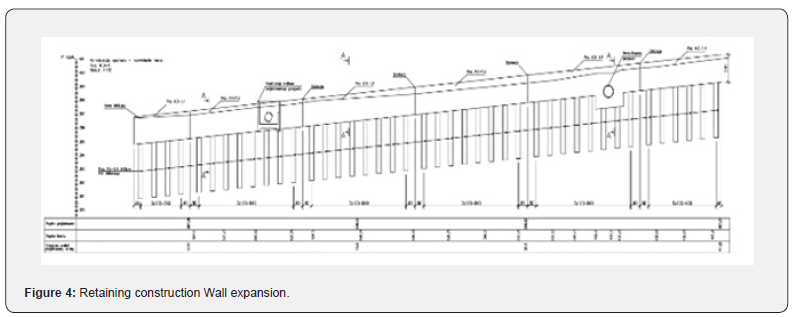
The initial assumption for checking statistics of cohesive soil slopes is to assume a circular slip surface [7,11]. Such situations usually occur within layers of low strength. The essence of determining the limit equilibrium is the combination of normal stress operations along the slip surface. In practice, the most popular test method is the strip method, according to which massive settling is divided into vertical parts and determined forces occurring in it when some of the developed methods currently used in computer software for statistical calculations of the slope are available Figure 3. The first of these is the Fellenius method, which only takes into account the condition of moment balance [4,5,12]. Another often used in calculations of slope stability is the bishop method, which takes into account the twoway interaction of adjacent strips and the condition of equilibrium of moments [4,5,12], and the calculation model is carried out based on iteration. Iteration is carried out until a situation is achieved when the results for the coefficients differ from each other by less than the value assumed in advance. The third method that is equally often used is the Janbu method, which bases its assumptions on inter-band interactions, while the equilibrium condition is the sum of projections of forces on the horizontal axis [5,12]. The shape of the slip surface does not affect the value of the stability factor. The basis of this calculation methodology is the bishop equation Figure 4.
Pikes according to Eurocode 7
Nowadays, engineering objects are increasingly demanding
and have to deal with difficult geotechnical conditions. Therefore,
pike foundations are starting to become a more and more popular
foundation method. These types of foundations transfer the load
from the structure through the bottom and the side surface of the
pike.
i. Pikes should be designed based on:
ii. results of static test loads,
iii. analytical or empirical calculation methods,
iv. results of dynamic tests,
v. checking the behavior of similar pike foundations [13].
During pike dimensioning, the arrangement of layers in the soil has the greatest impact on their selection. In a situation where a weak layer surrounds the pike’s sidewall, it will be characterized by high compressibility, which will have a direct impact on the significant susceptibility of the pike to deformation and very limited shear strength, which may result in construction disasters. Therefore, the essence of designing pike foundations is to embed them in layers of strong soils, such as slate, rock. The load on the side of the pike is analyzed by dividing it separately on the pressure from the ground from the side of the loaded ground and the resistance on the opposite side. It appears with the difference of vertical stresses [9].
According to Eurocode 7, to demonstrate that the foundation will carry the designed interference load with a sufficient load safety margin, the following inequality must be met for all cases and load capacity combinations [14]:

Retaining structures according to Eurocode 7
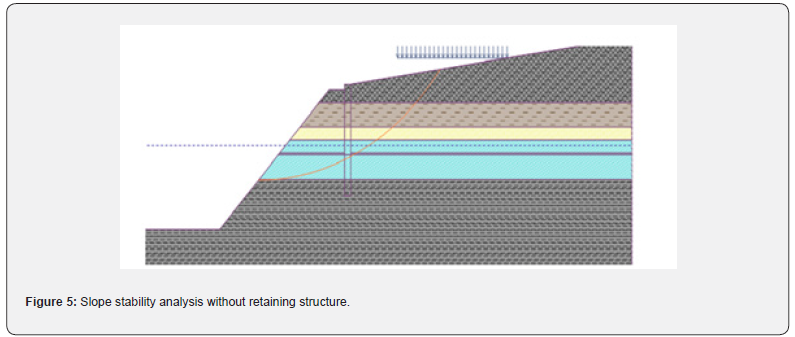
Retaining structures are engineering objects that are usually dimensioned for the transition from one ground level to another or to limit water tanks [15]. The rules and calculation procedure for retaining structures are contained in Chapter 9 Eurocode 7. It mainly contains recommendations and requirements for the correct design of retaining structures Figure 5. Annex C of Eurocode 7 sets out the methodology for calculating the limit values for soil pressure and repulse [15]. The calculations consider primarily deformations and displacements of the designed retaining structure, but also the results of the calculations taking into account changes in the water level, changes in time and space of the landmass, make a dig from the front of the designed structure, weight from existing structures, the impact of subsidence and extreme weather conditions (e.g., frost) and combinations of effects [16].
Materials & Experiments
Location
The beginning of the project is located - according to the kilometer of the road at 0 + 400km and the end at 0 + 455km in Żywiec.
The area of the active landslide covered by the study is located on the plots:
Description and assessment of soil and water conditions and geological conditions
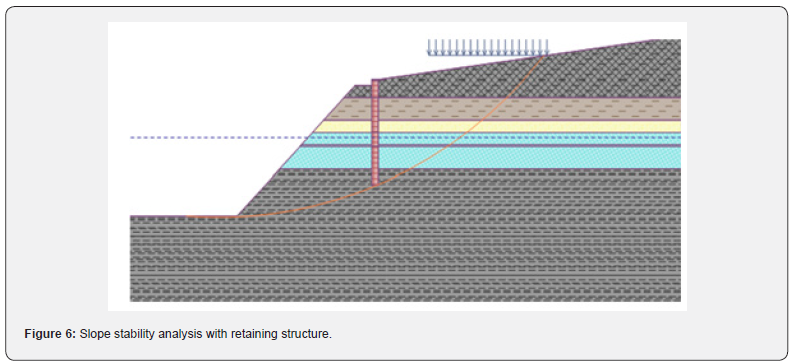
During the geological works, anthropogenic deposits (drilled in OG-2 and OG-6 wells) are associated partly with the embankment of the road in the form of mixed stones, old asphalt, glass, bricks, and organic parts (roots) were found. This uncontrolled embankment is associated with the wild garbage dump occurring in this area, i.e., on the entire southern slope below the road from the OG-1 to OG-3 well together with the entire landslide colloquium. Quaternary soils developed in the form of loam and sandy loam with stones, and at the bottom of the weathered clay shale occur throughout the entire surface of the slope falling south towards the Moszczanka stream. Paleogene (Oligocene) deposits are represented: sandy and clay shales (with a clear difference in shear strength Rc), sometimes separated by sandstone inserts. Slates alternate in the form of cracked and very cracked slate with less-cracked, less solid, slate. Coarse (conglomerate) sandstones, cracked, were drilled in the OG-1 well and along with the depth changed the grain fractions into smaller ones. The water table is usually free, and only locally it has a slightly thrust character - in places where aquifers are covered with poorly permeable sediments Figure 6. The water surface is usually at a depth of 2-4m, only locally deeper.
Under the Regulation of the Minister of Transport, Construction and Maritime Economy of 25 April 2012 on determining the geotechnical conditions for the foundation of building structures, the building has been included in the third geotechnical category in complex soil conditions.
Construction concept
Combination of materials [17-20]
i. Pikes
a) Concrete: C30 / 37
b) Reinforcement: IPE 140 Steel S235 profile
ii. Reinforced concrete retaining structure
a) Structural concrete: C25/30
b) Primer concrete: C8/10
c) Exposure class: XC3
d) Maximum w/c ratio: 0.50
e) Minimum cement content: 300kg
f) Minimal reinforcement cover thickness com: 50mm
g) Reinforcing steel: A-IIIN (RB500W)
Result
Calculations were made using the GEO5 program, Slope Stability module, and Wall analysis. The first step of the project was to average and define the tested soil layers in the place where the slope protection is to be designed.
The next step was to assign optimal values to individual soil
subsoil parameters. The next element of the project was the
task of the optimal slope shape for the created computational
model, based on the slope stability analysis without the retaining
structure. Computational simulations have shown that the slope
in the adopted model does not meet the requirements, and the use
of slope stability is:
i. according to the bishop method: 101.1%
ii. according to the Fellenius method: 103.2%
iii. according to the Janbu method: 101.3%
iv. according to the Morgenstern-Price method: 101.8%
and the escarpment is falling - the results of numerical calculations coincide with data from in situ tests for the analyzed area. Compliance in most cases oscillates around 100% - i.e., very good. This shows the model’s compliance with the real issue.
The results of in situ tests and numerical analysis indicate a very high consistent risk of the linear construction in question - the road at 0 + 405km and 0 + 455km in Żywiec.
The next step in the project is to design an optimal retaining
structure - a solution in the form of palisades was chosen for which
simulations of spacing and diameter were carried out. Suitably
converted variants gave the optimal solution to meet load capacity
conditions. The last design step was a calculation simulation for
checking the slope stability. The slope stability utilization using
the designed structure is successively for each:
i. Bishop’s method: 57.0%
ii. Fellenius method: 54.4%
iii. Spencer method: 50.6%
iv. Janbu method: 49.0%
v. Morgenstern-Price method: 49.3%
The Tessin Wall technology is the optimal method chosen to strengthen the embankment. The photo below shows damage to the roadway near the landslide, as a result of badly drained rainwater.
Discussion & Conclusion
Designed by the selected method and with the initial
assumptions given for the adopted calculation models, the
structure of the road protection in question, as a reinforced
concrete wall 2.0m high, mounted on a palisade of concrete pikes
with a diameter of 40cm spaced every 1.2m, reinforced with a steel
profile IPE140, meets all conditions perfectly optimally designed
(provide values):
Maximum values of displacements and internal forces
Maximum displacement = -1.0mm
Maximum displacement = 0.2mm
Maximum bending moment = 5.04kNm
Maximum bending moment = -12.85kNm
Maximum cutting force = 12.92kN
Checking the composite cross-section according to EN 1994-
1-1
All construction phases were included in the calculations.
Calculated section load factor = 1.00
Forces per profile
Mmax = 15.42 kNm; Q = 0.27kN
Qmax = 30.33 kN; M = 1.26 kNm
Checking max. Torque Max+ Q
Checking the shear cross-section:
Q / VRd = 0.002 ≤ 1 Meets the requirements
Checking the folded section for bending:
Mmax / Mpl, N, Rd = 0.284 ≤ 0.9 Meets the requirements
Check the max. Shear force Qmax + M
Checking the shear cross-section:
Qmax / VRd = 0.195 ≤ 1 Meets the requirements
Checking the folded section for bending:
M / Mpl, N, Rd = 0.023 ≤ 0.9 Meets the requirements
The retaining structure is a reinforced concrete wall mounted on a palisade. Such a method is an additional drainage method for rainwater for the exposed area, and what is more, the planned building intentions, taking into account the integrated and developed protection of all-natural values, will not hurt the bed of the Moszczanica stream or the surrounding area.
Acknowledgment
Thank you for the opportunity to cooperate with a highly qualified team of engineers from the Engineering Office ALBIS in Bielsko - Biała and the Public Road Administration in Żywiec for their consent to share materials and tools for writing this engineering work under the supervision of Ph.D. Eng. Monika Gwóźdź – Lason.
References
- Lasoń MG (2017) Slope reinforcement with the utilization of the coal waste anthropogenic material, IOP Conference Series: Materials Science and Engineering 245(3): 9.
- Lasoń MG (2010) How to calculate the impact of geotechnical condition of the plot with commercial use on market value this type of real estate, Geotechnical challenges in megacities: proceedings of the International Geotechnical Conference, Petersburg.
- Jermołowicz P (2017) Methods of securing landslides. Civil Engineer 156: 72-80.
- Szruba M (2017) Stabilization of slopes and landslides. Modern Civil Engineering Construction, pp. 42-51.
- Obrycki M, Pisarczyk S (2005) Selected problems of foundation: examples of calculations. Office of Warsaw University of Technology, Warsaw, pp. 113-118.
- Furtak K, Sala A (2005) Stabilization of communication landslides by construction methods. Geoengineering: roads, bridges, tunnels 3(6): 12-22.
- Lasoń MG (2016) Geotechnical Design = Geotechnical Design - Chapter pp. 93-128 in the book: Basics of geotechnical design: introduction to new technologies in geotechnics: collective work / edited by Aleksander Urbański; TEAM. Cars. Gwóźdź R, Lasoń MG, Karolina Łach, Aleksander Urbański; Cracow University of Technology Tadeusz Koś Krakow: Publisher, Poland.
- PN-EN 1992-1-1 (2004) Eurocode 2. Designing of concrete structures. Part 1-1: General rules and rules for buildings.
- Kurłatowicz Z (2004) Lateral load of pikes with a layer of low strength soil. Gdansk University of Technology Publisher, Poland, pp. 9-11.
- Garwacka – Piórkowska S, Cios I (2014) Designing typical direct foundations and retaining structures taking into account Eurocodes together with examples. Warsaw University of Technology Publishing House, Warsaw 138: 161-162.
- Lasoń MG (2016) Construction investments on landslide areas – cause-and-effect analysis of occurrence of damage in buildings during works connected with modernization of an adjacent investment, Przegląd Budowlany, pp. 25-32.
- (2009) Problems of landslides in transport construction - National Scientific and Technical Conference Zakopane Sitkrp Branch in Krakow, Sitk RP Gddka, MOIIB in Krakow.
- Gwizdała K (2013) Pike foundations: research and applications. T2 WY dawn Sciences PWN, Warsaw, pp. 1-3.
- Lasoń MG (2014) Trans-disciplinary concept of geotechnical slope stability design, pp. 373-382, eds. Heinz Brandl, Dietmar Adam. – Vienna: Austrian Association of Engineers and Architects, 2014, Geotechnics of Roads and Railways: proceedings of the 15th European Conference on Geotechnical Engineering, Austria.
- Starosolski W (2016) Reinforced concrete structures according to Eurocode 2 and related standards. Volume III PWN Scientific Publisher, Warsaw, pp. 460-461.
- Pisarczyk S (s2005) Geoengineering. Soil modification methods. Office of Warsaw University of Technology, Warsaw, pp. 193-200.
- Wysokiński L, Godlewski T (2011) Geotechnical design according to Eurocode 7: guide. Building Technology Institute, Warsaw, pp: 226-228, 233-235, 242-244.
- PN-EN 1993-1-1 (2005) Eurocode 3. Design of steel structures. Part 1-1: General rules and rules for buildings.
- PN-EN 1997-1 (2004) Eurocode 7. Geotechnical design. Part 1: General principles.
- Lewandowska AS (2011) Deep excavations: design and workmanship. WKŁ, Warsaw, pp. 69-78.

























