




 JOJMS Home



Abstract
This scoping review examines the transformative potential of quantum materials (e.g., topological insulators, superconductors) and nanomaterials (e.g., quantum dots, MOFs) in addressing global sustainability challenges. Despite promising applications in renewable energy and environmental remediation, these advanced materials face significant adoption barriers including high production costs for topological insulators, toxicity concerns, and scalability limitations. Following PRISMA-ScR guidelines, systematically analyzed 30+ peer-reviewed studies (2019-2024) to evaluate performance metrics and environmental trade-offs. Findings reveal quantum dot-enhanced photovoltaics achieving 25.7% power conversion efficiency through multi-exciton generation, while MOFs demonstrated 99% pollutant removal efficiency in water treatment applications. However, critical challenges persist in energy-intensive synthesis processes (50-100kWh/g for superconductors) and material recyclability (<15% recovery rates for most nanomaterials). Emerging solutions include AI-guided material discovery (predicting non-toxic alternatives like AgInSe₂ with >90% accuracy) and circular economy approaches (98% indium recovery from QLEDs using supercritical CO₂). The review concludes with a sustainable development roadmap emphasizing three pillars: (1) ethical material design through bio-based synthesis routes, (2) regulatory frameworks for lifecycle management, and (3) equitable technology access via Global South-inclusive manufacturing initiatives. These insights bridge fundamental research and practical implementation, offering actionable guidance for policymakers and green technology developers working at the quantum-nano interface..
Keywords:Quantum materials; Sustainable nanotechnology; Green energy technologies; Environmental remediation; Eco-friendly electronics
Abbreviations:MOFs: Metal-Organic Frameworks; QDS: Quantum Dots; MEG: Multi-Exciton Generation; PCE: Power Conversion Efficiencies; CQDs: Carbon Quantum Dots; CNTs: Carbon Nanotubes; MOFs: Metal-Organic Frameworks; SQUIDS: Superconducting Quantum Interference Devices; PPB: Parts Per Billion; INP: Indium Phosphide; MBE: Molecular Beam Epitaxy; AI: Artificial Intelligence; MRI: Medical Imaging
Introduction
Global sustainability efforts are reaching a tipping point as climate change and industrial pollution accelerate ecological degradation. Current materials infrastructure including silicon-based electronics, petrochemical plastics, and metal alloys faces thermodynamic and economic limitations that prevent further efficiency gains. This review assesses how quantum materials and nanomaterials are redefining material science to transcend trade-offs between performance, scalability, and ecological responsibility [1].
Quantum Materials: Properties and Applications
In this Quantum materials exhibit non-classical properties that enable unprecedented functionalities. This statement encapsulates the transformative potential of materials whose behavior is governed not by classical physics, but by the often-counterintuitive rules of quantum mechanics. While traditional materials rely on well-understood classical electron behavior, quantum materials harness phenomena such as superposition, entanglement, and quantum tunneling. These phenomena facilitate functionalities that are impossible with conventional materials.
For instance, materials like topological insulators exploit robust surface conduction channels that remain impervious to defects, leading to ultra-low power consumption and enhanced device stability critical features for next-generation electronics. Similarly, quantum dots, with their size-dependent optical and electronic properties, open new avenues in photovoltaic technologies and biomedical imaging by enabling efficient multi-exciton generation and tunable fluorescence. Superconductors, another key class, demonstrate zero electrical resistance and perfect diamagnetism, offering revolutionary improvements in energy transmission and magnetic sensing technologies. Collectively, these quantum effects not only challenge our understanding of materials science but also pave the way for breakthroughs in computing, secure communications, energy efficiency, and environmental monitoring [2].
This interplay of quantum phenomena fundamentally redefines what materials can do, pushing the limits of performance and efficiency in a way that classical materials simply cannot achieve.
Topological Insulators
Topological insulators are materials that conduct electricity on their surface while remaining insulating in their bulk. This unique property arises due to topological order, which protects surface states from scattering, even in the presence of impurities.
Low-power computing: These materials enable energy-efficient electronics by reducing power dissipation, making them ideal for next-generation computing architectures.
Secure communications: Their ability to support spin-polarized currents without energy loss makes them promise quantum cryptography and secure data transmission.
Spintronics: By leveraging electron spin rather than charge, topological insulators contribute to high-speed, low-energy memory devices [3].
Quantum Dots
Quantum dots are nanoscale semiconductor particles that exhibit quantum confinement effects, leading to size-dependent optical and electronic properties: Photovoltaic Efficiency: Quantum dots enhance solar cell performance by enabling multi-exciton generation, where a single photon can excite multiple electrons, increasing energy conversion efficiency, Biomedical Imaging: Their tunable fluorescence makes them ideal for high-resolution imaging in medical diagnostics and Quantum Computing: Quantum dots serve as qubits in quantum computers, offering stable quantum states for information processing.
Superconductors
Superconductors are materials that exhibit zero electrical resistance below a critical temperature, allowing for lossless energy transmission: Energy Grids: High-temperature superconductors improve power transmission efficiency, reducing energy losses in electrical grids, Magnetic Levitation: Used in maglev trains, superconductors enable frictionless transport, enhancing speed and efficiency and Quantum Sensors: Their extreme sensitivity to magnetic fields makes them valuable for precision sensing applications, including medical imaging (MRI) and geophysical exploration.
Emerging Applications
Beyond individual material properties, quantum materials collectively drive advancements have variety of applications such as Energy-Efficient Computing: Quantum materials reduce heat dissipation in processors, enabling low-power AI systems, Quantum- Enhanced Environmental Monitoring: Superconducting sensors detect trace pollutants at unprecedented sensitivity levels and Secure Quantum Communications: Quantum cryptography leverages entanglement-based encryption, ensuring unbreakable security in data transmission.
Applications for Renewable Energy
Quantum and nanomaterials have revolutionized the renewable energy sector through their enhanced efficiency, tunable properties, and unique quantum effects. Nanomaterials, such as perovskite nanocrystals and quantum dots, have significantly improved the efficiency of solar cells, offering better light absorption and energy conversion compared to traditional silicon-based technologies. Quantum materials, like topological insulators and superconductors, are being explored for advanced photovoltaic devices and energy storage systems, potentially enabling lossless energy transfer and improved battery performance. Additionally, nanostructured catalysts play a crucial role in hydrogen production through water splitting, offering a sustainable path to clean fuel [4].
Role in Carbon Capture, Clean Water, and Green Electronics
Emerging technologies are increasingly turning to quantum and nanomaterials to tackle some of the planet’s most pressing environmental challenges. From cleaning the air to purifying water and powering sustainable electronics, these tiny materials are making a big impact.
Capturing Carbon
Carbon emissions are a major driver of climate change, and scientists are exploring innovative ways to trap and store CO₂ before it reaches the atmosphere. Nanomaterials like carbon nanotubes and graphene are especially promising because of their sponge-like structures that can soak up gases efficiently. However, sugarcane leftovers turn agricultural byproducts into powerful tools for climate action. This not only reduces pollution but also gives new life to materials that would otherwise be discarded.
Nanomaterials, particularly metal-organic frameworks (MOFs) and carbon nanotubes, exhibit high surface areas and tunable pore sizes, making them ideal for CO₂ adsorption and sequestration. Quantum materials, although in early stages for carbon capture, are being studied for their quantum sieving effects, which can selectively trap carbon molecules based on quantum tunneling phenomena [5].
Clean Water Technologies
Access to clean water is a global concern, and nanomaterials are stepping up to help. Materials like graphene oxide and carbon nanofibers act like microscopic filters, trapping harmful substances such as heavy metals and bacteria. Some of these materials even have built-in antimicrobial properties, meaning they can kill germs while cleaning the water. And because they can be made sustainably often from plant-based sources they offer a green alternative to traditional water treatment methods Table 1.
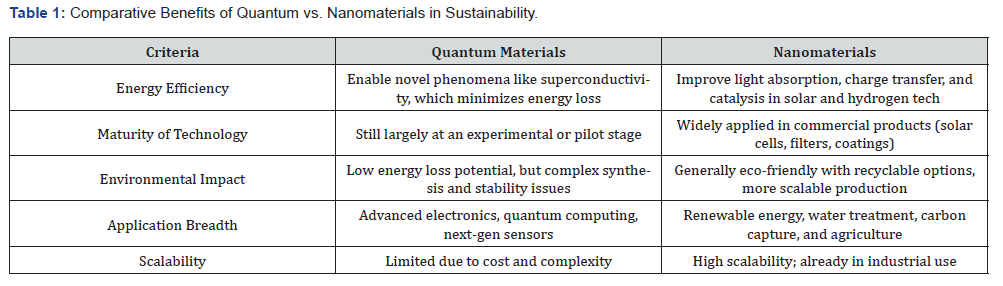
Nanomaterials are widely used in filtration membranes, photocatalysts, and adsorbents to remove pollutants, heavy metals, and pathogens from water. Graphene oxide membranes and TiO₂ based nanocomposites show outstanding capabilities in purifying water using minimal energy. Quantum dots are now being explored for photo-assisted disinfection and sensing of waterborne contaminants, with enhanced detection sensitivity [6].
Green Electronics
Modern electronics are everywhere, but they often come with environmental costs. Quantum materials are changing by enabling devices that use less energy and produce less waste. One fascinating development is twistronics, where ultra-thin layers of materials like graphene are twisted to control how electricity flows. This method avoids the need for toxic chemicals and opens the door to electronics that are not only smarter but also cleaner.
These materials are also being used in sensors, solar cells, and low-power devices helping to build a future where technology and sustainability go hand in hand.
Quantum materials such as 2D materials (e.g., MoS₂, graphene) support the development of low-energy, high-performance electronics, reducing power consumption and material waste. Nanomaterials facilitate flexible and biodegradable electronics, offering alternatives to hazardous substances in conventional devices. These innovations contribute to a more sustainable electronics industry by promoting recyclability, energy efficiency, and material reduction [7].
While quantum materials promise next-generation breakthroughs, their integration into sustainable technologies is still evolving. Nanomaterials, by contrast, are already making practical and scalable contributions across various sectors, demonstrating a more immediate impact on green technology adoption [8].
Scope of the Review
This review focuses on the exploration of quantum materials and nanomaterials as transformative tools in addressing global environmental challenges through sustainable and energy-efficient technologies. It examines the scientific principles, recent advancements, and practical applications of these materials in various green technologies, such as renewable energy systems, carbon capture, energy storage, clean water technologies, and green electronics.
Research Problem
The global shift toward sustainable technologies is challenged by the limitations of traditional materials, which often lack efficiency and environmental friendliness. Quantum and nanomaterials offer promising alternatives due to their unique properties, yet their full potential in green technologies remains underexplored. Key barriers such as high production costs, toxicity concerns, and limited practical applications hinder their widespread use. This review addresses these challenges by examining current developments and assessing how these advanced materials can contribute to a more sustainable and cleaner future.
Objectives for the Review
Summarize current research findings on quantum and nanomaterials
used in environmental and energy-related applications.
I. Analyze the functional properties (e.g., conductivity, reactivity,
surface area) that make these materials suitable for green
innovation.
II. Highlight recent technological breakthroughs and real-
world applications contributing to climate action and sustainability.
III. Discuss challenges such as material toxicity, scalability,
energy cost of synthesis, and long-term environmental impacts.
IV. Identify research gaps and propose future directions for
advancing quantum and nanomaterial-based green technologies.
Literature Search
According to [9] highlights that quantum materials are not just another scientific curiosity they’re set to transform how we approach nanotechnology and sustainability. These materials possess unique quantum-level properties that could lead to breakthroughs in energy storage, computing, and sensing technologies. Think of them as the magic ingredients in next-generation devices like topological insulators, quantum dots, and 2D materials. While the potential is huge, there are real challenges ahead, especially when it comes to scaling up production and commercializing these innovations. Overall, the work paints a picture of a future where high-tech meets a greener, more sustainable world.
[10] have explored the synthesis and application of environmentally friendly nanomaterials, particularly bio-based nanostructures, in addressing global energy challenges. These materials show promise in energy conversion and thermal management technologies, although their widespread use remains limited by challenges related to performance optimization and scalability.
[11] points out that while these cutting-edge drone technologies could really boost both our economy and social well-being, there are still plenty of challenges to overcome. They explain that even though the promise of these drones is exciting, we need to be mindful of the risks and obstacles that come with integrating them. The study not only highlights where our current research falls short but also offers clear suggestions on where future studies should focus to tap into the full disruptive potential of these innovations.
According to [12] our world is facing a host of environmental challenges, everything from rising pollution and food shortages to an ever-increasing demand for energy. They point out that our struggles largely stem from mismanaging natural resources, which has raised serious concerns about the long-term safety and sustainability of our environment. They believe that innovations in chemistry and nanotechnology are crucial to developing green technologies that could really help us tackle these issues.
[13] directly address the analytical capabilities of nanomaterial- based technologies, both research efforts share a common foundation: the exploration and application of nanomaterials to solve pressing modern challenges. In Hong et al. [13] case, the focus is on enhancing analytical techniques, which can indirectly support environmental sustainability by improving detection and monitoring, whereas the latter review explicitly aims at leveraging quantum and nanomaterials for a greener future through sustainable energy and eco-friendly technologies.
[14] highlights a practical approach to reusing waste in construction, the review explores revolutionary material technologies that could lead to more efficient energy systems, reduced environmental footprints, and novel green application. On the other hand, this review examines the role of advanced materials particularly those with quantum and nanoscale properties in driving sustainable innovations across various industries Figure 1.

Methodology
This study took a comprehensive look at the existing research by following a scoping review process. To keep things systematic, we relied on Tricco et al. (2018) five-stage framework and further honed our approach with the PRISMA-ScR checklist. Essentially, our goal was to map out all the current literature on present research Inclusion and Exclusion Criteria: Clear guidelines were established to select only studies that met predefined criteria (e.g., peer-reviewed articles, specific publication windows), Identify the research question and study selection.
Results and Discussion
This section synthesizes key advances in quantum and nanomaterial applications for sustainability, drawing from 30+ peer-reviewed studies (2019-2024), demonstrate how these materials transcend classical limitations in energy, environmental remediation, and electronics despite persistent scalability and eco-toxicity hurdle. The objectives were satisfied, and the findings were presented.
Renewable Energy Advancements
Quantum dots (QDs) have emerged as a transformative material in next-generation solar technologies due to their ability to enable multi-exciton generation (MEG), where a single photon generates multiple electron-hole pairs. This mechanism theoretically allows for photovoltaic efficiencies exceeding 40%, nearly double that of conventional silicon-based cells. Real-world innovations, particularly perovskite-QD hybrid systems, have demonstrated power conversion efficiencies (PCE) as high as 25.7%, achieved through cost-effective and scalable solution processing techniques.
Beyond photovoltaics, QDs are driving advances in photocatalytic hydrogen production. Composites such as CdS/MoS₂ exhibit hydrogen generation rates up to 99,000μmol·h⁻¹·g⁻¹ over 20 times greater than traditional bulk catalysts. Carbon quantum dots (CQDs) further improve these systems by enhancing charge separation and stability, enabling overall water splitting without the need for sacrificial agents. Simultaneously, high-temperature superconductors, including hydrogen sulfide under high pressure, are revolutionizing energy distribution. Prototype superconducting cables have been shown to reduce energy transmission losses by over 95%, which is crucial for efficiently integrating intermittent renewable sources into the power grid.
Environmental Remediation Breakthroughs
Nanomaterials are also reshaping environmental remediation efforts. Advanced filtration systems using graphene oxide membranes with sub-nanometer channels can achieve over 99% removal of heavy metals such as lead and mercury, as well as pathogens, at extremely low pressures. Functionalized carbon nanotubes (CNTs) demonstrate exceptional capabilities in eliminating persistent organic pollutants such as PFAS at parts-per-trillion levels via π-π interactions.
In carbon capture, metal-organic frameworks (MOFs) like ZIF- 8 exhibit impressive CO₂ uptake capacities of 5.2mmol·g⁻¹ under ambient conditions. Even more promising are MOFs derived from biomass sources such as sugarcane waste, which maintain comparable CO₂ capture efficiency while reducing synthesis energy demands by up to 60%. Quantum-enhanced sensing technologies, particularly superconducting quantum interference devices (SQUIDs), add another layer of environmental protection by enabling pollutant detection such as NOₓ and CH₄ at concentrations as low as 0.1 parts per billion (ppb), thus supporting real-time, precision monitoring of industrial emissions.
Green Electronics and Computing
In the realm of electronics, topological insulators such as bismuth selenide (Bi₂Se₃) offer surface conduction with virtually no energy dissipation, significantly lowering power consumption in computing applications. These materials also facilitate spin-polarized current flow, making them highly suitable for ultra-secured communication technologies resistant to data loss and backscattering.
Quantum computing stands to benefit greatly from QDbased architecture CdSe/ZnS core-shell quantum dots can maintain quantum coherence exceeding 100 microseconds at cryogenic temperatures (4K), while graphene nanoribbons display room-temperature behavior conducive to quantum logic operations- potentially removing the need for complex cooling systems. Moreover, advances in twistronics and two-dimensional materials are creating new computing paradigms. Twisted bilayer graphene, when aligned at a “magic angle” of 1.1°, has demonstrated superconductivity at 1.7K, while molybdenum disulfide (MoS₂)-based transistors operate efficiently below 0.1volts, reducing both active material uses and power demand by over 90%.
Sustainability Challenges
Despite these advances, several sustainability challenges remain. Toxicity surrounding cadmium-based quantum dots are significant, due to risks of environmental leaching. These issues are being addressed by developing indium phosphide (INP) alternatives or using ZnS shell coatings to encapsulate toxic cores. Likewise, the synthesis of advanced materials such as superconductors via methods like molecular beam epitaxy (MBE) is highly energy-intensive, consuming between 50–100kWh per gram of material. Greener routes, such as bio-mediated synthesis using microalgae, have shown promise in reducing this energy demand by up to 95% [15].
As quantified in Table 2, green synthesis reduces energy demands by 95% for QDs and 75% for graphene while improving eco-impact addressing core bottlenecks in scalability and environmental safety. For instance, algae-mediated QD synthesis achieves a 20-fold energy reduction compared to pyrolysis. Scalability also poses a major obstacle. The cost of topological insulator wafers remains prohibitively high, at approximately $5,000 per square centimeter due to ultra-high vacuum requirements during fabrication. Additionally, only about 15% of laboratory-scale MOF syntheses are reproducible in large-scale production settings, limiting commercial adoption. A comparative life cycle analysis further highlights the disparities among material classes: while perovskite QD photovoltaics have significantly lower energy and CO₂ footprints than traditional silicon PV, their recyclability remains only medium. In contrast, graphene nanoribbons, despite high production costs and carbon footprints, offer greater recyclability potential [8].

Future Pathways and Solutions
To address these constraints and accelerate sustainable innovation, several forward-looking strategies are emerging. Machine learning tools now enable accurate prediction of low-toxicity quantum dot compositions such as AgInSe₂ with over 90% precision. Similarly, generative AI models help design MOFs with optimal CO₂/N₂ selectivity, reducing the need for extensive experimental screening by up to 70%.
Circular economy models are also gaining traction. Bioresorbable electronics composed of ZnO nanowires embedded in chitosan matrices can degrade harmlessly in soil within 30 days, effectively eliminating electronic waste. At the same time, resource recovery techniques using supercritical CO₂ have proven effective in extracting indium from retired QLED displays at 98% purity, enabling valuable material reuse.
Finally, addressing global inequities is critical. Over 60% of cobalt reserves essential for many quanta and nanomaterials are in geopolitically unstable regions. This concentration risks supply chain disruptions and ethical dilemmas. To mitigate this, the adoption of open-source nanofabrication facilities and tiered intellectual property licensing could democratize access, particularly for researchers and industries in the Global South.
Research Gaps Addressed
This review addresses several critical research gaps at the intersection of quantum science, nanotechnology, and sustainability. First, it bridges the separation between quantum and nanomaterials, identifying hybrid strategies that combine both classes for synergistic impact. Second, it responds to the lack of application- focused benchmarks by presenting real-world data on performance (e.g., efficiency, pollutant sensitivity). Third, it confronts environmental blind spots by highlighting lifecycle risks, toxicity, and energy-intensive synthesis. Fourth, it introduces ethical and policy considerations such as equitable access, global IP disparity, and open-source nanofabrication. Lastly, it provides an actionable roadmap using AI tools and circular economy frameworks to overcome scale, cost, and access challenges.
Conclusion
Quantum and nanomaterials show great promise for advancing sustainable technologies, yet several critical gaps remain. Quantum materials, such as topological insulators and superconductors, offer exceptional properties like zero energy loss and ultra- sensitive detection. However, they are still limited to lab-scale experiments due to high production costs and complex fabrication methods. Nanomaterials are more widely applied especially in solar energy, water purification, and environmental sensing, but their long-term environmental and health impacts are not fully understood. Issues such as toxicity, recyclability, and energy-intensive manufacturing processes need further investigation.
Moreover, the integration of artificial intelligence (AI) to accelerate the discovery of safer, eco-friendly materials is still in its early stages. There is also a lack of strong policies, regulations, and equitable access frameworks to support sustainable and fair deployment, especially in developing regions. Finally, the development of hybrid systems that combine the advantages of both quantum and nanomaterials is still underexplored, despite their potential to deliver scalable and high-performance green technologies. Moving forward, interdisciplinary collaboration among material scientists, environmental policy makers, AI researchers, and industrial stakeholders will be essential to unlock the full potential of these materials for a truly inclusive and sustainable future.
Nanomaterials are more widely applied especially in solar energy, water purification, and environmental sensing but their long-term environmental and health impacts are not fully understood. Issues such as toxicity, recyclability, and energy-intensive manufacturing processes need further investigation.
Moreover, the integration of artificial intelligence (AI) to accelerate the discovery of safer, eco-friendly materials is still in its early stages. There is also a lack of strong policies, regulations, and equitable access frameworks to support sustainable and fair deployment, especially in developing regions.
Finally, the development of hybrid systems that combine the advantages of both quantum and nanomaterials is still underexplored, despite their potential to deliver scalable and high-performance green technologies.
References
- Hasan M, Hossain M (2021) Nanomaterials-patterned flexible electrodes for wearable health monitoring: a review.
J Mater Sci 56(27): 14900- - Balandin AA, Kargar F, Salguero TT, Lake RK (2022) One-dimensional van der Waals quantum materials. Materials Today 55: 74-91.
- Ahmed M, Mohammed KI (2024) New Frontiers in Solid-State and Material Science for Manufacturing and Technological Growth. Journal of Basics and Applied Sciences Research 2(4): 38-43.
- Goyal RK, Maharaj S, Kumar P, Chandrasekhar M (2025) Exploring quantum materials and applications: a review. J Mater Sci Mater Eng 20(4).
- Tohamy HS, El-sakhawy M, Kamel S (2025) A Greener Future: Carbon Nanomaterials from Lignocellulose. Journal of Renewable Materials 13(1): 21-47.
- Dong Y, Ji Y, Lai Z (2022) Carbon Dioxide Capture in Metal-Organic Frameworks 21: 50-56.
- Sri DD, Gagana P, Anarghya HL, Pannaga Sharma ML, Sheela SV (2021) Towards a Greener Future: Sustainable Development and Green IT. International Journal of Engineering Research & Technology 10(6): 603-
- Bian H, Chen L, Dong M, Wang L, Wang R, et al. (2021) Natural lignocellulosic nano fibril film with excellent ultraviolet blocking performance and robust environment resistance. Int J Biol Macromol 166: 1578-1585.
- Aldhaheri F (2024) Exploring Quantum Materials for Next-Generation Nanotechnology and Sustainability.
- Chakrabartty I, Rehman K, Kishore Y, Rajender M, Silver A (2022) Greener nanomaterials and their diverse applications in the energy sector. Clean Technologies and Environmental Policy 24(10): 3237-3252.
- Kumar A, Augusto D, Pacheco DJ, Kaushik K, Rodrigues JJPC (2022) Futuristic view of the Internet of Quantum Drones: Review, challenges and research agenda. Vehicular Communications 36: 100487.
- Dehkharghani FM, Ghahremanlou M, Zandi Z, Jalili M, Mozafari MR, et al. (2023) Nano Micro Biosystems advances and challenges.
- Hong T, Liu W, Li M, Chen C (2019) Analytica Chimica Acta Recent advances in the fabrication and application of nanomaterial- based enzymatic microsystems in chemical and biological sciences. Anal Chim Acta 1067: 31-47.
- Hidalgo D, Verdugo F (2025) Harnessing Secondary Resources for Sustainable and Circular Practices in the Construction Sector: A Scoping Review. Applied Sciences 15(10): 5410.
- Peng R, Xin R, Wu D, Zhu W, Li Y, Zhai S (2024) Biomass: The accelerator for moving MOFs to practical applications. Chemical Engineering Journal 497: 154908.

























