




 JOJCS Home



Shoulder Pain After Appendectomy
Carlos Felipe Bustillos Serna1*, Sol Angie Rincon Mora2, Adriana Milena Castrillón Herrera3 and Julio César Moreno Alfonso4
1 School of Medicine, Pontificia Universidad Javeriana Cali, Colombia
2 School of Medicine Fundación Universitaria Sanitas, Bogotá, Colombia
3 Clínica Medicadiz, Colombia
4 Department of Pediatric Surgery, Hospital Universitario de Navarra. Pamplona, Spain & Fundación Universitaria Juan N. Corpas (FUJNC), Colombia
Submission: June 01, 2026;Published:June 09, 2026
*Corresponding author: Carlos Felipe Bustillos Serna, School of Medicine Pontificia Universidad Javeriana Cali, Cali, Valle del Cauca, Colombia
How to cite this article: Carlos F B S, Sol Angie R M, Adriana M C H, Julio C M A. Shoulder Pain After Appendectomy. JOJ Case Stud. 2026; 16(2): 555932. DOI: 10.19080/JOJCS.2026.16.555932.
Keywords: Single-port transumbilical surgery; Acute appendicitis; Case report; Pneumoperitoneum
Case Report
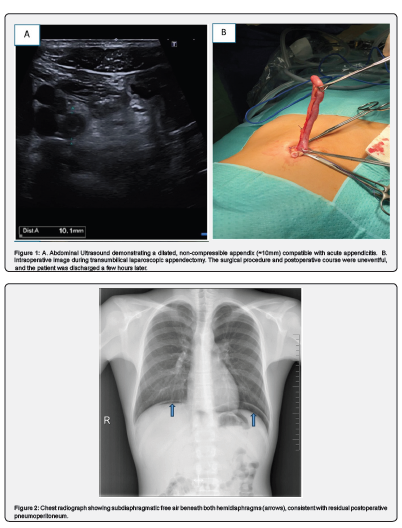
A 13-year-old boy underwent urgent single-port transumbilical video-assisted appendectomy for acute phlegmonous appendicitis (Figure 1). Eight days later, he presented to the emergency department with acute, well-localized pain at the xiphoid process and right shoulder that worsened in the supine position, without fever or abdominal pain. Physical examination revealed a soft, non-tender abdomen without peritoneal signs; the umbilical wound showed mild erythema without signs of infection.
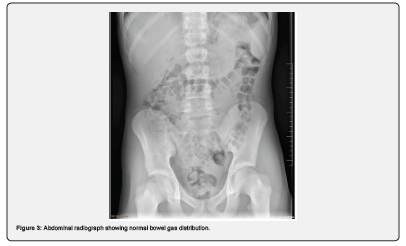
Given the clinical presentation, chest and abdominal radiographs were obtained, demonstrating bilateral subdiaphragmatic free air (Figure 2), more evident beneath the left hemidiaphragm, with normal intestinal gas distribution and no radiological signs of intra-abdominal complication (Figure 3). In the context of a benign clinical status and normal abdominal examination, these findings were interpreted as residual postoperative pneumoperitoneum causing diaphragmatic irritation and referred shoulder pain. The patient showed favourable clinical evolution with conservative management and remained asymptomatic at follow-up.
Residual pneumoperitoneum is a common finding after laparoscopic procedures and may persist beyond the immediate postoperative period [1]. In children, diaphragmatic irritation caused by subdiaphragmatic free air may manifest as abdominal, chest or shoulder pain, potentially mimicking complications [2,3]. Recognition of this benign entity and correlation with clinical stability are essential to avoid unnecessary diagnostic tests and interventions.
References
- Chapman BC, McIntosh KE, Jones EL, Wells D, Stiegmann GV, et al. (2015) Postoperative pneumoperitoneum: is it normal or pathologic? Journal of Surgical Research 197(1): 107-111.
- Song T, Kim KH, Lee KW (2017) The Intensity of Postlaparoscopic Shoulder Pain Is Positively Correlated with the Amount of Residual Pneumoperitoneum. J Minim Invasive Gynecol 24(6): 984-989.e1.
- Muñoz-Serrano AJ, Delgado-Miguel C, Velayos M, Fernandez KE, Delfa SB, et al. (2022) Postoperative Pneumoperitoneum in Pediatric Patients: Residual Air or Surgical Complication? A Prospective Study. J Laparoendosc Adv Surg Tech A 32(5): 576-582.

























