




 JOCCT Home



Abstract
Background: Acute coronary syndromes (ACS) in women are characterized by specific epidemiological, clinical and angiographic features that
remain poorly documented in sub-Saharan Africa. This study aimed to compare sex-related characteristics of ACS in a Cameroonian tertiary
interventional cardiology center.
Methods: We conducted a cross-sectional descriptive and analytical study at Yaoundé General Hospital, including patients aged ≥18 years
admitted for ACS who underwent coronary angiography between November 2022 and November 2025. Sociodemographic, clinical, biological,
echocardiographic, angiographic and therapeutic data were collected. Statistical comparisons were performed using appropriate tests, and
multivariable logistic regression was used to identify factors independently associated with female sex.
Results: A total of 115 patients were included, of whom 25 were women (21.7%). Women were older and had a higher prevalence of hypertension.
NSTEMI was more frequent among women, whereas STEMI predominated in men. Normal coronary angiography was more common in women.
In multivariable analysis, women were significantly less likely to receive optimal medical therapy prior to admission.
Conclusion: Women with ACS in Cameroon exhibit distinct profiles, including a high prevalence of non-obstructive coronary artery disease
and suboptimal early medical management. These results highlight the need for training on this deadly cardiovascular emergency that does not
differentiate between sexes.
Keywords:Acute coronary syndrome; Women; Coronary angiography; Coronary lesions; Sub-Saharan Africa; Cameroon
Introduction
Acute Coronary Syndromes (ACS) represent a major cause of cardiovascular morbidity and mortality worldwide. While their incidence has historically been higher in men, recent data show that women present distinct clinical, pathophysiological, and prognostic profiles, often associated with diagnostic delays and management that is less compliant with international guidelines. These disparities contribute to a mortality rate that is sometimes comparable to, or even higher than, that of men, despite a lower apparent coronary lesion burden [1,2].
In Western countries, several large-scale registries have highlighted that women with ACS are, on average, older, more frequently hypertensive or diabetic, and more commonly present with non-ST-segment elevation coronary syndromes, as well as a higher proportion of non-obstructive coronary artery disease [3]. Research from the CRUSADE, CLARIFY, and WISE registries has particularly emphasized the increased frequency of normal coronary angiographies and coronary microvascular dysfunction in women, suggesting pathophysiological mechanisms distinct from those observed in men [4].
In sub-Saharan Africa, data remain limited, even as the epidemiological transition is accompanied by a rapid increase in cardiovascular risk factors [5]. The few available studies, notably those from the REPACI registry in Côte d’Ivoire, indicate that Black African women present notable peculiarities, characterized by a high prevalence of hypertension and obesity, as well as a significantly higher probability of non-obstructive coronary lesions and normal coronary angiographies, despite clinical presentations comparable to those of men [6].
In Cameroon, the sex-specific characteristics of ACS remain insufficiently documented. This study aims to describe and compare the epidemiological, clinical, biological, angiographic, and therapeutic characteristics of acute coronary syndromes in women and men, in order to better characterize the female coronary profile in our context and optimize diagnostic and therapeutic strategies adapted to sub-Saharan Africa.
Materials and Methods
Study Setting and Design
We carried out a cross-sectional, descriptive, and analytical study at the Yaoundé General Hospital (YGH), the primary reference center for interventional cardiology in Cameroon. Located in Yaoundé, the country’s political capital, this facility houses the first and only functional cardiac catheterization laboratory in Cameroon, operational since November 2022 and under the responsibility of an interventional cardiologist.
The catheterization laboratory is equipped with a SIEMENS Artis One coronary angiography system, allowing for diagnostic and interventional coronary explorations according to international standards.
Study Period
The study was conducted over a three-year period, from November 8, 2022, to November 8, 2025.
Study Population
The study population consisted of all patients aged 18 years or older, hospitalized at or referred to the Yaoundé General Hospital for an acute coronary syndrome, who underwent diagnostic coronary angiography during the study period.
Inclusion Criteria
The following patients were included:
• Patients aged ≥ 18 years;
• Male or female patients;
• Patients presenting with an acute coronary syndrome
(STEMI, NSTEMI, or Unstable Angina);
• Patients who underwent coronary angiography showing
significant coronary stenosis during the study period.
Non-inclusion Criteria
The following were excluded:
• Patients under 18 years of age;
• Incomplete or unusable medical records;
• Patients who did not undergo coronary angiography;
• Patients who did not provide informed consent.
Operational Definitions
• Acute Coronary Syndrome was defined according to
international recommendations, including ST-segment elevation
ACS (STEMI), non-ST-segment elevation ACS (NSTEMI), and other
related clinical forms.
• Normal Coronary Angiography was defined as the
absence of significant atherosclerotic lesions visible on the
epicardial coronary arteries.
• Significant Coronary Lesion was defined as stenosis ≥
70% in a major epicardial artery or ≥ 50% in the left main stem.
• Coronary Lesions were classified by the number of
vessels involved (single-, double-, or triple-vessel disease) and by
the ACC/AHA morphological classification (types A, B1, B2, C).
• Lipoprotein(a) was considered elevated at a value ≥ 50
mg/dl.
Data Collection
Data were collected from medical records, catheterization
laboratory registries, and coronary angiography reports. They
included:
• Sociodemographic data (age, sex);
• Cardiovascular risk factors and medical history;
• Clinical data (type of ACS, time to consultation, access
site);
• Biological and echocardiographic data;
• Angiographic data;
• Therapeutic management modalities, including dual
antiplatelet therapy (DAPT), optimal medical therapy (OMT), and
revascularization strategies.
Statistical Analysis
Statistical analyses were performed using appropriate statistical software (SPSS version 26.0). Qualitative variables were expressed as frequencies and percentages, then compared using Pearson’s Chi-square test or Fisher’s exact test according to theoretical counts.
The normality of the distribution of quantitative variables was assessed using the Shapiro–Wilk test. Quantitative variables with a normal distribution were compared using the Student’s t-test, while those with a non-normal distribution were analyzed using the Mann–Whitney test.
Associations were expressed as Odds Ratios (OR) with 95% confidence intervals. A multivariate binary logistic regression was performed to identify factors independently associated with the female sex.
The threshold for statistical significance was set at p < 0.05.
Ethical Considerations
The study was conducted in accordance with the ethical principles of the Declaration of Helsinki. Patient anonymity and data confidentiality were strictly respected. The data were used exclusively for scientific purposes.
Results
The sociodemographic profile of the study population (115 patients) reveals a clear male predominance, with 90 men (78.3%) versus 25 women (21.7%). The overall mean age was 57.58 ± 11.25 years, ranging from 27 to 82 years. Although the difference was not statistically significant (p=0.060), women tended to be older at the time of diagnosis, with a mean of 61.32 ± 10.2 years compared to 56.54 ± 11.3 years for men (P=0.060).
Analysis of age groups underscores this trend: the majority of women (60%) were in the over-60 age group (without statistically significant differences), while men were more represented in the younger age groups, particularly between 41 and 60 years, where they constituted nearly 58% of their group (also without statistically significant differences). The Figure 1 below describes this sociodemographic profile.

The cardiovascular risk profile of the patients is characterized by a high prevalence of hypertension, particularly among women, where it reaches 84% compared to 68.9% in men. Multivariate analysis confirms that hypertension is the primary factor associated with the female sex, with an adjusted Odds Ratio of 2.97 (p=0.077). Table 3 describes the multivariate analysis.
Type 2 diabetes is also frequent, affecting 36% of women and 26.7% of men. In contrast, dyslipidemia and smoking are more commonly found in men (48.9% and 8.9%, respectively) than in women (44% and 4%). Regarding biological and structural parameters, there is no significant difference between the two sexes concerning the prevalence of elevated Lipoprotein(a) (47.1% in women versus 44.1% in men) or impaired left ventricular ejection fraction (44% vs. 48.3%). Finally, personal history of coronary artery disease and pre-existing heart failure are distributed comparably across both groups. Table 1 below describes these findings.

aOR: adjusted odds ratio CI: Confidence interval
The comparison of biological and functional parameters by sex did not reveal any statistically significant differences. Median lipoprotein(a) levels, which followed a non-normal distribution, were comparable between women and men: 47.8 [29.1 – 76.3] mg/dl versus 47.2 [29.5 – 63.1] mg/dl (Mann-Whitney test, p=0.796). Left ventricular ejection fraction was also similar between the two groups: 51.36 ± 10.43% versus 50.53 ± 11.78% (Student’s t-test, p=0.750).
Clinically, ST-segment elevation myocardial infarction (STEMI) was the predominant presentation in men (46.7%), while women presented more frequently with NSTEMI (24% versus 13.3% in men).
The time to management was predominantly less than one month for both sexes, although 72% of women sought consultation within this timeframe compared to 64.4% of men.
Radial access was the preferred route for coronary angiography in both groups (68% in women and 64.4% in men).
A notable finding was the high frequency of normal coronary angiographies among women, reaching 32% compared to 26.7% in men. Among patients with organic lesions, single-vessel disease was the most common (32% of women and 41.1% of men).
Triple-vessel disease affected 16% of women and 14.4% of men. According to the ACC/AHA classification, a significant proportion of lesions remained unidentified (NI), involving 52% of women and 46.7% of men. Regarding therapeutic management prior to admission, the majority of patients of both sexes were receiving dual antiplatelet therapy (DAPT), with utilization rates of 92% in women and 92.2% in men.
However, a significant disparity was observed concerning the Optimal Medical Therapy (OMT) received previously: multivariate analysis revealed that women were significantly less likely to benefit from it, with an adjusted Odds Ratio of 0.38 (95% CI: 0.15- 0.99; p=0.048) compared to men. Table 2 describes these clinical characteristics.
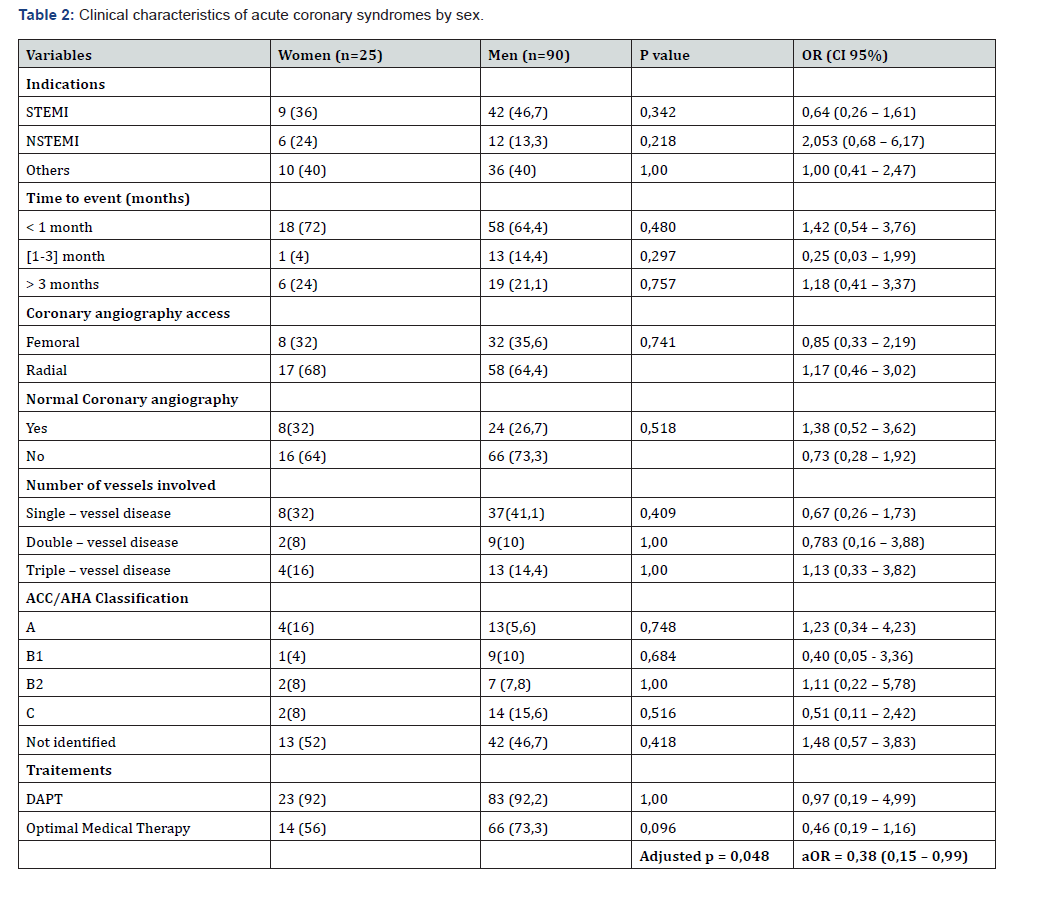
STEMI: ST elevation myocardial infarction, NSTEMI: Non-ST elevation myocardial infarction DAPT: Dual Antiplatelet Therapy, OMT: Optimal Medical Therapy, aOR: Adjusted Odds Ratio CI: Confidence interval
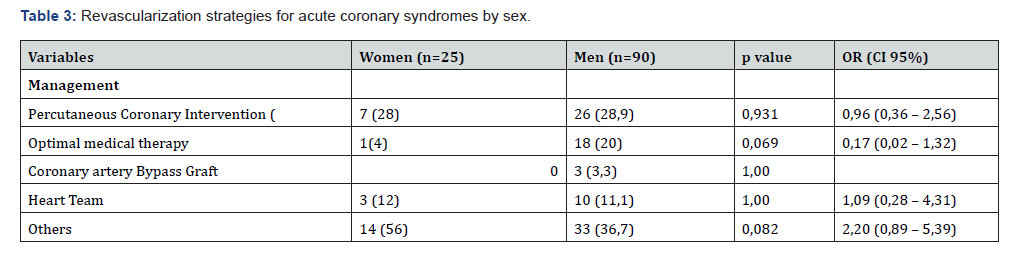
Regarding revascularization strategies, the use of coronary angioplasty was similar in both groups (28% in women versus 28.9% in men).
Coronary artery bypass graft (CABG) surgery remains marginal, having been performed in only 3.3% of the men in the cohort.
Finally, decisions made during multidisciplinary heart team meetings involved approximately 11% to 12% of patients, with no distinction by sex. Table 3 details the sex-specific distribution of these revascularization strategies.
Discussion
The present study describes the epidemiological, clinical, biological, angiographic, and therapeutic characteristics of acute coronary syndromes (ACS) by sex in a Cameroonian interventional cardiology reference center. Our results confirm the existence of notable differences between women and men, aligning with observations reported in international and African registries [1,7].
Epidemiologically, the proportion of women in our cohort remains low (21.7%), reflecting the classic male predominance reported in ACS [8]. This female underrepresentation has also been observed in large international registries such as CRUSADE and CLARIFY, where women accounted for less than 30% of included patients [3]. Women in our study were, on average, older than men, although the difference was not statistically significant. This trend is consistent with literature data suggesting a hormonal protective effect that delays the onset of coronary events in women [9].
Regarding cardiovascular risk factors, hypertension emerges as the factor most frequently associated with the female sex, with a trend toward an independent association after multivariate adjustment. This observation is consistent with African and Western data, where hypertension constitutes a major determinant of coronary risk in women [5]. Conversely, smoking remained more frequent in men, confirming a sex-differentiated risk profile [10].
Clinically, women presented more frequently with NSTEMI, while men were more often affected by STEMI. This result is widely reported in the literature and could be explained by distinct pathophysiological mechanisms, including a higher prevalence of microvascular dysfunction and plaque erosion in women [4, 11].
One of the major findings of our study is the high proportion of normal coronary angiographies in women (32%), as well as the significant frequency of non-obstructive coronary lesions.
These data are consistent with the results of the REPACI registry in Côte d’Ivoire and the WISE study, which showed a significantly higher probability of clear or non-obstructive coronary arteries in women [2,7,12]. These observations reinforce the hypothesis of myocardial ischemia linked to non-epicardial mechanisms, particularly coronary microvascular dysfunction, which is often underdiagnosed in our settings due to a lack of specialized diagnostic tools [13].
Regarding therapeutic management, the use of dual antiplatelet therapy was high and comparable between the two sexes. In contrast, women were significantly less likely to receive optimal medical therapy prior to admission, even after multivariate adjustment. This therapeutic disparity, widely documented in international registries, could contribute to persistent prognostic inequalities in women with ACS [1,3,14]. Finally, revascularization strategies were similar between sexes, suggesting decision-making equity at the interventional stage once coronary angiography is performed. However, the high proportion of medical treatment decisions in women might reflect the higher prevalence of non-obstructive lesions in this group.
Conclusion
Acute coronary syndromes in women in Cameroon present distinct characteristics from those observed in men. Although representing a minority of cases, women are distinguished by a higher prevalence of hypertension, a clinical presentation dominated by NSTEMI, and a significant proportion of normal coronary angiographies or non-obstructive coronary lesions. Once coronary angiography is performed, interventional management strategies appear comparable between sexes. However, women benefit less frequently from optimal medical therapy prior to admission, highlighting persistent disparities in the pre-hospital phase. These results underscore the need for training strategies regarding this life-threatening cardiovascular emergency, which makes no distinction between the sexes.
Conflict of Interest: The authors declare that they have no conflict of interest.
Authors’ Contributions: All authors contributed to the design, analysis, interpretation, and writing of this work. Consequently, all authors assume responsibility for all aspects of the manuscript.
Funding: The authors received no financial support for the design, writing, and/or publication of this article.
References
- Blomkalns AL, Chen AY, Hochman JS, Peterson ED, Trynosky K, et al. (2005) Gender disparities in the diagnosis and treatment of non-ST-segment elevation acute coronary syndromes: large-scale observations from the CRUSADE (Can Rapid Risk Stratification of Unstable Angina Patients Suppress Adverse Outcomes With Early Implementation of the American College of Cardiology/American Heart Association Guidelines) National Quality Improvement Initiative. J Am Coll Cardiol 45(6): 832-837.
- Johnson BD, Shaw LJ, Buchthal SD, Bairey MCN, Kim HW, et al. (2004) Prognosis in women with myocardial ischemia in the absence of obstructive coronary disease: results from the National Institutes of Health-National Heart, Lung, and Blood Institute-Sponsored Women's Ischemia Syndrome Evaluation (WISE). Circulation 109(24): 2993-2999.
- Steg PG, Greenlaw N, Tardif JC, Tenders M, Ford I, Kaab S, et al. (2012) Women and men with stable coronary artery disease have similar clinical outcomes: insights from the international prospective CLARIFY registry. Eur Heart J 33(22): 2831-2840.
- Camici PG, Crea F (2007) Coronary microvascular dysfunction. N Engl J Med 356(8): 830-840.
- Marijon E, Mirabel M, Celermajer DS, Jouven X (2013) Coronary heart disease in sub-Saharan Africa. Bull World Health Organ 91(5): 361-364.
- Guetta RN, Yao H, Ekou A, Cho MMHN, Angoran I, et al. (2016) Study of coronary lesions in black African woman: Preliminary data from the REgistre Prospectif des Actes de Cardiologie Interventionnelle de l’Institut de Cardiologie d’Abidjan (REPACI). Rev Cardiovasc Med 17(Suppl 1): S44.
- Guetta RN, Yao H, Ehouman E, Ekou A, Anzouan KJB, et al. (2019) Coronary angiographic findings in dilated cardiomyopathy in a sub-Saharan African population. Cardiovasc J Afr 30(3): 157-161.
- Hanssen M, Cottin Y, Khalife K, Hammer L, Goldstein P, et al. (2012) French Registry on Acute ST-elevation and non-ST-elevation Myocardial Infarction 2010. FAST-MI 2010. Heart 98(9):699-705.
- Wenger NK, Speroff L, Packard B (1993) Cardiovascular health and disease in women. N Engl J Med 329(4): 247-256.
- Lee CY, Liu KT, Lu HT, Mohd Ali R, Fong AYY, et al. (2021) Sex and gender differences in presentation, treatment and outcomes in acute coronary syndrome, a 10-year study from a multi-ethnic Asian population: The Malaysian National Cardiovascular Disease Database—Acute Coronary Syndrome (NCVD-ACS) registry. PLoS One 16(2): e0246474.
- Maas AH, van dSYT, Regitz ZV, Swahn E, Appelman YE, et al. (2011) Red alert for women's heart: the urgent need for more research and knowledge on cardiovascular disease in women: proceedings of the workshop held in Brussels on gender differences in cardiovascular disease, 29 September 2010. Eur Heart J 32(11): 1362-1368.
- Gehrie ER, Reynolds HR, Chen AY, Neelon BH, Roe MT, et al. (2009) Characterization and outcomes of women and men with non–ST-segment elevation myocardial infarction and nonobstructive coronary artery disease: results from the Can Rapid Risk Stratification of Unstable Angina Patients Suppress Adverse Outcomes with Early Implementation of the ACC/AHA Guidelines (CRUSADE) Quality Improvement Initiative. Am Heart J 158(4): 688-694.
- Kothawade K, Bairey Merz CN (2011) Microvascular coronary dysfunction in women: pathophysiology, diagnosis, and management. Curr Probl Cardiol 36(8): 291-318.
- Mehilli J, Kastrati A, Dirschinger J, Pache J, Seyfarth M, et al. (2002) Sex-based analysis of outcome in patients with acute myocardial infarction treated predominantly with percutaneous coronary intervention. JAMA 287(2): 210-215.

























