




 JOCCT Home



Abstract
Background: Acute coronary syndromes (ACS) are a major cause of cardiovascular morbidity and mortality worldwide, with poorer outcomes reported in sub-Saharan Africa, largely due to delays in diagnosis and treatment. Thereforre many studies had been carried out in our context on the delays of management of ACS. Since 2022 the Cameroonian government has equipped in one catheterization laboratory (Cathlab) the two major hospitals in the two capital (Yaoundé and Douala) This study assessed management delays and in-hospital outcomes of ACS patients in
three referral hospitals in Cameroon in the era of Interventional cardiology. So, at the best of our knowledge, this is the first study including the admission in Cathlab in Yaoundé.
Methods: We conducted a retrospective cross-sectional study in three cardiology centres in Yaoundé, including patients treated for confirmed
ACS between January 2019 and July 2023. Sociodemographic characteristics, comorbidities, admission routes, diagnostic and therapeutic delays,
treatments received, and in-hospital outcomes were analysed.
Results: Forty patients were included; 67.5% were male, with a mean age of 54.1 ± 11.3 years. The median delay from symptom onset to
admission was 14 hours (IQR: 5 - 48), and 32.5% of patients presented ≥48 hours after pain onset. Among referred patients, the median
referral-to-admission delay was 28 hours (IQR: 24 - 72). Median delays from admission to paraclinical investigations and confirmed diagnosis
were 12 hours and 20 hours, respectively. Only 50% underwent coronary angiography, with a median delay of 27.5 days from symptom onset.
Revascularization was performed in 57.5% of patients. In-hospital mortality was 2.5%.
Conclusion: Significant pre-hospital and in-hospital delays persist in the management of ACS in Cameroon, particularly for diagnosis and
access to coronary angiography. Despite relatively low in-hospital mortality, these delays highlight the need for improved referral systems, early
recognition, and timely access to definitive care.
Keywords: Delay; Acute coronary syndrome; Management; Interventional Cardiology; Yaoundé
Abbreviations:ACS: Acute Coronary Syndrome;
Background
Acute Coronary syndrome (ACS) encompasses a spectrum of acute ischemic heart diseases resulting from a sudden reduction in coronary blood flow. It represents one of the leading causes of cardiovascular mortality in the world and is associated with high short term and long-term complications [1]. An analysis based on the 2021 global burden of disease reported that 31 872 778 new cases of ischemic heart disease were recorded in 2021 representing an increase of 1.02% from 1990. Also, the number of deaths stood at 8 991 637, with an age-standardized mortality rate of 108.73 per 100 000 individuals.
Overall, Sub-Saharan African subregions had higher agestandardized incidence rates (314-379 per 100 000) compared with USA (174 per 100 000) and Western Europe (172 per 100 000) in 2021 [2]. The outcome of patients with ACS is usually worse in sub–Saharan Africa due to limited finances with limited access to medical insurance, poorly equipped health facilities and lack of wholistic preventive care [3]. The current paper aims to evaluate the delays in diagnosis and treatment of ACS and the consequent outcomes in three referral centers in Cameroon in the era of Interventional Cardiology.
Methods
Study Design and Setting: We carried out a retrospective cross-sectional study in the duration from February 2023 to July 2023 in the cardiology units of the Yaoundé Central Hospital, the Yaoundé General Hospital and the Jourdain Medical Center Cameroon on patients treated between January 2019 to July 2023.
Study Population: All patients treated for a confirmed Acute coronary syndrome during the study period with a complete file.
Data Collection: Data was extracted from the files of patients admitted to the emergency unit, the intensive care unit and the Cardiology units. We collected data on sociodemographic, comorbidities, presenting symptoms and duration of symptoms, physical exam findings and paraclinical findings of the patients.
Statistical Analysis: Data was entered and analyzed using CSPro version 7.6. Continuous variables were expressed as mean ± standard deviation and categorical variables as frequencies and percentages. Statistical significance was set at p < 0.05.
Results
Sociodemographics: A total of 40 files were included in this study. Males represented most cases with a prevalence of 67.5%. The mean age was 54,05 ± 11,33 with a range of 16 – 75 years (Table 1).

Comorbidities
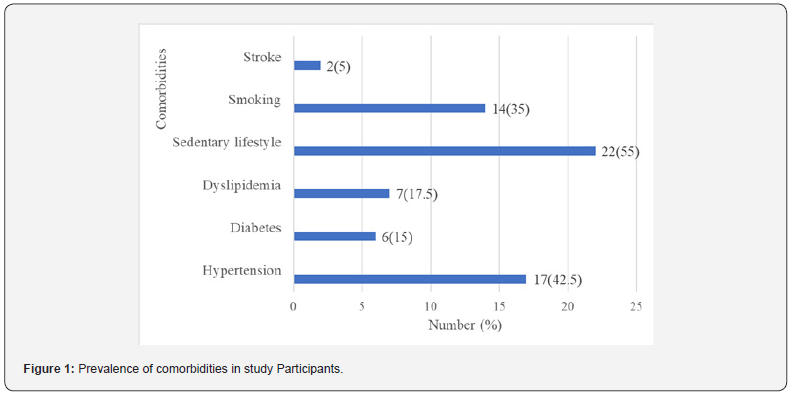
The most frequent comorbidities were a sedentary lifestyle (55%), hypertension (42.5%) and smoking (35%). 2 patients (5%) had had a previous ischemic stroke episode (Figure 1).
Route of admission of patients to the specialized service
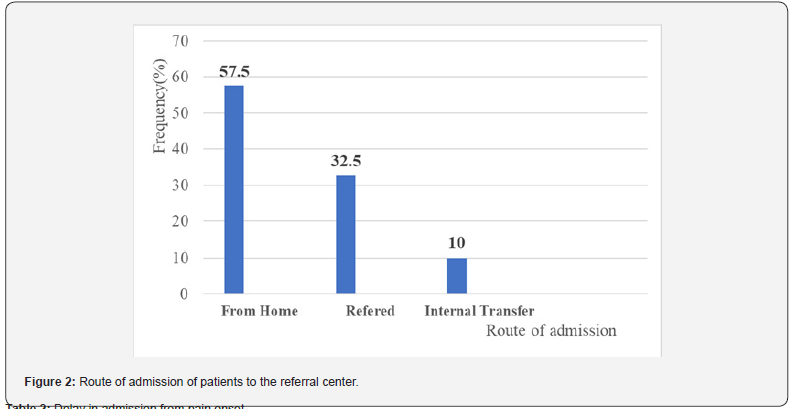
Most patients (57.5%) left home directly to the specialized cardiology centers while 32.5% of patients consulted at another health service provider before being referred to the specialized center. Only 10% of patients were transferred from another unit to the cardiology unit in the same specialized center (Figure 2).
Delay From Pain Onset to Admission, Investigations and Treatment
The median duration between onset of pain and admission to the specialized unit was 14 hours (IQR:5 – 48). Most patients (52.5%) were admitted within 6hours of pain onset while a significant number; 13 (32.5%) were admitted at least 48hours after onset of pain (Table 2). Amongst the referred or internally transferred (n=17), the median delay from referral or transfer to admission in specialized service was 28 hours (IQR:24 – 72) (Table 3). The median delay from admission to realization of paraclinicals and positive diagnosis was 12 hours (IQR:6-28) and 20 hours (IQR: 9 – 48) respectively (Table 4). Only 50% of the study population benefited from a coronarography. The median delay from pain onset to coronarography was 27.5 (IQR: 12 -90) days with a range of 1 – 360 days (Table 5). Most patients; 13(32.5%) received specific treatment for ACS at least 24 – 48hours after onset of pain. Up to 11 patients (27.5%) of patients received specific treatment 72hours after onset of symptoms.
Treatment
In this study, 23(57.5%) patients benefited from revascularization treatment with 13 (32.5%) having a stent placed, 8 (20.0%) benefiting from angioplasty and 2(5%) receiving IV thrombolysis. Majority of patients received anticoagulant treatment (87.5%), antiplatelets (95%) and a statin (80%). Only one patient underwent a primary percutaneous intervention (Table 6).


Outcome
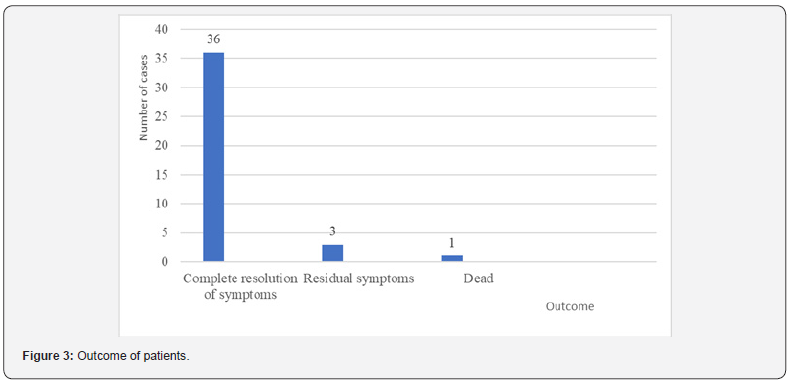
In hospitals resolution of symptoms was documented in 90% of patients, with residual symptoms in 7.5% of patients at discharge. One patient of the 40 patients died giving an in-hospital mortality of 2.5% (Figure 3).
Discussion
In this study a total of 40 patients with ACS were recruited and of these the majority; 67.5% were males. This is consistent with previous studies like the EURHOBOP study in Europe which reported that men made up to 70% of their ACS patients were men [4]. A study from south America; Cuba in the same vein reported similar trends in sex discrepancies with a 72% male majority [5]. The mean age of our study population was 54.1(SD:11.3) years with a range of 16 - 75 years. The most frequent age group being 55 - 65 years. This age was much lower that the ages for the EURHOBOP cohort which reported mean ages of 63.8±12.9, 68.1±12.7 and 66.5±12.8 in France, Germany and Greece respectively [4]. An Asian study in India reported higher age range from 30 - >70 years with the most frequent age group being 51 - 60 years [6].
A South American study from Cuba reported a closer age range of 18 - >80 years with the most frequent age group being 60 - 69 years [5]. Finally, a similar study in Cameroon in 2020 covering the period from 2016 – 2019 reported a higher mean age of 60.8 ±13.7 years with the most frequent age group being 60 – 70 years [7]. Most patients were in the informal sectors (35%), meaning they could be farmers, housemaid, shepherds. The minimal salary of the citizen in Cameroon was 80USD. An angiography costs 1545,92 USD and an angioplasty with one stent 4001,43 USD and there is no medical insurance provided by the government. Everyone has then to subscribe for his own and this contributed in lengthening the delay of admission in cathlab.
The most frequent comorbidities were a sedentary lifestyle (55%) followed by hypertension (42.5%) and smoking (35%). The European EURHOBOP study, the Cuban study and a 10-year systematic review in sub–Saharan Africa all reported hypertension as the most prevalent cardiovascular risk factor with frequencies of 50.3-77.3%, 69% and 50-55% respectively [4,5,8]. All these studies did not include a sedentary life style as a risk factor in their series. Similarly, the Cameroonian study reported a similar finding of hypertension as the most prevalent comorbidity with a frequency of 80.4% despite including a sedentary lifestyle as a variable [7]. This discrepancy could be since a sedentary lifestyle was gauged through a subjective evaluation with possible over estimation.
Also, the lower prevalence of hypertension in our series could be due to the younger age of participants. The median duration between onset of pain and admission to the specialized unit was 14 hours (IQR:5 – 48). This time is longer that those reported in some South African studies with pain to admission times ranging from 2.3 – 3.6 hours. Our value was closer to the 12.9 hours in one Kenyan study and much lower than the 20 – 44.7 hours in studies from Ivory Coast [8]. A Russian multicentric study reported a median prehospital delay of 5.1 hours (IQR 2.8–12.2) which was much lower than that in our study [9]. The median delay from admission to realization of para clinicals was 12 hours (IQR:6- 28) which was longer than the delay from admission to ECG realization in a Senegalese study which reported a 9hours delay from admission to ECG testing [10]. The median delay from pain onset to coronarography was 27.5 (IQR: 12 -90) days with a range of 1 - 360 days.
This delay was like that reported in a Portuguese study with a median delay from admission to angiography being 30.9 hours (20.3-70.2) for high-risk NSTE-ACS and 26.6 hours (17.1-52.0) for intermediate-risk NSTE-ACS even though both delays were longer than the recommended time [11]. Most patients; 13(32.5%) received specific treatment for ACS at least 24 - 48hours after onset of pain. Up to 11 patients (27.5%) of patients received specific treatment 72hours after onset of symptoms. The main revascularization treatment was PCI (52.5%) with only 2 patients receiving IV thrombolysis.
This reflects a positive shift from the usual practice in Cameroon in the years before 2019 where majority of patients received IV thrombolysis as demonstrated by the results of the study in the same city but covering the period from 2016 to 2019 in which 28% of patients received IV thrombolysis and only 13% received PCI and these were patients who were medically evacuated abroad for the PCI [7]. Our delay as well as those from similar African studies except South Africa probably reflects absence of emergence ambulance services, limited knowledge on ACS as well as financial limitations. Finally, in this current study, a mortality rate of 2.5% was recorded, which was lower than the 8.4% reported in a European cohort [4]. It was also lower than the mortality reported from a similar study in Cameroon on patients prior to 2019 which reported a 13% mortality [7]. This trend might lead to an improvement in ACS care in the region.
Conclusion
This study demonstrates substantial delays at multiple stages of ACS management in referral hospitals in Cameroon, from symptom onset to admission, diagnosis, and definitive treatment. Limited access to timely coronary angiography and revascularization remains a major challenge though there is a positive shift towards PCI in Cameroon in the past years with more patients receiving this treatment in the country. Although in-hospital mortality was low, delayed care may contribute to adverse long-term outcomes. Strengthening pre-hospital pathways, improving early diagnosis, and expanding access to invasive cardiology services are essential to improve ACS outcomes in this new interventonal cardiology setting.
Conflicts of Interest
We do not have any conflicts of interest
Funding
No funding has been granted for this study
Ethical considerations:
Ethical clearance was obtained from the Institutional Ethics Committee of the Faculty of Medicine and Pharmaceutical Sciences, University of Douala. Administrative authorization was granted by the three hospitals. Confidentiality was maintained.
Strengths of the study
• First updated local data on the delay of management
of acute coronay syndrom since the inauguration of the only
catheterization center in the Cameroonian main capital.
• Highlighting the gap between international
recommendations and actual practice.
Limitations of the study
Sample size. A more representative sample would provide more usable results. The main limitation were, the underestimation of the cases, the financial difficulties.
References
- Landi A, Varga A, Veulemans V, Milzi A (2025) Editorial: Short and long-term treatment options in patients with acute coronary syndrome. Frontiers in Cardiovascular Medicine 12: 1563882.
- Liu C, Jin Q, Han C, Jiao M (2025) Global, regional, and national burden of ischaemic heart disease from 1990 to 2021: a comprehensive analysis based on the Global Burden of Disease study 2021. Journal of Global Health 15: 04291.
- Vedanthan R, Seligman B, Fuster V (2014) Global Perspective on Acute Coronary Syndrome: A Burden on the Young and Poor. Circ Res 114(12): 1959-1975.
- André R, Bongard V, Elosua R, Kirchberger I, Farmakis D, Häkkinen U, et al. (2014) international differences in acute coronary syndrome patients’ baseline characteristics, clinical management and outcomes in Western Europe: the EURHOBOP study. Heart 100(15): 1201-1207.
- Dzebu AS, Blanco SO, Medina JMA (2023) Characterisation of Patients with Acute Coronary Syndrome: A 10-Year Experience. EMJ Cardiology 66-74.
- CH Monica Lakshmi Priyanka, Mamatarani, Asiya Zeba, Anusha S J (2025) Clinical and Angiographic Profile of Acute Coronary Syndrome Patients: A Prospective Observational Study. Eur J Cardiovasc Med 15(5): 1006-1009.
- Nganou-Gnindjio CN, Nkeck JR, Tchouanlong AT, Essama DB, Menanga AP (2021) State of care of acute coronary syndromes in a sub-Saharan African setting: five years in review of management revealing an alarming situation in Yaoundé, Cameroon. Tropical Cardiology (Cardiologie Tropicale).
- Hermann Yao, Arnaud Ekou, Thierry Niamkey, Sandra Hounhoui Gan, Isabelle Kouamé (2022) Acute Coronary Syndromes in Sub-Saharan Africa: A 10-Year Systematic Review. Journal of the American Heart Association 11(1): e021107.
- Bates K, Schirmer H, Kontsevaya A, Bobrova N, Leon DA, McKee M (2022) Pre-Hospital Delays among Patients with Acute Coronary Syndrome in the Russian Federation: a multicentre prospective observational cohort study (the AMIR Study). Research Square 1.
- Dioum M, Issa KA, Joseph S Mingou, Papa N Ndiaye, et al. (2020) Care time Delays in Acute Coronary Syndromes with Persistent St Elevation (stem) and the Delaying Factors: Prospective STUDY About 50 Cases in the Cardiology Department of Aristide le Dante Hospital. Cardiology Research and Reports 2(1).
- Viana M, Laszczyńska O, Araújo C, Borges A, Barros V, Ribeiro AI, et al. (2020) Patient and system delays in the treatment of acute coronary syndrome. Revista Portuguesa De Cardiologia 39(3): 123-131.

























