




 JOCCT Home



Abstract
Background: Aortic dissection (AD) is a life-threatening cardiovascular emergency with high mortality rates if not promptly diagnosed and
treated. Data on AD in sub-Saharan Africa remains limited.
Objective: To describe the epidemiological, clinical, diagnostic, therapeutic, and prognostic characteristics of patients with AD at the Regional
Hospital Center of Saint-Louis, Senegal.
Methods: This retrospective descriptive study included all confirmed AD cases from January 2020 to June 2024. Data collection encompassed
demographic characteristics, risk factors, clinical presentation, diagnostic workup, treatment modalities, and outcomes.
Results: Six patients were included (3 males, 3 females) with a mean age of 54.16 ± 10.15 years. Hospital frequency was 0.48%. Hypertension
was the most common risk factor (66.7%). Acute chest pain was present in all patients (100%), with sudden onset in 83.3%. Type A dissection
predominated (83.3%). Diagnosis was confirmed by CT angiography in all cases. Medical management included beta-blockers in all patients.
Three patients underwent surgical intervention (Bentall procedure). Overall mortality was 33.3%.
Conclusion: AD remains a rare but severe condition requiring urgent multidisciplinary management. Early diagnosis and appropriate treatment
are crucial for improving outcomes.
Keywords: SAortic dissection; Diagnosis; Treatment; Senegal
Introduction
Aortic dissection (AD) represents one of the most catastrophic cardiovascular emergencies, characterized by a longitudinal tear in the aortic media, typically resulting from an intimal rupture and partial medial involvement [1,2]. Since its first anatomical description by Morgagni in 1761 and the first successful surgical repair by DeBakey in 1955, significant advances have been made in understanding and managing this complex pathology [3,4].
The natural history of untreated AD is grim, with mortality rates approaching 20% within the first 24 hours and 50% within 48 hours for type A dissections [5]. Despite therapeutic advances, AD continues to challenge clinicians worldwide due to its varied clinical presentations and the need for rapid intervention. The incidence of AD varies globally, with reported rates of 2.9-4.3 per 100,000 person-years in developed countries [6,7]. However, epidemiological data from sub-Saharan Africa remains scarce, highlighting the need for regional studies to better understand the disease burden and improve management strategies.
This study aims to analyze the diagnostic, therapeutic, and prognostic aspects of AD in a West African setting, providing insights into the clinical characteristics and outcomes of patients managed at a regional referral center in Senegal.
Methods
Study Design and Setting
This retrospective descriptive study was conducted at the Cardiology Department of the Regional Hospital Center of Saint-Louis, Senegal, over a 4.5-year period (January 1, 2020, to June 28, 2024).
Study Population
All patients with confirmed AD diagnosis admitted to the cardiology department during the study period were included. Diagnosis confirmation required CT angiography evidence of aortic dissection. Patients with suspected but unconfirmed AD were excluded.
Data Collection
Data were extracted from medical records using a standardized
form, including:
• Demographic characteristics and cardiovascular risk
factors
• Clinical presentation and physical examination findings
• Diagnostic investigations (ECG, chest X-ray,
echocardiography, CT angiography)
• Treatment modalities (medical and surgical)
• Outcomes and complications
Statistical Analysis
Descriptive statistics were used to summarize the data. Continuous variables were expressed as means ± standard deviation, and categorical variables as frequencies and percentages.
Results
Epidemiological Characteristics

The hospital frequency of AD was 0.48% among all cardiovascular admissions during the study period. The Table 1 summarizes the demographic and risk factor profile of the study population.
Clinical presentation
All patients presented with acute chest pain. The predominance of sudden onset pain (83.3%) aligns with the characteristic acute presentation. The Table 2 details the clinical characteristics and symptom profile of patients at presentation.

Diagnostic investigations
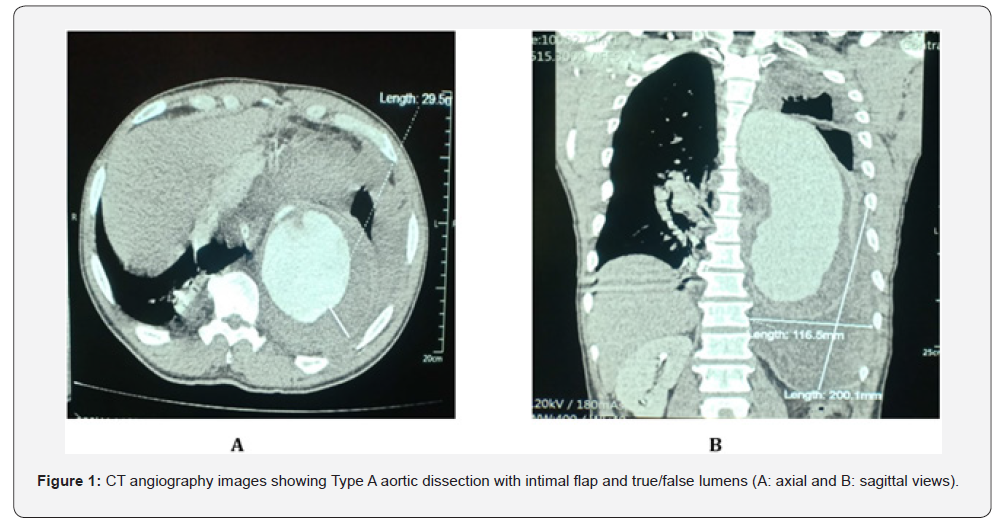
The CT angiography demonstrated 100% diagnostic accuracy. The prevalence of type A dissection was 83.3%. The Table 3 summarizes the diagnostic findings across different imaging modalities.
The Figure 1 shoes CT angiography images showing Type A aortic dissection with intimal flap and true/false lumens (axial and sagittal views).
Treatment and outcomes
All type A dissections received appropriate medical management with beta-blockers, and 60% of type A cases underwent surgical repair. The mortality rate was 33.3%. The Table 4 outlines the therapeutic approaches and clinical outcomes.


Discussion
This study represents one of the few reports on AD from West Africa, providing valuable insights into the clinical characteristics and outcomes of this life-threatening condition in a resourcelimited setting.
Epidemiological considerations
The mean age of 54.16 years in our cohort is consistent with other African studies [8,9,10] but younger than typically reported in Western populations (mean age 63.1 years in IRAD) [11]. This age difference may reflect the earlier onset of cardiovascular risk factors, particularly hypertension, in African populations [12].
The equal gender distribution in our series contrasts with the typical male predominance reported in most studies [13]. This finding may be influenced by the small sample size and requires validation in larger cohorts.
Hypertension was the predominant risk factor (66.7%), aligning with its established role as the most important modifiable risk factor for AD [14,15]. The high prevalence of hypertension in sub-Saharan African populations, often inadequately controlled, likely contributes to the AD burden in this region [16].
Clinical presentation and diagnosis
The classic triad of sudden-onset chest pain (100%), pulse asymmetry (16.7%), and aortic regurgitation murmur (66.7%) was variably present, emphasizing the diagnostic challenge of AD [17]. The predominance of chest pain with back radiation (83.3%) is consistent with typical AD presentations [18,19].
CT angiography achieved 100% diagnostic accuracy in our series, confirming its role as the gold standard imaging modality for AD diagnosis [20,21]. The limited use of chest X-rays (33.3%) and their abnormal findings in all performed cases highlight the importance of having high clinical suspicion for AD.
Transthoracic echocardiography demonstrated good sensitivity (83.3%) for detecting AD signs, though its diagnostic accuracy varies significantly with operator experience and patient characteristics [22,23]. The combination of clinical assessment, basic imaging, and CT angiography provided a robust diagnostic approach in our setting.
Management and outcomes
All patients received appropriate initial medical management with beta-blockers, following current guidelines for AD management [24,25]. The use of additional antihypertensive agents in 83.3% of cases reflects the need for strict blood pressure control in AD patients.
The surgical management rate of 60% for type A dissections aligns with current recommendations for emergency surgical intervention [26,27]. The Bentall procedure was the surgical technique of choice, reflecting the need for comprehensive root replacement in these complex cases [28].
The overall mortality rate of 33.3% is concerning but falls within expected ranges for AD, particularly in settings with limited immediate surgical capabilities [29,30]. The short mean hospital stay (48.5 hours) may reflect either rapid stabilization or early mortality, highlighting the acute nature of this condition [31-37].
Limitations
This study has several limitations inherent to its retrospective design and small sample size. The single-center experience may not be representative of the broader regional picture. Additionally, the lack of long-term follow-up data limits assessment of chronic outcomes and late complications.
The limited availability of certain diagnostic modalities, such as transesophageal echocardiography and cardiac MRI, may have influenced diagnostic accuracy and treatment planning. However, this reflects the real-world constraints of practicing medicine in resource-limited settings.
Implications for clinical practice
This study highlights several important considerations for AD
management in West Africa:
- Enhanced awareness: The rarity of AD (0.48% hospital
frequency) necessitates increased clinical suspicion and
awareness among healthcare providers.
- Diagnostic protocols: CT angiography should be the
first-line imaging modality when AD is suspected, given its high
diagnostic accuracy.
- Treatment standardization: All AD patients should
receive immediate medical management with beta-blockers,
regardless of subsequent surgical plans.
- Referral systems: Robust referral networks to centers
with cardiac surgical capabilities are essential for optimal type A
dissection management.
- Risk factor modification: Given the high prevalence
of hypertension, comprehensive cardiovascular risk reduction
programs are crucial for AD prevention.
Future research directions
Future multicenter studies with larger sample sizes are needed to better characterize AD in West African populations. Prospective registries could provide valuable insights into longterm outcomes and guide the development of region-specific management protocols.
Investigation of genetic factors predisposing to AD in African populations may reveal important ethnic differences in disease susceptibility. Additionally, cost-effectiveness analyses of different diagnostic and therapeutic strategies could inform resource allocation decisions in low- and middle-income countries.
Conclusion
Aortic dissection remains a rare but life-threatening cardiovascular emergency in West Africa. Our study demonstrates that despite resource limitations, appropriate diagnosis and management can be achieved with good outcomes in selected patients. The predominance of hypertension as a risk factor emphasizes the importance of cardiovascular disease prevention programs in this region.
Early recognition, prompt diagnosis with CT angiography, immediate medical stabilization, and timely surgical intervention when indicated are the cornerstones of successful AD management. Continued efforts to improve diagnostic capabilities, treatment protocols, and referral systems will be essential for reducing the morbidity and mortality associated with this devastating condition.
Conflicts of Interest: The authors declare no conflicts of interest.
References
- Nienaber CA, Clough RE (2015) Management of ssacute aortic dissection. Lancet 385(9970): 800-811.
- Isselbacher EM, Preventza O, Hamilton BJ, Augoustides JG, Beck AW, et al. (2022) 2022 ACC/AHA Guideline for the Diagnosis and Management of Aortic Disease. J Am Coll Cardiol 80(24): e223-e393.
- Morgagni GB (1761) De sedibus et causis morborum per anatomen indagatis. Venice: Ex Typographia Remondiniana.
- DeBakey ME, Cooley DA, Creech O Jr (1955) Surgical considerations of dissecting aneurysm of the aorta. Ann Surg 142(4): 586-612.
- Harris KM, Nienaber CA, Peterson MD, Woznicki EM, Braverman AC, et al. (2022) Early Mortality in Type A Acute Aortic Dissection: Insights From the International Registry of Acute Aortic Dissection. JAMA Cardiol 7(10): 1009-1015.
- Mészáros I, Mórocz J, Szlávi J, Schmidt J, Tornóci L et al. (2000) Epidemiology and clinicopathology of aortic dissection. Chest 117(5): 1271-1278.
- Clouse WD, Hallett JW Jr, Schaff HV, Spittell PC, Rowland CM et al. (2004) Acute aortic dissection: population-based incidence compared with degenerative aortic aneurysm rupture. Mayo Clin Proc 79(2): 176-180.
- Ndiaye MB, Diao M, Kane AD, Mbaye A, Doucouré I et al. (2010) Aspects diagnostiques, thérapeutiques et évolutifs de la dissection aortique à Med Afr Noire 57(8-9): 420-424.
- Atipo-Galloye R, Moumpala S, Ossere TB, Ngounda Monianga SA, Ajjaja R, et al. (2021) Acute Aortic Dissection in Brazzaville: a Report of Four Cases. Health Sci Dis 22(10).
- Mvondo CM, Lucille C, Tsague N, Ngowe MN (2023) Composite aortic root replacement in African patients with type A aortic dissection: report of 12 cases. Pan Afr Med J 45: 104.
- Hagan PG, Nienaber CA, Isselbacher EM, Bruckman D, Karavite DJ, et al. (2000) The International Registry of Acute Aortic Dissection (IRAD): new insights into an old disease. JAMA 283(7): 897-903.
- Adeloye D, Basquill C, Aderemi AV, Thompson JY, Obi FA (2015) An estimate of the prevalence of hypertension in Nigeria: a systematic review and meta-analysis. J Hypertens 33(2): 230-242.
- Mehta RH, Suzuki T, Hagan PG, Bossone E, Gilon D, et al. (2002) Predicting death in patients with acute type a aortic dissection. Circulation 105(2): 200-206.
- Januzzi JL, Isselbacher EM, Fattori R, Cooper JV, Smith DE, et al. (2004) Characterizing the young patient with aortic dissection: results from the International Registry of Aortic Dissection (IRAD). J Am Coll Cardiol 43(4): 665-669.
- Golledge J, Eagle KA (2008) Acute aortic dissection. Lancet 372(9632): 55-66.
- Kengne AP, Mayosi BM (2013) Readiness of the primary care service for cardiovascular disease prevention in sub-Saharan Africa. Glob Heart 8(3): 247-250.
- Spittell PC, Spittell JA Jr, Joyce JW, Tajik AJ, Edwards WD, et al. (1993) Clinical features and differential diagnosis of aortic dissection: experience with 236 cases (1980 through 1990). Mayo Clin Proc 68(7): 642-651.
- Khan IA, Nair CK (2002) Clinical, diagnostic, and management perspectives of aortic dissection. Chest 122(1):311-328.
- Trimarchi S, Nienaber CA, Rampoldi V, Myrmel T, Suzuki T, et al. (2005) Contemporary results of surgery in acute type A aortic dissection: The International Registry of Acute Aortic Dissection experience. J Thorac Cardiovasc Surg 129(1): 112-122.
- Shiga T, Wajima Z, Apfel CC, Inoue T, Ohe Y (2006) Diagnostic accuracy of transesophageal echocardiography, helical computed tomography, and magnetic resonance imaging for suspected thoracic aortic dissection: systematic review and meta-analysis. Arch Intern Med 166(13):1350-1356.
- Tsai TT, Nienaber CA, Eagle KA (2005) Acute aortic syndromes. Circulation 112(24): 3802-3813.
- Cecconi M, Chirillo F, Costantini C, Iacobone G, Lopez E, et al. (2012) The role of transthoracic echocardiography in the diagnosis and management of acute type A aortic syndrome. Am Heart J 163(1):112-8.
- Evangelista A, Avegliano G, Aguilar R, Cuellar H, Igual A, et al. (2010) Impact of contrast-enhanced echocardiography on the diagnostic algorithm of acute aortic dissection. Eur Heart J 31(4): 472-479.
- Erbel R, Aboyans V, Boileau C, Bossone E, Di Bartolomeo R, et al. (2014) ESC Guidelines on the diagnosis and treatment of aortic diseases. Eur Heart J 35(41):2873-2926.
- Hiratzka LF, Bakris GL, Beckman JA, Bersin RM, Carr VF, et al. (2010) 2010 ACCF/AHA/AATS/ACR/ASA/SCA/SCAI/SIR/STS/SVM guidelines for the diagnosis and management of patients with Thoracic Aortic Disease. Circulation 121(13): e266-e369.
- Nienaber CA, Rousseau H, Eggebrecht H, Kische S, Fattori R, et al. (2009) Randomized comparison of strategies for type B aortic dissection: the INvestigation of STEnt Grafts in Aortic Dissection (INSTEAD) trial. Circulation 120(25): 2519-2528.
- Estrera AL, Miller CC 3rd, Safi HJ, Goodrick JS, Keyhani A, et al. (2006) Outcomes of medical management of acute type B aortic dissection. Circulation 114(1 Suppl): I384-1389.
- Bentall H, De Bono A (1968) A technique for complete replacement of the ascending aorta. Thorax 23(4): 338-339.
- Rampoldi V, Trimarchi S, Eagle KA, Nienaber CA, Oh JK, et al. (2007) Simple risk models to predict surgical mortality in acute type A aortic dissection: the International Registry of Acute Aortic Dissection score. Ann Thorac Surg 83(1): 55-61.
- Tsukube T, Hayashi T, Kawahira T, et al. (2005) Neurological outcomes after coronary artery bypass grafting and aortic surgery: comparative study between on-pump and off-pump techniques. Eur J Cardiothorac Surg 27(4): 571-575.
- Kodolitsch YV, Schwartz AG, Nienaber CA (2000) Clinical prediction of acute aortic dissection. Arch Intern Med 160(19):2977-2982.
- Klompas M (2002) Does this patient have an acute thoracic aortic dissection? JAMA 287(17): 2262-2272.
- McMahon MA, Squirrell CA (2010) Multidetector CT of Aortic Dissection: A Pictorial Review. Radiographics 30(2): 445-460.
- Sebastià C, Pallisa E, Quiroga S, Alvarez-Castells A, Dominguez R, et al. (1999) Aortic dissection: diagnosis and follow-up with helical CT. Radiographics 19(1): 45-60.
- Howard DP, Banerjee A, Fairhead JF, Perkins J, Silver E, et al. (2013) Population-based study of incidence and outcome of acute aortic dissection and premorbid risk factor control: 10-year results from the Oxford Vascular Study. Circulation 127(20): 2031-2037.
- Pape LA, Awais M, Woznicki EM, Suzuki T, Trimarchi S, et al. (2015) Presentation, Diagnosis, and Outcomes of Acute Aortic Dissection: 17-Year Trends from the International Registry of Acute Aortic Dissection. J Am Coll Cardiol 66(4): 350-358.
- Berretta P, Patel HJ, Gleason TG, Sundt TM, Myrmel T, et al. (2016) IRAD experience on surgical type A acute aortic dissection patients: results and predictors of mortality. Ann Cardiothorac Surg 5(4): 346-351.

























