




 JOCCT Home



Looking at the Efficacy of SGLT2 Inhibitors in Heart Failure with Mildly Reduced and Preserved Ejection Fraction: A Systematic Review and Meta-Analysis
Menon Tushar MD* and Bhagwagar Shahin DO
Department of Internal Medicine, Abrazo Community Health Network, Arizona, USA
Submission: April 24, 2023; Published: May 08, 2023
*Corresponding author: Menon Tushar, Internal Medicine Resident, Abrazo Healthcare Network, 18701 N 67th Ave, Glendale, AZ 85308, USA
How to cite this article: Menon Tushar MD and Bhagwagar Shahin DO. Looking at the Efficacy of SGLT2 Inhibitors in Heart Failure with Mildly Reduced and Preserved Ejection Fraction: A Systematic Review and Meta-Analysis. J Cardiol & Cardiovasc Ther. 2022; 18(3): 555990. DOI: 10.19080/JOCCT.2023.18.555990
Background
Due to the diverse etiologies and sub-phenotypes that characterize HFpEF (heart failure with preserved ejection fraction), it is challenging to treat all cases with a single medication [1,2]. As a result, patients with HFpEF and HFmrEF (Hear failure with mildly reduced ejection fraction defined as those with an EF of 40-49%) have few treatment alternatives. The current recommendations state that diuretics are suggested for HFpEF patients when needed to treat their symptoms [3,4]. The extensive range of pharmacotherapies that have been tried so far have not significantly improved the consequences for patients with HFmrEF or HFpEF. A crucial unmet need in the treatment of these individuals is the hunt for a pharmacotherapeutic drug that will reduce “hard endpoints,” such as mortality and serious cardiac events [5].
SGLT2 (sodium-glucose cotransporter 2) inhibitors combined with conventional therapy have been shown to minimize cardiovascular mortality and heart failure (HF) events in individuals with decreased and preserved ejection fraction [6,7]. Dapagliflozin has recently been shown to be efficacious and safe in patients with heart failure with low ejection fraction across a wide age range [8]. Although sodium-glucose cotransporter 2 inhibitors are very promising for improving results in patients with HFrEF as evidenced by recently published studies [9], SGLT2 inhibitor recommendations in the new guidelines are either absent or weak in regards to HFpEF and HFmrEF.
This pre-specified meta-goal analysis’s is to investigate the effects of SGLT2 inhibitors in HFpEF and HFmrEF by combining information from all available clinical RCTs to increase statistical power. This meta-analysis, which comprised six placebocontrolled trials involving HFpEF and HFmrEF, evaluated the impact of SGLT2 (sodium-glucose cotransporter 2) inhibitors on heart failure hospitalizations, mortality outcomes, adverse events, and in various clinically significant subgroups.
Methods
Protocol
This meta-analysis was carried out in accordance with the Cochrane and PRISMA criteria (Preferred Reporting Items for Systematic Reviews and Meta-Analyses) [10]. Without any other influences, the inclusion criterion adhered to the predetermined rules. As a result, the findings of this systematic review and metaanalysis were produced honestly to provide genuine and correct insights into the subject at hand.
Literature search
The PRISMA statement and the publication bias guidelines were followed during the literature search. From their foundation until 2022, an electronic search of the Cochrane Central Register of Control Trials (CENTRAL), Google Scholar, PubMed, CINAHL, Scopus, and Web of Science databases was done. The papers were chosen based on how pertinent they were to the question under study. All of the sources were written in English. For the search, the following keywords and MeSH phrases were used: (“SGLT-2 inhibitor” OR “sodium-glucose co-transporter inhibitor” OR “SGLT2 inhibitor” OR “sergliflozin” OR “SGLT-2 inhibitor” OR stofogliflozin OR “empagliflozin” OR “canagliflozin” OR “dapagliflozin” OR remogliflozin OR “ertugliflozin” OR luseugliflozin OR “sipragliflozin”) AND (“cardiac failure “OR “heart failure”).
The population (P), intervention (I), comparison (C), outcome (O), and site (S) framework is a well-known method for defining a research question, identifying preset measurable outcomes, and searching the literature (Eriksen et al, 2018). The PICOS approach was used in this study to create an eligibility criterion.
P: Patients diagnosed with Heart Failure
I: SGLT2 inhibitors
C: Comparing SGLT2 inhibitors to placebo or non-SGLT2 inhibitor
O: Safety of drug, efficacy of drug,
S: Inpatient.
The articles found through the systematic search were exported to the EndNote Reference Library program, and duplicates were deleted. The remaining papers were initially selected based on title and abstract, then the whole text was checked to determine relevancy. Two reviewers worked independently to screen articles. Any disagreements were settled through conversation until consensus was reached. Articles were chosen for inclusion if they matched all of the predefined eligibility criteria.
i. SGLT2 (sodium-glucose cotransporter 2) drugs were contrasted with a placebo or any other non-SGLT2 (sodiumglucose cotransporter 2) inhibitor.
ii. Comprised Heart failure patients.
iii. Either clinical trials or RCTs
iv. At least one of the predetermined outcomes of interest was reported.
Exclusion criteria
For this systematic review, many exclusion standards were established, including the following:
1. Duplicates, abstract-only, not for publication or peer review
2. Articles from wikis and encyclopedias, case studies, review articles, opinion essays, and systematic reviews.
3. Studies using non English language.
4. Studies published before 2010.
Talk with a third reviewer who acted as an arbiter helped the reviewers come to an agreement when they couldn’t. Cross references between the chosen studies and pertinent papers were examined. Independently reading the entire texts of the remaining articles, they were graded. Any disagreements among the authors on the articles were resolved throughout the article selection and data extraction phase.
Extraction of data, Quality assessment
Using a standardized form (a Microsoft excel), the two reviewers’ separately extracted data. When the data from the evaluated papers were available, the following factors were noted: study features, baseline demographics, outcome data, and safety data, study design, the nation in which the study was perfumed, sample size, features of the control group, exposure and outcomes, and findings. The Cochrane Risk of Bias tool was used to conduct a quality assessment of the included RCTs or clinical trials. Two reviewers separately extracted the data and assessed its quality; disagreements were settled through conversation.
Data Synthesis
Using the Cochrane Review Manager Software, a meta-analysis of the various sub-group data gathered from the chosen studies was carried out. This meta-analysis employed a random-effects model to account for the variability between studies because different studies’ research designs and measuring periods varied, the summary measurements were combined and visualized as forest plots. The review calculated the level of heterogeneity using the I2 statistic. In order to ensure that the included studies were highly homogeneous, a level of heterogeneity 25% was acceptable. The distribution of the studies’ results’ symmetry was evaluated using a funnel plot. A sensitivity analysis was also done to identify any possible sources of heterogeneity.
Results
Study selection
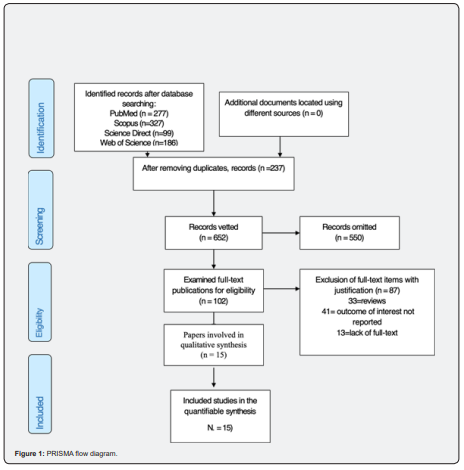
The procedure of probing for and choosing articles is summarized in the PRISMA flow chart (Figure 1). The electronic searches turned up 889 studies in total, 237 of which were eliminated because of duplication. After reading the study titles and abstracts, 550 studies were also disregarded. Reading the complete texts allowed us to evaluate the remaining 102 research. Data were included from eleven RCTs and four clinical trials that evaluated SGLT2 (sodium-glucose cotransporter 2) inhibitors.
Characteristics of the included studies
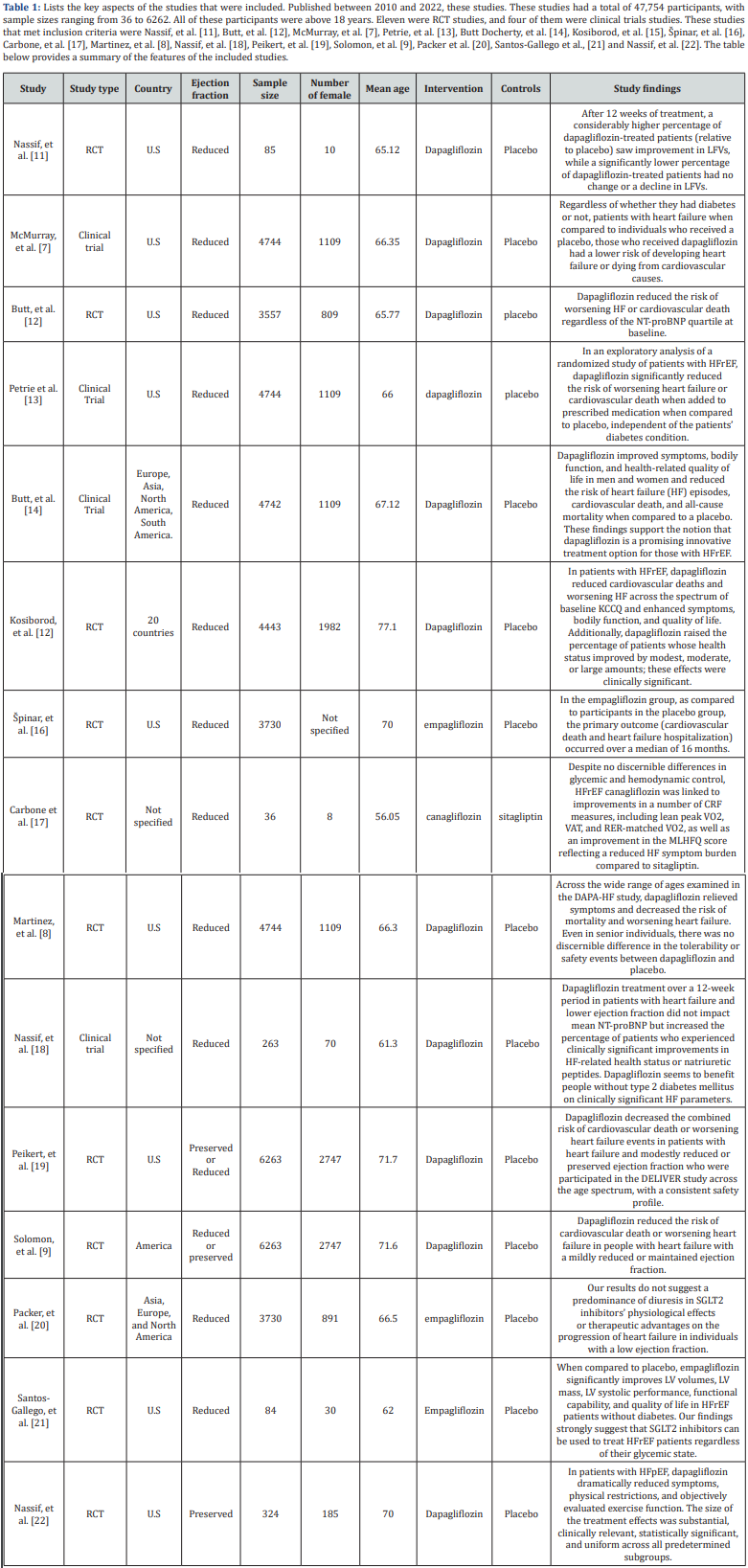
Table 1 lists the key aspects of the studies that were included. Published between 2010 and 2022, these studies. These studies had a total of 47,754 participants, with sample sizes ranging from 36 to 6262. All of these participants were above 18 years. Eleven were RCT studies, and four of them were clinical trials studies. These studies that met inclusion criteria were [7-9, 11,12-22]. The table below provides a summary of the features of the included studies.
Quality assessment
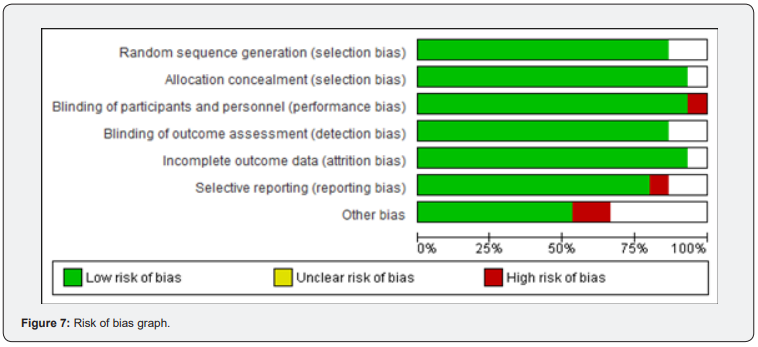
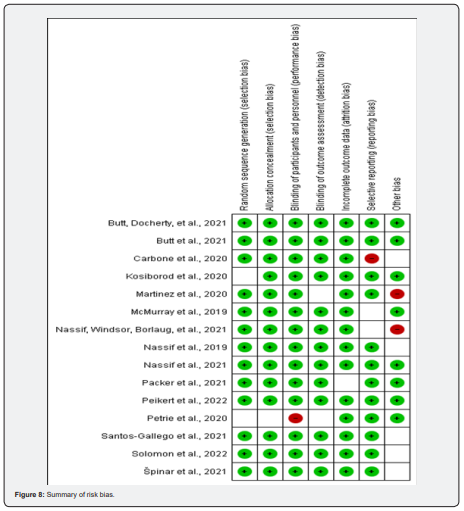
Internal validity (RoB) is characterized as a systemic error produced by faults in the study’s design, conduct, or analysis that results in incorrect outcomes and conclusions (Furuya-Kanamori et al., 2021). The risk of bias (RoB) in this study was assessed and reported in accordance with the Preferred Reporting Items for Systemic Reviews and Meta-Analyses (PRISMA) statement. According to the unified and standard techniques, the two investigators self-reliantly assessed, preliminary nominated, and tested the literature facts. They then included the data in the literature strictly in line with the enclosure and rejection criteria, and gathered data. The Cochrane Reviewer Handbook 5.1.0, which was judged as high (red), low (green), or unclear (yellow) (Higgins et al., 2011). Quality evaluation standard was used to assess the quality of the chosen publications (Generation of a random sequence, concealment of allocation, blinding of participants and personnel, blinding of result assessment, insufficient outcome data, selective reporting, and other biases).
Meta-analysis
Mortality or hospitalization of participant due to SGLT2 Inhibitors versus Placebo group
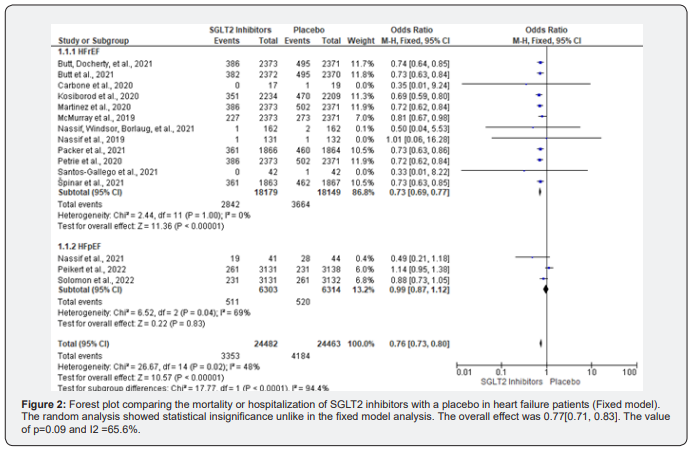
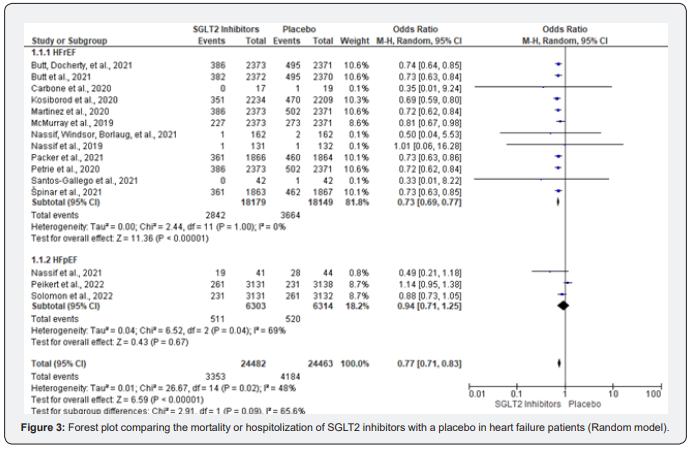
A subgroup analysis was also performed to test whether the type of ejection fraction modifies the overall effect. The odds ratio calculated in HFrEF (OR), was 0.73 with confidence interval (CI) of 95%, 0.69-0.77, and value of p < 0.00001. The HFpEF sub group odds are was 0.99 with confidence interval (CI) of 95%, 0.87- 1.12 and the value of p=0.83. HFrEF sub-group was statistically significance but HFmEF was insignificant. Overall, Sodium-glucose co-transporter inhibitor 2 significantly decreased the composite of cardiovascular death or Heart failure hospitalization [HR: 0.76 (0.73–0.80); I2 = 94.4%; P < 0.0001]. The collected research showed significant heterogeneity of P =0.02 and I² = 48%.
Patients with HFmrEF/HFpEF that are at risk for adverse outcomes in SGLT2 (sodium-glucose cotransporter 2) Inhibitors versus Placebo group
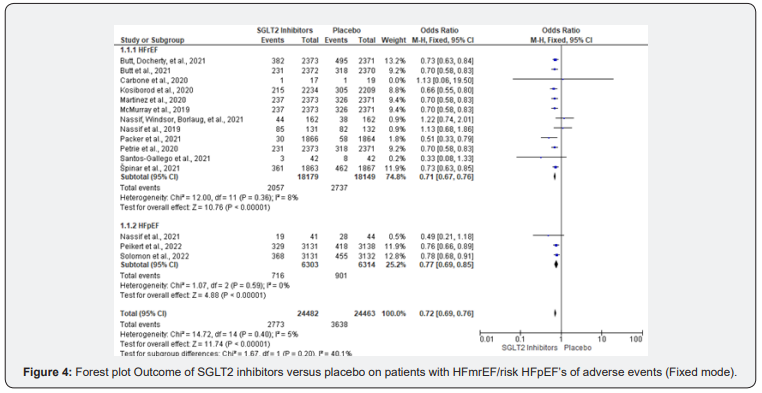
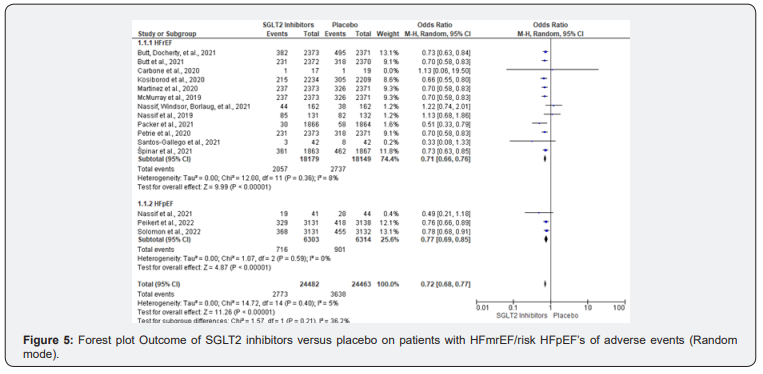
The pooled effect estimate of serious side effects of SGLT2 inhibitors to patients with HFrEF or HFpEF versus placebo showed significant difference and more serious side effect in SGLT2 inhibitors than placebo. The pooled estimate effect detailes are (OR = 0.72, 95% CI [0.69, 0.76], P < 0.00001, and the pooled studies were heterogeneous (P = 0.40, I² = 5%) (Figure 4). Studies that were included are [7-9, 11-25].
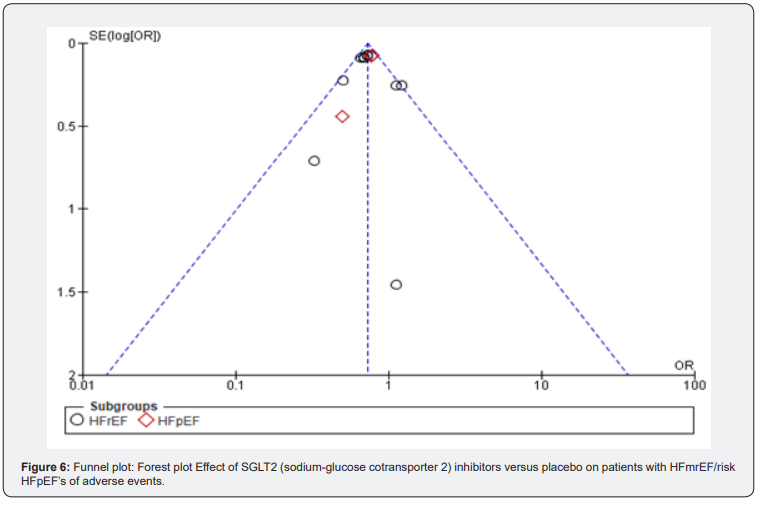
The standard error of each study is plotted against the average effect size in the funnel plot below to highlight how variable each study is. Visual analysis of the funnel plot revealed that there was small study bias. The publication bias might have been caused by insignificant findings, small effect size, and/or unfavorable outcomes.
Risk of bias graph
Cochrane Risk of Bias tool provided in Cochrane handbook version 5.1. The domains included were:
1. Random sequence generation (selection bias).
2. Allocation concealment (selection bias).
3. Blinding of participants and personnel (performance bias).
4. Outcomes assessment (detection bias).
5. Incomplete outcome data (attrition bias).
6. Other potential sources of bias. The reviewers judged the domains as: ‘’ low risk’’, ‘’ high risk’’ or ‘’ unclear’.
The risk of bias summary and traffic light analysis is illustrated in Figures 2 and 3, where studies were graded based on random allocation sequence, allocation concealment, blinding of participants, personnel, and outcomes, incomplete data, and selective reporting.
Discussion
Despite having a normal LVEF, patients with HFpEF have a poor outcomes because of decreased myocardial contractility and left ventricular systolic performance. This meta-analysis and systematic review of fifteen studies using different types of SGLT2 inhibitors in patients with HFpEF and HFmrEF revealed that the SGLT2 inhibitors significantly decreased the hospitalization for heart failure or cardiovascular death, demonstrating their efficacy as a primary treatment for patients with heart failure. In the same breath, SGLT2 inhibitors are associated with adverse effects compared to placebo.
Even as individuals with HFpEF or HFmrEF, SGLT2 (sodiumglucose cotransporter 2) inhibitors reduced the risk of cardiovascular death and hospitalization for heart failure. They did not, however, eliminate the risk of single cardiovascular or overall deaths. This indicates that the positive effects of SGLT2 (sodium-glucose cotransporter 2) inhibitors were mostly due to a decrease in the frequency of heart failure hospitalizations in patients with HFpEF or HFmrEF. There is mounting evidence that SGLT2 (sodium-glucose cotransporter 2) inhibitors can reduce oxidative stress and inflammation, which will lower the frequency of harmful cardiovascular events. There was finding that SGLT2 inhibitors cause adverse effects when compared to placebo.
In addition, by disrupting metabolic mechanisms, SGLT2 inhibitors can alleviate the symptoms of HFpEF. Myocardial energy can be increased and function can be improved by employing energy-efficient ketone bodies, which can be induced by SGLT2 inhibitors. Furthermore, SGLT2 inhibitors may cause natriuresis and have an antifibrotic effect on the myocardium. As a result, SGLT2 inhibitors may be beneficial for HFpEF patients in a number of ways.
The effects of SGLT2 (sodium-glucose cotransporter 2) inhibition in HFpEF patients are different from HFrEF. This is clearly acknowledged on the sub-group analysis The odds ratio calculated in HFrEF (OR), was 0.73 with confidence interval (CI) of 95%, 0.69-0.77, and value of p < 0.00001. The HFpEF sub group odds are was 0.99 with confidence interval (CI) of 95%, 0.87-1.12 and the value of p=0.83. It is scientifically correct to say SGLT2 inhibitors are more effectiv in heart failure reduced ejection fraction than in heart failure with preserved ejection fraction. On the other hand, the small number of studies in heart failure with preserved ejection fraction might have influence the outcome negatively, therefore future studies should consider large number of studies to eliminate bias dues to small number of studies.
We acknowledge the limitations of our study. First, there were variations in baseline traits, such as age, LVEF, and duration of follow-up, which might contribute to heterogeneity. Second, not all studies involving patients with HFpEF and HFmrEF reported cardiovascular death, death from any cause, and heart failure hospitalization. Thirdly, dapagliflozin and empagliflozin only inhibit SGLT2 (sodium-glucose cotransporter 2) but sotagliflozin inhibits both SGLT1 (sodium-glucose cotransporter 1) and SGLT2 (sodium-glucose cotransporter 2). Last but not least, “positive outcomes” for “hard endpoints” like all-cause and cardiovascular death were not seen. In patients with HFpEF and HFmrEF, SGLT2 inhibitors showed cardiovascular benefits, according to this metaanalysis. Additional, larger trials are required to assess the impact of the SGLT2 (sodium-glucose cotransporter 2) inhibitors in a sufficient number of patients with HFpEF or HFmrEF in order to draw conclusive conclusions about these efficacy outcomes.
All of the constraints had a harmful effect on the validity of the results and the whole quality of the study. Future studies investigating the SGLT2 Inhibitors in Heart Failure with Preserved Ejection Fraction or Reduced will be built on the results of the current systematic review. Future research should consider more clinical aspects of the association such as predictive factors.
Conclusion
SGLT2 inhibitors significantly decreased the risk of the composite of cardiovascular mortality and hospitalization for heart failure, according to this meta-analysis of patients with heart failure who had Ejection fraction of the left ventricle (LVEF) > 40.0%. SGLT2 (sodium-glucose cotransporter 2) inhibitors ought to be viewed as the standard of care for all patients with Heart failure with ejection fraction preservation (HFpEF) or heart failure with mild reduced Ejection Fraction (HFmrEF). Our data confirm that SGLT2 (sodium-glucose cotransporter 2) inhibitors may be beneficial for all HF patients, independent of their historical disease suffering status.
Authors Contributions
All the authors planned and carried out the meta-analysis and systematic review with support from other experts. Furthermore, they were significantly involved in the research’s selection, data extraction, screening and scrutiny, clinical trial quality review, and data synthesis. The author was present throughout the review and approval process for the final paper.
References
- Savarese G, Stolfo D, Sinagra G, Lund LH (2021) Heart failure with mid-range or mildly reduced ejection fraction. Nat Rev Cardiol 19(2): 100-116.
- Parasuraman SK, Loudon BL, Lowery C, Cameron D, Singh S, et al. (2019) Diastolic Ventricular Interaction in Heart Failure With Preserved Ejection Fraction. J Am Heart Assoc 8(7): e010114.
- Heidenreich PA, Bozkurt B, Aguilar D, Allen LA, Byun JJ, et al. (2022) 2022 AHA/ACC/HFSA Guideline for the Management of Heart Failure: A Report of the American College of Cardiology/American Heart Association Joint Committee on Clinical Practice Guidelines. Circulation 145(18).
- McDonagh TA, Metra M, Adamo M, Gardner RS, Baumbach A, et al. (2021) 2021 ESC Guidelines for the Diagnosis and Treatment of Acute and Chronic Heart Failure. European Heart Journal 42(36): 3599-3726.
- Borlaug BA (2020) Evaluation and management of heart failure with preserved ejection fraction. Nat Rev Cardiol 17(9): 559-573.
- Anker SD, Butler J, Filippatos G, Ferreira JP, Bocchi E, et al. (2021) Empagliflozin in Heart Failure with a Preserved Ejection Fraction. N Engl J Med 385(16): 1451-1461.
- McMurray JJV, Solomon SD, Inzucchi SE, Køber L, Kosiborod MN, et al. (2019) Dapagliflozin in Patients with Heart Failure and Reduced Ejection Fraction. N Engl J Med 381(21): 1995-2008.
- Martinez FA, Serenelli M, Nicolau JC, Petrie MC, Chiang CE, et al. (2020) Efficacy and Safety of Dapagliflozin in Heart Failure With Reduced Ejection Fraction According to Age: Insights From DAPA-HF. Circulation 141(2): 100-111.
- Solomon SD, McMurray JJV, Claggett B, De Boer RA, DeMets D, et al. (2022) Dapagliflozin in Heart Failure with Mildly Reduced or Preserved Ejection Fraction. N Engl J Med 387(12): 1089-1098.
- Liberati A, Altman DG, Tetzlaff J, Mulrow C, Gotzsche PC, et al. (2009) The PRISMA statement for reporting systematic reviews and meta-analyses of studies that evaluate healthcare interventions: explanation and elaboration. BMJ 339: b2700.
- Nassif ME, Windsor SL, Tang F, Husain M, Inzucchi SE, et al. (2021) Dapagliflozin effects on lung fluid volumes in patients with heart failure and reduced ejection fraction: Results from the DEFINE-HF trial. Diabetes Obes Metab 23(6): 1426-1430.
- Butt JH, Adamson C, Docherty KF, de Boer RA, Petrie MC, et al. (2021) Efficacy and Safety of Dapagliflozin in Heart Failure With Reduced Ejection Fraction According to N-Terminal Pro-B-Type Natriuretic Peptide: Insights From the DAPA-HF Trial. Circ Heart Fail 14(12): e008837.
- Petrie MC, Verma S, Docherty KF, Inzucchi SE, Anand I, et al. (2020) Effect of Dapagliflozin on Worsening Heart Failure and Cardiovascular Death in Patients With Heart Failure With and Without Diabetes. JAMA 323(14): 1353-1368.
- Butt JH, Docherty KF, Petrie MC, Schou M, Kosiborod MN, et al. (2021) Efficacy and Safety of Dapagliflozin in Men and Women With Heart Failure With Reduced Ejection Fraction. A Prespecified Analysis of the Dapagliflozin and Prevention of Adverse Outcomes in Heart Failure Trail. JAMA Cardiol 6(6): 678-689.
- Kosiborod MN, Jhund PS, Docherty KF, Diez M, Petrie MC, et al. (2020) Effects of Dapagliflozin on Symptoms, Function, and Quality of Life in Patients With Heart Failure and Reduced Ejection Fraction: Results From the DAPA-HF Trail. Circulation 141(2): 90-99.
- Špinar J, Špinarová L, Vítovec J (2021) EMPEROR reduced - empagliflozin in patients with heart failure and reduced ejection fraction. Vnitr Lek 67(1): 43-47.
- Carbone S, Billingsley HE, Canada JM, Bressi E, Rotelli B, et al. (2020) The effects of canagliflozin compared to sitagliptin on cardiorespiratory fitness in type 2 diabetes mellitus and heart failure with reduced ejection fraction: The CANA-HF study. Diabetes Metab Res Rev 36(8): e3335.
- Nassif ME, Windsor S, Tang F, Khariton Y, Husain M, et al. (2019) Dapagliflozin Effects on Biomarkers, Symptoms, and Functional Status in Patients With Heart Failure With Reduced Ejection Fraction: The DEFINE-HF Trial. Circulation 140(18): 1463-1476.
- Peikert A, Martinez FA, Vaduganathan M, Claggett BL, Kulac IJ, et al. (2022) Efficacy and Safety of Dapagliflozin in Heart Failure with Mildly Reduced or Preserved Ejection Fraction According to Age: The DELIVER Trial. Circ Heart Fail 15(10): e010080.
- Packer M, Anker SD, Butler J, Filippatos G, Ferreira JP, et al. (2021) Empagliflozin in Patients With Heart Failure, Reduced Ejection Fraction, and Volume Overload: EMPEROR-Reduced Trial. J Am Coll Cardiol 77(11): 1381-1392.
- Santos GCG, Vargas DAP, Requena IJA, Garcia RA, Mancini D, et al. (2021) Randomized Trial of Empagliflozin in Nondiabetic Patients With Heart Failure and Reduced Ejection Fraction. J Am Coll Cardiol 77(3): 243-255.
- Nassif ME, Windsor SL, Borlaug BA, Kitzman DW, Shah SJ, et al. (2021) The SGLT2 inhibitor dapagliflozin in heart failure with preserved ejection fraction: a multicenter randomized trial. Nat Med 27(11): 1954-1960.
- Docherty KF, Jhund PS, Anand I, Bengtsson O, Böhm M, et al. (2020) Effect of Dapagliflozin on Outpatient Worsening of Patients With Heart Failure and Reduced Ejection Fraction: A Prespecified Analysis of DAPA-HF. Circulation 142(17): 1623-1632.
- Jensen J, Omar M, Kistorp C, Poulsen MK, Tuxen C, et al. (2019) Empagliflozin in heart failure patients with reduced ejection fraction: a randomized clinical trial (Empire HF). Trials 20(1): 374.
- Evenson KR, Eze Nliam C, Ferguson JF, Generoso G, Ho JE, et al. (2022) Heart Disease and Stroke Statistics-2022 Update: A Report From the American Heart Association. Circulation 145(8): e153-e639.

























