




 JGWH Home




Abstract
Objective: To describe maternal characteristics, obstetric management, gestational age, birthweight, and immediate neonatal outcomes of singleton live births recorded as fetal growth restriction at Pikine National Hospital, Senegal, from 2019 to 2024.
Methods: This retrospective descriptive study included 259 records from the e-Perinatal database. Descriptive statistics were calculated using available observations for each variable. The original case definition used birthweight below the third Gardosi percentile; calculated percentiles were unavailable for independent verification.
Results: Mean maternal age was 27.83±6.55 years. Severe preeclampsia was recorded in 133 women (51.4%), and 213 (82.2%) delivered by cesarean section. Mean gestational age was 36.42±3.31 weeks (n = 173), with 45.7% of documented births occurring before 37 weeks. Mean birthweight was 1,880.8±527.7 g (n = 258); 86.0% weighed less than 2,500 g. A five-minute Apgar score ≥7 was recorded in 236 of 256 newborns (92.2%). Neonatal resuscitation was recorded in 54 of 232 newborns (23.3%).
Conclusion: This series showed high frequencies of severe preeclampsia, cesarean delivery, preterm birth, and low birthweight. Missing data and the absence of a comparison group limit interpretation. Improved documentation of fetal growth and neonatal follow-up is needed.
Keywords: Fetal growth restriction; Small for gestational age; Preterm birth; Birthweight; Preeclampsia; Senegal
Abbreviations: FGR: Fetal Growth Restriction; SGA: Small for Gestational Age; CHNP: Centre Hospitalier National de Pikine; ANC: Antenatal Care; BMI, body mass index; SD, standard deviation.
Introduction
Fetal growth restriction (FGR) is a pathological limitation of fetal growth potential. It should be distinguished from small for gestational age (SGA), which describes a low weight percentile without necessarily identifying the underlying mechanism. This distinction is particularly relevant to studies based primarily on birthweight. International guidelines combine fetal biometry, growth trajectory, and Doppler findings when assessing suspected FGR [1,2]. Birthweight classification also depends on the reference standard. Gardosi charts customize expected weight according to physiological characteristics [3]. Birthweight below the third percentile identifies a particularly small newborn but does not replace antenatal assessment of growth and placental function. In a Senegalese cohort of 251 twin pregnancies, Sene and colleagues compared Gardosi and EPOPé classifications, illustrating the influence of chart selection [4]. At a referral maternity hospital, the case profile is influenced by maternal disease, transfers, and access to antenatal care. A hospital-based description can identify surveillance needs and documentation gaps. Gestational age and birthweight provide complementary information about neonatal vulnerability. This study aimed to describe these parameters, maternal characteristics, obstetric management, and immediate neonatal outcomes among singleton live births recorded as FGR at CHNP from 2019 to 2024.
Materials and Methods
Study setting and design
This retrospective descriptive study was conducted in the Department of Obstetrics and Gynecology at CHNP, a referral maternity hospital in Dakar, Senegal. Data were obtained from the e-Périnatal platform. The analysis used the individual-level extract and was restricted to deliveries recorded from 2019 through 2024.
Study population and case definition
The 259 included records concerned singleton pregnancies resulting in live births and a positive FGR indicator. The original protocol specified inclusion of births after 22 weeks of gestation with birthweight below the third Gardosi percentile, and exclusion of multiple pregnancies, congenital malformations, and intrauterine fetal deaths. The extract contained the diagnostic indicator but neither calculated percentiles nor an explicit malformation variable. The original classification and all exclusions therefore could not be independently reproduced. The population comprised cases recorded according to the original protocol.
The total number of eligible births during the study period was unavailable in the case extract. Population prevalence was therefore not calculated.
Variables and definitions
Variables included maternal age, recorded parity, previous cesarean delivery, admission mode, ANC visits, maternal conditions, BMI, gestational age, labor onset, final mode of delivery, birthweight, five-minute Apgar score, neonatal resuscitation, and neonatal transfer. Numeric parity was grouped as 0, 1, 2–4, and ≥ 5. Gravidity was not analyzed because its coding, including numerous zero values, was ambiguous.
Severe preeclampsia, obesity, gestational diabetes, and anemia were derived from dedicated database indicators without independent reassessment of clinical criteria. Available BMI values were classified as < 18.5, 18.5 to < 25, 25 to < 30, and ≥30 kg/m². BMI-defined obesity was distinguished from the diagnostic obesity indicator. Equivalent labels for cesarean delivery before labor were combined. Labor onset was distinguished from final mode of delivery. Preterm birth was defined as delivery before 37 weeks and low birthweight as birthweight < 2,500 g. Gestational age was grouped as < 28, 28 to < 32, 32 to < 37, 37 to < 42, and ≥42 weeks. Birthweight was grouped as < 1,000, 1,000–1,499, 1,500–2,499, and ≥2,500 g. Apgar categories of 0–3, 4–6, and ≥7 were recalculated from numeric scores. Resuscitation and transfer were analyzed using available yes/no fields.
Data processing and statistical analysis
The original workflow involved exporting the database to Excel and processing data in Stata. Quantitative variables are reported as means, sample SDs, ranges, and medians where appropriate. Categorical variables are reported as counts and percentages with explicit denominators. Missing values were not imputed. Maternal conditions could coexist. No comparative tests or multivariable models were performed. One implausible gestational age value was excluded from gestational age summaries without excluding the record from other analyses. ANC means were reported.
Ethical considerations
The study used retrospectively collected routine care data. Direct identifiers were not included in the analytical dataset, confidentiality was maintained, and patients were not contacted.
Results
Study population
The analysis included 259 singleton live births recorded as FGR from 2019 to 2024. Annual counts were nine in 2019, 66 in 2020, 42 in 2021, 27 in 2022, 90 in 2023, and 25 in 2024. These counts describe the analyzed extract and do not represent estimates of annual incidence.
Maternal characteristics
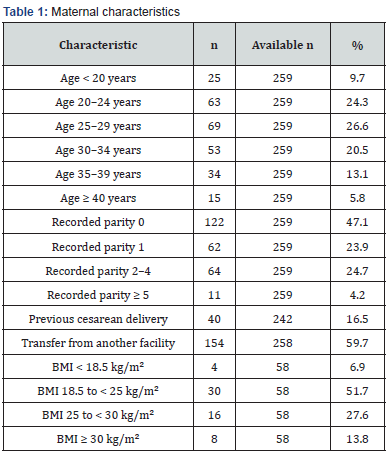
Mean maternal age was 27.83±6.55 years, ranging from 16 to 42 years. Women aged 25–29 years accounted for 26.6% of cases. Recorded parity was zero in 122 women (47.1%). Among the 242 women with documented cesarean history, 40 (16.5%) had a previous cesarean delivery. Transfer from another facility was recorded in 154 of 258 women (59.7%). BMI was available for only 58 women, of whom eight (13.8%) had a BMI≥30 kg/m² (Table 1).
Antenatal care and maternal conditions
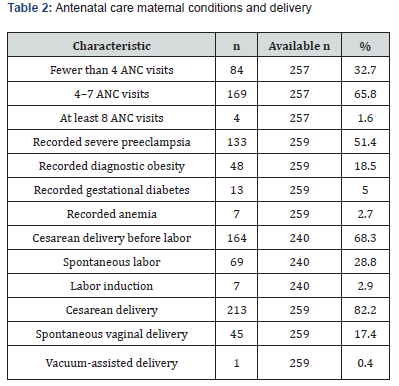
The median number of ANC visits was four among 257 documented records. Fewer than four visits were reported for 84 women (32.7%). Excluding the atypical value of 27 visits, the mean was 3.95 ± 1.31 visits (n = 256; range, 1–8); including this value, the mean was 4.04±1.94 (n = 257; recorded range, 1–27). Severe preeclampsia was recorded in 133 women (51.4%), obesity in 48 (18.5%), gestational diabetes in 13 (5.0%), and anemia in seven (2.7%) (Table 2).
Obstetric management
Final mode of delivery was documented in all records: 213 women (82.2%) delivered by cesarean section, 45 (17.4%) had spontaneous vaginal delivery, and one (0.4%) had vacuum-assisted delivery. Among the 240 records documenting labor onset, 164 (68.3%) indicated cesarean delivery before labor, 69 (28.8%) spontaneous labor, and seven (2.9%) labor induction. The 19 missing values were not classified as cesarean delivery before labor.
Gestational age birthweight and neonatal outcomes
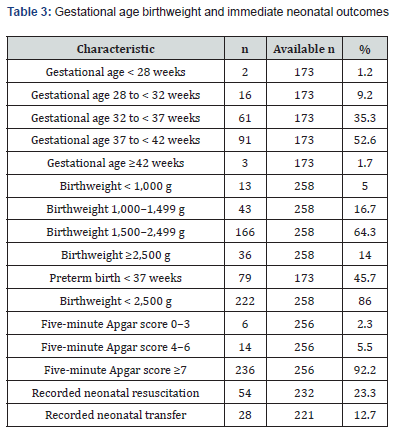
Gestational age was usable in 173 records after exclusion of one implausible value. Mean gestational age was 36.42±3.31 weeks (range, 24.29–44.00 weeks). Preterm birth occurred in 79 of 173 documented births (45.7%). Two births (1.2%) occurred before 28 weeks, 16 (9.2%) at 28 to < 32 weeks, and 61 (35.3%) at 32 to < 37 weeks. Birthweight was documented for 258 newborns, with a mean of 1,880.8±527.7 g (range, 470–3,600 g). A total of 222 newborns (86.0%) weighed < 2,500 g, including 56 (21.7%) weighing < 1,500 g (Table 3). The numeric five-minute Apgar score was available for 256 newborns: 236 (92.2%) had a score ≥7, 14 (5.5%) a score of 4–6, and six (2.3%) a score of 0–3. Overall, 20 newborns (7.8%) had a score < 7. Resuscitation was recorded in 54 of 232 newborns (23.3%) and transfer in 28 of 221 (12.7%). Neonatal discharge status was documented in only nine records, preventing estimation of neonatal mortality.
Discussion
Principal findings
This series of 259 cases recorded as FGR from 2019 to 2024 showed high frequencies of severe preeclampsia, transfers, and cesarean delivery. Mean gestational age was below 37 weeks and mean birthweight was approximately 1,881 g. Although most newborns with available data had an Apgar score ≥ 7, the frequencies of preterm birth, low birthweight, and resuscitation indicate neonatal vulnerability. These results describe a selected population and do not establish causal effects of maternal characteristics or the comparative effectiveness of obstetric strategies.
Birthweight classification and the Senegalese twin study
Birthweight below the third percentile identifies severe SGA but is insufficient by itself to establish pathological antenatal growth restriction. Interpretation of Gardosi charts requires documentation of the reference standard, customization parameters, and pregnancy dating. The absence of calculated percentiles prevented independent verification of classification. Without a denominator of eligible births, FGR prevalence cannot be estimated. Our previous study of 251 twin pregnancies in Senegal demonstrated strong agreement between EPOPé M2 and Gardosi, with κ coefficients of 0.858 for the first twin and 0.828 for the second. This agreement did not demonstrate the prognostic superiority of either model or validate FGR diagnosis based solely on a percentile. Twin findings cannot be directly extrapolated to singleton births. Their contribution is methodological: chart selection changes classification, whereas clinical interpretation requires growth trajectory, Doppler findings, and neonatal outcomes.
Antenatal care and maternal conditions
The median of four ANC visits and the proportion of women reporting fewer than four visits support improved documentation of the timing and content of care. The World Health Organization recommends eight contacts for uncomplicated pregnancies, with surveillance adapted to risk [5]. Visit counts do not measure care quality, and shorter pregnancies also provide fewer opportunities for visits. The frequency of severe preeclampsia is consistent with referral hospital recruitment and the coexistence of hypertensive disorders and impaired growth. Takahashi and colleagues investigated FGR as an initial finding in pregnancies subsequently complicated by preeclampsia [6]. Our study cannot estimate the risk of FGR associated with this condition. Obesity also requires cautious interpretation because BMI was missing for most women and BMI classification differed from the diagnostic indicator. Numeric fundal height measurements did not allow a gestational age-adjusted classification to be reproduced. International symphysis-fundal height standards provide a framework for longitudinal monitoring [7], but measurement conditions and local thresholds remain to be documented.
Obstetric management
The cesarean rate of 82.2% describes final mode of delivery, whereas the 68.3% frequency of cesarean delivery before labor applies only to records with documented labor onset. These indicators address different questions. Their frequencies may reflect maternal severity, fetal condition, and transfers, but the completeness of clinical data was insufficient to assess individual indications. The DIGITAT trial compared induction with expectant monitoring for suspected growth restriction near term and found no important differences in its principal outcomes or cesarean rates [8]. Those findings cannot be directly applied to this series, which included many preterm births. Delivery strategies should be assessed in relation to maternal and fetal circumstances.
Gestational age birthweight and neonatal adaptation
Preterm birth accounted for 45.7% of births with usable gestational age data. Low birthweight affected 86.0% of weighed newborns, and 21.7% weighed < 1,500 g. These dimensions should not be conflated: low birthweight may reflect prematurity, growth restriction, or both. Available data do not fully distinguish their contributions. The preterm birth estimate was based on 173 records and may not represent all 259 cases. The Apgar score describes immediate neonatal adaptation and should be interpreted alongside gestational age and resuscitation; it is insufficient to diagnose asphyxia or predict individual prognosis [9]. A reassuring score does not exclude morbidity in preterm or low-birthweight newborns. Studies distinguishing SGA from antenatally diagnosed FGR emphasize the value of documenting neonatal complications [10]. In this series, resuscitation indications, hypoglycemia, hypothermia, and reliable death outcomes were unavailable. Selection of live births and highly incomplete discharge status precluded estimation of perinatal mortality.
Strengths and limitations
This study provides a local description of cases identified in a computerized hospital database. The tables present detailed distributions of recorded parity, previous cesarean delivery, gestational age, birthweight, and Apgar scores. The series of 259 cases provides a useful summary of the profile of patients managed at the hospital. Limitations include the retrospective single-center design, selection of recorded cases, lack of a comparison group, and incomplete documentation of Gardosi calculations. Missing data, particularly for gestational age and BMI, may introduce bias. Gravidity coding, atypical values, and discrepancies between diagnostic and numeric fields limit data quality. The extract did not permit reliable identification of possible duplicate records or reconstruction of all initial exclusions. Independent risk factors, population prevalence, and perinatal mortality cannot be inferred. The retained maximum gestational age of 44 weeks also warrants verification.
Conclusion
The 259 singleton live births recorded as FGR at CHNP from 2019 to 2024 were characterized by high frequencies of severe preeclampsia and cesarean delivery. Among available observations, mean gestational age was 36.42 weeks and mean birthweight was 1,880.8g; preterm birth and low birthweight were frequent. Despite generally reassuring five-minute Apgar scores, recorded resuscitation indicates neonatal care needs. Improved documentation of growth, pregnancy dating, and neonatal follow-up is necessary. A comparative study with a validated case definition would help clarify associated factors and prognosis.
Declarations
Funding: This study received no specific funding.
Conflicts of interest: The author declares no conflicts of interest.
Data availability: Confidential clinical data are not publicly available. An anonymized dataset may be considered for review upon reasonable request, subject to applicable institutional authorizations.
References
- Lees CC, Stampalija T, Baschat AA, da Silva Costa F, Ferrazzi E, et al. (2020) ISUOG Practice Guidelines: diagnosis and management of small-for-gestational-age fetus and fetal growth restriction. Ultrasound Obstet Gynecol 56: 298-312.
- Melamed N, Baschat A, Yinon Y, Athanasiadis A, Mecacci F, et al. (2021) FIGO initiative on fetal growth: Best practice advice for screening, diagnosis, and management of fetal growth restriction. Int J Gynaecol Obstet 152(Suppl 1):3-57.
- Gardosi J, Mongelli M, Wilcox M, Chang A (1995) An adjustable fetal weight standard. Ultrasound Obstet Gynecol 6:168-174.
- Sene M, Gueye KA, Gueye M, Diakhate A, Wade M, et al. (2026) Birthweight Classification in Twins Using Gardosi and Epopé Growth Models: A Historical Cohort Of 251 Pregnancies in Senegal. J Gynecol Womens Health 28(3):556238.
- World Health Organization. (2016) WHO recommendations on antenatal care for a positive pregnancy experience. Geneva: World Health Organization.
- Takahashi M, Makino S, Oguma K, Imai H, Takamizu A, et al. (2021) Fetal growth restriction as the initial finding of preeclampsia is a clinical predictor of maternal and neonatal prognoses: a single-center retrospective study. BMC Pregnancy Childbirth 21(1):678.
- Papageorghiou AT, Ohuma EO, Gravett MG, Hirst J, da Silveira MF, et al. (2016) International standards for symphysis-fundal height based on serial measurements from the Fetal Growth Longitudinal Study of the INTERGROWTH-21st Project: prospective cohort study in eight countries. BMJ 355: i5662.
- Boers KE, Vijgen SMC, Bijlenga D, van der Post JAM, Bekedam DJ, et al. (2010) Induction versus expectant monitoring for intrauterine growth restriction at term: randomised equivalence trial (DIGITAT). BMJ 341:c7087.
- American Academy of Pediatrics Committee on Fetus and Newborn; American College of Obstetricians and Gynecologists Committee on Obstetric Practice (2015) The Apgar score. Pediatrics 136(4): 819-822.
- Lubrano C, Taricco E, Coco C, Di Domenico F, Mandò C, et al. (2022) Perinatal and neonatal outcomes in fetal growth restriction and small for gestational age. J Clin Med 11(10): 2729.