




 JGWH Home



Abstract
Objective: To compare birthweight classifications generated by the customised Gardosi model and three EPOPé models in a Senegalese population of twin pregnancies.
Methods: We conducted a single-centre historical cohort study of twin pregnancies delivered at Philippe Maguilen Senghor Health Centre, Dakar, from 1 January 2016 to 31 December 2021. Pregnancies at ≥22 weeks with the variables required for centile calculation were included. Birthweights of the first and second twins were classified as <3rd, 3rd–10th, or >10th centile using Gardosi and EPOPé M0, M1, and M2. Agreement was assessed using Cohen’s κ.
Results: We analysed 251 twin pregnancies (502 newborns). Mean maternal age was 28.0 ± 5.9 years and 20.7% of women were aged ≥35 years. Mean gestational age was 37.0 ± 3.45 weeks. Mean birthweight was 2410 ± 585 g for the first twin and 2355 ± 570 g for the second. Gardosi classified 44.2% and 49.4%, respectively, below the 3rd centile, compared with 35.5% and 40.6% for EPOPé M0, 34.3% and 39.0% for M1, and 43.4% and 47.8% for M2. Agreement with Gardosi was moderate for M0 (κ=0.583 and 0.612) and M1 (κ=0.622 and 0.615), and strong for M2 (κ=0.858 and 0.828); all p<0.001.
Conclusions: EPOPé M2 yielded classifications close to Gardosi, whereas M0 and M1 did not. The high frequency of twins classified below the 3rd centile with models developed for singletons should not be interpreted as established fetal growth restriction. Prospective outcome-based validation and twin-specific African standards are required.
Introduction
Assessment of fetal growth is central to identifying fetuses at increased risk of perinatal morbidity and mortality. Small for gestational age (SGA) is a statistical designation based on centile position, whereas fetal growth restriction describes failure to reach growth potential and requires dynamic or functional evidence. The terms are therefore not interchangeable [1,2]. Twin growth trajectories differ from those of singletons, particularly in the third trimester, and singleton references may inflate the apparent prevalence of SGA among twins [3–6]. Gardosi charts estimate customised growth potential using maternal and fetal characteristics [7,8]. The French EPOPé models provide progressive customisation: M0 is unadjusted, M1 is sex-adjusted, and M2 additionally incorporates maternal height, weight, and parity [9]. Evidence on the behavior of these models in sub-Saharan African twin populations is limited. We compared birthweight classification using Gardosi and EPOPé M0, M1, and M2, described maternal and neonatal characteristics, and explored agreement in hypertension and obesity subgroups.
Methods
Study design and setting
This historical, observational, analytical cohort study was conducted at Philippe Maguilen Senghor Health Centre, a referral maternity facility in western Dakar, from 1 January 2016 to 31 December 2021. Reporting was guided by STROBE [10].
Participants
All twin pregnancies in the obstetric database were screened. Pregnancies at ≥22 weeks were eligible when gestational dating, maternal weight and height, parity, and the birthweight and sex of both newborns were available. Pregnancies complicated by fetal malformation or intrauterine fetal death, pregnancies ending before 22 weeks, and incomplete records were excluded. The source data did not provide the total number screened or the number excluded.
Variables and definitions
Data were obtained from the continuously maintained FileMaker Pro obstetric database. Maternal variables included age, parity, weight, height, body mass index (BMI), hypertension, diabetes, and post-term pregnancy. Neonatal variables included gestational age, sex, birthweight, and five-minute Apgar score. Obesity was defined as BMI ≥30 kg/m², hypertension as blood pressure ≥140/90 mmHg, and preterm birth as birth before 37 completed weeks.
Each twin’s birthweight was converted to a centile using four models originally developed for singleton pregnancies: Gardosi and EPOPé M0, M1, and M2. Categories were <3rd, 3rd–10th, and >10th centile. We use “below the 3rd centile” rather than “severe fetal growth restriction”, because centile position alone does not establish a pathological growth process.
Statistical analysis
Data were exported to Microsoft Excel 2019 and analyzed using IBM SPSS Statistics version 20. Quantitative variables are reported as mean ± standard deviation and categorical variables as counts and percentages. Agreement between each EPOPé model and Gardosi was estimated separately for the first and second twins using Cohen’s κ. Tests were two-sided with α=0.05. Gardosi was a methodological comparator, not an independent clinical reference standard; concordant classifications were therefore not interpreted as diagnostic sensitivity or specificity.
Ethical considerations
Data were analyzed in de-identified form and confidentiality was maintained throughout the study (Figure 1).
Results
Study population
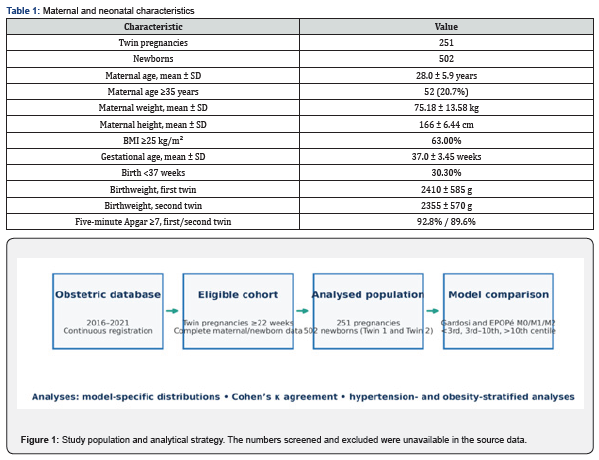
The cohort comprised 251 twin pregnancies (502 newborns). Annual enrolment ranged from 8 pregnancies in 2016 to 73 in 2021. Mean maternal age was 28.0 ± 5.9 years (range 17–42), and 52 women (20.7%) were aged ≥35 years. BMI was ≥25 kg/m² in 63.0%. Among 196 recorded maternal conditions, obesity accounted for 59.8% and hypertension for 25.5%. Mean gestational age at birth was 37.0 ± 3.45 weeks, and 30.3% delivered before 37 weeks. Mean birthweight was 2410 ± 585 g for the first twin and 2355 ± 570 g for the second. Five-minute Apgar score was ≥7 in 92.8% and 89.6%, respectively (Table 1).
Classification across growth models
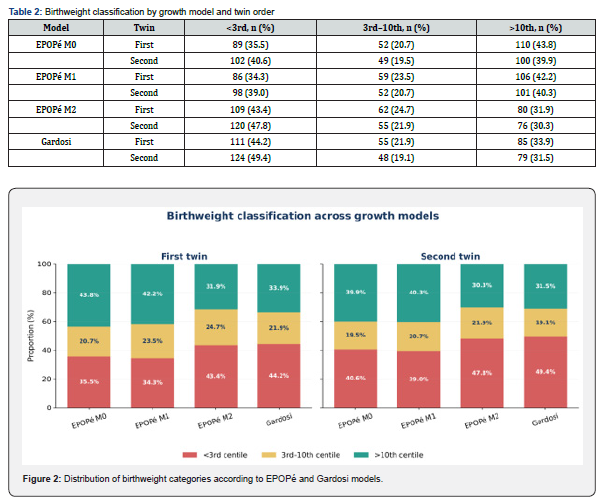
For every model, the proportion below the 3rd centile was higher for the second than for the first twin. Gardosi yielded the highest proportions (44.2% and 49.4%), closely followed by EPOPé M2 (43.4% and 47.8%). M0 and M1 classified fewer newborns below the 3rd centile (Table 2) (Figure 2).
Agreement between models
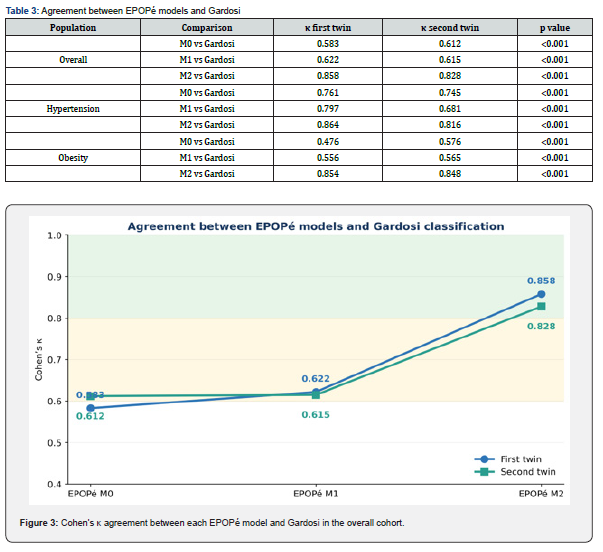
Agreement with Gardosi was moderate for EPOPé M0 and M1 and strong for M2 in both twins. M2 also had the highest κ coefficients in analyses stratified by maternal hypertension and obesity (Table 3) (Figure 3).
Discussion
Principal findings
In this cohort of 251 twin pregnancies, Gardosi classified 44.2% of first twins and 49.4% of second twins below the 3rd centile. EPOPé M2 generated a similar distribution and showed strong agreement, whereas M0 and M1 showed only moderate agreement. These findings primarily demonstrate the substantial influence of maternal customisation on birthweight classification.
Clinical interpretation
The high frequency of classification below the 3rd centile requires caution because all four models were developed for singleton pregnancies. Twin growth diverges from singleton growth during the third trimester. Singleton charts may overclassify twins as SGA, while twin-specific charts may improve specificity but alter sensitivity for adverse outcomes. Centile classification alone therefore cannot diagnose fetal growth restriction. The stronger agreement between M2 and Gardosi is consistent with their shared incorporation of several maternal and fetal determinants of expected birthweight. By contrast, M0 and M1 apply fewer adjustments. Stronger agreement does not demonstrate clinical superiority: two models may agree while both remain poorly calibrated for Senegalese twins. Second twins were more frequently classified in lower categories with every model. Interpretation would require chronicity, intertwin discordance, Doppler findings, neonatal morbidity, and perinatal mortality. Contemporary guidance recommends integrating growth, chronicity, and Doppler surveillance in twin pregnancy [11].
Strengths and limitations
Strengths include six years of continuous registration, separate analysis of 502 newborns, and paired comparison of four growth models in an under-represented African setting. Limitations include the retrospective single-center design; unavailable screening and exclusion counts; exclusion of incomplete records without missing-data analysis; absence of chronicity and outcome-based validation; use of singleton models; and failure to model within-pair correlation. Subgroup analyses lacked confidence intervals and should be considered exploratory. Gardosi was a comparator rather than a clinical gold standard; external validation against independent outcomes, including mortality, acidosis, neonatal admission, composite morbidity, and Doppler abnormalities, is required.
Implications
These findings do not support immediate adoption of a single model. They support a prospective multicentre African cohort recording chronicity, longitudinal growth, Doppler indices, and perinatal outcomes. Such a study could compare singleton references, customised models, and twin-specific standards and identify thresholds most closely associated with clinical risk.
Conclusion
In this Senegalese cohort, EPOPé M2 showed strong agreement with Gardosi, whereas M0 and M1 showed moderate agreement. All models classified a very high proportion of twins below the 3rd centile, particularly second twins. The findings demonstrate sensitivity of classification to chart choice but establish neither the true prevalence of fetal growth restriction nor the prognostic superiority of any model. Outcome-based validation or development of growth standards for African twin pregnancies is needed.
Conflict Of Interest
The authors report no conflicts of interest.
Funding
This research received no specific grant from any funding agency in the public, commercial, or not-for-profit sectors.
Author Contributions
All authors contributed to the preparation of the manuscript, critically reviewed its intellectual content, and approved the final version for submission.
References
- Ego A (2014) Definitions: small for gestational age and fetal growth restriction [in French]. Rev Sage-Femme 13:129-150.
- Grangé G (2013) Screening and diagnosis of the small-for-gestational-age fetus [in French]. J Gynecol Obstet Biol Reprod 42: 921-928.
- Min SJ, Luke B, Gillespie B, Min L, Newman RB, et al. (2000) Birth weight references for twins. Am J Obstet Gynecol182(5): 1250-1257.
- Cohen SB, Dulitzky M, Lipitz S, Mashiach S, Schiff E (1997) New birth weight nomograms for twin gestation on the basis of accurate gestational age. Am J Obstet Gynecol 177(5): 1101-1104.
- Hiersch L, Okby R, Freeman H, Rosen H, Nevo O, et al. (2022) Should twin-specific growth charts be used to assess fetal growth in twin pregnancies? Am J Obstet Gynecol 227(1): 10-28.
- Giorgione V, Bhide A, Bhate R, Reed K, Khalil A (2021) Perinatal outcomes of small for gestational age in twin pregnancies: twin vs singleton charts. Am J Obstet Gynecol 10(4): 643.
- Gardosi J, Chang A, Kalyan B, Sahota D, Symonds EM (1992) Customised antenatal growth charts. Lancet 339(8788): 283-287.
- Gardosi J, Figueras F, Clausson B, Francis A (2011) The customised growth potential: an international research tool to study the epidemiology of fetal growth. Paediatr Perinat Epidemiol 25(1): 2-10.
- Ego A, Prunet C, Lebreton E (2016) Adjusted and unadjusted in-utero growth charts adapted to the French population. I—Methods of construction [in French]. J Gynecol Obstet Biol Reprod 45: 155-164.
- von Elm E, Altman DG, Egger M, Pocock SJ, Gøtzsche PC, et al. (2007
) The STROBE statement: guidelines for reporting observational studies. Lancet 370: 1453-1457. - Khalil A, Sotiriadis A, Baschat A, Bhide A, Gratacós E, et al. (2025) ISUOG Practice Guidelines (updated): role of ultrasound in twin pregnancy. Ultrasound Obstet Gynecol 65(2): 253-276.
- Monier I, Blondel B, Ego A, Kaminski M, Goffinet F, et al. (2015) Poor effectiveness of antenatal detection of fetal growth restriction and consequences for obstetric management and neonatal outcomes: a French national study. BJOG 122(4): 518-527.
- Gaillard R, de Ridder MAJ, Verburg BO, Witteman JCM, Mackenbach JP, et al. (2011) Individually customised fetal weight charts derived from ultrasound measurements: the Generation R Study. Eur J Epidemiol 26(12): 919-926.
- Gassama O, Mbaye M, Niass A, Boye D, Biaye B, et al. (2018) Epidemiological, clinical, prognostic and therapeutic aspects of twin delivery in two referral maternity units in Dakar, Senegal. Int J Reprod Contracept Obstet Gynecol 7(2): 364-369.
- Ong S, Lim M, Fitzmaurice A, Campbell D, Smith A, et al. (2002) The creation of twin centile curves for size. BJOG 109(7): 753-758.

























