




 JFSCI Home



Abstract
Advances in augmented reality (AR) and three-dimensional (3D) reconstruction technologies are transforming the way criminal investigators are trained to interpret complex crime scenes. This research examines the integration of AR tools in improving investigative skills. Drawing upon publicly available court case information and witness testimony, the researchers in this study assumed the role of investigators and developed a three-dimensional digital reconstruction of the crime scene described in the legal proceeding’s narrative to model spatial relationships, evidence placement, bullet trajectory, movement pathways, and the sequence of events associated with the incident. Findings indicate that AR-supported visualization enhances spatial reasoning, supports hypothesis testing, and allows investigators to explore crime scenes from multiple perspectives in a safe, repeatable, and cost-effective manner. By eliminating logistical limitations associated with physical simulations, AR provides innovative experiences to modernize crime scene investigation and strengthen training in forensic science. Additionally, the use of AR promotes active learning by enabling practitioners to interact dynamically with reconstructed environments, thereby reinforcing analytical decision-making, collaboration, and evidentiary interpretation skills. These findings underscore the implementation value of AR-based crime scene reconstruction, which holds significant potential as a scalable training tool for advancing experiential learning to improve spatial cognition, and applied problem-solving skills. AR-based systems strengthen investigator competencies by bridging the gap between theoretical knowledge and practical investigative applications. As immersive technologies continue to evolve, their integration into criminal investigators’ toolkit has the potential to significantly enhance the development of their expertise.
Keywords: Augmented Reality; Crime Scene Reconstruction; Criminal Investigator Training; Forensic Science Education; 3D Crime Scene Visualization; Firearm Trajectory Analysis; Immersive Learning; Digital Forensics
Abbreviations: AR: Augmented Reality; 3D: Three-dimensional; VR: Virtual Reality
Introduction
Augmented reality (AR) has gained increasing attention in research as a training tool that enhances teaching and learning by integrating digital content into real-world instructional settings. AR supports active, hands-on learning by enabling investigators to interact with visual and spatial representations of complex concepts, thereby promoting engagement, conceptual understanding, and knowledge retention. Studies suggest that AR-based instructional approaches foster inquiry, collaboration, and higher-order thinking by allowing users to explore content in authentic contexts. As a result, AR has demonstrated promises in science and applied practice, where contextualized visualization and experiential learning are essential to enhancing and developing investigator skill sets.
AR can improve learning efficiency and effective outcomes when compared to traditional instructional methods. For example, medical students using a mobile AR learning environment showed significantly greater knowledge gains compared to textbook-based instruction, highlighting AR’s potential to support both cognitive and emotional dimensions of learning [1]. These findings are particularly relevant for subjects involving complex or ethically sensitive content, where direct real-world exposure may be limited. AR has also been shown to promote engagement and interest through game-based and contextualized learning designs through a mobile AR forensic science game. AR-supported learning experiences fostered student flow and triggered situational interest in science, with higher engagement predicting greater likelihood of interest development [2].
From a pedagogical perspective, AR supports collaborative learning by enabling shared visualizations and interaction with 3D content. Research on collaboration in AR environments indicates that these representations enhance communication, collaboration, and hypothesis development by reducing the cognitive distance between task space and discussion space [3,4]. These affordances align with constructivist learning theories that emphasize active knowledge construction through social interaction. Within criminal justice and forensic education, AR and related technologies offer significant opportunities for learners to engage with realistic, low-risk, scenarios in a safe and repeatable manner and provide potential to support skills development and applied learning [5]. Despite the benefits demonstrated, effective AR integration depends on sound instructional design, educator preparedness in developing training materials, and alignment with learning objectives. State-of-the-art reviews highlight persistent research gaps, including the need for standardized assessment methods, larger samples, and longitudinal studies to better evaluate AR’s long-term pedagogical impact [6].
AR and related immersive technologies have become increasingly prominent due to their ability to support experiential, project-based, and applied learning. In forensic science and criminal justice disciplines, these technologies are especially valuable for teaching crime scene reconstruction, where spatial reasoning, evidence interpretation, and procedural accuracy are essential learning outcomes. Virtual technologies enhance students’ ability to understand and analyze complex crime scenes. Early implementations of virtual reality (VR) for crime scene investigation showed that immersive simulations could effectively address limitations associated with physical crime scene spaces, including restricted access, high costs, and limited scenario variability. A VR-based crime scene investigation system demonstrated that users perceived computer generated crime scenes as realistic and pedagogically effective, allowing repeated practice without logistical limitations [7]. These findings highlight VR’s capacity to provide equitable access to authentic learning experiences while reducing institutional resource burdens, which can also be applied to investigators’ use of AR.
The role of immersive reconstruction technologies in developing analytical and spatial reasoning skills is a critical proficiency for criminal investigators. 3D forensic crime scene reconstruction through these technologies improves accuracy, efficiency, and collaboration in crime scene analysis when compared to traditional two-dimensional such as photographic, written, and drawing methods [8]. Advanced technological integrations, such as photogrammetry, laser scanning, VR, and artificial intelligence, within immersive environments can support detailed evidence examination, measurement, and hypothesis testing while minimizing contamination and subjective bias [9]. These capabilities are particularly favorable for training settings, where investigators can engage in realistic reconstruction tasks while receiving structured, repeatable learning experiences.
3D technologies further reinforce the didactic value of crime scene reconstruction. Analyses of AR adoption in indicate that learning through computer simulated environments increases engagement, motivation, and conceptual understanding, especially in disciplines that require visualization of abstract or spatially complex information [10]. Student performance outcomes reflected high levels of comprehension, participation, and retention, indicating that immersive technologies can strengthen critical thinking and applied forensic competencies [11]. Within forensic education, virtual crime scene simulations enable investigators to practice evidence identification and analytical reasoning in ways that the physical scene and traditional classroom instruction cannot easily replicate.
Materials and Methods
This study employed a qualitative case study approach to gauge the application of augmented reality (AR) to crime investigators’ task in scene reconstruction. Using a publicly available court opinion from the State of New York (USA) Court of Appeals [12] of a shooting that resulted in the death of the victim, the researchers assumed the role of criminal investigators and developed a 3D digital model representing the physical environment and participant movements associated with the incident to understand the events from different perspectives. The researchers collaborated on all aspects of the reconstruction from interpreting the legal documents to placement of artifacts in the visualization. The crime scene was created in TwinMotion AR software, which was selected due to its intuitive, user-friendly design which is beneficial to practitioners in this field. Advantages include a drag-and-drop workflow and access to an extensive built-in library of assets, including architectural elements, environmental features, and objects commonly encountered in real-world settings. This functionality allowed the researchers/ investigators to rapidly construct and modify the simulated crime scene described in the court’s decision without requiring programming knowledge or advanced technical expertise [13].
Validation and Reliability of Spatial Modeling Outputs
To ensure the consistency of the reconstructed environment corresponded with the court documents, repeated walkthroughs were conducted by the investigators throughout the AR simulation process to validate the spatial accuracy, scalability, and visibility of the digital models. This methodology is consistent with previous research on AR reconstructions to enhance methodological rigor through iterative model refinement and triangulation of multiple vantage points to simulate positioning of the shooter, victim and witness [14].
Case Selection and Data Sources
In the present case, details were obtained through openly
available records and relied primarily on the eyewitness testimony
and the medical examiners’ reporting described in the court
documents. Specifics indicated that there was a dispute between
the victim and a shopkeeper of a hair salon relating to an illegal
drug transaction between the two individuals. The shopkeeper
called an armed friend for assistance, who then confronted the
victim. While arguing inside the doorway to the store, the friend,
while facing the victim, “drew his gun and shot him six times,”
resulting in his death. The friend/shooter had believed there was
an imminent danger from the victim who threatened him with a
razor blade close to his face. The medical examiner opined that they
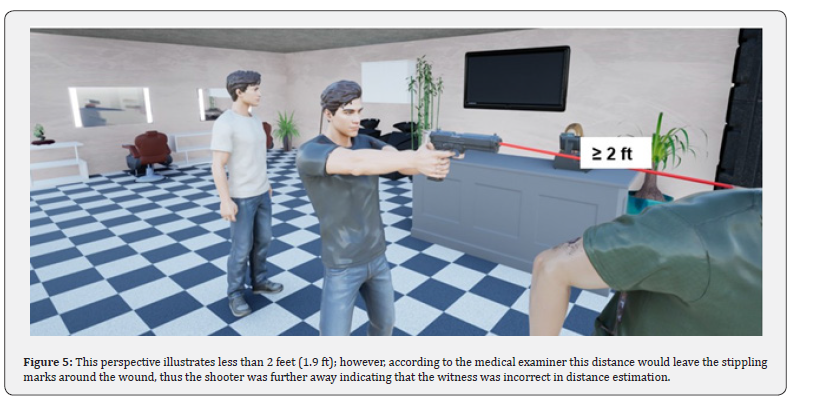
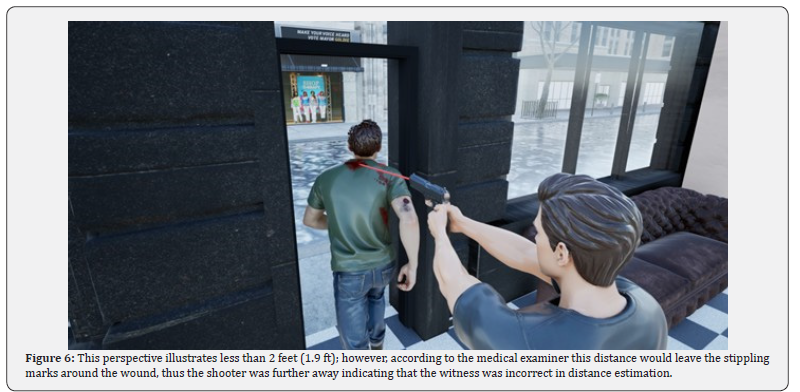
were more than two feet apart due to the victim’s bullet wounds
lacking certain stippling markings, which would be present if the
shooter was in closer range. Thus, the issue for the investigators
was to determine if indeed the victim holding the razor blade
constituted a threat based on his distance from the shooter. The
autopsy revealed that the victim sustained a bullet wound to the
side, one in the arm, and four entered through his back; the one to
the side and two of the bullets in the back each would have been
fatal with none exhibiting the wound characteristics of a shooting
less than two feet from the firearm. Thus, two Research Questions
arise:
RQ1: What are the benefits and limitations of using AR as a
training tool by investigators in re-creating a crime scene?
RQ2: Can the AR software visually depict the shooting in a
clear and understandable format to test the eyewitness testimony
for accuracy?
Results
The AR environment enabled the researchers to assume the role of investigators assigned to reconstruct and present the sequence of events in a visual and spatially accurate manner, including the relative positioning of individuals, movement pathways, and bullet trajectories. By presenting the chain of events through an interactive AR visualization, the study illustrates how complex investigative narratives can be transformed into understandable and accessible artifacts. This approach supports forensic science education by allowing investigators to analyze spatial and temporal aspects of crime scenes, engage in hypothesis testing, and develop evidence-based reasoning skills without the restrictions of building replica crime scene facilities or revisiting the scene of the crime. This is in line with prior reporting on the beneficial aspect of immersive technologies in creating a convenient repeatable environment in which to study the scenario [5].
Therefore, the answers to the research questions are as follows: RQ1: The AR software offered beneficial capabilities to training investigators; in addition to ease of use and simplicity in operation in terms of functionality such as adding architectural elements, and environmental features, it also benefited investigators’ skill development. The researchers were able to explore multiple perspectives, visualize spatial relationships between evidence, and analyze bullet trajectories in a dynamic 3D environment to support analytical decision-making and evidence interpretation. Additionally, this immersive technology enabled the application of theoretical concepts to determine the relative positions and movement of the shooter and victim, ascertain the chain of events, and strengthen communication and collaboration in the discussion of evidence and investigative hypotheses. The researchers in this study (AKA investigators) interpreted the court documents, worked together in partnership to evaluate and assess different viewpoints, brainstorm ideas, and implement AR to reflect those understandings. Similarly, when investigators work in the field, they need to identify theories and test hypotheses, however, it is difficult to test and visualize the findings in a manner which is easily comprehendible especially when it involves firearm discharges. 3D technologies offer an apparatus that makes the process more efficient and results in representations that can be manipulated to test assumptions and theories in a manner that is simple to grasp. This finding supports previous research that AR assists in discussion spaces which leads to heightened learning from social interaction [3,4]. This collaborative capability enhances investigative coordination and allows investigators to present complex spatial evidence more clearly during case briefings or courtroom testimony. Although the limitations are technical in nature; for example a narrow selection of models, the inability to adjust the model posture and facial expressions, the more important constraint involves the scalability in that the lack of precise measurements and placement of objects within the scene is imperfect, but with technology and perhaps artificial intelligence (AI), that can eventually be rectified. Therefore, the answer to the second research question is apparent: AR technologies clearly depict the event through various true-to-life visual representations of the roles of the individuals involved as displayed in the images. The ability to adjust and test alternative positioning and perspectives to determine proximity of the victim with the razor blade prior to the shooting offers a unique ability to determine the events that unfolded (Figures 1-3), while experimenting with different distances noted by the witness which was contradictory and inconsistent with the medical examiners reporting (Figures 4-6). The ability to have investigators interact with crime scenes in an immersive and dynamic manner, provides an effective tool to enhance their spatial reasoning and evidence interpretation. As immersive 3D technologies continue to evolve, their integration into investigative training programs may play an increasingly important role in preparing criminal investigators to analyze complex crime scenes and make informed investigative decisions.
Discussion
This study presents a case-based module to visualize bullet trajectories through virtual vectors and model the movement paths of the shooter and victim. The results of this research indicate that AR-based environments facilitate active knowledge construction by allowing users, in this case investigators, to visualize abstract concepts, manipulate virtual objects, and apply theory within authentic contexts. AR has emerged as a transformative applied technology that enhances skill building abilities by blending digital content with real-world environments. By supporting interactive, experiential, and learner-centered applications, AR promotes deeper conceptual understanding and improved spatial reasoning which makes it particularly effective for applied investigative fields where observation, analysis, and contextual understanding are critical in practice.
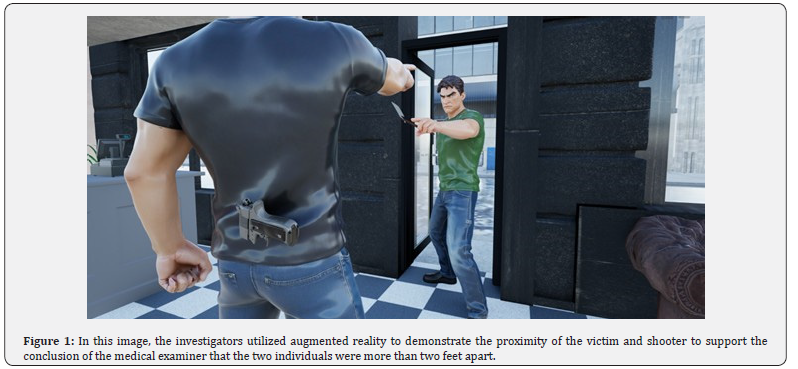
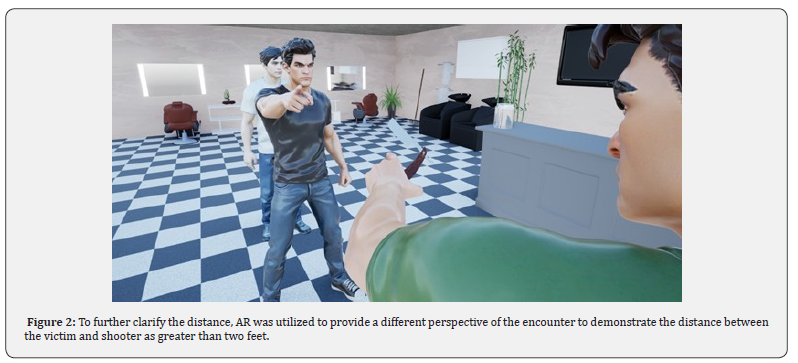
Unlike fully immersive VR environments, AR enables investigators to remain aware of their physical surroundings while simultaneously interacting with digital evidence markers, trajectory lines, and reconstructed scene elements. Research on AR-based training platforms has demonstrated that these technologies can improve investigator comprehension of crime scene dynamics by visually representing spatial relationships that are often difficult to interpret using traditional two-dimensional photographs or diagrams [15]. By visualizing evidence within a real-world context, AR allows users to develop stronger cognitive connections between theoretical investigative procedures and their practical application.
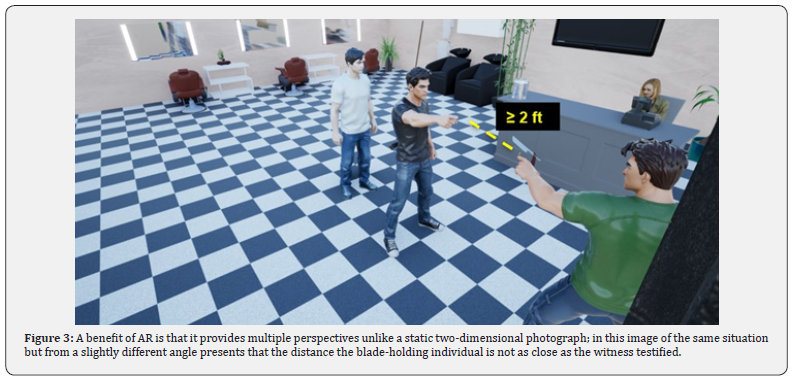
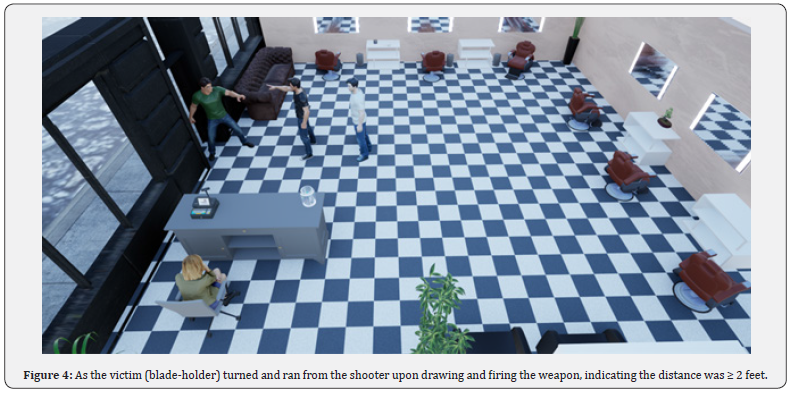
Immersive technologies are particularly valuable in the training of investigators involved in firearm-related incidents. Ballistic investigations frequently require investigators to interpret projectile trajectories, determine the relative positioning of shooters and victims, and analyze bullet impact patterns within complex environments. Studies examining immersive visualization technologies demonstrate that investigators can more effectively interpret ballistic evidence when trajectory paths and impact points are visualized within a 3D environment. These digital reconstructions allow investigators to observe the trajectory of a projectile from multiple vantage points and evaluate how environmental features such as walls, furniture, or structural barriers, may have influenced bullet paths [16]. Such capabilities enhance investigators’ spatial reasoning and improve their ability to reconstruct the sequence of events during a shooting incident.
Research focusing on immersive ballistic analysis further supports the value of 3D visualization in investigator training. In a VR-based system for example, forensic practitioners can examine ballistic evidence using 3D graphical reconstructions of bullets and cartridge cases. By allowing investigators to manipulate digital evidence within an immersive environment, the system enhances the ability to identify patterns and compare ballistic evidence more effectively than traditional two-dimensional visualization methods [17]. Although this research focuses primarily on forensic analysis, the methodological approach demonstrates how immersive environments can strengthen investigators’ understanding of firearm evidence and trajectory relationships within crime scenes.
Conclusion
Augmented Reality (AR) offers significant training benefits for crime scene practitioners by bridging theoretical instruction with applied practice. By overlaying digital evidence, spatial markers, and analytical tools onto a simulated environment, AR enables investigators to visualize complex relationships such as weapon placement and scene dynamics in ways that exceed traditional twodimensional or physical methods. These immersive imaginings support the development of spatial reasoning, critical thinking, and core decision-making competencies in forensic science and criminal investigator trainings.
In the field setting, AR provides safe, repeatable access to realistic crime scene scenarios without the logistical limitations or financial costs associated with building physical mock scenes. This flexibility allows investigators to revisit scenes, test reconstruction hypotheses, and collaborate in shared visual environments, thus reinforcing procedural accuracy and scientific reasoning. Moreover, AR-supported undertakings promote user engagement and motivation by enabling interactive, learnercentered exploration of authentic investigative tasks.
AR provides a new tool to enhance both the quality and accessibility of crime scene investigators’ capabilities. As AR technologies continue to advance and become more accessible, their adoption in forensic science has the potential to strengthen investigators’ preparedness and modernize the approaches to crime scene reconstruction training.
Methodological Limitations and Future Directions
This study utilized a small case sample, limiting the ability to generalize findings to the broader population of firearmrelated incidents; additionally, the AR platform utilized in this research, (TwinMotion), is not specifically designed for forensic or crime scene reconstruction. Future research should employ a larger sample and a mixed-method design incorporating qualitative interviews and survey data from a larger population of investigators using AR to reconstruct crime scenes as well as methods to ensure scalability to ensure accuracy in dimensions and measurements.
Acknowledgements
The authors are thankful to St. John’s University student research assistants Kosta Alexandratos and Richard A. Castimore for their technical expertise and utilization of TwinMotion software.
Conflict of Interest
The present study has no financial or personal relationship with any person or organization.
References
- Albeedan M, Kolivand H, Hammady R (2023) Effect of augmented reality and virtual reality in crime scene investigations, IEEE Xplore 16th International Conference on Developments in eSystems Engineering (DeSE); Istanbul, Turkiye.Bressler, DM, Tutwiler, MS, Bodzin, AM (2021) Promoting student flow and interest in a science learning game: a design-based research study of school scene investigators, Educ Tech Research Dev; 69: 2789-2811.
- Bressler, DM, Tutwiler, MS, Bodzin, AM (2021) Promoting student flow and interest in a science learning game: a design-based research study of school scene investigators, Educ Tech Research Dev; 69: 2789-2811.
- Lukosch S, Billingurst M, Alem L, Kiyokawa K (2015) Collaboration in augmented reality, Computer Supported Cooperative Work 24: 5151-525.
- Wilkins HA, Spikmans V, Ebeyan R, Riley B (2024) Application of augmented reality for crime scene investigation training and education Sci & Justice 64(3): 289-296
- Meenaghan, M, Sintermaartensdijk, IV (2024) The use of XR technology in criminal justice teaching and education: a scoping review, Smart Learning Environments 11: 60.
- Alhebaishi S, Stone R (2024) Augmented reality in education: Revolutionizing teaching and learning practices- state of the art, Inter’l J of Advanced Computer Sci and Apps 15(11): 23-36.
- Cardwell A, Murray J, Croxton R, Nurse B (2017) The use of virtual reality in education and learning: A case study for teaching crime scene investigation, 9th International Conference on Education and New Learning Technologies; Barcelona, Spain 3005-3015.
- Maneli MA, Isafiade OE (2022) 3D forensic crime scene reconstruction involving immersive technology: a systematic literature review, IEEE Access 10: 88821-88857.
- Zappala A, Guarnera L, Rinaldi V, Livatino S, Battiato (2024) Enhancing crime scene investigations through virtual reality and deep learning techniques, IEEE International Conference on Metrology for eXtended Reality, Artificial Intelligence and Neural Engineering; St Albans, United Kingdom 722-727.
- Al-Ansi AM, Jaboob M, Garad A, Al-Ansi A (2023) Analyzing augmented reality (AR) and virtual reality (VR) recent development in education, Soc Sci & Humanities Open 8(1): 100532.
- Brothers-Gray D, Velez-Torres W (2024) Virtual reality in higher education, J Forensic Sci Educ 6(2).
- State of New York Court of Appeals, The People v. Jairo Castillo 2024: 1-7.
- Byrne DS, Rizzo KJ, Bharat CI, Reyes JS (2026) Implementation of augmented reality technology for crime scene reconstruction: A case study of a shooting victim, J Forensic Sci & Criminal Inves 20(2).
- Byrne, DS, Budhai, SA, Yates, MA (2026) A 3D reconstruction framework for visualizing environmental crime risk in built environments: A forensic spatial analysis approach. J Forensic Leg Investig Sci 12: 109
- Albeedan M, Kolivand H, Hammady R (2024) Effect of Augmented Reality and Virtual Reality in Crime Scene Investigations. IEEE Xplore 16th International Conference on Developments in eSystems.
- Wilkins HA, Spikmans V, Ebeyan R, Riley B (2024) Application of augmented reality for crime scene investigation training and education Sci & Justice 64(3): 289-296.
- Guarnera L, Giudice O, Livatino S, et al (2023) Assessing forensic ballistics three-dimensionally through graphical reconstruction and immersive VR observation. Multimedia Tools and Applications 82: 20655- 20681.

























