




 JFSCI Home



Abstract
Augmented reality (AR) is an interactive experience that enhances the real world with computer-generated perceptual information technology which overlays digital content onto real-life environments. Through the implementation of terrestrial photogrammetry and specialized 3D software, investigators can produce images to reconstruct a crime superimposed onto physical objects. This technology can provide a powerful tool in forensic science, throughout the investigative process, and in the courtroom. This paper utilized a case study based on witness testimony as described in a court decision of a homicide to visualize the spatial relationships of the trajectory of a bullet using virtual lines and the movement paths of the shooter and victim during the event. Findings indicate that images generated with AR can support theories and explanations of the encounter from multiple angles and different perspectives which are beneficial to criminal investigators which previously was difficult to achieve in traditional 2-dimensional methods of photographs and drawings.
Keywords: Augmented reality; 3D; Three-dimensional software; Crime scene reconstruction; Visualization; Bullet trajectory; Forensic science; Witness testimony; Crime scene investigation; CSI
Abbreviations: AR: Augmented Reality; 3D: Three-dimensional, CSI: Crime Scene Investigation
Introduction
Augmented reality in crime-scene reconstruction provides a clearer, more defensible ability to demonstrate the trajectory of projectile paths and shooter and victim positioning. The benefits include the ability to visit a crime scene without contamination or risk to the investigator; the avoidance of logistical restraints of building physical mock facilities; improved spatial reasoning; increased collaboration between investigators; enhancement of learning; and utilization of technology at a low cost. Data acquisition in AR is similar to virtual reality as they both consist of 3D crime-scene data captured via photogrammetry and laser scanning of digital models imported into a virtual environment [1,2]. System development involves the creation of 3D images through the combination of scanning, modeling, and immersive visualization of realistic simulated crime scenes reconstructed digitally to provide methodological grounding for trajectory accuracy in an immersive environment [3]. Unlike virtual reality, AR enables multiple investigators to work in concert on the system and develop a consensus of the cause of crime and in theory development through collaboration [4]. When introduced into the courtroom, these simulations provide clear and convincing demonstrations to the jury of the events that transpired in the interpretation of evidence [5]. Similarly, computer-game animation technologies can add an explicit time dimension to include movement and sequencing that is often essential for explaining similar events and can be used for reconstructions involving trajectories and changing viewpoints [6].
A recurring enabling factor is improved 3D capture to include photogrammetry, laser scanning, and the growing use of artificial intelligence (AI) to assist in managing complexity. However, several limitations occur in the evidential validity and error characterization as AR overlay alignment issues such as drift and variable scanner error margins can jeopardize evidential integrity if not quantified and disclosed [7]. An additional concern of digital simulation technologies involves human factors from lack of cognitive bias controls that can impact objective evaluations [8]. A key contribution is the explicit emphasis on repeatability, the ability to revisit and reproduce investigators’ prior comparison steps. This aligns with broader forensic concerns about transparency and review, particularly when evidence must be defended in legal contexts [9].
Specialized Software Utilized
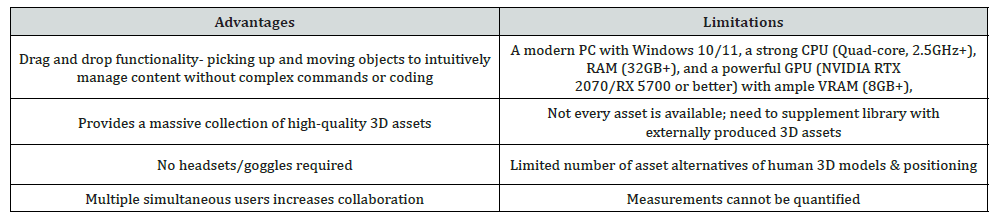
The AR software utilized for this research was developed by TwinMotion which offers the program at no cost to educational institutions, and students and small businesses that gross less than $1 million USD annually. This real-time visualization tool originally designed for architects, construction planners, and landscape designers and has since been transformed into a program with unlimited applications as it enables users to quickly produce high-quality images, panoramas, 360° virtual reality videos, and interactive presentations from 3D data [10]. The resulting immersive experience offers an exceptional opportunity for professionals and students in forensic science and criminal investigations due to its user-friendliness and simple drag and drop functionality of a vast library of digitally based materials, assets, props, and furnishings which can easily be customized to fit practically any scenario and without the necessity of coding nor physical equipment of headsets/goggles enabling multiple users to work simultaneously and collaboratively via computer monitors. It also enables the ability to create paths of movement of pedestrians, vehicles, automatic opening of parametric doors and parallax windows to create adaptable models from different perspectives resulting in a precise, vibrant digital 3D environment.
The following table provides a list of advantages and limitations of TwinMotion as a tool for augmented reality in crime scene investigations (Table).
Case Report
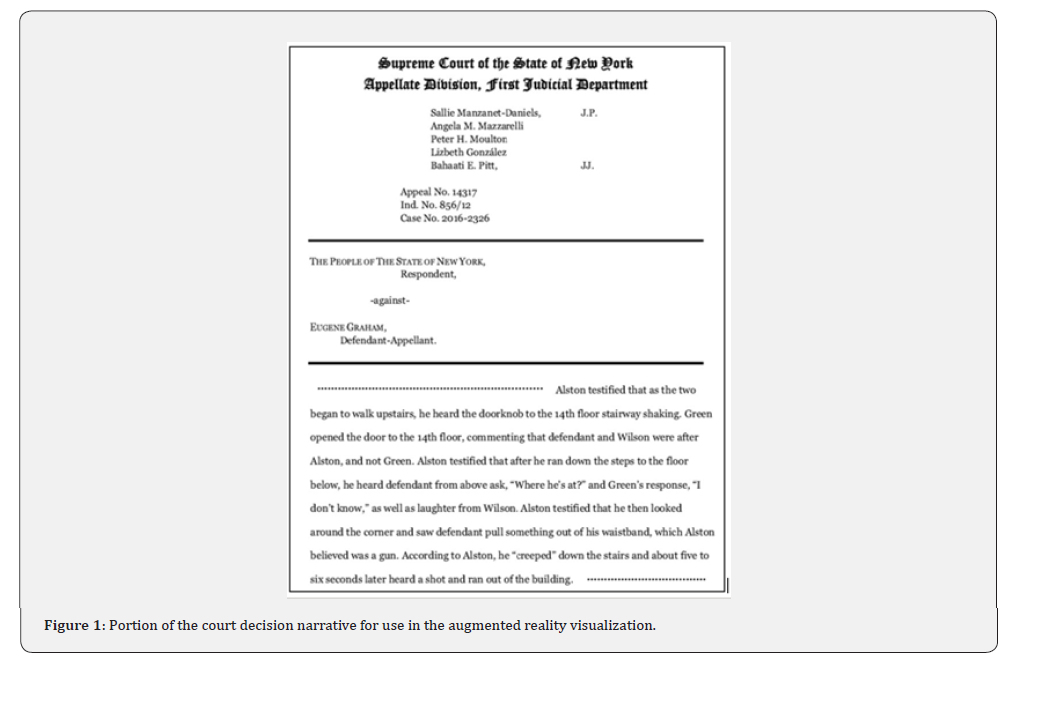
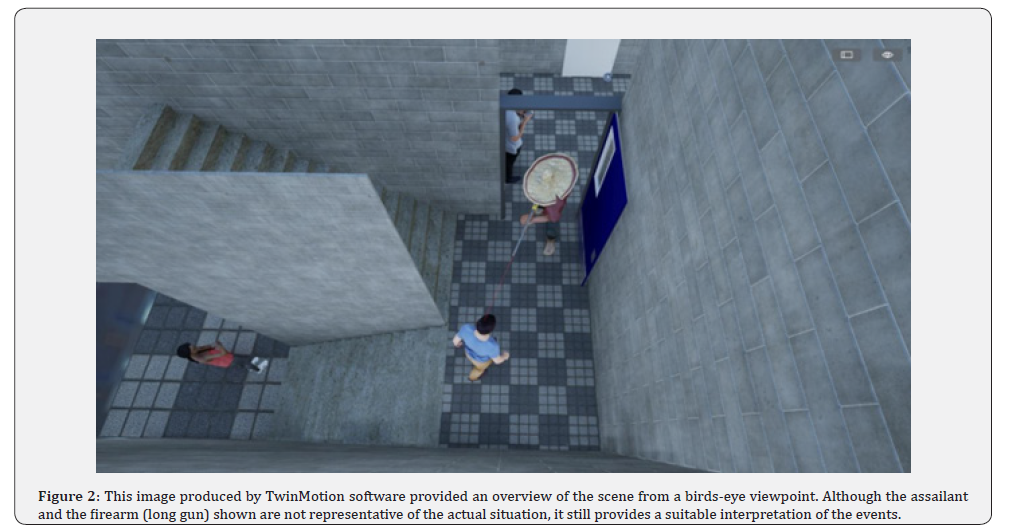
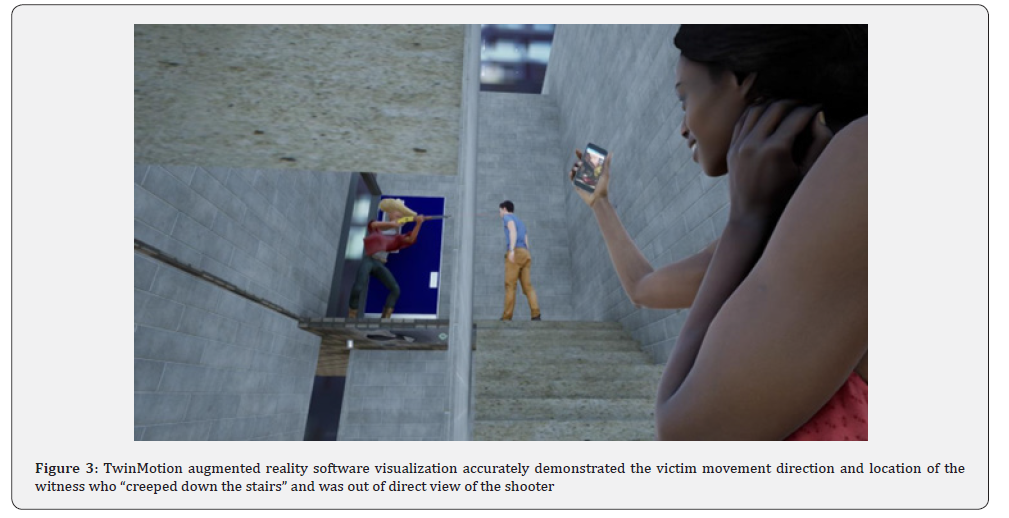
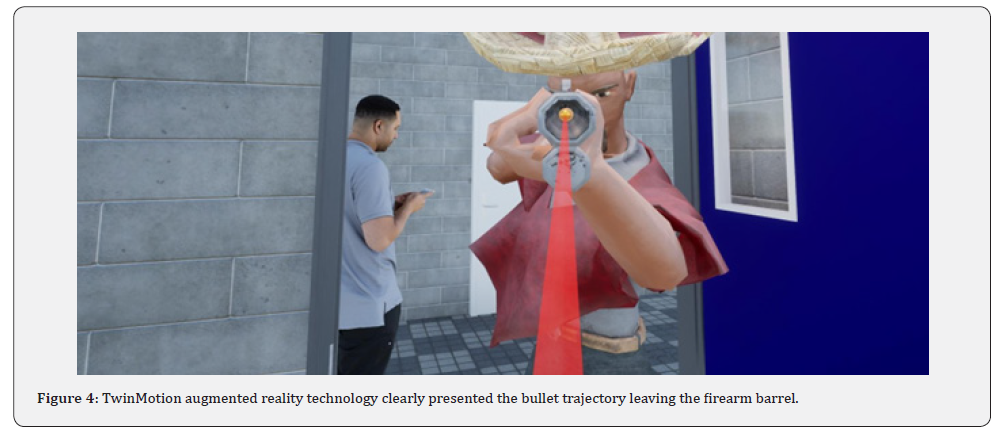
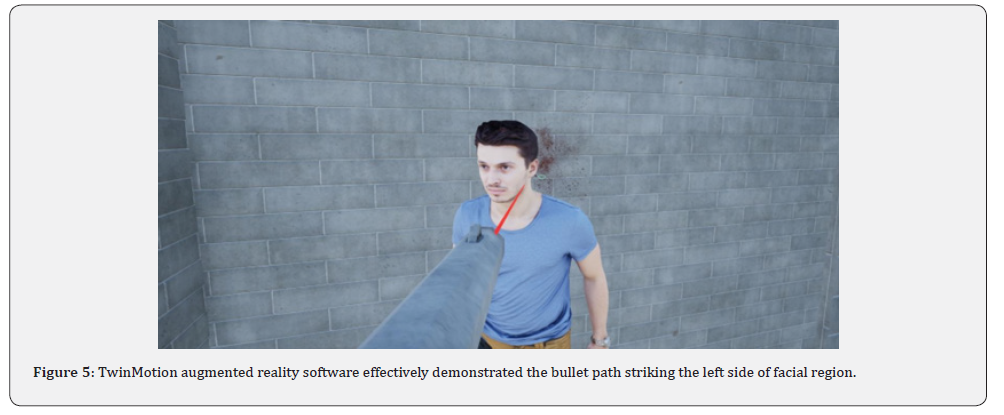
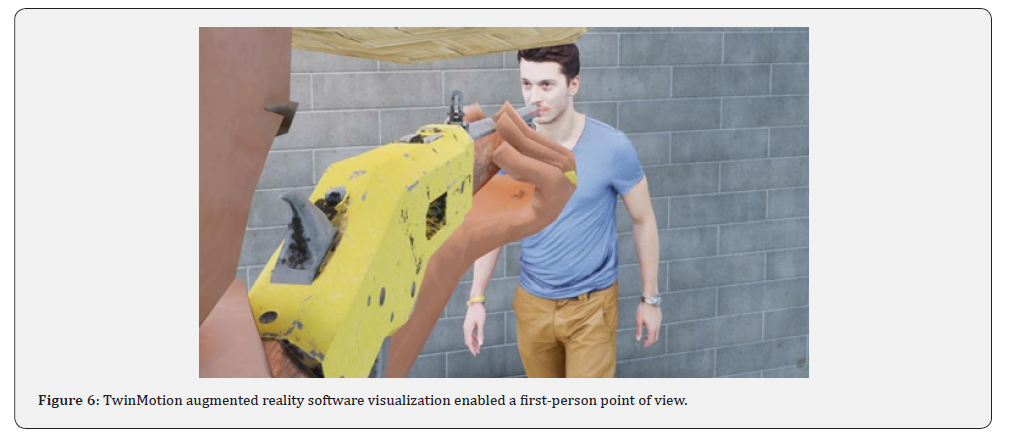
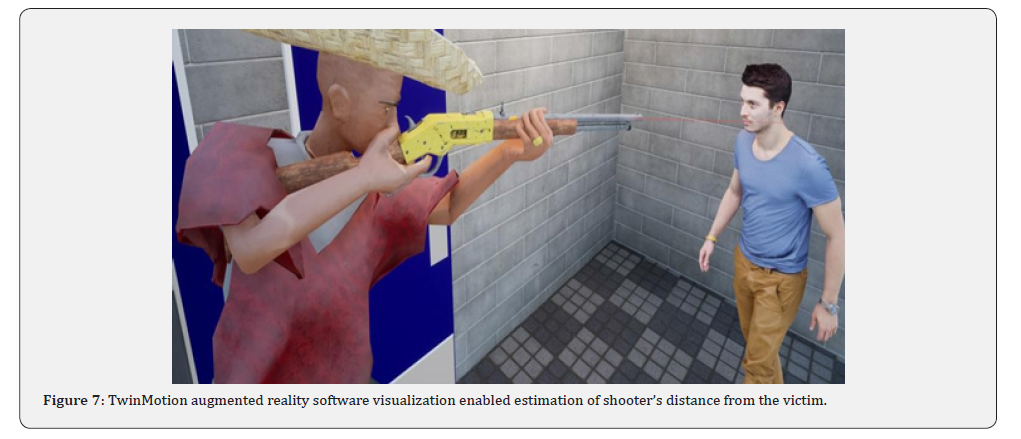
This research utilized the testimony provided by a witness to a homicide of the chain of events that preceded the shooting which led to the murder of the victim (Figure 1). In summary, the details of the case involved two individuals chased into the stairway of an apartment complex by a violent street gang with the intent on killing them for selling narcotics in their territory ultimately leading to the assailant shooting the victim on the landing while the other, the witness, was just out of sight on the staircase leading to a lower floor [11]. To accurately comprehend this segment of the narrative from the court decision, a visual representation is essential to portray the movements and positioning of the shooter, victim, and trajectory of the bullet projectile, thus necessitating the implementation of AR technology.
Results and Discussion
Developing the AR scenario was quite straightforward which involved searching through the library of 3D media assets to locate the appropriate items such as the staircases and doorway, cutout of the building on an upper floor, and selecting individuals to represent the shooter, victim and others presented in the witness testimony narrative. This process of dragging and dropping items into the virtual environment was simple as well as moving and placing the assets in different locations throughout the scene. The whole process of creating the visualization based on the witness statement once the digital assets were selected extended approximately 3 hours from start to finish, with much of that time spent on getting used to the controls and functionality of the software. Note that the assets provided in the TwinMotion library do not allow for customary changes in clothing, hence the shooter in this example is not representative of the assassin in the narrative. Additionally, certain assets provided are stagnant and cannot be manipulated in terms of positioning, adjusting facial expressions, or modifying items in possession (i.e.: placing a firearm in the hand of 3D model) (Figure 2-7).
Conclusion
Implementation of AR can greatly benefit crime-scene reconstruction through the visualization of the witness narrative to demonstrate the series of events leading up to the violent outcome. Providing an accurate representation of the victim in relation to the perpetrator of the crime, in this case, the shooter that killed the individual, can offer a crucial element to criminal investigators and courtroom attorneys without the need for expensive software or physical simulation environments and technically savvy experts to utilize the system. The TwinMotion software proved to be exceptionally simple in terms of functionality and depicted the sequence of events accurately and in a fashion that anyone could quickly understand to what occurred. It successfully demonstrated the trajectory reconstruction of the projectile path and shooter-to-victim positioning. There are some limitations to this technology that can directly affect the AR trajectory workflow, such as alteration or misalignment in overlays. These can undermine measurement credibility and the inability to offer exact quantitative measurements for evidential defensibility. Furthermore, the digital assets in this case produced an imperfect 3D model which were not representative of the described shooter and weapon used in the murder. Overall, the transformative potential of AR in providing forensic investigators with a tool to visualize and manipulate evidence while enhancing collaboration will have enormous value in the future use in crime scene investigations through the leveraging of immersive technologies.
Acknowledgements
The authors are thankful to research assistants, Kosta Alexandratos, Shyla Budha, and Richard Castimore for contributing their time and expertise in the utilization of TwinMotion software.
References
- Zappala A, Guarnera L, Rinaldi V, Livatino S, Battiato (2024) Enhancing Crime Scene Investigations through Virtual Reality and Deep Learning Techniques IEEE International Conference on Metrology for eXtended Reality, Artificial Intelligence and Neural Engineering.
- Wilkins HA, Spikmans V, Ebeyan R, Riley B (2024) Application of Augmented Reality for Crime Scene Investigation Training and Education. Sci & Justice 64(3): 289-296.
- Albeedan M, Kolivand H, Hammady R, Saba T (2023) Seamless Crime Scene Reconstruction in Mixed Reality for Investigation Training: A Design and Evaluation Study. IEEE Transaction on Learning Technologies 17: 856-873.
- Albeedan M, Kolivand H, Hammady R (2024) Effect of Augmented Reality and Virtual Reality in Crime Scene Investigations. IEEE Xplore 16th International Conference on Developments in eSystems. Engineering (DeSE).
- Chango X, Flor-Unda O, Bustos-Estrella A, Gil-Jimenez P, Gomez-Moreno H (2025) Extended Reality Technologies: Transforming the Future of Crime Scene Investigation. Technologies 13(8): 315.
- Schofield D (2009) Animating Evidence: Computer Game Technology in the Courtroom J. Inf. Law Technol., 2009
- Maneli MA, Isafiade OE (2022) 3D Forensic Crime Scene Reconstruction Involving Immersive Technology: A Systematic Literature Review. IEEE Access 88821-88857.
- Villa C, Lynnerup N, Jacobsen C (2023) A Virtual, 3D Multimodal Approach to Victim and Crime Scene. Reconstruction Diagnostics 13: 2764.
- Guarnera L, Giudice O, Livatino S, Paratore AB, Salici A, Battiato S (2022) Assessing Forensic Ballistics Three-Dimensionally Through Graphical Reconstruction and Immersive VR Observation. Multimed Tools Appl 82: 20655-20681.
- TwinMotion website https://www.twinmotion.com/en-US
- Judicial Opinion of the Supreme Court of the State of New York (USA) Appellate Division, 1st Judicial Department; The People of the State of New York vs. Eugene Graham, decision date 12/16/2021.

























