




 JDVS Home



Abstract
Adulteration in dairy industry has taken a very grim look over the decades. Excess additives, colorants as well as adulterants are added maliciously to increase the supply and meet demands of consumers. Often, these externally added entities are above permissible limit as set by Food agencies as well as policy rules. This leads to undesirable ailments and complications in consumers when taken for a prolonged time. To tackle this, the immediate requirement is the availability of rapid diagnostic techniques. As far as these techniques are concerned, most of them are laboratory based requiring trained personal which is laborious as well as expensive. To combat these, facile sensing routes such as paper based, plasmonic chip based as well as fiber optic-based techniques are widely established and they show promising results. Taking cue of this, this short communication highlights these techniques as to how they can be beneficial for dairy industry. Apart from this, there sensing parameters are also briefly outlined. We can create a more robust and sustainable food system and guarantee that everyone has access to wholesome food by utilizing the potential of these cutting-edge technologies.
Keywords:Adulteration; Dairy industry; Global food system; Food agencies
Abbreviations:PBS: Paper Based Sensing; SERS: Surface-Enhanced Raman Scattering; GC: Gas Chromatography; MS: Mass Spectrometry; FOS: Fiber Optic Sensors
Introduction
The global food system is growing more concerned with ensuring the authenticity and safety of our food supply. Food adulteration in dairy industry, which is the intentional or unintentional addition of additives to food that reduce its quality, deceive consumers, or jeopardize their health, is a major threat to global food security and public health. There are many adulterants such as melamine, hydrogen peroxide, formaldehyde, urea etc. which are predominantly used in dairy industry. To meet supply demands, there is malicious practice of using them above the permissible limit set by regulatory bodies. It is imperative to sense them at trace level as their high concentration may result in many ailments to the consumer [1-10]. The labor-intensive and time-consuming laboratory studies needed for existing methods of adulteration detection hinder rapid and efficient food safety surveillance. However, by offering previously unheard-of opportunities for rapid, accurate, and non-destructive adulterant identification, emerging advances in artificial intelligence (AI) and optical techniques are revolutionizing food safety regulation [11-12]. In such cases, the rapid diagnosis is always better. In this scenario, some emerging detection routes are now widely accepted by researchers around the globe. This article outlines these emerging routes concisely - with emphasis on sensing schematization and their principle.
Emerging frontiers in sensing
Paper based sensing
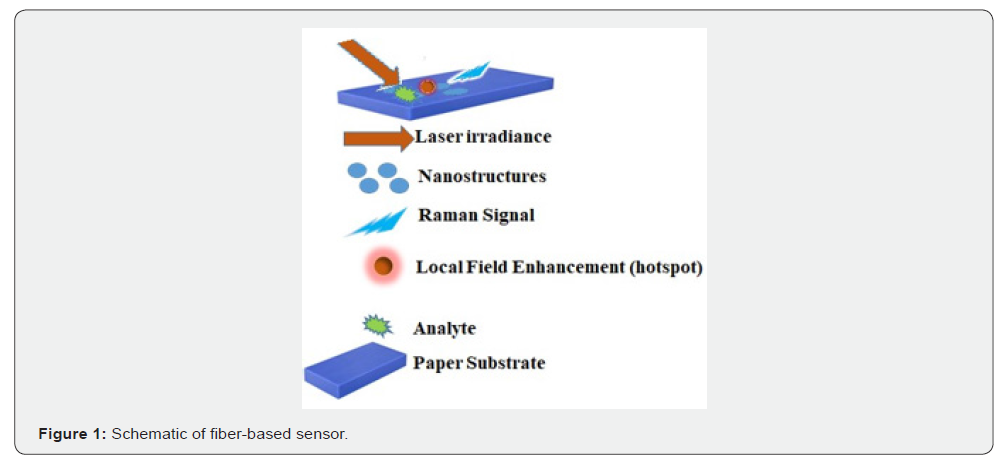
Paper based sensing (PBS) has become a potent method for accurately identifying a variety of adulterants in dairy industry. Paper based substrates make use of the special qualities of paper, including as fluid transport and capillary action, to make it easier to detect a variety of analytes, including dairy adulterants. Their use in food safety monitoring is further improved by the incorporation of cutting-edge technologies like colorimetric detection and Surface-Enhanced Raman Scattering (SERS). The interaction of the analyte with the substrate, which results in a colour shift, is the foundation of paper-based sensors. However, even if the colour shift is invisible, it can still be examined using fundamental characterization methods like UV-Vis Spectroscopy. Raman spectroscopy can be used in certain situations. The sensing in the former scenario is known as colorimetric sensing. It is referred to as SERS-based sensing in the latter group. Figure 1 schematizes the paper-based sensor. When the paper-based substrate is subjected to plasmonic nanostructures with functional elements, the addition of adulterants may either cause visible color change leading colorimetric detection or may scatter light inelastically leading the way to creation of Raman Signal. Depending on extent of color change or Raman shifts, the concertation in the food matrix can be identified.
Plasmonic Chip Based
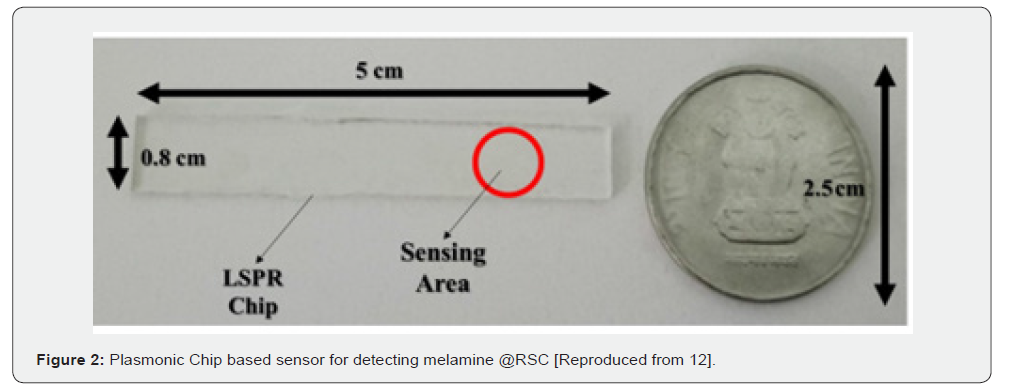
To detect adulterants in dairy industry, conventional analytical techniques including HPLC and gas chromatography/ mass spectrometry (GC/MS) are commonly used. However, routine monitoring of these adulterants is quite difficult due to the advanced methodologies and the need for skilled personnel. Although nanoparticles in colloidal form are employed for sensing in most procedures, which is a quick and easy process, these methods mainly aid in qualitative analysis. This restricts their ability to produce accurate, repeatable, and quantitative results. The development of an easy-to-use, quick sensing technique is crucial. In this regard, plasmonic nanostructures provide an affordable and extremely dependable way to create a portable, sensitive, and quick detection device for milk adulterants. The usage of plasmonic chips, which offer remarkable simplicity and do away with the need for any complicated nanoparticle fabrication methodology or substantial sample preparation, is a novel and extremely effective technology for detecting adulterants in order to tackle this issue and close the gap. As illustrated in Figure 2, plasmonic nanoparticles are created by a traditional borohydride reduction process and then functionalized with maleic acid. A tiny glass slide was coated with these surface-functionalized nanoparticles. This synthetic substrate functions as a highly selective chip that can identify minute variations in the medium’s refractive index around the nanoparticles caused by the melamine in milk. The chip is so tiny that its dimensions are comparable to those of a coin.
Fiber Optic Based
Fiber optic sensors [FOS] have been thoroughly studied for a variety of applications, such as environmental monitoring, biomedical diagnostics, and food quality assessment. They are predicated on the notion that light passes through optical fibers and is impacted by changes in its environment, including variations in its refractive index. By analyzing these fluctuations, the sensor can detect contaminants or other differences in the sample. To detect adulteration in dairy industry, a variety of sensing methods have been studied, including spectroscopic methods, electrochemical sensors, and biosensors. However, these methods sometimes need complex setups or are not suitable for on-site testing. There are sensor configurations such as D-shaped, Tapered, U-shaped which are immensely used for a variety of sensing applications. In all these configurations, particularly U-shaped ones, provide a simpler and more dependable approach. U-shaped fiber is a unique type of optical fiber configuration.
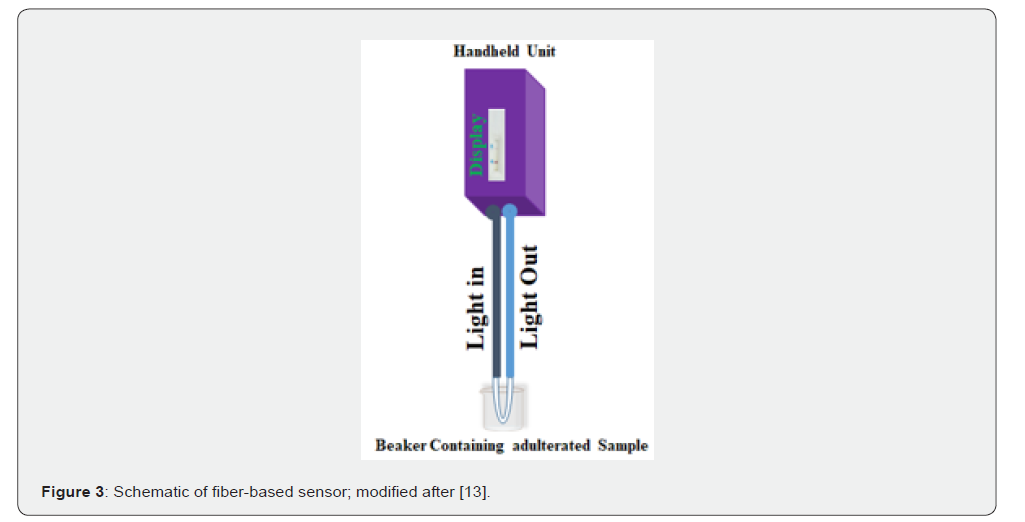
Regarding configurations, there are three types: tapered, U-shaped, and D-shaped. Among these, the complex design problems make tapered and D-shaped fiber challenging to manufacture. For example, D-shaped fiber offers a greater surface for interaction with impinging light, but it is also severely limited by loss. Similarly, the low waist angle affects the tapering fiber. As the analyte interact with the evanescent wave of cladding modes, there arises shift in frequency or wavelength owing to change in refractive index. This shift is a direct consequence of altering concentration of adulterants. Accordingly, these adulterants can be directly assessed. The sensing mechanism is shown in Figure 3. The primary focus here is the analyte-specific functional coating in conjunction with plasmonic nanoparticles in the probe region. Linkers like aptamers can also be used to increase sensitivity. All concentrations of a pure material will have the same transmitted intensity. Nevertheless, depending on the particular interactions with the probe, the transmitted intensity may decrease or increase when the probe is dipped in contaminated samples that contain melamine, urea, formalin, detergent mostly used as adulterants in dairy industry.
Conclusion
The continuous development and application of cutting-edge techniques is essential to monitor quality of food items in dairy industry. This brief article has looked at the emerging technologies like paper based, plasmonic chip based and fiber optic-based sensing, all of which have the potential to efficiently detect adulterant. Their working principle along with schematization is also underlined. Future studies could concentrate on creating more reliable and affordable paper sensors for adulterant detection. Additionally, these sensors’ capabilities and applicability can be readily increased by investigating their integration with cuttingedge technologies like microfluidics or smartphone integration. The design of the sensor can be further expanded with the use of artificial intelligence and machine learning algorithms, especially in terms of enhancing selectivity and sensitivity for a wider variety of pervasive adulterants in food industry. Even though these emerging sensing routes have many benefits, there are still issues like raising detection limits and guaranteeing constant performance in various environmental settings. Future advancements might concentrate on incorporating digital technology and strengthening these devices’ resilience for wider uses in food safety and other fields. Combining these state-of-theart optical methods with powerful AI algorithms like machine and deep learning could make food safety surveillance a proactive and successful process.
References
- Upama Das, Rajib Biswas (2023) Unravelling optical properties and morphology of plasmonic gold nanoparticles synthesized via a novel green route. Chemical Papers 77(6): 3485-3493.
- Upama Das, Rejabul Hoque, Rajib Biswas (2023) Biosynthesized silver nanoparticles as an efficient colorimetric sensor towards detection of melamine. Applied Physics A: Materials Science and Processing 129(5): 328.
- https://www.foodengineeringmag.com/articles/102514-ai-based-inspection-system-brings-for-potato-processors
- Upama Das, Simata Saikia, Rajib Biswas (2024) Highly sensitive biofunctionalized nanostructures for paper-based colorimetric sensing of hydrogen peroxide in raw milk. Spectrochemical Acta - Part A: Molecular and Biomolecular Spectroscopy 316: 124290.
- Das U, Daimari NK, Biswas R, Mazumder N (2024) Elucidating impact of solvent and pH in synthesizing silver nanoparticles via green and chemical route. Discover Applied Sciences 6(6): 320.
- Das U, Gayan A, Biswas R (2025) A highly sensitive facile plasmonic scheme for assessment of melamine in raw milk. Analytical Methods 17(3): 552-561.
- Das U, Biswas R, Mazumder N (2024) One-Pot Interference-Based Colorimetric Detection of Melamine in Raw Milk via Green Tea-Modified Silver Nanostructures. ACS Omega 9(20): 21879-21890.
- Das U, Biswas R (2026) Developing and implementing a facile colorimetric method for detecting salicylic acid in raw milk via biogenic plasmonic nanostructures, Measurement.
- Das U, Daimari NK, Islam K, Biswas R (2026) Copper Electrodes Modified with Gold Nanoparticles Detect Two Hazardous Contaminants (As, Cd) in Raw Milk. Recent Patents on Nanotechnology 19(4): 535-543.
- Upama Das, Rajib Biswas, Nirmal Mazumder (2021) Quantifying Hydrogen Peroxide in Cattle Milk via a Novel Plasmonic Nanofilm. ACS Omega.
- Das U, Dhar T, Biswas R, Mazumder N (2026) Maleic acid assisted facile plasmonic chip for assessment of adulterants in cattle milk. RSC advances 16(29): 26948-26958.
- Biswas R (2024) U-shaped fiber optic sensor as a feasible solution for assessing adulteration in milk. Food Materials Research 4: e037.

























