




 JDVS Home



Abstract
Synbiotics, a combination of probiotics and prebiotics, have gained significant attention in animal nutrition due to their potential to enhance livestock growth, productivity, and overall health. The present mini-review aimed to describe the benefits of synbiotics as an innovative and effective alimentary supplementation in livestock production purpose, highlighting its vast potential due to their better efficacies through dynamic synergistic effects that mix probiotics (live cells or viable spore-formers) with a substrate selectively utilized by host microorganisms-prebiotic agent on modulating gut microbiota, nutrient absorption, and immune system functioning and driving growth rates/productivity up across different species. Studies confirm key advantages including higher body weight, better feed conversion ratios (FCR), and improved milk, egg and meat quality. Moreover, synbiotics are a potential substitute for antibiotics and help in maintaining gut health & preventing gastrointestinal infections. Although challenges remain for optimizing these synbiotic formulations across animal species, their importance in promoting sustainable and profitable livestock farming is pronounced. This review highlights recent advances in synbiotic research and outlines future directions for their application in livestock production.
Keywords: Synbiotics; Probiotics; Prebiotics; Livestock; Health
Abbreviations: FCR: Feed Conversion Ratios; FOS: Fructooligosaccharides; GOS: Galactooligosaccharides; ISAPP: International Scientific Association for Probiotics and Prebiotics
Introduction
Synbiotics, a synergistic combination of probiotics (live beneficial bacteria) and prebiotics (non-digestible food ingredients that promote the growth of beneficial bacteria), have garnered increasing interest in animal nutrition due to their potential to enhance both growth performance and overall health. Probiotics help to maintain the balance of gut flora, while prebiotics serve as substrates that selectively stimulate the growth and activity of beneficial microbes in the gastrointestinal tract. However, when combined they can have a synergistic effect to benefit the livestock’s digestion but also gut health and immune function. The combination of probiotic and prebiotic ingredients in a product offers greater efficacy than using either one alone. Combining these ingredients into a synbiotic offers enhanced health benefits compared to using each ingredient separately. This review demonstrates the current literature regarding synbiotics and their role in the growth performance, productivity, and health of different animal species. It was discussed and further proposed as an alternative to antibiotics for the promotion of animal performance [1,2].
Mechanisms of Action
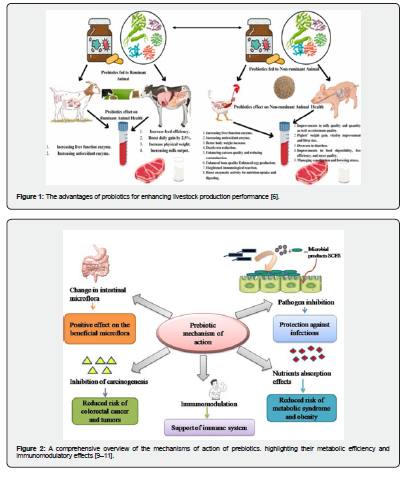
Synbiotics exert their effects primarily through modulation of the gut microbiota. Probiotics introduce beneficial bacterial strains such as Bacillus, Lactobacillus, Bifidobacterium, Enterococcus and Streptococcus as well as some fungi and yeast strains such as Saccharomyces cerevisiae and Kluyveromyces which improve gut health by competing with pathogens for nutrients and adhesion sites, producing antimicrobial compounds, and enhancing gut barrier function [3-5]. The benefits of probiotics in ruminants and non-ruminant animals are shown if Figure 1. Prebiotics, such as fructooligosaccharides (FOS), inulin, and galactooligosaccharides (GOS), selectively promote the growth of these beneficial bacteria by serving as their energy source [2-5]. The precise mechanism of prebiotic utilization is not well-defined. Based on their structure and composition, specific bacteria can utilize prebiotics as sources of carbon and energy [6,7]. Several proposed models demonstrate the prebiotic effect in different areas of the body. For example, the regulation of hepatic lipogenic enzymes can enhance the production of short-chain fatty acids, such as propionic acid and butyric acid, through fermentation [8]. The fermentation products increase the availability of various genes for transcription factors, allowing gut microflora to enhance their population [9-11]. The mechanism of probiotics is presented in Figure 2.
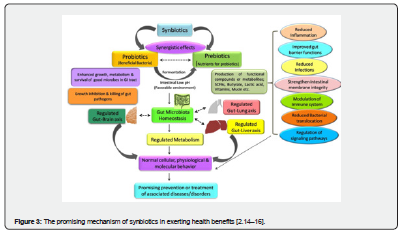
The International Scientific Association for Probiotics and Prebiotics (ISAPP) provides a broader definition of synbiotics as “a mixture comprising live microorganisms and substrate(s) selectively utilized by host microorganisms that confers a health benefit on the host.” In this context, the microbial component does not have to be an independent probiotic, nor does the substrate need to be a standalone prebiotic. However, if the combination provides a health benefit, it is considered a synergistic symbiotic [12]. This way of combining these two elements improve overall gut health by establishing and stabilizing a structurally rich microbial characterized community. Creating a healthier gut environment is critical to promote nutrient absorption, which in turn influence growth while lowering bacterial pathogen burden and also enhancing immune function [13]. In synergistic synbiotics, substrates are specifically designed to be selectively utilized by the co-administered microorganisms, while the live microorganisms are chosen for their ability to provide health benefits and promote the growth and activity of the selected microorganisms. Although the substrate may also support other beneficial members of the gut microbiota, its primary focus is on the ingested microorganisms [14]. However, designing and proving the efficacy of a synergistic synbiotic is experimentally challenging. As a result, most commercial synbiotics used in clinical trials, and nearly all synbiotics in commercially available products, are complementary synbiotics [15]. These mechanisms (illustrated in Figure 3) work together to promote gut microbiota homeostasis, aiding in the treatment or prevention of various diseases [16].
Growth Performances
Growth performance have consistently shown that synbiotics improve growth performance in various livestock species, including poultry, pigs, and ruminants. For example, a study in broiler chickens fed with synbiotics showed significantly increased body weight gains than their negative control groups. The birds showed improved feed conversion ratios (FCR), indicating more efficient nutrient utilization [13]. Synbiotics have shown beneficial effects in growth and performance, gut health promotion, reducing the risk of diarrhea, and promoting feed digestibility aspects in swine production. In a meta-analysis of several research studies, pigs that were fed with synbiotics had 5-10% improved daily weight gain and feed efficiency [17]. Synbiotics have demonstrated some potential for enhancing rumen fermentation in ruminants and thus improving feed efficiency. While the area of research is still in the early stages, initial data are promising especially for young ruminants where firming up gut development can be critical [18].
Productivity in Livestock
Synbiotics not only stimulate growth but also increase other productivity parameters such as milk yield in dairy cows, egg production in poultry, and meat quality of livestock animals. Feeding dairy cows, a synbiotic is not only associated with increased milk production, which can most likely be explained by improved nutrient availability and higher animal health status in these animals [19]. They are also beneficial for improving egg production and quality in poultry. Laying hens fed synbiotics have shown improved egg mass, shell quality, and reduced breakage rates, contributing to better economic returns for farmers [20]. In meat production, synbiotics are reported to promote muscle development and reduce fat deposition in order to enhance the quality of meat. Further, the decrease in pathogenic bacteria within the gut resulting from synbiotics will likely provide more favorable conditions for combatting infections as fewer antibiotics would be used leading to cleaner and safer meat [21].
Overall, Health Outcomes
Synbiotics are increasingly recognized for their role in enhancing immune function and improving overall health outcomes in livestock. Synbiotics improve the gut barrier integrity, and at the same time suppress inflammatory processes in animals which makes them able to combat infections especially those that are specific to the gastrointestinal tract. For example, in pigs (P< 0.05), synbiotic supplementation has been shown to reduce the high incidence of post-weaning pig diarrhea, a common health issue in swine production [22]. Synbiotics have also shown promise in reducing the reliance on antibiotics, as they enhance the natural defense mechanisms of the animals. This is particularly important in light of growing concerns over antimicrobial resistance [23]. Furthermore, synbiotics may alleviate stress-related gastrointestinal problems observed during transportation or diet changes [24].
Challenges and Considerations
Although synbiotics are promising, their effectiveness depends on the particular strains of probiotics and the type of prebiotic used, as well as other factors such as animal species and environmental conditions. This is in line with studies that have identified conflicting reports among other factors, which may be explained by variations in diet composition or housing conditions [25]. There is also a need for more long-term studies to assess the sustainability of synbiotic use in large-scale farming’s. Additionally, while synbiotics generally have fewer side effects compared to antibiotics, there can still be issues related to over-supplementation, which may lead to imbalances in gut microbiota or reduced nutrient absorption [24].
Future Perspectives
>Future research should focus on optimizing synbiotic formulations for different livestock species and production systems. There is a need to explore the synergistic effects of specific probiotic-prebiotic combinations tailored to the physiological and nutritional needs of various animals. Additionally, synbiotics could play a crucial role in the shift towards more sustainable farming practices, particularly in antibiotic-free and organic farming systems [25]. One important key to the future acceptance of this technology will be the development of cost-effective synbiotic supplements that do not alter feed taste or palatability.
Acknowledgements
The authors would like to express their sincere gratitude to the University of Veterinary and Animal Sciences (UVAS), Lahore, for providing academic support and a conducive research environment during the preparation of this mini review. We also acknowledge the valuable resources and literature access that facilitated the development of this work. No external funding was received for this study.
References
- Gibson GR, Roberfroid MB (1995) Dietary modulation of the human colonic microbiota: Introducing the concept of prebiotics. J Nutr 125(6): 1401-1412.
- Markowiak P, Śliżewska K (2017) Effects of probiotics, prebiotics, and synbiotics on human health. Nutrients 9(9): 1021.
- Kim SK, Guevarra RB, Kim YT, Kwon J, Kim H (2019) Role of probiotics in human gut microbiome-associated diseases. J Microbiol Biotechnol 29(9): 1335-1340.
- Markowiak P, Śliżewska K (2018) The role of probiotics, prebiotics and synbiotics in animal nutrition. Gut Pathog 10(1): 21.
- Davani-Davari D, Negahdaripour M, Karimzadeh I, Seifan M, Mohkam M (2019) Prebiotics: Definition, types, sources, mechanisms, and clinical applications. Foods 8(3): 92.
- Fu C, Shah AA, Khan RU, Khan MS, Wanapat M (2023) Emerging trends and applications in health-boosting microorganisms-specific strains for enhancing animal health. Microb Pathog 183: 106290.
- Singh M, Kumar S, Banakar PS, Vinay VV, Das A (2021) Synbiotic formulation of Cichorium intybus root powder with Lactobacillus acidophilus NCDC15 and Lactobacillus reuteri BFE7 improves growth performance in Murrah buffalo calves via altering selective gut health indices. Trop Anim Health Prod 53(2): 291.
- Vonk RJ, Reckman G (2017) Progress in the biology and analysis of short chain fatty acids. J Physiol 595(2): 419-420.
- Alkasir R, Li J, Li X, Jin M, Zhu B (2017) Human gut microbiota: The links with dementia development. Protein Cell 8(2): 90-102.
- Holscher HD (2017) Dietary fiber and prebiotics and the gastrointestinal microbiota. Gut Microbes 8(2): 172-184.
- Chen XY, Gänzle MG (2017) Lactose and lactose-derived oligosaccharides: More than prebiotics? Int Dairy J 67: 61-72.
- Swanson KS, Gibson GR, Hutkins R, Reimer RA, Reid G, et al. (2020) The ISAPP consensus statement on the definition and scope of synbiotics. Nat Rev Gastroenterol Hepatol 17(11): 687-701.
- Pourakbari M, Seidavi A, Asadpour L, Martínez A (2016) Probiotic level effects on growth performance, carcass traits, blood parameters, cecal microbiota, and immune response of broilers. An Acad Bras Cienc 88(2): 1011-1021.
- Kolida S, Gibson GR (2011) Synbiotics in health and disease. Annu Rev Food Sci Technol 2: 373-393.
- Krumbeck JA, Walter J, Hutkins RW (2018) Synbiotics for improved human health: Recent developments, challenges, and opportunities. Annu Rev Food Sci Technol 9: 451-479.
- Sergeev IN, Aljutaily T, Walton G, Huarte E (2020) Effects of synbiotic supplement on human gut microbiota, body composition and weight loss in obesity. Nutrients 12(1): 222.
- Yang Y, Iji PA, Choct M (2009) Dietary modulation of gut microflora in broiler chickens: A review of the role of six kinds of alternatives to in-feed antibiotics. Worlds Poult Sci J 65(1): 97-114.
- Ajay B, Rao KA, Latha PA, Muralidhar M (2022) Effect of feeding probiotics and synbiotics on hematological and serum biochemical parameters in Murrah buffaloes. Asian J Dairy Food Res.
- Singh RK, Chang HW, Yan D, Lee KM, Ucmak D, et al. (2017) Influence of diet on the gut microbiome and implications for human health. J Transl Med 15(1): 73.
- Ustundag AO, Ozdogan M (2018) Effects of feed additives used as an alternative to antibiotics on mineral absorption and bone characteristics in poultry: A review. Hayvansal Uretim 59(1): 79-85.
- Cheng YF, Chen YP, Du MF, Wen C, Zhou YM (2018) Evaluation of the effects of symbiotic supplementation in pigs during the late growing-finishing period on growth performance, muscle antioxidant capacity, mineral accumulation and meat quality..
- Saha S, Namai F, Nishiyama K, Villena J, Kitazawa H (2024) Role of immunomodulatory probiotics in alleviating bacterial diarrhea in piglets: A systematic review. J Anim Sci Biotechnol 15(1): 112.
- Gaggìa F, Mattarelli P, Biavati B (2010) Probiotics and prebiotics in animal feeding for safe food production. Int J Food Microbiol 141: S15-S28.
- Scaldaferri F, Gerardi V, Lopetuso LR, Del Zompo F, Mangiola F (2013) Gut microbial flora, prebiotics, and probiotics in IBD: Their current usage and utility. Biomed Res Int 2013: 1-9.
- Roberfroid M (2007) Prebiotics: The concept revisited. J Nutr 137(3): 830S-837S.

























