




 JDVS Home



Abstract
The study was carried out in Damot pulasa district, Wolaita zone, Southern Ethiopia, to assess dairy product handling, consumption, utilization and marketing. Multistage purposive and random sampling techniques were used for study. The district was stratified into two locations based on the distance from the district town as, location close to district town and location far from district town. Three kebeles from each location making a total of six representative kebeles were selected for the study. Households having dairy production were identified and listed in each kebeles and finally a total of 100 respondent households (50 from each location) were randomly selected from the list. Dairy production, handling, consumption, utilization and marketing data were collected. All of respondents (100%) in the study area used hand milking, with calf suckling was sole for milk stimulation for milking in the study area. The milking frequency in the study area was dominated by three times per day 46 %. Most of households (89 %) washed their hands before milking and a total of 81 % were cleaned milk container. There was no significant difference (P>0.05) in milking methods, milk stimulation methods and washing hand and there was a significant difference (P < 0.05) in frequency of milking, the washing udder, and washing milking equipment’s. Most dominant milking equipment’s in the study area were clay spot (29 %) and the types of plants used for cleaning milking equipment were kosorote (Oocimum haardiense 64%).
In the study area commonly used dairy products in buttermilk 39 %, butter 13 %, ergo 10 %, raw milk 24 %, cheese 4%, whey 1% and all of them 12% in the study area. Majority of respondent 40 % process raw milk into further dairy product, 38 % sold raw milk directly and the remaining 22 % use raw milk for home consumption. All of respondents (100 %) used clay pots for equipment for milk churning. There was a significant difference (p < 0.05) in the frequency of churning and the purpose of production of raw milk, but there was no significant difference (P > 0.05) in the purpose of production of butter, cheese buttermilk and equipment for milk churning in the study area. The overall milk, butter, cheese produced per day was 3.25±1.22, 0.92±0.31 and 0.77±0.33, respectively. This study suggests that better and more appropriate milk processing materials, such as churners and cram cream separators, provision are very important to optimize milk processing for sustainable dairy production in the study area.
Keywords: Dairy Handling; Marketing; Processing
Introduction
Ethiopia has the largest livestock in Africa with 70 million head of cattle, 42 million sheep, 52 million goats, 8 million camels and 56 million chickens CSA [1]. According to the CSA [1], exotic breeds account for around 0.3 percent of bovine animals, 1.9 percent of cross-breed animals and 97.8 percent of native bovine animals. The average number of head of cattle per one hundred persons, measured in Tropical Livestock Units (TLU) between 2000 and 2016, was 51 TLU, more than double the continental average of 23 TLU. Despite its great size, the livestock sector in Ethiopia is generally less productive and its direct contribution to the national economy is modest compared to its potential. The main contributors to low productivity are the weak genetic potential of the animals for production traits combined with poor nutrition, health and management practices (FAO, 2022). Dairy farming is one of the livestock sub-sectors which can provide smallholder farmers with income and employment and contribute to their economic sustainability FAO [2]. In Ethiopia, the milk and milk products sector accounts for half of the livestock production and around 30 percent of employment Tesfaye et al. [3]. However, dairy cow productivity is at its lowest level due to various technical and non-technical constraints. The total amount of milk produced in Ethiopia in 2020/21 was an estimated 7.1 billion liters from all types of milk-producing animals, including cattle, camels, and goats, 4.96 billion liters of milk produced from cow, (CSA, 2020/21).
Dairy products are essential for family consumption and serve as a source of income. Due to the small volume of daily milk produced, producers store the milk produced for three to four days until it has accumulated enough to be processed into dairy products. The dairy production system is an important part of livestock rearing in many parts of the world. They supply milk, meat, manure and other products which are vital to both rural and urban populations. However, the development of milk is hindered by a number of constraints, including genotype, feed sources, access to services and marketing. In order to mitigate these problems and to promote better milk production and marketing systems, it is important to assess current trends in milk production systems, milk processing, use and marketing (Lemma et al., 2018). The district of Damot Pulasa is known for its large milk cattle production, processing and marketing. However, no comprehensive studies on the production and processing, use and marketing of dairy products in the whole district have been carried out. The evaluation of existing dairy production under farmer management and milk product handling, use and marketing is important to identify appropriate development interventions for increasing dairy production and hygienic milk product handling, use and marketing. It will also help identify and address productivity and quality bottlenecks. The study was therefore carried out to assess the milk production, processing, use and marketing of milk products in the district of Damot Pulasa. This research will help improve the livelihoods of farmers and contribute to Ethiopia's dairy development.
Materials and Methods
Description of the Study Area
Damot Pulasa is one of district in Wolaita zone Southern Ethiopia region. It is Part of the Wolaita Zone bordered on the east and south by Damot Gale, on the west by the Boloso Sore, and on the north by the Zone. The district has two agro-ecologies, that is midland 96%and highland (4%).The district was known by many livestock, comprising cattle 78,484, sheep 19,163, goat 1527 poultry 120,190 and equine 2488. It is about 25km from Wolaita Sodo to Northwest. District Latitude 7°0′59″ N and Longitude 38°21′21″ 21°E. The administrative center of the district is Shanto Wzfed [4].
Sampling Techniques and Sample Size Determination
Multistage sampling techniques were used for this study. In the first stage, the district was selected purposively based on dairy production potential and stratified in to two based on proximity to district town. These were areas close to the district town and areas far from the district town. Being close to a district town can significantly affect dairy production and dairy product handling, processing, consumption, and marketing. In the second stage three kebeles from each making a total of six kebeles were selected purposively based on crossbred cattle population and road accessibility. Thirdly, households having at least one dairy cows in each kebeles were identified and listed in each kebeles. Finally, respondent households were selected randomly from the list. The sample size was determined by using the Cochran formula. Accordingly, 100 households were used for data collection for this study.
Data Collection Method
Both Primary and secondary data were used for this study. Primary data collected from the households using a semi-structured questionnaire. The questionnaire was designed to collect information on Milk production system, milk products production, handling, processing, preservation, consumption, and marketing. Secondary data was also collected from written documents of the agricultural office, books, and journals. In addition, group discussions were conducted with kebeles administrators and extension workers to acquire relevant information.
Data Analysis
The collected data was checked for normality and simple descriptive statistics such as frequency, percentage, and mean were analyzed by the statistical package for social sciences (SPSS), version 26. Chi-square and independent sample T-test were employed to see the effect of location on the dairy product production, handling, processing, consumption and marketing. The model used to analyze the categorical data was: Yij= µ+αi+εij; Where Yij=the response variable. µ=overall mean, αi=fixed effect of location for survey (i=area close to district town or area far to district town), εij=residual error. The results were presented in the form of tables
Results and Discussion
Milking Practices
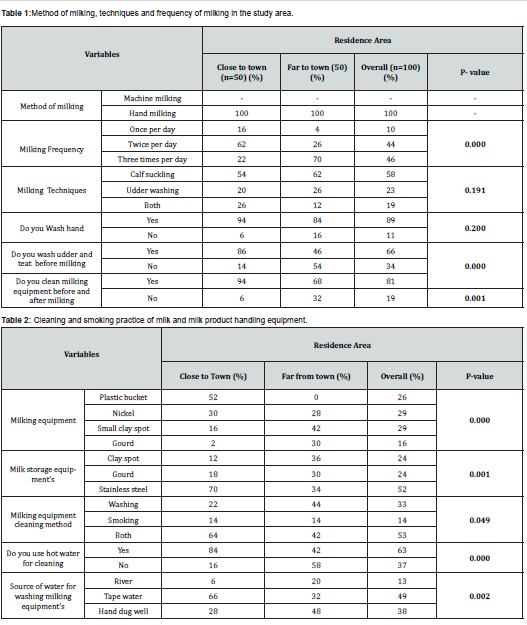
The overall study result revealed that hand milking was sole techniques of milking dairy cows in the study area, with calf suckling was sole for milk stimulation or initiation for milking in the study area. Washing teat was the second techniques of milking, and the use of both calf suckling and udder washing were another third method in the study area. A washing of the teat, calf suckling, and both washing teat and calf suckling techniques of the milking stimulating method before milking were practiced in both close to town and far to town in the study area. The funding was in line with Nigus et al. [5], who reported that hand milking was the sole milking method practiced and calves were allowed to suckle their dams before and after milking. The milking frequency in the study area was dominated by three times per day 46 % followed two per day 44 % and 10 % one times per day in the study area. Most of households (89 %) washed their hands before milking, and the remaining (11 %) did not wash their hands before milking in the study area. In residence area close to town, (94 %) and (6%) of respondents were washing their hands before and were not washing their hands before milking, respectively, whereas in area far from town, (84%) and (16%) of respondents were washing their hands before milking and were not washing their hands before milking, respectively. This result was not in line with Gemechu [6], who indicated that 95.6% of respondents wash their hands before milking. The study disagreed with the finding of Maru et al. [7] in Eastern Ethiopia indicated only 52.5% of respondents wash their hands before milking.
The study result revealed that 66 % of households were washing the udder and teat of the cow before milking and the remaining 34 % not washing udder before milking. In residence area close to town (86%) of households was practicing washing the udder and teats of the cow before milking, and the remaining (14 %) were not washing the udder and teats of the cow before milking. This is because in the area close to town the awareness of respondents about the importance of udder washing was relatively higher than in areas far from district town. The study is disagreed with the finding in Ezha districts of Gurage Zone that 100% of respondents do not wash the udder before milking reported by Abebe et al. [8]. This study result was lower than the report of Yeserah et al. [9], who reported that all respondents (100%) practice udder washing before milking in urban and per urban areas of Hadya Zone, Southern Ethiopia.
Before and after milking, a total of 81 % were cleaned milk containers whereas 19% were not cleaned milk containers in the study area. In areas close to district town, 94% respondents were cleaning the milk containers in the study area. In area far to district town about, 68 % and 32% were cleaning and not cleaning the milk containers in the study area, respectively. There was no significant difference (P>0.05) in the milking methods ,milking techniques(stimulation) washing hands before milking, and there was a significant difference (P < 0.05) in frequency of milking, the washing udder and teat before and after milking, and washing milking equipment’s before and after milking in the study areas. This difference may be due to the awareness difference among residence area and water availability in the area.
Cleaning and smoking of dairy products handling equipment
Most dominant milking equipment’s in the study area were clay spot (29 %) and nickel or jog (29 %) followed by plastic bucket container. Large proportion of respondents in the area close to district town used plastic containers for milking (52%), while in the far to district town, none of respondents used plastic buckets instead small clay spot (42%) and gourd (30%) is dominantly used milking equipment in the area. It is a comparable to the Yeserah et al. [9], showed that gourd, plastic, and stainless steel were used as milking tools in the Dangila zone in the western Amhara region. Utensils used for storage were clay pots (24%), gourd (24%), and stainless steel (52%) in the study area. In area close to town, the milk utensils used for storage were clay pots (12%), stainless steel (70%), and gourd (18%) whereas in area far from district town, the milk utensils used for storage were clay pots (36%), stainless steel (34%) and gourd (30 %) in the study area. This funding is disagree with the results of Yeserah et al. [9] who reported all respondents (100%) used clay pots, gourds, Plastic materials, and Stainless steel as handling and traditional milk processing materials in Hosanna Town, Hadya Zone, and southern parts of Ethiopia.
About 53% of the interviewed respondents practiced both washing and smoking methods to clean milk containers followed by washing only 33% and smoking alone 14 % in the study area. In area far from district town, 62% of respondents used both washing and smoking techniques to clean milk containers, while 22 % respondents practiced washing milk handling equipment and 14 % of respondents smoking. In area far from district town, 42% of the respondents used both smoking and washing to clean milk containers, while 44% of the interviewees admitted to washing milk handling equipment and 14% practiced smoking alone in the study area. This value was lower than results of Abebe et al. [8] that reported the majority of the respondents practiced washing their milk utensils (87.5%) before milking in Ezha district of the Gurage zone, Southern Ethiopia.
In the current survey, 63% reported washing milk equipment with hot water and the remaining 37% not use hot water for washing milking utensils. About 84% area close to district town and 42% area far from district town in the study area used hot water to clean milk handling equipment, respectively. This outcome was lower than that reported by Haile et al. (2012), who claimed that 85.6% of respondents in Hawassa City cleaned milk handling equipment using hot water. However, the current result was better than the one found by Lijalem & Zereu [10], who found that just 26.5% of respondents in the Wolaita Zone utilized hot water. The water sources for cleaning milk and milk product handling equipment were tap water; hand dug well water, and river accounts. The use of tape water was higher than in area close to town than area far from town. This may be due awareness difference and availability of water sources in the area. The milking containers, storage equipment’s used, cleaning method, the use of hot water and the source of water among the residence area were differ significantly (P > 0.05). This might be due awareness difference, water source availability, equipment availability and the purpose of production.
Types of plant used for washing dairy product handling equipment
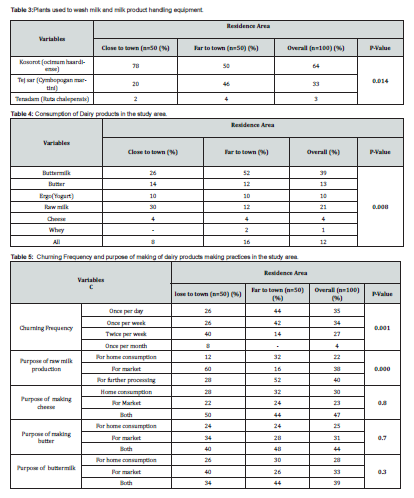
The types of plants used for cleaning milking equipment were kosorote (Oocimum haardiense), tej SAR (Cymbopogan martini), tenadem (Ruta chalepensis), all available anywhere in the area, at 64%, 33%, and 3%, respectively. Based on residence area the type of plants used for cleaning milking equipment’s were all anywhere based these available in the area accounts 78%, 20%, 2%, respectively in area close to town and 50%, 46%, and 4% respectively in area far from district town. There was a significant difference (p < 0.05) in type of plants used for cleaning milking equipment in the study areas.
Dairy products and Consumption in the study area
Dairy products consumed in the study area were buttermilk 39 %, butter 13 %, ergo 10 %, and raw milk 24 %, cheese 4%, whey 1% and all of them 12% in the study area. In area close to district town raw milk was 30%, butter 14%, Ergo 10%, buttermilk 26%, cheese 4 %, and all of them was 8 % whereas in area far from district town was 12%, butter 12%, ergo 10%), buttermilk 52%, and cheese 4%,whey 2% and all of them was 16% in the study area. From these products, the three most prioritized milk and milk products and consumable in the area were raw milk, buttermilk and butter with their ascending ranking order. In area close to district town raw milk 52% was preferable than other dairy products whereas in area far from district town buttermilk counts higher than 30% another dairy product. The current result is in line with reports of Yeserah et al. [9] that they revealed fresh whole milk, Ergo, defatted sour milk, butter, ghee, a traditional cottage cheese and a traditional fermented cottage cheese are the common dairy products produced and consumed in different part of Ethiopia.
The reason for processing milk into various products in the study area was mainly to increase the shelf life of the product 20 %, and diversify the products 70 %, and both of them were 10% in the study area. This result was the same with Lijalem & Zereu [10], who reported that milk was processed to increase its shelf life, add value, have a variety of products, and for all purposes, as reported by 11.2%, 14.2%, 24.6%, and 45.5% of respondents in Wolaita Zone. This result was higher than Mekonnen [11], who indicated that only 38.8% and 3.4% of respondents in mid rift valley Ethiopia processed milk to increase the shelf life and diversify the products, but the rest indicated it was for all purposes. There was significant difference (p<0.05) on the availability, consumption and on the reasons of milk processing in the study areas. This may be due to the purpose of production, consumer preference, effect of urbanization and production status among the residence area.
Churning Frequency and Dairy products making practice in the study area
All of respondents (100 %) used clay pots for equipment for milk churning. The current study higher than the results of Tadesse and Shelima (2015), they reported that 85.5% of gourds were used in Bahir Dar Zuria and Mecha districts. The difference might be due to the cultural trends of the people and their access to the equipment. The churning frequency of milk in the study area was once per day 35 %, once per week 34 %, twice per week 27 % and once per month 4%. Majority of respondent 40 % process raw milk into further dairy product, 38 % sold raw milk directly and the remaining 22 % use raw milk for home consumption.
Butter produced for home consumption and market sale 44%, market sale only 31 % and home consumption only 25 % and cheese was 30 %, 23% and 47% for home consumption, for market and for both market and home consumption respectively in the study area. Buttermilk produced for home consumption and for sale. There was a significant difference (p < 0.05) in the frequency of churning and the purpose of production of raw milk, but there was no significant difference (P > 0.05) in the purpose of production of butter, cheese buttermilk and equipment for milk churning in the study area. This difference might be due to the market access difference and producers preference to use products among the residence area [12-14].
. Marketing system, Marketing places and Means of transportation of Dairy products in the study area
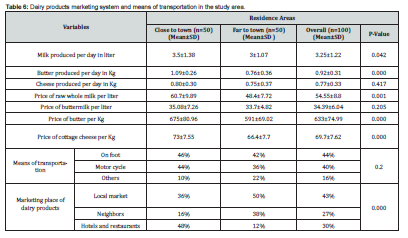
The overall milk produced per day was 3.25±1.22, from which 3.5±1.38 and 3±1.07 was from area close to district town and area far from district town respectively in the study area. The overall butter produced per day was 0.92±0.31, from which 1.09±0.26 and 0.76±0.36 was from area close to district town and area far from district town respectively in the study area. The overall cottage cheese produced per day was 0.77±0.33, from which 0.80±0.30 and 0.75±0.37 was from area close to district town and area far from district town respectively in the study area [15-17]. The average price of fresh milk price per liter in study area was 54.55±8.8 and from these 60.7±9.89 and 48.4±7.72 of area close to district town and area far from district town respectively. The overall price of butter milk per litter was 34.39±6.04, from this area close to district town was 35.08±7.26 and area far to district town was 33.7±4.82 in the study area. The average price of butter per kg was 633±74.99, from these 675±80.96 and 591±69.02 of area close to district town and area far from district town respectively. The average price of cottage cheese per kg was 69.7±7.62, from these 73±7.55 and 66.4±7.7 of area close to district town and area far from district town respectively.
Most of the farmers, who live far from market places, have to transport their dairy products to the market places to sell. Farmers used different means of transportation, namely on foot, by motor cycle and others means. About 44% of the respondents traveled on foot, and 40% used a motor cycle and the rest 16% used others means of transportation to transport milk and milk products to the market. In area close to district town about 46% of the respondents traveled on foot, 44% used Bajaj and the rest 10 % used others means of transportation to transport milk and milk products to market. In area far to district town, 42 % traveled on foot, 36% motor cycle and 22 % other means of transportation used to transport dairy products to market. Milk and milk products were sold at different places, such as at hotel and restaurants 30%, local markets 43%, and neighbors’ homes consumers 27% in the study area. In area close to district town, milk and milk products were sold at hotel and restaurants 48 %, local market 36%, and neighbors consumers 16 %, and in area far from district town, they were sold at hotel and restaurants 12%, local market 50%, and neighbor’s consumers 38% in the study area. There was a significant difference (p < 0.05) on milk produced per day; butter produced per day, price of raw milk and price of butter among residence area, there was also the significant difference on the dairy products marketing places. This might be due to productivity difference, demand difference, market access and management difference among the residence area in the study area. There was no significant difference (p > 0.05) on the means of transportation in the study area.
Conclusion and Recommendation
The present study was aimed to assess dairy product handling, processing, utilization and marketing in the Damot pulasa district of Wolaita zone Southern Ethiopia. The goals of processing milk into different products were to diversify the product and to add value. Majority of respondent 40 % process raw milk into further dairy product, 38 % sold raw milk directly and the remaining 22 % use raw milk for home consumption. Most popular processed dairy products in the study area were butter milk, yoghurt (Ergo), cheese, whey and raw milk. While the equipment’s used by respondents for churning milk was clay spot (100%).The majority of milk was churned once per day. The churning frequency of milk in the study area was once per day 35 %, once per week 34 %, twice per week 27 % and once per month 4%. The most dominant dairy products handling equipment’s in the study area were clay spot and gourd. Since walking was the most popular form of transportation in this district. Milk and milk products were sold at different places, such as at local market, neighbor consumers and hotel and restaurants. Changing the attitude of the farmers through training and other mechanisms should be done in order to improve the handling practices of milk and milk products and to avoid cultural restrictions in milk marketing, particularly in study areas. Encourage milk marketing in rural areas, farmers' attitudes regarding the nutritional value of milk and milk products need to be improved.
References
- CSA (2023) Agricultural Sample Survey. Livestock, Poultry and Beehives population (private peasant holdings). Federal Democratic Republic of Ethiopia Central Statistical Authority (CSA), Addis Ababa, Ethiopia.
- FAO (2010) Status and Prospects for Smallholder Milk Production: A Global Perspective. Hemme T, Otte J (Eds.), Rome, Italy.
- Tesafye L, Puskur R, Azage T, Hoekstra D (2008) Exploring innovation capacity in the Ethiopian dairy systems. Paper presented at international conference on advancing agriculture in developing countries through knowledge and innovation.
- Wzfed (2018) Wolaita Zone Finance and Economic Development Office, Annual Report.
- Nigus A, Ashebo Z, Zenebe T, Adimasu T (2017) Assessment of dairy production and management practice under small holder farmer in Adigrat town. Journal of Natural Sciences Research 7(13).
- Gemechu T, Amene T (2017) Dairy cattle milk production, handling, processing, utilization and marketing system in Bench Maji Zone, Southwest Ethiopia. International Journal of Livestock Production, 8(9): 158-167.
- Maru TD, Wari LF, Fufa AJ, Mekete B (2023) Milk Handling Practices, Processing Methods, and Microbial Quality.
- Abebe B, Zelalem Y, Ajebu N (2013) Handling, processing and utilization of milk and milk products in Ezha district of the Gurage zone, Southern Ethiopia. Journal of Agricultural Biotechnology and Sustainable Development 5(6): 91-98.
- Yeserah B, Tassew A, Mazengia H (2019) Microbiological Quality of Raw Cow’s Milk In and Around Bahir Dar City, Ethiopia.
- Lijalem T, Zereu G (2015) Hygienic Milk Handling and Processing at Farmer Level in Wolaita Zone, Southern Ethiopia. Food Science and Quality Management.
- Mekonnen A (2017) Assessment and Monitoring of Traditional Milking and Milk Product Handling, Processing and Marketing in Dessie Zuriea Woreda and Dessie Town, South Wollo Zone, Amhara, Ethiopia.
- Abebe M, Tassew A, Asmare B (2021) Appraisal of Milk Production, Processing and Marketing In Selected Urban and Peri-Urban Dairy Production Systems of Northwestern Ethiopia. Scientific Papers: Animal Science & Biotechnologies 54(1).
- Asaminew T (2007) Production, handling, traditional processing practices and quality of milk in Bahir Dar milk shed area, Ethiopia. M. Sc. Thesis, Haramaya University, Ethiopia.
- Ayalew H, Abatenhe A (2018) Dairy Cattle Production, Processing and Handling of Milk and Milk Products in Enemay District, East Gojjam, Amhara, Ethiopia. J Adv Dairy Res 6(214).
- Cochran WG (1963) Sampling Techniques, second Edition., New York.
- Fufa A, Nigus T, Fikru R, Dinka A, Kebede A (2019) Handling Practices, Quality and Safety of Milk along the Dairy Value Chains in Selected Sub Cites of Addis Ababa, Ethiopia. Journal of Scientific Technical Research 13(1).
- (2022) IBM Corporation, SPSS Statistics 29. Documentation.

























