




 JDVS Home



Abstract
The primary objective of the study was to evaluate the safety of sodium percarbonate, a preservative used in processing milk and other foods for human or animal consumption, when added to milk fed to preweaned dairy calves. Each of 4 treatment groups (untreated control milk, 1200 mg/ gal, 1600 mg/gal, or 2000 mg/gal of sodium percarbonate) contained 4 Holstein and 4 Jersey pre-weaned dairy calves, for a total of 32 calves. Milk was fed twice daily for a mean of 121 feedings per calf. There were no signs of unpalatability, colic or other calf discomfort or pathology associated with adding sodium percarbonate to 2968 feedings of milk to dairy calves. The calves that died and had complete necropsy had no signs of irritation or ulceration of any part of the GI tract suggestive of any toxicity from the sodium percarbonate. A secondary objective was to provide preliminary data regarding its association with calf health or disease outcomes. When breed, age, and other potential predictor variables as well as treatment group were tested in general linear models for percentage of feedings with diarrhea or feedings with respiratory disease, the concentration of sodium percarbonate fed was not significantly associated with outcome of either disease. Sodium percarbonate was a safe and practical preservative when added to milk fed to dairy calves. Further study of efficacy/association with reducing diarrhea or respiratory disease in preweaned calves is indicated.
Keywords:Milk; Dairy Calves; Sodium Percarbonate; Diarrhea; Disease
Introduction
Sodium percarbonate (sodium carbonate peroxyhydrate, sodium carbonate peroxide) is a disinfectant powder also used as a preservative in processing milk, dairy products and other foods for human or animal consumption as well as toothpaste; it releases hydrogen peroxide, which becomes water and oxygen when dissolved in aqueous solutions [1-4]. Sodium percarbonate is also used to treat human drinking water [3]. The powder is readily soluble in milk, and is exempted from U.S. Environmental Protection Agency (EPA) tolerances [5]. When used for milk preservation, the World Health Organization states that sodium percarbonate “does not present a toxicological hazard” [6]. Sodium percarbonate is also added to water for raising farmed fish, is safe for the fish, and the fish can be defined as organic for human consumption with no withdrawal period [1,7].
For more than 100 years, the Pasteurized Milk Ordinance (now called the Grade A PMO) standards have recommended that the Standard Plate Count (SPC) of milk for human or animal consumption, including for dairy calves should not exceed 20,000 cfu/ml [8,9]. However, at ambient temperatures at or near 32°C (90°F), SPC rapidly rise to > 100,000 cfu/ml and often reach > 40,000,000 cfu/ml within a few more hours, including in postpasteurized milk [10]. A previous study by one of the authors investigated the addition of sodium percarbonate to postpasteurized milk for feeding to dairy calves and associated changes in SPC over time [11]. In that study, SPC following pasteurization were compared between untreated control milk and treatments of 300 mg/L, 400 mg/L, or 500 mg/L of sodium percarbonate, added following pasteurization. At 32°C (90°F), mean SPC in all sodium percarbonate treated milks were <3,000 cfu/ml from 2hr through 8hr post-pasteurization. In contrast, untreated milk SPC means exceeded 40,000 cfu/ml at 2hr, 650,000 cfu/ml at 5hr, and 55 million cfu/ml at 8 hr [11].
Most dairy farms do not pasteurize milk fed to calves. Purchasing, operating, maintaining and cleaning on-farm pasteurizers incur expenses and present management challenges [8]. Success of pasteurization was reported to be variable on all farms studied, including from equipment failures [8]. Especially during summer weather or when milk is kept warm, bacteria count rise rapidly even in pasteurized milk [8].
The primary objective of the current study was evaluation of the safety of sodium percarbonate when added to unpasteurized milk fed to Holstein and Jersey dairy calves. A secondary objective was to provide preliminary data regarding its association with calf diarrhea and respiratory disease, the two most important disease complexes of dairy calves [12,13].
Materials and Methods
Study population of dairy calves
Holstein and Jersey calves enrolled in the study were raised at the Utah State University dairy farm. The lactating herd was composed of 55 to 58 Holsteins and 55 to 58 Jerseys, milked using two automated milking system (AMS) Lely Astronaut A3® model milking robots, one for Holsteins and one for Jerseys. Mean 305- day actual milk production was 19,215 lb (8724 kg) for Jerseys and 26,840 lb (12,185 kg) for Holsteins. Mean bulk tank SCC was 151,000/ml. The lactating herd was housed in free stalls bedded with recycled manure solids, and pre-weaned dairy calves were housed in plastic hutches with wire fences, bedded with straw over sand. Bedding was completely changed and hutches were cleaned between each calf housed in a hutch. All calves were born and raised entirely on the Utah State University dairy farm. The project was approved by the Utah State University Institutional Animal Care and Use Committee (IACUC) protocol number 14323.
Determination of sample size
Sample size calculation was based on multiple factors. There are no specific guidelines for the number of dairy calves in a feed additive safety trial. Previous calf feed additive efficacy studies have often studied approximately 30 calves [14]. However, some feed additive safety studies have been performed with 4 bovines per treatment, fed for only 3 days [15]. Sufficient calf numbers were desired such that biologically significant decreases in diarrhea and respiratory disease could be detected as statistically significant. Simulations indicated that 32 calves was a marginal sample size, borderline sufficient to detect these differences. Additionally, there was an important practical issue. Because of summer weather and the availability of student calf feeder personnel due to the academic calendar, it was determined from the outset that the study would take place from June through October. This led to the question of whether at least 32 female calves, half Holsteins and half Jerseys, were expected to be available on the Utah State University dairy farm during that time period. Based on the number of expected calvings and all cows having been impregnated with sexed semen selected for a majority of calves born to be females, it was expected that this number of calves could be obtained, but barely; there were not likely to be many more. All of these factors resulted in the planned sample size of 32 calves, 16 Holsteins and 16 Jerseys.
Assignment of calves to treatment groups
Dairy calf feed studies are recommended to begin at less than 56 days old, with a planned duration of at least 56 days [16]. A completely randomized block design, such as assigning treatments among animals divided into equal numbers based on sex and/or breed, is recommended so the treatment groups are as alike as possible in important risk factors [16]. In order for each calf to be one experimental unit, calves should be housed individually [16]. Only female calves (housed in individual hutches) were enrolled in the present study, reflecting the majority of calves in the dairy industry that are born and raised to weaning age. Calves were also blocked on breed, Holstein or Jersey. The 4 treatment groups (each comprised of 4 Holsteins and 4 Jerseys) were: calves fed untreated control milk, 1200mg/gal, 1600mg/gal or 2000mg/gal of 100% sodium percarbonate added to their milk (approximately the same concentrations as 300, 400, or 500mg/L, respectively; farm personnel were used to handling milk in units of gallons).
The assignment of calves to a treatment group was prerandomized such that each sequence of 4 Holstein female calves born had one calf assigned to each treatment, and each sequence of 4 Jersey female calves born had one calf assigned to each treatment, but not always in the same order of treatments. E.g., one sequence for 4 Jersey calves born might be 1200, 0, 2000, 1600mg/ gal. Calves that died were replaced into the same treatment group by the next female calf of that breed that was born, and then the pre-randomized sequence of treatment groups resumed with the next calf born following the replacement.
Harvesting, treating and feeding milk to calves
The calf feeders arrived to the farm at 12hr intervals. Their first task was to consult a chalk board near the calf feeding supplies. The amount of milk to feed each calf was on the board, and was updated several times per week - and whenever a new calf was born - by the calf care supervisor. The board also had a color-coded list of calf ID’s to be fed which treatment and each calf’s ID number in the appropriate treatment color was on a calf hutch map. All newborn calves were added to the calf hutch map and their amount of milk to be fed was added on the day they were born. Newborn female calves’ treatment group was assigned according to the pre-randomized order described above. The amount of milk to feed each calf was copied from the chalk board and carried on a paper list by the feeders at each feeding. Feeders were already trained that copying a new list from the board at each feeding was imperative because of frequent changes in the amount of milk to be fed as calves grew, and the addition of new calves born.
Only saleable milk from Jerseys was fed to calves - including the Holstein calves - on the farm, a practice in place for years before the study. Calf milk was harvested from only Jersey cows that were identified by the AMS as having saleable milk, by diversion into plastic buckets on the AMS. At each feeding, the amount of milk needed to feed all pre-weaned calves - including older calves not enrolled in the study - was calculated, rounded up to the nearest gallon (3.8 L), and harvested into the AMS buckets. Collecting the necessary milk through the Jersey cow AMS usually required 60 to 75 min (however, if any cow whose milk was to be discarded for treatment reasons entered the AMS to be milked, followed by a 10-minute cleaning in place, this increased the total milk collection time by approximately 16 min). For each sodium percarbonate treatment group, color coded calibrated measuring scoops added either 1200, 1600, or 2000mg/gal of the powder to the bottom of the appropriate color coded 5-gallon (18.9L) bucket while it was still empty. There was a color for untreated control milk also. As milking progressed, the volume of milk to feed each group’s calves was regularly added to the appropriate bucket and milk was thoroughly stirred. Each 5-gallon bucket was then covered with a “gamma lid” screw top cover of the same color as the bucket, and transported along with nipple bottles and buckets to the calf feeding area 300ft (91m) away using a wagon. A colored leg band corresponding to the treatment group was also attached to each calf’s hutch from the time they were enrolled. Milk from the appropriate colored bucket was added to each calf’s bottle or bucket for feeding.
Monitoring calf disease and health outcomes
The 3 calf feeders, the dairy clinical veterinarian for Utah State University (RS), the calf care supervisor and one of the authors (DW) worked together for several feedings to standardize the observation-based case definitions for diarrhea and respiratory disease. Not surprisingly, it became evident that these case definitions were in accordance with practices already well established on the farm before the study. Diarrhea was defined as feces looser or less formed than normal. Respiratory disease was defined as presence of coughing, nasal discharge, and/or labored breathing. The case definitions were not based on consecutive feedings with either disease or on any attempt to define severity, only whether diarrhea or respiratory disease were present or absent in each calf at each feeding. Whether calves have disease or not at any given feeding is more important to calf raisers and calf health than attempting to define the disease based on consecutive days of duration, treatment duration or attempting to characterize severity [12,13, D. Wilson, personal communication]. A clipboard, pen and recording forms were used by the calf feeders to record health and disease at every feeding. Four days per week, DW also recorded calf health and disease, approximately one hour after the calves had been fed. This was usually in the morning, but sometimes in the evening, and always included at least one Saturday or Sunday. Additionally, RS or the calf care supervisor also recorded disease outcomes several times per month. Multiple evaluators of the same feeding did not see the previous evaluators’ results before performing their own evaluations. Regardless of how many people observed calves following any feeding, that feeding and the health or disease outcome results of that feeding were counted once and only once.
The outcomes recorded were: Date, a.m. or p.m. (circle one), Calf ID, Treatment Group (circle one, color coded), Normal (Y/N), Diarrhea (Y/N), Respiratory Disease (Y/N), Died (Y/N), Comments. It was emphasized that recording a calf as Normal was only correct when no other disease signs were present. The Comments field was used to note any details, recumbency, enophthalmos (“sunken eyes”), or perception of anything else that was observed of concern about calf health. According to practice in place for years before the study, all concerns about health of any calf observed by the calf feeders or DW were also written on another form in the farm office and were checked at least once daily by RS and the calf care supervisor. Treatments were administered accordingly as described in the next paragraph.
Treatment of sick calves and necropsy of those who died
If dehydrated, calves with diarrhea were treated with oral electrolytes and depending on degree of dehydration, I.V. normal saline with other medications sometimes added. Diarrheal calves were also treated with kaolin-pectin and minimal antibiotic therapy. Calves with respiratory disease were treated as above if dehydrated, and were treated with either S.Q. procaine penicillin G 9,000units/lb (19,800 units/kg) or S.Q. ceftiofur hydrochloride 1 mg/lb (2.2mg/kg) for 5 days. Treatment was continued until either recovery or death. Case-by-case calf treatment decisions, including whether treatment modification or euthanasia were indicated, were made by the clinical veterinarian RS, often in consultation with DW. All treatments and calf care were in accordance with the IACUC protocol described earlier. Calves were removed from the study when they were weaned, died, or when the study ended (right censored).
Calves that died were transported immediately to the Utah Veterinary Diagnostic Laboratory for complete necropsy. Written reports of the findings composed by board certified veterinary pathologists were provided to DW and RS.
Statistical analysis
There are several different recommended methods for analyzing the results of the type of study conducted here. The number of milk feedings was a continuous numerical variable, and was compared between each breed, between each treatment group, and between breed within treatment group (all categorical variables) using analysis of variance (ANOVA), Statistics Kingdom [16,17]. Tukey’s test was used to test for individual treatment differences in number of feedings between breeds or treatment groups if significant differences were detected [16,17]. The categorical disease outcome variable Died (Y/N) was tested for statistical significance between each breed, between each treatment group, and between breed within treatment group (all categorical variables) using chi-square, Social Science Statistics [18]. A general linear model (GLM), Stats Blue, was used to analyze the data for diarrhea and respiratory disease [16]. A GLM evaluates all potential input variables, such as treatment group or breed for example, for their influence on each other as well as on the outcome variable. In this study the outcomes tested by GLM were the % of feedings with diarrhea and the % of feedings with respiratory disease for each calf. Stepwise regression was used; all potential predictor variables including interactions were entered into the GLM and using backward elimination, only those with P value less than 0.05 were retained in the final model. However, treatment - sodium percarbonate concentration - was forced into the final model even if it was not statistically significant. Using either ANOVA, chi-square, or GLM as described, the P value for statistical significance was calculated. Alpha was 0.05.
Results
There were 32 calves, 16 Holsteins and 16 Jerseys, enrolled in the study. Each treatment group (untreated control, 1200, 1600, or 2000 mg/gal of sodium percarbonate) contained 4 Holsteins and 4 Jerseys. Three Holstein calves and one Jersey calf died. One Holstein replacement calf was added before the study ended; there were no other calves born in time to replace the other 3. Therefore 33 calves contributed data to the study, and there were 29 live calves at the end of the study, 14 Holsteins and 15 Jerseys.
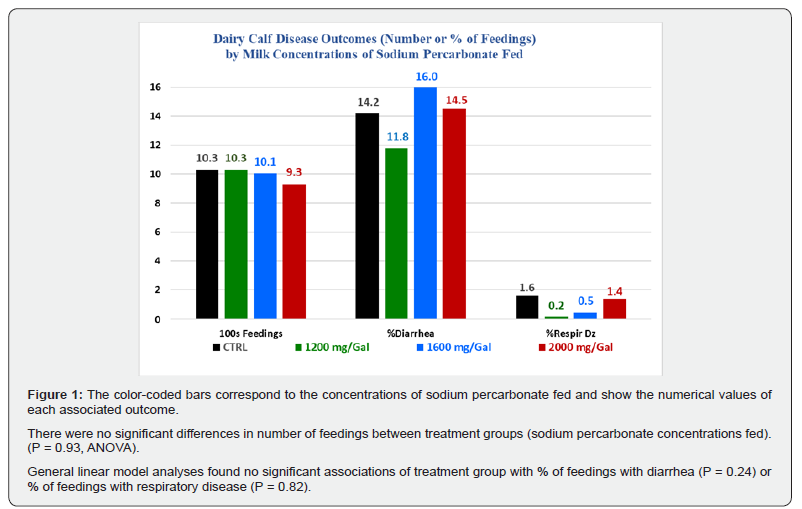
Milk was fed twice daily for a mean of 121 feedings per calf. The number of milk feedings (total n = 3996 feedings) to the different treatment groups (P = 0.93), to Holsteins and Jerseys (P = 0.23), and to breeds within treatment groups (all P between 0.12 and 0.80, ANOVA) were not significantly different from each other. The mean numbers of feedings are shown in Table 1. Figure 1 shows the number of feedings (range 934 to 1,029) for each treatment group.
There were no signs of unpalatability, colic or other calf discomfort observed in association with adding sodium percarbonate to the milk that was fed for a total of 2968 feedings to the 24 non-control calves. The calves that died and had complete necropsy had no signs of irritation or ulceration of any part of the GI tract suggestive of any toxicity from the sodium percarbonate.
Causes of the 4 deaths diagnosed at necropsy were: 2 Holsteins with large patent ductus arteriosus (PDA), full sisters from a super ovulated cow but not twins, that died at 6 and 10 days old. Both calves’ feces were tested using a qPCR enteric panel for Bovine coronavirus, Bovine rotavirus A, Cryptosporidium spp., enterotoxigenic E. coli F5 (K99), and Salmonella spp., major pathogens associated with calf diarrhea [12]. The 6-day old calf (2000 mg/gal treatment group) had no signs of disease, and was found dead. In addition to the PDA, that calf had a “detected” qPCR result for Bovine coronavirus (the calf had been vaccinated with a modified live virus vaccine for Bovine rotavirus and Bovine coronavirus 5 days earlier, and as noted in the necropsy report, that “may result in positive PCR result for the organism [for] up to a few weeks post-vaccination”). The 10-day old calf (untreated control group) had diarrhea for 3 days before death. In addition to the PDA, that calf had a “detected” qPCR result for Cryptosporidium spp. One Jersey (2000 mg/gal treatment group) that had diarrhea for 7 days and respiratory disease for 3 days before death also had a moderate sized PDA that was described at necropsy as “potentially associated with right sided cardiac disease” that died at 18 days old. The qPCR enteric panel did not detect any of the enteric pathogens despite the diarrheal feces, and there was no pathology evident in the respiratory system except “pulmonary congestion associated [with] cardiovascular collapse”. One Holstein (untreated control group) that had diarrhea and respiratory disease for 5 days before death, with a large ventricular septal defect (VSD) described at necropsy as “contributing to inability to oxygenate well” that predisposed to bronchopneumonia, died at 64 days old. No microbiological testing was performed on lungs, feces or any other specimens, per judgement of the pathologist.
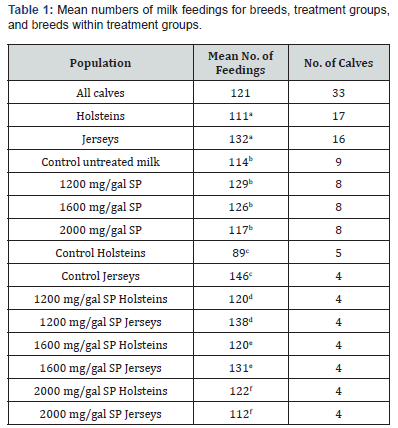
Abbreviation: SP = sodium percarbonate added to calf feeding milk. Means with the same superscript letters were not significantly different. Mean number of calf milk feedings was not different between breeds, treatment groups, or breeds within treatment groups. (All P values from 0.12 to 0.93, ANOVA).
Overall, diarrhea was observed at 563/3996 feedings (14.1%). Jerseys had diarrhea at 284/2108 (13.5%) of feedings and Holsteins had 279/1888 (14.8%) of feedings with diarrhea. There were 69/3996 (1.7%) feedings where multiple observers of the calves did not have the same conclusion as to whether or not the calves had a current diagnosis of diarrhea. This occurred either when calves had not passed feces before the feeders were finished evaluating, and then exhibited diarrheal feces when DW, RS or the calf care supervisor evaluated later, or during hot weather when the feeders recorded diarrheal calf feces that were occasionally dried by the sun to the extent that it could not be determined whether there was fresh diarrhea by the time DW, RS or the calf care supervisor evaluated later. Therefore, when any of the observers identified diarrhea at a feeding, that feeding was defined as having diarrhea; no observations of diarrhea were defined as false positive. As described earlier, whether one person or multiple people observed calves following any feeding, that feeding and the results of that feeding were counted once and only once.
Overall, respiratory disease was observed at 36/3996 feedings (0.9%). Jerseys had respiratory disease at 21/2108 (1.0%) of feedings and Holsteins had 15/1888 (0.8%) of feedings with respiratory disease. There were 2/3996 (0.05%) feedings where multiple observers of the calves did not have the same conclusion as to whether or not the calves had a current diagnosis of respiratory disease. Therefore, when any of the observers identified respiratory disease, that feeding was defined as having respiratory disease; no observations of respiratory disease were defined as false positive. Whether one person or multiple people observed calves following any feeding, that feeding and the results of that feeding were counted once and only once.
The percentage of feedings with diarrhea per treatment group are shown in Figure 1. Calves fed milk with 1200 mg/gal of sodium percarbonate had a numerically lower percentage of feedings with diarrhea (121/1029, 11.8% diarrhea) than for calves fed untreated control milk (146/1028, 14.2%), 1600mg/gal (161/1005, 16.0%) or 2000mg/gal (135/934, 14.5%). However, none of the differences were statistically significant (see GLM results below).
The percentage of feedings with respiratory disease per treatment group are shown in Figure 1. Similarly, calves fed milk with 1200 mg/gal of sodium percarbonate had a numerically lower percentage of feedings with respiratory disease (2/1029, 0.2% respiratory disease) than for calves fed untreated control milk (16/1028, 1.6%), 1600 mg/gal (5/1005, 0.5%), or 2000 mg/gal (13/934, 1.4%). However, none of the differences were statistically significant (see GLM results below).
The final GLM for % of feedings with diarrhea is shown in Table 2. Only the starting and ending ages of the calves were significantly associated with diarrheal feedings; each increase of one day of age was associated with a decrease in % of feedings with diarrhea. Treatment, the concentration of sodium percarbonate fed, forced into the final model was not significantly associated with diarrhea, P = 0.24. Neither were any of the other potential predictor/input variables such as breed, interaction of treatment with breed, or interaction of treatment with age.

£Treatment = concentration of sodium percarbonate fed; the effect estimate is the change in % of feedings with diarrhea associated with each increase of 1 mg/L (4 mg/gal) of sodium percarbonate fed. ±Start Age, End Age = calves’ age in days; the effect estimate is the change in % of feedings with diarrhea associated with each increase of 1 day of age when a calf started and when it ended the study. R2 = 0.60, N = 33 calves, F (3,29 df) = 14.3, P < 0.0001
No GLM for % of feedings with respiratory disease found any significant associations with that disease. None of the potential predictor/input variables including breed, number of feedings, age or others were significantly associated with respiratory disease, including treatment, the concentration of sodium percarbonate fed. The final GLM for % respiratory disease had an R2 = 0.12, P = 0.61, and treatment had P = 0.82.
The number of deaths, 2 in the untreated control group, 2 in the 2000 mg/gal group, and none in the other groups, were not significantly different between any treatment groups by chisquare.
Discussion
Sodium percarbonate is safe and is used considerably in food preparation, including in the dairy industry [1-7]. Previous studies by the authors indicated that it was associated with marked reductions in bacterial growth in milk for calves following pasteurization, especially in warm ambient temperature conditions [10-11]. The study’s primary objective was to evaluate safety of pre-weaned dairy calves when sodium percarbonate was added to their milk. The preservative was safe in milk fed to calves at all 3 concentrations previously demonstrated to be associated with lower and safer SPC bacteria counts compared to those in untreated milk [8-11]. Palatability was unaffected and there were no signs of calf discomfort observed in association with adding sodium percarbonate to the milk that was fed for nearly 3000 feedings to the calves in the treated milk groups. Calves that died and had complete necropsy exhibited no signs of irritation or ulceration of any part of the GI tract suggestive of any toxicity from the sodium percarbonate.
An inexpensive and practical additive for calf milk that reduced bacterial growth and also reduced the major diseases in pre-weaned dairy calves would be beneficial to the dairy industry. Therefore, preliminary data regarding the association of adding sodium percarbonate to calf milk with the outcomes of diarrhea/ enteritis and respiratory disease was a secondary objective of the study. Those are the most important disease complexes of preweaned dairy calves [12,13]. However, there were no statistically significant associations between concentration of sodium percarbonate fed and either of those disease outcomes detected by general linear models. Besides relatively small sample size, part of the reason that % of feedings with respiratory disease were not detected as different between treatments was that this was a rare outcome among all calves overall.
Limitations of the study were that it was performed on one farm, and in order to evaluate possible efficacy in reducing diarrhea or respiratory disease in calves, a larger sample size is needed. Strengths of the study were that the dairy farm raising the calves had good management, both Holstein and Jersey breeds were studied, the experimental design achieved the goal of no major confounding, records of disease outcomes were diligent and complete, and treatments were administered correctly; there was excellent overall attention to detail by all study personnel.
Conclusion
Adding sodium percarbonate at 1200 to 2000 mg/gal (300 to 500 mg/L) to calf milk as a preservative was safe and practical. Sodium percarbonate shows promise as a cost-effective management practice in raising of pre-weaned dairy calves. Further study of efficacy/association with reducing diarrhea or respiratory disease in preweaned calves is indicated.
Acknowledgments
We thank John Wallentine, Jon Schumann, Shane Summers, Eneli Jenson, Kyson Jenson, and Kortnee Selin for their help with calf care, housing, and feeding.
Conflict of Interest
The authors declare no conflict of interest. The funders had no role in the design of the study; in the collection, analyses, or interpretation of data; in the writing of the manuscript, or in the decision to publish the results.
References
- Buchmann K, Jensen PB, Kruse KD (2003) Effects of sodium percarbonate and garlic extract on Ichthyophthirius multifiliis theronts and tomocysts: in vitro experiments. N Am J Aquac 65(1): 21-24.
- Fisher MB, Iriarte M, Nelson KL (2012) Solar water disinfection (SODIS) of Escherichia coli, Enterococcus spp., and MS2 coliphage: effects of additives and alternative container materials. Water Res 46(6): 1745-1754.
- Sodium percarbonate. Lerochem (2025)
- Liu X, He S, Yang Y, et al. (2021) A review on percarbonate-based advanced oxidation processes for remediation of organic compounds in water. Environ Res 200(9): 1-11.
- S. Environmental Protection Agency (2017) Sodium Percarbonate PC Code: 128860. 1-25.
- World Health Organization (1989) Evaluations of the Joint FAO/WHO Expert Committee on Food Additives. Sodium percarbonate. FAO Combined Compendium of Food Additive Specifications.
- Forwood JM, Harris JO, Landos M, et al. (2014) Evaluation of treatment methods using sodium percarbonate and formalin on Australian rainbow trout farms. Aquacult Eng 63(12): 9-15.
- Elizondo-Salazar JA, Jones CM, Heinrichs AJ (2010) Evaluation of calf milk pasteurization systems on 6 Pennsylvania dairy farms. J Dairy Sci 93(11):5509-5513.
- Food and Drug Administration (2023) Grade A Pasteurized Milk Ordinance (PMO 33-210).
- Wilson DJ, Goodell GM, Kelly T (2012) On-farm pasteurized milk fed to dairy calves - association of bacteria counts following pasteurization with season, temperature and time until feeding. J Vet Sci Technol 3(6): 1-5.
- Wilson DJ, Goodell GM, Kelly T (2025) Sodium percarbonate added to pasteurized milk for feeding to dairy calves and associated changes in Standard Plate Count over time. Adv Dairy Res 13:1:1-4.
- Cho Y, Yoon K-J (2014) An overview of calf diarrhea - infectious etiology, diagnosis, and intervention. J Vet Sci 15(1):1-17.
- Karle BM, Maier GU, Love WJ, et al. (2019) Regional management practices and prevalence of bovine respiratory disease in California's preweaned dairy calves. J Dairy Sci 102(8): 7583-7596.
- Assessment of the safety and efficacy of an additive of Saccharomyces cerevisiae CNCM I1079 as a feed additive for calves, all other ruminant species (for rearing and fattening), and camelids (for rearing and fattening). Food Standards Scotland, 4/12/2023.
- Bampidis V, Azimonti G, de Lourdes Bastos M, et al. (2022) Safety and efficacy of a feed additive consisting of zearalenone hydrolase produced by Escherichia coli DSM 32731 for all terrestrial animal species (Biomin GmbH). EFSA J 20(2): 1-21.
- Bampidis V, Azimonti G, de Lourdes Bastos M, et al. (2024) Guidance on the assessment of the efficacy of feed additives. EFSA J 22(7): 1-25.
- Mc Hugh ML (2011) Multiple comparison analysis testing in ANOVA. Biochem Med 21(3):203-209.
- Mc Hugh ML (2013) The chi-square test of independence. Biochem Med 23(2):143-149.

























