




 JDVS Home



Abstract
The aim of the present study was to identify the main etiological agents of neonatal diarrhea in lambs and kids in Bulgaria, as well as the macro- and microscopic lesions caused in the affected intestinal sections of the digestive tract. The study included a total of 20 dairy farms (10 goat farms and 12 sheep farms) from 8 regions of the country, with gastrointestinal problems in newborn and growing lambs and kids. The population of newborn and growing lambs and kids totaled 6456 for both species, aged from 24 hours after birth to 40 days. A clinical, epidemiological and etiological study was conducted in all livestock farms. A total of 220 carcasses (110 kids and 110 lambs) were pathologically examined, all of which died with signs of gastrointestinal diseases, and tissue samples for histopathological examination were obtained from the intestinal sections. Rotaviruses, coronaviruses, cryptosporidia and colibacteria, as well as combinations of them, were identified as causes of diarrhea. The pathomorphological changes recorded in the gastrointestinal tract in these intestinal infections have a relevant and accurate diagnostic and differential diagnostic value compared to other diseases with intestinal manifestations.
Keywords:kids, lambs; neonatal diarrhea; pathomorphology; ruminants
Introduction
Gastrointestinal diseases in newborn and young ruminants are mainly caused by infectious agents [1,2]. Neonatal diarrhea in kids and lambs up to 21 days of age is one of the most common diseases, causing high morbidity and mortality in this group of animals. Rotaviruses, adenoviruses, herpes viruses, and coronaviruses are the most common viruses causing enteritis in humans and animals [3]. According to [4], the most common etiological agents of diarrhea in lambs and kids during the first month of life are Escherichia coli, Cryptosporidium spp., Giardia spp., Salmonella spp. and Clostridium spp.
According to other studies [5], E. coli is considered the main cause of diarrhea in newborn lambs and kids under 10 days of age. Neonatal diarrhea, observed in kids and lambs, is one of the most common diseases causing high morbidity and mortality in this category of animals. The values of these indicators depend on the conditions of rearing and farm management, varying from 25% to 50%. The delayed growth and development of newborn kids and lambs suffering from gastroenteritis increases treatment costs, and high rates of morbidity and mortality lead to large economic losses for farmers [6].
Clinical signs of enteritis in small ruminants include depression, inability to move, and prolonged recumbency. The stools may be soft, watery, yellowish, sometimes with mucus and blood, and have an unpleasant odor. Dehydration, loss of skin elasticity, perianal area stained with diarrheal stools, disheveled fur, dry nostrils, fever, rapid heart and respiratory rate are often observed. The described pathological changes in the intestine consist of hyperemia of the mesenteric blood vessels, mesenteric lymphadenopathy, ballooned small and large intestines. The intestinal mucosa was edematous with hemorrhages [7]. The aim of the present study is to identify the main etiological agents of neonatal diarrhea in lambs and kids on farms in Bulgaria, as well as the macro- and microscopic lesions caused in the affected intestinal sections of the digestive tract.
Materials and Methods
The study included a total of 20 dairy farms (10 goat farms and 12 sheep farms) from 8 regions of the country, with gastrointestinal problems in newborn and growing lambs and kids. The population of newborn and growing lambs and kids totaled 6456 for both species, ranging in age from 24 hours after birth to 40 days. A clinical, epidemiological and etiological study was conducted in all livestock farms. In all farms, animals were vaccinated against clostridial infections and treated against coccidiosis. A total of 900 fecal samples were obtained, 450 from lambs and 450 from kids with diarrhea. Antigenic quantitative ELISA for detection of coproantigens (BIOX Diagnostics, easy digest, 4 Belgium) sandwich test for feces, Rotavirus, Coronavirus, E. coli F5 and Cryptosporidiosis was used. A total of 220 carcasses (110 kids and 110 lambs) were examined pathologically following the standard autopsy protocol, all of which died with signs of gastrointestinal diseases. Tissue samples for histopathological examination were obtained from the affected sections of the proximal, middle and distal parts of the gastrointestinal tract: ileum, duodenum, jejunum with mesenteric lymph nodes, ileum, cecum, colon and rectum - 2.5 cm long. The materials for histopathological examination were fixed in 10% neutral buffered formalin for 48–72 hours and embedded in paraffin. From the obtained paraffin blocks, 4μm thick sections were prepared using a Leica RM 2235 microtome and stained conventionally with hematoxylin-eosin (H/E). Samples were obtained from the corpses and for bacteriological examination from the liver, kidney, spleen, intestinal segment with lymph nodes, and coagulum from the heart.
Results
From the clinical studies conducted in a total of 20 farms - 10 goat farms and 12 sheep farms - the diseased animals were observed to be recumbent with a deteriorated general condition, high-grade dehydration and profuse diarrhea. In some, subnormal body temperature was observed in the agonal period. From the epidemiological studies conducted, the highest morbidity of 45.09% and 25.02% mortality was recorded in lambs and kids aged between 4 and 26 days after birth. The results of the laboratory antigenic methods for the diagnosis of neonatal diarrhea proved that in 40% of cases, rotaviruses GRA BRV dominate. The second most common infection was E. coli with 30%, and the third and fourth were Cryptosporidium parvum with 20% and coronaviruses BCoV - 10%. In 48% of cases, there were associated infections with bacteria, viruses and protozoan agents: Cryptosporidium spp.+ rotaviruses, rota + coronaviruses, rota + E. coli F5. No aerobic and anaerobic bacterial agents were isolated from the bacteriological examination conducted.
Pathological examination
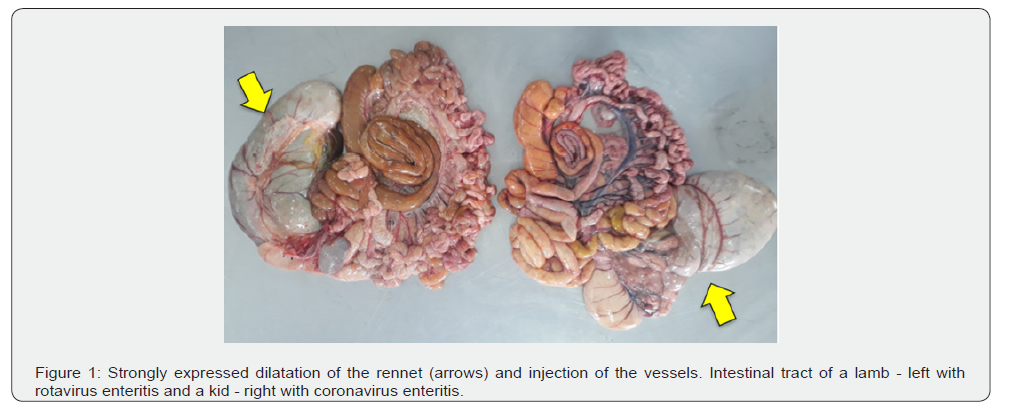
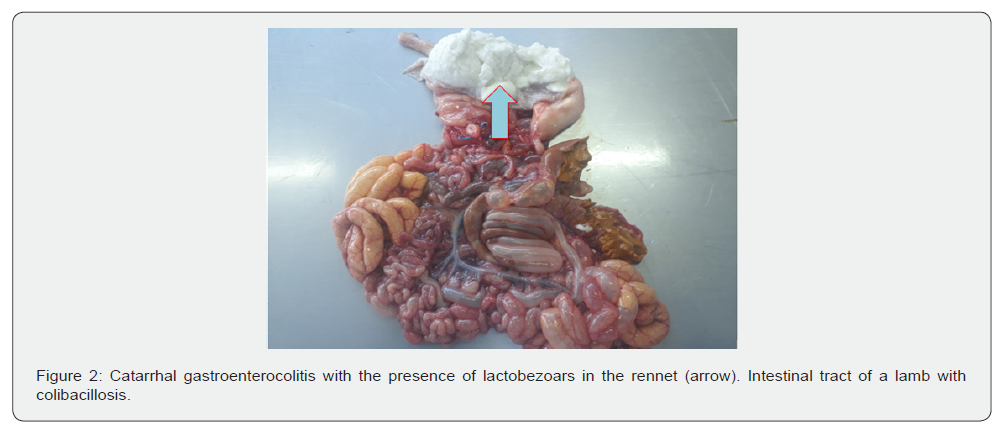
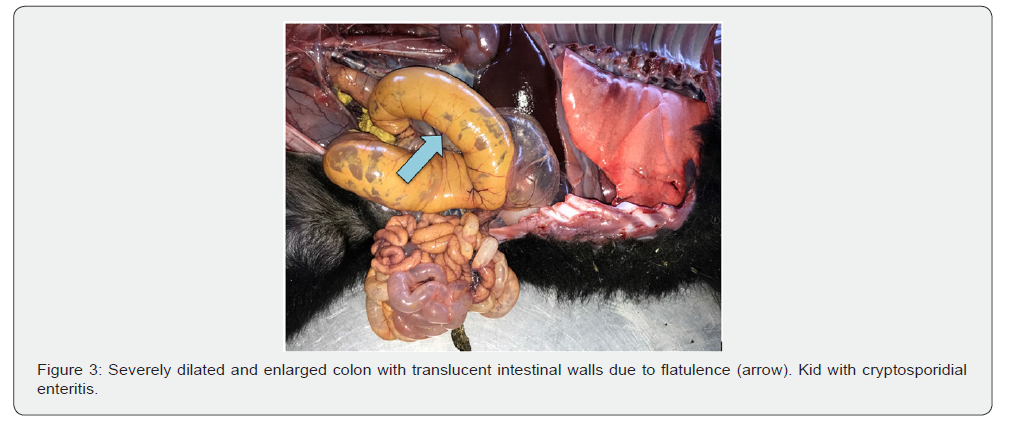
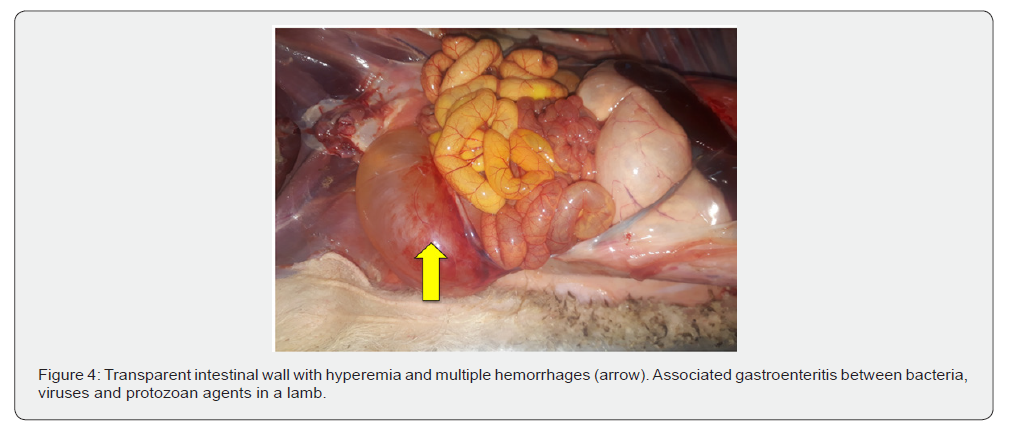
On external examination of all 220 lamb and kid carcasses, there was marked dehydration with enophthalmos and staining of the perianal area, pelvic limbs and base of the tail yellow-green and slimy, and in some cases bloody diarrheal feces. The macroscopic lesions were of varying intensity, mainly in the gastrointestinal tract. In all examined cadavers, the serosa along the entire length of the intestinal tract was diffusely hyperemic and dotted with subserosal petechial hemorrhages in cases of coinfections. In lambs and kids with rotavirus and coronavirus enteritis, dilatation of the rennet was observed, and the contents in the intestine were yellow to brown with a slimy consistency (Figure 1). In cases of coronavirus infection, there were also pneumonic foci in the lungs of the examined lambs and kids. In cases of colibacteriosis, there was catarrhal gastroenteritis in three lambs and gastroenterocolitis with lactobezoars in the rennet (Figure 2). Thrombosis of the umbilical vessels, and the liver was congestive. In the lungs, a single pneumonic area of lobular character was observed catarrhal pneumonia. There were hemorrhages on the endocardium, and hematomas on the bicuspid valves. In cases of cryptosporidial enteritis, the intestinal contents are yellowish, in some cases mixed with blood and mucus, having a mushy consistency. The large intestine was severely dilated due to the developed flatulence (Figure 3). In cases of associated enteritis infections, the mesenteric lymph nodes are enlarged, juicy and red. Along the entire length of the small and large intestines, the mucosa was dotted with hemorrhages, and the intestinal wall was transparent (Figure 4). The serosa was hyperemic with multiple hemorrhages. The medullary part of the mesenteric lymph nodes was juicy and hyperemic in all 220 lambs and kids tested.
Histopathological examination
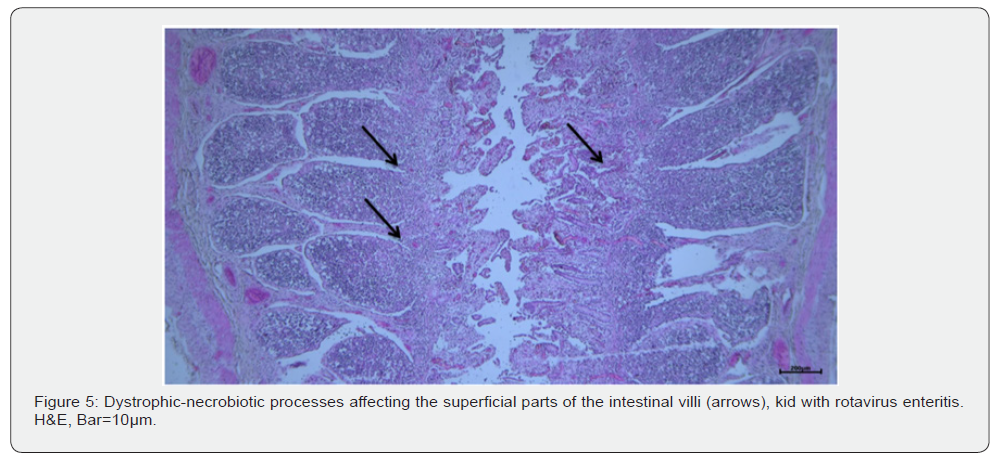
From the histopathological examination of different segments of the gastrointestinal tract of lambs and kids with rotavirus enteritis. Microscopic changes were most drastic in the jejunum and ileum. They were expressed in dystrophic-necrobiotic processes in the superficial parts of the intestinal villi (Figure 5). Individual crypts were filled with desquamated epithelial cells and exudate. There was also submucosal and intermuscular edema with glandular hypersecretion. The propria was infiltrated with numerous lymphocytes.
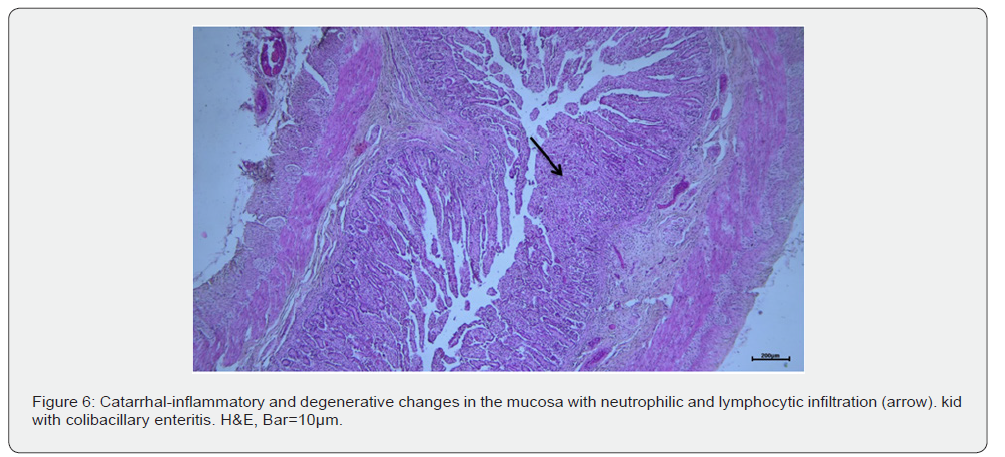
In all cases of colibacillosis in kids and lambs, the microscopic lesions were mainly in the proximal part of the small intestine and the rennet. They represented catarrhal-inflammatory and degenerative changes, accompanied by neutrophilic and lymphocytic infiltration of the mucosa (Figure 6). In individual intestinal segments of the duodenum, intestinal villi were absent due to severe microlesional changes in the mucosa, and inflammatory proliferative changes were observed, most pronounced in the ileum.
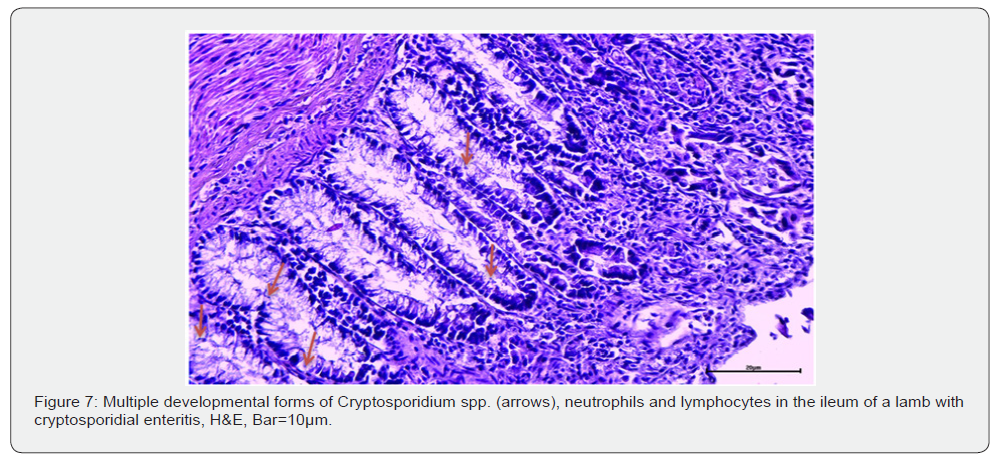
In cases of cryptosporidiosis enteritis, there was superficial desquamative catarrh of the small and large intestines with atrophy and fusion of some of the intestinal villi. There was infiltration with neutrophils in the mucosa and submucosa. In the jejunum and ileum, multiple developmental forms of the causative agent Cryptosporidium parvum were observed (Figure 7). Hemorrhagic colitis was observed in 4 lambs and 7 kids, and hemorrhagic proctitis in 1 kid.
Pathohistological changes in cases of coronavirus enteritis were expressed in deep catarrhal inflammation with degenerative and necrobiotic lesions in the epithelial cells. Single erosions were observed on the small intestinal mucosa, and individual villi were atrophied. In the ileum, the crypts were oval and filled with exudate, eosinophils and epithelial cells.
Discussion
After comparing the results obtained from the clinical, epidemiological and etiological studies in kids and lambs with data from our previous studies in calves, kids and lambs, we have reason to claim that neonatal diarrhea occurs in lambs and kids up to the first month. Caused mainly by rotaviruses, cryptosporidia and colibacteria, as well as in combination between them. This allows us to support the claim of researchers such as [1,2] that gastrointestinal diseases in newborn and growing ruminants are mainly caused by infectious agents.
According to us and Papp et al. [8] in epizootic and enzootic cases of diarrhea in lambs and kids, the detection of viral agents in feces is possible through field and laboratory antigenic diagnostic methods. The macroscopic lesions observed in the mouth and coronavirus infection were most intense in the proximal and distal small intestine, and in individual cases of coronavirus enteritis there was also lobular pneumonia. Similar lesions in the lung have also been observed in calves with coronavirus pneumoenteritis syndrome [9].
A characteristic pathological finding in viral enteritis in kids and lambs was catarrhal enteritis to enterocolitis in cases of coronavirus infection. Similar to ours are the results of the studies [10], which reflect changes in the intestine and lung in lambs with corona and rotavirus enteritis. In contrast to viral and protozoal enteritis in colibacillosis, we found catarrhal gastroenteritis in three lambs and gastroenterocolitis with lactobezoars in the rennet and thrombosed umbilical vessels. In the lungs, similar to coronavirus enteritis, single pneumonic foci were observed. Endocardial hemorrhages and bicuspid valve hematomas were present. In cases of cryptosporidial enteritis, the intestinal contents were yellowish mixed with blood and mucus, as well as flatulence in the large intestine. Similar lesions were not observed in other intestinal infections. These results are partially consistent with our previous studies on gastrointestinal diseases in newborn and growing calves [11-13], as well as with the results of other authors working in the field of gastrointestinal pathology [4,14].
The results obtained from microscopic examinations allow us to register the specific location and characteristic intensity of microlesional manifestations in different segments of the gastrointestinal tract in the diseases that became the subject of the present study. Histopathological studies confirmed that rotavirus enteritis affected the superficial villi along the jejunum and ileum, with glandular hypersecretion and lymphocytic infiltration in the propria. In coronavirus enteritis, erosive areas in the mucosa and villous atrophy were observed in the small intestine. The crypts were oval and filled with exudate, eosinophilic leukocytes and epithelial cells. According to other researchers in the field [3], the characteristic microlesional findings in the intestine in viral infections in lambs and kids are submucosal edema with vascular hyperemia. Erosions and ulcers of the intestinal epithelium, shortening and fusion of the villi with infiltration of inflammatory cells. In isolated cases, mucosal necrosis and intranuclear inclusions in epithelial cells have also been observed.
Microscopic lesions in colibacillosis were in the proximal part of the small intestinal tract, expressed by catarrhal-inflammatory and degenerative changes, absence of intestinal villi, neutrophil and lymphocytic infiltration of the mucosa. Authors such as [10] have observed in coli infection in kids and lamb’s superficial desquamation of the villi with degenerative-necrobiotic changes of the epithelial cells, atrophy and fusion of the villi. The small intestine’s lumina was infiltrated with numerous lymphocytes and macrophages. Other authors such as [14] have observed transmural hemorrhages and thrombosis of the vessels in the rennet of lambs. In contrast, we [15] observed hemorrhagic abomasitis in goats with colibacillosis. Microscopic changes in the rennet were vascular hyperemia, mucosal hemorrhages, goblet cell hyperplasia, and infiltration of lymphocytes and plasma cells.
Unlike viral and bacterial enteritis, cases of cryptosporidiosis, enteritis have superficial desquamative catarrh of the small and large intestines with atrophy and fusion of some of the intestinal villi. There was infiltration by neutrophils in the mucosa and submucosa. Multiple developmental forms of the causative agent Cryptosporidium parvum were observed in the jejunum and ileum. According to data from [16] studies in calves with C. parvum prove that the infection also affects the jejunum and ileum. In our previous [6] studies in lambs with coccidiosis and cryptosporidiosis, we have observed villous atrophy in the ileum and colon, as well as multiple developmental forms of Cryptosporidium spp. and Eimeria spp. on and in intestinal epithelial cells. According to [3], coinfections involving viral and bacterial agents together with cryptosporidia increase the severity of intestinal macro and microlesions in individual segments. Neutrophilic infiltrates have been observed in the mesenteric lymph nodes of lambs and kids.
In conclusion, we believe that the observed macro- and microscopic lesions in the gastrointestinal tract in cases of neonatal diarrhea (rotavirus infection, colibacteriosis, cryptosporidiosis, and coronavirus infection) in lambs and kids have an applicable and accurate diagnostic and differential diagnostic value compared to other diseases with intestinal manifestations.
References
- Singh D, Pawaiyar R, K Gurukaj K, Mishra K, Singh R (2018) Detection of Clostridium perfringens toxinotypes, enteropathogenic E. Coli, Rota and corona viruses in the intestine of neonatal goat kids by molecular techniques. Indian J Anim Res 88: 655–661.
- Esmaeili H, Joghataei S (2024) Peracute enterotoxemia in saanen and alpine goat herd. J Med Bacteriol 12: 34–
- Ozmen O, Haligur M, Aydogan A, Demir N (2018) Immunohistochemical Detection of Viral Etiopathogenesis in Lambs and Goat Kids with Neonatal Diarrhea. Acta Scientiae Veterinariae, 46: 15–72.
- Martella V, Decaro N, Buonavoglia C (2015) Enteric viral infections in lambs or kids. Vet Microbiol 181(1-2): 154–160.
- Tarabees R, Elsify A, Mahboub H, Salah S (2016) Multi-Drug-Resistant Aerobic Bacteria Associated with Pneumo-Enteritis in Small Ruminants in Three Egyptian Provinces a field Study. Alexandria Journal of Veterinary Sciences 51(1): 37-47.
- Kalkanov I (2025) Pathomorphological studies in clinical cases of cryptosporidium and eimeria enteritis in lambs. Traditional and modennity in veterinary medicine 10 1(18): 70–77.
- Kalkanov I, Dinev I, Zarkov I (2021) Etiological and pathomorphological investigations of coronavirus and rotavirus gastroenteritis in goat kids and lambs. Mac Vet Rev 44 (2): 111–117.
- Papp H, Malik Y, Farkas S, Jakab F, Martella V, Banyai K (2014) Rotavirus strains in neglected animal species, including lambs, goats and camelids. Virus Disease 25(2): 215–222.
- Kalkanov I, Dinev I, Zarkov I (2019) Etiological and pathomorphological investigations in calves with coronaviral pneumoenteritis. Macedonian Veterinary Review 42: 12–35.
- El-gbily S, Marwa M, Diabb R, Osama M, Beshir E, Kamal S, Shahenaz M (2025) Severe lamb diarrhea outbreak: Clinical features, identification of the causative agent, and a prophylactic approach Comparative Immunology. Microbiology and Infectious Diseases 118: 102–318.
- Kalkanov I, Dimitrov K, Dinev I (2014) Clinicomorphological studies in a case of complicated neonatal calf diarrhea. Animal Studies & Veterinary Medicine IV (5): 37–43.
- Kalkanov I, Dinev I, Dimitrov K, Iliev P (2015) Clinical and morphological investigationis in a spontaneous Cryptosporidium enteritis outbreak in calves. Bulg J Vet Med 19(4): 334–339.
- Kalkanov I, Dinev I, Aleksandrov М, Dimitrov K, Zarkov I (2016) Morphological and etiological investigations in a rotaviral enteritis outbreak in calves. Kafkas Univ Vet Fak Derg 22(2): 309–313.
- Christodoulopoulos G, Scott P, Jehl N, Filioussis G, Smith S (2013) Clinical, microbiological and histological findings in lambs affected by ‘salivary abomasum disease. Vet Rec 172: 100–100.
- Esmaeili H, Almasi S, Joghatae S (2025) Etiology and risk factors of hemorrhagic abomasitis in goat kids. Scientific Reports 15: 6-13.
- Paraud C, Chartier C (2012) Cryptosporidiosis in small ruminants. Small Ruminant Research 103: 93–97.

























