




 JDVS Home




Abstract
The length–weight relationship (LWR) and condition factor (CF) are widely used tools in fisheries biology to assess growth patterns, well-being and population status of fish. However, baseline datasets from earlier decades remain scarce for many Indian freshwater fishes, including the commercially important Mastacembelus armatus and Macrognathus aculeatus. In the present study, LWR and CF were estimated from 494 M. armatus (Total length- 18.7 cm to 53.7 cm and total weight- 40 g to 350 g) and 561 M. aculeatus (Total length- 9.2 cm to 30.3 cm and total weight- 10 g to 100 g) collected from the Godavari River between 2005 and 2007. The regression equation obtained was W = aLᵇ, with a value of a = -0.285 and b = 1.5106. for M. armatus and with a value of a = -0.98 and b = 1.94 for M. aculeatus. The growth exponent b approximated is lesser than 3 for both the fishes, indicating negative allometric growth. The relative condition factor (K) was 1.01 ± 0.15 for M. armatus and 1.04 ± 0.315 for M. aculeatus, reflecting the overall well-being of the species during the study period. LWR was significant at P < 0.01 for both mastacembelid fish species, with the coefficient of determination (R2) for M. armatus (R2= 0.802) and M. aculeatus (R2= 0.584) respectively. This dataset provides a historical baseline for two mastacembelid fish in the Godavari River, against which contemporary populations can be compared in light of anthropogenic pressures, habitat modifications, and climate change. Such long-term biological records are valuable for fisheries management, ecological monitoring, and conservation planning in Indian River systems.
Keywords:Length- weight relationship, Condition factor, Mastacembelus armatus, Macrognathus aculeatus, Godavari River, Historical dataset, Baseline fisheries biology.
Introduction
Fish are an integral part of the ecosystems as they support food webs, maintain ecosystem resilience and are good source of food to humans [1,2]. Fish is an importance source of high-quality protein, omega 3-fatty acids, nutrients and mineral [3]. Rivers are vital ecosystems providing food to millions of people all over the world, support biodiversity and serve as key indicator of river ecosystem health. River Godavari is the second longest river in India originating from Maharashtra, traversing through Telangana, Andhra Pradesh, Chhattisgarh and Orissa and is a home to a wide variety of freshwater fish [4-9]. Biometric studies in fisheries management is one of the leading factors used to assess the biomass and stock condition of fish species [10-15]. A significant aspect of morphometric investigations is evaluating the species growth characteristics based on the length-weight relationship, as well as the health of fish species influenced by various bio-ecological factors [16-18]. Fish species are considered to be apposite for biological assessment due to their easy identification, taxonomic importance, broad tolerance, sensitivity to environmental change and integration of stressors [13, 19]. Several studies illustrate that calculating the correlation between length and weight (LWR) can be imperative in classifying fish species [20-24]. This type of studies will provide the information about the biography of fish, health condition and other biometric characters along with growth pattern, well-being and ecological condition of an aquatic environment [20,25,26]. The length-weight relationship acts as an imperative tool in fish population estimation models studies, aquatic biome modeling, gonad development, and maturity status to estimate weight-at-age [27,28]. The condition factor is also considered as an essential characteristic by fisheries scientists that enable to understand the physiological state of the fish and how it impacts its welfare [29,30]. LWRs allow conversion between length and weight, enabling biomass estimation from length-frequency dataimportant where weighing every specimen is impractical [22,31]. Condition indices (e.g., Fulton’s K, relative condition Kn) derived from LWRs are sensitive to food availability, reproductive status, parasitism and environmental stress, making them practical indicators of habitat quality [32,33]. Differences in b among life stages (e.g., juveniles vs adults) or sexes can reveal ontogenetic shifts in energy allocation (growth vs reproduction), informing management of spawning seasons, recruitment, and habitat protection. Repeated LWR patterns across populations can reflect inherent morphological constraints and adaptive responses to benthic/ nocturnal feeding strategies [27]. Regional comparisons (between river basins, seasons, or anthropogenic gradients) provide context for assessing resilience and vulnerability [18, 20, 30]. By comparing two fish populations that live in various ecological situations and evaluating the gonad development and feeding activity of these species, the condition factor (K) also offers information about their well-being [34-36]. Although numerous biometric studies were conducted on different water bodies in Andhra Pradesh, very few of these studies are from river Godavari during 2005 and 2007. Over the period, anthropogenic pressures from dams, sand mining, industrial pollution and climate change have brutally degraded the Godavari River’s fisheries [4, 37]. These pressures have caused a decline in native fish populations, changed habitats and threatened the livelihoods of local fishing communities. Though, the river has been noted for having good environmental conditions in some stretches, the overall effect has been a crisis for riverine biodiversity [9, 38-41]. Mastacembelid fishes (Family: Mastacembelidae) commonly known as spiny eels are a group of elongated, eel-like freshwater fishes characterized by an extended, tapering body, reduced or small scales, a long dorsal fin preceded by a series of isolated spines, and a pointed rostral region [42-45]. They restrict their habitat to South-East Asia and occupy a variety of lotic and lentic habitats such as rivers, streams, floodplain wetlands and vegetated margins [46-48]. They are often benthic, enigmatic and nocturnally active, adapted for burrowing or hiding in substrate and vegetation and thus, form a firm basis of several economically important fisheries in Southern India [49- 52]. The spiny eels, Macrognathus aculeatus Bloch (lesser spiny eel) and Mastacembelus armatus Lacepede (giant spiny eel) are often noted as an important food and aquarium species in parts of southern and eastern India and highly relished as ‘Bommidai’ due to their rich source of proteins, vitamins and medicinal value [53-57]. They have great palatability and high consumer appeal in India and neighboring countries as they play an important role to meet the nutritional requirements of common people [58]. There are reports on parasites of mastacembelid fishes during the study period, but the LWR studies are scarce [59-63]. For mastacembelid fishes, published LWR studies have reported a range of b values (often below 3) reflecting their elongated body form and ecological habits; several regional studies on Mastacembelus and Macrognathus species provide LWR parameters, condition factor analyses, and seasonal/size-class comparisons [64-66]. These studies are essential for understanding species-specific growth patterns, condition and health, population dynamics, stock assessment, and for guiding conservation or exploitation measures [67-70]. There were no comparative account studies on LWR dataset of mastacembelid fishes of River Godavari during the study period, however, LWR studies on mastacemblids from different river basins was performed [71-73]. Hence, this study quantifies LWRs of two species of mastacembelid fishes and calculates K to determine the environmental condition of River Godavari during 2005-2007 which can provide a comparative baseline to the scientists working on LWRs and condition factor of fishes of River Godavari. Historical baseline studies of this kind are of paramount importance as they can help in emphasizing the ecological conditions of river Godavari and its biodiversity during the years 2005–2007 i.e., before major industrial expansions and river alterations in the Godavari.
Material and Methods
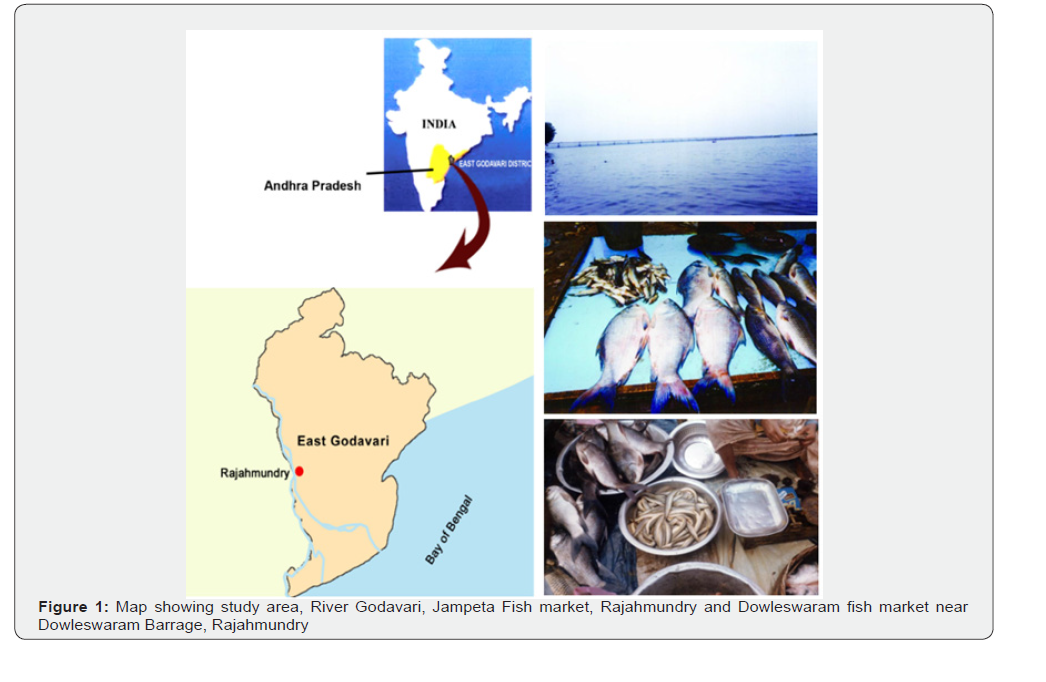
A total of 1055 specimens (494- M. armatus and 561- M. aculeatus) were collected monthly from 2005 to 2007 from local fishermen and nearby fish markets of River Godavari (Figure 1). The specimens were brought to the laboratory to conduct the biometric analysis. The total length was measured from the tip of the snout to the end of the caudal fin ray to the nearest cm using a measuring scale, and the weight of the fish was estimated to the nearest gram by using a weighing balance. The data were grouped into four sets of samples i.e., total, male, female and juveniles.
The length weight relationship (LWR) was calculated by using
Le Cren’s (1951) formula [74].
W= aLb
Where ‘W’ is the weight of the fish in grams (g), L is the total
length of the fish in centimetres (cm), ‘a’ is a constant and ‘b’ is the
exponent of growth. A linear relationship formula can be attained
by expressing a logarithmic function
Log W= Log a + b Log L
Where ‘W’ is weight of the fish in grams (g), ‘L’ is the length
in cm. ‘Log a’ is the intercept of the regression line and ‘b’ is the
slope of the regression line. The relative condition factor Kn, is a
measure of the well-being or stoutness of a fish was determined
using length weight data of fish samples and is designed by Le
Cren (1951) formula:
Kn = W / aLb
Where ‘W’ is the observed weight and ‘aLb’ is the calculated
weight.
Results and Discussion
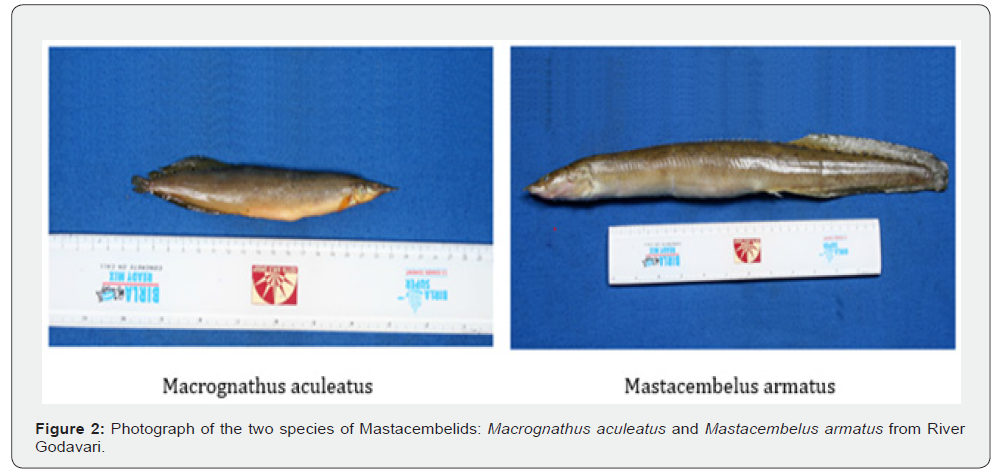
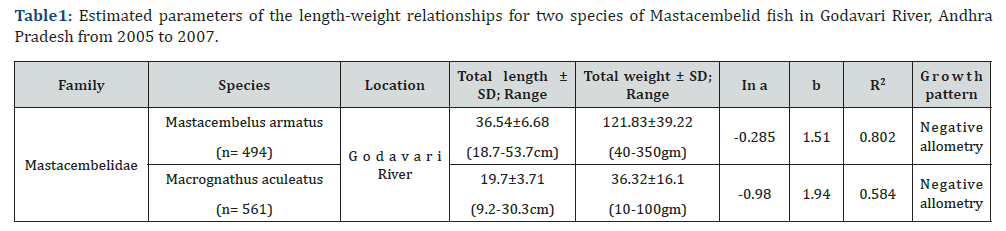
A total of 494- M. armatus (TL- 36.54±6.68 cm, Range- 18.7-
53.7 cm; TW- 121.83±39.22 g, Range- 40-350 g) and 561- M.
aculeatus (TL- 19.7±3.71 cm, Range- 9.2-30.3 cm; TW- 36.32±16.1
g, Range- 10-100 g) specimens were analyzed for length-weight
relationship (Figure2). Of the 494 M. armatus, 273 were females
(TL- 37.4±6.59 cm, Range- 20.9-53.7 cm; TW- 125.6±41.77 g,
Range- 40-350 g) and 221 males (TL- 35.43±6.64 cm, Range-
18.7-52.3 cm; TW- 116.27±36.73 g, Range- 40-270 g). Of the 561
M. aculeatus, 281 were females (TL- 20.66±3.63 cm, Range- 12.9-
30.3 cm; TW- 40.25±16.83 g, Range- 10-100 g), 236 males (TL-
19.63±3.11 cm, Range- 9.2-27.2 cm; TW- 35.34±13.44 g, Range- 10-
75 g) and 44 were juveniles (TL- 14.07±1.46 cm, Range- 10.8-16.7
cm; TW- 16.54±6.50 g, Range- 10-30 g). Linear length regression
equation between total length and weight of pooled, male, female
and juvenile of the two species of fish were plotted.
M. armatus:
Pooled: Log W= -0.285+1.5016 Log L (R2= 0.8025)
Female: Log W= -0.28+1.503 Log L (R2= 0.541)
Male: Log W= -0.291+1.514 Log L (R2= 0.842)
M. aculeatus:
Pooled: Log W= -0.98+1.941 Log L (R2= 0.5837)
Juvenile: Log W= -1.243+2.120 Log L (R2= 0.347)
Female: Log W= -0.886+1.872 Log L (R2= 0.527)
Male: Log W= -0.667+1.694 Log L (R2= 0.438)
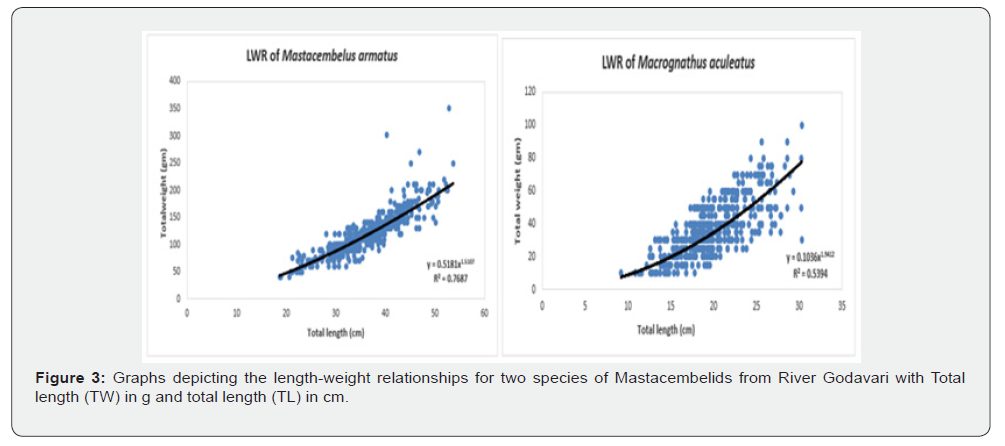
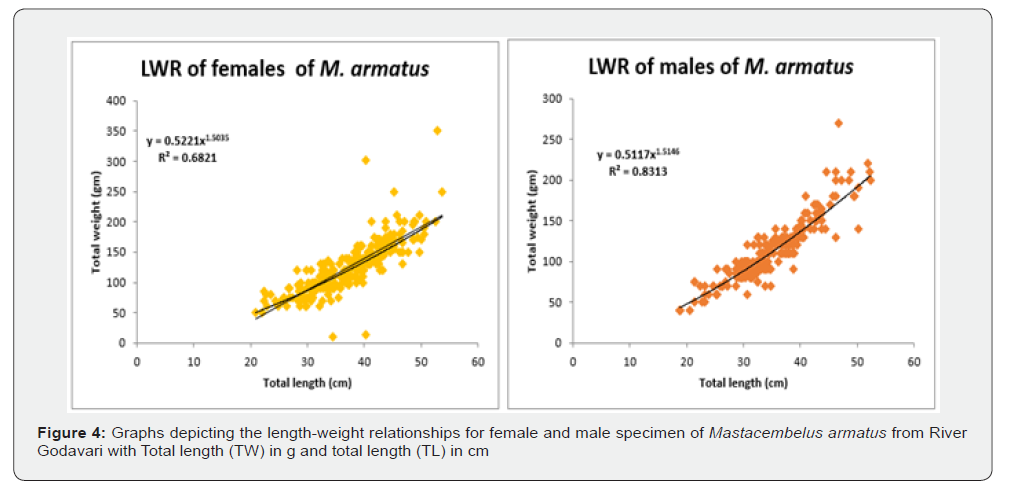
The b value of length-weight relationship of the two species ranged between 1.501 to 2.120. It was found that b value of juveniles was higher. The correlation coefficient obtained for M. armatus are total population (r=0.855), male (r=0.906) and female (r=0.819). The correlation coefficient obtained for M. aculeatus are total population (r=0.742), juvenile (r= 0.557), male (r=0.637) and female (r=0.725) (Table-1, Figure 3 & 4). A strong positive correlation exists between the variable’s length and weight; weight increases according to the increase in the length. The growth is considered as isometric when b=3; this is always the case in an ideal fish that retains its shape without any change [14, 75-77]. When a species exhibits isometric growth, b value will be close to 3. The weight of the fish will increase eight times when there is a double increase in the length of the fish i.e., length and weight follow cubic relationship. A difference in b value 3 signifies the direction and the rate of change of condition or form; if b<3 indicates reduction in condition of fish with an increase in length, i.e., negative allometry. Similarly, b>3 indicates an increase in length or condition i.e., positive allometry. The values of b usually tend to vary between 2.5 and 3.5 [78]. In the present study, the estimated b values of M. armatus were 1.510 (pooled), 1.503 (females) and 1.514 (males), indicating negative allometric growth in which fish body weight does not grow faster in relation to their length. Similarly, the b values of M. aculeatus were 1.941 (pooled), 2.120 (juveniles), 1.872 (females) and males (1.694). The lower b values of M.armatus and M. aculeatus is indicative of negative allometric growth where the increase in body weight is not proportional to the increase in length. Such a trend is characteristic of elongated, laterally compressed species belonging to the family Mastacembelidae. The comparatively low b value can be accredited to their slender body form, benthic and nocturnal feeding behavior, and low energy conversion efficiency, resulting in reduced body mass relative to length. Environmental and seasonal factors, such as fluctuations in food availability and spawning stress, may also influence the weightlength relationship. Similar observations have been reported in other studies on mastacembelid fishes, suggesting that negative allometric growth is typical for this group, reflecting their morphological adaptations and ecological niche [45, 47, 66, 72, 73, 79]. From the present study, the b value of juveniles of M. aculeatus is higher than the b values of mature fish. The rapid growth rate of juvenile fish compared to mature fish may be attributed to quick fish growth in terms of length before attaining maturity and extensive utilization of energy to growth of gonadal tissues instead of somatic tissues. Relative condition factor (Kn) proposed by Le Cren (1951), measures the individual deviation of the fish from the average weight for the length and signifies the health of a fish during a particular period of time [74, 78]. The relative condition factor (Kn) of Mastacembelus armatus and Macrognathus aculeatus exhibited values close to or slightly above unity, indicating that both species were generally in good physiological condition. In M. armatus, the Kn values recorded were 1.016 ± 0.16 (pooled), 1.005 ± 0.18 (female), and 1.008 ± 0.129 (male). These values suggest that the individuals were healthy and well-nourished, with minimal variation between sexes, implying similar feeding efficiency and environmental influence on growth. The Kn values near unity also indicate that the habitat provided adequate food resources and favorable ecological conditions for the species. Similarly, in M. aculeatus, the relative condition factor ranged from 0.93 ± 0.303 in juveniles to 1.067 ± 0.313 in females, with a pooled mean of 1.04 ± 0.315. The relatively low value in juveniles may be attributed to high metabolic demands during growth, while higher Kn in adult females reflects better energy reserves and possible gonadal development during the pre-spawning phase. Males also showed slightly elevated values (1.048 ± 0.311), indicating healthy condition and comparable feeding status. The increasing trend of Kn from juveniles to adults in M. aculeatus suggests a positive correlation between maturity and condition, emphasizing improved feeding and nutrient assimilation with age. Overall, the relative condition factors for both M. armatus and M. aculeatus during the study period indicate that the sampled populations were in stable health under favorable environmental and trophic conditions. The slight interspecific variation, with M. aculeatus exhibiting marginally higher Kn values, may reflect better adaptability or resource utilization efficiency of this species within the studied ecosystem. Since this dataset represents 2005– 2007 conditions, it provides a baseline for future comparisons, especially under current scenarios of anthropogenic pressure, pollution, and habitat alteration in the Godavari basin.
Conclusion
The current investigation on the length-weight relationship and relative condition factor of Mastacembelus armatus and Macrognathus aculeatus revealed a strong positive correlation between length and weight, signifying that weight increases proportionally with length in both species. The estimated b values, ranging from 1.501 to 2.120, demonstrated negative allometric growth, suggesting that body weight increases at a slower rate than length. This growth pattern is characteristic of elongated, laterally compressed mastacembelid fishes and may be influenced by morphological adaptations, benthic feeding habits and ecological factors such as food availability and spawning stress. The relative condition factor (Kn) values close to unity in both species signify that the studied populations were in good physiological condition and that the habitat presented favorable ecological and trophic conditions. The slightly higher Kn values observed in M. aculeatus, particularly in females, may reflect enhanced adaptability, feeding competence and gonadal development compared to M. armatus. The higher b value in juveniles of M. aculeatus implies rapid somatic growth prior to sexual maturity. Overall, the results emphasize that both M. armatus and M. aculeatus populations in the study area display stable health and growth patterns consistent with their ecological adaptations. The results can contribute to long-term monitoring of fish biology and can serve as reference points for population assessment, conservation management and future ecological monitoring of mastacembelid fishes in the River Godavari system.
Acknowledgement
The author is grateful to CSIR for providing financial assistance as JRF and SRF (CSIR Award No.CSIR 9/2(467)/2004/EMR.dt.07- 11-2004).
References
- Naman SM, White SM, Bellmore JR, McHugh PA, Kaylor MJ, et al. (2022) Food web perspectives and methods for riverine fish conservation. WIREs Water 9 (4): e1590.
- Lisbeth L (2023) Fish biodiversity and the health of aquatic ecosystems. Poult Fish Wildl Sci 11: 234.
- Alp-Erbay E, Yeşilsu AF (2021) Fish Protein and Its Derivatives: Functionality, Biotechnology and Health Effects. Aquat Food Stud 1(1): AFS13.
- CICFRI- Central Inland Capture Fisheries Research Institute (2000) River Godavari- Environment and Fishery. Central Inland Capture Fisheries Research Institute Bull. No.102.
- Shillewar KS, Nanware SS (2008) Biodiversity of fishes of Godavari River at Nanded (Maharashtra), India. Biosci Biotechnol Res Asia 5 (2).
- Rankhamb SV (2011) Ichthyofaunal Diversity of Godavari River at Mudgal Tq. Pathri, Dist. Parbhani. Rec Res Sci Tech 3 (12): 11-13 ISSN: 2076-506.
- Prasad KSK, Narasimha Ramulu K, Benarjee G (2012) Ichthyofauna Diversity and Its Abundance in East Godavari District, Andhra Pradesh. Nat Environ Pollut Tech 11 (4): 675-679.
- Deore SR, Vasait JD (2024) Study of freshwater fish diversity in Godavari River flowing in Northern Western Ghats of India. Ecol. Environ. Conser 30: S434-S438.
- Jadhav S, Karuthapandi M, Jaiswal D, Banerjee D (2024) Freshwater fishes of River Godavari Zool sur. Ind.
- Fujita R (2021) The assessment and management of data limited fisheries: Future directions. Mar Pol (133): 104730.
- Mustafa MG, Rajaee AH, Hamli HA, Rahim KA (2021) Biometric indices and population parameters of three polynemid fishes from Batang Lassa Estuary of East Malaysia. PeerJ 15 (9): e12183.
- Nadia ZM, Saha N, Roy P, Iqbal MA, Sarmin MS, et al. (2022) Evaluating biometric indices for Indian Gagata, Gagata cenia (Hamilton, 1822) through multi-model inferences. Heliyon. 9 (1): e12739.
- Yousuf T, Bakhtiyar Y, Andrabi S, Wani GB (2023) Length-weight relationship and condition factor of seven fish species in Manasbal Lake, Kashmir, India. Croat J Fisher 81: 13-22.
- Rahman O, Laboni TA, Khatun MS, Rahman MA, Islam MA, Rahman MM, et al. (2024) Estimating the growth parameters, exploitation rate, biomass and maximum sustainable yield of long whisker catfish Mystus gulio (Hamilton, 1822) in the coastal waters from southwestern Bangladesh. Heliyon 10 (8): e29788.
- Vayghan AH, Ghanbarzadeh M, Su N-J (2025) Stock Status of non-commercial fish species in Aras Dam reservoir: mismanagement endangers sustainable fisheries. Biology 14: 1242.
- Bagenal TB, Tesch FW (1978) Age and growth. In: Methods for assessment of fish production in fresh waters. IBP Handbook No. 3, Blackwell, Oxford.
- Jisr N, Younes G, Sukhn C, El-Dakdouki MH (2018) Length-weight relationships and relative condition factor of fish inhabiting the marine area of the Eastern Mediterranean city, Tripoli-Lebanon. Egypt. J Aquat Res 44 (4): 299-305.
- Azrita A, Hafrijal S, Netti A (2024) Length and Weight Relationship, Condition Factor, and Morphometric Characteristics of Eleven Freshwater Fish Species in Koto Panjang Reservoir, Indonesia. Int J Zool 9927705, 14 pp.
- Rumysa K, Ali SA, Bilal A, Tariq Z, Farooq M (2016) On the fish diversity, conservational management and rehabilitation aspects of Wular Lake, Kashmir. India. Biosci Biotech Res Comm 9 (4): 872-877.
- Karna SK, Panda S (2012) Length-weight relationship (LWR) of 20 fish species in Chilka lagoon, Odisha (India). Asian J Ex Biol Sci 3 (1): 243-246.
- Gupta D, Tripathi M (2017) Length-weight relationships and condition factors of five cyprinidae species (Subfamily- Barbinae) from three diverse rivers of Uttar Pradesh, India. Int J Fisher Aquat Stud 5 (2): 594-598.
- Ragheb E (2023) Length-weight relationship and well-being factors of 33 fish species caught by gillnet from the Egyptian Mediterranean waters off Alexandria. Egypt. J Aquat Res 49 (3): 361-367.
- Rao VN, Jawahar P, Jayakumar N, Sujathkumar NV, Rani V, Rathod R, et al. (2024) Length-weight Relationship and Condition Factor of Siluriformes Fish Species, Endangered Eutropiichthys vacha, Hamilton (1922) and Endemic Deccan Catfish Rita kuturnee (Sykes, 1839) of Godavari River, Andhra Pradesh, South India. Ind J Anim Res 58 (2): 336-341.
- Kasif TA, Rahman MM, Younos IB, Sharker MR, Rahman MS, Islam MF (2025) Length–weight relationships, condition factors, and form factors of 10 freshwater small indigenous fish species in a Wetland Ecosystem of Northwestern Bangladesh. J Appl Ichthyol 5536545 P: 11.
- Mehanna SF, Farouk AE (2021) Length-weight relationship of 60 fish species from Eastern Mediterranean Sea, Egypt. Front Marine Science 8.
- Pinna M, Zangaro F, Saccomanno B, Scalone C, Bozzeda F, et al. (2023) An Overview of Ecological Indicators of Fish to Evaluate the Anthropogenic Pressures in Aquatic Ecosystems: From Traditional to Innovative DNA-Based Approaches. Water 15: 949.
- Kumar A, Jakhar JK, Vardia HK (2017) Length-Weight Relationship and Relative Condition Factor of Clarius batrachus (Linnaeus, 1758) from Gaurmati Fish Farm, Kawardha, Chattisgarh, India. Int J Curr Microbiol Appl Sci 6 (12): 1425-1431.
- Li Y, Feng M, Huang L, Zhang P, Wang H, et al. (2023) Weight–Length Relationship analysis revealing the impacts of multiple factors on body shape of fish in China. Fishes 8: 269.
- Brosset P, Cooke SJ, Schull Q (2021) Physiological biomarkers and fisheries management. Rev Fish Biol Fisheries 31: 797–819.
- Deekrachang C, Grudpun C, Suvarnaraksha A, Phomikong P, Jutagate T (2024) Length-Weight Relationship and Condition Factor of Fishes in Two Major Rivers, the Chao Phraya and the Bang Pakong, in Thailand. Trop Life Sci Res 35 (1): 259-275.
- Chandrvanshi R, Uraon R, Sarang N, Vardia HK (2019) Studies on length-weight relationship (LWR) and condition factor of Labeo rohita and Cirrhinus mrigala in sutiapat reservoir, Kabirdham, Chhattisgarh, India. J Ent. Zool Stud 7 (1): 420-424.
- Blackwell BG, Brown ML, Willis DW (2000) Relative Weight (Wr) Status and Current use in Fisheries Assessment and Management. Rev Fisher Sci 8 (1): 1–44.
- Ravikumar T, Neethiselvan N, Jayakumar N (2023) Length-weight Relationships and Fulton’s Condition Factor (K) for 29 Demersal Reef Fishes Caught by Longline. Thalassas 39: 1263–1270.
- Datta SN, Kaur VI, Dhawan A, Jassal G (2013) Estimation of length-weight relationship and condition factor of spotted snakehead Channa punctata (Bloch) under different feeding regimes. Springer plus 4 (2): 436.
- Ahmed EO, Ali ME, Aziz AA, Rafi EMK (2017) Length-weight relationships and condition factors of five freshwater fish species in roseires reservoir, Sudan. Eur J Phy Agricul Sci 5 (2).
- Magloo AH, Bhat FA, Shah TH, Wanjari RN, Bazaz AI, et al. (2024) Length-weight relationship and condition factor of an indigenous fish, Triplophysa marmorata (Heckel, 1838), from Kashmir Valley. Int J Vet Sci Anim Hus 9(1): 766-77.
- NRCD- National River Conservation Directorate (2024) Report on ‘Godavari River at a Glance’. P: 44.
- Dandawate RR, Lonkar RS (2014) Fish biodiversity of Godavari River at Kopergaon and Pravara River at Pravara Sangam in District Ahmednagar, Maharashtra, India. UP J Zool 34(2): 109-112.
- Totawar DV (2018) Fish diversity of Godavari River, Nanded, Maharashtra. India. Int J Sci Res 7 (3).
- Sanapala C, Kondala K, Allada V, Sandeep P (2021) Fish Diversity of Godavari River at Rajamahendravaram, Andhra Pradesh, India. Annal Roman. Soc Cell Biol 25 (6): 21017–21022.
- Ray P, Malla G, Johnson JA, Sivakumar K (2022) An overview of the fish diversity and their threats in the Gowthami-Godavari Estuary in Andhra Pradesh, India. J Threaten. Tax 14 (8): 21588-21604.
- Cakmak E, Alp A (2010) Morphological differences among the Mesopotamian Spiny eel, Mastacembelus mastacembelus (Banks & Solander, 1794) populations. Turk J Fisher Aquat Sci 10: 87-92.
- Rahman MM, Hossain MY, Hossain MA, Ahamed F, Ohtomi J (2012) Sex ratio, length-frequency distributions and morphometric relationships of length-length and length weight for spiny eel, Macrognathus aculeatus in the Ganges River, NW Bangladesh. World J Zool 7: 338-346.
- Hossain MY, Hossen MA, Yahya K, Ahmed ZF, Sarder MRI, Islam MA, Ahmed KKU (2015) Threatened fishes of the world: Mastacembelus armatus (Lacépède, 1800) (Synbranchiformes: Mastacembelidae. Croat J Fisher 73 (3): 137-139.
- Çoban MZ, Eroğlu M, Düşükcan M (2021) Some biological properties of spiny eel (Mastacembelus mastacembelus, Banks & Solander, 1794) living in the Upper Euphrates River Basin, Turkey. Sci Rep 11: 11761.
- Faridi AA, Bano F, Serajuddin M (2020) Aspects of reproductive biology of the lesser spiny eel Macrognathus aculeatus (Bloch, 1786) from River Ganga, Uttar pradesh, India. Ind J Fisher 67 (2): 15-22.
- Faridi AA, Serajuddin Md, Moshahid Md, Rizvi A (2019) Feeding biology of Mastacembelus armatus of Delhi and NCR in place of biology of Mastacembelus armatus of Delhi and NCR. Int J Fisher Aquat Res 4 (2): 21-23.
- Alam A, Gopinath V, Jha DN, Joshi KD, Kumar J, et al. (2020) Food and feeding biology of commercially important freshwater eel, Mastacembelus armatus (Lacepède, 1800) from the Ganga River, India. J Oceanogr Fish 11 (4): 69-73.
- Nelson JS (1994) Fishes of the World. Third edition. John Wiley &Sons,Inc., New York. 600p.
- Gupta S (2016) Feeding and reproductive biology of Mastacembelus pancalus (Hamilton, 1822), an indigenous fish species of Indian subcontinent: A review. Int J Res Fish Aquac 6 (1): 8-12.
- Serajuddin M, Khan AA, Mustafa S (1998) Food and feeding habits of the spiny eel, Mastacembelus armatus (Hamilton). Asian Fish Sci 11 (1): 271-278.
- Serajuddin M, Ali R (2005) Food and feeding habits of striped spiny eel, Mastacembelus pancalus (Hamilton). Indian J Fish 52 (1): 81-86.
- Gupta S, Banerjee S (2016) Food, feeding habit and reproductive biology of tire-track spiny eel (Mastacembelus armatus): A review. J Aquaculture Res. Dev 7 (5): 429.
- Li Q, Xu R, Shu H, Chen Q, Huang J (2016) The complete mitochondrial genome of the zig-zag eel Mastacembelus armatus (Teleostei, Mastacembelidae). Mitochondrial DNA Part A 27 (1): 330–331.
- Xue LZ, Guo XF, Zhou YL, Wang ZW, Fan HP, Li DP et al (2020) Screening and characterization of sex-specific markers by 2b-RAD sequencing in zig-zag eel (Mastacembelus armatus) with implication of XY sex determination system. Aquacult 528: 735550.
- Jumanto D (2023) Lesser spiny eel (Macrognathus aculeatus) feeding preferences in the Progo River, Yogyakarta, Indonesia. Int. J. Bonorowo Wetlands 13 (1): 36-42.
- Yang Y, Wang Y, Wu Y, Liu Y, Liu C, Jiang Z, Mu X (2023) Population genetics of zig-zag eel (Mastacembelus armatus) uncover gene flow between an isolated island and the mainland China. Front Mar Sci 10: 1100949.
- Absar A, Vaisakh G, Dharma NJ, Kripal DJ, Jeetendra K (2020) Food and feeding biology of commercially important freshwater eel, Mastacembelus armatus (Lacepède, 1800) from the Ganga River, India. Oceanogr Fish Open Access J 11 (4): 555819.
- Vankara AP, Chikkam V (2010) Community structure of metazoan parasites of the freshwater eel, Macrognathus aculeatus Bloch, 1786 from river Godavari, India. Biosystematica 4 (2): 5-18.
- Vankara AP, Chikkam V (2013) Histopathology of heart of freshwater spiny eel, Mastacembelus armatus naturally infected with Tetracotyle metacercaria (Trematoda: Strigeidae). Res J Parasitol 8(2): 45-54.
- Vankara AP, Vijayalakshmi C (2015) Population dynamics of cestode, Circumonchobothrium shindei (Cestoda: Pseudophyllidea Carus, 1863) in the freshwater eel, Mastacembelus armatus Lace´pe`de, 1800 from River Godavari, Rajahmundry. J Parasit Dis 39 (2): 287–291.
- Vankara AP, Mani G, Chikkam V (2011a) Metazoan parasite infracommunities of the freshwater eel, Mastacembelus armatus Lacèpéde, 1800 from River Godavari, India. Int J Zool Res 7 (1): 19-33.
- Vankara AP, Mani G, Chikkam V (2011b) A report on various digenetic metacercariae from the freshwater fishes of River Godavari, Rajahmundry. J Par Dis 35 (2): 177-185.
- Ahirrao SD (2009) Nutritional status and energy content of a freshwater spiny eel, Mastacembelus armatus during reproductive cycle. Nat Envir Poll Tech 8 (4): 715-718.
- Uthayakumar V, Sreedevi PR, Kumar DS, Munirasu S, Kiruba A, Ramasubramanian V (2013) Impact of seasonal variation and feeding on reproductive behavior of fresh water spiny eel Mastacembelus armatus from Cauvery River. Asian Pac J Reprod 2(3): 189-195.
- Abujam SKS, Biswas SP (2016) Length-weight relationship of spiny eel Macrognathus pancalus (Hamilton-Buchanan) from upper Assam. India J Aquacul Eng Fisher Res 2 (2): 50-60.
- Narejo NT, Rahmatullah SM, Rashid MM (2021) Length-weight relationship and relative condition factor (Kn) of Mastacembelus armatus (Lacepede) from Mymensingh, Bangladesh. Indian J Fish 50 (1): 81-87.
- Oyebola OO, Omitoyin SB, Hounhoedo AOO, Agadjihouèdé H (2022) Length-weight relationship and condition factor revealed possibility of mix strains in Clarias gariepinus population of Oueme Valley, Benin Republic (West Africa). Total Environ Res Themes 3–4: 100009.
- Alit MA, Salam MA, Alam MS, Mazumder SK, Rahman ML (2023) Domestication process influencing the growth, gonadal development and hematology of the endangered spiny eel (Mastacembelus armatus). Egypt J Aquat Biol Fisher 27(3): 319 – 343.
- Barman M, Phukan B, Talukdar A, Silpa S (2024) Unveiling the Genetic Resemblances and Phylogenetic Relationship of Species Belonging to the Family Mastacembelidae (Teleostei: Synbranchiformes) from Indian Waters. UP J Zool 45 (15): 451-459.
- Serajuddin M (2005) Length-weight relationship of freshwater spiny eel, Mastacembelus armatus (Lacepede) from Aligarh region, Uttar Pradesh, India. Proc Nat Acad Sci Ind- Sec-A 75 (1): 13-18.
- Pathak BC, Zahid M, Serajuddin M (2013) Length -Weight, Length -Length Relationship of the Spiny Eel, Macrognathus pancalus (Hamilton 1822) sampled from Ganges and Brahmaputra River basins, India. Iran J Fisher Sci 12 (1): 170 – 182.
- Pathak BC, Serajuddin M (2015) A comparative study of length-weight relationship and condition factor of lesser spiny eel, Macrognathus aculeatus (Bloch) from the different river basins of India. World J Fish Mar Sci 7 (2): 82-86.
- Le Cren ED (1951) The length-weight relationship and seasonal cycle in gonad weight and condition factor in the perch (Perca fluviatilis). J Anim Ecol 20: 201-219.
- Karachle PK, Stergiou KI (2012) Morphometrics and Allometry in Fishes, Morphometrics. InTech ISBN: 978-953-51-0172-7.
- Lohani V, Ram RN (2018) Length-weight relationship and condition factor-based assessment of growth pattern of a cold-water fish Schizothorax richardsonii from different habitats of Himalayan region. J Entomol Zool Stud 6 (6): 765-770.
- Rahman MM, Ahmed GU, Rahmatullah SM (2006) Fecundity of wild freshwater spiny eel Mastacembelus armatus (Lacepede) from Mymensingh Region of Bangladesh. Asian Fish. Sci 19: 51- 59.
- Froese R (2006) Cube law, condition factor and weight–length relationships: history, meta‐analysis and recommendations. J. Appl. Ichthyol 22 (4): 241–253.
- Mogalekar SHS, Lal SJ, Kashyap D (2023) Length-Weight Relationship and Condition Factor of Mastacembelus armatus (Lacepède 1800) from Burhi Gandak River, North Bihar, India. Ind J Ecol 50 (4): 1196-1198