




 JDVS Home



Summary
Considerable variation exists in the literature relating to vocal cord and/or ventricle (VC/V) surgical procedures, as an adjunct to laryngoplasty or as a sole treatment for laryngeal hemiplegia. This includes whether the procedure is necessary, which side to operate on, unilateral or bilateral procedure, which exact structure to remove, the timing as related to the laryngoplasty if an adjacent, and the complications resulting from the procedure elected, such as contributing to aspiration and dysphagia.
This paper describes a novel technique, which was to use a modified punch intranasally in the standing horse under endoscopic guidance, (similar to an epiglottic entrapment hook), to transect the left vocal cord only in a minimalistic approach. This was ultimately successful in minimizing the respiratory noise and returning the horse to competitive form 2 ½ years after a laryngoplasty, that had gradually lost abduction and settled in a grade 4 (Dixon)/Grade B (Rakestraw) position. A first unsuccessful partial transection of the leading edge was followed by a second total transaction which appeared as apparently successful. This is a low-cost technique, within the realms of many practitioners, that deserves more evaluation both post laryngoplasty and as a sole treatment for laryngeal hemiplegia.
Keywords:Thoroughbred; Vocal Cordectomy; Laryngoplasty; Recurrent Laryngeal Neuropathy
Introduction
Recurrent laryngeal neuropathy (RLN) is a common, widespread condition, with Laryngoplasty (LP) being currently described as the technique of choice for improving athletic performance [1,2]. However, respiratory noise may be present post-surgery, especially in cases of sub-optimal abduction which is the most common LP complication [3,4], so it is common to perform a unilateral or bilateral ventriculectomy, vocal cordectomy, or ventriculocordectomy. Usually done at the time of surgery, these vocal cord/ventricle (VC/V) procedures are said to be effective in decreasing respiratory noise during exercise, [5-8]. In populations that perform at submaximal exercise, a VC/V procedure without laryngoplasty may be the preferred treatment, to avoid the many LP complications [2,910]. A ventriculectomy is said to improve airway noise, whereas a ventriculocordectomy is said to improve both noise and airway function [6,7]. However, other studies suggest the improvement in noise reduction and athletic performance with VC/V surgical procedures may be debatable [11,16].
With post LP surgery complications of dysphagia and cough being described with increasing emphasis more recently [4,16-18], it has been suggested a more conservative unilateral vocal cordectomy may be the surgery of choice, conserving tissue in the vocal cord area, and decreasing the chances of food and saliva aspiration during swallowing [4,19]. Unilateral laser surgery would also help avoid the potential complication of webbing, although other strategies have been described to overcome this complication in the bilateral laser procedures [4,8].
There is also some debate regarding the optimal degree of abduction to aim for with the LP procedure. Some surgeons advocate that, with evidence suggesting there is no athletic increase in performance with increasing abduction [20], but more chances of dysphagia complications, laryngoplasty with moderate abduction in conjunction with ventriculocordectomy is recommended to improve performance and limit complications [2]. While one study surprisingly found more respiratory noise with greater arytenoid abduction [21], others found better athletic performance and less noise with a grade A (Rakestraw) pull outs [22,23]. Hence some surgeons prefer a grade A abduction as the optimal outcome for race horses, without any need for VC/V, this being the preferred approach by the author [18]. Post LP surgery dynamic endoscopy may also be of value. The cause of any respiratory noise can be more specifically identified, and any adjunct procedure targeted accordingly, with Dorsal Displacement of the Soft Palate (DDSP) a possible common contribution to post LP respiratory noise [24,3,25].
Original techniques for VP/V procedures described a surgical approach through a laryngotomy incision, normally at the end of surgery, under General anesthesia [23]. More recent techniques describe the use of an intra-nasal laser technique, either under GA, or standing, as standing LP procedures have become more widespread, once again predominantly at the time of surgery [23]. However, URT laser surgery can be expensive, and requires a high skill factor to avoid complications [4]. No intranasal instrumentation exists for an endoscopic guided approach to perform a VP/V procedure, as exists for epiglottis entrapment [26].
The suggestion to delay the VP/V procedure until post LP abduction grade, surgical noise and complications have been ascertained, then using a minimal tissue sparing unilateral procedure of vocal cordectomy only if warranted, (preferably post dynamic endoscopy), was made after ex vivo experimentation [19]. However, no clinical published reports exist to date describing results in clinical cases following this protocol, using non laser instrumentation to perform intranasal endoscopic guided vocal cordectomy.
Materials and Methods
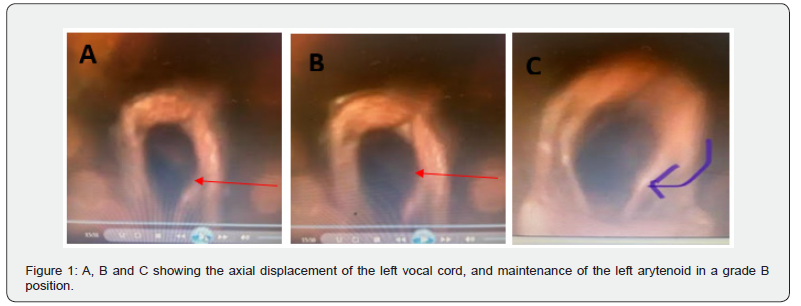
A 7-year-old racing thoroughbred underwent a routine laryngoplasty on 21/7/21. After 26 starts, it presented again 2 ½ years later with a history of recent increased respiratory noise and poor performance. Endoscopy at rest revealed a grade 4 (Dixon) or grade B (Rakestraw) post laryngoplasty score, with a slight degree of arytenoid abduction. A dynamic endoscopy was performed, which revealed that the left arytenoid cartilage abduction of grade B (Rakestraw) was maintained, as well as the axial displacement of left vocal cord into the rima glottis space (Figure 1). The decision was made to manage the noise with a tissue-sparing procedure of vocal cordectomy, involving the trimming of the left vocal cord, and to trial specialist equipment made up for the procedure.
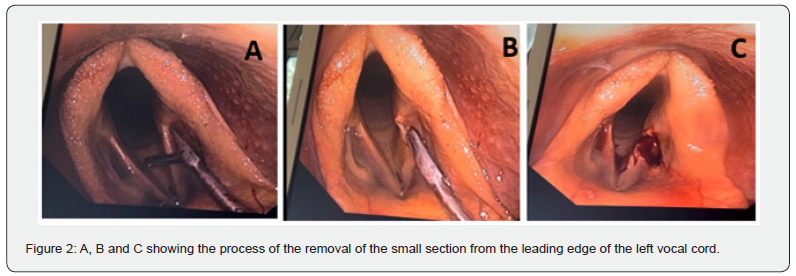
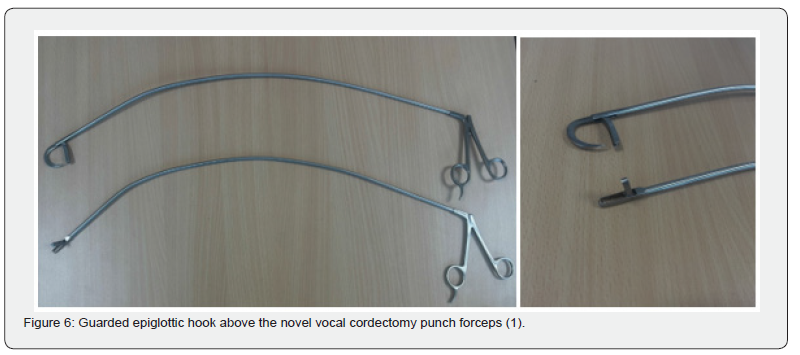
The horse was presented to the hospital for the procedure three weeks later, on 20/12/23. It was immobilized in a crush and was sedated with detomidine (0.012mg/kg) and butorphanol (0.025mg/kg). Under endoscopic guidance, 20mls of Vetacaine (mepivacaine) local anesthetic was sprayed onto the surfaces of the larynx via a catheter through the endoscope. A custommade prototype instrument was manufactured, from stainless steel, similar in size, shape, and length to a guarded epiglottic entrapment hook (Figure 6). Scissor handles acted to open and shut punch forceps in a horizontal plane. With the endoscope in the right nostril, the specialist equipment was passed through the horse’s left nostril and extended to the left vocal cord, at which point a small section was removed via the novel punch instrument under endoscopic guidance (Figure 2). The section was taken off the leading edge of the cord to avoid complications such as dysphagia and aspiration (Lean et al., 2022).
Results
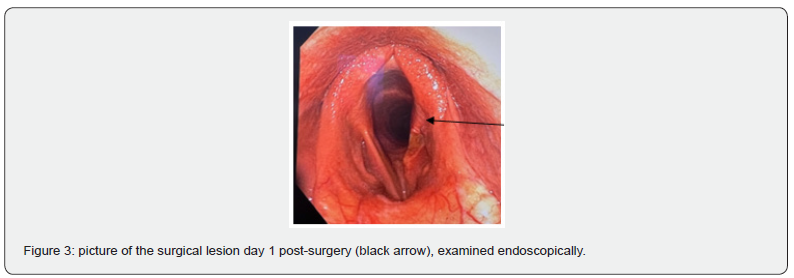
The next day, the horse was re-scoped to examine the early stages of the healing, and the lesion was found at the expected leading edge of the vocal cord (Figure 3).
The horse was then put on box rest and was walked for the next 7 days, and then returned to work.
The trainer reported that the respiratory noise had not improved, and the horse raced twice post-surgery (20/1/24 and 11/2/24), running poorly both times (near last both times).
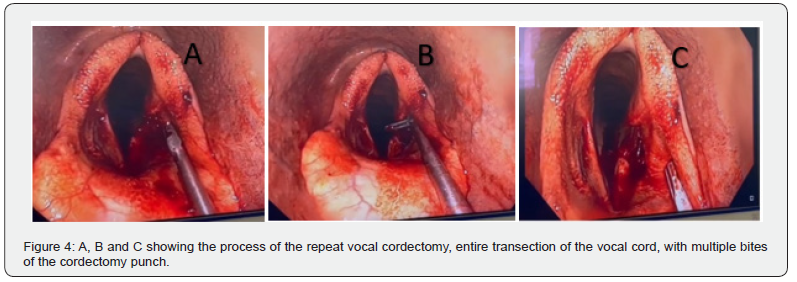
It was decided to repeat the surgery on 23/2/24, using the same technique, however this time taking multiple bites with the punch forceps, to ensure the entire vocal card was transected (see Figure 4).
The horse was returned to work after 7 days walking, and the trainer reported an immediate improvement in the respiratory noise.
The horse raced 3 ½ weeks after surgery with an improvement in form, running 5th of 11 horses. The horse subsequently raced 8 times over the course of the next 7 months, placing 3 times and winning once, an apparent improvement on pre-surgery form (see Table 1).
A follow up endoscope exam 4 months after the second surgery, during the horse’s improvement in form and reduction in noise is shown in figure 5.

Discussion
Although the results of this novel technique are limited to one clinical case, the procedure did subjectively improve performance and decrease respiratory noise. This would support the findings of recent literature in experimental situations [19], that unilateral vocal cordectomy can be effective in grade B and C grades of post laryngoplasty abduction.
It is assumed that grade A cases, with good performance and making minimal noise, would not benefit from the procedure [18,19], hence this case would support delaying any VC/V procedure several months post-surgery, so the final abduction, amount of noise, and performance can be ascertained, and other potential causes of post laryngoplasty respiratory noise can be ruled out by dynamic endoscopy.
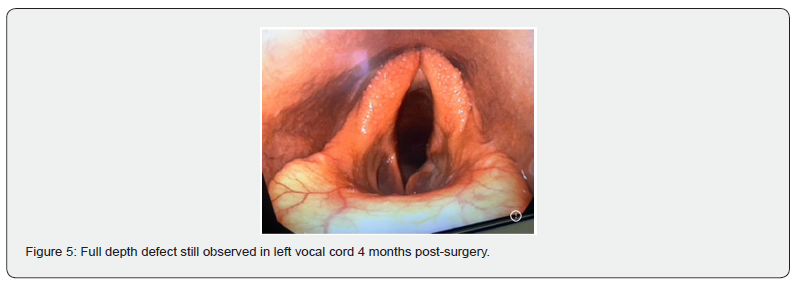
In this case the first attempt was apparently unsuccessful, taking only the leading edge of the vocal cord. When repeated, this time ensuring the entire vocal cord was transected, immediate improvement was reported. This may explain in the literature why vocal cordectomy have varying degrees of success reported [19,14,27], which could be due to the variation in techniques. Based on this case full transection of the vocal cord would be recommended.
Using a steel instrument (1) similar in concept and operation to the guarded epiglottic entrapment hook (Figure 6) seemed a safe and economic alternative to laser treatment, especially in the hands of the lesser skilled and experienced surgeons. Conceivably, the technique could also be done under GA, or at the time of laryngoplasty (standing or GA) if required.
While a small alteration in vocal cord function could dramatically alter respiratory noise, this case had no objective noise measurement so future evaluations of the technique would ideally include this to improve the reliability of the data. Similarly, while the horse did show apparent improvement in form (Table 1) with the 2nd procedure, there are many other contributing factors to performance, and further studies with more numbers, preferably randomized prospective cohort studies with matched controls, would be needed to ascertain if this procedure did improve airway function in grade B and C post laryngoplasty sufficiently to affect performance
Conclusion
The novel method of vocal cordectomy using a specifically designed surgical instrument, taking care to fully transect the vocal cord rather than the leading edge, seems a promising approach for resolving issues of collapsing vocal cords in horses presenting with respiratory noise and exercise intolerance, either post-laryngoplasty in racehorses, or potentially as an alternative in sport horses with laryngeal hemiplegia.
In racehorses, this would enable the surgeon to dispense with VC/V adjunct procedures at the time of laryngoplasty surgery, sparing tissue and avoiding complications of cough and dysphagia. Horses can be followed up and a vocal cordectomy using this equipment performed at a later stage only if indicated.
References
- Marks D, Mackay-Smith MP, Cushing LS, Leslie JA (1970) Use of a prosthetic device for surgical correction of laryngeal hemiplegia in horses. Journal of the American Veterinary Medical Association 157: 157-63.
- Cramp P, Barakzai SZ (2012) Surgical management of recurrent laryngeal neuropathy. Equine Veterinary Education 24: 307-321.
- Dixon PM, Mcgorum BC, Railton DI, Hawe C, Tremaine WH, Dacre K, Mccann J (2003) Long-term survey of laryngoplasty and ventriculocordectomy in an older, mixed-breed population of 200 horses. Part 1: Maintenance of surgical arytenoid abduction and complications of surgery. Equine Veterinary Journal 35: 389-396.
- Rossignol F, Ducharme NG (2021) Complications in larynx surgery. In: Complications in Equine Surgery (Eds) LM Rubio-Martinez, DA Hendrickson. Wiley.
- Barnett TP, O’Leary JM, Parkin TD, Dixon PM, Barakzai SZ (2013) Long-term exercising video-endoscopic examination of the upper airway following laryngoplasty surgery: A prospective cross-sectional study of 41 horses. Equine Veterinary Journal 45: 593-597.
- Kraus BM, Parente EJ, Tulleners EP (2003) Laryngoplasty with ventriculectomy or ventriculocordectomy in 104 draft horses (1992-2000). Vet Surg 32: 530-538.
- Cramp P, Derksen FJ, Stick JA, Nickels FA, Brown KE, et al. (2009) Effect of ventriculectomy versus ventriculocordectomy on upper airway noise in draught horses with recurrent laryngeal neuropathy. Equine Veterinary Journal 41: 729-734.
- Barakzai SZ, Wells J, Parkin TDH, Cramp P (2019) Overground endoscopic findings and respiratory sound analysis in horses with recurrent laryngeal neuropathy after unilateral laser ventriculocordectomy. Equine Vet J 51: 185-191.
- Taylor SE, Barakzai SZ and Dixon P (2006) Ventriculocordectomy as the sole treatment for recurrent laryngeal neuropathy: Long-term results from ninety-two horses. Veterinary Surgery: VS. 35: 653-657.
- Henderson CE, Sullins KE, Brown JA (2007) Transendoscopic, laser-assisted ventriculocordectomy for treatment of left laryngeal hemiplegia in horses: 22 cases (1999-2005). Journal of the American Veterinary Medical Association. 231: 1868-1872.
- Derksen FJ, Stick JA, Scott EA, Robinson NE, Slocombe RF (1986) Effect of laryngeal hemiplegia and laryngoplasty on airway flow mechanics in exercising horses. American Journal of Veterinary Research 47: 16-20.
- Hawkins JF, Tulleners EP, Ross MW, Evans LH, Raker CW (1997) Laryngoplasty with or without ventriculectomy for treatment of left laryngeal hemiplegia in 230 racehorses. Veterinary Surgery VS 26: 484-491.
- Jansson N, Ducharme NG, Hackett RP, Mohammed HO (2000) An in vitro comparison of cordopexy, cordopexy and laryngoplasty, and laryngoplasty for treatment of equine laryngeal hemiplegia. Veterinary Surgery: VS. 29: 326-334.
- Brown JA, Derksen FJ, Stick JA, Hartmann WM, Robinson NE (2005) Laser vocal cordectomy fails to effectively reduce respiratory noise in horses with laryngeal hemiplegia. Veterinary Surgery: VS 34: 247-252.
- Tetens J, Derksen FJ, Stick JA, Lloyd JW, Robinson NE (1996) Efficacy of prosthetic laryngoplasty with and without bilateral ventriculocordectomy as treatments for laryngeal hemiplegia in horses. American journal of veterinary research 57: 1668-16
- Ducharme NG, Goodrich L, Woodie B (2002) Vocal cordectomy as an aid in the management of horses with laryngeal hemiparesis/hemiplegia. Clinical Techniques in Equine Practice 1: 17-21.
- Vidovic A, Delling U (2017) Aryepiglottic fold augmentation as treatment for late-onset dysphagia following surgical treatment of recurrent laryngeal neuropathy. Tierarztliche Praxis. Ausgabe G, Grosstiere/Nutztiere 45: 219-225.
- Shaw DL, Lexmond NS, Rosanowski SM (2024) Unsuccessful treatment of post laryngoplasty cough and dysphagia with initially arthramid, then subsequently bone cement, injections of the left aryepiglottic fold and vocal fold. Journal of Dairy & Veterinary sciences 16.
- Lean NE, Bertin FR, Ahern BJ (2022) Influence of unilateral and bilateral vocal cordectomy on airflow across cadaveric equine larynges at different Rakestraw grades of arytenoid abduction. Veterinary surgery VS. 51: 974-981.
- Barakzai SZ, Boden LA, Dixon PM (2009) Postoperative race performance is not correlated with degree of surgical abduction after laryngoplasty in National Hunt Thoroughbred racehorses. Veterinary Surgery: VS. 38: 934-940.
- Brown JA, Derksen FJ, Stick JA, Hartmann WM, Robinson NE (2004) Effect of laryngoplasty on respiratory noise reduction in horses with laryngeal hemiplegia. Equine Veterinary Journal 36: 420-425.
- Rakesh V, Ducharme NG, Cheetham J, Datta AK, Pease AP (2008) Implications of different degrees of arytenoid cartilage abduction on equine upper airway characteristics. Equine Veterinary Journal 40: 629-635.
- Hawkins J (2015) Evaluation and management of the horse with dysphagia following prosthetic laryngoplasty. In: Advances in Equine Upper Respiratory Surgery, Ed: J Hawkins, Wiley.
- Compostella F, Tremaine WH, Franklin SH (2012) Retrospective study investigating causes of abnormal respiratory noise in horses following prosthetic laryngoplasty. Equine Veterinary Journal 44: 27-30.
- Leutton JL, Lumsden JM (2015) Dynamic respiratory endoscopic findings pre- and post-laryngoplasty in Thoroughbred racehorses. Equine Veterinary Journal 47: 531-536.
- Lacourt M, Marcoux M (2011) Treatment of epiglottic entrapment by trans nasal axial division in standing sedated horses using a shielded hook bistoury. Veterinary Surgery: VS. 40: 299-304.
- Luedke LK, Cheetham J, Mohammed HO, Ducharme NG (2020) Management of postoperative dysphagia after prosthetic laryngoplasty or arytenoidectomy. Veterinary Surgery: VS 49: 529-539.

























