




 JCMAH Home



Collective Psychic Mind: How Group Intuition and Intention Shapes Reality
Raymond T. Bradley*
Research Center, Institute for Whole Social Science, RD 1, Hikurangi, Northland, New Zealand
Submission: July 16, 2024; Published: July 02, 2024
*Corresponding author: Dr. Raymond Bradley, Research Center, Institute for Whole Social Science, RD 1, Hikurangi, Northland, New Zealand, Email: wholesocialscience@gmail.com
How to cite this article: Raymond T. Bradley*. Collective Psychic Mind: How Group Intuition and Intention Shapes Reality. J Complement Med Alt Healthcare. 2024; 13(1): 555851. DOI: 10.19080/JCMAH.2024.13.555851
Abstract
Although there is a century of solid evidence of psychic effects (human nonlocal communication of information or intention by no known physical means), most research has focused on the individual. Less studied is collective generation of nonlocal effects-viz, the question of collective psychic mind. This article examines three kinds of collective nonlocal phenomena-nonlocal communication within collectives, collective intuition, and collective intentionality-with three objectives in mind. Namely, to distill what is known and highlight gaps in research; sketch an approach to the question of explanation; and consider the implications for practice. Regarding the first, there is compelling evidence of nonlocal communication within dyads, groups, and social collectives, and for collective intentionality-the psychic power of group mind to induce change in physical systems (including quantum phenomena) and bio-social life. While studies suggest collective intuition is highly likely, research is needed to validate group foresight. Of import across the research, is evidence showing that psychic effects-both at the individual and collective levels-are accessed by selfless states of unconditional love. Drawing on the principles of classical and quantum holography, and the concept of multiscale entanglement, a theory (presented in summary form) describes the psychoenergetic and imaging/information communication processes that account for intuition and intention-including amplification effects in group/collective contexts. The article concludes with five Principles of Nonlocal Interaction which may have value as research hypotheses and utility for practice/action to the betterment of humanity at this perilous time on Earth.
Keywords: Intuition; Intentionality; Collective Consciousness; Psi research; Nonlocality; Love; Quantum holography
Abbreviations: ESP: Extra Sensory Perception; PK: Psychokinesis; GCP: Global Consciousness Project; PCAR: Phase Conjugate Adaptive Resonance; ANS: Autonomic Nervous System; IIEDs: Intention Imprinted Electrical Devices
Since primeval times, people have spoken of strange and sometimes profoundly meaningful personal experiences. Such experiences have been reported by the majority of the world’s population and across all cultures. … These experiences, called “psychic” or psi, suggest the presence of deep, invisible interconnections among people, and between objects and people. The most curious aspect of psi experiences is that they seem to transcend the usual boundaries of time and space.
Dean Radin, The Conscious Universe (1997), page 13.
Nonlocality and the nonlocal quantum hologram provide the only testable mechanism discovered to date which offers a possible solution to the host of enigmatic observations and data associated with consciousness and such consciousness phenomena.
Edgar Mitchell (2000), “Nature’s Mind: The Quantum Hologram,” page 299.
Love is a kind of exalted but unspecialized telepathy; the simplest and most universal expression of that mutual gravitation or kinship of spirits which is the foundation of the telepathic law.
F. W. H. Myers, Human Personality and Its Survival of Bodily Death (1907), page 344.
Prologue
Phenomena that involve action at-a-distance-the transmission of a force or effect by no known physical means-are paradoxical and perplexing. Because they contradict the laws of physics, they defy reason and common sense and have confounded even the greatest minds in science. Thus, Newton struggled with the nonlocal nature of gravity and Einstein famously dismissed quantum nonlocality as “spooky action at- a-distance.” Paradoxically, that as Einstein was struggling with this “spooky” discovery of nonlocality in quantum physics at the turn of the Twentieth Century, a few years before (1897) Emile Durkheim, one of the ‘founding fathers’ of modern social science, published these prescient words in his classic study,
The Elementary Forms of Religious Life (i).
“The collective consciousness is the highest form of psychic life, since it is the consciousness of the consciousnesses. Being placed outside of and above individual and local contingencies, it sees things only in their permanent and essential aspects …. at every moment of time, it embraces all known reality; that is why it alone can furnish the mind with the molds which are applicable to the totality of things, and which make it possible to think of them (Durkheim, 1965: 492; italics added)”.
Portending Denis Gabor’s discovery of holography in physics by some fifty years, Durkheim’s concept is of an all-seeing, allknowing omniscient collective consciousness-the notion of a socio-psychic ‘mind’ above and beyond local existent reality as a tacit, nonlocal holographic order. As the “consciousness of the consciousnesses,” it is this collective mind that knows all, projects the “molds” for all, and thus shapes our perceptions and actions in spacetime reality. —as described below.
These days, action-at-a-distance is known as nonlocality. Following experiments confirming quantum entanglement in the 1980’s (the inherent interconnectedness of sub-atomic particles, no matter how vast the distance), nonlocality is not only accepted as a scientific fact, but its status as ‘scientific truth’ was formalized with the awarding of the 2022 Nobel Prize in physics. Moreover, because the individual particles in particle pairings appear to act is if they instantly “know” what is happening to each other and display an unconditional, unbreakable union, some physicists characterize this bond as “passion at-a-distance” (e.g., [1]). In short, quantum entanglement is not only seen as fundamental to understanding the physical universe but is also thought integral to the question of consciousness—including psychic phenomena [2-4]. A recent discovery of atomic entanglement, at Muenchen University in Germany, documents inseparability and instant communication between atoms at the macroscale level of spacetime reality. This suggests multiscale entanglement—viz, inseparability between subatomic particles and macroscale constituents of organisms (including humans), as the basis for instant communication in consciousness and psychic phenomena [5].
Introduction
Despite a century of evidence of psychic effects (human nonlocal communication of information or intention by no known physical means) studies were ignored or vilified by mainstream science (see [6]). However, a growing number of experiments are now published in leading journals in psychology and even in physics (e.g., [7,8]), suggests that psi research is finally gaining some legitimacy. Similarly, where compelling evidence of nonlocal effects was ignored or derided in social science (e.g., [9]), studies are now appearing in mainstream publications (e.g., [10-14]).
Most research focuses on the individual, documenting two broad kinds of nonlocal phenomena: extra sensory perception (ESP), the capacity to receive/perceive information about nonlocal objects or events; and psychokinesis (PK), the capacity to intentionally induce change in a nonlocal object/event. Less studied is collective generation of nonlocal effects-sociopsychic phenomena. Because these phenomena have important implications for both individual health and societal/global wellbeing, in the interest of stimulating urgently needed research, my threefold purpose here is to:
i. Distill what is known and highlight gaps in research;
ii. Sketch a quantum holographic approach to the question of explanation; and,
iii. Examine the implications for action/practice.
The article concludes with a set of principles which may have utility for practice considerations and value as research hypotheses.
Review of Research
We begin with a highly compressed overview of the research addressing three key questions: nonlocal communication within the group; collective intuition of nonlocal events; and collective intentional effects on a nonlocal object.
Nonlocal Communication
Nonlocal psychoenergetic interaction is a well-documented phenomenon within and among all living ystems. As will become clear in our review of research for humans, there is compelling evidence that love-the bonds of attachment-mediates access to and the efficacy of our psychic powers, both as individuals and collectively.
Dyadic Interaction
Studies of dyads reveal an implicit socio-affective energetic channel of communication implicated in regulating interactional dynamics, development, and behavior. This has been documented in mother-fetus interactions in the womb-including those from external social sources, and between mothers and infants/ toddlers (e.g., [15]) (Figure 1) and is known to influence neurobiological and psychosocial development [16-19]. Other studies, using electrophysiological instruments, document heartto- heart and heart-brain communication (including entrainment) between non-conversing pairs/couples within conversational distance (~5-6 feet), but with no physical contact [20,21] (Figure 2). And there is evidence of an unconscious channel of nonverbal communication operative in non-touching conversing dyads (e.g., [22]). Of note is discovery of an inaudible low frequency band in vocal interactions (beneath 0.5 kHz, below normal human hearing range: 15-20 kHz) which operates as an unconscious regulator of relational dynamics (including social status accommodation) and is related to task performance [23].
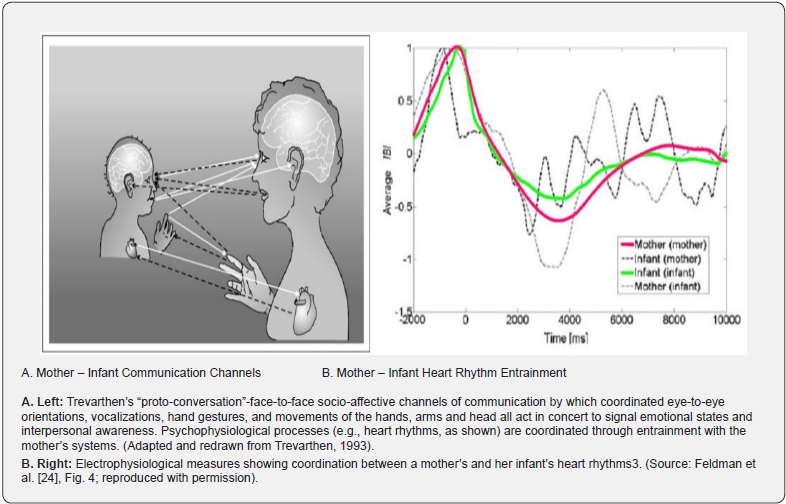
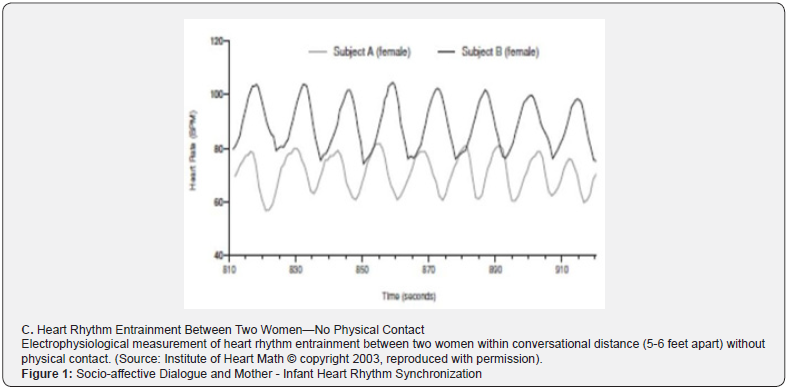
Interaction in Social Collectives
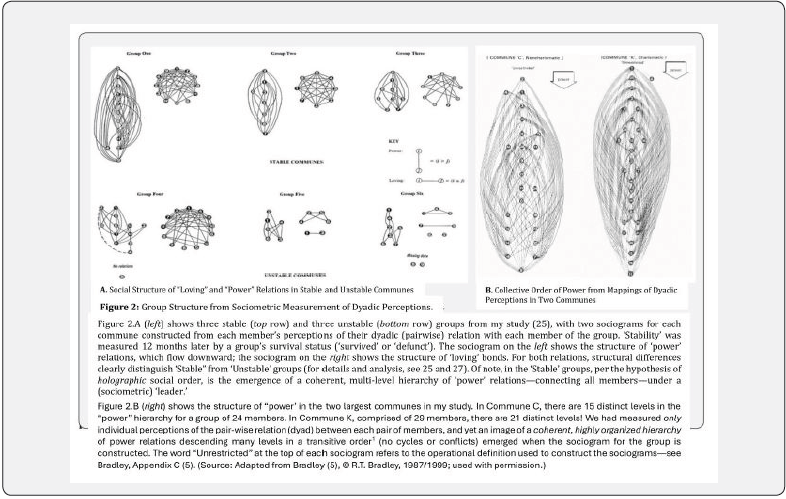
In a large-scale longitudinal study of 57 urban communes, conducted at Columbia University in the mid 1970’s, I found that information about collective order was implicitly encoded in member responses to a sociometric instrument mapping dyadic relations within the group [25]. Although respondents were not asked about group structure, what emerged, when sociograms were constructed from dyadic information about ‘Loving’ and ‘Power’ relations between each pair of members, was a highly detailed view of the global structure of these relations for the group (Figure 2). Because power involves a directional vector, the discovery of a coherent hierarchy of power relations extending many levels in the groups, raised a basic question: namely, how is it possible to obtain a view of the social whole (the group) solely from measurement of its parts (individual perceptions of dyadic relations)?
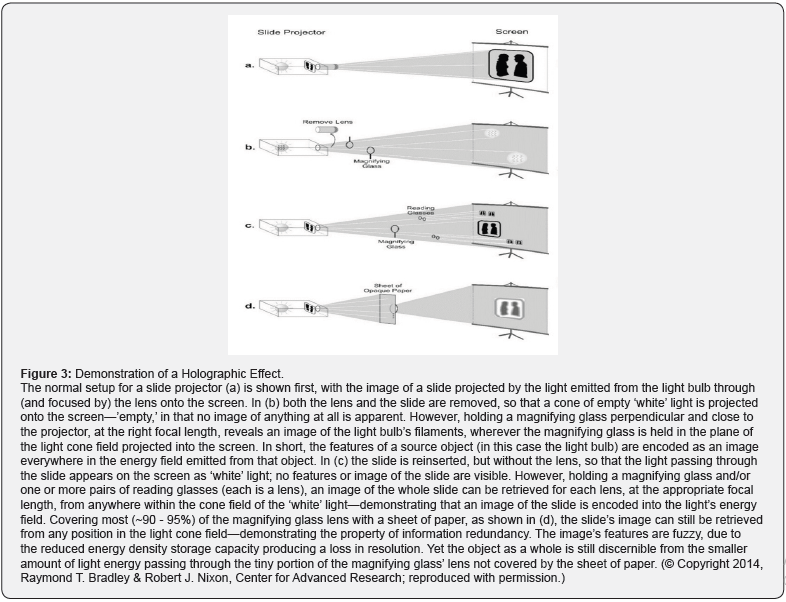
The answer-a novel hypothesis-was suggested by the paradox implied in the question: namely, that information about collective organization is encoded as a hologram and tacitly communicated throughout the group to all members [25]. Holographic organization is a field concept of order in which information about the object as a whole is energetically encoded as an interference pattern and distributed by the movement of energy to all parts and locations [26]. This makes it possible to retrieve an image of the whole from any point or location in the field (Figure 3).
Using membership turnover as a measure of disturbance or loss of collective memory, I found that only groups with a globally coherent structure of power were able to perpetuate this order through time, despite high levels of turnover or loss of a leader/s. I also found that global hierarchical coherence was directly related to group survival, was coincident with a dense network of loving bonds, and that, when linked as a complementary balanced coupling, structural measures of these patterns of love and power predicted group survival some twenty-four months into the future [27,28]. In short, these findings suggest that information about social order is not localized to specific parts or positions but is holographically encoded as an implicit collective consciousness and communicated nonlocally, via the energized field of attachment bonds—love, throughout the group (see [25]: 197-274).
Global Consciousness
This nonlocal nature of collective mind has been found repeatedly in field studies and controlled experiments using a radically different instrumentation-namely, random number generators (RNGs). RNGs are hardware circuits that use inherent electronic noise to generate truly random bits. Each RNG is attached to a personal computer which continuously collects 200 random bits per second. It should be emphasized that in research settings the RNG/s has no physical connection to human participants, or the researchers involved.
The effects of group/global consciousness is registered by RNGs in various settings-meetings, meditations, sports events, ceremonies, natural disasters, and human-caused tragedies (e.g., [29-32]. Studies have consistently found that collectively focused attention generates a shift in RNG behavior to a non-random pattern. In social groups, the effect is strongest in those with high social coherence and engaged in an emotionally intense common focus, such as workshops and therapy groups (e.g., [33]), plus there is an amplification effect four-times stronger in closelybonded relationships than for that of an individual [34]. Studies have also found synchronized group meditation (in large groups with over 1,500 meditators) produce the greatest nonrandom departures, especially when using a specific/advanced technique, such as Transcendental Meditation or “yogic flying” (e.g., [32]). These effects were corroborated in a subsequent experiment using an objective stimulus (binaural-beat audio tones, known as Hemi-Sycn®) to generate a state of “mental coherence”, in 14 replications of a group workshop [35].
RNGs have also been used to measure global consciousness in the on-going internet-based Global Consciousness Project (GCP), initiated in 1998 by Roger Nelson. Data generated by RNGs are collected continuously from more than 60 sites throughout the world, and analyzed to determine if there is a correlation between global events of mass attention-such as, Princess Dianna’s death, the 2000 Olympic Games Opening Ceremony, the US 9/11 terrorist attacks, the 2004 Sumatra earthquake and tsunami, Obama’s reelection, Valentine’s Day Meditation 2009 (Figure 4.A) and so forth-and periods of non-random order:
‘Our research hypothesis predicts the appearance of increasing coherence and structure, or non-random trends, in the globally distributed [RNG] data collected during major events in the world. The events . . . share a common feature, namely, that they powerfully engage human attention all around the world, and draw us in large numbers into a common focus. ([30]: 550-551; italics added.)’
Because the statistical effect for a single event is ‘tiny’ and difficult to differentiate from noise, data must be accumulated over many replications for a real effect to become statistically detectable. The hypothesis has been repeatedly verified by analyses of the aggregated RNG data from world events—see, for example, GCP results in Figure 4.B (e.g., [31]). Analysis of the “cumulative deviation from chance expectation” for 465 world events (August 1998 through April 2014) “is highly significant. The odds against chance are much greater than a billion to one”4 (Figure 4.B).
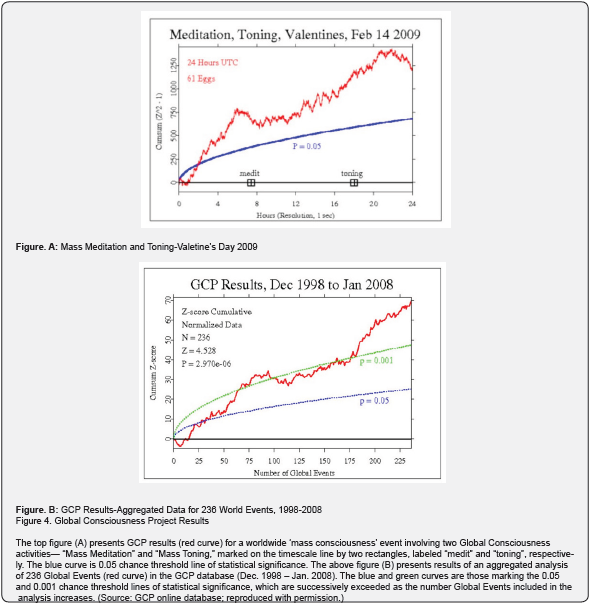
In commenting on their analysis, Bancel and Nelson point to a collective effect of “coherent attention or emotional response” ([31]: 1; italics added). Moreover, in a follow-up analysis on data from 247 world events, Nelson finds that:
i. Events with high emotional intensity generate strongest effects on RNGs, while those neutral or low do not;
ii. The emotional valence of the world event to people is significant: “The largest effect sizes in the database are produced by events characterized by fear (4.5 sigma), or compassion and love (3.6 sigma)”;
iii. There is a “non-local interconnection of human consciousness at an unconscious level”; and that,
iv. An “unknown mechanism links consciousness with physical systems, yielding detectable changes in their behavior” ([30]: 1).
Nelson’s finding that the emotional intensity and valence of an event generates the largest effect size, suggests the arousal of bio-emotional energy is mechanism of connection to the energy created by the event. Like all events in the universe, this can be understood as a holographic process, as elaborated below, in which the outgoing wavefield of energy from a given percipient intersects with the incoming wavefield of energy from the event. The conjunction of the two wavefields creates an interference pattern in which the event’s evolving features, as an object, are spectrally encoded as a succession of quantum holograms. The reception and unconscious processing of this tacit information about the event is precognitively perceived by the percipient’s psychophysiological systems, and then brought to conscious awareness as intuition.
Nonlocal Intuition and Intention
In moving to the topics of intuition and intentionality, I want to take a moment to clarify how I view these concepts, as this will inform the discussion that follows. Very briefly, for the technical details are too complex to recount here, Marcer [36] has mathematically determined that “accurate perception” requires an outgoing wavefield of attentional energy and an incoming wavefield of energy emitted from the object, and that a relation of Phase Conjugate Adaptive Resonance (PCAR) must hold between the percipient and the object:
‘Marcer (1995) has proposed that … resonance requires a virtual path mathematically equal but opposite to the incoming sensory information about the object. Further, that it is the incoming space/time information (visual, acoustic, etc.), which decodes the information of the quantum hologram and establishes the condition of PCAR, so that accurate three-dimensional perception is possible.5’
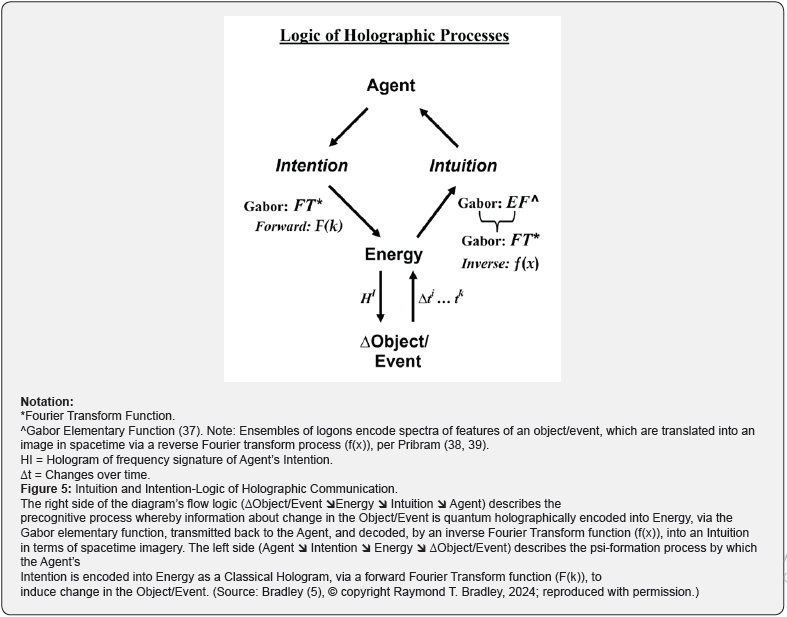
Both outgoing and incoming wavefields contain information about their respective sources encoded as quantum holograms in the movement of energy. It is our emotional connection to an object of interest which activates the arousal of biological energy required for the act of attention/intention (Figure 5). Thus, tuning into and maintaining resonance with energy frequency of the object, attentional focus creates a two-way quantum level communication channel between the percipient and the object.
Passionate attention-which Dean Radin [6] calls “rapt attention”-generates a coherent channel of resonating energy through which incoming information from a nonlocal objectincluding its future potentials-is perceived by the body’s psychophysiological systems as intuition [40]. Passionate intention [11] transmits a willful thought/desire to the nonlocal object where, through a process of oscillatory entrainment (described below), the intention can induce change in the object’s organization/behavior [5].
Nonlocal Intuition
Most research on intuition adopts a cognitive approach in which intuition is viewed as the brain’s extrapolation from stored memory of prior experience (e.g., [9]). Thus, Akinci and Sadler- Smith ([41]: 1) define collective intuition “as independently formed judgement based on domain‐specific knowledge, experience and cognitive ability, shared and interpreted collectively.”
There is, however, unequivocal evidence of another informational basis for intuitive perception: namely, the energetic radiations from all objects/events holographically encoding features of the source, its entire event history, and, via spectral overlap among quantums of information (logons), and its future potentials [4]. Such tacit information about remote/futurenonlocal- events is processed by the body’s psychophysiological systems and perceived as certainty of knowledge or feeling (positive or negative) about something distant or yet to happen [42]. In drawing on this concept of nonlocal intuition, collective intuition is signified by shared implicit awareness of remote or future events jointly perceived by the members of a group [4]. There are two distinct levels: a relational and a collective form.
Relational Intuition
While there is an extensive body of research on nonlocal intuition, virtually all work has been on the individual (see [3,6]. Despite enumerable anecdotal or subjective accounts, there appears to be dearth of studies on intuition in relationships, other than research on the implicitly “entwined lives” of identical twins when reared apart [43]6. However, there is work measuring nonlocal communication in a relational setting. To wit, the numerous so-called ‘staring’ studies, spanning many decades, which have consistently found nonlocal effects on a receiver’s awareness (measured electrophysiologically) of being “watched” (on a random schedule) by a sender at a remote location (e.g., [44]). Sheldrake [45] has corroborated these effects in social media contexts, showing intuitive anticipation by the intended receiver when the sender is engaged in formulating an internetmediated communication.
Of relevance, also, are the findings from the presentiment experiments of the past few decades (see [3]) which investigate physiological predictors of future emotional stimuli, and, hence, are integral to the processing of socio-affective information in our relations and interactions [4,19]. Using rigorous computer assisted experiment protocols and electrophysiological measures, researchers have consistently found that the human autonomic nervous system (ANS) unconsciously responds to randomly selected future emotional stimuli some four to seven seconds before the experimental stimulus is presented (e.g., [46]).7 Moreover, evidence shows that the heart is directly involved [42,47-49], and that the heart receives the pre-stimulus information a second or two before the brain [50]-suggesting that the heart receives intuition information first, and then alerts the brain, via the afferent pathways, for potential decision/action In the McCarty et al. study [50], there was also a noteworthy finding for gender. In female participants (but not males) the coherent heart rhythm pattern, induced by intentional activation of a sustained positive emotion-Psychophysiological Coherence8 -throughout the experiment, was associated with pre-stimulus perception of an “emotional” stimulus but not for a “calm” one. Intriguingly, this is consistent with Nelson’s [41] finding (above) that events with high emotional intensity generate the strongest mass consciousness effect on RNGs, while those neutral or of low intensity do not.
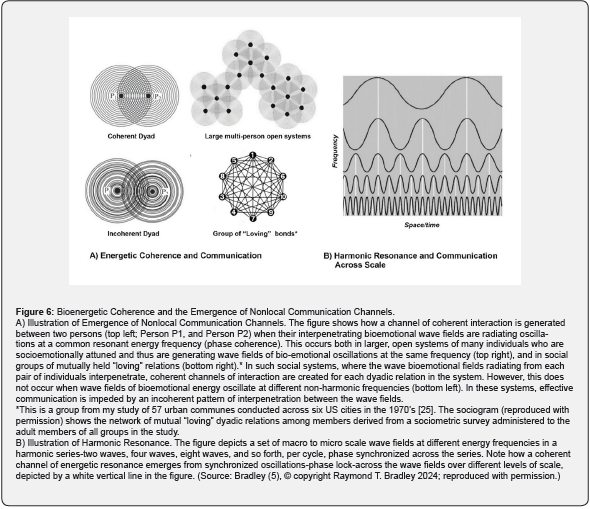
These results have a direct bearing on communication of intuitive information in social situations. For the heart is the most powerful generator of energy in our body and it encodes information on our internal states (including our feelings and emotions, and desires and intentions) in patterns of heart rhythm activity, which are communicated nonlocally to those around us [21]. Intersecting with the incoming radiation of energy emissions from all objects, a two-way multi-frequency channel of communication is created between our body and nonlocal objects (Figure 6). It is through this channel of connection that incoming intuition and outgoing intention (described below) is communicated as quantum holographically encoded information, as detailed elsewhere [4,5,51].
Collective Intuition
As noted for relational intuition, there appears to be scarcity of studies on collective intuition. Apart from research in organizational/management science which pursues a strictly cognitive approach (e.g., [47]), there are groundbreaking electrophysiological experiments documenting the heart’s involvement in entrepreneurial intuition [10,49,52] and finding group amplification of the pre-stimulus signal [48-50]. Also, a recent presentiment study [53] of users of Twitter, documents this collective dimension of intuitive foresight among participants on social media platforms. Building upon Czihzenmayhali’s [54] pioneering work on “flow” states, Sawyer [55] has been studying ‘group flow’-viz, the emergence of an implicit collective mind that anticipates, coordinates, and guides collaborative activity for optimal performance. While initial results appear promising (e.g., [56]), little is known of the unconscious nonlocal flow dynamics of collective communication and continuously adaptive action.
Returning to the GCP, there are intriguing data on implicit mass response to certain world events in the database suggestive of world-wide collective intuition at the global level of consciousness. As noted above, signal registration from mass focused attention for any given event on the RNG network is typically very weak and well below the chance expectation threshold. However, for some events the signal structure exceeds chance, and among these are a handful where RNG output deviates from randomness minutes and even hours before the event actually occurred. Three of these are natural disasters. In the online GCP database (Table 2: Results for Individual Events), these are: #34, Turkey earthquake; #67, Central American earthquake (Figure 7.A); and #189, Sumatra earthquake and tsunami. All showed the RNG signal exceeded chance ~15 minutes prior to the actual event. But one event, with a large departure from chance (p < 106), was a humancaused catastrophe: the terrorist attacks on the US the morning of September 11, 2001 (Figure 7.B). Independent analysis by Nelson [57] and Radin [58] found notable nonrandom departure beginning some 3-4 hours before the first plane crashed into the North Tower of the World Trade Center at 8: 45 a.m. (bottom graph), suggesting implicit global foreknowledge of the impending attacks. Further, the day of September 11 also generated largest departure from randomness for the 2001 year (top graph), which remained unexplained by artefacts such as electrical disturbances or high mobile phone use. Indeed, in commenting on a similar antecedent to the Central American earthquake, Nelson observes:
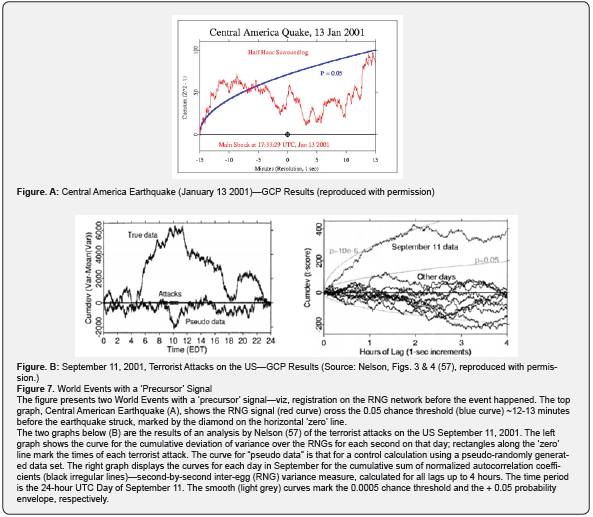
‘As in 1999 [Event #34, Turkey earthquake], there is a surprisingly strong deviation prior to the first shock. This could be a chance occurence (sic), but it might be interpreted, if found in other cases, to indicate that there is some influence on the Egg [RNG] network that is a precurso[r] (sic) [signal] to the actual quake. … a suggestion of something like an “earth consciousness” that feels the pressures and tension that lead to the seismic event (Event #67, Table 2, GCP database; italics added)’.
However, the 9/11 terrorist attack response suggests something more than precursor “pressures and tension” to seismic events is the mechanism. It points to an emotional connection to the nonlocal event: unconscious global fear of the terrorist’s imminent malevolent actions [4,59]. Another category of events that produce significant RNG nonrandom deviations are synchronized mass prayer/meditation, which sometimes generate a ‘precursor’ signal before the event happens (see GCP database). While such results from the GCP are tantalizing and suggestive, more world events displaying such a precursor RNG signal are required for definitive statistical analysis. However, it does seem likely that socially coherent emotion underlies collective intuition, and that collective intuition itself is an intrinsic faculty of global consciousness.
Collective Intention
For our purpose here, collective intention means “the power of minds to be jointly directed at objects, matters of fact, states of affairs, or values” ([60]: 1). This includes instances of an explicit shared awareness and those in which the “joint”/collective action is unconscious. For instance, in my study of communes, mentioned above, a further discovery was dynamically adaptive adjustment, overtime, to maintain a balanced complementary coupling between the structures of loving and power relations in surviving groups- presumably by an emergent, regulatory process of collective mind. This implicit collective awareness was not evident in non-surviving groups which, instead, were typified by extreme imbalances in the ratio of these two key relational systems ([25]: 167-193). To highlight the nature and range of these nonlocal phenomena, I broaden the concept of collective intentionality to include situations in which the collective is the context within which an intentional act occurs. We begin with these.
Relational Intention
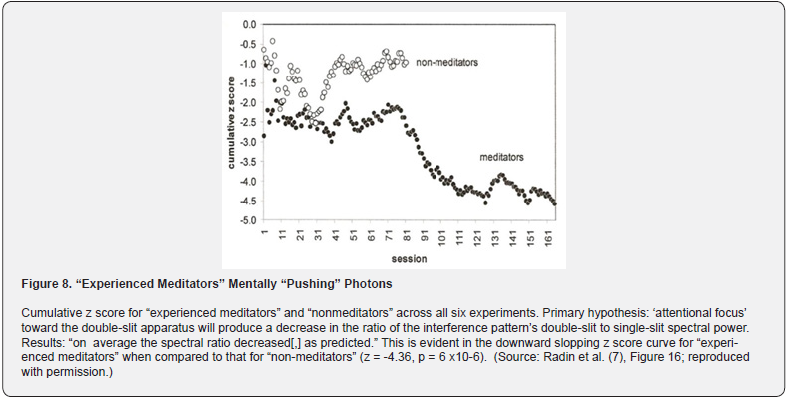
As surprising as this may seem, there is a large body of rigorous experimental evidence consistently showing that focused mental intention can exert a measurable nonlocal effect on a physical object/system or a living organism/system (e.g., [3,61,62]). As already noted for nonlocal effects on RNGs, these effects are typically tiny and subtle, usually becoming statistically detectable in large databases composed of many replications (e.g., [61,62]). For instance, in a groundbreaking experiment comprised of six experiments and more than 250 trials, Radin and his collaborators [7] found “experienced meditators” could mentally “push” photons (massless subatomic particles) generated by an interferometer in a novel variation of the double-slit physics experiment, whereas non-meditators could not (Figure 8). Of profound import, this experiment shows the power of focused intention to influence quantum phenomena, and thus documents the connection between mind and the quantum domain.
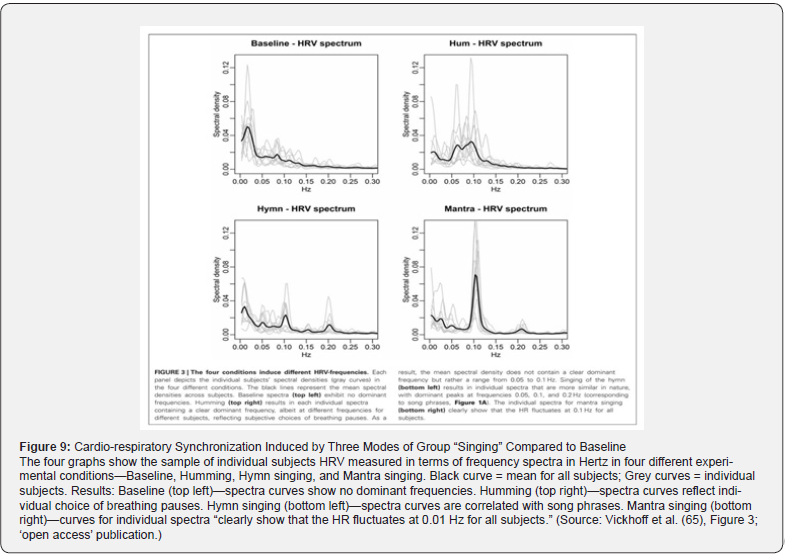
As for intuition, most research is focused on nonlocal intention in individuals. However, if we include instances where a social bond is involved-whether conscious or unconscious-we find compelling evidence of intentional nonlocal effects on another person’s bodily function, their ANS. For instance, Braud and Schlitz [63] showed a remote “sender” was able generate unconscious fluctuations in emotion (measured by electrodermal activity) in a “receiver” purely by thinking to arouse or calm that person. Plus, there is evidence that heart and brain entrainment between non-touching pairs/couples and in groups can be intentionally induced [21,48]. Also, that certain kinds of collective activity in unison (such as, poetry recitation, praying-including the Buddhist “om” technique [64], group singing, especially mantra chanting [65], and other forms of collective rhythmic activity (which induce cardiorespiratory synchronization) spontaneously facilitates a group-wide state of socio-psychophysiological coherence (Figure 9). As documented in the Appendix, in this coherence state the individual’s psychophysiological system is phase-shifted to an optimal state of function (measured at 0.012 Hz in the ECG spectrum).
Relational Healing
Of relational relevance, also, is the large body of experiments investigating the nonlocal effects of distant healers-including intercessory prayer and other healing modalities, which Radin and colleagues subjected to a rigorous review [66]. They asked two basic questions. First, the all-important “proof of principle” question: “Does it work? … If person A and person B are strictly isolated by shielding, distance, or time, is there empirical evidence that A can affect B in any way?” They note that “hundreds of experiments” have been independently replicated in different laboratories throughout the world, and then conclude from the results of metanalyses that: “Cumulatively … “Yes, A can affect B at a distance” ([66]: 67; italics added). The second question concerns efficacy: “Can A in fact heal B?” On this they find that “The preponderance of evidence for DHI [distant healing intention] effects in simple living systems and for intercessory prayer is at best suggestive of its effectiveness to alter outcomes,” while acknowledging that some studies show compelling positive results-particularly with reiki therapy ([66]: 70). In another study, implicating love, Radin and colleagues found nonlocal activation of the patient’s ANS when their distant long-term pair mate (friend pairs, partner pairs, married couples, and mother-child pairs) focused “compassionate intention” on the patient. They concluded that “strong motivation to heal and to be healed, and training on how to cultivate and direct compassionate intention, may further enhance this effect” [67].
Group Meditational Intention
A further line of research concerns the nonlocal intentional effects of synchronized mass group meditation on social order. Numerous studies, many of which were conducted by Maharishi University, have found that focused mass meditation intention has a positive impact at the city, state, national, and international levels, documenting:
i. Reductions in crime, car accidents, suicides, hospital admissions, alcohol consumption, and war casualties [68-70];
ii. Reductions in terrorist activity and international armed conflict [71];
iii. Improved stock market performance [72]; and,
iv. Improvement in the ‘quality of life’ [70].
Of import, is the discovery of a time-lag effect in which the positive ‘effect’ of an intentional meditation on social order (measured by societal indicators) carries forward over several months before dissipating [69, 70]. This has been found for synchronized group meditation as well [32], and is documented in Tiller’s experiments, as discussed next.
William Tiller’s Experiments9
At the turn of this century, William Tiller and associates published a work of monumental importance, Some Science Adventures with Real Magic [62]. The book reports on a 35-year series of experiments documenting the effect of “lovingly held” intention imprinted, via group meditation, into simple electrical devices (Intention Imprinted Electrical Devices-IIEDs)10 on various proximate and remote targets,11 some as far as 6,000 miles away. They conclude:
‘The experimental summary of findings … indicate to us that there is a profound connectivity between any one part of nature and another. Every one of us can influence all biological life forms around us via our biofield emissions and the information that they carry whether we consciously intend to or not.12’
“Real Magic”-A New Physics
In assessing Tiller’s work, Murray Gillin (73) writes that “[T]he importance of Tiller’s research [is] to open up a type of ontology that sees consciousness and matter as two complementary aspects of one reality [which enables a] fuller understanding of human intention… .”13 This is evident in Tiller’s model (Figure 10.A), where Consciousness is portrayed, outside physical reality, as a series of higher dimensions-Emotion, Mind, and Spirit. Working synergistically together, they are the means by which intention exerts its will on Matter.
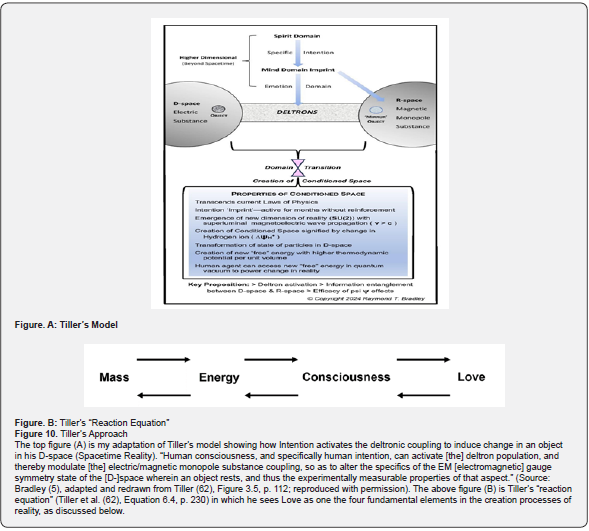
In substantive terms, the process logic of Tiller’s model can be described as follows. An agent’s focused intention, when empowered by sustained unconditional love, generates a domain transition to Tiller’s ‘conditioned space.’ This activates deltronic coupling between D-space and R-space, which operates as the ‘bridge’ between spacetime reality and that of the quantum domain, and links, via ‘information entanglement’, the particles and the waves of the ‘Object’ and ‘Mirror Object,’ respectively, in the two spaces. This facilitates a further domain transition involving the emergence of a “new” dimension of reality-Tiller’s “higher gauge symmetry state” (SU(2)). It is here where transformation of the Object’s particles is induced by prompting “Free” energy from the Quantum Vacuum to power the change, in accordance with the Agent’s Intention imprint.
Major Findings
Many of Tiller’s findings are truly groundbreaking discoveries that, altogether, shed new light on the scientific understanding of how psi phenomena occur. Among these, is that the IIED conditioning imprint of intention transfers to both local and nonlocal targets-which can include ‘unintended’ transfer and can stay ‘active’ for many months without reinforcement. A second major finding, is their discovery of a “new kind of [superluminal] energy”, accessed from the quantum vacuum, which “yields a higher thermodynamic free energy per unit volume state.” Because this ‘new’ energy is “sensitive” to “[human] subtle energies” it provides an inexhaustible source of ‘free’ energy, and empowers human intention in a way not previously understood14
‘[Tiller’s] experiments show, unambiguously, that humans can tap into this field [of “free” energy] through prayer, fasting and meditation, and using ‘human intention’ can access available energy [in the physical vacuum] to produce physical change in the selected material objects in D-space.15’
Moreover, “These subtle energies are, in part, associated with the human acupuncture meridian system and at least one of them appears to increase its speed on entering dense matter [such as the body] so that it travels at v > c [the speed of light].”16 Thus human consciousness “can … modulate a subtle energy carrier wave” to transmit intention nonlocally:
‘… aspiring humans, through their conscious intent acting on and through their acupuncture/chakra systems into the U(1) level world [our space-time reality], can slow down and perhaps even reverse the degradations of that world via lifting themselves and their surroundings to ever higher EM [electromagnetic] gauge symmetry [higher dimensional] states!17’
Finally, is their discovery of change in the hydrogen ion (ΔψH+) as a marker of the shift to this ‘new’ “higher gauge dimension” of reality (SU (2)), wherein a special kind of “information entanglement” operates:
“A postulated substance, called deltrons from the domain of emotion [outside of physical reality], exists and has the quality of being able to travel at velocities both above and below c [the speed of light] and to interact with substances from both levels of physical reality [viz, Tiller’s D-space-spacetime] where “everything” travels below c, and that of “the information wave level in the physical vacuum [his R-space] where everything travels at v > c.”18
Overall, while Tiller’s work represents a significant leap in scientific knowledge and understanding of human consciousness and psychic interactions, unfortunately there are some significant limitations. Described in depth elsewhere [5], these involve his “postulated” concepts of deltrons and information entanglement, and his use of Claude Shannon’s [74] concept of informationreduction of uncertainty-both as an explanatory framework19 and the method Tiller used to calculate the amount of “free” energy released in the quantum vacuum during an episode of psychic intention.20 These limitations, along with other considerations described elsewhere,21 have led me to develop a quantum holographic approach to this question of explanation, as presented in a highly condensed form below.
Conclusions from the Review of Evidence
Before moving to the question of explanation, I want to address the three questions posed at the outset.
i. Nonlocal communication within collectives? Although there is great need for more research-both replications and on new topics-we saw evidence of nonlocal interaction in dyadic relations, in social groups, and in mass social aggregations. Also, there appears compelling evidence of an implicit collective consciousness operative in groups and at the global level. Thus, the answer appears affirmative.
ii. Collective nonlocal intuition? There are large gaps in research at both the relational and group levels-the evidence is indirect, at best; studies are urgently needed. At the global level, the RNG data for certain world events are intriguing and compelling. However, more cases of events displaying a precursor RNG signal are required for definitive statistical analysis. Thus, while collective intuition seems highly likely, at this point the answer is inconclusive.
iii. Nonlocal Collective Intentionality? While there are gaps in research, in addition to the nonlocal impact of jointly focused minds on RNGs-physical electronic devices, there is the compelling evidence of nonlocal intentional effects on bodily function at the relational level. To repeat Radin and his coauthors’ ([66]: 67) conclusion: “Yes, A can effect B at a distance”; however, evidence that “Can A in fact heal B” is “at best suggestive”. Also, we found consistent evidence of positive nonlocal effects of mass meditation on social order. And there is Tiller’s ground-breaking research showing how intention can be imprinted into a simple electrical device to exert nonlocal influence overtime on matter or life across all levels of scale. Thus, while there are gaps in knowledge and an urgent need for research, the answer appears affirmative.
Sketch of a Quantum Holographic Account-Love’s Vital Role
In reflecting upon what accounted for the nonrandom departures in their mind-machine (telekinesis) experiments, Jahn and Dunne explain:
“Careful application of scientific knowledge and rigor of method, within a permeating atmosphere of “love” … appears particularly pertinent …for it is precisely through the bonds of consciousness established between human operators, or with their technical devices and processes, that the anomalous [nonrandom] data seem to emerge. Thus, the spiritual component participates in a very pragmatic sense: selfless investment of self can affect physical reality (Jahn & Dunne [61]: 293; italics added)”.
Even more, Tiller et al.’s [62] experiments show, unequivocally, that unconditional Love plays a crucial role in the psychophysics of how such psychic/anomalous consciousness phenomena occur-a finding consistent with the review of other studies above. In an important chapter on consciousness and healing, Tiller presents his “reaction equation” in which Love plays a primary role see (Figure 10.B above).22 Tiller explains the equation’s significance in these terms:
“Here, Einstein provided us with the quantitative relationship connecting the first two terms on the left [E = MC2] …. The last term on the right [Love] is the force of all creation …. [and] centering one’s consciousness within a framework of unconditional love, nurturing, caring, etc., can allow the healing process to unfold from right to left in the above equation ….23”
Although Tiller depicts a reciprocal relationship between each pair of factors in a specific order, wherein Love does not have a direct effect on Energy or Mass/Matter, many studies find direct evidence of a loving component.24 Drawing on the principles and concepts of Classical [26] and Quantum Holography [37], I have been developing a theory to explain the psychoenergetic and information communication processes involved in psychic interactions25 -including group or collective manifestations, such as collective intuition and intention. The present version (5) builds upon Tiller’s work and resolves some basic limitations in his approach.
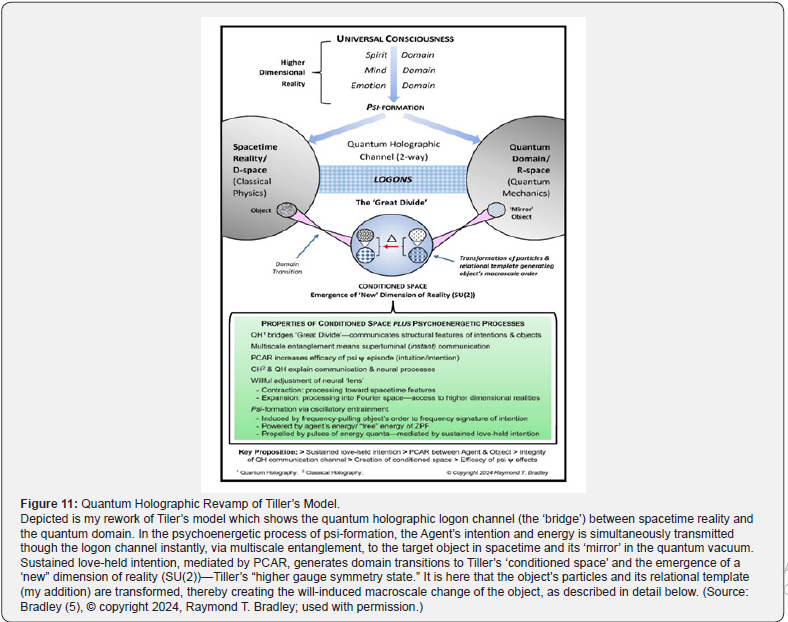
By replacing Tiller’s postulation of deltronic coupling between D-space and R-space (see Figure 10.A, above), with Gabor’s [37] energetic units of information-logons (which apply to all energetic frequencies), we have an empirically based informational ‘bridge’ between spacetime reality and the quantum domain (see Figure 11). Because logons encode the structural features of objects, they provide the means for communicating figural information in psychic interactions, such as imaging in remote viewing or intuition, or envisioning in healing or intention. Based on the recent discovery of macroscale entanglement—inseparable nonlocal connection at the atomic level, I develop the concept of multiscale entanglement as the physical means of instant tacit communication between/among parents and children, couples, friends, or group members bound by love.26
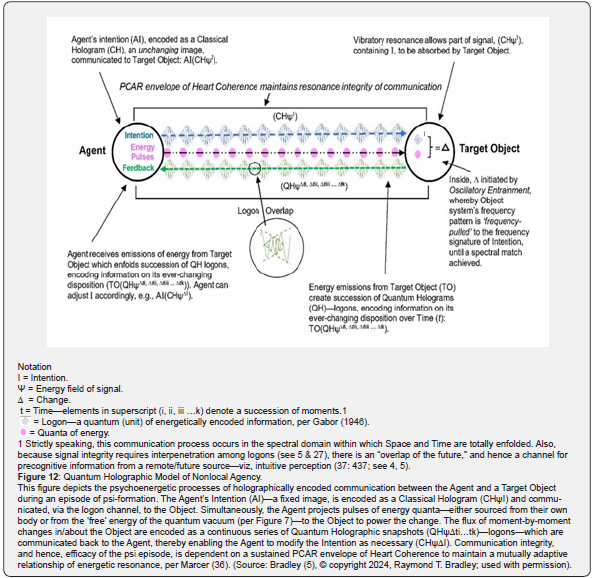
To demystify the transformational ‘magic’ of processes within Tiller’s ‘conditioned space,’ I postulate that such will-induced change occurs by oscillatory entrainment. In this process, the order of the target’s system is frequency-pulled to the frequency signature of the image of order encoded in the agent’s hologram of intention. Whereas the agent’s intention is encoded as a classical hologram-a static image, feedback to the agent on the target’s ever-changing disposition and existential circumstances are quantum holographically encoded. This succession of logons reflects moment-by-moment change of the object in spacetime reality, and enables modifications of the intention by the agent, as necessary. Communication integrity, and hence the efficacy of success, requires a PCAR envelope of the of heart coherenceunconditional Love-for the duration of the psi-formation episode (see Figure 12).
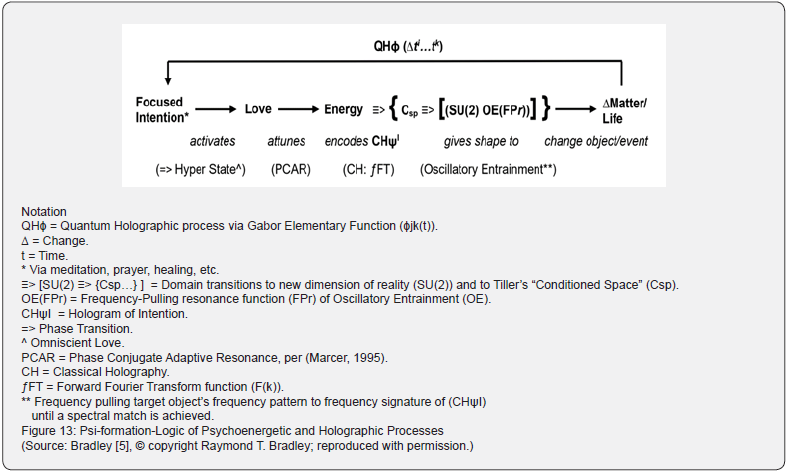
Processes of nonlocal communication are greatly amplified in harmonious groups and mass social aggregations when in a coherent state of socio-bio-emotional resonance [25,30,31,57,75]-essentially, a collective state of heart coherence, a point Tiller emphasizes in relation to ‘healing’ dyads.27 Collective coherence greatly amplifies the reception and transmission of energetically encoded information, in much the same way that a signal of radio waves from distant stars and galaxies is amplified by an array of radio telescopes. Moreover, the degree to which the harmonious group focuses collective attention/ intention on an object/event of common interest, the efficacy of nonlocal communication is further amplified. Conversely, nonlocal communication is greatly impeded in socially incoherent groups/ aggregations, wherein social order is fraught with emotional stress, or by relations of disaffection, tension, or conflict. Under these conditions, both at the individual and collective levels, the wave fields of bio emotional energy are not only too disorganized to access information from nonlocal sources, but too unstable and incoherent to receive/transmit focused attentional/intentional energy [4,25,31]. Finally, these and other considerations prompted a revamp of Tiller’s equation (Figure 10.B, above), with a new ‘equation’ highlighting Love’s crucial role in the relations of creation, which is presented below (Figure 13) and shows the process logic of my theory.
Implications for Practice
By way of summary, we can derive five Principles of Nonlocal Interaction which may have utility in informing practice considerations and value as research hypotheses:
i. Principle 1: Our bio-emotional emissions interconnect us to everything around us, proximate or distant, which means that we influence and are influenced by all systems-including the Universe itself-whether, consciously, we intend to or not.
ii. Principle 2: By holding a loving state in our daily lives, we are energetically attuned to everything around us and can receive intuitive insights and creative inspirations which can guide our decisions and actions.
iii. Principle 3: Holding deeper states of unconditional Love, by sustained meditation, prayer, or deep selfless introspection, we can access spiritual Truth, the Laws of Nature, and the Source of everything.
iv. Principle 4: Holding sustained focused intentions, we can heal ourselves and others and induce change in material and living systems, and in doing so even change the world.
v. Principle 5: Nonlocal effects (intuition and intention) are greatly amplified by collective energetic resonance generated by a commonly held focus in mass social aggregations and in groups with high socioemotional coherence.
By way of elaboration, if unconditional Love is the access channel to the domain of Universal Consciousness wherein tacit Knowledge and Truth is stored, then effective emotion regulation techniques [21], advanced meditation practices-such as yoga, qi gong, and collective activities in unison (which synchronize cardiorespiratory rhythm (e.g., [64,65]) should enhance nonlocal interaction potential. When practiced in synchronized sessions in a group, this potential is greatly boosted by the amplification effects of socioemotional coherence, such as collective communion, in repeated sessions to mitigate the waning power of nonlocal effects over time. Moreover, as long known by ancient spiritual traditions, effective practice and application requires self-less unconditional love and non-attachment to outcomes. Also, the scope of application appears virtually universal, encompassing relational, group, organizational, collective, and global settings (including online social media), across all functional and substantive domains. Furthermore, Tiller’s simple device (IIED) has enormous potential in health and healing when imprinted with a healing intention. And it seems that RNGs could be employed as an early warning system detecting changes in collective consciousness, both locally and globally:
‘Just as changes in seismic meters are used to detect … impending earthquakes, RNG outputs could warn us of changes in collective consciousness … [including] any anticipatory effects …. [and] to evaluate preventive and ameliorative measures that utilize collective consciousness. … including group meditations to reduce collective stress … [and] to reduce local and global tragedies (Mason et al. [32]: 315; italics added)’.
However, while studies have investigated mainly ‘positive’ applications-such as distant healing, improved social order, and so forth, there is potential for a ‘dark’ side wherein collective nonlocal effects can be harnessed for malevolent ends. These include acts of malicious intention directed to individuals, groups, or populations, or to remotely located machines/information processing devices, like computers and servers. Also, operator feelings and thoughts (whether conscious or unconscious) can generate anomalous machine behavior when the two are in energetic resonance (61).
Conclusion
In closing, the discoveries of psi research-which include those on collective nonlocal interaction-are revolutionary in their implications. At the most basic level of science, a revision of the fundamental laws of physics is required to explain how nonlocal interactions defy space-time constraints and the temporality of cause and effect (e.g., [2]). This will spur development of a new psychophysics that Tiller [62] has undertaken and has been further developed by others (e.g., [73]) and in my own work (e.g., [4,5,51])-with the addition socio-collective effects. This will radically alter our understanding of human consciousness, perception, and agency. For humanity, this paradigm shift in science will transform our conception of reality itself, profoundly empowering our potential, both as individuals and collectively.
We are at a pivotal moment for the future of humanity and for that of all life on this precious planet of ours. The world stands at the inflection point between two radically different futures. In Ervin Laszlo’s [76] words: “a path UP to healing and evolution, [or] a path DOWN to crisis and chaos”.28 The path “UP” he calls “The Great Upshift”-the radical transformation from an order based on greed, inequality, and environmental degradation, to a sustainable world in which humanity lives in peace and harmony with itself and with nature. NOW is the moment to hone and use our psychic proficiencies, both as individuals and collectively, to propel a transformation of the world for the betterment of future generations and the web of all life upon which humanity’s existence and wellbeing depends.
Appendix. Psychophysiological Coherence
A ground-breaking discovery by the Institute of HeartMath, showed that when self-induced by adoption of a loving focus the heart entrains the brain, the psychophysiological system, and the other major systems of the body into a state of systemwide Psychophysiological Coherence which studies have shown is optimal for bodily function, health, emotional stability, and performance [21].
Figure A.1 shows real time recordings of an individual’s heart rhythm activity (heart rate variability pattern), pulse transit time (a measure of beat-to-beat blood pressure), and respiration rhythms over a 10-minute period (top graph). At the 300 second mark, the individual used a HeartMath emotion self-regulation technique to activate the psychophysiological coherence state, causing these three physiological systems to synchronize in a state of entrainment. The bottom graphs show the ECG frequency spectra of the same data on each side of the dotted line in the center of the top graph. Note that the graphs on the right show that the three systems have entrained to the same frequency (0.12 Hz).
In subsequent investigation, Heart Math researchers found different basic emotions were marked by a distinctive HRV signature differentiated along two dimensions—emotional arousal and emotional valence. Also, that in addition to the phase transition from ‘normal’ experience of a positive emotion to the coherence state (shown in Figure A.1), another shift involving ‘extreme’ emotions were observed beyond Psychophysiological Coherence as abrupt ‘jump’ to a hyper state of coherence.29 This second phase shift can be seen in the electrophysiological recordings of an individual shown in Figure A.2.
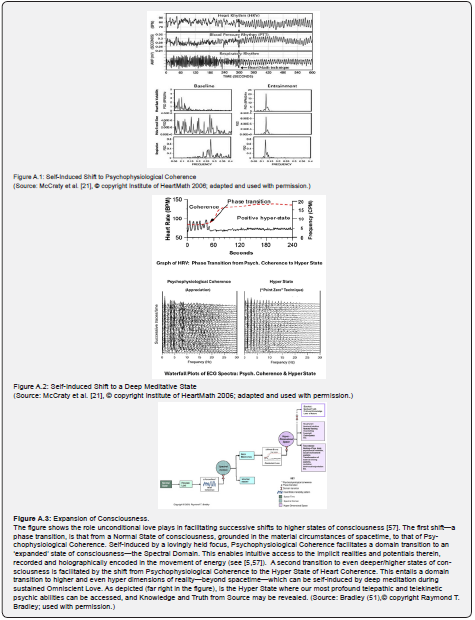
The top the top graph in the figure displays the change in pattern of heart activity as the individual switches their internal focus from a loving state of “appreciation” to a deeper meditative state (HeartMath [21] calls “Emotional Quiescence“) using a “one pointed” meditation technique. Electrophysiologically, this shift is signified by a marked phase transition in heart activity to a higher rhythmic frequency (Figure A.2: top graph, red dotted curve) with low amplitude waveforms (black line curve). Notably, when measured in terms of electromagnetic frequency (hertz; see bottom graph), the ECG spectra for this Hyper State of heart coherence displays a harmonic series. This is clearly evidenced in the ‘waterfall’ plot (bottom right graph) by vertical alignment of the standing waves over the succession of traces down the graph. By contrast, the ‘waterfall’ plot for Psychophysiological Coherence (bottom left graph) shows little evidence of harmonic alignment among wave traces over the series.
First-hand accounts of the experience of this Hyper State of love characterize it as a ‘higher state’ of consciousness-love in its most ‘self-less, all-seeing, non-judgmental’ mode ([21]: 33-43), which, elsewhere, I have described as Omniscient Love since it appears to exemplify the ‘all-seeing eye’ of Universal Consciousness [51]. As portrayed in Figure A.3, it is this deeper meditative state of unconditional love that enables access to an energetic channel of communication beyond spacetime reality to the spectral domain and the ‘higher/hyper’ dimensional space/s of Universal Consciousness.
Acknowledgements
This article is a totally revised and updated version of a previous work [75]. I thank Marta Sinclair for helpful comments on a previous version. I am grateful to my wife, Chaarenne Torris, for her incisive comments on earlier drafts, and especially for her unconditional love and support. I thank Professor Ruth Feldman for permission to reproduce Figure 1.b (with my adaptation); the Institute of HeartMath for permission to reproduce Figures 3, A.1 and A.2; Roger Nelson for permission to reproduce Figures 5 and 6, and Figure 9 from the GCP’s online database, and Figure 10 from his own work; and Dean Radin for permission to reproduce Figure 11. I am grateful to Professor Bjorn Vickhoff and his coauthors [65] for being able to reproduce Figure 12 from their ‘open access’ publication. Finally, I thank my brother, Barry Bradley (a world class cartographer) for redrawing Figure 1.a-my adaptation of Trevarthen’s (1993) model of “protoconversation.”
Foot Note
1. This is a totally revised and updated version of a previous work [75].
2. Physicists at Muenchen University (Germany) have reported successfully entangling two atoms each separated in laboratories 400 meters apart, using the “entanglement swapping” protocol (see https://xqp.physik.uni-muenchen.de/research/atom_photon/ entangling_atoms/index.html).
3. Feldman et al. conclude “…that during moments of vocal and affect synchrony, the synchrony between the mother’s and her infant’s heart rhythms increases significantly” ([24]: 574).
4. Nelson’s conclusion-see http://noosphere.princeton.edu/results/ nw.results.html; accessed April 20, 2019.
5. Mitchell [77]: 297.
6. A Google search of “studies of intuition in couples”/ “relationships” or other derivatives produced “no results”.
7. A study I was involved in, suggests that the heart can receive the prestimulus (intuition) signal some 15 seconds or so before the computer presents the randomly selected experimental stimulus to the research subject [10].
8. See the “Appendix.”
9. This section draws heavily on my recent work [5,5159,77,79].
10. The intention template statement is ‘imprinted’ into the IIED through a focused meditation process in which Tiller and his two associates-all of whom are highly trained meditation adepts with decades of practiceadopt of loving-held emotional state to encode the intention statement into the electrical circuitry of the device with repeated meditations. See Tiller et al. [62] for a full description of their procedure; and Tiller and Dibble [80] for an overview Tiller’s research program.
11. These targets include, the pH behavior of water, air temperature of a controlled space, enzyme activity, and fruit fly larvae maturation.
12. Tiller et al. [62]: 92; italics added.
13. Gillin [73]: 236-237; italics added.
14. Tiller et al. [62]: 104-105; italics added.
15. Gillin [73]: 366.
16. “Subtle” energies behave differently than those associated with the four fundamental forces-electromagnetic, the strong and weak nuclear forces, and gravity. Tiller et al. [62]:103-104; italics added.
17. Tiller et al. [62]: 255; italics added.
18. Tiller et al. [62]: 137; italics added.
19. Shannon’s [74] concept of information and its associated unit of information—the BIT (which codes qualities/categories in binary symbolic logic only), cannot capture the structural/figural features of objects/events.
20. Nobel Laureate Dennis Gabor [81] shows Shannon’s approach is fundamentally flawed (see [5]).
21. See [4,5,51,77].
22. Tiller et al. [62]: Equation 6.4, p. 230.
23. Tiller et al. [62]: 230; bold and italics added.
24. E.g., [3,8,30,75,82].
25. See Bradley [4,5,40,51,77,79].
26. See Bradley [5] for the details.
27. See Tiller et al. [62]: 210.
28. Laszlo [76]: v.
29. Based on these discoveries, we constructed a typology of emotional states in The Coherent Heart ([21]:18-24).
References
- Shimony A (1993) Controllable and uncontrollable non-locality. In: A. Shimony (Ed.), Search for a naturalistic world, Cambridge University Press 2: 130–139.
- Penrose R (1994) Shadows of the Mind: A Search for the Missing Science of Consciousness. Oxford University Press, New York, USA.
- Radin DI (2006) Entangled Minds: Extrasensory Experiences in a Quantum Reality. Paraview Pocket Books: New York, NY.
- Bradley RT (2007) Psychophysiology of intuition: A quantum-holographic theory of non-local communication. World Futures 63(2): 61–97.
- Bradley RT (2024) Harnessing the force of all creation: Part Two. Psi-formation-Psychoenergetic and quantum holographic processes. World Futures 1-47.
- Radin DI (1997) The Conscious Universe: The Scientific Truth of Psychic Phenomena. San Francisco, CA: HarperEdge.
- Radin DI, Michel L, Galdmez K, Wendland P, Rickenbach R, & Delorme A (2012). Consciousness and the double-slit interference pattern: Six experiments. Physics Essays 25 (2): 157-171.
- Radin D, Michel L, Johnston J, & Delorme A (2013). Psychophysical interactions with a double-slit interference pattern. Physics Essays 26 (4): 553-556.
- Myers DG (2002) Intuition: Its Powers and Perils. New Haven: Yale University Press 322.
- Bradley RT, M Gillin R, McCraty & M Atkinson (2011) Nonlocal intuition in entrepreneurs and non-entrepreneurs: Results of two experiments using electrophysiological measures. International Journal of Entrepreneurship and Small Business 12(3): 343-372.
- Bradley RT, & Tomasino D (2011) A quantum-holographic approach to the psychophysiology of intuitive action. In, L.P. Dana (ed.), World Encyclopedia of Entrepreneurship 318-347.
- Sinclair M (Ed.) (2011) Handbook of intuition research. Edward Elgar 296.
- Sinclair M (Ed.) (2020) Handbook of intuition research as practice. Edward Elgar 352.
- Milovanovic D (2014) Quantum Holographic Criminology: Paradigm Shift in Criminology, Law and Transformative Justice. Carolina Academic Press.
- Feldman R (2007) Parent-Infant Synchrony: Biological Foundations and Developmental Outcomes, Current Directions in Psychological Science. 16(6): 340-345.
- Schore AN (1994) Affect Regulation and the Origin of the Self: The Neurobiology of Emotional Development. Hillsdale, NJ: Lawrence Erlbaum. Cambridge University Press 542.
- Schore AN (2003) Affect Dysregulation and Disorders of the Self. New York and London: W.W. Norton and Company. J Can Acad Child Adolesc Psychiatry 15(2):100-101
- Pribram KH, & Bradley RT (1998). The brain, the Me and the I. In, M. Ferrari & R. Sternberg (Eds.), Self-Awareness: Its Nature and Development. New York: The Guilford Pres 273-307.
- Bradley RT (2003) Love, power, mind, brain, and agency. In D. Loye (Ed.), The Great Adventure: Toward a Fully Human Theory of Evolution, New York. SUNY Press 99–150.
- Bradley RT (2012) Nonlocality, consciousness, and the eye of love. Consciousness & Development 2.0. S. Momo (Ed.), Spanda Journal, III.1/2012, 193–205.
- McCraty R, Atkinson M, Tomasino D, & Bradley RT (2006) The Coherent Heart: Heart–Brain Interactions, Psychophysiological Coherence, and the Emergence of System-Wide Order. Boulder Creek, CA: Research Center, Institute of Heart Math.
- Gregory SW, & Hoyt BR (1982) Conversation partner mutual adaptation as demonstrated by Fourier series analysis. Journal of Psycholinguistic Research 11: 35–46.
- Gregory SW, Kalkhoff W, Harkness SK, & Paul JL (2009) Targeted high and low speech frequency bands to right and left ears respectively improve task performance and perceived sociability in dyadic conversations. Laterality: Asymmetries of Body, Brain and Cognition 14(4): 423–440.
- Feldman R, Magori-Cohen R, Galili G, Singer M, & Louzoun Y (2011) Mother and infant coordinate heart rhythms through episodes of interaction synchrony. Infant Behavior and Development 34(4): 569– 577.
- Bradley RT (1987) Charisma and Social Structure: A Study of Love and Power, Wholeness and Transformation. New York: Paragon Press 365.
- Gabor D. (1948) A new microscopic principle. Nature 161: 777-778.
- Bradley RT, & Pribram KH (1998). Communication and stability in social collectives. Journal of Social and Evolutionary Systems. 21(1): 29–81.
- Bradley RT (2015) Bonds and quanta: Commentary on Quantum Holographic Criminology. Journal of Theoretical & Philosophical Criminology 7(2): 95-136.
- Jahn RG, Bradish G, Dobyns Y, Lettieri A, Nelson R & Mischo J (2000) Mind/Machine Interaction Consortium: PortREG replication experiments. Journal of Scientific Exploration 14(4): 499-555.
- Nelson R (2008) The emotional nature of global consciousness. Paper for the Bial Foundation 7th
- Bancel P, & Nelson R (2008) The GCP experiment: design, analytical methods, results. Journal of Scientific Exploration 22(3): 309–333.
- Mason LI, Patterson RP, & Radin DI (2007) Exploratory Study: The Random Number Generator and Group Meditation. Journal of Scientific Exploration 21(2): 295-317.
- Targ R, & Katra JE (2000) Remote viewing in a group setting. Journal of Scientific Exploration 14: 107–114.
- Nelson RD, Dobyns YH, Dunne BJ, & Jahn RG (1991) Analysis of variance of REG experiments: Operator intention, secondary parameters, database structure, Technical Note PEAR 91004, PEAR, Princeton University.
- Radin DI, & Atwater FH (2009) Exploratory Evidence for Correlations between Entrained Coherence and Random Physical Systems. Journal of Scientific Exploration 23 (3): 263-272.
- Marcer P (1995) A proposal for a mathematical specification for evolution and the psi field. World Futures: The Journal of General Evolution 44(283): 149–159.
- Gabor D. (1946) Theory of communication. Journal of the Institute of Electrical Engineers 93(3) 429-457.
- Pribram KH (1991) Brain and Perception: Holonomy and Structure in Figural Processing. Lawrence Erlbaum & Associates.
- Pribram KH (2013) The Form Within: My Point of View. Prospecta Press.
- Bradley RT (2010) Passionate attention and the psychophysiology of entrepreneurial intuition: A quantum-holographic theory. International Journal of Entrepreneurship and Small Business 9(3): 324-348.
- Akinci, C., & Sadler-Smith, E. (2018). Collective intuition: Implications for improved decision making and organizational learning. British Journal of Management 30(3): 558-577.
- McCraty R, Atkinson M & Bradley RT (2004a) Electrophysiological evidence of intuition: Part 1. The surprising role of the heart. Journal of Alternative and Complementary Medicine. 10 (1): 133–143.
- Segal NL (1999) Entwined Lives: Twins and What They Tell Us About Human Behavior. New York, New York: Dutton Books, The Penguin group.
- Braud WG (1981) Psi performance and autonomic system activity. Journal of the American Society for Psychical Research 75: 1-35.
- Sheldrake R (2013) The Sense of Being Stared At: And Other Unexplained Powers of Human Minds. Rochester, Vermont, USA; Toronto, Canada: Park Free Press.
- Radin DI (1997a) Unconscious perception of future emotions: an experiment in presentiment, Journal of Scientific Exploration, 11(2): 163–180.
- Tressoldi PE, Martinelli M, Zaccaria E, & Massaccesi S (2009) Implicit intuition: How heart rate can contribute to prediction of future events. Journal of the Society for Psychical Research. 73(894): 1–16.
- McCraty R & Atkinson M, (2014) Electrophysiology of intuition: Pre-stimulus responses in group and individual participants using a Roulette paradigm. Glob Adv Health Med 3(2): 16-27.
- Rezaei S, Mirzaei M, & Zali MR (2014) Nonlocal intuition: Replication and paired-subjects enhancement effects. Glob Adv Health Med 3(2): 5–15.
- McCraty R, Atkinson M & Bradley RT (2004b) Electrophysiological evidence of intuition: Part 2. A system-wide process? J Altern Complement Med 10 (2): 325–336.
- Bradley RT (2024). Harnessing ‘the force of all creation’: Part One. The power of love to shape reality. World Futures. 1-37.
- Gillin M, LaPira F, McCraty R, Bradley RT, Atkinson M, Simpson D (2007) Before cognition: The active contribution of the heart/ANS to intuitive decision making as measured in repeat entrepreneurs in the Cambridge Technopol. In M. Gillin (ed.) 114-139.
- Radin D I (2023) Sentiment and presentiment in Twitter: Do trends in collective mood “Feel the future”? World Futures 79 (5): 525-535.
- Csikszentmihalyi M (1975) Beyond boredom and anxiety. San Francisco, CA: Jossey‐
- Sawyer K (2007) Group Genius: The Creative Power of Collaboration. New York, NY: Basic Books.
- Salanova M, Rodríguez-Sánchez A, Schaufeli WB, Cifre E (2014). Flowing together: A longitudinal study of collective efficacy and collective flow among workgroups. Journal of Psychology. 148(4): 435-455.
- Nelson RD (2002) Coherent consciousness and reduced randomness: Correlations on September 11, 2001. Journal of Scientific Exploration 16 (4): 549-570.
- Radin DI (2002) Exploring the relationship between random physical events and mass human attention: Asking for whom the bell tolls. Journal of Scientific Exploration 16 (4): 533-547.
- Bradley RT (2024) The Lens of Love: Holographic Eye of Universal Consciousness.
- Schweikard DP, Schmid HB (2013) Collective intentionality. The Stanford Encyclopedia of Philosophy, Edward N. Zalta (Ed.)
- Jahn RG, Dunne BJ (1987) Margins of reality: The Role of Consciousness in the Physical World. New York-San Diego, CA: Harcourt Brace Jovanovich.
- Tiller WA, Dibble WE, Fandel JG (2005) Some Science Adventures with Real Magic. Walnut Creek, CA: Pavior Publishing.
- Braud WG, Schlitz MJ (1991) Consciousness interactions with remote biological systems: anomalous intentionality effects. Subtle Energies 2: 1-46.
- Cysarz D, von Bonin D, Lackner H, Heusser P, Moser M, Bettermann H (2004) Oscillations of heart rate and respiration synchronize during poetry recitation. Am J Physiol Heart Circ Physiol 287: 579-587.
- Vickhoff BH, Malmgren R, Åström G, Nyberg S, Ekström M, et al. (2013). Music structure determines heart rate variability of singers. Front Psychol 4: 334.
- Radin D, Schlitz MJ, Baur C (2015) Distant healing intention therapies: An overview of the scientific evidence. Global Advances in Health Medicine. 4(Suppl): 67-71.
- Radin D I, Stone J, Levine E, Eskandarnejad S, Schlitz M, et al. (2008). Compassionate intention as a therapeutic intervention by partners of cancer patients: Effects of distant intention on the patients’ autonomic nervous system. Explore 4 (4): 235-243.
- Dillbeck MC, Landrith III GS, Orme-Johnson DW (1981). The Transcendental Meditation program and crime rate changed in a sample of forty-eight cities. Journal of Crime and Justice. 4: 25-45.
- Hagelin JS, Rainforth MV, Orme-Johnson DW, Cavanaugh K L, Alexander CN, (1999). Effects of the group practice of the Transcendental Meditation program on preventing violent crime in Washington D.C.: Results of the National Demonstration Project, June-July, 1993. Social Indicators Research 47(2): 153-201.
- Orme-Johnson DW, Alexander CN, Davies JL, Chandler HW, Larimore WE (1988) International peace project in the Middle East. Journal of Conflict Resolution 32 (4): 777-812.
- Orme-Johnson DW, Dillbeck MC, Alexander CN (2003) Preventing terrorism and international conflict: Effects of large assemblies of participants in the Transcendental Meditation and TM-Sidhi Programs. Transcendental Meditation in Criminal Rehabilitation and Crime Prevention. The Haworth Press, Inc. Pp. 283-302.
- Cavanaugh KL, Orme-Johnson DW, Gelderloos P (1989) The of the Taste of Utopia Assembly on the World Index of international stock prices. In R. A. Chalmers G. Clements H. Schenkluhn & M Weinless (Eds.), Scientific Research on Maharishi’s Transcendental Meditation and TM-Sidhi Programme: Collected Papers 4: 2715-2729.
- Gillin LM (2021) Jesus: The Social Entrepreneur. Australia: Ocean Reeve Publishing.
- Shannon CE (1949) The mathematical theory of communication. In: The mathematical theory of communication, Eds. C. E. Shannon and W. Weaver, 3-91. Urbana: The University of Illinois Press.
- Bradley RT (2020) Group intuition and intentionality: Collective action at-a-distance? Chapter 15, in Sinclair, M. (Ed.), Handbook of Intuition Research as Practice, pages 196-210. Cheltenham, UK and Northampton, MA, USA: Edward Elgar.
- Laszlo E (2022). The Upshift: The Path to Healing and Evolution on Planet Earth. CA: Waterside Productions.
- Bradley RT (2023b) Love The force of all creation. In E. Lazslo & D. Lorimer (Eds.), The Great Upshift: Humanity’s Coming Advance Toward Peace and Harmony on the Planet, Chapter 31, pages 317-329 & 365-367.
- Mitchell E (2000) Nature’s mind: the quantum hologram. Int. J. of Computing Anticipatory Systems, 7: 295-312.
- Bradley RT (2023a) The great adventurer: David Loye’s “hololeap” to future vision. World Futures79 (1): 1-28.
- Tiller WA, Dibble WE, (2009) White paper I. A brief introduction to intention-host device research. The William A. Tiller Foundation.
- Gabor D (1953) Communication theory and physics. Transactions of the IRE Professional Group on Information Theory 1: 48-59.
- Sheldrake R (1999) Dogs that know when their masters are coming home: And other unexplained powers of animals. New York, NY: Three Rivers Press.

























