



 JCMAH Home



Hypoglycemic and Antioxidant Effect of Anthocleista Grandiflora Hydro-Ethanol Extract in Alloxan Induced Diabetic Rats
Abdullahi MH1, Ashikaa BA1*, Abdullahi HS1, Akyengo O2 and Abdullahi AB1
1Department of Biochemistry, Nasarawa State University, Nigeria
2Nigerian Institute of Leather and Science Technology, Samaru, Nigeria
Submission: September 09, 2023; Published: October 26, 2023
*Corresponding author: Ashikaa BA, Department of Biochemistry, Nasarawa State University, Keffi, Nigeria
How to cite this article: Abdullahi MH, Ashikaa BA, Abdullahi HS, Akyengo O, Abdullahi AB. Hypoglycemic and Antioxidant Effect of Anthocleista Grandiflora Hydro-Ethanol Extract in Alloxan Induced Diabetic Rats. J Complement Med Alt Healthcare. 2023; 12(3): 555838. DOI: 10.19080/JCMAH.2023.12.555838
Abstract
Background
Diabetes is characterized by insulin deficiency or cell resistance to insulin leading to hyperglycemia accompanied by impaired antioxidant defense mechanisms. The aim of the study was to evaluate the hypoglycemic and antioxidant effect of Anthocleista grandiflora wood bark hydro-ethanol extract in albino rats.
Materials/Methods
The wood bark was extracted with 30:70 percent hydro-ethanol using soxhlet extraction method. 150mg/kg of alloxan was used to induce diabetes in the rats. Thirty (30) male albino rats were randomized into six (6) groups of five (5) rats each. Group 1 served as a negative control. Group 2 served as diabetic control (induced untreated). While, groups 3, 4, 5, and 6 were induced and treated with 22.5 mg/kg of metformin, and 100, 200, and 300 mg/kg of Anthocleista grandiflora extract for 21 days.
Results
The results showed a significant (p<0.001) increase in glucose levels in the diabetic control compared to the negative control. Treatment with the plant extract showed a significant (p<0.001) dose-independent decrease in glucose level compared to the diabetic control group, and higher than the metformin-treated group. The liver and kidney antioxidants showed a significant (p<0.001) decrease in superoxide dismutase, catalase, glutathione peroxidase, and reduced glutathione, with a significant (p<0.001) increase in malondialdehyde level in diabetic control. Treatment with the extract showed a significant (p<0.001) increase in superoxide dismutase, catalase, and reduced glutathione, with a significant (p<0.001) decrease in malondialdehyde level compared to the diabetic control group, and higher than the metformin-treated group in the liver.
Conclusion
This study concluded that the hydro-ethanol extract of Anthocleista grandiflora showed potent hypoglycemic and antioxidant properties. Hence, the extract could be used for the treatment and management of diabetic complications.
Keywords: Diabetes mellitus; Plant extract; Phytochemicals; Glucose level; Oxidative stress
Introduction
Diabetes mellitus is a chronic disease characterized by hyperglycemia resulting from decreased insulin secretion or insulin resistance, which leaves the body incapable of responding fully to insulin [1]. This leads to an increase in the blood level of glucose, which is called hyperglycemia and has been considered globally as one of the major health problems with the prevalence shown to be progressively on the increase (6.4%) among adults [2]. The worldwide diabetes mellitus epidemic affected 425 million people in 2017, and the number of people with diabetes is expected to increase to 629 million by 2045 [1]. The prevalence of DM has been shown to be progressively on the increase [2]. The African continent is expected to have the highest increase in the number of diabetics compared to other continents [3].
During diabetes or insulin resistance, failure of insulin-stimulated glucose uptake by fat and muscle causes glucose concentrations in the blood to remain high and consequently increases glucose uptake by insulin-independent tissues [4]. This increase in glucose flux is accompanied by impaired antioxidant defense mechanism leading to excess free radicals, pro‐oxidant agent generation, and the formation of different biomarkers of oxidative stress such as 8‐OH‐guanine, hydroperoxides, 8‐OHdeoxyguanine, malondialdehyde, reduction of glutathione and antioxidative capacity which have been shown that diabetesinduced oxidative stress which is associated with many of the complications of chronic hyperglycemia [5]. Antioxidant therapy has been of great interest to combat oxidative stress in diabetic patients over the past decade [6]. These antioxidants have high efficiency, and they defend against free radical-induced oxidative stress via; reactive (ROS) scavenging activity, Chelating the free radicals by complexing, and preventing the propagation reaction by exchanging protons with free radicals [1].
Plant materials that have been used as traditional medicine for the treatment of DM are considered good sources for a new drug [7]. These plants are enriched with phytochemicals such as tannins, saponins, flavonoids, essential oils, and alkaloids that seem to have therapeutic properties and are used in the traditional system of medicine to manage various ailments [8]. The antioxidant potentials of medicinal plants are linked to the presence of phenolic, flavonoid, alkaloid, and terpenoid compounds that readily donate hydrogen atoms to the radicals to neutralize them [9].
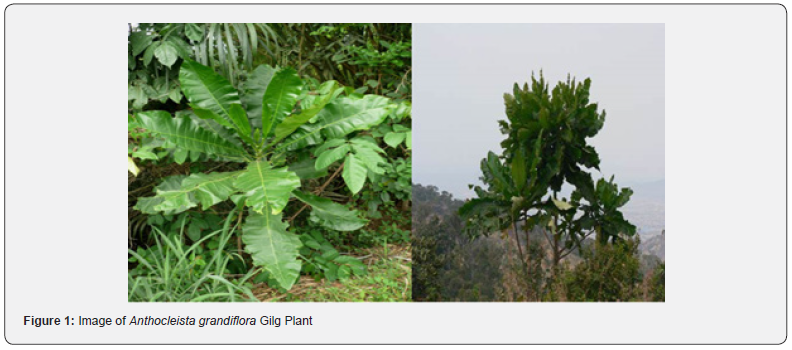
Anthocleista grandiflora Gilg commonly known as forest fever tree, big-leaf fever tree, big leaf, forest big-leaf, and cabbage tree, is a medicinal plant that has gained wide acceptance in the treatment of various ailments in Nigeria folk medicines [10]. The Genus Anthocleista (Gentianaceae) is a dicot genus consisting of approximately fifty species worldwide and fourteen species in tropical Africa including Comoros, Madagascar, and Mascarene Island which are mostly trees and shrubs, usually with woody stems [11]. Traditionally, they are used to treat constipation, malaria fever, typhoid fever, hypertension, stomach aches, hemorrhoids, syphilis, diabetes, contraceptives, laxatives, and purgatives [12] (Figure 1).
Materials and Methods
Plant Sample Collection and Extraction
The Anthocleista grandiflora stem back was harvested at Barkin Kotar, Keana Local Government Area, Nasarawa State, and was taken to the Department of Biochemistry, Nasarawa State University, Keffi. The plant was identified using the African Flowering Plant Database (version 3.1, Taxonomy ID: 28539). The plant stems back were washed and air-dried at room temperature (25-27oC) under laboratory conditions for two weeks. 500 g of the dried powder was filled in the porous cellulose thimble and subjected to soxhlet extraction using hydro-ethanol (30:70) as a solvent for 12 hours at 75oC, followed by filtration through a Whatman No. 1 filter paper. The hydro-ethanol extract obtained was concentrated to dryness at 60oC using a rotary evaporator under reduced pressure. The concentrated extract was 97 g and was stored at 4oC for further use [13].
Experimental Protocol
A Completely Randomized Design (CRD) was used with five replicates assigned to each group. Group 1 was the control, group 2, 3, 4, 5, and 6 were induced injected with 150 mg/kg body weight single dose of alloxan intraperitoneal to induce diabetes. Group 3 was treated with 22.5 mg/kg body weight of metformin. While, group 4, 5 and 6 were treated with 22.5, 100, 200 and 400 mg/ kg of the extract using the gavage method of administration for 21 days.
Determination of Blood Glucose
The blood sample was obtained from the tip of the rat tail and was collected on a reagent strip to determine the blood glucose level using a portable glucometer (Arcu Check Inc. California, USA). The glucose levels were taken before the commencement of treatment and at 7-day intervals to determine the response to treatment.
Collection of Tissues Homogenates for Biochemical Analysis
After the experimental period, the rats were sacrificed, and their liver and kidneys were removed and used for the preparation of tissue homogenate in 0.1 M phosphate buffer (pH 8, stored 2-8℃) for estimations of anti-oxidative parameters. The homogenate was centrifuged at 3000g for 10 min using a centrifuge. The supernatant was used for the antioxidant assay [14].
Biochemical Analysis
Superoxide dismutase (SOD) was determined using Cayman’s Superoxide Dismutase Assay Kit (No: 706002) which utilizes a tetrazolium salt for the detection of superoxide radicals generated by xanthine oxidase and hypoxanthine and the absorbance was measured at 440-460 nm. Catalase activity was determined using the Cayman Catalase Assay Kit (No: 707002) which utilizes the peroxidation function of CAT for the determination of enzyme activity and the absorbance was measured at 540 nm. Glutathione Peroxidase (GPx) was determined using the Cayman Glutathione Peroxidase Assay Kit (No: 703102) which measures GPx activity indirectly by a couple of reactions with Glutathione Reductase (GR) and the absorbance was measured once in every minute at 340 nm at 5 points. Reduce glutathione (GSH) was determined using the Cayman Glutathione Assay Kit (703002) which utilizes a carefully optimizing enzymatic recycling method of glutathione reductase (GR) for the quantification of GSH and the absorbance of TNB was measured at 405-414 nm. Malondialdehyde was determined using the Cayman TBARS Assay Kit (No:100090550) which provides a sample, reproducible and standardized tool for assaying lipid peroxidation in the sample and measured colorimetrically at 530- 540 nm.
Results and Discussion
Results
The results of fasting blood glucose levels showed a significant (p<0.001) increase in glucose levels in the alloxan-induced group compared to the control. Treatment with metformin showed a significant (p<0.01) decrease in glucose levels compared to the alloxan-induced group. However, treatment with Anthocleista grandiflora hydro-ethanol extract at different doses showed a non-dose dependent significant (p<0.001) decrease in glucose levels compared to the alloxan-induced group (Figure 2).
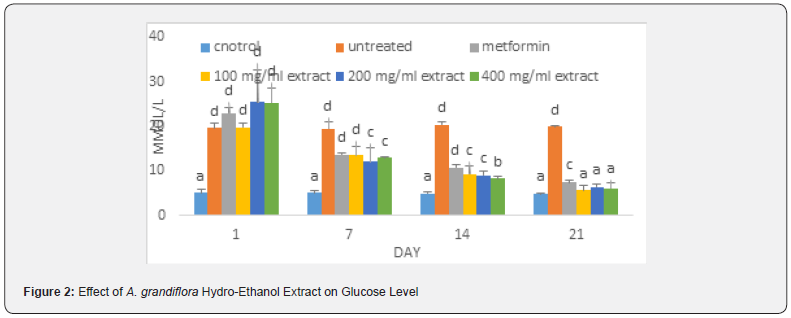
Results are presented as mean ± standard deviation. a = p>0.05, b = p>0.05, c = p<0.01, d = p<0.001
The results of liver antioxidants showed a significant decrease in SOD (p<0.01), CAT (p<0.001), and GPx (p<0.001) activity and GSH (p<0.001) levels, with a significant increase (p<0.001) in MDA levels in alloxan-induced diabetic group compared to control. Treatment with the hydro-ethanol extract showed a dosedependent increase in SOD (p<0.01), CAT (p<0.001), GPx (p<0.01), and GSH (p<0.001), with a significant (p<0.001) decreased in MDA levels compared to alloxan-induced diabetic group. Metformin antioxidant activity showed a significant decrease in SOD (p<0.01), CAT (p<0.05), and GPx (p<0.01), with a significant (p<0.001) in MDA levels compared to the alloxan-induced diabetic group (Figure 3).
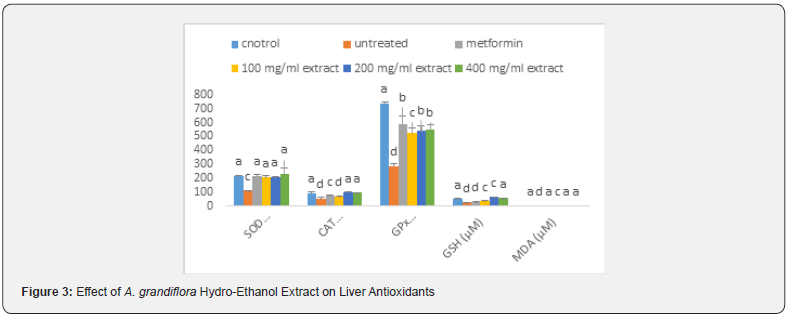
Results are presented as mean ± standard deviation. a = p>0.05, b = p>0.05, c = p<0.01, d = p<0.001
The results of kidney antioxidants showed a significant decrease in SOD (p<0.001), CAT (p<0.001), and GPx (p<0.05) activity, with a significant increase (p<0.01) in MDA levels in alloxan-induced diabetic group compared to control. Treatment with the hydro-ethanol extract showed a dose-dependent increase in SOD (p<0.001), CAT (p<0.01), GPx (p<0.05), with a significant (p<0.01) decrease in MDA levels compared to alloxan-induced diabetic group. Similarly, the metformin antioxidant activity showed a significant decrease in SOD (p<0.001), CAT (p<0.05), and GPx (p<0.01), with a significant (p<0.001) in MDA levels compared to the alloxan-induced diabetic group (Figure 4).
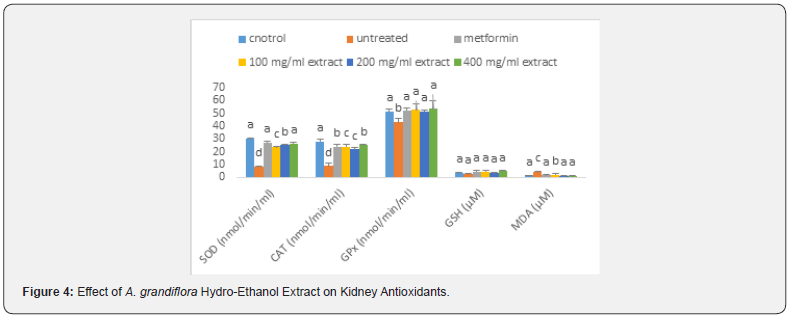
Results are presented as mean ± standard deviation. a = p>0.05, b = p>0.05, c = p<0.01, d = p<0.001
Discussion
Natural remedies have led to the discovery and development of novel drugs for treating and managing various ailments [7]. The present study investigated the hypoglycemic and antioxidant properties of Anthocleista grandiflora stem bark hydro-ethanol extract. Previous studies have identified the presence of several phytochemicals including flavonoids, saponins cardiac glycosides, tannins, phenols, terpenoids, and steroids in Anthocleista grandiflora extract [12]. These phytochemicals are reported to possess several biological and therapeutic properties [8]. The results of the hypoglycemic activity showed a significant (p<0.001) increase in glucose levels with the induction of alloxan. Treatment with the plant extract showed a significant (p<0.001) non-dose dependent hypoglycemic effect compared to the diabetic untreated group. This hypoglycemic effect of the extract was higher than metformin which showed a significant (p<0.05) decrease in glucose levels compared to the diabetic untreated group. This hypoglycemic effect of the plant extract could be due to the presence of flavonoids, polyphenols, alkaloids, and saponins in the plant extract as they are known to possess potent antihyperglycemic activity by being involved in insulin secretion and free radical scavenging activities [15].
Also, the present study showed a marked significant decrease in liver and kidney SOD, CAT, GPx, and GSH, with increased MDA levels in alloxan-induced untreated rats compared to the control group. However, treatment with the extract significantly increased the liver SOD and GPx (p<0.01), CAT, and GSH (p<0.001) and decreased MDA (p<0.001) compared to the diabetic untreated group. This antioxidant activity of the plant extract was higher than metformin which showed no significant effect on GSH and a lower activity on CAT. The antioxidant activity of the plant extract on the kidney also showed a significant increase in SOD (p<0.001), CAT (p<0.01) GPx (p<0.05), and a decrease in MDA (p<0.01) compared to the diabetic untreated group. This kidney antioxidant activity of the plant extract was like the standard drug (metformin) used. This antioxidant potential may be linked to the presence of phytochemicals in the extract since they can readily donate hydrogen atoms to the radical [9] to neutralize it. Therefore, this plant extract could be used as a source of natural antioxidants for the prevention and treatment of diseases associated with oxidative stress, especially diabetes.
Conclusion
The findings of this study showed that Anthocleista grandiflora hydro-ethanol extract possessed potent hypoglycemic and antioxidant properties higher than metformin. These effects may be due to the presence of phytoconstituents in the plant extract. Hence, the extract of Anthocleista grandiflora could be used for the management of diabetes and its complications Further studies will be required for investigations of the fractions of these plants to isolate potential lead for prophylaxis and therapeutic use for various diseases, especially diabetes.
References
- Zhang P, Li T, Wu X, Nice EC, Huang C, et al. (2020) Oxidative stress and diabetes: antioxidative strategies. Front Med 14(5): 583-600.
- Sheriff OL, Olayemi OO, Taofeeq AO, Riskat KE, Ojochebo DE, et al. (2019) A New Model for Alloxan-Induced Diabetes Mellitus in Rats. Journal of Bangladesh Society of Physiology 14(2): 56-62.
- Zaruwa ZM (2018) Hypoglyceamic Activity of Two Medicinal Clay; Nzu and Ulo. International Journal of Scientific Research 7(9): 29-31.
- King GL, Loeken MR (2004) Hyperglycemia-induced oxidative stress in diabetic complications. Histochem Cell Biol 122(4): 333-338.
- Yaribeygi H, Atkin SL, Sahebkar A (2019) A review of the molecular mechanisms of hyperglycemia-induced free radical generation leading to oxidative stress. J Cell Physiol 234(2): 1-13.
- Rains JL, Jain S.K. (2011) Oxidative stress, insulin signaling, and diabetes. Free Radical Biology and Medicine 50(5): 567-75.
- Zaruwa MZ, Manosroi J, Akihisa T, Manosroi A (2015) Castalagin from Anogeissus acuminata (Roxb.ex. DC) Guill. Ex. Perr, a potent Hypoglycemic Agent. International Journal of Current Research and Academic Review 3(7): 147-152.
- Ashikaa BA, Zaruwa MZ, Muhammed BY, Bamidele OT, Haruna GS (2022) Antioxidant, anti-inflammatory and analgesic properties of Stachytarpheta angustifolia mill vahl (Verbenaceae) methanol extract. Asian Journal of Research in Biochemistry 11(3-4): 45-54.
- Ruiz-Ruiz JC, Moguel-Ordoñez YB, Segura-Campos MR (2017) Biological activity of Stevia rebaudiana Bertoni and their relationship to health. Critical reviews in food science and nutrition 57(12): 2680-2690.
- Onwusonye JC, Obijuru NT, Kalu MU, Nleonu EC, Odu DA (2018) Effect of Aqueous Extracts of Anthocleista grandiflora on Serum Total Protein and Kidney Histology of Albino Rats. World Journal of Pharmaceutical Research 7(6): 505-513.
- Jimoh MO, Olowokudejo JD (2017) Leaf epidermal morphology and petiole anatomy of the genus Anthocleista Afzel. ex R.Br. (Gentianaceae). Journal of Tropical Agriculture 55(2): 121-133.
- Haruna GS, Abdullahi HS, Ashikaa BA, Ejiogu CI, Madu H (2022) Phytochemical Profiling and GC-MS Analysis of the Methanol Extract of Anthocleista grandiflora Wood Bark. Asian Journal of Research in Biochemistry 11(2): 1-9.
- Omoregie ES, Osagie AU (2012) Antioxidant properties of methanolic extracts of some Nigerian plants on nutritionally stressed rats. Nigerian Journal of Basic and Applied Science 20(1): 7-20.
- Suchitra K, Senthilkumar S, Mathew DH, Rajagopalan V, Jayakumar R (2020) Studies on Parkinson’s-disease-linked genes, brain urea levels and histopathology in rotenone-induced Parkinson’s disease rat model. World Journal of Neuroscience 10: 216-234.
- Bharti SK, Krishnan S, Kumar A (2018) Antidiabetic phytoconstituents and their mode of action on metabolic pathways. Therapeutic Advances in Endocrinology and Metabolism 9(3): 81-100.

























